A regulatory due diligence checklist for a pharma data room is not a list of headings; it is a list of pairs. Each class of document you ask the seller for — approvals and supplements, agency correspondence, the commitment list, meeting minutes, labeling, the inspection file, the archive index — has a counterpart in a public record that can contradict it, and the checklist is finished only when every requested document has been set beside the record that can. The work is hard because a mid-size target's data room holds tens of thousands of files and the seller keeps uploading in batches until the bid, so the team reads closely only what it can reach and trusts a summary for the rest. Botminds' Regulatory Due Diligence reads every regulatory file the seller uploads, pulls each registration, commitment, open agency clock and inspection with the page it came from, and sets the seller's statements beside the agencies' own published words — so a checklist like the one below can be worked across all of the files rather than a sample of them.
The deal on this page is fictional sample data inside the solution: Project Larch, a bid for Orvelle Pharmaceuticals, with five products and a data room that was still filling two days before the report was due.
What a request list has to cope with
41,870files
in the sample target’s data room by Day 16
6,214
of them regulatory, in nine classes
~30%
of the regulatory files a four-person team sampling for four weeks typically reads closely
6hrs
design target from a seller upload to a scored, cited finding
What regulatory due diligence actually covers, and where it stops
Regulatory due diligence is the workstream that answers one question before the bid: are the target's approvals, obligations, open agency clocks and inspection history as clean as the management presentation says? Its subject is everything a medicines regulator has written to or about the target, and everything the target has promised a regulator in return. Its output is two things — a red-flag report for the deal committee, and an inventory of registrations and obligations that outlives the report and becomes the integration plan.
It stops in three places, and saying so at the start saves a fortnight. It does not value the business: a finding states an effect in months and in money, and the deal team prices it. It is not legal diligence, which reads the contracts around a registration rather than the registration itself, nor commercial diligence, which tests the forecast the registrations support. And it cannot reach what was never written: an agency's current thinking on a product, expressed in a call and never minuted, is outside the reach of any checklist.
What it does reach is wider than most request lists assume, because a growing share of the regulatory record is published by the regulator. That is the half of the checklist this page is about.
The five objects worth building an inventory of
Request lists are written in documents; diligence is decided in objects. A document is evidence. An object is the thing that transfers to the buyer with the product, carries a date and an owner, and can be late. Five of them are worth the trouble of a formal inventory, each one row per instance, each row with the page it came from.
Registrations. One row per application per market: the application number, the holder of record, the status, the approval date, any conditions attached to it, and the route its transfer will take after close. Commitments. Every post-marketing requirement, post-marketing commitment, post-authorisation efficacy study and condition of approval, with its milestone dates and its current status. Open agency questions. Anything with a clock running: an information request, a safety labeling change notification, a complete response letter not yet answered, a non-compliance letter. The date the clock expires matters more than the subject. Inspections. Every inspection of the target's and its contract manufacturers' sites in the past five years, with the classification each one received. The archive. The eCTD sequence index per application, and the gaps in it — the thing nobody asks for and the integration office cannot work without.
The inventory: five objects, every row with its source
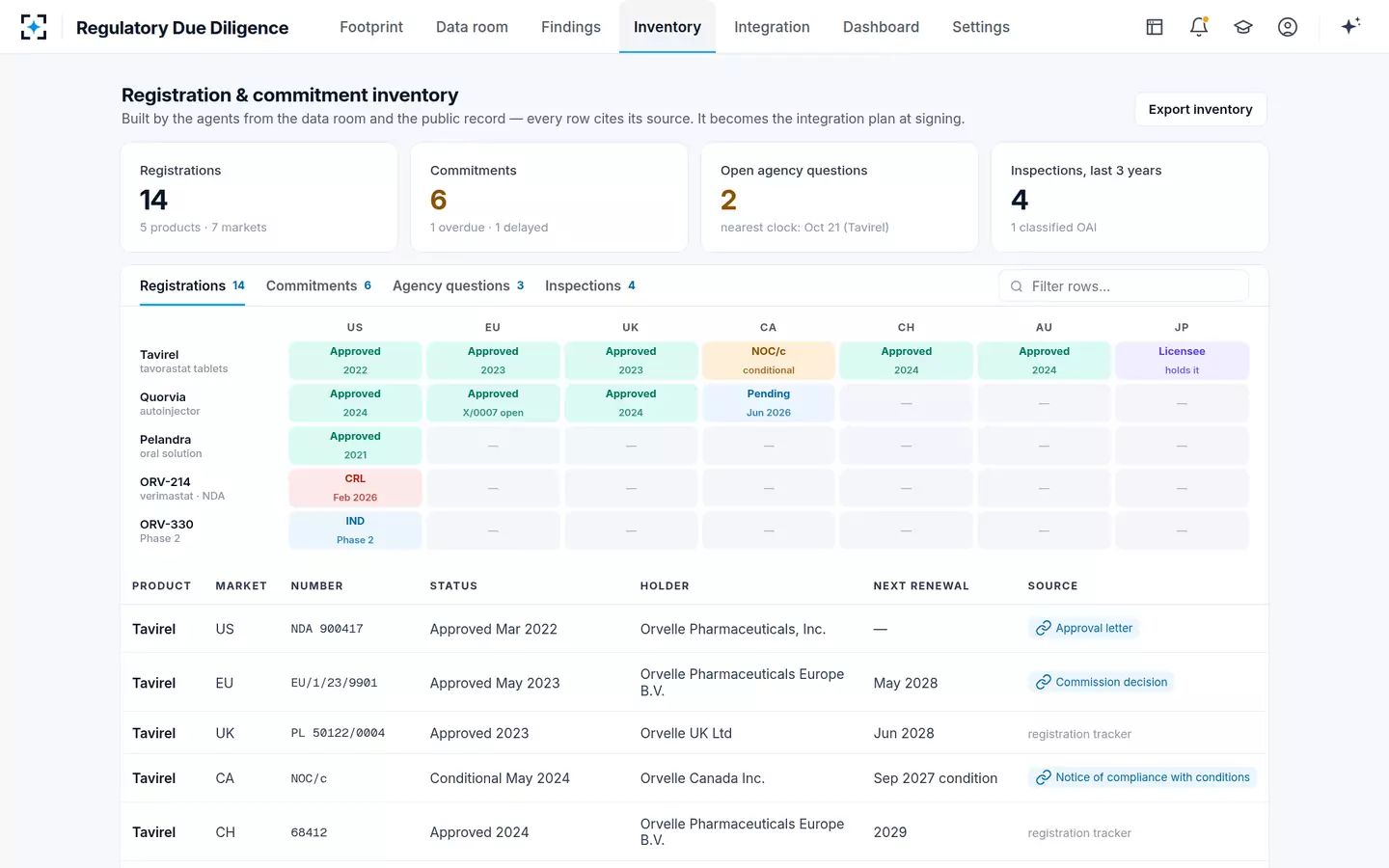
The inventory is also the answer to the question a deal lead asks on the second call: how much of the forecast sits on a problem? That answer is only as good as the object list behind it, which is why the inventory is built before anything is scored.
What to request, class by class — and what each is checked against
Below is the request list with its second column filled in. Five of the nine classes have a public counterpart that can contradict the seller; four do not, and knowing which is which is what stops a team spending its best week on the wrong documents.
The request list, and the public record that checks each class
| Ask the seller for | Why it matters | Check it against |
|---|---|---|
| Approvals, supplements and their conditions | The registration is the asset; its conditions travel with it. | The agency's own approval record for each market. In the EU the assessment report is published about two weeks after the Commission's decision. |
| Agency correspondence and decision letters | A refusal or a deficiency letter sets the real approval date. | FDA has published complete response letters since July 2025, redacted. In the EU, refusal assessment reports and withdrawal letters. |
| The commitment list, with milestone dates | A missed requirement can be a violation, not an awkwardness. | FDA's post-marketing requirements and commitments database, which carries every open item. |
| Inspection file: reports, responses, classifications | An unacceptable classification at a contract site is a supply problem and an approval problem at once. | FDA's inspection classification database, updated weekly, and the published warning letters. |
| Meeting minutes and scientific advice | What the agency actually agreed, as opposed to what the deck says it agreed. | Nothing public. Ask for the agency's own minutes, never the sponsor's note of the meeting. |
| Labeling history and safety labeling changes | A forced warning moves the forecast before it moves the label. | The approved label on the agency site; a pending change is usually not public yet. |
| eCTD archive index, sequence by sequence | A gap in the archive is a transfer that stalls after close. | Nothing public. Count the sequences per application and reconcile to the submission history. |
| Contracts that bind a registration | Change-of-control and consent clauses decide whether a transfer is even available. | Nothing public. Read for consent, territory and who holds the registration in each market. |
| Pharmacovigilance system master file and audit history | The obligation transfers with the authorisation on day one. | Nothing public, but the inspection record of the system is. |
The commitment row is the one to press hardest, because a commitment is the rare regulatory object whose transfer is written into the rules. When an application changes hands, the new owner must file a letter containing, in the regulation's own words, its commitment to what the last owner promised.
The new owner's commitment to agreements, promises, and conditions made by the former owner and contained in the application
21 CFR 314.72(a)(2)(i), Change in ownership of an application
Read it the way a buyer should: an unfinished study on the seller's list becomes an unfinished study on yours, on the same timetable, whether or not it was mentioned on a slide. Whether a missed milestone is then a legal violation or a broken promise depends on which kind of obligation it is, which is worked through in post-marketing requirement against commitment.
What documents do you request in regulatory due diligence?
Request nine classes of document, for every product and every market, and name the market in the request: approvals and supplements with their conditions; all correspondence with each agency, including decision letters; the commitment list with milestone dates and status; the inspection file for the target's own and its contract manufacturers' sites; meeting minutes and scientific advice as the agency issued them; the labeling history, including any change under discussion; the eCTD sequence index; the contracts that bind each registration; and the pharmacovigilance system master file with its audit history. Ask for an index of the regulatory folders on the first day, and for a dated list of what has been uploaded since, so a late batch is visible as a batch.
A request list is easy. A list that cannot quietly fail is the harder thing, and these are the ten properties worth insisting on before the reading starts.
The ten checks a finished regulatory request list must pass
- Every class is requested per market, not per product
A product approved in seven markets has seven conditions sets, seven labels and seven transfer routes. One row per product hides six of them.
- Every class names the form of the document
Ask for the agency's minutes, not a summary of the meeting; the classification, not an assurance about it.
- Each requested class is paired with what it will be checked against
Five of the nine classes can be tested against a public source; the other four can only be tested by a question to the seller.
- The commitment list carries dates and status, not titles
A commitment without its milestone date cannot be called late, and late is the only thing you are looking for.
- Open clocks are a class of their own
An information request with 14 days left is a different object from a letter closed two years ago. Sort by the date the clock expires.
- Contract manufacturers are inside the scope
The inspection history that matters is often at a site the target does not own.
- The archive index is requested in the first week
Missing sequences take weeks to reconstruct and are needed the day after close, not the day before the bid.
- Nothing is marked clean while files behind it are unread
A provisional colour is honest; a green tile over an unread folder is not.
- Every extracted value carries its file and page
A finding a signer cannot open at the page is a finding nobody will sign.
- Late uploads are read before the report, not after it
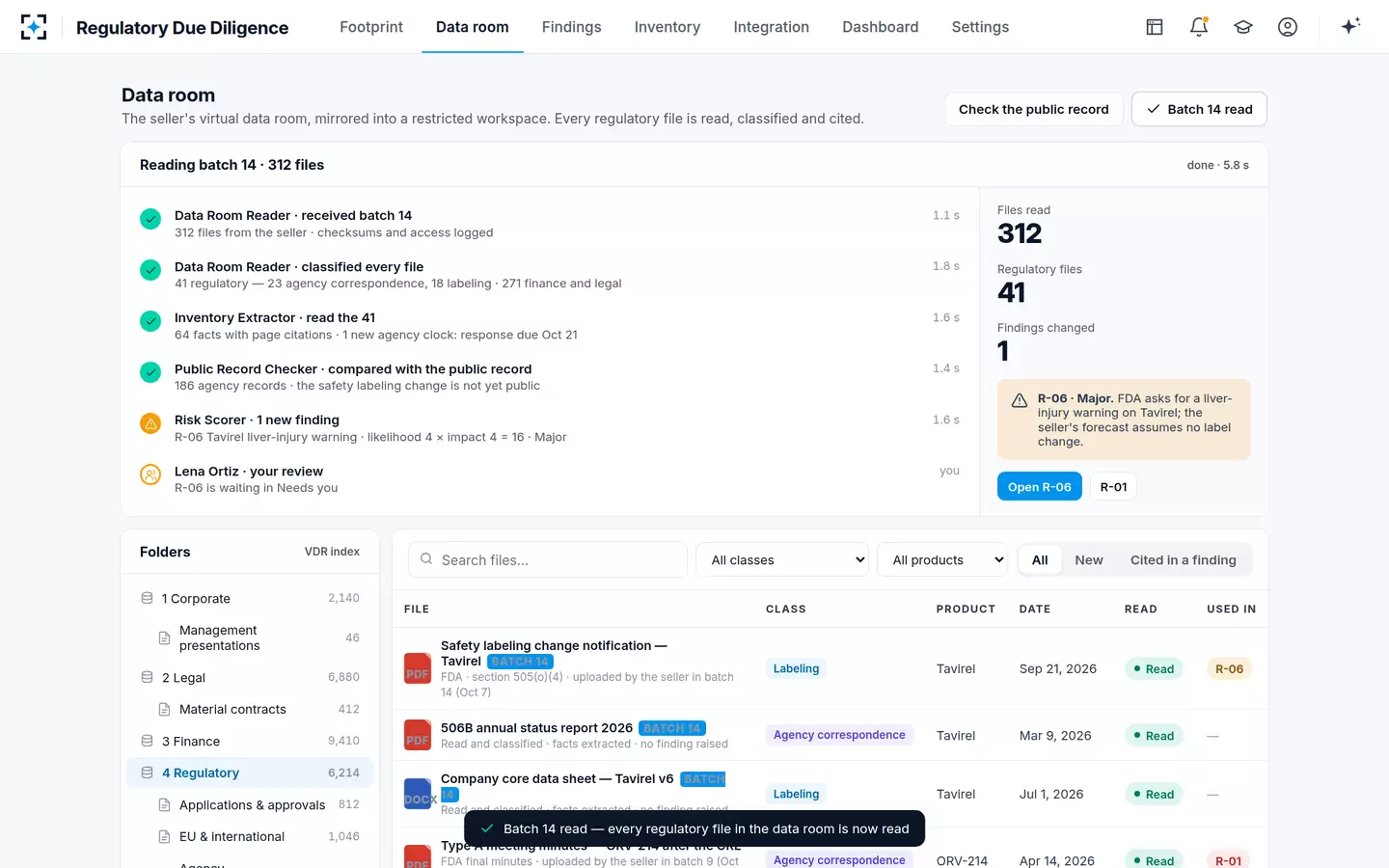
In the sample deal 312 files arrived two days before the report was due, 41 of them regulatory, and one of them raised a new finding.
The public record you do not have to ask the seller for
Four public sources carry enough of the regulatory record that a diligence team can test a seller's account of it without ever asking. None is complete, and each has an edge worth knowing.
The commitment register. FDA publishes a searchable database of post-marketing requirements and 506B commitments, which it describes as covering "those studies and trials for clinical safety, clinical efficacy, clinical pharmacology, and nonclinical toxicology" (FDA, about the PMR and PMC database). Its scope is the thing to hold in mind: it carries "all open PMRs and 506B PMCs and only those closed (released or fulfilled) within the last year", so an item that was closed two years ago has left the register and can only be evidenced by the seller.
The European assessment report. For a centrally authorised medicine, "around 2 weeks after the European Commission's decision on the marketing authorisation of a new medicine, a comprehensive set of documents called the European Public Assessment Report (EPAR) is published on the medicine's page" (EMA, guide to information on human medicines, EMA/207532/2025). The assessment report inside it is the agency's own reasoning, and it is the fastest way to find the condition or the open question the seller summarised in one line.
The inspection classification. FDA's inspection classification database "is updated weekly" (FDA, inspections database FAQ), which makes it the one source on this list that can change during a four-week diligence. A site that was unclassified when the request list went out may be classified before the bid. Reading a target's inspection record is a subject of its own in the inspection classification database.
Decision letters. Since 2025 FDA publishes complete response letters, which changes a seller's account of a refusal from the only available version into a checkable claim. What is published is redacted — confidential commercial and trade secret information is removed before disclosure (openFDA, complete response letters) — so a blacked-out passage is an unknown rather than an absence. The practical consequences are set out in are FDA complete response letters public.
The same inventory, drawn as a map of what the deal is actually buying
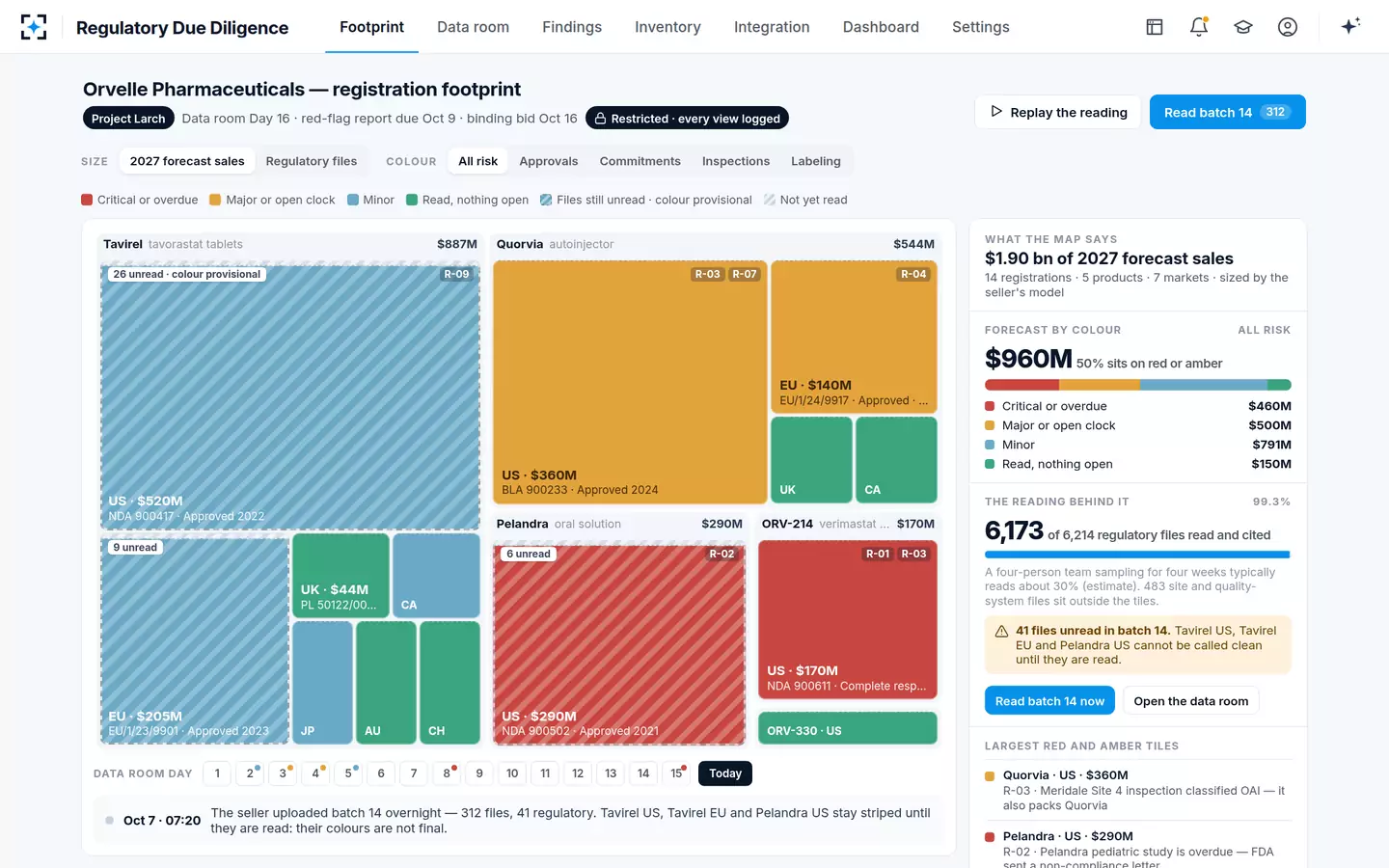
Why a citation on every row is the point of the inventory
A diligence inventory is read by people who will not read the data room: a signer, a deal committee, and after close an integration office that inherits the list. For them the inventory is only as good as the trip back to the page. The rule worth writing into the workstream is that no value enters the inventory without the file and page it came from, and no finding is raised without at least one citation — because the first question a signer asks about an uncomfortable finding is where it comes from, and a day spent re-finding the passage is a day the clock does not give back.
That rule also decides the shape of the reading. Each step produces something the next step can check, and the two decisions that matter are reserved for named people.
How one seller batch becomes a scored, cited finding
Agent
Read and classifyEvery file in the batch is classified — approval, agency letter, decision letter, inspection, labeling, archive, contract — and linked to a product and market, with the page of each fact kept.
Never: summarises a file it could not read; it marks it unreadable
Agent
Extract the objectsRegistrations, commitments, open agency questions with their clocks and inspections are pulled into the inventory, one row per instance.
Never: records a value without a citation
Agent
Compare with the public recordThe published side — decision letters, assessment reports, inspection classifications, the commitment register — is set beside the seller's own statement.
Never: searches a public source with terms that would identify the deal
Agent
Score the differenceWhere the two disagree, the gap is scored for likelihood and impact, with its effect stated in months and in money, one question drafted for the seller and one protection proposed.
Never: raises a finding without at least one cited passage
A person decides
The diligence lead decidesConfirms the finding, downgrades it with a reason on the audit trail, or sends the question to the seller.
A person decides
A named signer releases itA finding at the top severity reaches the deal team only after a named person signs it, with the meaning of the signature recorded.
How do you verify what the seller says about an approval?
Verify a statement about an approval by finding the agency's own words on the same subject and reading both side by side, in that order — the public record first, the seller's account second, so the reading is not anchored on the seller's framing. For a US approval, that means the approval record and any published decision letter; for a European one, the assessment report published about two weeks after the Commission's decision; for a condition or a study, the commitment register; for a site, the inspection classification. Where the two disagree, the sensible default is that the agency's text wins and the difference becomes a question for the seller, not a conclusion about the seller.
Three gaps do not resolve this way, and each has its own move. Where the public source is silent because an item has aged out of a register, ask for the closure letter by name. Where the public source is redacted, treat the redaction as unknown rather than as absence. And where there is no public source at all — minutes, archives, contracts — the only verification available is internal consistency: does the minute match the submission that followed it, does the sequence index match the submission history, does the contract's territory match the registration's holder of record?
A late batch read, and what it moved
The questions that come back to the seller, and how to phrase them
A checklist produces questions, and badly phrased questions produce another fortnight of correspondence. Four habits earn their keep. Ask for a document, not a view: "please provide the agency's minutes of the Type A meeting of 14 March" rather than "please confirm the agency agreed to the modelling approach". Name the discrepancy without characterising it, because a question that implies bad faith returns a lawyer's answer rather than a file. Put a date on every answer you need, and say which decision it feeds. And number the questions in the inventory, so an open question is an object with a status like every other.
In the sample deal two questions did more work than the rest: one asked for the closure correspondence on a pediatric assessment that the public register showed as open, and one asked for three missing archive sequences by their numbers. Both were answerable from the seller's own files in a day, and both would have been unanswerable as a general request for comfort on commitments.
What the checklist cannot tell you
Three things stay out of reach, and a report is better for saying so. The first is the unwritten: an agency's view expressed in a call, a reviewer's scepticism, a policy about to change. The second is the redacted: a published decision letter with its commercial detail removed tells you a deficiency exists and not how large it is, which is a reason to ask and not a reason to assume. The third is the unuploaded, and it is the one that costs deals. A checklist can only test the documents that exist in the room; what it can do is make the absence visible — a class requested and not delivered should sit on the report as an open item with the date it was requested, not disappear because the week ended.
Nor does a checklist produce a judgment. It produces an inventory and a set of differences between what the seller said and what the record says; a named person still decides which difference changes the price, and someone still signs. How those differences become six sections a committee can read is the subject of the regulatory due diligence report, section by section. To see the inventory, the public-record comparison and the report in one place, start from Regulatory Due Diligence.
Questions people ask
What regulatory documents are in a pharma data room?
Typically nine classes: approvals and supplements with their conditions, agency correspondence including decision letters, the commitment list, the inspection file for the target's own and its contract sites, meeting minutes and scientific advice, the labeling history, the eCTD archive index, the contracts that bind each registration, and the pharmacovigilance system master file. In the fictional sample deal the regulatory folders held 6,214 files inside a data room of 41,870.
Who does regulatory due diligence on a pharma deal?
A small regulatory workstream inside the deal team, usually a diligence lead who reads and scores, a head of regulatory strategy who signs, a chemistry-manufacturing and inspections reviewer, the business development deal lead on the other side of the clean-team wall, and an integration office lead who inherits the inventory at close. Outside counsel reads the contracts around the registrations rather than the registrations themselves.
What should you ask a pharma seller for first?
An index of the regulatory folders and a list of every registration by product and market, on the first day. The index shows which of the nine classes exist before anyone reads a file, and the registration list is the spine the rest of the inventory hangs from. Ask at the same time for a dated list of each upload, so a late batch is visible as a batch rather than as files that quietly appeared.
How long does regulatory due diligence take?
On a bolt-on deal with a handful of marketed products, three to four weeks of a small team's time is common, running from the opening of the data room to the red-flag report, with transfer planning continuing after signing. The constraint is rarely the analysis; it is the reading, which is why late batches hurt so much — in the sample deal 312 files arrived two days before the report was due.
What is the difference between regulatory, legal and commercial due diligence?
Regulatory diligence tests what the agencies have decided and what the target has promised them. Legal diligence tests the contracts, litigation and ownership around those assets, including the consents a registration transfer will need. Commercial diligence tests the forecast the registrations support. They overlap at exactly the points that matter, which is why the regulatory inventory is worth sharing with the other two workstreams as it is built rather than at the end.
Does the checklist change for a biologic or a device-drug combination?
The classes stay the same; three of them get heavier. The inspection file matters more because a biologic's licence is tied to its manufacturing sites, the archive is larger, and the transfer route differs — a biologics licence moves under the biologics rules rather than the drug-application ownership rule in 21 CFR 314.72. Add the device-side quality and reporting history as a tenth class for a combination product.