Regulatory due diligence in a pharma deal is the buyer's review of the target's approvals, agency correspondence, post-marketing obligations, open review clocks, inspection history and manufacturing sites, to establish whether the seller's account is true and what any difference does to the price, the timetable and the deal terms. It needs five decisions with five owners: a diligence lead who turns differences into findings, a CMC and inspections reviewer who owns the manufacturing view, a senior signer who releases the findings that move the price, a business development deal lead who prices them, and an integration lead who turns the inventory into a transfer plan. It is hard because the work arrives as thousands of files in a few weeks, and a small team reads only part of them closely. Botminds' Regulatory Due Diligence reads every regulatory file in the data room, sets each seller statement beside the agency's own record and cites every finding, while the five seats decide.
This guide is for heads of business development, regulatory strategy and integration who staff the workstream. The deal on this page is fictional sample data inside the solution; the rules are quoted from FDA regulations and US statute.
One sample deal's regulatory workstream
6,214
regulatory files in the sample data room, read and cited by the agents
1 in 3
files a four-person team reads closely by hand in the time a deal allows — our estimate
$960M
of the target’s 2027 forecast, half the total, sits on products and markets with open regulatory risk
Who decides what in regulatory due diligence on a pharma deal?
Five seats, each owning one decision that cannot be passed sideways. Reading and scoring decide what the data room contains and what counts as a problem; signing decides what leaves the regulatory team; pricing decides what a finding is worth in the bid; transferring decides whether the approvals still work after close.
Nine steps in the workstream, and who owns each
| Step | Owner | What it means in practice |
|---|---|---|
| Classify each uploaded file | The agents | Approval, agency letter, decision letter, inspection, labelling, archive or contract, linked to a product and market |
| Extract every registration, commitment, clock and inspection | The agents | One row each, none without a citation to its page |
| Compare the seller with the public record | The agents | The published record set beside the seller’s statement |
| Score likelihood and impact | The agents | Against thresholds the team set, with the effect in months and in money |
| Confirm, downgrade or ask the seller | Diligence lead | The only person who turns a scored difference into a finding, with a reason either way |
| Own the inspection and manufacturing view | CMC and inspections reviewer | Observations beside the published classification for every site, contract sites included |
| Sign the top-severity findings and the report | Head of regulatory strategy | Nothing at the top severity reaches the deal team before this signature |
| Price the finding into the bid | Business development deal lead | The effect and proposed protection taken into the model and the purchase agreement |
| Approve the transfer plan | Integration office lead | Each market a route, a clock and an owner, scheduled from the close date |
On a small bolt-on deal one person may hold two seats, most often diligence lead and CMC reviewer. The seats that should never merge are the diligence lead and the signer: a finding the lead scored and then signed has had no second reader, and the signature is what the deal team relies on when it changes the price.
The five seats on the sample deal, and how each one's weeks change
Today
Samples the data room against the clock and writes the report on what could be reached.
With agents
Opens each finding with the seller’s statement beside the agency’s words, and confirms, downgrades or asks.
Still theirs: What is a finding, and what goes back to the seller.
Today
The seat most often left empty, so the inspection file is skimmed by whoever has an hour.
With agents
Reads observations beside the published classification for every site, including contract manufacturers.
Still theirs: Whether a manufacturing problem is a supply problem, an approval problem or both.
Today
Reads a draft late and signs under time pressure.
With agents
Signs each top-severity finding and the report with the cited passage open and the meaning recorded.
Still theirs: The signature, and what it means.
Today
Gets answers qualified by what nobody had time to read.
With agents
Sees reading coverage, where the risk sits, and each confirmed finding with its effect and a proposed protection.
Still theirs: The bid, the protections and the walk-away.
Today
Rebuilds the registration list from scratch after signing.
With agents
Gets the inventory as a transfer plan with a route, clock and owner per market.
Still theirs: Approval of the plan, and the Day 1 list.
What the diligence lead reviews, and how a finding is made
The diligence lead owns the request list, the reading order, the inventory and the comparison. The core method is a pairing: every seller statement in the management presentation or disclosure schedule is set beside the agency's own words — the approval letter, the complete response letter, the post-marketing requirement, the inspection classification — and every difference is scored.
The inventory is the lead's main product: each registration by product and market with its holder of record and status, every post-marketing requirement and commitment with its due date, every open agency clock, and every inspection by site. A seller deck that calls a complete response letter "limited to observations at our third-party manufacturer" is a statement; the letter itself says what the agency asked for. What the data room should contain is set out in the regulatory due diligence checklist, and how a post-marketing obligation transfers to a buyer in requirement vs commitment.
Scoring needs thresholds set before the room opens. On the sample deal a finding is Critical from a likelihood-times-impact score of 20 and Major from 9, and the lead is the only person who can confirm a scored difference as a finding, downgrade it with a reason, or send a numbered question to the seller. Pediatric study obligations are a frequent source of overdue items, because PREA deferrals carry dates and extensions that must be requested and granted (21 U.S.C. 355c).
Why CMC due diligence needs its own seat
Because manufacturing findings have two separate consequences, and only someone who reads inspection files for a living sees both. An inspection classified Official Action Indicated means, in FDA's words, that "regulatory and/or administrative actions are recommended" (FDA, inspection classifications) — which can mean withholding approval of a pending application that names the site. The same site may also make a product already on the market, so one classification can be an approval risk and a supply risk at once.
The reviewer's method is the same pairing as the lead's: the Form 483 observations and the company's responses from the data room, beside the classification FDA published for the site, which may have changed since the seller assembled the room. Contract manufacturers need the same reading as owned sites, and are the ones most often skimmed. How to read a target's record in FDA's database, and its gaps, is set out in the FDA inspection classification database.
The signer: what a signature on a top-severity finding should mean
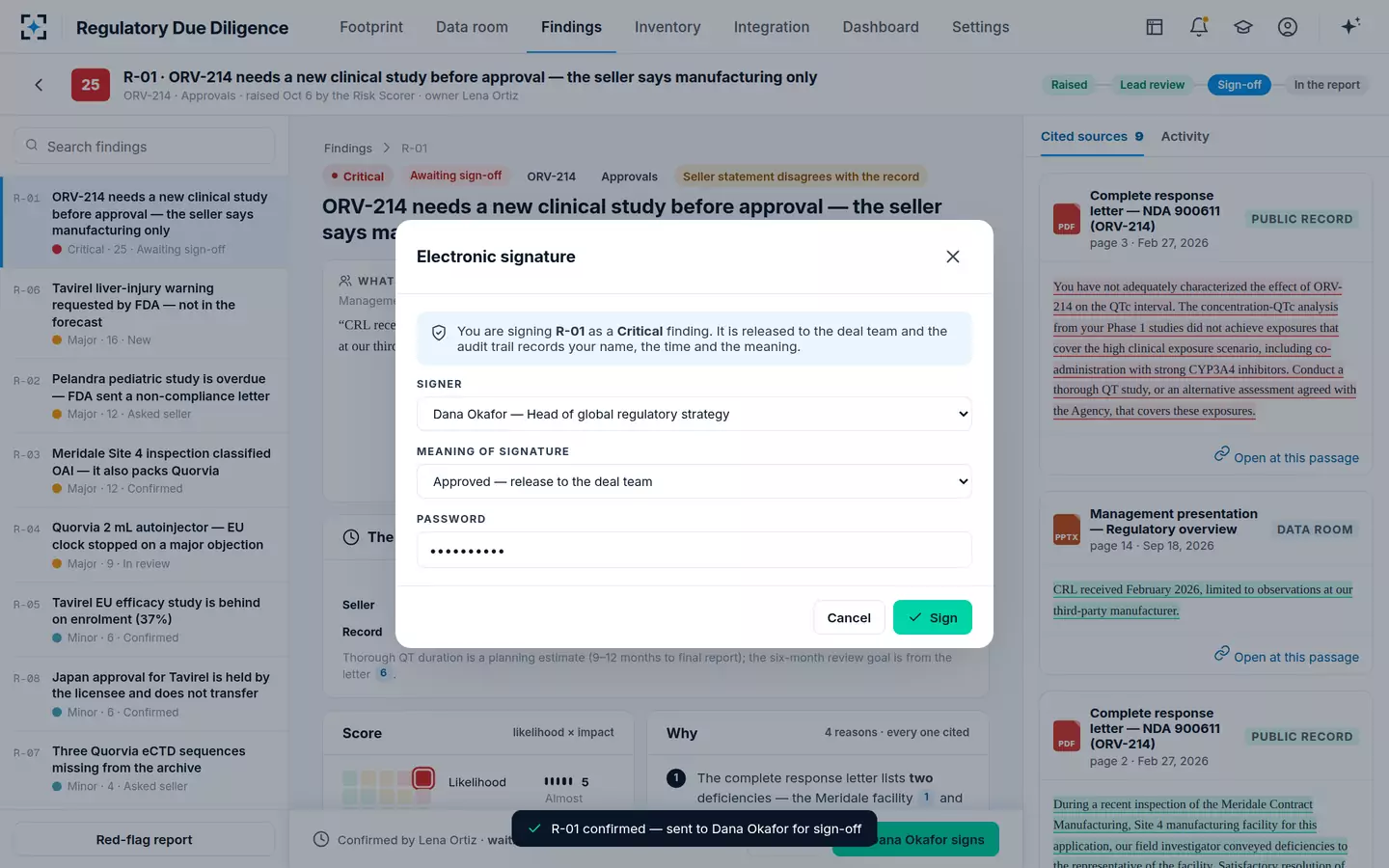
The signer releases the findings that will move the price, and the signature should say what it attests. For signed electronic records FDA's rule requires the signer's printed name, the date and time, and the meaning of the signature, such as review, approval, responsibility or authorship (21 CFR 11.50); a diligence workstream that adopts the same standard can show after the deal who stood behind each number.
The decision has two parts: whether the finding is supported by what was actually read, and whether it is released to the deal team. On the sample deal the head of regulatory strategy signs every Critical finding and the red-flag report, and a Critical finding is held until the signature exists, so the deal team never hears a number the regulatory team has not stood behind. Both the threshold and the signer are settings recorded on the audit trail.
A named signer releases the Critical finding to the deal team
What the deal lead needs from the regulatory workstream
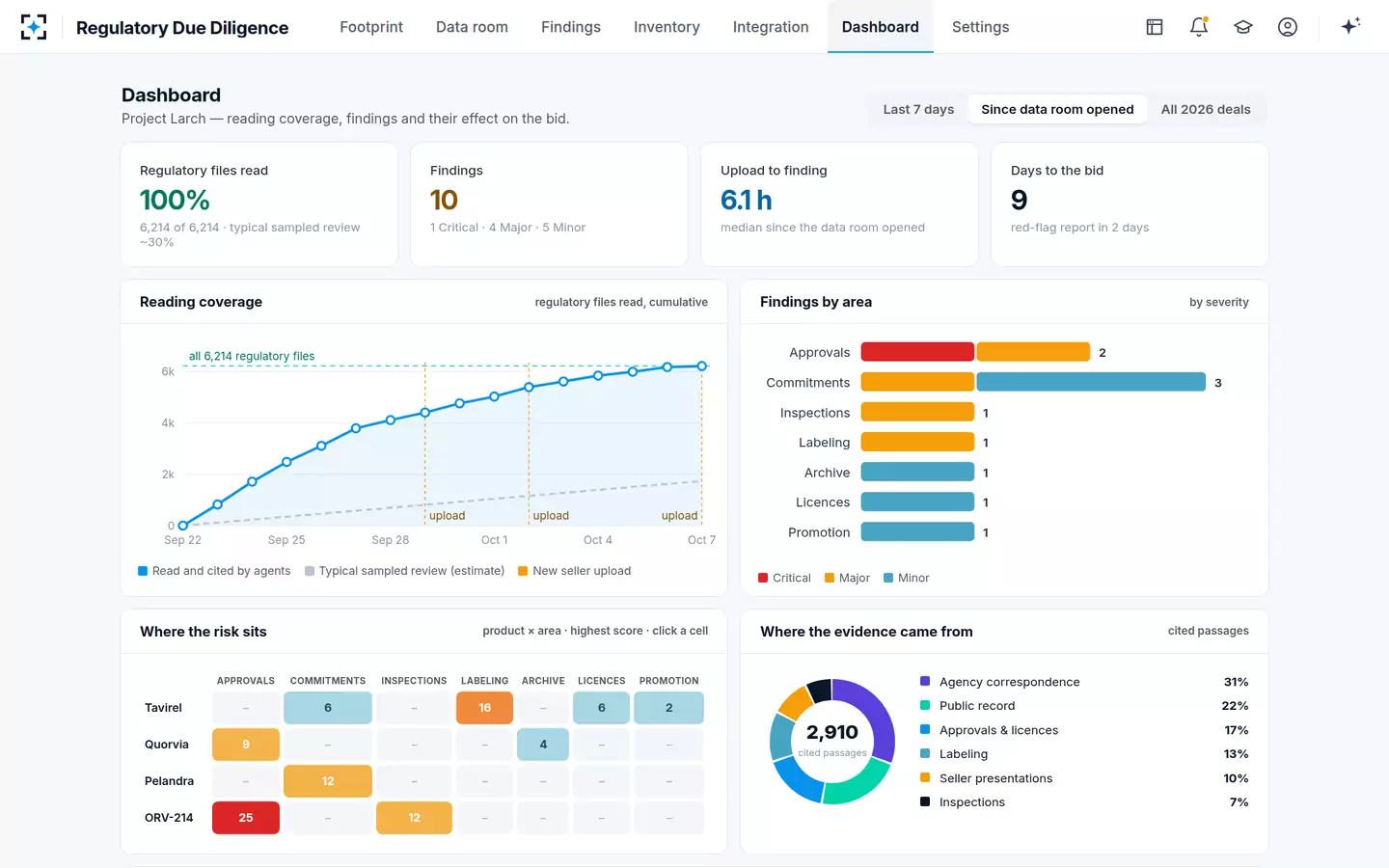
Five things: how much of the room has been read, where the unread parts are, which findings are confirmed, what each does to the date or the forecast, and what protection the purchase agreement could carry. The regulatory team hands over an effect and a proposed protection; the pricing decision, the indemnity and the walk-away are the deal lead's.
Coverage comes first because a finding count means nothing without it. On the sample deal 6,173 of 6,214 regulatory files are read and cited, and three product-market tiles stay marked provisional after an overnight batch of 312 files, 41 of them regulatory, until the new files are read. Between signing and closing the parties remain separate businesses: where a filing is required, US law bars completing an acquisition until the waiting period has expired (15 U.S.C. 18a), so competitively sensitive information in the room is usually handled through a clean team and the workstream's access controls should reflect it.
Reading coverage first, then findings and where the risk sits
The integration lead: turning the inventory into a transfer plan
Every approval the deal buys has to change hands after close, and each has its own filing and clock. For a US drug application, the former owner submits "a letter or other document that states that all rights to the application have been transferred to the new owner", and the new owner commits to "agreements, promises, and conditions made by the former owner and contained in the application", with the effective date (21 CFR 314.72). That commitment is why the diligence inventory of obligations is also the new owner's to-do list.
The same rows the lead built become the plan: each registration with its route, clock and owner, scheduled from the close date. On the sample deal 13 registrations move, Japan stays with a licensee, 1,842 eCTD sequences migrate and the last transfer lands on Day 118. The routes and clocks by market are set out in transfer of marketing authorization.
Where the workstream's days go
Most of a small team's days go on handling files rather than on judgement. On our estimate for a four-week review of a bolt-on deal with a handful of marketed products, 40% of about 20 working days goes on indexing, classifying and reading uploads, against 15% on scoring findings and drafting seller questions.
The regulatory workstream's working days, by hand and with the agents reading
By hand, about 20 working days
- Indexing, classifying, reading · 40%
- Checking against public records · 15%
- Scoring and seller questions · 15%
- Writing, signing, transfer plan · 30%
With the agents reading, about 4.5 days
- Indexing, classifying, reading · 22%
- Checking against public records · 11%
- Scoring and seller questions · 22%
- Writing, signing, transfer plan · 45%
The deal's dates do not move; the report is still due before the binding bid. What moves is the week in which the uncomfortable finding surfaces, which decides whether it can still be negotiated. The cost side of the same arithmetic is worked through in what a due diligence report costs.
Staffing checks for a pharma regulatory workstream before the room opens
- Name an owner for each of the five decisions.
Diligence lead, CMC and inspections reviewer, signer, deal lead, integration lead.
- Keep the signer separate from the lead.
A top-severity finding needs a second reader before it moves the price.
- Fill the CMC seat, including contract sites.
Inspection findings can be approval and supply risks at once.
- Set severity thresholds and the signer in writing.
Before the first finding, so no threshold is set to fit a result.
- Report reading coverage with every finding count.
The share of the room read is what makes a clean result mean anything.
- Start the transfer plan from the inventory, not after signing.
The new owner inherits the former owner’s commitments under 21 CFR 314.72.
Where Regulatory Due Diligence fits on the deal team
Regulatory Due Diligence reads every regulatory file in the data room, new uploads within two hours, and classifies each against a product and market. It extracts registrations, commitments, clocks and inspections with their pages, prefers the public record over the seller's summaries, compares each seller statement with the agency's own words, flags commitments past their due date, scores each difference against the team's thresholds, and drafts the report and the transfer plan from the same inventory.
It does not decide. The diligence lead confirms every finding, downgrades it with a reason or asks the seller; the head of regulatory strategy signs Critical findings and the report; the deal lead prices; the integration lead approves the plan. What changes for the workstream is that the people in those seats work from the whole room rather than a sample, with every finding traceable to its page.
Questions people ask
Who should lead regulatory due diligence on a pharma acquisition?
A regulatory diligence lead who owns the reading, the inventory and the conversion of differences into findings, reporting to a senior regulatory signer such as the head of regulatory strategy. The business development deal lead owns pricing and protections, and an integration lead owns the post-close transfer plan.
What does CMC due diligence cover?
Manufacturing sites, including contract manufacturers, their inspection history and published classifications, Form 483 observations and responses, and whether any site named in a pending application has an unresolved classification. An Official Action Indicated classification means FDA has recommended regulatory or administrative action, which can affect both approval and supply.
How many people does a regulatory due diligence workstream need?
Five decisions need owners, which on a small deal can be three or four people. By our estimate, a four-person team reading by hand covers about a third of the regulatory files closely in the time a deal allows and samples the rest, which is why reading coverage should be reported with every finding.
What does a buyer inherit when an FDA application changes hands?
Under 21 CFR 314.72 the new owner submits a letter committing to the agreements, promises and conditions the former owner made in the application, with the effective date of the change. Post-marketing requirements, commitments and their due dates therefore pass to the buyer and belong in the diligence inventory.
Who signs off on regulatory due diligence findings?
A senior regulatory signer, separate from the diligence lead, should sign each top-severity finding and the red-flag report before they reach the deal team. Recording the signer's printed name, time and the meaning of the signature, as 21 CFR 11.50 requires for signed electronic records, makes the release traceable after the deal.
How long does regulatory due diligence take in pharma?
Typically a few weeks before a binding bid, set by the deal timetable rather than the size of the data room. On a bolt-on deal with a handful of marketed products, our estimate is about 20 working days of team time by hand, most of it on indexing and reading uploads.