How much does a due diligence report cost? For the regulatory workstream of a bolt-on pharmaceutical acquisition the honest answer is a range, not a price: roughly forty to sixty thousand dollars of loaded staff time for four people over four weeks, derived below from published wage data with every assumption stated. It is an unusual cost in that it barely moves. Four seats for four weeks is four seats for four weeks whether the data room holds 6,000 regulatory files or 16,000 — which is why the real question is not what the report costs but how much of the data room it leaves unread. Botminds' Regulatory Due Diligence changes that second number rather than the first.
Diligence engagements have no published market price, so none is quoted. What follows is built from wage data, published agency fees and research, with our own arithmetic labelled wherever it appears, and illustrated on a fictional sample deal — Northwind bidding for Orvelle Pharmaceuticals.
The published anchors this page is priced from
$80,730
median annual wage, 2025, for the compliance-officer group that regulatory affairs specialists sit in
$141,900
median annual wage, 2025, for the wider managers group that regulatory affairs managers sit in
$4.6M
FY2027 application fee where covered clinical data is required
$416,857
FY2027 annual prescription drug program fee, per product
What the regulatory workstream is actually made of
Almost none of this cost is software, data or travel. It is a small number of expensive people reading, cross-checking and writing to a deadline somebody else set. O*NET describes the specialist's work as preparing and reviewing regulatory submissions, at home and abroad, and keeping a current picture of existing and emerging regulations, standards and guidance; the manager's as to "develop regulatory strategies and implementation plans for the preparation and submission of new products". On a deal those same skills are pointed backwards, at somebody else's filings.
A typical shape for a bolt-on with a handful of marketed products is four people for four weeks: a lead who owns the report, a specialist on approvals and correspondence, a reviewer on manufacturing and inspections, and a half-seat each of deal-team and integration time that in practice adds up to a fourth person. Against twenty working days each, the work divides roughly like this.
Where a four-week regulatory review's days go
By hand — twenty working days
- Indexing and classifying each seller upload · 20%
- Building the registration and commitment inventory · 20%
- Checking seller statements against public records · 15%
- Scoring findings and drafting seller questions · 15%
- Writing and signing the report · 15%
- Planning each market's transfer · 15%
With agents doing the reading — four and a half days
- Indexing and classifying · 11%
- Inventory · 11%
- Checking against public records · 11%
- Scoring and questions · 22%
- Writing and signing · 22%
- Transfer planning · 23%
How much does a due diligence report cost?
Build it from the wages up and state every assumption. Take a team of one manager and three specialists. At the 2025 medians that is $141,900 plus three times $80,730, or $384,090 of base pay a year for the four seats together.
Base pay is not what a seat costs an employer. The usual way to get from one to the other is a loading multiplier covering employment taxes, benefits, paid leave and the overhead the seat consumes. There is no published multiplier for this profession, so we have used a range of 1.4 to 2.0 and say so: 1.4 is close to employment costs alone, 2.0 is a commonly used fully absorbed figure. That gives $537,700 to $768,200 a year for the four seats, $10,300 to $14,800 a week, and for four weeks:
The regulatory workstream, priced from published medians
The seats
1 manager + 3 specialists
$141,900 + (3 × $80,730) = $384,090 of base pay a year
O*NET 2025 median annual wages
The loading
× 1.4 to 2.0
Employment taxes, benefits, paid leave and overhead. Our assumed range, not a published figure.
Stated assumption
The weeks
4 weeks ÷ 52
$10,300 to $14,800 a week for the four seats together
Estimated review length for a bolt-on deal
The bill for the time
≈ $41,000 to $59,000
About $50,000 at the mid-point of the loading range
Our arithmetic on the three terms above
Two things about that number are worth more than the number. The first is how little of it is variable: a bigger data room does not buy more weeks, it buys a smaller share read. The second is how small it is against everything around it. The Federal Trade Commission and Department of Justice "took 18 merger enforcement actions to maintain competition in critically important markets, including healthcare, technology, energy, defense, consumer goods and services, labor and manufacturing" in fiscal year 2025; on a deal large enough to draw that attention, the legal and financial workstreams are likely to dwarf the regulatory one. A pharmaceutical acquisition is rarely decided on the cost of its regulatory review.
Pricing the seats: what the published wage data supports
Two cautions on the medians. They are national medians across all employers, and a deal team in a major hub is above them — a point to handle by scaling the whole calculation rather than by guessing a premium. And a median is a wage, not a billing rate: a firm that buys the same hours from outside pays for someone else's loading, margin and utilisation, which nobody publishes.
That is also the honest limit on the outsourcing comparison. The inputs that can be priced from public data are internal. Whether an outside team is cheaper depends on a rate nobody publishes, so the sound way to compare is on something other than price: what share of the files each reads, how each cites a finding, and how quickly either can absorb a 312-file upload two days before the bid.
The hours that are reading, and the hours that are chasing
Inside the twenty days, the hours divide into three kinds, and only one of them is what anybody was hired for. There are reading hours — opening files, classifying them, pulling out facts. There are checking hours — finding the agency's published words for the same product and setting them beside the seller's. And there are chasing hours, which nobody budgets: re-indexing a folder the seller re-uploaded with different names, reconciling a schedule against the documents behind it, and the standing cost of a data room that keeps changing underneath the review.
The same bill, line by line, with and without agents doing the mechanical half
| The work | By hand | With agents | What actually changes |
|---|---|---|---|
| Indexing and classifying each seller upload | 4 days | half a day | The reading stops being the constraint. A late batch is read on arrival instead of in the next available gap. |
| Building the registration and commitment inventory | 4 days | half a day | Every row carries a page citation, so the inventory is checkable rather than retyped from the seller's schedule. |
| Checking seller statements against public records | 3 days | half a day | The comparison is run against every statement, not against the ones somebody had time to test. |
| Scoring findings and drafting seller questions | 3 days | 1 day | Less time saved, and rightly: this is where judgement starts. |
| Writing and signing the report | 3 days | 1 day | The draft arrives cited; the hours go into reading it as the author rather than assembling it. |
| Planning each market's transfer | 3 days | 1 day | The plan is generated from the inventory that already exists, instead of being rebuilt from it. |
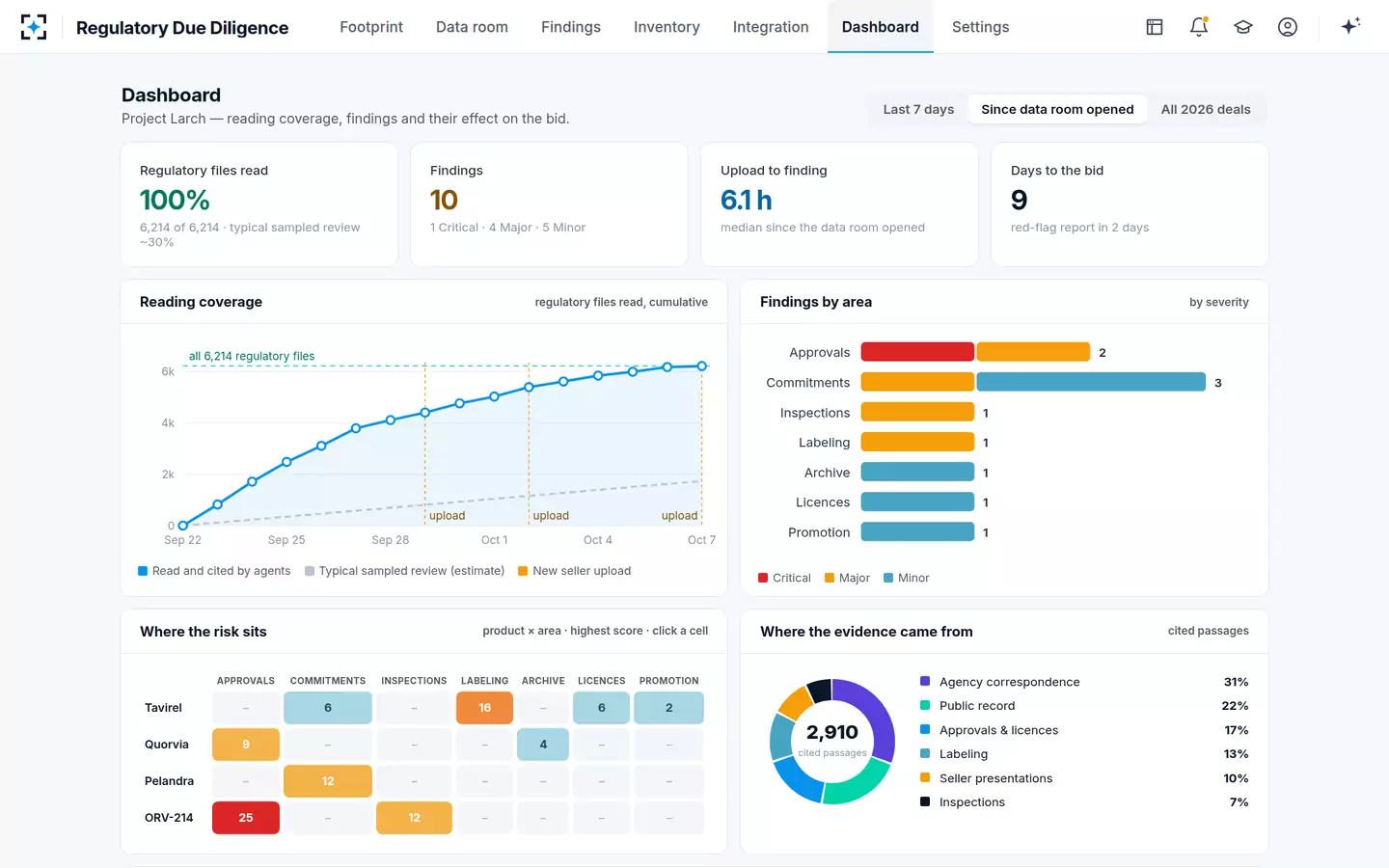
Coverage, cost's only honest denominator
What a missed finding costs, worked through three ways
Set the workstream's cost beside the thing it exists to catch and the comparison stops being close. Three shapes recur, and none of them is hypothetical in the sample deal.
The cost of the review, against three findings it exists to catch
What it costs to find: Reading one published letter against one slide of the management presentation — minutes, inside a review already paid for.
What it carries if it is missed: A resubmission the seller planned as a two-month review becomes a six-month one, because the agency asked for new clinical data. In the sample deal the approval moves from mid-2027 to mid-2028.
What it costs to find: Comparing the commitment inventory with the public register — one of the twenty days.
What it carries if it is missed: A requirement past its date can put the product in violation and expose it to enforcement, and it arrives with the registration. The buyer inherits the study, the deadline and the correspondence.
What it costs to find: One notification in the seller's own data room, read against slide 22.
What it carries if it is missed: In the sample deal, a liver-injury warning with monthly tests, and a forecast reduction of 4 to 7 percent from 2027 on a product carrying $520M of 2027 forecast sales — $21M to $36M on demonstration figures, by our arithmetic.
The second row is the most common and the least dramatic. FDA's own performance report for fiscal 2024 found that of the off-schedule post-marketing requirements on new drug and biologics applications, "the majority (approximately 99 percent) were off schedule because they were delayed" — not terminated, not disputed, simply late. Late obligations are the ordinary condition of a portfolio, which is exactly why a buyer has to count them rather than assume the seller has. What the buyer inherits, requirement by commitment works through the difference.
The costs that arrive after close and nobody budgets
The review is cheap; what it discovers is not. Three post-close costs are predictable enough to put in the model at signing.
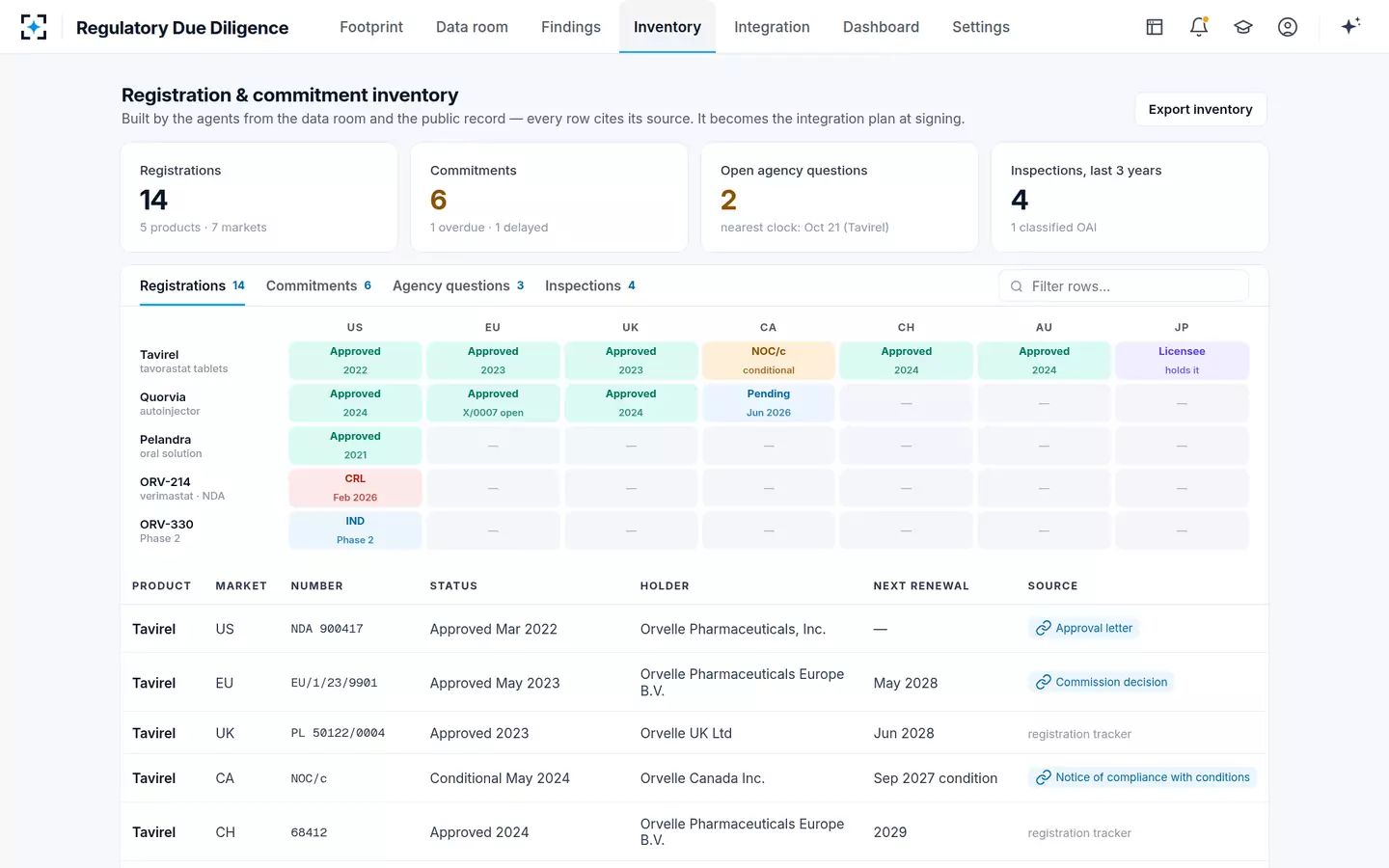
The first is agency fees, which follow the products. FDA's FY2027 rates set the annual prescription drug program fee at $416,857 per product, and an application requiring covered clinical data at $4,600,753 — so a pipeline asset the buyer intends to file carries a seven-figure line before anyone has run a study. The second is the transfer work itself: every registration needs its own filing, its own documents and its own clock, as the route and clock by market sets out, and the archive migration behind it is a project rather than a task. The third is the open commitments: six of them in the sample deal, each needing a named owner at the buyer within three weeks of close.
What the workstream actually has to produce, and what each row costs to carry
What does a delayed approval cost?
More than anything else on this page, and the mechanism is usually procedural rather than scientific. Under FDA's user-fee performance goals a Class 1 resubmission is reviewed against a two-month goal and a Class 2 resubmission against six months. The dividing line is narrow: "Class 1 resubmitted applications are applications resubmitted after a complete response letter (or a not approvable or approvable letter) that include the following items only (or combinations of these items)" — a short list covering labelling, safety updates, stability, assay validation and minor clarifications. Anything else, including anything that would go to an advisory committee, is Class 2.
So a company that reads its decision letter as a manufacturing problem plans a two-month cycle; a company that reads the same letter as a request for a new clinical study is planning a study plus a six-month cycle. In the sample deal that gap is the Critical finding, and the sell-side deck and the published letter are two pages apart on which one it is. Reading the published letter against the deck is where that finding comes from.
What the delay is worth depends on the asset, and the only defensible general figure is the capitalised cost of development itself. A widely cited peer-reviewed estimate puts it at $1,395 million (2013 dollars) of out-of-pocket cost per approved new compound, rising to $2,558 million once those costs are capitalised to the point of approval at a real discount rate of 10.5%. The capitalisation is the relevant half: nearly half that figure is the cost of time. A year of delay on an asset of that scale is not a line item in a diligence budget; it is the reason the diligence budget exists.
Building the case: the four numbers to put in front of a committee
A business case built on a cost saving will lose, because the saving is small and the committee knows it. Build it on coverage instead.
The four numbers, and why each one belongs in the paper
- The share of regulatory files the last review actually read
Take it from the last deal, not from a vendor. If nobody can answer it, that is the finding, and the rest of the case writes itself.
- The cost of the workstream, derived and labelled
Seats, weeks, loading multiplier, total — with the multiplier named. A committee will accept an assumption it can see and reject one it has to infer.
- The value sitting on registrations with an open issue
In the sample deal, $1,480M of 2027 forecast sales on red or amber registrations, 78 percent of the total. Demonstration figures, but the calculation is one any team can run on its own portfolio.
- The time from a seller upload to a scored, cited finding
The measure of whether a late batch changes the report or merely arrives before it. In the sample deal a 312-file batch two days before the deadline raised a new Major finding.
Where spending more does not help
Three places, and knowing them saves more than any of the above. Adding a fifth reviewer to a four-week review does not produce a fifth more coverage, because co-ordination costs rise with the team and the deadline does not move. Buying a longer review rarely works either: the window is set by the bid, not by the workstream. And paying for a second opinion on a finding that is already cited to its page is paying someone to open a link you can open yourself — the check described in how to check a finding in two minutes is the cheapest quality control on the deal.
What does repay spending is anything that moves the coverage number: reading every file rather than a sample, reading late uploads on arrival, and making every finding openable at its source so that senior time goes into judgement instead of assembly. That is the whole case, and it is a case about what the report rests on rather than what it costs.
Questions people ask
How much does a due diligence report cost?
For a pharmaceutical regulatory workstream on a bolt-on deal, roughly $41,000 to $59,000 of loaded staff time for four people over four weeks — derived here from the 2025 median wages O*NET shows for specialists ($80,730, the compliance-officer group median) and managers ($141,900, the wider managers group median), loaded at an assumed 1.4 to 2.0 times base pay. It excludes external advisers, data-room costs and the opportunity cost of four senior people. Engagements have no published market price, so none is quoted.
How many people do you need for regulatory due diligence?
On a deal with a handful of marketed products, four is the common shape: a lead who owns the report and signs nothing without a citation, a specialist on approvals and agency correspondence, a reviewer on manufacturing and inspections, and roughly a seat's worth of deal-team and integration time. More people on the same four weeks buys co-ordination, not coverage.
Is it cheaper to outsource regulatory due diligence?
Unanswerable from published data, because engagement rates are not published. What can be compared without a price is the thing that matters: what share of the regulatory files each option reads, whether every finding opens at its source, how a late upload is handled, and what it costs to run the whole review again when the seller changes the room.
What does a missed finding cost in a pharma deal?
Orders of magnitude more than the review. The three recurring shapes are a decision letter that asks for more than the seller said, which turns a two-month resubmission cycle into a six-month one; an overdue post-marketing requirement, which travels with the registration and can expose the product to enforcement; and a label change the forecast did not assume. On the sample deal's demonstration figures the third alone is tens of millions of forecast sales.
What are FDA user fees for 2027?
FDA set the FY2027 rates at $4,600,753 for an application requiring covered clinical data, $2,300,376 for one not requiring it, and $416,857 for the annual prescription drug program fee, effective 1 October 2026 through 30 September 2027. For a buyer these are post-close costs that follow the products, so the number of marketed products and planned filings belongs in the model at signing.
How do you build a business case for diligence software?
Not on the cost of the workstream, which is small and fixed. Build it on four numbers: what share of the regulatory files your last review read, what that review cost with the assumptions shown, how much forecast revenue sits on registrations with an open regulatory issue, and how long it takes you today to turn a late seller upload into a scored finding with citations.