AI data room analysis is software reading the documents in a transaction's data room and turning them into something a deal team can act on. It is sold as AI due diligence software, and the category is now crowded enough that the marketing has stopped distinguishing one product from another. The useful questions are narrow and awkward: what share of the in-scope files did it actually read, can every sentence it produced be opened at the page it came from, does deal content stay inside the people entitled to see it, and who is accountable for a conclusion it reached? Those four properties separate tools; adjectives do not. Botminds' Regulatory Due Diligence is one entry in this category, built for the regulatory workstream of a pharma or biotech acquisition, and this page is written as the buyer's side of that conversation — including the places where it, and anything like it, should stop.
The deal used as an illustration is fictional sample data inside the solution, and every product figure on this page is tagged as sample data or as a design target.
The four numbers to ask any data-room reader for
100%
share of in-scope regulatory files read and cited — the only honest coverage answer
0
findings raised without a citation that opens at the page
6hrs
design target from a seller upload to a scored, cited finding
2,006
US transactions notified under the merger rules in fiscal 2025, about 31.8% above $1 billion
What a regulatory data-room reader has to do, in order
Write the specification before looking at products, because the order of the work is what makes it testable. A regulatory data-room reader has six jobs. It receives each seller batch as it lands, with the files logged and checksummed. It classifies every file and links it to a product and a market. It extracts the objects that matter — registrations, obligations, open agency clocks, inspections — recording the page each value came from. It compares what the seller wrote with what the agencies published. It scores each difference for likelihood and impact, stating the effect in months and in money. And it drafts the two artefacts a deal needs from each finding: a question for the seller, and a protection for the purchase agreement.
Then it stops, and two decisions belong to people: whether a scored difference is a finding, and whether a finding is released. A tool that blurs that boundary is not more advanced; it has simply moved an accountability it cannot carry. The complete request list the reader is working through is set out in the regulatory due diligence checklist.
Four ways this work gets done today, compared
Every buyer is really choosing between four options, and three of them are already in the building. Comparing them honestly is more useful than comparing vendors, because it exposes which property you are actually short of.
Four ways a regulatory data room gets read, on the properties that matter
| Approach | What it gives you | Where it fails |
|---|---|---|
| People only, sampling | Judgment on everything that is read, and complete accountability. | Coverage. A small team against tens of thousands of files reads a minority of them closely and trusts a summary for the rest — and cannot say which minority. |
| People plus keyword search in the data room | Fast retrieval of documents whose wording you can guess. | Everything you did not think to search for. A keyword finds a known word; it does not notice that an obligation is past its date or that a letter says more than a slide does. |
| People plus an agentic reader | Coverage that can be stated, a citation per fact, and comparison against public records at a speed a late batch cannot outrun. | It still cannot decide. It will also produce confident errors if nobody opens the citations, which is why the pilot below counts wrong findings separately. |
| Outsourced review | Capacity on demand, and someone else carrying the hours. | Repeatability and cost on the second pass. The reading is not retained, so every new batch and every follow-on deal is a new engagement. |
The four properties that actually distinguish one tool from another
Stated coverage. The share of in-scope files the tool has read and cited, visible per product and per market, and visibly provisional where files are unread. Everything else a tool claims is conditioned on this number, and it is the one most products do not offer.
A citation on every fact. Not a source list at the end of a finding, but a link from each extracted value to the file and page it came from, openable by the person who will sign. A reviewer who cannot get from the sentence to the page in one click will stop checking by the second week, which is when the errors start to travel.
Confidentiality that is structural, not promised. Named access, logging that cannot be switched off, watermarked exports, and — specific to this work — public-record lookups that never carry deal-identifying terms. Searching a public register with the target's name and a code name beside it is a disclosure.
A named human decision point. There should be a place in the product where a person confirms, downgrades with a reason, or asks the seller, and a place where a named signer releases. If a tool cannot show you those two places, it has been designed for a demonstration rather than for a deal.
How do you evaluate AI due diligence tools?
Evaluate them on a closed data room from a deal you have already completed, against pass marks agreed before anyone sees the output, and judge four things: coverage, citation quality, confidentiality behaviour and the two human decision points. Everything else — the model behind it, the interface, the speed of a demonstration — is downstream of those. Below are the twelve questions worth putting in writing, each with the answer that should worry you.
Twelve questions for a data-room reader, and the answer that should worry you
- What share of the in-scope files did you read and cite?
Worrying answer: a number about documents processed rather than files read and cited, or no number at all.
- Show me a finding, and open the page behind each sentence.
Worrying answer: a list of source documents rather than a page, or a citation that supports a different sentence.
- What happens to a file you cannot read?
Worrying answer: it is skipped silently. The right answer is that it is marked unreadable and counted against coverage.
- What does the tool do when the seller uploads 300 files two days before the report?
Worrying answer: a re-run that takes a week, or a coverage figure that does not change until someone refreshes it.
- Which public sources do you compare against, and how current are they?
Worrying answer: a vague claim about public data. Ask for the named registers and their refresh cycles.
- What leaves our environment, and in what form?
Worrying answer: anything that includes the target name alongside deal identifiers in an outbound query.
- Who can open a finding, and is that log able to be disabled?
Worrying answer: an administrator can turn off access logging. For inside information, that is the whole control.
- Where does a person confirm or downgrade, and is the reason recorded?
Worrying answer: a review step with no stored reason, which means a downgrade cannot be defended later.
- Who signs, and what does the signature say it means?
Worrying answer: an approval button with no recorded meaning, name and time.
- How often is a finding wrong, and how do you know?
Worrying answer: an accuracy percentage with no description of how it was measured or on what.
- What does the tool refuse to do?
Worrying answer: nothing. A product with no stated limits has not thought about accountability.
- What does the second deal cost?
Worrying answer: the same as the first. Retained reading is most of the value of buying rather than outsourcing.
Coverage is the measurement nobody offers — insist on it
Coverage is the share of the in-scope files that have actually been read and cited, and it is the measurement that makes every other claim interpretable. A tool that raises eight findings from a quarter of the room and a tool that raises eight findings from all of it are not comparable products, and without a coverage number you cannot tell which one you are looking at. The same is true of your own team: by our estimate, a sampled review that closely reads roughly a third of the regulatory files is the baseline many deals already run, and it is the thing a purchase is supposed to improve on.
The demand to make of a vendor is that coverage is visible where the risk is, not in a summary statistic. In the sample deal the registration map stripes any tile whose files are not all read and marks its colour provisional, so a product cannot look clean because nobody has reached its folder yet. That display is also the honest form of the claim: it shows what is not known.
Coverage shown where the risk is, not in a summary line
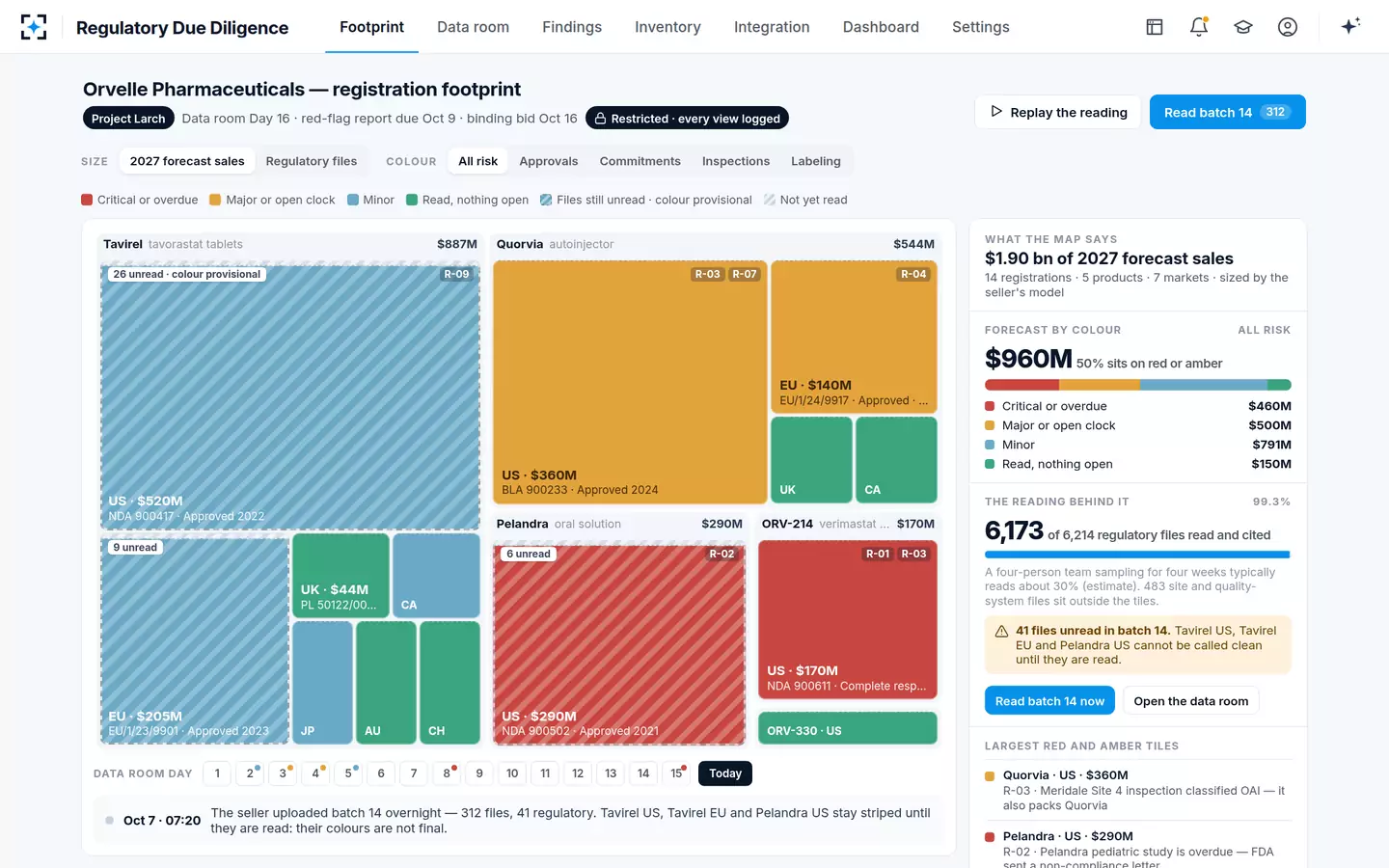
Measurement is also what the public frameworks for trustworthy systems are built around. NIST describes its AI risk framework as voluntary, a tool for building trustworthiness into how AI systems are designed, developed, used and evaluated (NIST AI Risk Management Framework 1.0). Voluntary is the operative word for a buyer: nobody will make a vendor measure coverage, so it has to be a condition of purchase.
The reading, replayed day by day, as a check on the claim
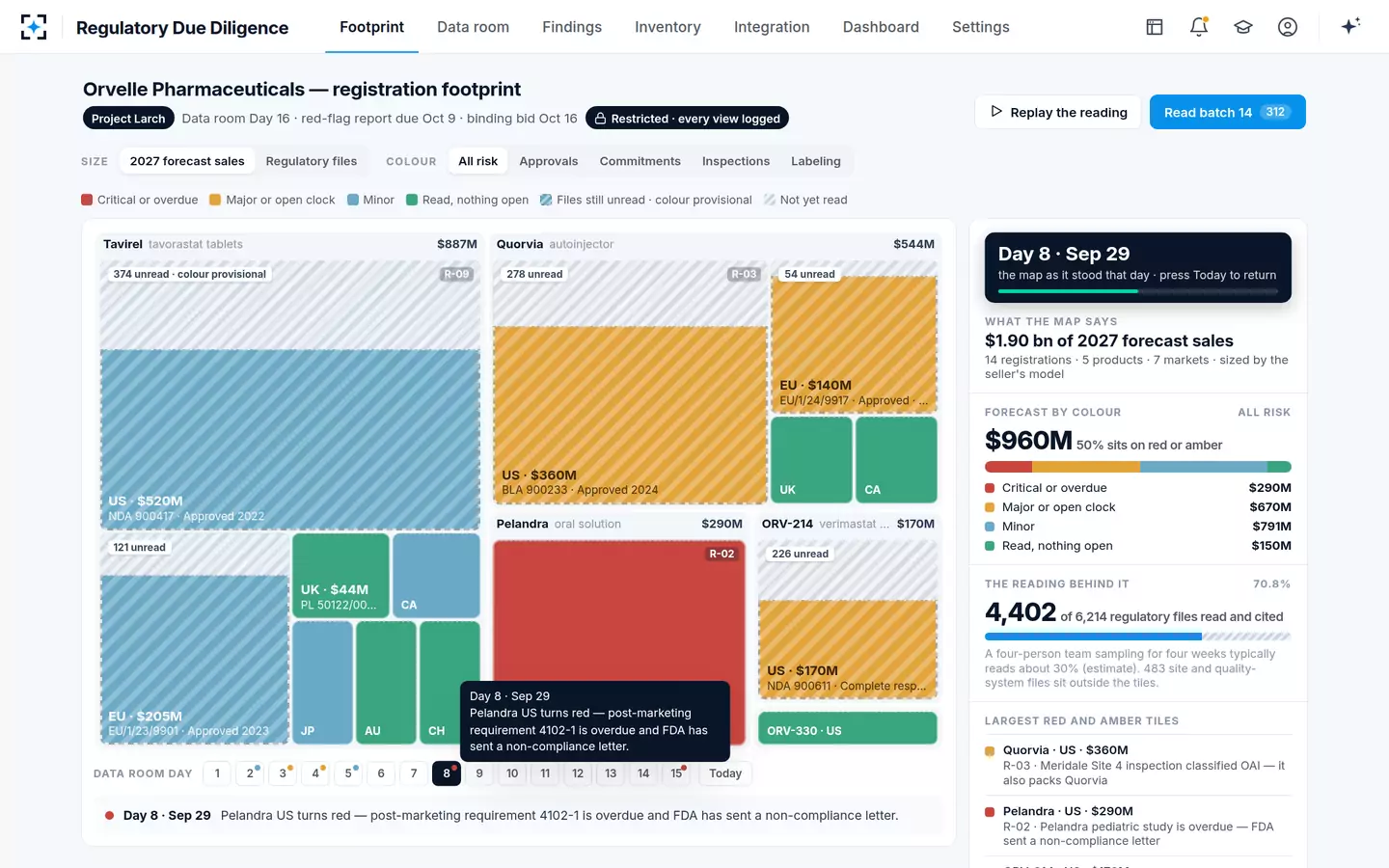
Confidentiality: the clean team, and what the regulators expect of it
Between signing and closing the two companies are still competitors, and the antitrust agencies are explicit about the handling that follows.
If the information is necessary to the merger process, the merging parties should take care to employ a "clean team" or use other protections to prevent the information from reaching people responsible for the normal operation of the businesses during the waiting period.
US FTC and DOJ, note to the OECD competition committee, DAF/COMP/WD(2018)94
The same note states the underlying expectation plainly: "each company should be careful to keep operating as a separate, independent entity during the waiting period" (FTC and DOJ, 2018). For a data-room reader this translates into four concrete requirements. Access is by named person, not by role or by link. The log of who opened what cannot be turned off by anyone, including an administrator. Exports carry the reader's name, so a leaked page can be traced back to the person who took it. And queries to public sources go out with product and application identifiers only — never with the target's deal name, the code name, or anything that would reveal a transaction to an observer of the query.
It is worth sizing the risk honestly: 2,006 transactions were notified under the US merger rules in fiscal 2025, about 31.8% of them valued above a billion dollars (FTC and DOJ, fiscal 2025 annual report). This is routine work at scale, and routine work is where controls lapse. The seat that lives with these constraints day to day is described in who decides what on a pharma deal.
Who is responsible for a finding an agent produced
In practice, the person who signed it. Medicines regulators do not license the software used in merger diligence, and a vendor claiming regulatory approval for a diligence tool is describing something that does not exist. But both major agencies have written down the posture they expect when these systems touch regulated decisions, and the posture transfers.
EMA's reflection paper puts the accountability where a buyer should want it: its key principle makes the sponsor, the applicant or holder, or the manufacturer responsible for making sure every algorithm, model, dataset and data pipeline it uses is fit for purpose and meets the legal, ethical, technical, scientific and regulatory standards that apply (EMA, reflection paper on the use of artificial intelligence in the medicinal product lifecycle). The same paper keeps two kinds of stakes apart, which is useful when scoping a tool: risk to patients' safety, and impact on a regulatory decision.
FDA's draft guidance of January 2025 frames the same question as a proportionality test: it proposes judging how far a model can be trusted for one particular context of use, with the evidence asked for scaled to the risk (FDA, considerations for the use of artificial intelligence to support regulatory decision-making). Context of use is the phrase to borrow in a procurement: a reader that extracts a date from a letter and cites the page is a modest context of use; one that is asked to conclude that a target is clean is not. The practical answer inside a deal remains the same either way — a named person confirms the finding and a named signer releases it, and the audit trail records both.
How do you pilot due diligence software on your own data room?
Pilot it on a completed deal, where the answer is already known, and agree the pass marks in writing before the tool sees a file. A pilot that cannot fail is a demonstration with a longer timetable.
A four-week pilot on a closed data room, with marks agreed in advance
Week 1
A closed room, and the marks agreed in writing
Use a deal that has already completed, so the right answer is known. Agree the three pass marks before anyone sees output: coverage, citation rate, and the findings the original team raised.
Week 2
Read it cold
No tuning on the answers, no hand-picked folders. The tool reads the regulatory folders as they were uploaded, in the order they were uploaded, including the late batch.
Week 3
Score the output against the known result
Count three things: findings the original team raised that the tool also raised; findings the tool raised that the team missed; and findings the tool raised that are wrong. The third number matters most.
Week 4
Open every citation
Take twenty findings at random and open the cited page for each. A citation that does not support the sentence is the failure mode that survives every demonstration.
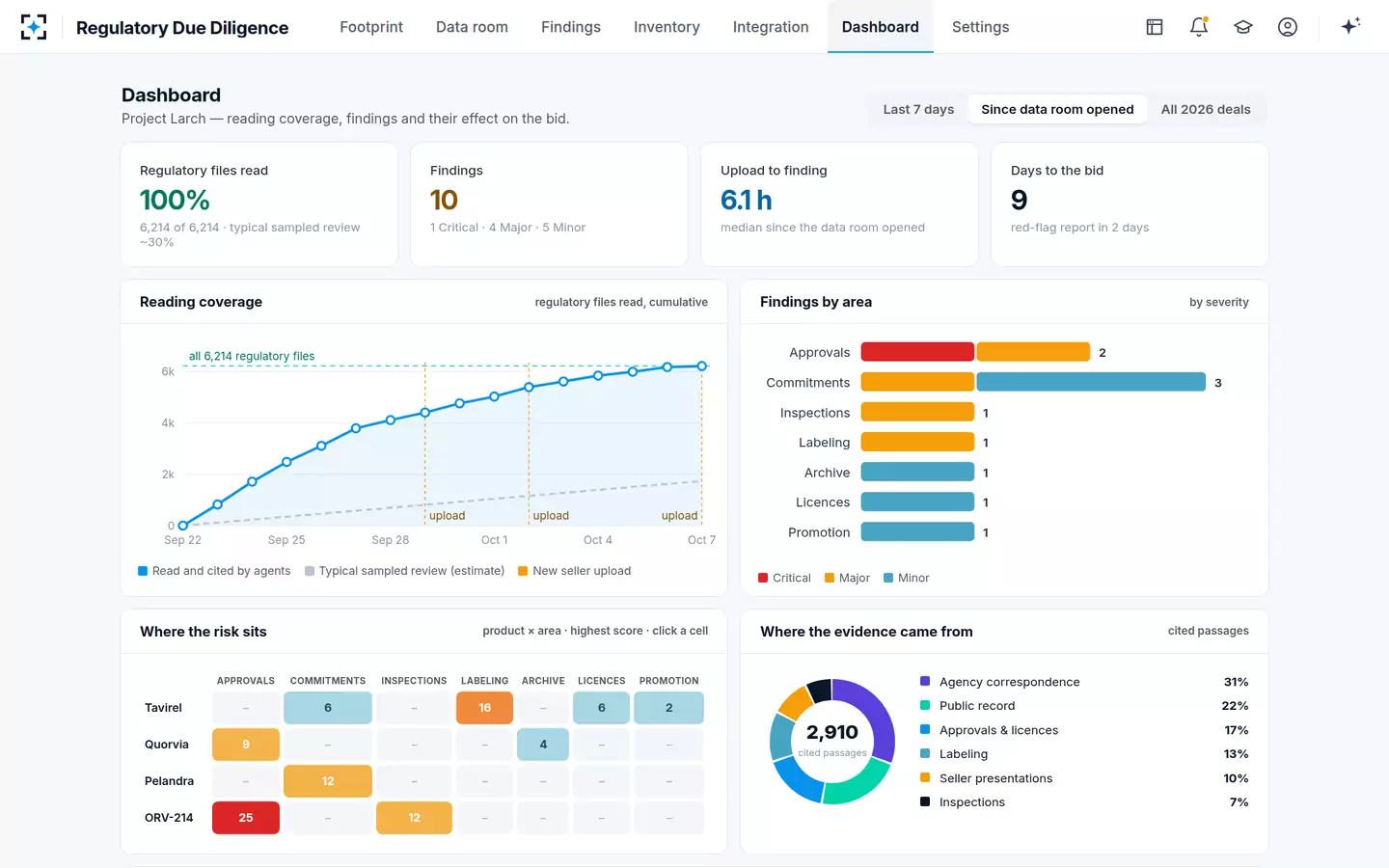
Three things the pilot must prove, stated as numbers rather than impressions: the share of in-scope files read and cited; the proportion of sampled citations that genuinely support the sentence they are attached to; and the count of findings the tool raised that are simply wrong. Set a pass mark for each before you start. A sensible starting point is complete coverage of the in-scope folders, every sampled citation supporting its sentence, and a wrong-finding count low enough that a reviewer's trust survives the week.
What a buyer is really purchasing: a measured read
What this will not do for you
Four limits, and a vendor who will not state them has not earned the pilot. It does not value the business: a finding states an effect in months and in money, and the deal team decides what that is worth. It does not negotiate, and it does not replace counsel — the contracts around a registration, the consents a transfer needs and the drafting of a protection are legal work. It cannot read what was never uploaded, which is why the absence of a requested class of document belongs on the report as an open item rather than disappearing. And in this product nothing is written to any operational system before close, because the integration plan is a plan until the deal is a deal.
The honest summary of the category is that an agentic reader changes the coverage and the citation trail, and changes nothing about who is accountable. That is a smaller claim than most of the market makes and a more useful one to buy against. To see the coverage display, the public-record comparison and the two human decision points on a sample data room, start from Regulatory Due Diligence; what the output looks like when it reaches a committee is in the regulatory due diligence report.
Questions people ask
What should AI due diligence software do?
Receive and log every batch, classify and link each file, extract the objects that matter with a page citation on each value, compare the seller's statements with the published record, score each difference with its effect, and draft a question and a proposed protection. Then stop: whether a difference is a finding, and whether a finding is released, are decisions for named people. A tool that does the first six well and is clear about the last two is the shape to buy.
What is the difference between keyword search and an agentic reader?
A keyword search retrieves documents containing words you thought of; an agentic reader works through every file in a defined scope, classifies it, extracts values with their pages and compares them with something else. The difference shows up in what each can notice. A search cannot notice that an obligation's milestone date has passed, or that a published letter contains a deficiency the management presentation left out, because neither of those is a word you could have searched for.
How do you measure whether a data-room reader missed something?
Run it on a deal that is already finished and compare three counts: findings the original team raised that the tool also raised, findings the tool raised that the team missed, and findings the tool raised that are wrong. Coverage tells you what was read; this comparison tells you what the reading was worth. Agree all three pass marks before the pilot starts, or the result will be interpreted after the fact.
Can you use AI on a data room without breaching confidentiality?
Yes, if the controls are structural rather than contractual. Access by named person, logging that cannot be disabled, exports watermarked with the reader's name, and outbound queries to public sources that carry product and application identifiers only, never deal-identifying terms. The antitrust agencies' expectation is that information necessary to the merger is handled so that it does not reach the people running the businesses during the waiting period, and tooling has to be built to that standard rather than promised to it.
Who owns the findings an AI tool produces?
The buyer, and the responsibility sits with the person who confirms and the person who signs. Medicines regulators do not license software used in merger diligence, but both FDA and EMA have set out the posture they expect where these systems touch regulated decisions: the organisation using the model is responsible for it being fit for its context of use. In a deal, that means a finding is owned the moment a named person releases it, and the audit trail should make that moment reconstructable.
What does due diligence automation actually automate?
The reading, the extraction, the comparison and the first draft of the score — the work that scales with the number of files. It does not automate the judgment of what matters, the conversation with the seller, the pricing, or the signature. Measured honestly, the gain is that a four-week review spends most of its days on differences rather than on handling documents, and that the share of the room behind every conclusion can be stated.