A regulatory due diligence report — the red-flag report the deal committee reads before it prices a bid — is a short document carrying a great deal of weight, and almost all of that weight comes from what sits underneath each sentence. Six sections is the usual shape: a summary, the Critical findings, the Major findings, the registrations and commitments the buyer would inherit, the protections recommended for the purchase agreement, and what has to happen after close. Botminds' Regulatory Due Diligence drafts those six sections from confirmed findings only, with the passage behind every sentence open at its page, and will not let a finding into the draft without one.
The worked example below is a fictional sample deal: Project Larch, Northwind bidding for Orvelle Pharmaceuticals, 6,214 regulatory files in the seller's data room, ten findings, a report due a week before the binding bid. The companies and people are invented.
The sample report, in the numbers its first page states
6
sections, in the order the committee reads them
10
findings — 1 Critical, 4 Major, 5 Minor
6,214
regulatory files read and cited, plus 186 public agency records
2
questions still open with the seller when the draft went out
What the report is for, and who reads which part of it
The report has three audiences and they do not read it the same way. The deal committee reads the summary and the recommended protections, and wants to know what changes about price, structure or timing. The lawyers drafting the purchase agreement read the findings and the protections, and need each one specific enough to turn into a clause. The integration office reads the registrations, the commitments and the last section, because those become a plan with dates on it the day the deal signs.
That is why a single narrative does not work. A summary with the findings folded into prose leaves the drafting lawyer reconstructing which sentence was a finding and which was context. The sections exist so each reader can take their own part whole, and so a finding can be traced from the summary line to the data-room page without anyone's memory in between.
The report is also a dated artefact, written against a data room still being filled: in the sample deal the seller uploaded 312 more files two days before the draft was due. One that does not say when it was cut, and against which uploads, is making a claim about a moving target.
What goes in a regulatory due diligence report?
Six sections, each answering a different question, and each resting on a different kind of evidence. The list below is the shape the sample report uses; the second half of each line is the part most templates leave out.
The six sections, and what each one has to rest on
- Summary
What the regulatory workstream found, in a page. It must open with the reading behind it — how many regulatory files were read and how many public agency records were checked — before it says anything about the target.
- Critical findings
The findings that change the bid. Each rests on the seller's own statement, quoted and located, beside the agency text that contradicts it, also quoted and located.
- Major findings
The findings for the weekly deal meeting. Same anatomy as a Critical one, with the score that put it below the Critical threshold shown rather than asserted.
- Registrations and commitments
The inventory the buyer would inherit: every registration, every post-marketing requirement and commitment, every open agency clock. Each row rests on a page citation, not on the seller's schedule.
- Recommended protections
One proposed purchase-agreement protection per finding that needs one — an indemnity, a closing condition, a price adjustment, a contingent payment. Each names the finding it answers.
- Integration
What happens after close: each registration's legal route, the archive to migrate, the commitments that need a named owner. It rests on the same inventory as section four, not on a separate list.
The last three sections of a drafted report, with a numbered citation on every sentence
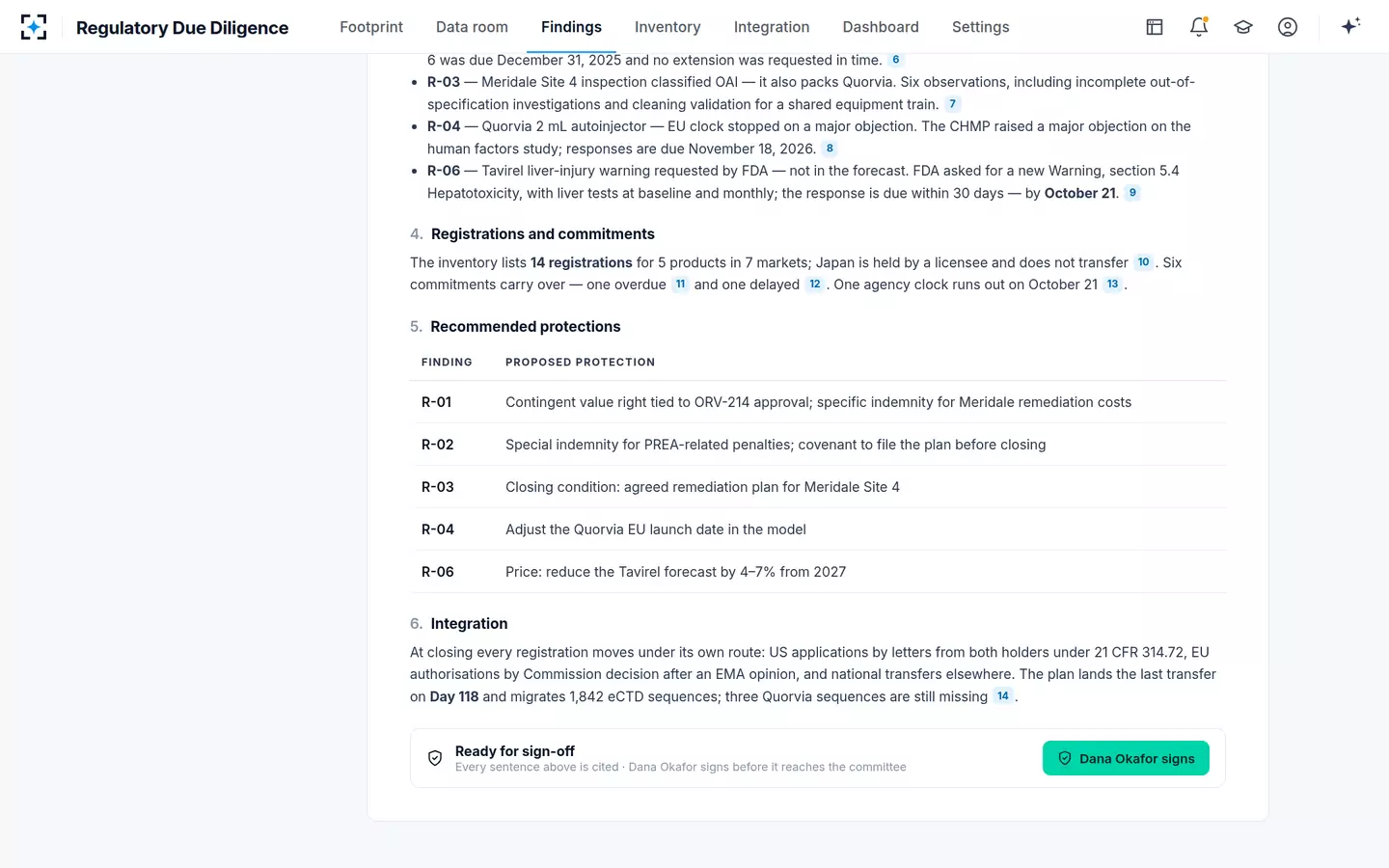
Section by section, and what each one has to rest on
Two sections deserve more than a line, because they are where reports most often drift from evidence into summary.
The registrations and commitments section is an inventory, and an inventory is only as good as its sourcing. A post-marketing requirement is not a scheduling note; it exists because the statute lets FDA require a study for one of three reasons — "(i) To assess a known serious risk related to the use of the drug involved. (ii) To assess signals of serious risk related to the use of the drug. (iii) To identify an unexpected serious risk when available data indicates the potential for a serious risk." Which of the three a given commitment answers changes what a missed deadline means, so the inventory row should carry the authority as well as the date. The difference between a requirement and a commitment is worked through separately, because the buyer inherits them on different terms.
The findings sections rest on decision letters, and a decision letter is a more precise document than most decks allow. A complete response letter "reflects FDA's complete review of the data submitted in an original application or abbreviated application (or, where appropriate, a resubmission) and any amendments that the agency has reviewed", and "when possible, a complete response letter will recommend actions that the applicant might take to place the application or abbreviated application in condition for approval". A finding that says the seller's remediation plan does not match the letter has to quote both: the recommended actions, and the plan.
The anatomy of one finding: statement, record, score, effect, protection
A finding is not a paragraph; it is a record with fields, and every field answers a question a reader would otherwise have to ask. Below is one Major finding from the sample deal set out field by field. Nothing in it is narrative — each row is either quoted from a document or derived by a rule stated in advance.
One Major finding, field by field
| Field | What it holds in finding R-06 | Where it comes from |
|---|---|---|
| What the seller says | Label stable — no safety labeling changes assumed in the 2027–2031 forecast. | Management presentation, slide 22, quoted and linked to the page |
| What the record says | FDA asks for a new Warning and Precaution, section 5.4 Hepatotoxicity, with liver tests at baseline and monthly for the first three months. | Safety labeling change notification in the data room, pages 1 and 2 |
| Likelihood | 4 of 5 | The rule in the settings, applied to the evidence |
| Impact | 4 of 5 | The rule in the settings, applied to the evidence |
| Score and severity | 16 — Major, because the Critical threshold is 20 | Arithmetic on the two fields above, against thresholds set before the finding |
| Effect on the deal | A new Warning with monthly liver tests is likely to slow uptake; the forecast assumes no label change. | Stated as an estimate, not as a measured number |
| Owner and status | The diligence lead, awaiting a decision | The workflow, not the agents |
| Question for the seller | Drafted, to go through the data-room questions and answers | One per finding where the record is ambiguous |
| Proposed protection | Price: reduce the Tavirel forecast by 4–7% from 2027. | Drafted by the agents, decided by people |
Read the table downwards and the argument is visible without trusting anyone. The seller said one thing, a document in the seller's own data room says another, the gap was scored by a published rule, the consequence was labelled an estimate, and a protection was proposed that a lawyer can draft. A report that gives only the first and last rows is asking to be believed.
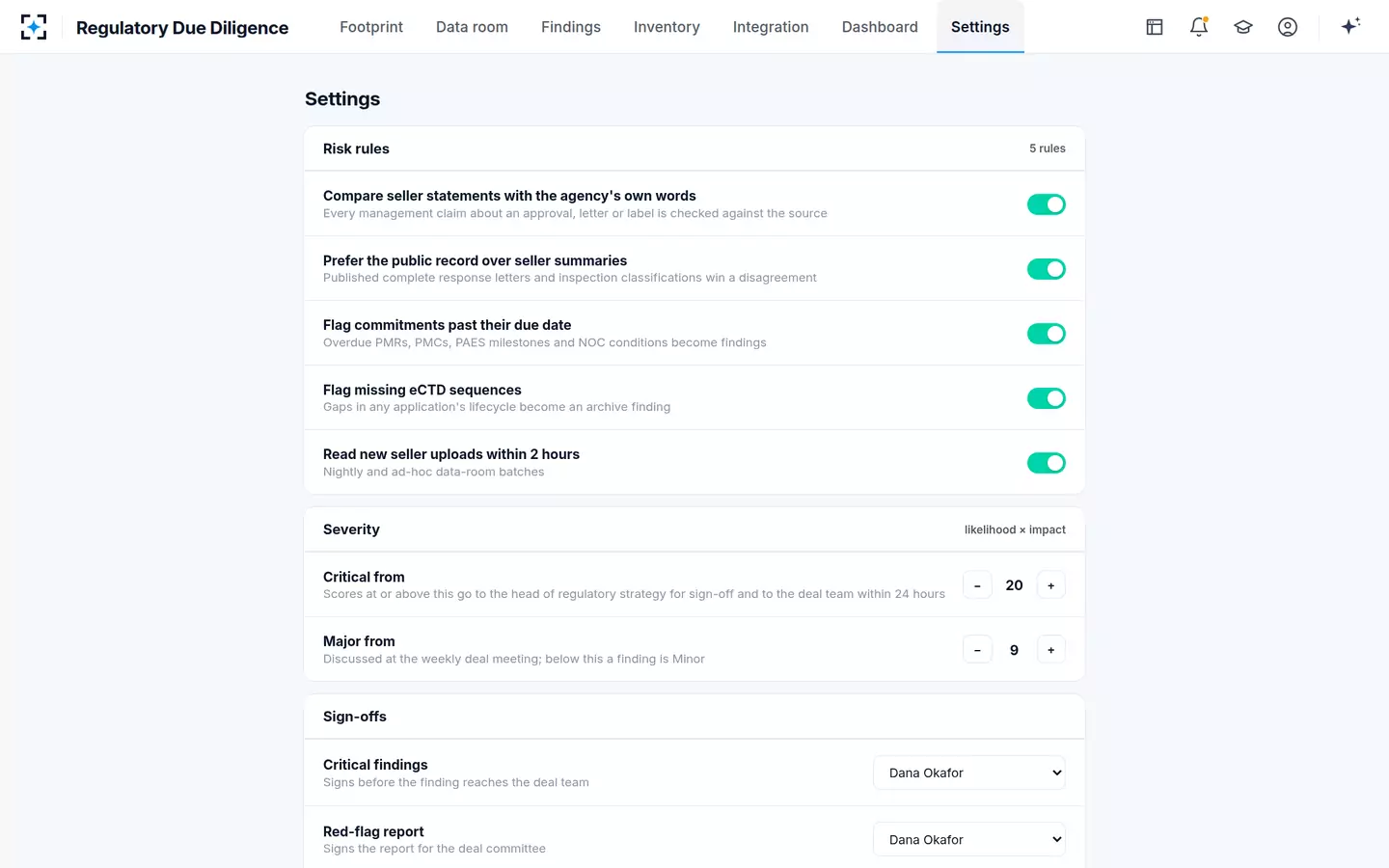
Scoring: likelihood times impact, and why the thresholds are set first
The scoring rule in the sample deal is the common one: likelihood from one to five, multiplied by impact from one to five, giving a score from 1 to 25. A score of 20 or more is Critical, which means it goes to a named signer and reaches the deal team within 24 hours. Nine or more is Major, discussed at the weekly deal meeting. Below nine it is Minor and appears in the final report only.
The thresholds matter less than when they are set. Agreed at the start of the review, they are a rule, and a finding that scores 20 is Critical whether or not that is convenient two days before a bid. Agreed afterwards, they are a dial, and the severity column becomes a summary of how the team felt. Writing them down first — and keeping the change on the record if they move — is the difference between a scored report and a graded one.
The eight named findings on the sample deal, by likelihood times impact
The scoring rule, the thresholds and the signers, written down before the review
Stating coverage instead of implying it
Every regulatory report makes an implicit claim about how much of the data room it rests on, and most of them never state it. A four-person team with four weeks reads a minority of a mid-size target's regulatory files closely and samples the rest — a working estimate, not a published figure, and one worth putting in the report rather than leaving to the reader's imagination.
What the report rests on, said out loud
The sample deal, every regulatory file read and cited
- Read and cited · 100%
A four-person team sampling for four weeks (our estimate)
- Read closely · 30%
- Sampled, or taken from the seller's summary · 70%
Coverage is not only a number; it is a per-registration fact. In the sample deal a product tile stays striped and its colour provisional until every file behind it has been read, so a registration cannot be described as clean while its correspondence folder is unopened. The equivalent sentence in a report is specific: this product's assessment rests on all 1,148 of its regulatory files; that one rests on a sample, and here is which folders were not reached. The same discipline applies to the public side, where a quiet inspection record is not a clean one.
What makes a due diligence finding defensible?
A finding is defensible when someone who disagrees with it can check it without asking you anything. That reduces to five tests, and a finding that fails any one of them should not reach the committee in the form it is in.
First, every factual sentence opens at its source — the data-room page or the agency document, not a summary of either. Second, the seller's words are quoted rather than characterised, because the disagreement is usually about what the seller actually said. Third, the score follows a rule that existed before the finding. Fourth, the consequence is labelled: measured, estimated or assumed, and whose assumption. Fifth, the trail is intact — who raised it, who changed it, when, and why.
The fifth test is the one that is easiest to lose and hardest to rebuild. It is also the one the pharmaceutical industry already has a standard for: FDA's electronic-records rule requires a secure, computer-generated, time-stamped audit trail that independently records when anyone creates, changes or deletes a record, and it forbids a change from hiding what was recorded before. That rule governs records in regulated work rather than deal documents, but it describes exactly the standard a reader of a diligence report is entitled to expect.
Confirm, downgrade or ask: the three things a human does to a finding
The agents raise and score; a person decides. There are only three decisions available, and each leaves a different mark on the report.
Confirm keeps the finding and sends it on — to the weekly meeting if it is Major, to a named signer if it is Critical. Downgrade changes the severity and requires a reason, recorded with the change, so a reader can see that a Major became a Minor and why. Ask the seller moves the finding into the data-room questions and answers and holds it there with a status of its own: in the sample deal two findings were out with the seller when the draft was cut, and the report says so rather than dropping them.
From a raised finding to a released one, with the line each step will not cross
Agent
Risk Scorer raises and scoresSets likelihood and impact against the rules in the settings, states the effect in months and value, and drafts one seller question and one proposed protection.
Never: raises a finding without at least one cited passage
A person decides
The diligence lead decidesConfirms the finding, downgrades it with a reason that is recorded, or sends it to the seller as a question and waits for the answer.
Never: leaves the decision to the agents
A person decides
A named signer releases a Critical findingSigns with a stated meaning before the finding reaches the deal team, so the release itself has an author.
Never: releases a Critical finding to the deal team unsigned
Agent
Report Writer drafts the six sectionsBuilds the report from confirmed or signed findings only, carrying each sentence's citation with it.
Never: writes a sentence without a citation, or puts valuation numbers outside the clean team
A person decides
The same signer signs the reportSigns the finished report before it reaches the deal committee, with the meaning of the signature recorded.
Never: lets a draft reach the committee ahead of the signature
The signature, and what it has to record
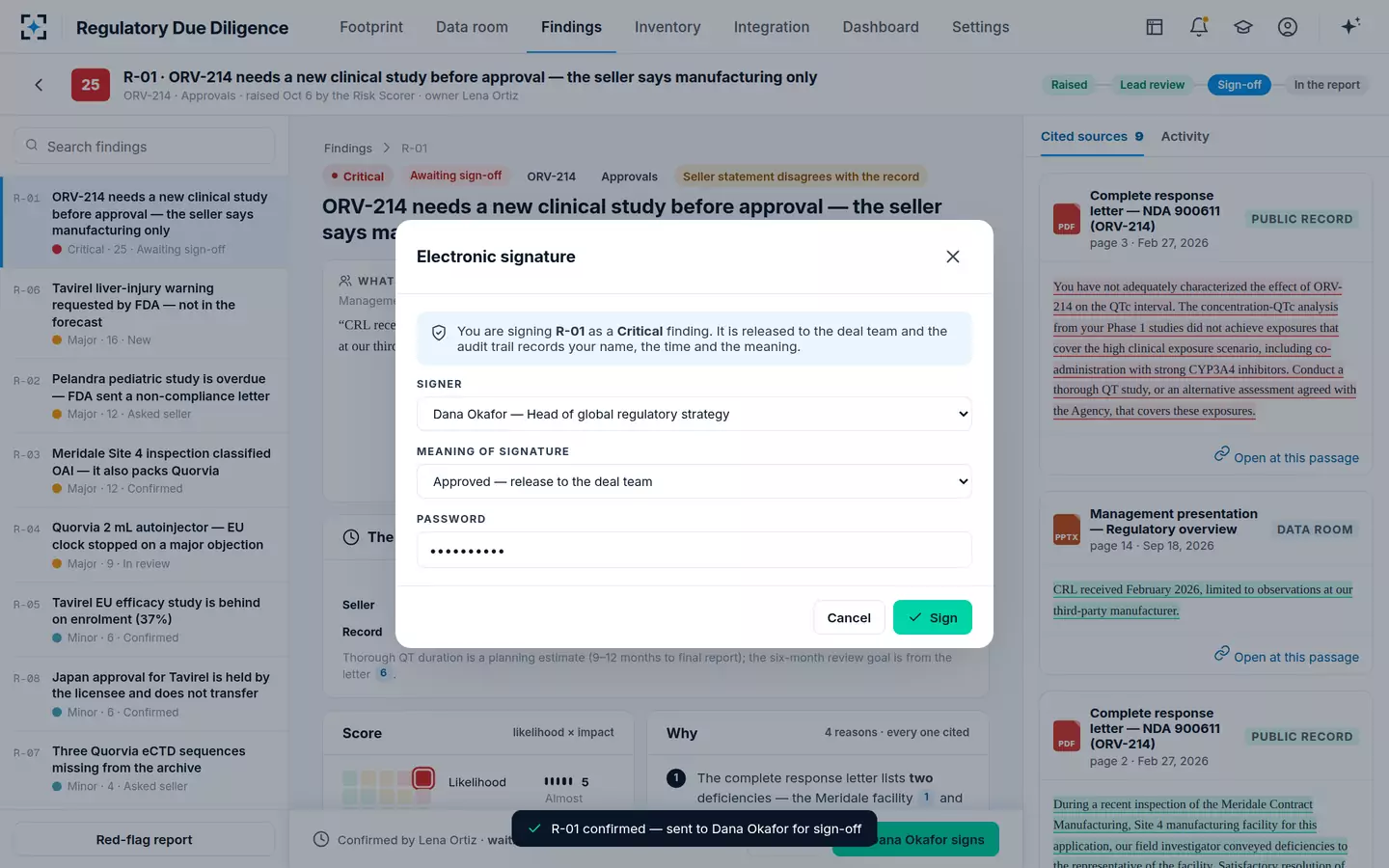
A signature on a diligence finding is a claim about a person, not a formatting flourish, and the industry reading the report already works to a standard for what one must carry. FDA's rule on signature manifestations requires a signed electronic record to show the signer's printed name, the date and time the signature was executed, and the meaning associated with it — review, approval, responsibility or authorship. It then adds the part that matters for a document that will be printed and circulated: those three items carry the same controls as the record and must appear on any human-readable form of it, on screen or on paper.
That rule governs electronic records in FDA-regulated work, not purchase agreements. It is worth borrowing anyway, because it answers the question a committee member should ask of any signed finding: signed by whom, when, and meaning what. In the sample deal the head of global regulatory strategy signs the Critical finding with the meaning "Approved — release to the deal team", and signs the report itself before it reaches the committee; both the name and the meaning travel with the document.
A named person releasing a Critical finding, with the meaning recorded
There is a reason the signature cannot be automated away, and the regulators have written it down. The European Medicines Agency's reflection paper on artificial intelligence in the medicinal product lifecycle asks for a risk management plan setting out how a model is likely to fail, and asks for it most of all where no human is in the loop. The cheaper and better answer, for a document that will move a price, is to keep the human in the loop and make the loop visible. Which decisions an agent may and may not make is the subject of what an agent may read, and never decide.
Questions people ask
What is a red flag report?
A short report that lists only the issues material to a transaction, rather than describing everything the reviewers saw. In a regulatory workstream it carries the findings that could change price, structure or timing — an overdue post-marketing requirement, a decision letter that asks for more than the seller said, an inspection classified Official Action Indicated — each with its score and its proposed protection. It is deliberately not a full report of the review.
How are due diligence findings scored?
A common approach is likelihood times impact, each on a scale of one to five, giving a score from 1 to 25, with thresholds that turn a score into a severity. In the sample deal 20 and above is Critical, 9 and above is Major, and below that is Minor. The scale itself matters less than fixing the thresholds before the findings, so that severity is a consequence of the evidence rather than a judgement made at the end.
Who signs a due diligence report?
Whoever the deal has named in advance, which for a regulatory report is usually the senior regulatory leader accountable for the function — in the sample deal, the head of global regulatory strategy. The useful rule is that the signer is set in the settings at the start, not chosen when the report is ready, and that the same person signs each Critical finding before it reaches the deal team.
What does a signature on a finding mean?
Only what it records. FDA's electronic-records rule asks for three things on a signed record — the printed name, the date and time, and the meaning, such as review, approval, responsibility or authorship — and requires them to appear on any human-readable form of the record. Applied to a finding, that turns "signed" into something specific: approved by this person, at this time, for release to the deal team.
How do you state coverage in a diligence report?
Put it in the first paragraph of the summary, as a count rather than an adjective: how many regulatory files were read, out of how many in the data room, and how many public agency records were checked. Then repeat it per registration, because coverage is uneven — one product's folder may be read in full while another's correspondence is half open. Say which folders were not reached and what was taken from the seller's summary instead.
What is a proposed protection in a purchase agreement?
A clause suggested to answer one finding. The common forms are an indemnity for a specific identified risk, a closing condition that must be satisfied before the deal completes, a price adjustment that takes the finding into the model, and a contingent payment that pays the seller only if an uncertain event happens. In the sample deal the Critical finding carries two: a contingent value right tied to an approval, and a specific indemnity for a manufacturing site's remediation costs.