The FDA inspection classification database is the agency's public list of how each closed inspection ended: No Action Indicated, Voluntary Action Indicated or Official Action Indicated, against a named site and a date. On an acquisition it is the cheapest check a buyer can make and the most often misread, because a classification is assigned only once an inspection is closed, a long list of inspections never enters the database at all, and an empty result for a site means nothing in particular. Botminds' Regulatory Due Diligence reads every regulatory file a seller uploads and sets the agency's own words — classifications, letters, assessment reports — beside the sentence in the management presentation that describes them.
The worked examples below come from a fictional sample deal used throughout this solution: Northwind bidding for Orvelle Pharmaceuticals, five products and 14 registrations in seven markets. The companies, people and sites are invented.
What the public inspection file can and cannot settle
3
classifications an inspection can be given, and only after it closes
Weekly
how often FDA updates the inspection classification database
1,065
drug inspections FDA reported for fiscal 2023, foreign and domestic
36%fewer
than in fiscal 2019, so silence about a site carries less meaning
What the three classifications mean, in FDA's own words
A classification is FDA's post-inspection judgement of the site, not of the observations. It is decided after the investigator's report has been reviewed, and it is the one field in the database that carries a consequence. FDA defines the three in a sentence each.
No Action Indicated means that "no objectionable conditions or practices were found during the inspection". Voluntary Action Indicated means that "objectionable conditions or practices were found, but the agency is not prepared to take or recommend any administrative or regulatory action". Official Action Indicated means that "regulatory and/or administrative actions are recommended".
Read them as three different sentences about the agency, not three grades of the site. NAI says the investigator found nothing to cite. VAI says things were found and the agency decided to leave the fix to the firm. OAI says the agency's own people have recommended that it act — a warning letter, an import alert, withholding approval of an application that depends on the site, or more. The distance between VAI and OAI is the distance between a site that writes its own corrective plan and a site whose plan FDA will now insist on and verify.
What is the difference between NAI, VAI and OAI?
The difference that matters on a deal is what each one lets a buyer conclude, and the three conclusions are not symmetrical. An OAI is near-proof of a problem; a VAI is a judgement call that depends entirely on what was observed; an NAI proves only that one inspection, on one date, for one scope, found nothing to cite.
The same three letters, read as a compliance grade and read as deal evidence
What the classification says: No objectionable conditions or practices were found during the inspection.
What a buyer may conclude from it: One inspection, one date, one scope. It says nothing about the site today, about the lines the investigator did not look at, or about a quality system that has drifted since. Ask when, who, and what the inspection covered.
What the classification says: Objectionable conditions or practices were found, but the agency is not prepared to take or recommend any administrative or regulatory action.
What a buyer may conclude from it: The useful document is the observation list, not the letters. A VAI with one documentation finding and a VAI with three sterility-assurance findings are the same three letters and different risks.
What the classification says: Regulatory and/or administrative actions are recommended.
What a buyer may conclude from it: Treat as a supply question and an approval question at once. Ask what action followed, whether the site has been re-inspected since, and which applications name it as a manufacturing site.
What the classification says: The site does not appear, or its latest inspection has no classification yet.
What a buyer may conclude from it: Not a clean result. The inspection may be open, excluded from the database, or may never have happened. Say so in the report rather than colouring the site green.
The five public sources, and what each one adds
No single file holds a site's compliance history. The classification gives the verdict, the Form FDA 483 gives the observations, a warning letter gives the agency's formal position, and the European databases give a second regulator's view of the same walls and the same people. Each answers a different question, and a report that cites only one of them is thinner than it looks.
Five public files on one manufacturing site, and the question each one answers
| The file | What it shows | What it cannot show |
|---|---|---|
| Inspection classification database | How a closed inspection was classified, against a site and a date. Updated weekly. | Open inspections, excluded inspections, and anything about why the classification was given. |
| Form FDA 483 | The specific conditions the investigator observed and cited, in the investigator's words. | The agency's conclusion. It is not a final determination, and it is not an all-inclusive list of what is wrong at the firm. |
| Warning letter | The agency's formal position after review, the violations it alleges, and what it requires in reply. | Whether the matter has since been closed, unless a close-out letter has been issued and posted. |
| EudraGMDP certificates and non-compliance statements | What an EU competent authority concluded after inspecting the same site, entered in a public EU database. | The underlying observations, which EU authorities do not publish the way a 483 is released. |
| European public assessment reports | The assessment behind an EU decision, including a refusal, with commercially confidential information redacted. | Anything about a site that has not been part of a centralised application. |
What the database leaves out — and why that matters on a deal
FDA is explicit that the database is a selection. "Most inspections FDA conducts are included with several exceptions (such as inspections of mammography facilities and some preapproval inspections)." Nonclinical laboratories inspected for compliance with Good Laboratory Practices "are also not included because those inspections can be found at the nonclinical lab inspection page". And because the file carries verdicts rather than visits, FDA warns that "since not all inspections are disclosed in the Inspection Classification Database, and only those with final classifications are posted, it can't be used to count all FDA inspections conducted".
The preapproval exclusion is the one that bites hardest in diligence. A preapproval inspection is exactly the event a buyer most wants to know about when a target has an application pending, and it is precisely the category FDA names as sometimes absent. A target with an open application and a quiet database row is not evidence of a clean preapproval inspection; it is an absence of evidence, and the two are different sentences in a report.
The second gap is arithmetic. Inspections have not returned to their pre-2020 rate. GAO reported in November 2024 that "FDA data show it conducted 621 foreign and 444 domestic inspections in fiscal year 2023, although there were 36 percent fewer than in fiscal year 2019", and that "from Nov. 2021 to June 2024, the vacancy rate among investigators who inspect foreign and domestic manufacturers jumped from 9% to 16%". Fewer visits means longer gaps between a site's last verdict and today, which makes the age of a classification as important as its letters.
FDA drug inspections, fiscal 2023 against the pre-2020 rate
The third gap is the one nobody can close from a desk: the database holds federal drug inspections, not state licensing inspections, not a customer's own audit, and not the quality agreements between the target and the contract sites that actually make its product. Those live in the data room, which is why the public file is a check on the seller's account rather than a replacement for reading it.
How a site's record is assembled, site by site
A target's manufacturing footprint is a list of sites, not a company. Each needs its own record, built in the same order, and the order matters because each step tells you what to look for in the next. The sequence below is the one a reviewer can repeat for every site on the list, including the ones the target does not own.
Building one site's record, in the order Regulatory Due Diligence assembles it
- Fix the site, not the company
Start from the registration: which establishment address is named as a manufacturing site for which application. A corporate name covers several addresses and several histories.
- List every inspection, classified or not
Record the date, the scope and the classification where one exists. An inspection with no classification is a row in its own right, not an omission.
- Read the observations, not the letters
Pull the Form 483 where one has been released. The letters grade the site; the observations tell you whether the finding was a signature or a sterility assurance failure.
- Check for a warning letter, and for its close-out
A warning letter without a close-out letter is still open on the public file, whatever the seller says about remediation.
- Cross the Atlantic
Look the same site up in the EU database of certificates and non-compliance statements. Two regulators inspecting the same walls occasionally reach different conclusions, and the difference is worth a question.
- Date the whole thing
Write the as-of date on the record. A compliance record is a photograph, and the next inspection is not on anyone's calendar.
- Tie each site back to the applications that depend on it
The question a bid needs answered is not whether a site has a problem but which revenue and which pending approval sit behind it.
Is a Form 483 public?
Often, but not automatically, and the distinction matters when a seller offers one as evidence. FDA posts frequently requested and proactively released compliance documents in its reading rooms — "Form FDA 483 and establishment inspection reports for domestic and foreign companies may be found on the Office of Inspections and Investigations (OII) FOIA Electronic Reading Room" — and others are released on request under the Freedom of Information Act, redacted. A 483 that is not in a reading room is not necessarily unavailable; it may simply not have been asked for yet.
What the form is, and is not, is the part most decks get wrong. FDA's own training material is blunt: "The Form FDA 483 does not constitute a final Agency determination of whether any condition is in violation of the FD&C Act or relevant regulations." It is issued "to firm management at the conclusion of an inspection when an investigator(s) has observed conditions that in their judgment may constitute violations". And it is not a complete picture of the site: "there may be other objectionable conditions that exist at the firm that are not cited on the Form FDA 483", because "FDA investigators are instructed to note only what they observed during the course of the inspection".
The Form FDA 483 does not constitute a final Agency determination of whether any condition is in violation of the FD&C Act or relevant regulations.
FDA, Understanding the Form FDA 483 Process and Timeline
Two practical consequences follow. A seller that shows a 483 with six observations and no classification has shown you the beginning of a story, not its end — the classification, when it arrives, is the agency's verdict on the same visit. And a buyer who counts observations is measuring the wrong thing: one finding about an incomplete out-of-specification investigation on a shared equipment train is worth more attention than five about documentation, because it reaches every product made on that train.
The contract manufacturer problem: a site you do not own and cannot inspect
Most of the manufacturing risk in a mid-size target sits at sites the target does not own. The buyer inherits the applications that name those sites, inherits the supply agreements, and inherits none of the control. The contract site has its own customers, its own remediation queue and its own commercial reasons not to discuss either.
In the sample deal this is finding R-03. Meridale Contract Manufacturing, Site 4, was classified Official Action Indicated. The site is named in the pending ORV-214 application and it also packs Quorvia, so one site carries both an approval risk and a supply risk for a product already on the market. Dr. Maya Chen, the reviewer who owns inspections on the deal, reads the Form 483 observations beside the public classification and owns the finding, scored 12 and Major, with its effect stated as supply and approval risk until the site is re-inspected.
One finding per risk, with the site that carries two of them
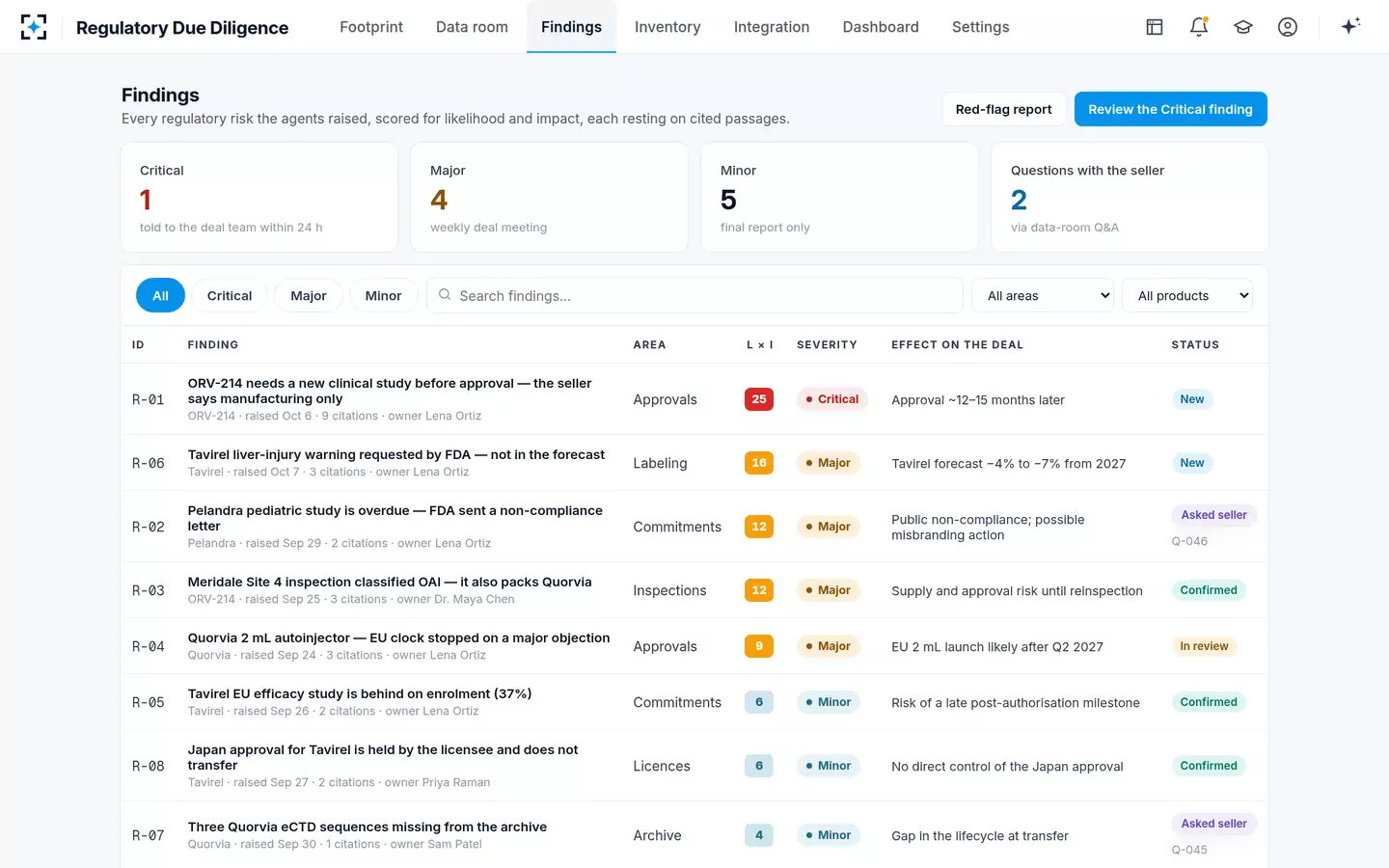
A contract site's record is assembled exactly like a target's own, with one addition: find out which of the buyer's existing products the same site makes. A remediation that the seller treats as the contractor's problem becomes the buyer's problem the moment two portfolios share a line. The transfer side of this is covered in transfer of marketing authorization: route and clock by market, because a registration that names a troubled site moves with the site attached.
Reading the European side: GMP non-compliance and assessment reports
Europe publishes a different shape of the same information. "After inspecting a manufacturing site, EU competent authorities issue a GMP certificate or a non-compliance statement, which is entered in the EudraGMDP database", which EMA describes as "a publicly accessible EU database which contains manufacturing and import authorisations, registration of active substance manufacturers, GMP certificates and non-compliance statements". There is no European equivalent of the 483: the verdict is published, the observations usually are not.
The assessment reports fill part of that gap from the other direction. EMA publishes the report behind a centralised decision, and it publishes one behind a refusal too: the refusal package includes "the refusal public assessment report, which is the assessment report as adopted by the CHMP. Only information of a commercially confidential nature is redacted." For a target whose European application was refused or withdrawn, that document is the closest thing to a European decision letter, and it is public.
Set the two regulators side by side on the same site and the same product. Where one has certified and the other has not inspected, say so. Where one has issued a non-compliance statement and the seller's deck mentions only a United States classification, that is a finding, and the agency text wins over the summary.
What an OAI at a third-party site does to an approval date
An Official Action Indicated classification is a recommendation that the agency act, and one of the actions available to it is not approving an application whose manufacturing depends on the site. That is the mechanism by which a quality problem at a contractor becomes a revenue problem on a bid model: the product does not change, the clinical data do not change, and the date moves.
The honest way to carry this into a valuation is as a conditional, not a number. The buyer cannot know when the site will be re-inspected, and neither can the seller; FDA's own inspection rate says the wait may be long. What a report can state is the chain — which applications name the site, which of them are pending, what the public file says today, and what has been done since — and then let the deal team price the conditional. In the sample deal that chain is why the same site appears in a Critical finding about a pending approval and a Major finding about a marketed product.
A registration coloured by what has been read, not by what the seller said
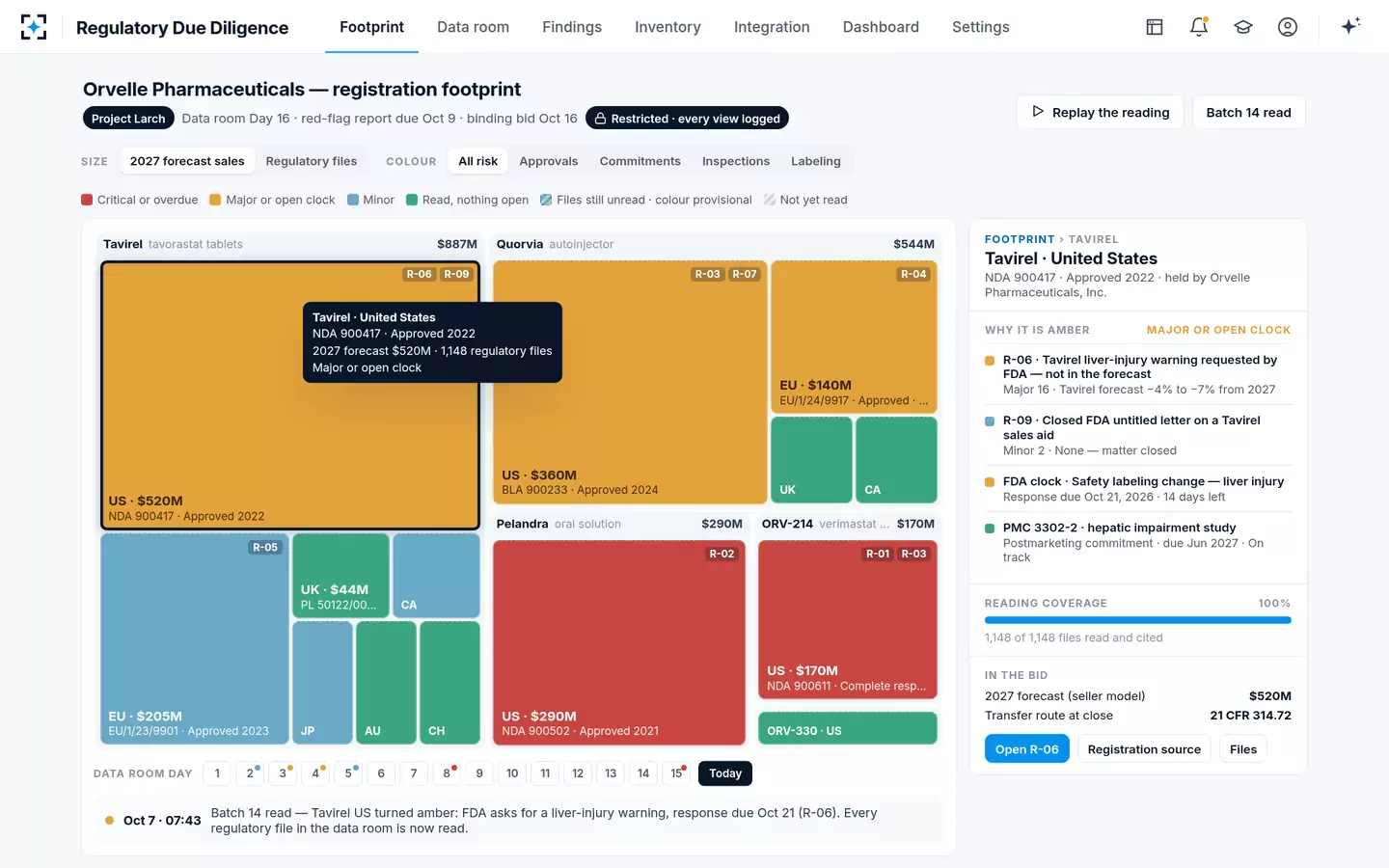
The wider point is the one the inspection file teaches better than any other public source: absence of a finding is not a finding of absence. A register that only records closed inspections, that excludes some of the inspections a buyer most wants, and that is filled at a rate a third below the pre-2020 one, will show many sites as quiet. The reviewer's job is to say which of those silences has been tested and which has not — which is the same discipline as stating coverage in a red-flag report rather than implying it.
Questions people ask
What does OAI mean in an FDA inspection?
Official Action Indicated: FDA's own definition is that "regulatory and/or administrative actions are recommended". It is the classification given when the agency's review of an inspection concludes that it should act — for example with a warning letter, an import alert, or by withholding approval of an application that depends on the site. It is a verdict on the inspection, assigned after the inspection closes.
How do I find a company's FDA inspection history?
Work from sites, not from the company name. Take each establishment address named as a manufacturing site in the relevant applications, look it up in the inspection classification database for classified inspections, then look for released Form 483s and warning letters in FDA's reading rooms, and look the same address up in the EU's EudraGMDP database. A corporate group usually has several addresses with several different histories.
How often is the FDA inspection database updated?
FDA states that "the Inspection Classification Database is updated weekly". That is the publication cadence, not the lag: a row appears only once the inspection has been closed and classified, and FDA does not publish a standard interval between the end of an inspection and the appearance of its classification.
What inspections are missing from the FDA database?
FDA says most inspections are included "with several exceptions (such as inspections of mammography facilities and some preapproval inspections)", and that inspections of nonclinical laboratories for Good Laboratory Practices compliance are not included either. Inspections that are open or not yet classified do not appear. FDA adds that because only final classifications are posted, the database "can't be used to count all FDA inspections conducted".
Does a contract manufacturer's OAI affect my approval?
It can. An application names the sites that will make the product, so an agency that has recommended action against one of those sites may decline to approve the application that depends on it. The practical questions are which pending applications name the site, what action actually followed the classification, and whether the site has been inspected again since.
How many inspections does FDA do a year?
GAO reported that FDA conducted 621 foreign and 444 domestic inspections in fiscal year 2023 — 36 percent fewer than in fiscal year 2019 — and that the vacancy rate among the investigators who do them rose from 9% to 16% between November 2021 and June 2024. For a buyer, the figure matters mainly as context: the gaps between visits to any one site are wider than they were.