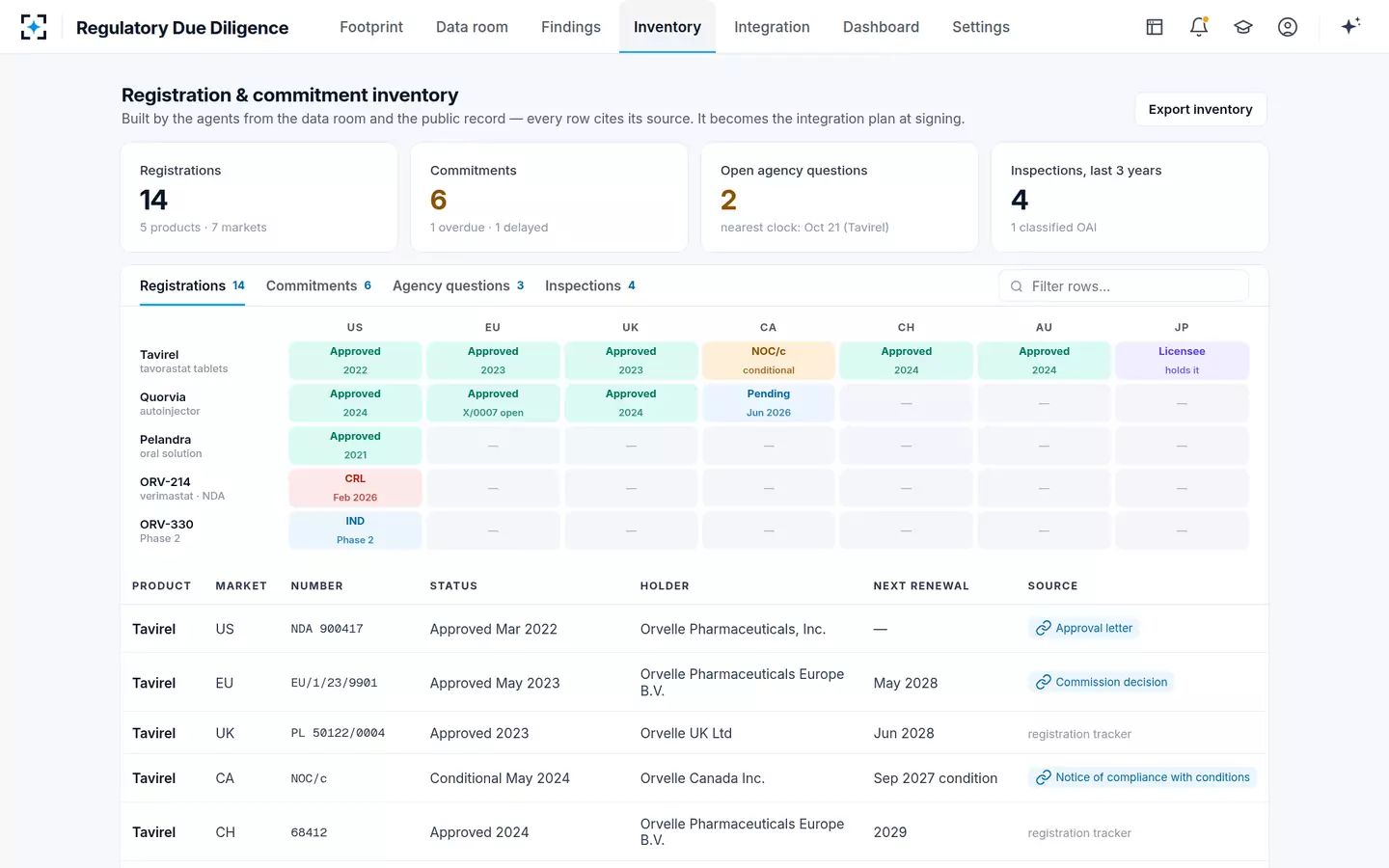
A post-marketing requirement is a study or clinical trial an applicant must run after approval because a statute or a regulation says so; a post-marketing commitment is one the applicant agreed in writing to run, with no statute behind it. That single difference decides what a missed milestone is — a violation of the law with a misbranding consequence, or a broken promise with a commercial one — and it is the reason a commitment list in a data room cannot be read as one list. For anyone buying the product it matters twice over, because the obligations do not stay with the seller: the new owner of an application commits in writing to the promises and conditions the former owner made. Botminds' Regulatory Due Diligence builds the target's commitment inventory from the data room with a page citation on every row and sets it against the public register, so a buyer can see which obligations are already behind schedule before the seller's summary says anything at all.
The deal used as an illustration — Project Larch and its products — is fictional sample data inside the solution.
The population a buyer is reading one target out of
1,636
open post-marketing requirements across US drug and biologic applications
386
open post-marketing commitments alongside them
30%
of those open requirements were off schedule
402
applicants carrying them, under 826 applications
What is the difference between a PMR and a PMC?
FDA states the distinction in one sentence of its own annual report: "A postmarketing requirement (PMR) is a study or clinical trial that an applicant is required by statute or regulation to conduct postapproval. A postmarketing commitment (PMC) is a study or clinical trial that an applicant agrees in writing to conduct postapproval, but that is not required by statute or regulation" (FDA, FY2024 performance report). Everything else follows from the words required and agrees.
In a data room the two look identical. They appear on the same list, often in the same table, with the same kind of milestone dates, and a seller has no incentive to separate them. The separation has to be made by the reader, from the authority cited for each one, and it changes what every later question means: who can release the obligation, what a slipped date is, whether the item appears in a public register at all, and what a buyer is taking on.
Requirement and commitment, row by row
Post-marketing requirement: A statute or a regulation: the safety authority at section 505(o)(3), pediatric studies under PREA, accelerated approval, or the animal efficacy rule.
Post-marketing commitment: A written agreement between the applicant and the agency at or after approval. No statutory authority behind it.
Post-marketing requirement: The agency, as a required schedule with milestone dates.
Post-marketing commitment: Negotiated, then recorded in the approval correspondence.
Post-marketing requirement: Potentially a violation of the subsection, with a misbranding consequence attached to it by statute.
Post-marketing commitment: A broken undertaking. Consequences are regulatory pressure and reputation, not a statutory violation.
Post-marketing requirement: Only the agency, in writing, when the study is no longer feasible or would no longer be useful.
Post-marketing commitment: Also the agency, in writing — a commitment is not released by the applicant deciding it is done.
Post-marketing requirement: Yes, while open, for the reportable categories.
Post-marketing commitment: Yes for 506B commitments; manufacturing-related commitments are not reported in the same way.
Post-marketing requirement: The obligation and its schedule, with the new owner's written commitment to it.
Post-marketing commitment: The same promise, on the same timetable, whether or not a slide mentioned it.
Where each one comes from: 505(o)(3), PREA, accelerated approval, the animal rule
Four authorities produce almost all the requirements a target will be carrying, and they behave differently enough that an inventory should record which one applies to each row. The safety authority at section 505(o)(3) covers studies required to assess a known or signalled serious risk. PREA covers pediatric assessments, which are usually deferred at approval because the product is ready for adults first — which is why so many of them sit in a status that is not yet late. Accelerated approval carries confirmatory studies to verify the predicted clinical benefit. The animal efficacy rule covers products that cannot be tested for efficacy in humans, and its studies can sit indefinitely because they depend on an event nobody wants.
The reason to record the authority is that the off-schedule rate is wildly uneven between them. Across all open requirements at the end of fiscal 2024, PREA accounted for more delayed items than everything else combined.
Open post-marketing requirements that were off schedule, by the authority behind them
For a buyer the practical reading is that a long PREA list is normal and a long accelerated-approval list is not. An overdue pediatric assessment is a common finding with a specific and well-marked consequence; a confirmatory study behind schedule on an accelerated approval is rarer and sits much closer to the product's licence.
What a missed milestone legally is — and what it is not
For a requirement under the safety authority, the statute says what a missed timetable makes of the responsible person.
If the responsible person fails to comply with such timetable or violates any other requirement of this subparagraph, the responsible person shall be considered in violation of this subsection, unless the responsible person demonstrates good cause for such noncompliance or such other violation.
21 U.S.C. 355(o)(3)(E)(ii), FD&C Act section 505(o)(3)
That violation then reaches the product through the misbranding provisions. A drug is misbranded, the statute says, "if it is a drug, and the responsible person (as such term is used in section 355(o) of this title) is in violation of a requirement established under paragraph (3) (relating to postmarket studies and clinical trials) or paragraph (4) (relating to labeling) of section 355(o) of this title with respect to such drug" (21 U.S.C. 352(z)). Misbranding is not an abstraction: it is the hook on which enforcement hangs, and it attaches to the product the buyer is acquiring, not to the executive who let the date slip.
What it is not is an automatic threat to the approval. For pediatric assessments Congress said so explicitly: the failure may make the product misbranded, but it "shall not be the basis for a proceeding — (A) to withdraw approval for a drug under section 355(e) of this title; or (B) to revoke the license for a biological product" (21 U.S.C. 355c(d)(2)). The exception is accelerated approval, where the licence really is at stake: the agency may withdraw approval using expedited procedures if "the sponsor fails to conduct any required postapproval study of the product with due diligence" (21 U.S.C. 356(c)(3)(A)(i)). A diligence reviewer who collapses these three regimes into "FDA could pull the product" has made the report less useful, not more cautious.
Pending is not late: the statuses, and the one that matters
The most common error in reading a commitment list is treating anything not finished as behind. The register uses seven statuses, and only one of them means late. Pending means the study has not started and was not due to have started. Ongoing means it is proceeding according to or ahead of the original schedule. Delayed means, in FDA's own definition, "the study or clinical trial is behind the original schedule". Terminated means it ended before completion with no final report. Submitted means a final report has gone in. Fulfilled and released are the two closed states — the agency has either accepted the report or written to say the obligation no longer applies.
FDA puts the warning in its own report: "It is important to note that PMRs/PMCs that are in pending status are not yet delayed; that is, per the milestones, the studies or clinical trials are indeed on schedule and are not expected to be underway yet" (FDA, FY2024 performance report). On a pediatric list, pending is the normal state for years. A finding that counts pending items as risk inflates the report and burns the credibility the uncomfortable findings need.
The status to chase is delayed, and the number to chase it with is the original schedule rather than any revised one. FDA's report is explicit that status is measured against the original schedule regardless of whether the agency has acknowledged that more time was needed — which is exactly the convention a buyer should adopt, because a date the seller renegotiated is still a date the seller missed.
The commitment list as rows with dates, statuses and sources
What the public register shows, and what it withholds
FDA publishes a searchable database of post-marketing requirements and 506B commitments (FDA, about the database), and for diligence it is the single most useful public source about a target's obligations, because it is one of the few places where the agency's view of a company's performance is visible without asking the company. Three limits decide how it should be used.
It is bounded in time: it carries every open item but only those closed within the last year, so an obligation released two years ago is simply absent, and absence is not evidence of anything. It is bounded in subject: the annual reporting rules cover clinical safety, clinical efficacy, clinical pharmacology and nonclinical toxicology studies, and FDA notes that manufacturing-related commitments and studies a company started on its own initiative are not reported under those rules at all — so a target's chemistry and manufacturing undertakings will not appear. And it is bounded in time again at the other end: it is refreshed on a quarterly cycle, so a milestone that moved last month may not have moved in the register.
What the seller must file against each open item is the annual status report, and asking for them by name is more productive than asking for a summary of commitments. FDA describes its contents plainly: the report "must include a description of the PMR/PMC, a schedule for completing the PMR/PMC, and a characterization of the current status of the PMR/PMC", filed within 60 days of the anniversary of approval (FDA, FY2024 performance report). Three consecutive annual status reports tell a buyer more about an obligation than any slide about it.
What happens if a post marketing requirement is missed?
Four things follow a missed requirement, in roughly this order. The item's status in the register becomes delayed, which is public while the item stays open. The applicant must explain the slippage in its next annual status report. Under the safety authority the responsible person is considered in violation unless good cause is demonstrated, and the product may be misbranded on that basis. And the agency has its enforcement options, which for pediatric assessments begin with a non-compliance letter rather than anything touching the approval.
The numbers say how ordinary this is. Across the whole population at the end of fiscal 2024, "most open PMRs (70 percent (1147/1636) for NDAs and BLAs combined) and most open PMCs (80 percent (307/386) for NDAs and BLAs combined) were progressing on schedule" (FDA, FY2024 performance report) — which is also to say that three in ten open requirements were not.
The commitment population at the end of fiscal 2024, and what it means for one target
| What FDA reported | The figure | How a buyer should read it |
|---|---|---|
| Applicants with open requirements or commitments | 402, under 826 applications | Carrying open obligations is the normal state of a marketed portfolio, not a red flag in itself. |
| Open requirements progressing on schedule | 70% (1,147 of 1,636) | A target materially worse than seven in ten is worth a question about how it resources study delivery. |
| Open commitments progressing on schedule | 80% (307 of 386) | Promises are kept slightly better than requirements, which is counter-intuitive and worth remembering. |
| Open drug-application requirements off schedule | 35% (415 of 1,196) | The base rate for the kind of finding a diligence report raises. Use it to size the finding, not to excuse it. |
| Open biologic-application requirements off schedule | 17% (74 of 440) | Biologic portfolios run a markedly lower off-schedule rate, so the same slip reads worse on a biologic. |
| Share of off-schedule items that were delayed rather than terminated | about 99% | Almost nothing is abandoned outright; the risk is a schedule quietly stretching, not a study vanishing. |
PREA deferrals, non-compliance letters, and the 60-day clock to publication
Pediatric assessments deserve their own paragraph because they are the most frequently late obligation and the one with the most specific public consequence. A deferral is granted at approval when the product is ready for adults and the pediatric work is not yet appropriate; the assessment is then due on a date in the approval letter. When a person fails to submit a required assessment, the statute directs the agency to issue a non-compliance letter, and that letter "shall require the person to respond in writing within 45 calendar days of issuance of such letter" (21 U.S.C. 355c(d)(1)).
Then comes the detail that changes a diligence timetable. The letter does not stay private.
Such letter and the person's written response to such letter shall be made publicly available on the Internet Web site of the Food and Drug Administration 60 calendar days after issuance, with redactions for any trade secrets and confidential commercial information.
21 U.S.C. 355c(d)(1), FD&C Act section 505B(d)(1)
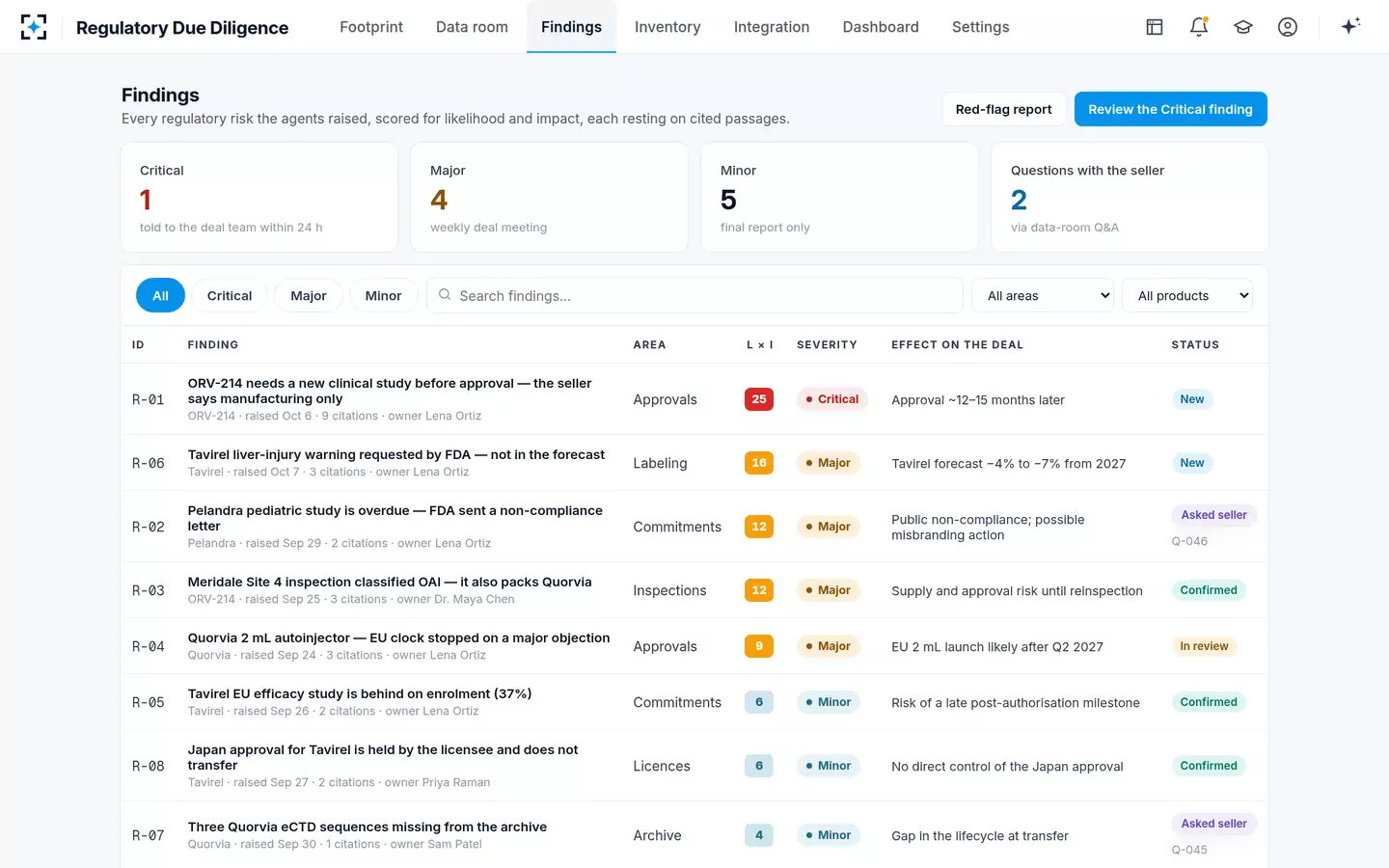
For a buyer this is a date, not a principle. If a target has received a non-compliance letter, the letter and its answer become readable 60 days later, which may fall before the bid, between signing and closing, or in the first weeks of ownership. A diligence report that notes the issue date and counts forward is telling the deal team something it can act on; one that records only that an assessment is overdue is not. In the fictional sample deal this is exactly the shape of the finding on the overdue pediatric assessment: the obligation is late, the agency has already written, and the correspondence has a publication date of its own.
Where an overdue commitment lands among the rest of the findings
Why the obligation follows the product to the buyer
Nothing about a transfer of ownership resets a commitment. When a US application changes hands the new owner's filing must contain its commitment to the agreements, promises and conditions the former owner made and which are contained in the application, and the new owner then has to keep the agency informed: the regulation requires that "the new owner shall advise FDA about any change in the conditions in the approved application" (21 CFR 314.72(b)). The buyer therefore acquires the study, the timetable and the slippage, together with the explanation it will have to give at the next annual status report. The full text of the ownership rule, and what else to request alongside it, sits in the regulatory due diligence checklist.
The practical consequence is a line item in the integration plan rather than only a line in the report. Every open obligation needs an owner on the buyer's side from Day 1, a budget, and a view on whether the original schedule is still achievable — which is a different question from whether the seller was going to achieve it. Where the registration transfers themselves go, market by market, is covered in transfer of marketing authorization.
The six questions to ask of every commitment in a data room
A commitment list is worth exactly as much as the six answers below. Each one is answerable from a document, and a seller who cannot answer any of them has told you something.
Six questions per commitment, and the document that answers each
- Which authority requires it, or is it a promise?
The approval letter or the correspondence that created it. Without this, nothing else on the list can be interpreted.
- What is the milestone schedule, as originally set?
The approval letter again. Ask for the original schedule explicitly, because the one on the slide is often the revised one.
- What status was reported at the last anniversary?
The annual status report. Ask for the last three, not the latest one.
- Has the agency written about it?
Agency correspondence, and for pediatric assessments the non-compliance letter and the response, which become public 60 days after issue.
- Has anything been formally released or fulfilled?
The agency's written notice. A study the company considers finished is not closed until the agency says so.
- What does it cost to finish, and who will run it?
The study protocol, the contract research agreement and the budget. This is the question the integration plan needs and diligence often skips.
Run those six questions across a target's whole commitment list and the result is an inventory the integration office can use unchanged, which is the real test of a diligence artefact. To see that inventory built from a data room and set against the public register, start from Regulatory Due Diligence.
Questions people ask
Who is responsible for a PMR after an acquisition?
The new owner of the application. The transfer rules require the new owner to file its commitment to the agreements, promises and conditions the former owner made and which are contained in the application, and to keep the agency advised of changes in the approved application's conditions. In practice that means the obligation, its original timetable and any slippage all move with the product, which is why an open commitment needs a named owner on the buyer's side from the first day of ownership.
Are post-marketing requirements public?
Largely, while they are open. FDA publishes a searchable database of requirements and 506B commitments, carrying all open items and those closed within the last year. It does not cover manufacturing-related commitments or studies a company started on its own initiative, and it is refreshed quarterly, so it tells you what the agency has on record rather than what happened last month.
What is a PREA deferral?
Permission to do the required pediatric assessment after approval rather than before it, granted when the product is ready for adults and the pediatric work is not yet appropriate — for instance because safety data from other studies has to be reviewed first. The assessment then carries a due date, and the deferral is the reason so many pediatric requirements sit in a status that is correctly described as pending rather than late.
How many post-marketing requirements are delayed?
At the end of fiscal 2024, 489 of 1,636 open requirements across drug and biologics applications were off schedule, about 30%, of which roughly 99% were delayed rather than terminated. The rate differs sharply by application type: 35% of open drug-application requirements against 17% of open biologic-application requirements.
Can FDA withdraw approval for a missed PMR?
It depends on the authority. For a pediatric assessment the statute says the failure may make the product misbranded but shall not be the basis for a proceeding to withdraw a drug's approval or revoke a biologic's licence. For a product approved under accelerated approval the position is reversed: the agency may withdraw approval using expedited procedures where the sponsor fails to conduct a required post-approval study with due diligence. Under the safety authority the consequence runs through violation and misbranding rather than through withdrawal.
What is an annual status report for a PMR?
The report an applicant must file on each open requirement or commitment, within 60 days of the anniversary of the product's approval, until the item is closed. FDA describes it as having to include a description of the study, a schedule for completing it and a characterization of its current status. For a buyer it is the most useful single document on the commitment list, because reading three consecutive years of them shows whether a schedule is being delivered or restated.