Can an AI agent do due diligence? The reading, yes — and that is most of the hours. An AI agent for due diligence can open every file a seller uploads, classify it, pull each fact out with the page it sits on, and set the seller's own sentence beside the agency's published words. What it cannot do is be the author of the conclusion, the reviewer who confirms it, the person who approves it or the name on the signature, because responsibility for the output stays with the people and the firm who produced it. Botminds' Regulatory Due Diligence is built around that line: its agents raise and score, and every decision that changes what the deal team believes belongs to a named person.
The examples come from a fictional sample deal used throughout this solution — Northwind bidding for Orvelle Pharmaceuticals, 6,214 regulatory files, ten findings. The companies and people are invented.
The honest answer, decision by decision
"Can AI do due diligence" is the wrong unit of analysis, because diligence is not one job. It is a chain of about ten decisions, and the answer differs at each link. Written out, the chain also explains why the question keeps producing both vendor enthusiasm and blanket warnings: both are right about different links.
Ten decisions in a regulatory review, and who makes each one
An agent can do this: Decide that a document is an approval, an agency letter, a decision letter, an inspection document, labelling or an archive index, and link it to a product.
A person must do this: Nothing, until the classification is wrong in a way that matters — which is why misclassification has to be visible and correctable.
An agent can do this: Pull a registration number, a commitment, a due date or an agency deadline, and record the page it came from.
A person must do this: Nothing, provided no value is ever recorded without a citation.
An agent can do this: Find the published decision letter, assessment report or inspection classification for the same product and set the two texts side by side.
A person must do this: Decide which source wins when they disagree, and whether the disagreement is material.
An agent can do this: Apply a written rule — likelihood times impact — and show the inputs.
A person must do this: Set the rule and the thresholds, before the findings, and own the scale.
An agent can do this: Nothing. A raised finding is a proposal.
A person must do this: Confirm it, downgrade it with a recorded reason, or send it to the seller as a question.
An agent can do this: Draft the question.
A person must do this: Decide whether to ask it, which matters because a question tells the seller what the buyer has noticed.
An agent can do this: Draft each section from confirmed findings only, carrying every citation with it.
A person must do this: Read it as the author, because the name on it is a person's.
An agent can do this: Nothing.
A person must do this: Sign, with a recorded meaning, before a Critical finding reaches the deal team.
An agent can do this: State an effect as an estimate, labelled as one.
A person must do this: Decide what it is worth, and whether it changes the bid.
An agent can do this: Generate it from the inventory.
A person must do this: Approve it, and own the dates.
What an agent is good at: reading everything, and saying what it read
The hard part of a regulatory review is not judgement; it is volume under a deadline. A mid-size target's data room holds tens of thousands of files, of which several thousand are regulatory, and the seller keeps adding to it until the bid. A four-person team with four weeks reads a minority of them closely and samples the rest. That is not a failure of skill. It is arithmetic.
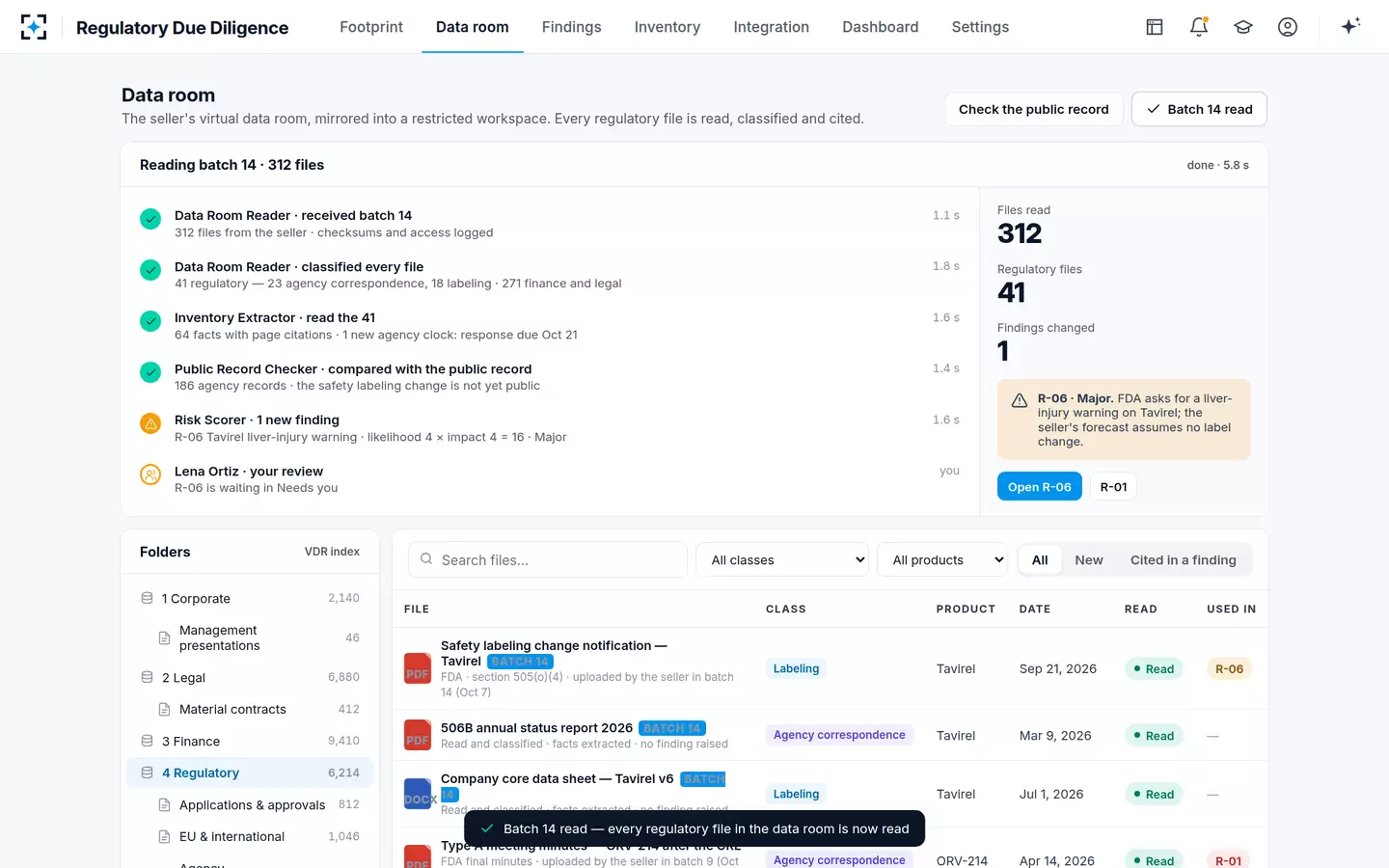
What changes when an agent does the reading is not that it reads better than a specialist — it does not — but that it reads all of it, consistently, and says what it read. Coverage becomes a number instead of an impression. In the sample deal a late batch of 312 files arrived overnight, 41 of them regulatory, and was read, classified, extracted and compared against the public record in seconds, raising one new Major finding on a label change the seller's forecast did not assume.
The four things to measure, whoever or whatever does the reading
100%
share of regulatory files read and cited — the number that makes coverage checkable
3+
cited passages behind each finding, openable at the page
0
findings raised without a citation — the only acceptable figure
6h
design target from a seller upload to a scored, cited finding
What can AI not do in due diligence?
Four things, and they are not arbitrary. It cannot decide what a disagreement means, because that requires knowing what the buyer intends to do with the asset. It cannot own a conclusion, because ownership is a property of people and firms. It cannot decide what to reveal to the other side, because a question to a seller is a negotiating act. And it cannot carry a signature, because a signature is a claim about a person at a time.
There is a fifth, quieter one: it cannot tell you what is not there. An agent reports on the documents it was given. A seller that has not uploaded the inspection folder has produced silence, and silence reads the same to a model as to a tired reviewer at midnight. The defence is structural rather than clever — count what should exist, compare it with what arrived, and show the gap as a gap. In the sample deal three archive sequences were missing out of 1,842, and that absence became a finding and a question to the seller rather than a quiet omission.
Hallucinated citations, and why every fact must open at its page
The specific failure that makes professionals distrust these tools is a fluent sentence attached to a source that does not say it. It is measurable, and it has been measured in a neighbouring profession. A preregistered study by researchers at Stanford and Yale, published in the Journal of Empirical Legal Studies in 2025, tested the commercial legal research tools of two major legal publishers — tools sold on exactly the promise that retrieval removes the problem — and found that each of them hallucinated on somewhere between about a sixth and a third of the queries tested — fewer than a general-purpose chatbot but far from none.
Measured hallucination rates in a preregistered study of legal research tools
The regulators have reached the same conclusion from the other direction. The European Medicines Agency's reflection paper on artificial intelligence in the medicinal product lifecycle says that tools used to draft, compile, edit, translate, tailor or review product information need close human supervision, and its reason belongs on the wall of every deal room: generative models tend to produce output that is plausible but wrong or incomplete, so a quality review has to confirm that every model-written sentence is correct before it goes to a regulator.
The design answer is to make the citation the thing, not the sentence. If every fact on a page is a link that opens the document at the passage it came from, a wrong citation is not a subtle error that survives review — it is an obvious one that dies in ten seconds. In the sample deal a finding will not be raised at all without at least one cited passage, and the seller's statement is quoted and located rather than characterised, so the two can be read against each other.
A late batch read, with each step's output and the citations it produced
Who is responsible when an AI tool gets a finding wrong?
The firm that produced the report, and the people who signed it. The pharmaceutical regulators have said as much about AI in their own field. The European Medicines Agency's reflection paper places responsibility for the fitness of the models, datasets and pipelines on the sponsor, applicant, holder or manufacturer deploying them — not on whoever built the tool — and makes the extent of scrutiny proportionate to what is at stake: the risk depends on the context of use and on how much influence the tool has over the decision, not only on the technology and its data.
Applied to diligence, that is a useful test. An agent that reads and cites exerts little influence over the decision, because every one of its outputs is checkable in seconds. An agent that scores and writes exerts a great deal, because a reader cannot check a judgement by opening a page. The appropriate controls are therefore not uniform: light on extraction, heavy wherever a conclusion forms.
The same paper sets the overall posture plainly: it asks for a human-centric approach to every stage of developing and deploying these tools, as the way to earn trust in their effectiveness, reliability and fairness. For a deal, the practical form of that is the one described in the anatomy of a defensible finding: a named owner for every finding, a recorded reason for every change, and a signature with a meaning.
The regulators' own position on AI in regulatory work
None of the four bodies below is writing about mergers. They are writing about the use of these tools in regulated pharmaceutical work, which is the same population of documents, the same professionals and the same standard of proof — so their positions are the nearest thing a deal team has to an external benchmark.
Four published positions, and what each one asks of a data-room reader
| Who, and what they published | What it says | What it means for diligence |
|---|---|---|
| FDA, draft guidance, January 2025 | It "provides recommendations to sponsors and other interested parties on the use of artificial intelligence (AI) to produce information or data intended to support regulatory decision-making regarding safety, effectiveness, or quality for drugs." | Credibility is assessed for a particular use, not for a tool in general. A reader that is good at extraction has not thereby been shown to be good at judgement. |
| EMA and CHMP/CVMP reflection paper, September 2024 | Tools for product-information work need close human supervision, because generative models can produce plausible output that is wrong or incomplete. | Drafting is the step to supervise most closely, because a fluent draft hides its own errors. |
| NIST AI Risk Management Framework | NIST "has developed a framework to better manage risks to individuals, organizations, and society associated with artificial intelligence (AI)"; the framework is voluntary and is being revised under the White House AI Action Plan. | A common vocabulary for asking a supplier how it governs its own system — and a reminder that the reference itself is moving. |
| FTC and DOJ, OECD submission on gun jumping | Merging firms "need to be careful about what and to whom they transmit this information" during diligence, and should consider a clean team where information is necessary to the process. | The confidentiality question is not about the model; it is about where the documents go and who can see the answers. |
The confidentiality boundary: clean teams, gun jumping and what may not leave
Before any question about accuracy comes a question about egress. A data room holds the other side's commercially sensitive material, and in a deal between competitors it holds material that competition authorities care about. The United States agencies put the test as a question rather than a rule: "although merging firms need some information during the due diligence and preconsummation planning periods, they need to be careful about what and to whom they transmit this information. A key question to ask is, if the merger does not go through, would the exchange of information between competitors facilitate collusion or harm competition in another way."
That question has a direct consequence for any agentic reader. Checking a target's statements against the public record means searching public sources — and a search carries the terms you search with. An agent that looks up a published decision letter by product name is doing what any analyst would. An agent that searches with the code name of the deal, or with both parties' names together, has told the open internet something nobody authorised it to say.
So the boundary runs in one direction: public material comes in, deal material does not go out. In the sample deal the public record checks are explicitly read-only and run on product names alone, never on deal-identifying terms; access is restricted to the named people on the deal, every view and download is logged against a person, exports carry the reader's name, and valuation effects are visible only to the clean team. Those are not features of the model. They are properties of the room it works in.
Seven questions to ask before an agent touches a data room
Most of what distinguishes a usable agentic reader from a demonstration is checkable in an afternoon, provided you ask the right seven questions and refuse to accept a description instead of a demonstration.
Seven questions, and the failure each one prevents
- What share of the files did you read, and can you show the unread ones?
Prevents the oldest failure in diligence — a confident summary resting on a sample nobody sized.
- Open this finding at its source, now
Prevents the fluent citation to a document that does not say it. If the passage does not open, the finding is a sentence.
- Show me a file you could not read
Prevents silent failure. A reader that never reports an unreadable scan is not reporting.
- What did you search for outside this room, and in what terms?
Prevents the confidentiality breach that no accuracy test would ever catch.
- Who can open this, and what does the log say?
Prevents the quiet spread of inside information through a tool nobody put on the access list.
- Which decisions does it make without a person?
Prevents the gradual drift from drafting into deciding, which happens by default unless it is designed against.
- Re-run it on last week's files and show me what changed
Prevents a result that cannot be reproduced, which is a result that cannot be defended.
How to check a finding in under two minutes
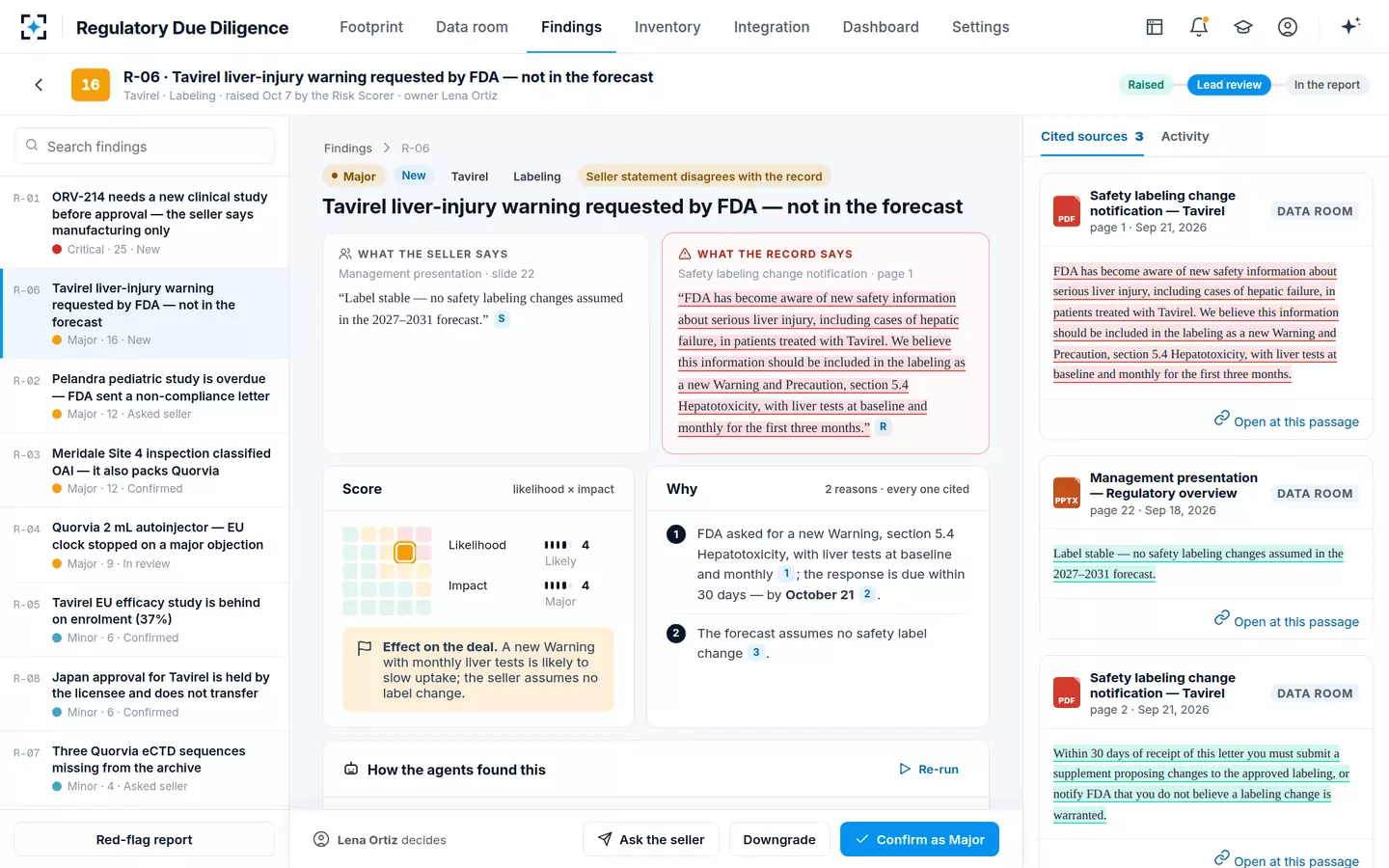
The reason the division of labour above is workable is that checking is far cheaper than producing. Take the sample deal's Major finding on a liver-injury warning. The claim is that the seller's forecast assumes no label change while the agency has asked for one.
Open the seller's side: slide 22 of the management presentation, quoted — "Label stable — no safety labeling changes assumed in the 2027–2031 forecast." Open the record's side: the safety labelling change notification in the seller's own data room, page 1, asking for a new Warning and Precaution with liver tests at baseline and monthly for the first three months. Check the score against the written rule: likelihood 4, impact 4, 16, Major because the Critical threshold is 20. Check that the consequence is labelled an estimate. That is the whole check, and it is about ninety seconds.
The seller's sentence and the agency's sentence, on one screen, both openable
A review that can be checked this way scales differently from one that cannot. The committee does not have to trust the reviewer uniformly; it can spot-check the findings that move the price and accept the rest on the strength of the method. That is a better bargain than either blanket trust or blanket suspicion, and it is the reason the useful question was never whether AI can do due diligence. If you are comparing tools rather than deciding the principle, what to look for in a data-room reader sets out the evaluation; the cost side is in what the regulatory workstream actually costs.
Questions people ask
Can AI do due diligence?
It can do the reading, which is most of the hours: classifying every file, extracting facts with the page each came from, and comparing the seller's statements with published agency records. It cannot own the conclusion. The decisions that change what a deal team believes — confirming a finding, deciding what to ask the seller, signing, pricing — stay with named people, because that is where accountability for the report sits.
Do AI tools hallucinate citations?
Yes, including tools built on retrieval and sold as having solved it. A preregistered study by Stanford and Yale researchers, published in 2025, tested leading legal research products and found them hallucinating between 17% and 33% of the time. That study is about legal research tools rather than diligence software; the sound conclusion to draw is about the class of tool, which is why every fact should open at its source rather than be taken on trust.
Can you send data room documents to an AI model?
That is a question for the confidentiality agreement and the deal's own protocol, not a general one. What any reviewer should be able to show is where the documents physically go, who can open them, that every view is logged against a person, and that nothing about the deal leaves — including in a search term. Public-record checks should run on product names only, never on deal-identifying terms.
Does using AI on a data room risk gun jumping?
The tool does not create the risk; the information flow does. The United States agencies ask merging firms to be careful about what information is transmitted and to whom during diligence, and suggest a clean team where the exchange is necessary. An agentic reader fits that model well, because it can be confined to a restricted area with a logged access list — and badly if its outputs reach people running the business day to day.
What does human in the loop mean?
In practice it means a named person makes a specific decision that the system will not make without them, and the record shows who and when. It does not mean a human is available, or reviews a sample. The test is whether the process stops: if a Critical finding cannot reach the deal team until a named signer has signed it, the loop is real.
How do you check an AI finding?
Open both sides and the rule. Open the quoted seller statement at its page, open the agency text at its page, confirm the two say what the finding says they say, then check the score against the scoring rule and confirm that any consequence is labelled an estimate. On a well-built finding this takes about two minutes, which is what makes spot-checking a realistic control rather than a gesture.