Yes. FDA complete response letters are public: the agency published more than 200 of them on 10 July 2025, added a batch of 89 previously unpublished letters on 4 September 2025, and said at the same time that it would release newly issued letters promptly rather than waiting for a request. That is a change in kind, not in degree. A complete response letter is the agency's written explanation of why an application was not approved, and until 2025 almost the only publicly available account of one was the sponsor's own announcement — which FDA's own research found to be a poor substitute. For anyone reading a company's regulatory history from outside, including the regulatory workstream of an acquisition, this is one of the most useful transparency changes in years; Botminds' Regulatory Due Diligence uses it directly, setting a seller's statement about a refusal beside the published letter, page by page, as a cited finding rather than an impression.
The deal used as an illustration is fictional sample data inside the solution.
What changed, and why it mattered
200+
decision letters published in the first release, 10 July 2025
89
previously unpublished letters added on 4 September 2025, alongside prompt release of new ones
85%
of FDA's safety and efficacy concerns went unmentioned in sponsors' announcements
14%
of the statements in the letters studied had a matching statement in a press release
The short answer, and what changed in 2025
Before 2025, a complete response letter reached the public only through a freedom-of-information request, which meant months of wait, heavy redaction and no guarantee the letter you needed was the letter you got. On 10 July 2025 the position reversed: "The U.S. Food and Drug Administration (FDA) today published more than 200 decision letters, known as complete response letters (CRLs)" (FDA press announcement). On 4 September the agency announced real-time release of new letters and posted a further batch of 89 (FDA press announcement).
The legal basis is not new, which is worth knowing because it is what makes the change durable rather than discretionary. FDA states that its "authority to release complete response letters is derived from the Federal Freedom of Information Act (FOIA) at 5 USC 552(a), section 505(l) of the Federal Food, Drug, and Cosmetic Act (FDCA) at 21 USC 355(l), and FDA information disclosure regulations at 21 CFR Part 20 and 21 CFR 312.130, 314.430, and 601.51" (openFDA, complete response letters). What changed in 2025 was the posture — proactive publication instead of disclosure on request — not the power to publish.
Where can I find FDA complete response letters?
In FDA's own published collection of them, reachable through the agency's transparency pages and as an openFDA endpoint. FDA describes its scope precisely: "This database contains Complete Response Letters (CRLs) associated with approved and unapproved New Drug Applications (NDAs) and Biologics License Applications (BLAs). Currently, the database includes CRLs issued to sponsors as recently as 2025" (openFDA, complete response letters). Two things in that sentence matter for research. Letters for applications that were later approved are included, so a product on the market today may still have a readable refusal in its history. And the agency has said it may add batches from its archives for withdrawn and approved applications, so an absence found today is not permanent.
In practice the search is by application and sponsor, and the first discipline is to match the letter to the cycle. An application with two refusals has two letters; reading the older one against a company statement about the newer one produces a confident, wrong conclusion. Take the letter's issue date, place it against the resubmission history, and only then read the text.
What a complete response letter must contain
The regulation sets the floor, and the floor is high: "A complete response letter will describe all of the specific deficiencies that the agency has identified in an application or abbreviated application" (21 CFR 314.110(a)(1)). It reflects FDA's complete review of the data submitted and identifies any amendments the agency has not yet reviewed, and where possible it recommends actions the applicant might take to place the application in condition for approval.
The regulation then narrows what can happen next to three choices. The applicant resubmits, addressing all deficiencies identified in the letter; or withdraws the application, without prejudice to a later submission; or asks for an opportunity for a hearing on whether there are grounds for denying approval. There is also a clock on doing nothing: FDA may treat a failure to take any of those actions within one year of the letter as a request to withdraw the application, unless an extension has been requested. For a diligence reader, that one-year rule is a quiet date to check — an application that has been "under evaluation internally" for fourteen months since a refusal is a different asset from one being actively resubmitted.
Why the press release was never a substitute: FDA's own 2015 study
FDA was blunt about its reason for publishing, and the sentence is the one to quote to anyone who thinks the company announcement is enough.
sponsors often misrepresent the rationale behind FDA's decision to their stakeholders and the public.
FDA press announcement, 10 July 2025
The evidence behind that statement is a peer-reviewed cross-sectional study by FDA researchers, published in the BMJ in 2015, which compared the content of 61 complete response letters issued between 2008 and 2013 with the press releases that followed them. Its central finding: "Press release statements matched 93 of the 687 statements (14%), including 16% (30/191) of efficacy and 15% (22/150) of safety statements" (Lurie et al, BMJ 2015;350:h2758). FDA's own summary of the same work puts it the other way round: "According to a 2015 analysis conducted by FDA researchers, sponsors avoided mentioning 85% of the FDA's concerns about safety and efficacy" (FDA, 10 July 2025).
One detail of the study deserves its own sentence, because it shows the shape of what goes missing rather than the quantity: "Seven complete response letters reported higher mortality rates in treated participants; only one associated press release mentioned this fact." The study's conclusion is the sentence a diligence team should write into its working rules: "Press releases are incomplete substitutes for the detailed information contained in complete response letters."
What is redacted, and what therefore cannot be checked
A published letter is a redacted letter. FDA says so explicitly: complete response letters "often contain confidential commercial information (CCI) and trade secret information (TSI), that will be redacted prior to public disclosure under the Trade Secrets Act 18 U.S.C. 1905 (TSA) and section 301(j) of the FDCA (21 USC 331(j))" (openFDA, complete response letters).
What survives redaction is usually enough for the question a reader is asking, because the deficiencies themselves are safety and effectiveness findings rather than commercial information: which domains were criticised, whether a new study is required, what was asked of a manufacturing site, and what actions were recommended. What tends to disappear is quantitative and proprietary — specific assay details, manufacturing particulars, commercial terms. The discipline that follows is simple and frequently broken: a redaction is an unknown, not an absence. A finding that says the letter did not mention something, when the relevant passage is blacked out, is a finding that will not survive the first conversation with the seller.
What is the difference between a Class 1 and a Class 2 resubmission?
The difference is the length of the review cycle the applicant agrees to by resubmitting, and it is large. The regulation states both: by resubmitting, the applicant agrees to a new review cycle that starts on the day FDA receives the resubmission — two months for one FDA classifies as Class 1, six months for Class 2 (21 CFR 314.110(b)(1)(i) and (ii)).
Which class applies is FDA's classification, not the applicant's election, and the test is a closed list. The performance goals letter enumerates what a Class 1 resubmission may contain — final printed labeling, draft labeling, safety updates in the original format, stability updates, commitments to perform Phase 4 studies, assay validation data, final release testing on the last one or two lots, a minor reanalysis of data already submitted, and other minor clarifying information — and then catches everything else: "Class 2 resubmissions are resubmissions that include any other items, including any items that would require presentation to an advisory committee" (FDA, PDUFA reauthorization performance goals FY2023–FY2027). New clinical data is not on the Class 1 list. That does not make a classification automatic — the agency classifies — but it tells a reader which way the evidence points.
The two review cycles a resubmission can start
- Review cycle from the receipt date2 months
- Review cycle from the receipt date6 months
Four months of difference is enough to move a launch across a fiscal year, which is why the class implied by a letter is worth more to a forecast than almost anything else the letter contains.
Reading a letter for the resubmission clock it implies
Read a complete response letter for five things, in this order, and the implied clock falls out of the second one.
Five things to pull out of a published complete response letter
Every deficiency the letter names
Not the first one, and not the one the announcement led with. The letter is required to describe all of the specific deficiencies the agency identified.
Whether new clinical data is asked for
This is the single line that most often decides whether the next cycle is short or long, because it decides what the resubmission will contain.
What was asked of third-party sites
A deficiency at a contract manufacturer is a different remediation, with a different owner and a different date, from one in the clinical package.
The recommended actions
Where the letter recommends what would place the application in condition for approval, that recommendation is the nearest thing to a route the agency will give in writing.
What is redacted, and where
The redactions mark the places a seller still has the only copy. Each one is a question, not a gap to fill in with the company account.
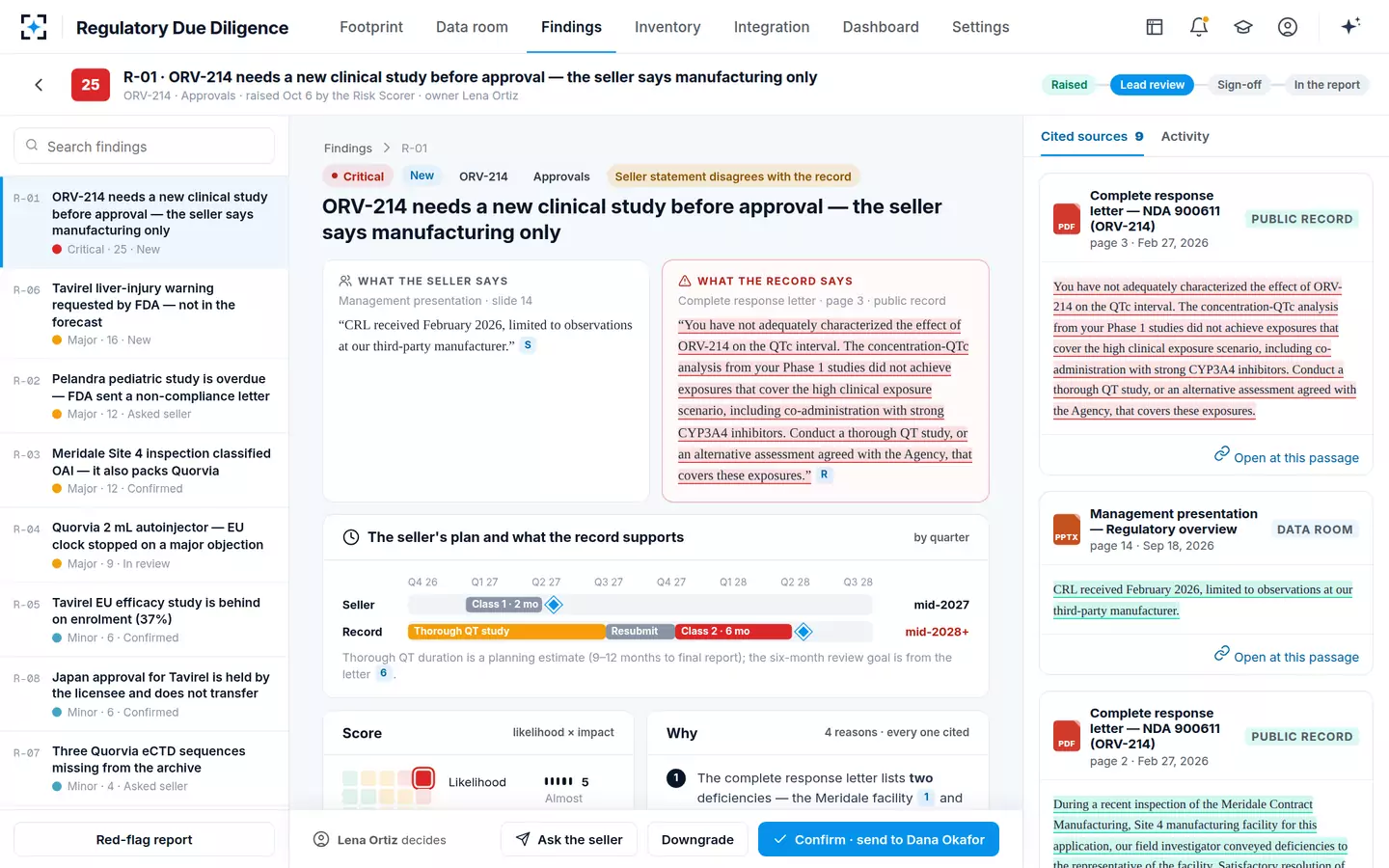
In the fictional sample deal this is exactly how one finding was built. The management presentation described the complete response on an unapproved application as limited to observations at a third-party manufacturer, and set out a Class 1 resubmission with approval in mid-2027. Page 3 of the published letter also asks for a thorough QT study, and the minutes of the Type A meeting that followed record that the agency did not accept a modelling approach instead. Neither fact is in the deck. Together they mean the resubmission would carry new clinical data, which is not among the items a Class 1 resubmission may contain — so the record supports a six-month cycle and an approval date around mid-2028 at the earliest.
The deck's sentence beside the letter's, and what each implies for the date
The management presentation: Limited to observations at a third-party manufacturer.
The published record: The letter also asks for a thorough QT study — a second deficiency, in the clinical package.
The management presentation: Not addressed.
The published record: The minutes of the meeting that followed record that modelling instead of a dedicated study was not accepted.
The management presentation: Manufacturing remediation and labeling.
The published record: New clinical data, which is not among the items a Class 1 resubmission may contain.
The management presentation: A two-month Class 1 cycle.
The published record: The record supports a six-month Class 2 cycle, on FDA classification.
The management presentation: Mid-2027.
The published record: Mid-2028 at the earliest, with the study still to run.
The management presentation: Prices the forecast as presented.
The published record: Scores the finding, asks the seller the question, and proposes a protection in the purchase agreement.
One finding, built from a slide and a page
The meeting minutes that settle what the agency agreed
A published letter tells you what the agency wrote on one day. What happened next is usually settled in a meeting, and the meeting that follows a refusal has a name. FDA's performance goals describe the category: "Type A meetings are those meetings that are necessary for an otherwise stalled drug development program to proceed (i.e., a 'critical path' meeting) or to address an important safety issue. Post-action meetings requested within three months after an FDA regulatory action other than approval (i.e., issuance of a complete response letter) will also generally be considered Type A meetings" (FDA, PDUFA performance goals).
Those minutes are not published, which makes them one of the classes of document a reader has to request rather than find. They are also the place where a disagreement about method is resolved. In the sample deal the method in question is whether a dedicated QT study can be replaced by an integrated analysis — a route the international guidance contemplates, but conditionally: an integrated nonclinical and clinical assessment "can be particularly valuable when a thorough QT study or concentration-QTc analysis meeting similar quality control as needed for a dedicated study as described in 5.1 is not feasible" (ICH E14/S7B questions and answers, Q&A 6.1). The guidance leaves room; the minutes record whether the agency used it. Asking for the agency's own minutes rather than the sponsor's note of the meeting is the whole of the technique, and it is item five on the regulatory due diligence checklist.
The European equivalent: refusal reports and withdrawal letters
Europe has no complete response letter, but it publishes the reasoning in two other shapes. When the committee gives a negative opinion, a refusal questions-and-answers document appears in the committee highlights on the Friday after the plenary, and about two weeks after the Commission's decision refusing the authorisation a refusal assessment report is published on the medicine's page — the assessment itself, not a summary of it.
The second shape is more useful than it sounds, because most applications in trouble are withdrawn rather than refused. EMA publishes a withdrawal questions-and-answers document, and then the applicant's own letter: "EMA also publishes the withdrawal letter sent by the applicant, which is linked to the withdrawal Q&A and includes the reason for the withdrawal" (EMA, guide to information on human medicines, EMA/207532/2025). A company's reason for withdrawing, in its own words, filed with the agency rather than written for investors, is a document worth looking for whenever a European application quietly disappears from a pipeline slide.
Where a decision-letter finding ends up
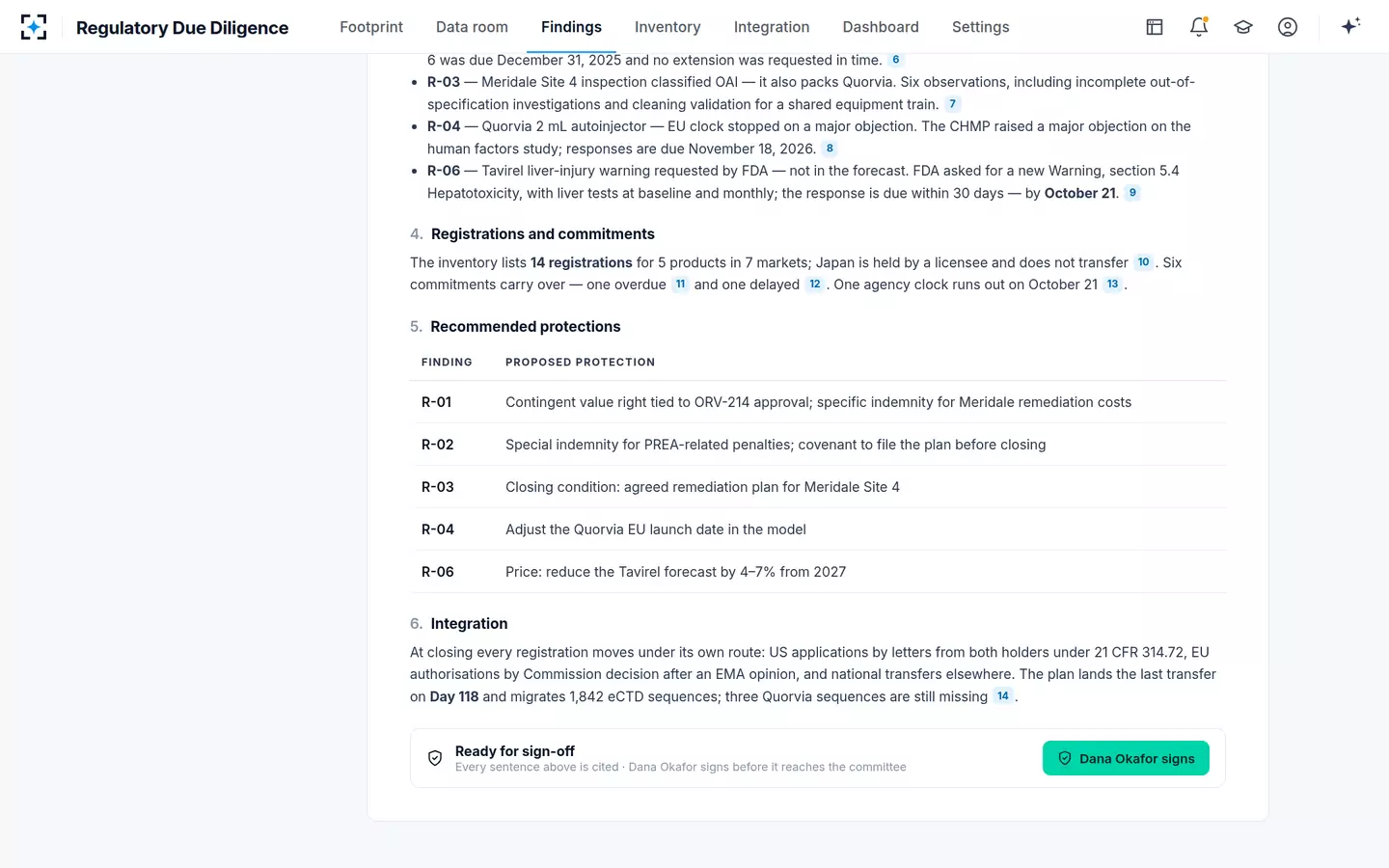
The practical summary for anyone holding a company's account of a refusal is short. Find the letter. Read all of its deficiencies, not the one that was announced. Work out what the resubmission would have to contain, and therefore which cycle it starts. Ask for the minutes of the meeting that followed. And treat every redaction as a question rather than a silence. How that reading becomes a scored, signed finding is shown from Regulatory Due Diligence, and the way the same method applies to overdue obligations is in post-marketing requirement against commitment.
Questions people ask
What does FDA redact from a published complete response letter?
Confidential commercial information and trade secret information, which FDA says is removed before disclosure under the Trade Secrets Act and section 301(j) of the Federal Food, Drug, and Cosmetic Act. In practice the deficiencies themselves usually survive, because they are safety and effectiveness findings; what disappears tends to be proprietary manufacturing and assay detail. Read a redaction as an unknown rather than as evidence that nothing was there.
How long does a resubmission take after a complete response letter?
Two months or six, depending on how FDA classifies it. The regulation treats a Class 1 resubmission as the applicant's agreement to a new two-month review cycle from the receipt date, and a Class 2 resubmission as agreement to a six-month cycle; the performance goals commit the agency to 90% within each. Classification turns on what the resubmission contains, and the Class 1 list is short and specific.
Can you tell from a press release what the CRL said?
Usually not. The peer-reviewed study of 61 letters found that press release statements matched only 14% of the statements in the letters, including 16% of efficacy and 15% of safety statements, and that of seven letters reporting higher mortality in treated participants only one press release mentioned it. The study's own conclusion is that press releases are incomplete substitutes for the letters. Since 2025 you can usually read the letter instead.
Were complete response letters available before 2025?
Only on request. The authority to release them under freedom-of-information law and FDA's disclosure regulations already existed, which is why the 2025 change could be made by the agency on its own. What changed is the posture: proactive publication of batches, then prompt release of newly issued letters, rather than disclosure case by case after a request and a wait.
What is a Type A meeting after a complete response letter?
The meeting category FDA uses for a stalled development programme or an important safety issue. A post-action meeting requested within three months of a regulatory action other than approval — which includes the issuance of a complete response letter — is generally treated as Type A. Its minutes are not published, so in a diligence setting they have to be requested, and the agency's own minutes are the ones to ask for.
Does EMA publish the reasons for a refusal?
Yes, in two forms. A refusal questions-and-answers document appears in the committee highlights shortly after a negative opinion, and a refusal assessment report is published on the medicine's page about two weeks after the Commission's decision refusing the authorisation. For withdrawn applications, EMA publishes the applicant's withdrawal letter, which includes the reason for the withdrawal.