Ask why post-acquisition integration fails and the usual answers are culture, overpaying and systems that never joined up. Those answers are real and they are also unfalsifiable, which is why they survive. In a deal done for a research pipeline there is a fourth answer that can actually be measured: the inventors who hold the knowledge leave at higher rates than comparable inventors who were not acquired, the ones who stay patent less, and the science nobody managed to read gets commissioned a second time. The common cause is not culture — it is that an acquirer buys tens of thousands of files it has never read and then makes portfolio decisions before anyone has read them. Botminds' Post-Merger R&D Integration is built against exactly that failure: agents read the inherited record where it lives, carry every fact back to its page, and answer "have we already run this?" before a study is booked.
The sample acquisition used for the worked figures below — Northwind Bio's purchase of Halden Therapeutics, four programmes, 38,412 inherited files — is fictional, as is every person, company, programme and study named with it. The research findings are published and linked where they appear, and we say whose estimate each number is.
Four numbers worth arguing with
20%
more likely to leave: inventors affected by a biotechnology acquisition
13.5%
fall in inventor retention after acquisition
35%
fall in citation-weighted patent productivity, per inventor
$28Ba year
spent on preclinical research that is not reproducible, in the United States alone
Why do mergers fail when the science was the reason for the deal?
Because the thing being bought is not the files; it is the understanding that produced them, and that understanding is held by people and by context rather than by documents. The published work puts this plainly: "in high-tech industries, where intellectual property is crucial, the acquisition of intangible assets and tacit knowledge of employees is one of the main motivations for Mergers and Acquisitions" (Humanities and Social Sciences Communications, 2025). If tacit knowledge is a main motivation for the deal, then a plan that has no mechanism for moving it is a plan that has not addressed the deal's own thesis.
What usually happens instead is that the research workstream is run as a systems and headcount exercise. Notebook platforms are compared, an organisation chart is drawn, retention letters are issued, and the actual content — four programmes' worth of studies, protocols, amendments, correspondence and raw data — waits for someone to have time. By the time a function head reads a study report in anger, the programme decision has already been taken and the person who could have explained the report has left.
So the failure is not dramatic. Nothing goes wrong in week three. The deal simply delivers less than the thesis, slightly later, for reasons that are individually defensible, and the post-mortem calls it culture.
The deal thesis, and the same four programmes a hundred days later
What the thesis assumed: Four programmes, one approaching Phase 2, bought for the science behind them.
What the first hundred days found: Nobody at the acquirer has read that science. A function lead needs about five weeks per asset to pull the record together by hand.
What the thesis assumed: Complete, indexed and already reviewed in diligence.
What the first hundred days found: Indexed for a valuation, not for a toxicology head: drafts sit beside finals, and much of the raw data behind the reports is in a contract laboratory’s archive instead.
What the thesis assumed: Key scientists retained for twelve months, so the knowledge comes with the asset.
What the first hundred days found: Retention ends on dates fixed before closing, and the published evidence says acquired inventors leave more often and patent less when they stay.
What the thesis assumed: Phase 2 dose selection proceeds on the package that was diligenced.
What the first hundred days found: The exposure margin rests on a value an amended final report corrected — 1.9× rather than 6.2× on the sample programme.
What the thesis assumed: Integration complete; the research workstream closes.
What the first hundred days found: The first dossier section a function owner is willing to sign is still about two weeks away.
What the published work says about the people you bought
The best evidence on this is specific to biotechnology and large enough to take seriously. Verginer and Riccaboni set out their scope precisely: "this study examines the effects of acquisitions on the retention and R&D productivity of inventors in the biotech sector, using data from 15,318 inventors involved in 1,375 acquisitions between 1990 and 2010" (authors' preprint; published in the Journal of Business Research, November 2025). Their headline results are a 13.5% fall in inventor retention and a 35% fall in citation-weighted patent productivity after acquisition.
Two things about those numbers deserve care in a management meeting. They are measured on inventors, not on a firm's total output, so they are not a forecast of what your combined patent count will do. And they are averages across acquisitions made over two decades, 1990 to 2010, and more than a thousand deals, so they describe a tendency rather than a prediction about your deal. What they establish is that the departure risk in a research acquisition is not a story — it is a measured, repeated effect, large enough to plan against.
The second study puts the departure rate at 20% higher for inventors affected by acquisitions than for matched inventors who were not. Taken together, the two tell you something useful about sequencing rather than about retention policy: whatever you intend to learn from the acquired company's scientists, the expected value of asking declines every week, and the questions only one person can answer are the ones to ask first.
The productivity of the ones who stay
The comfortable reading of a retention statistic is that the people who matter most will be kept. The research does not support it. The same study finds the productivity decline is sharper among inventors who remain with the acquiring firm, and sharpest of all among those whose expertise was most specific to the acquired company. In other words, the retention bonus works on exactly the people whose output then falls furthest.
That is not a reason to skip retention. It is a reason to treat a retention period as a window for questions rather than as a solution in itself. A scientist who stays for twelve months and is never asked anything specific has transferred nothing; a scientist who stays three months and answers four precise questions a week has transferred a great deal. The difference is whether the acquirer has read enough to know what to ask, which puts reading back at the front of the plan.
The second bill: paying twice for science you already own
The most avoidable leak in a research integration is the study that is run again because nobody could find the one that was already run. It is avoidable because the evidence is sitting in the acquired company's own reports and notebooks, and it happens anyway, because those reports are not searchable by the person planning the next study and the person who would have remembered has left.
In the sample acquisition, the programme leader plans an efficacy study of the lead compound in a mouse model of inflammation to support Phase 2 dose selection. The reuse check reads the plan, lists twenty candidate models from the literature and the acquirer's own catalogue, searches 412 acquired study reports and 9,742 notebook entries, and finds that seven of the twenty were already run or tried at the acquired company. Three were full studies rather than pilots. Two are recommended for reuse — and one of those two already carries most of the dose–response the new study was designed to produce: peritoneal interleukin-1β fell 48% at 10 mg/kg and 72% at 30 mg/kg, with the 10 mg/kg arm at an unbound maximum concentration close to what the planned Phase 2 dose would give. Only a lower 3 mg/kg arm is missing.
The accurate version of that result is not "we saved a study". It is "we replaced a study with one dose arm", which is a better outcome and a smaller claim. The sample acquisition's own team put the effect across two reused mouse studies at roughly seven months of in-vivo work not repeated — their estimate, on their sample, and the kind of number worth re-deriving on your own deal rather than borrowing.
Has this already been run? Twenty candidate models, narrowed to two
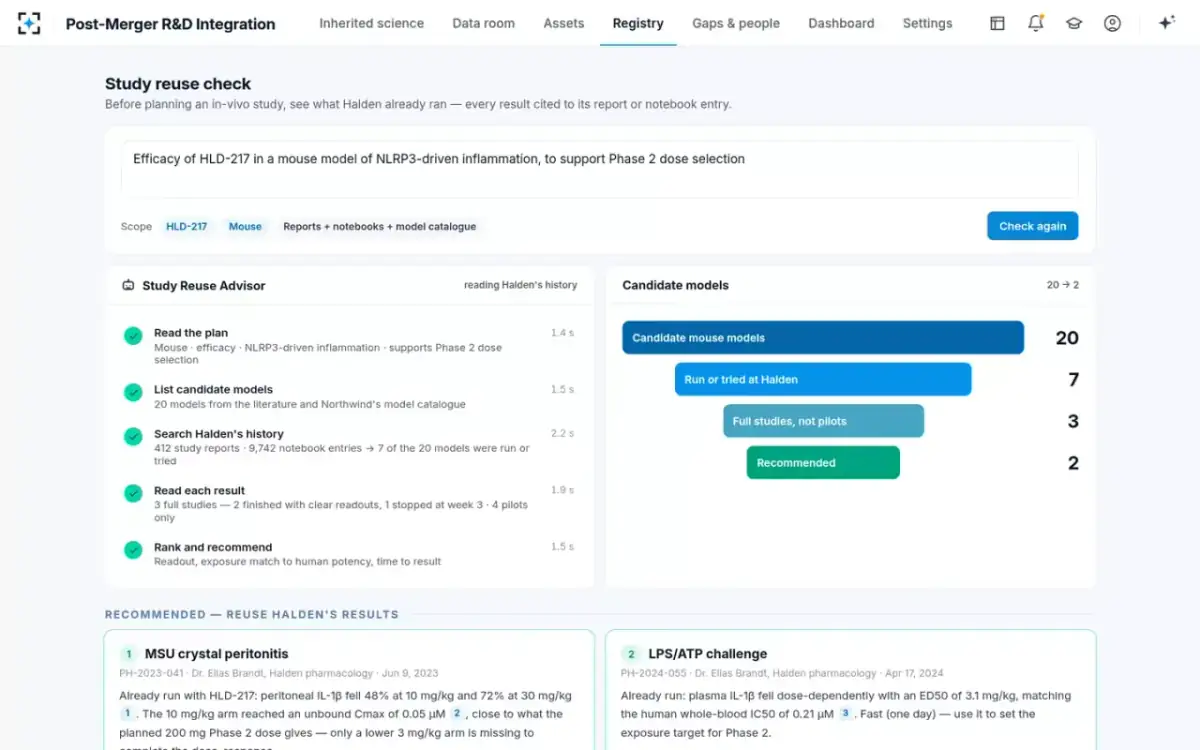
Note the last step in that funnel. Of the seven models tried, four were pilots and one full study was stopped at week three. A reuse recommendation that did not say so would be worse than useless, because it would send a programme leader to a result that cannot carry the weight. Saying when a prior study was stopped or inconclusive is the difference between reuse and wishful thinking.
What research waste looks like in a company, not a field
There is a serious literature on research waste, and it is worth separating from the integration problem even though the two rhyme. At field level, Freedman, Cockburn and Simcoe estimated that "the cumulative (total) prevalence of irreproducible preclinical research exceeds 50%, resulting in approximately US$28,000,000,000 (US$28B)/year spent on preclinical research that is not reproducible—in the United States alone" (PLOS Biology, 2015). That is a statement about an entire national research enterprise. It is not what an acquirer loses on a deal, and anyone who presents it as such should be asked for the arithmetic.
What does transfer to a company is the mechanism the waste literature identifies. The Lancet series on research waste names the specific failure an integration reproduces at speed: "insufficient consideration might be given to both previous and continuing studies" (Ioannidis and colleagues, 2014). An acquisition is the purest form of that problem — thousands of previous studies arrive at once, in a format nobody can search, owned by a team that has not read them, with a decision calendar already running.
The same authors are careful to call these failures correctable: "correctable weaknesses in the design, conduct, and analysis of biomedical and public health research studies can produce misleading results and waste valuable resources". Correctable is the operative word. Nothing about an inherited record forces a company to repeat work; it just makes repeating work the path of least resistance.
How much does it cost to repeat a study?
We are not going to quote you a price, and you should be suspicious of a page that does. Published, independently verifiable costs for a specific preclinical package are rare, many of the figures that circulate come from vendors and consultancies, and they vary by species, duration and site by more than any average would survive.
What can be reasoned about honestly is time, because time is what an integration actually spends. Three components are worth putting on the table separately. First, calendar time: the sample acquisition's team estimated that reusing two mouse studies avoided about seven months of in-vivo work. For a programme approaching a Phase 2 decision, seven months is usually the dominant cost, not the invoice. Second, the opportunity cost of the decision made while waiting — a dose chosen from a corrected value, a cohort designed without a result that already existed. Third, the assembly cost: the five weeks per asset of finding, extracting and checking that precedes any of it.
What an unread inheritance costs, per acquired asset
Assembly you pay for once, by hand
≈ 25 working days per asset
Finding and sorting the files, pulling out findings, PK, lots and commitments, checking summaries against the reports behind them, writing the cited sections and finding who knows.
Our estimate, from the solution’s own split
Science you pay for twice
studies repeated because the first could not be found
On the sample acquisition, two mouse studies already run — the team put it at about seven months of in-vivo work not repeated.
The sample team’s estimate
Answers that expire
open questions × the last day of the only person who can answer
Five of the twelve gaps raised by Day 50 name a scientist who is leaving; one becomes unanswerable nineteen days later.
Fictional sample acquisition
What the same work leaves instead
6 days per asset to a cited draft
A dossier section per function with every sentence carrying its document, version and page, ready for the owner to sign.
Design target for the live solution
Where an asset's five weeks actually go
The assembly cost is the one most integration plans never price, because it is distributed: a week here from a toxicologist, two days there from a regulatory lead, none of it on anyone's project plan. Broken down, roughly 25 working days per asset go to five activities, and only one of those five is the work anybody was hired to do.
Four of the five activities add nothing a reader can see
The checking bar deserves a second look. Four days per asset is what it takes to compare what the summaries say against what the reports say, and it is invariably the first thing dropped when the Day 100 review approaches. Drop it and the dossier still gets written, on time, with a dog no-observed-adverse-effect level of 50 mg/kg/day in it that an amended final report corrected to 15 — and the exposure margin to the planned Phase 2 dose quietly becomes 1.9× instead of 6.2×.
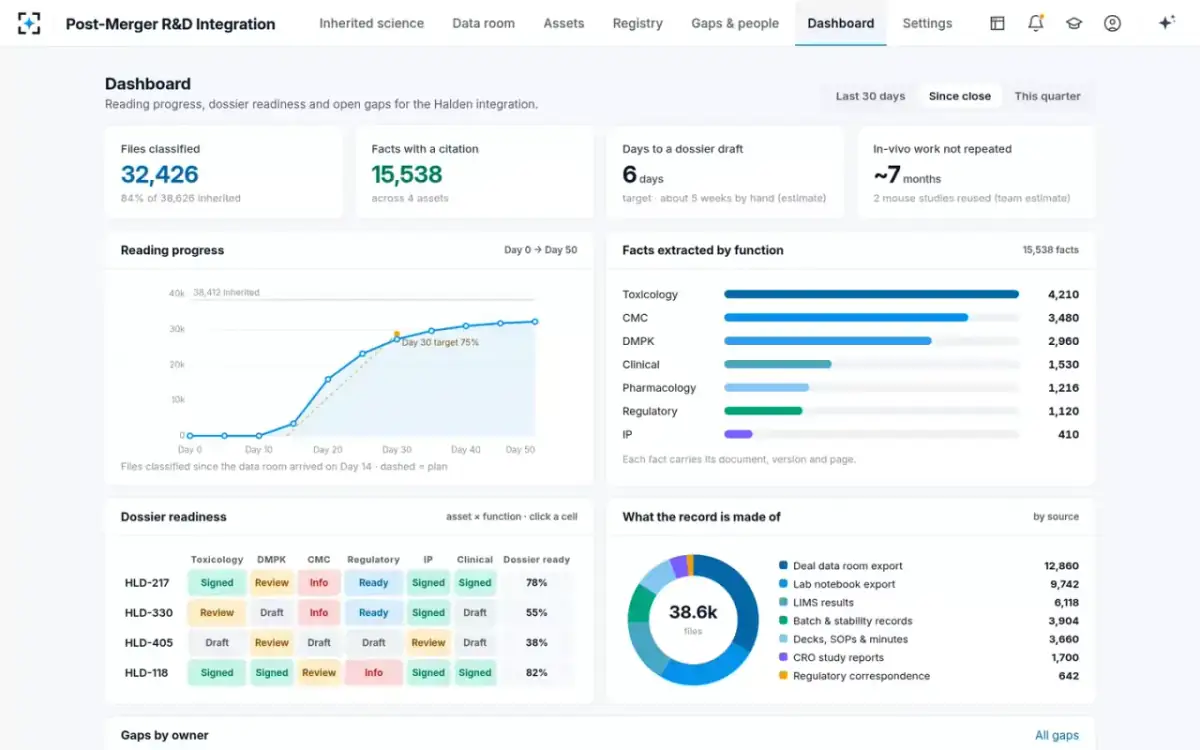
Reading progress against plan, as a curve rather than a status
Four leaks, and the week each one opens
Put the research and the arithmetic together and the leaks are specific enough to watch for. Each opens early and is noticed late.
The first opens in week one, when reading is deferred behind a systems or organisation decision. The second opens the day retention letters are signed without a question list attached, because the clock starts and nobody knows what to ask. The third opens the first time a summary is used as a source — a diligence memo, an IND module, a deck — without the report behind it being read; from then on every document built on it inherits the error. The fourth opens when the first new study is scoped from the literature rather than from the acquired company's own history, and it is the only one of the four with an invoice attached.
None of these is a failure of competence. They are all consequences of a single structural fact: at the moment the decisions are made, the acquirer has not read what it bought. That is why the only work that genuinely belongs in week one is reading, and why everything else in the hundred-day plan is downstream of it.
What would have to be true for the deal thesis to hold
A useful discipline, borrowed from the investment side of the same deal: rather than asking whether the integration is going well, ask what would have to be true for the thesis to hold, and then test each one.
Five tests for whether your own integration is leaking
- Can you name, today, how many of the acquired studies nobody at your company has read?
If the answer is a percentage of files classified, good. If it is "most of them, probably", the portfolio decision in week eight is being taken blind.
- For every key value in your dossier, can you open the page it came from?
Not the summary that states it — the report, at the page. A value that cannot be opened is a value that may already have been corrected somewhere you have not looked.
- Does every open question have a name and a date against it?
A question with an owner gets answered. A question on a risk list gets reported. The date is the leaver’s last day, not your milestone.
- Before the next in-vivo study is booked, has anyone searched what the acquired company already ran?
Searched, not asked. The people who would have known are the ones most likely to have gone, and the answer is usually in the notebooks.
- Do you know where the raw data behind each report is, and who is responsible for that archive?
Reports travel with a deal; raw data often does not. Finding out in week two is administration, and finding out in month nine is an incident.
There is one more thing worth knowing about the retention clock, which cuts the other way. Nonclinical records are kept for defined periods even when a programme stops: where a study did not go into an application, the rule is "a period of at least 2 years following the date on which the study is completed, terminated, or discontinued" (21 CFR 58.195(b)(3)). An acquirer that shuts a programme down still inherits the record and its clock, so the choice is never between reading and not reading — it is between reading while the authors are still reachable and holding files you cannot explain.
What you bought, before anyone has decided what to keep
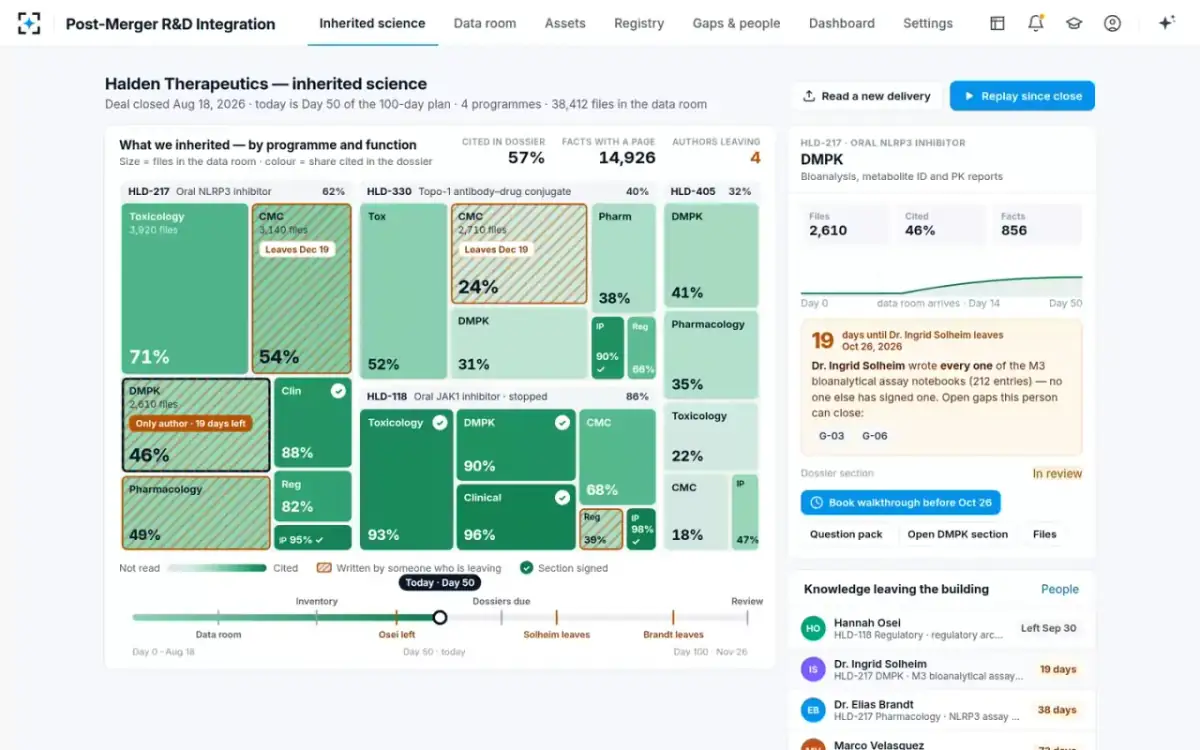
The research answer to why mergers fail is, in the end, unglamorous. The science was the reason for the deal, and the science was the last thing anybody read. To see what reading first looks like on an inherited data room, start from Post-Merger R&D Integration.
Questions people ask
What percentage of mergers fail?
No single figure is defensible, because "fail" is defined differently in every study — against the acquirer's share price, against the deal's own targets, against whether the business still exists. Rather than argue about a headline rate, the useful move in a research deal is to name the mechanisms you can measure on your own transaction: how much of the inherited science has been read, how many open questions have an owner and a date, and how many studies have been repeated.
Do acquisitions reduce innovation?
In biotechnology, the published evidence points one way for the inventors involved: acquired inventors leave at higher rates than matched inventors who were not acquired, and those who stay show a substantial fall in citation-weighted patent productivity, sharpest for those whose expertise was most specific to the acquired company. That is a finding about inventors, not a verdict on every acquisition, and it says more about how integrations are run than about whether they should happen.
What happens to R&D spending after a merger?
It is usually re-allocated rather than simply cut: programmes are re-ranked against the combined portfolio, duplicated capability is consolidated, and the money follows the assets that survive the review. The risk for a research acquisition is the sequencing — the re-ranking happens on the acquirer's calendar, which is often before anyone has read the acquired evidence well enough to rank anything honestly.
How do you avoid repeating research you already own?
Make the acquired company's own history searchable before the first new study is scoped, and make the search a required step in study planning rather than a courtesy. That means reports and notebook entries indexed together, each result readable with its report number, author and date, and an explicit statement when a prior study was stopped or inconclusive — otherwise the reuse recommendation is worse than no recommendation.
How long does it take to integrate an R&D organisation?
The organisational part follows the deal calendar and is usually done inside the hundred days. The knowledge part is bounded by two things the calendar does not control: how fast the inherited record can be read, and the dates in the retention letters. Treat the second as the binding constraint, and the honest plan is written backwards from the earliest last day rather than forwards from closing.
Is "research waste" the same problem as integration failure?
They share a mechanism and differ in scale. The waste literature describes a field-level problem — unreported studies, poor documentation, insufficient consideration of what came before. An integration compresses the same failure into a hundred days and a single balance sheet: a very large body of previous work arrives at once, in a form nobody can search, while decisions are being made. The field's problem is cultural; yours is operational, and therefore fixable on your own timetable.