A scientific data management system is software that captures, organises and keeps the data a laboratory produces, along with the context that makes it mean something. The work is hard the moment the system is not yours: after an acquisition an informatics lead inherits somebody else's notebook, somebody else's laboratory information management system and a folder tree nobody has mapped, and is asked in month two which to keep, which to migrate and which to switch off — before anyone has read what is in them. Botminds' Post-Merger R&D Integration is built for that gap: six agents read the inherited record where it lives, label what each file is and which version it is, and tie every extracted fact to its page, so the decision about systems is made after somebody knows what each one holds rather than before.
The acquisition on this page is sample data: Northwind Bio and Halden Therapeutics, 38,412 files from seven sources. Every company and source named in it is fictional. The guidance quoted is the MHRA's, written for UK industry and the public bodies it regulates, and the United States rules are cited separately where they apply.
Five places an acquired company's science actually lives
| What it is | What it holds | What its original record is | What reading it in place gives you |
|---|---|---|---|
| Electronic lab notebook (ELN) | Experiments as they were run: protocol, observations, attachments, the author and the date, witnessed or not. | The entry itself, with its attachments, its authorship and its history of changes. | Who did what and when — and, crucially, who the only author of something was. |
| Laboratory information management system (LIMS) | Samples, tests, results and certificates of analysis, tied to a sample identity and a method. | The result record and the metadata describing how it was produced. | Whether a specific sample was ever tested for a specific thing, which a report may not say. |
| Scientific data management system (SDMS) | Instrument output and the files around it, gathered from many systems and kept for the long term. | The raw instrument file, plus whatever is needed to reconstruct the run. | The layer under the results — usually the only place a derivation can be checked. |
| Document store or quality system | Reports, protocols, standard operating procedures and their versions and approvals. | The approved version, with its approval record. | Which version of a report is current, and whether an amendment exists. |
| The deal data room | A selection, made by the seller, exported for the transaction: PDFs, decks, spreadsheets. | Nothing. It is a copy of a selection, and that is what it is for. | A fast start, and a map of what you have not been given. |
What is a scientific data management system?
Narrowly, a scientific data management system is the layer that collects instrument and application output across a laboratory, stores it in one place for the long term, and makes it findable later. It sits under the notebook and the laboratory information management system rather than beside them: the notebook records what an experiment was, the information management system records what the samples did, and the data management system holds the files those conclusions were drawn from.
Broadly — and this is how the phrase is usually used by the person asking — it means the whole arrangement by which a company's scientific data is kept and found. That broader reading is the right one for an acquirer, because what you inherit is never one system. It is a notebook with four years of entries, an information management system with a decade of sample results, an instrument store somebody set up and half-abandoned, a quality document store, a shared drive, and a data room export that overlaps all of them unpredictably.
The question that matters is therefore not "what is their SDMS?" but "for each thing we will need to prove, where is the record that proves it, and can we still open it?" Those are two different questions, and the second one has a deadline attached: it is answered by whoever is still paying the licence.
ELN, LIMS, SDMS and the data room: four different things
The table above separates them, and the separation matters more after a deal than before one, because each answers a question the others cannot. An inherited notebook tells you who wrote something — which is how you find out that one departing scientist authored every entry behind a critical assay. A laboratory information management system tells you whether a particular sample was ever tested for a particular analyte, which a study report may be silent on. An instrument store is where a derivation can be checked. A document store tells you which version of a report is the current one, and a data room tells you none of these things reliably, because it is a selection somebody made for a different purpose.
One overnight delivery from the sample acquisition shows the texture of it. Two hundred and fourteen files arrived from a contract research partner's share; sorted, they were 41 study reports, 96 data tables, 58 letters and minutes, and 19 duplicates. Nearly half of what arrived was data rather than conclusions, a quarter was correspondence, and one file in eleven was something the archive already had.
What one inherited delivery was actually made of
214 files from one partner share
- Study reports · 41 · 19.2%
- Data tables · 96 · 44.9%
- Letters and minutes · 58 · 27.1%
- Duplicates · 19 · 8.9%
Telling a duplicate from a second version, before anything moves
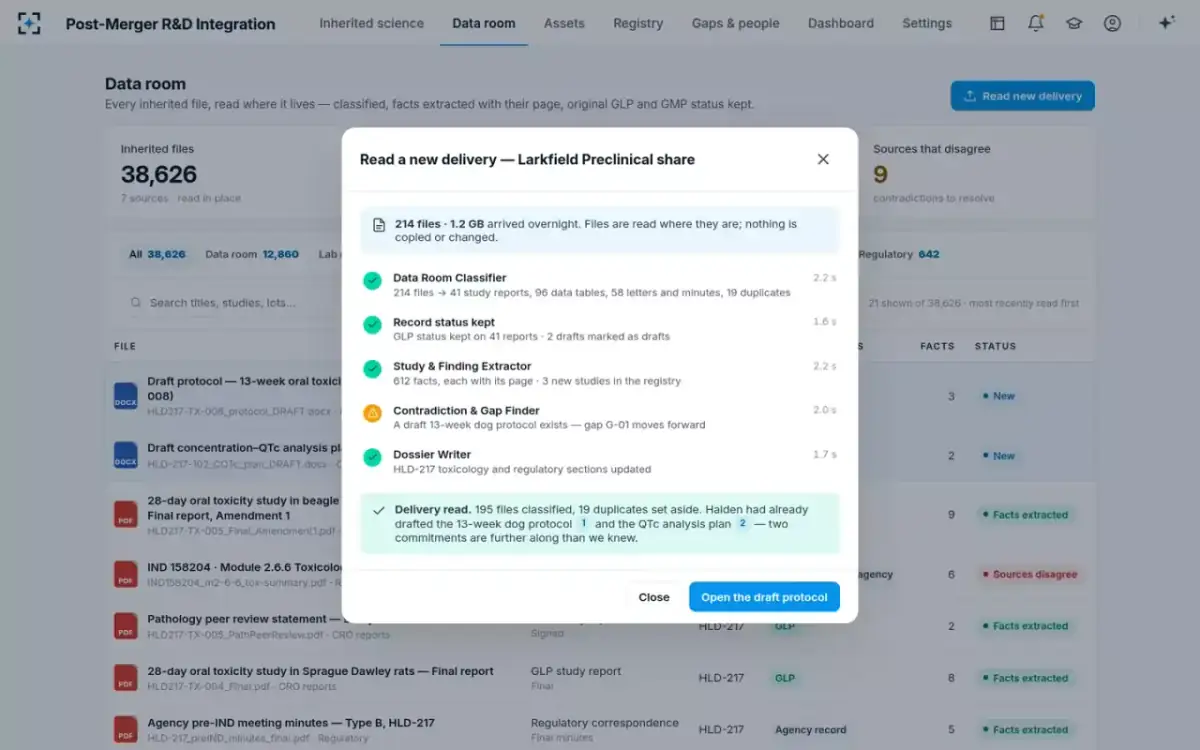
The duplicates are the detail worth dwelling on. Nineteen files in one delivery already existed somewhere in the archive, and a migration that treats arriving files as new records multiplies that problem across every source. Telling a duplicate from a second version of the same document is not a storage question; it is a reading question, and it has to be answered before anything is moved.
What happens when you migrate research data?
Migration is moving stored data from one durable location to another, and the MHRA's definition is careful about what may and may not change: it "may include changing the format of data, but not the content or meaning." Keeping the meaning is the hard part, and the guidance says so in one unusually blunt sentence.
The challenges of migrating data are often underestimated, particularly regarding maintaining the full meaning of the migrated records.
MHRA, GXP Data Integrity Guidance and Definitions, Revision 1, section 6.8
The same guidance sets out what a migration is supposed to involve: a documented rationale, a robust design, validation to show integrity is maintained, careful consideration of the data format and the potential for alteration at each stage, and an audit trail for the transfer itself. Done properly, that is a project. Done as a line item in a hundred-day plan, by people who have not read the data, it is a project with no acceptance criteria, because nobody involved can say what the records are supposed to mean on the other side.
And there is a point at which the guidance concedes the loss rather than preventing it. Where migrating with full original functionality is not technically possible, options are assessed on risk and on the importance of the data over time, and the file format is chosen "considering the balance of risk between long-term accessibility versus the possibility of reduced dynamic data functionality." It then says plainly that "it is recognised that the need to maintain accessibility may require migration to a file format that loses some attributes and/or dynamic data functionality." Sometimes you must trade; the question is whether you know what you are trading.
What gets lost, and why you would not notice
Four things go first, in roughly this order. Dynamic functionality: the ability to reprocess, re-integrate or expand a baseline, which a flattened export cannot do. Metadata: the method, the instrument settings, the units and the context that tell you what the number is. The audit trail: who changed what, when and why. And authorship, which in an acquisition is the one that costs most, because authorship is how you find the person who can answer a question.
The reason you would not notice is specific to an acquisition, and it is the strongest argument on this page. In your own company, a lost attribute announces itself: somebody goes to reprocess a chromatogram, finds they cannot, and raises it, because they remember what the system used to do. In an inherited archive there is no such person. Nobody at the acquirer knows what the notebook used to show, so a migration that silently drops it produces no complaint, no finding and no record. The loss is invisible precisely because the knowledge was never transferred — which is the same reason the people who could tell you are the ones on retention contracts, as key person risk after an acquisition sets out.
One result, in the three forms you are likely to be handed it
The dynamic original
The record in the system that made it, with its metadata and audit trail intact.
Can still answer
- Reprocess, re-integrate, expand a baseline
- Show who changed what, when and why
- Answer a question nobody thought to ask in 2021
Cannot
Be opened at all once the system is switched off, unless something keeps it readable.
A static export
The same result written out to a fixed file — a table, a spreadsheet, a report attachment.
Can still answer
- Be read by anyone, anywhere
- Carry the numbers the report was built on
- Be cited, page by page
Cannot
Be reprocessed, or answer a question about how the number was derived.
A printed summary
The conclusion, as a person wrote it at the time, in a deck or a submission section.
Can still answer
- Tell you what was concluded, and when
- Tell you who the author thought the audience was
Cannot
Be relied on as current. A summary written from a draft keeps the draft’s number.
Why read in place before you decide
The sequence most integration plans use is: consolidate systems, then work out what you have. Reversing it costs nothing and changes everything, because every question a migration plan has to answer — which records are critical, which are duplicates, which exist only in one place, which can lose dynamic functionality without harm — is a question about content, and content is what reading produces.
Reading in place means exactly that: files are read where they live, nothing is copied into a new system of record, nothing is altered, and an inherited good laboratory or manufacturing practice record keeps the status it arrived with rather than being re-labelled. Agents label record type, asset, study, version and original status; where a version is unclear, the file goes to a person instead of getting a guess. That is deliberately not a migration, and it is worth being exact about what the product does and does not claim: it does not keep an old system running, it does not replace a notebook or a laboratory information management system, and it does not move anything. It reads.
What that buys is a map: which programme's science sits in which source, how much of it is now cited in a dossier section somebody will sign, and where the archive is silent. With the map in hand, the migration conversation becomes tractable, because it can be had one system at a time against a known list of what that system uniquely holds.
The inherited archive, source by source, read where it lives
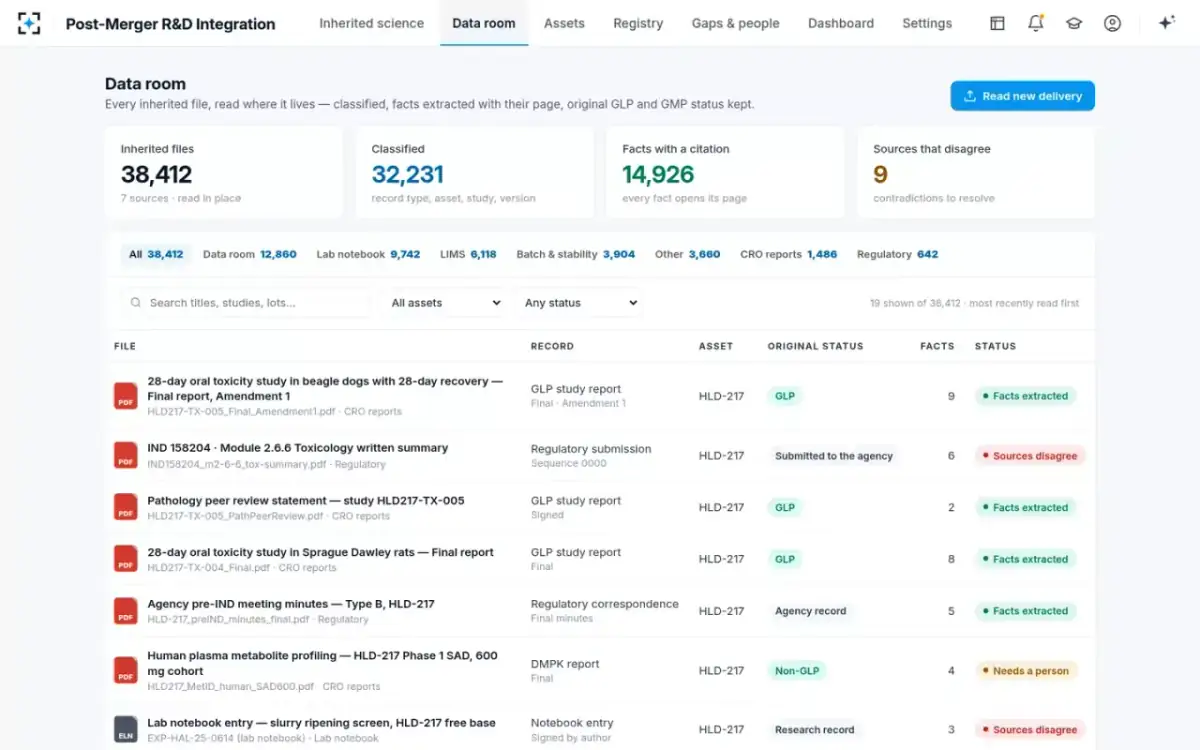
Migrate first, or read first
Consolidate the systems, then find out what you have: The system names, the licence costs and the renewal dates.
Read the record in place, then decide what to migrate: The same — but the first fortnight adds what each system uniquely holds.
Consolidate the systems, then find out what you have: Hard to state. The guidance warns the challenges of migrating are often underestimated, "particularly regarding maintaining the full meaning of the migrated records", and nobody at the acquirer knows the full meaning yet.
Read the record in place, then decide what to migrate: Stated: every critical fact traceable to a document, version and page in the system it came from.
Consolidate the systems, then find out what you have: Silent. A dropped attribute produces no complaint, because nobody remembers what was there.
Read the record in place, then decide what to migrate: Visible. A fact that cannot be traced is raised as a gap with an owner, not left as an absence.
Consolidate the systems, then find out what you have: Carried across and multiplied; drafts and finals arrive looking alike.
Read the record in place, then decide what to migrate: Told apart on arrival — in one sample delivery, 19 duplicates of 214 files set aside before anything was read for content.
Consolidate the systems, then find out what you have: A second migration, and a retention period you are now responsible for.
Read the record in place, then decide what to migrate: A fortnight of reading, and a shorter migration list.
Consolidate the systems, then find out what you have: When the migration is signed off — which is also when you find out what it lost.
Read the record in place, then decide what to migrate: When you can name what that system held that nothing else does, and have it somewhere readable.
How long do you keep the old system running?
Long enough to satisfy the retention obligation on the records it holds, and long enough to answer questions about them — which are not always the same period. Two rules frame it. The MHRA's archive expectation is an outcome: whatever the arrangement, the data and its metadata have to stay recoverable and readable for the whole of the required retention period. The United States electronic records rule asks for "the ability to generate accurate and complete copies of records in both human readable and electronic form suitable for inspection, review, and copying by the agency."
Both put the burden on readability rather than on the system staying alive, which is the opening. Where a system can no longer be supported, the MHRA's guidance says consideration should be given to maintaining the software for data accessibility purposes for as long as possible, and notes this may be achieved by keeping it in a virtual environment. It also says that where a system cannot be maintained, records should be archived according to a documented archiving strategy before decommissioning — not after, and not instead.
The good laboratory practice rules add the part that saves money: an archive need not hold everything physically, as long as it knows where things are. "Raw data and specimens may be retained elsewhere provided that the archives have specific reference to those other locations." A documented reference to another location is an acceptable answer; an undocumented belief that something is on a share somewhere is not.
What are the FAIR principles, and where do they help here?
FAIR — findable, accessible, interoperable, reusable — is a community framework published in Scientific Data in 2016, not a regulator's rule, and nothing in it has to be satisfied to pass an inspection. Its stated motivation is the one an acquirer feels acutely: "There is an urgent need to improve the infrastructure supporting the reuse of scholarly data." Its distinctive move is machine-first: the principles "put specific emphasis on enhancing the ability of machines to automatically find and use the data, in addition to supporting its reuse by individuals."
That emphasis is what makes it useful here rather than aspirational. An acquirer's first problem is exactly a findability problem at a scale no human can work through, and the parts of FAIR that pay off fastest are the cheap ones: a persistent identifier for each record, rich metadata that says what a file is and which study it belongs to, and metadata that still names its record after the record itself has moved or been archived. Those are achievable on an inherited archive without touching the archive, because they describe files rather than change them.
Where FAIR does not help is the part people hope it will. It is not a migration standard, it does not say which system to keep, and an archive can be perfectly FAIR and still fail a retention obligation. Treat it as a way to judge whether your reading of the inheritance is reusable by the next person, and keep the regulatory questions in their own column.
Static and dynamic records, and what a PDF throws away
The distinction underneath this whole argument is the MHRA's, and it is worth quoting because it explains a frustration every informatics lead has had. "Records in dynamic format, such as electronic records, allow an interactive relationship between the user and the record content." A static record, by contrast, is fixed and allows little or no interaction — the guidance's example is that once printed or converted to a static electronic format, chromatography records lose the capability of being reprocessed or of showing the baseline in more detail.
So a PDF of a chromatogram is a picture of a record. It is enough to read, to cite and to compare with another document; it is not enough to re-integrate when somebody questions how a peak was assigned. The guidance's position is that data must be retained in dynamic form where this is critical to its integrity or later verification — which makes "which of our inherited records are critical in that sense?" a question with a short, answerable list behind it, and one that a fortnight of reading produces.
Note what this does to the data room. Almost everything in a data room is static by construction, and the guidance's account of a true copy is demanding: an accurate and complete copy should include the meaning of the data — date formats, context, layout, electronic signatures and authorisations — and the full audit trail. A deal export rarely meets that. It is a fine thing to read and a poor thing to mistake for the archive, which is the same point the ALCOA discipline for inherited records makes from the integrity side.
A sequence that works: read, map, then decide
Three phases, in an order that lets each one produce the input the next one needs.
Eight questions to put to each inherited system before anyone proposes a migration
- What does this system hold that nothing else holds?
The only question that justifies keeping it. Answering it needs reading, not an inventory.
- Which of its records are critical in dynamic form?
Data must be retained in dynamic form where this is critical to its integrity or later verification; everything else can be a static copy.
- What is the retention obligation on what it holds, and who is responsible for meeting it now?
A change of owner does not restart a retention period, and the archive has to permit recovery and readability throughout it.
- Does the metadata travel if the files do — method, instrument, units, authorship, approvals?
A true copy must keep the metadata and audit trail needed for the full meaning to survive and the history to be reconstructed.
- Is there an audit trail, and would it survive a move?
The transfer itself is expected to have an audit trail, and audit trail documentation is retained at least as long as the records it describes.
- Who can still open it, and what happens when their contract ends?
Access and knowledge expire on different dates from licences, and in an acquisition both are on a schedule somebody has already signed.
- If it is switched off, where is the specific reference to where its records went?
Raw data and specimens may be held elsewhere provided the archive refers specifically to those locations — a documented reference, not a recollection.
- Could we defend this decision in two years, to someone who was not here?
The decision, its rationale and what was accepted as lost should be written down at the time; the guidance expects a documented archiving strategy before a system is decommissioned.
Phase one is reading, and it has a measurable end: every programme's inherited science classified by source and version, and every critical fact traceable to a document and a page. Phase two is the map — this system holds the authorship, that one holds the sample results, this folder duplicates both — which is the first artefact in the whole exercise a person can actually make a decision from. Phase three is the decision, taken one system at a time, with an acceptance criterion written by someone who now knows what the system means.
The rules that govern the reading are the buyer's own, not a vendor's: who signs each dossier section, whether the original good laboratory and manufacturing practice status is kept, whether final and amended reports are preferred over drafts, and the confidence below which a fact goes to a person. Those are settings, and in an inherited archive they are the whole argument about control.
The reading rules are the buyer's, and they are settings
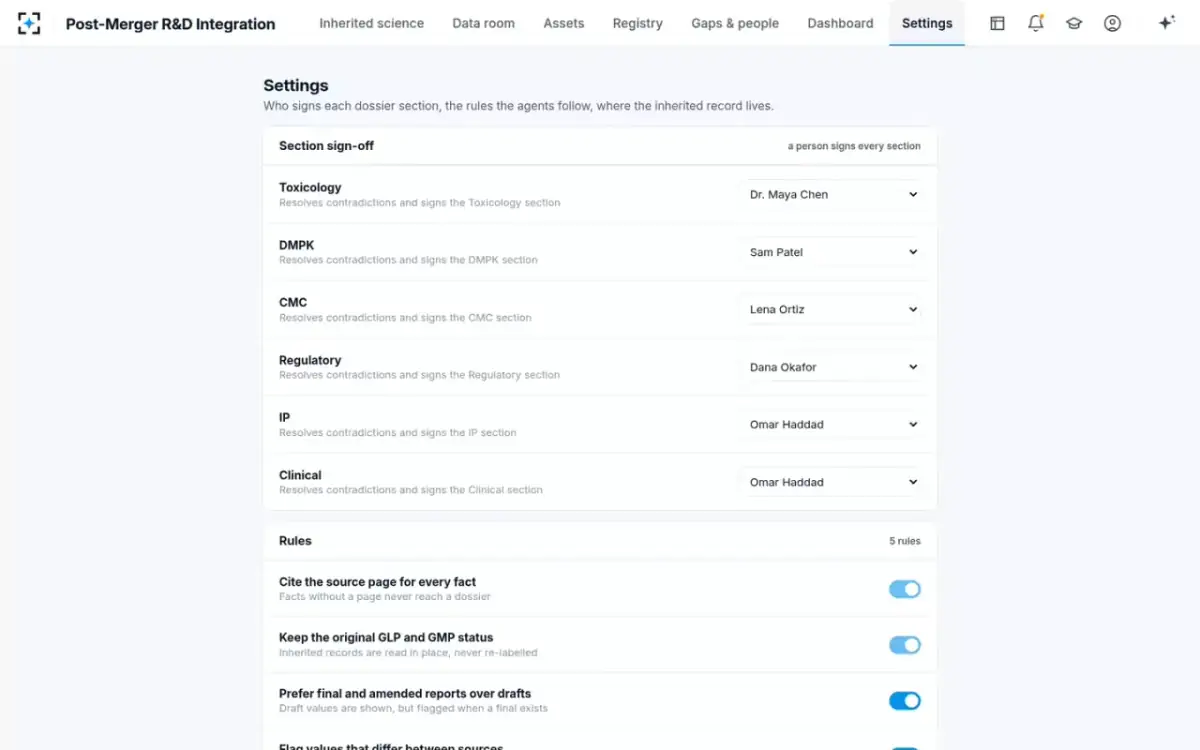
Done in that order, the migration that eventually happens is smaller, better specified and defensible. Done the other way, the first thing an integration team learns about the acquired science is what it lost. To see the reading, the map and the rules on one acquisition, start from Post-Merger R&D Integration.
Questions people ask
What is the difference between an ELN, a LIMS and an SDMS?
An electronic lab notebook records experiments as they were run — protocol, observations, attachments, who wrote it and when. A laboratory information management system tracks samples, tests and results, and issues certificates of analysis against them. A scientific data management system collects the underlying instrument output and keeps it findable for the long term. They answer different questions, and after an acquisition the useful order is: the notebook tells you who knew something, the information management system tells you whether a sample was ever tested, and the data management system is where a derivation can be checked.
What gets lost when you migrate research data?
Dynamic functionality first — the ability to reprocess or re-integrate, which a flattened export cannot do — then metadata, the audit trail and authorship. The MHRA's guidance says the challenges of migrating are often underestimated, particularly regarding maintaining the full meaning of the records, and acknowledges that keeping data accessible may require a format that loses some attributes or dynamic functionality. On an inherited archive the loss is worse, because nobody at the acquirer remembers what the original could do.
Can you read data without migrating it?
Yes, and that is the argument of this page. Reading in place means files stay in the systems and shares they live in, nothing is copied or altered, and an inherited good laboratory or manufacturing practice record keeps the status it arrived with. What is produced is a description: what each file is, which version it is, and what facts it contains with their pages. The systems question is then answered from knowledge rather than from a licence schedule.
How long do you have to keep legacy systems running?
The obligation is on the records, not the software. Archive arrangements must permit recovery and readability of the data and metadata throughout the required retention period, and a regulated entity must be able to produce accurate and complete copies in human readable and electronic form for inspection. Where a system can no longer be supported, the guidance suggests keeping the software accessible where possible — a virtual environment is named — and says records should be archived under a documented strategy before the system is decommissioned.
What are the FAIR data principles?
Findable, accessible, interoperable and reusable: a community framework published in Scientific Data in 2016 to improve the infrastructure supporting the reuse of scholarly data, with a deliberate emphasis on letting machines find and use data as well as people. It is not a regulatory requirement and does not decide retention questions. On an inherited archive the cheap parts — persistent identifiers and rich metadata that describe each record without altering it — pay back fastest.
What should you do with an acquired company's lab systems in the first hundred days?
Read before deciding. Work out what each system uniquely holds, which of its records are critical in dynamic form, what retention obligation now sits with you and who can still open it. Only then take the systems one at a time, with an acceptance criterion written by someone who knows what the records mean. The expensive mistake is not keeping a system too long; it is switching one off before anyone has read it.