Data integrity and ALCOA — attributable, legible, contemporaneous, original, accurate — describe how a regulated record has to be made and kept. The work is hard the moment the record is not yours. An acquirer inherits tens of thousands of files it never made, cannot correct, and must not alter, and the usual advice stops being usable: you cannot go back and make somebody else's entry contemporaneous, and the only lawful correction to a final report is an amendment by the study's own study director. Botminds' Post-Merger R&D Integration is built for that case — six agents read an acquired biotech's archive where it lives, tie every fact to its document, version and page, and surface the places where two inherited sources disagree so that a named owner decides between them and the decision, not the file, carries the change.
The acquisition on this page is sample data: Northwind Bio and Halden Therapeutics, four programmes, 38,412 files. Every person, company, programme and study named in it is fictional. The rules quoted are the agency's and the MHRA's own, linked where they appear.
One toxicology section of one inherited asset
14,926
facts extracted across the acquisition, each carrying the document, version and page it came from
1,412files
labelled for toxicology on this asset alone, with drafts and finals told apart
5
key facts behind the section, 1 contradiction between sources and 2 open gaps
8
citations in the drafted section, because a sentence without one does not go in
What is data integrity, and what does ALCOA stand for?
ALCOA stands for attributable, legible, contemporaneous, original and accurate: five attributes a record has to carry to be worth relying on. Data integrity is the broader idea those attributes serve. The MHRA's guidance, written for UK industry and the public bodies it regulates, defines it as "the degree to which data are complete, consistent, accurate, trustworthy, reliable and that these characteristics of the data are maintained throughout the data life cycle," and adds that the data should be collected and maintained securely so that they are "attributable, legible, contemporaneously recorded, original (or a true copy) and accurate."
The phrase that matters for an acquirer is throughout the data life cycle. The life cycle covers generation, processing, use, retention, archiving and destruction, and a change of owner is an event inside it, not the start of a new one. The files Halden made in 2022 do not become Northwind's records when the deal closes; they remain Halden's records, now held by Northwind, and every attribute they had or lacked they still have or lack.
That is more than a legal nicety. It sets what an integration team can and cannot do. It cannot improve attributability for an entry signed by one person. It cannot make a transcription contemporaneous. What it can do is preserve what is there, establish what each document is, and keep its own reading of the archive as honest as the archive allows.
ALCOA, letter by letter, asked of a record somebody else made
Attributable
Who generated this, and can you still tell? In an inherited archive the answer is often one name on 212 entries and nobody else.
Data should be attributable to the person generating it.
Legible
Can it still be read, in the format it was written, without the system it came out of?
Data should be legible and permanent.
Contemporaneous
Was it written when the work was done? You cannot make somebody else’s record contemporaneous later.
Data should be recorded contemporaneously.
Original
Is this the first capture, or a copy of a summary of it? The usual answer in a data room is the third one.
Data should be the original record, or a certified true copy.
Accurate
Accurate against what? Where two inherited documents disagree, accuracy is a decision somebody has to make and sign.
Data should be accurate.
ALCOA or ALCOA+, and why the argument does not matter
Half the training material in this field opens with a quarrel about whether there are five letters or nine. ALCOA+ adds complete, consistent, enduring and available. The MHRA settles the argument in one sentence and then moves on: whichever acronym you use, it says, the expectations are identical, because good data governance already has to keep data complete, consistent, enduring and available for its whole life cycle. The plus was added to emphasise requirements that were already there.
For an inherited archive the four extra words are the useful ones anyway, because they are the attributes most likely to have been lost in transit. Complete is the question of whether the data room holds the whole set or a diligence selection of it. Consistent is the question this page keeps returning to: a summary and a final report that give different numbers are not self-consistent, and somebody has to say which stands. Enduring and available are whether a 2019 file in a decommissioned system can still be opened at all, which is the subject of the systems you inherit, and why not to migrate them.
What counts as the original record?
The original record is "the first or source capture of data or information e.g. original paper record of manual observation or electronic raw data file from a computerised system, and all subsequent data required to fully reconstruct the conduct of the GXP activity." Two halves again: the first capture, and everything needed to reconstruct what was done. A spreadsheet of results with no method, no instrument settings and no audit trail is not the original record; it is a derivative that happens to carry the numbers.
A true copy is a verified copy — verified by a dated signature or generated through a validated process — carrying the same information, "including data that describe the context, content, and structure, as the original." The United States good laboratory practice rules say the same thing more briefly: records required by the part may be kept "either as original records or as true copies such as photocopies, microfilm, microfiche, or other accurate reproductions of the original records."
In a deal data room, most of what you are given is neither. It is an export: a PDF of a report, a flattened spreadsheet, a folder of scans with the metadata left behind. That is not a scandal — it is what a data room is for — but it decides what the files can be used for afterwards. A folder of exports is enough to read, to compare and to cite. It is not enough to treat as the archive, and an integration plan that assumes otherwise will discover the difference during the first inspection that asks where the raw data is.
Why you cannot correct a report you did not write
This is the rule that makes an inherited archive a different problem from your own. Under the good laboratory practice regulations, a final report is corrected in exactly one way: the study director issues an amendment, the amendment points to the part of the report it adds to or corrects and gives the reason, and the person responsible signs and dates it (21 CFR 58.185(c)).
Read it against the position an acquirer is in. The study director is a named individual at the facility that ran the study, under contract to the former sponsor. No one at the acquiring company is that person, and no decision taken at the acquirer can turn a draft number in someone else's report into a corrected one. The rule is not an obstacle; it is the thing that makes the archive worth anything at all. A record anyone downstream could edit would prove nothing.
So the acquirer's work is displaced by one step. Not: fix the record. Instead: establish which document is current, record who decided that and on what evidence, and keep that decision somewhere that is unmistakably not the record. The same displacement applies when the problem is an error in a submission rather than in a report — the correction belongs in the next report to the agency, made by the sponsor who now holds the obligation, which is the subject of the transfer of regulatory obligations when a sponsor changes.
A draft, a final and an amendment: which one stands
The sample acquisition carries the case in its cleanest form. The IND Module 2.6.6 toxicology summary gives a dog 28-day no-observed-adverse-effect level of 50 mg/kg/day. It is traceable: the summary took it from the draft report dated 2 November 2023. The final report's first amendment gives 15 mg/kg/day, after a pathology peer review found minimal liver necrosis at the higher dose. Both documents sit in the same data room, and nothing on the face of the summary says it is out of date.
How one inherited toxicology section was built
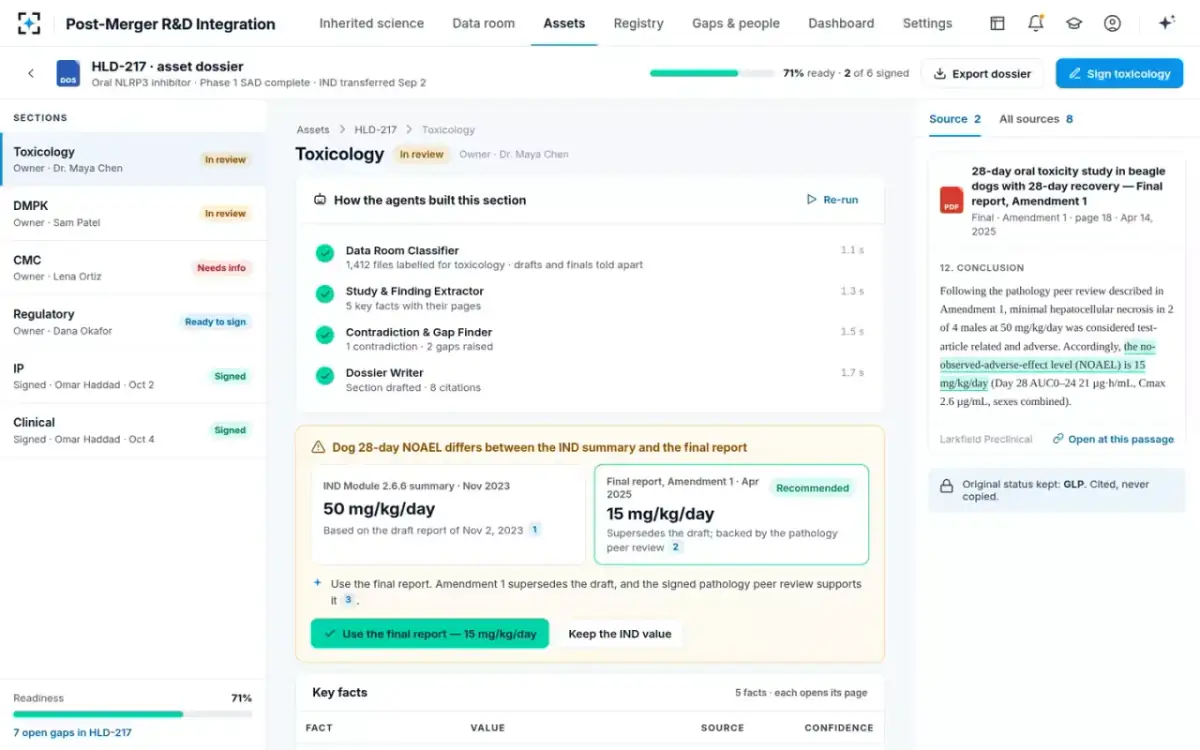
The same number, in two inherited documents
The IND toxicology summary: Dog 28-day no-observed-adverse-effect level of 50 mg/kg/day.
The final report, Amendment 1: Dog 28-day no-observed-adverse-effect level of 15 mg/kg/day.
The IND toxicology summary: A sponsor’s summary of the nonclinical data, written for a submission.
The final report, Amendment 1: The study’s own report, as amended by the study director after the fact.
The IND toxicology summary: The draft report of 2 November 2023.
The final report, Amendment 1: The study data, plus a pathology peer review that found minimal liver necrosis at 50 mg/kg/day.
The IND toxicology summary: The former sponsor’s regulatory author.
The final report, Amendment 1: The person responsible for the amendment, dated — the only lawful route to a correction.
The IND toxicology summary: Flagged for correction in the next report to the agency; the value stays visible, and nothing in the summary is altered.
The final report, Amendment 1: Stands. Every drafted sentence that used 50 is rewritten to 15 once the owner decides.
Note what the right-hand column does not say. It does not say the summary was edited. The summary is an inherited document and stays exactly as it is; what changes is the acquirer's own drafted section and the note that the agency will have to be told. The MHRA makes the general version of this point when it warns about working from summaries at all: "It must be acknowledged that summary reports are limited and critical supporting data and metadata may not be included," and an organisation receiving summary data from another organisation should evaluate that provider's integrity controls before using it. An acquirer is the extreme case of a receiving organisation.
What the audit trail has to show, and for how long
An audit trail, in the MHRA's definition, "provides for secure recording of life-cycle details such as creation, additions, deletions or alterations of information in a record, either paper or electronic, without obscuring or overwriting the original record." The clause at the end is the whole design. A trail that replaces the old value has not recorded a change; it has made one. The United States electronic records rule makes the same demand in its own terms (21 CFR 11.10(e)): the system itself has to stamp, securely and with the time, every entry or action by which someone creates, changes or deletes an electronic record — and a change may never hide what was recorded before it.
Two practical limits are worth stating, because this rule is routinely over-claimed. The electronic records rule applies to electronic records that a regulated entity keeps to satisfy a predicate rule, and to the systems it uses to keep them — it is not a blanket requirement attaching to every PDF someone copied into a data room. And an audit trail has a retention period: the same rule says such documentation "shall be retained for a period at least as long as that required for the subject electronic records and shall be available for agency review and copying." The subject records' period is therefore the one to find out.
For nonclinical studies that period is set in the good laboratory practice rules, which list three cases and apply whichever is shortest: at least two years after the agency approves a marketing application the study supported, at least five years after the results are submitted in support of an application — the case that governs studies behind an IND — and, for a study never submitted, at least two years after it was completed, terminated or discontinued (21 CFR 58.195(b)). The number a particular study needs depends on what happened to it, so the question to put to an inherited archive is not "how long" in the abstract but "which of these cases is this study in, and who has been keeping it."
The inherited archive: readable, retrievable, and whose?
The good laboratory practice rules are concrete about what an archive is for: "There shall be archives for orderly storage and expedient retrieval of all raw data, documentation, protocols, specimens, and interim and final reports." Expedient retrieval is a test an acquired archive can fail quietly. A folder structure that made sense to the people who built it is not retrieval; it is a map held in heads that are leaving.
The MHRA's requirement is the same idea stated as an outcome: "Archive arrangements must be designed to permit recovery and readability of the data and metadata throughout the required retention period." Both put the burden on whoever holds the archive today. After a deal, that is the acquirer, usually before anyone there has read a page of it.
A contradiction resolved in Post-Merger R&D Integration, with both sources still visible
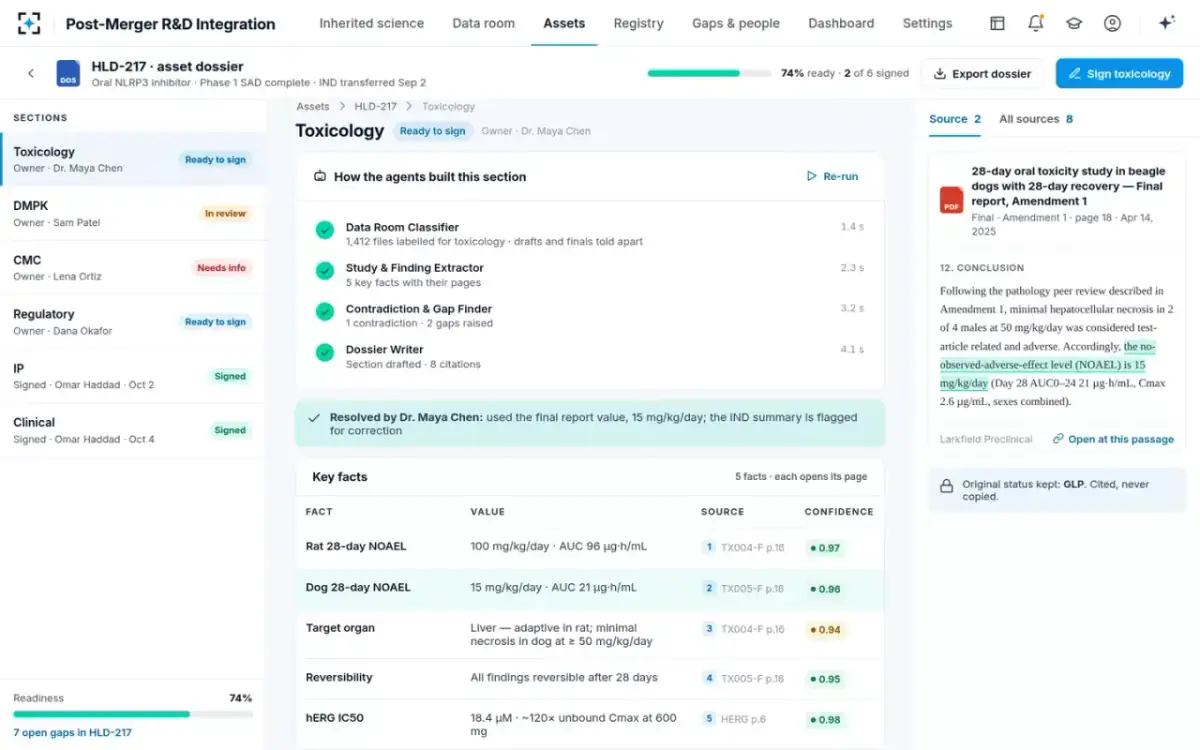
Reading in place, and why nothing is re-labelled
The design that follows from all of this is narrow, and it is the one the solution takes. Files are read where they live. Nothing is copied into a new system of record, nothing is rewritten, and a good laboratory practice or good manufacturing practice record keeps the status it already had. Agents label what a file is — record type, asset, study, version, original status — and where a version is unclear, the file goes to a person rather than getting a guess.
Two consequences are worth drawing out. First, the dossier the agents draft is not a regulated record and should never be described as one. It is a research summary that cites regulated records, and the distinction is what lets it be rewritten freely when a decision changes a value, as the sample section was when every sentence that used 50 became 15. Second, a fact with no page behind it does not reach that summary at all. The extractor records the document, version and page for every value, never infers one that is not written, and sends anything below 85 percent confidence to a person.
The MHRA's rule on excluded data is the right model for what to do with the superseded value: "All data (even if excluded) should be retained with the original data set, and be available for review in a format that allows the validity of the decision to exclude the data to be confirmed." Applied to an acquisition, that means the draft number stays visible beside the final one, with the reason the final one won. Delete the loser and you have made the decision unverifiable.
The life of one number, from the animal to the signature
- Measured in the dog studymeasured
- Draft report, Nov 2023drafted
- Summarised at 50 mg/kg/daysummarised
- Amended to 15 after peer reviewamended
- Both documents inheritedinherited
- Read and extracted with pagesread
- Contradiction raisedraised
- Owner decides; section signedsigned
How to show both sources without repeating the error
There is a tension in showing both values. Keep the superseded number visible, as integrity requires, and you risk it being quoted again by the next person who skims. Hide it and the decision cannot be checked. The resolution is in how the two are presented: never as a pair of equals, always as a decided question with the reason attached and the direction of supersession on the face of it.
Four rules do most of the work, and each can be set once rather than argued per section. Prefer final and amended reports over drafts, while keeping the draft value visible and flagged. Raise any value that differs between sources rather than silently picking one. Let only the section owner — the function head who will sign — resolve it. And refuse to sign a section that still has an open contradiction in it, which is the rule that stops a deadline from quietly resolving one.
The signature is the part people under-specify. A signature with no stated meaning is a date stamp. In the sample acquisition the head of toxicology signs with the meaning printed beside her name — that she reviewed the cited evidence and approves the section for the integration dossier — and with a password, and the section she signs is one in which every sentence carries a citation. The MHRA asks for the same shape in ordinary data review: a documented review with "a positive statement regarding whether issues were found or not, the date that review was performed and the signature of the reviewer."
A signed section, after the decision
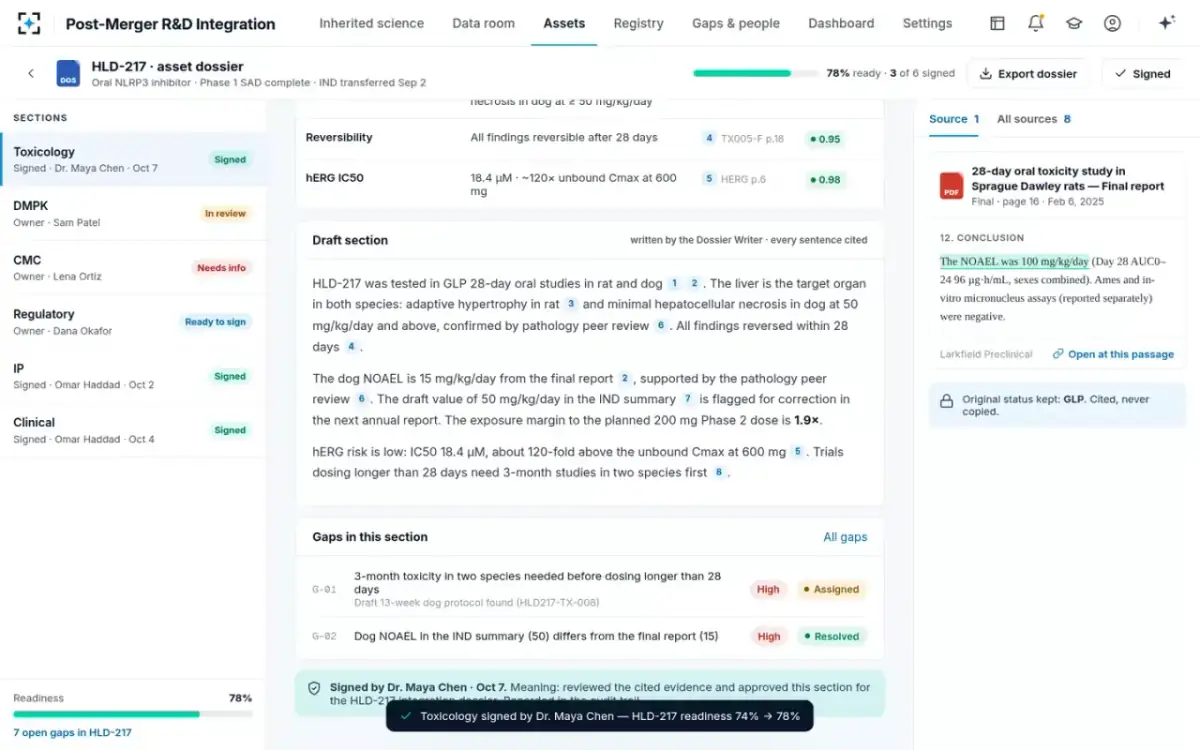
Nine integrity questions to put to an inherited archive
- For each critical value, which document is the original record and which are derivatives of it?
The original is the first capture plus everything needed to reconstruct the activity. A results table on its own is not it.
- Where you hold copies, is there anything that makes them true copies?
A true copy is verified by a dated signature or generated through a validated process and keeps the context, content and structure of the original.
- Which inherited files are static exports of something that was dynamic?
A static record allows little or no interaction with the content; a chromatogram printed to PDF can no longer be reprocessed.
- Do the audit trails travel with the data you were given, and for how long must they be kept?
Audit trail documentation is retained at least as long as the records it describes, and must be available for agency review and copying.
- Which studies are in which retention case, and who is holding them?
The good laboratory practice rules set different periods for different outcomes, and the shortest applicable one governs — so the answer depends on what happened to each study.
- Does the archive permit expedient retrieval by someone who did not build it?
The rule asks for orderly storage and expedient retrieval of raw data, documentation, protocols, specimens and reports — not for a folder tree that worked for the authors.
- Where two sources disagree, is the superseded value retained with the reason it was superseded?
Excluded data stays with the original set in a form that lets the validity of the decision be confirmed. The same logic applies to a value a decision set aside.
- Who, at your company, is entitled to decide which value stands — and is it written down before the first contradiction?
Deciding is not correcting; a correction to a report is an amendment by its study director. The decision is yours and has to be attributable.
- Is every sentence of anything you draft from this archive traceable to a page?
A fact without a page cannot be checked by the next person, and in an inherited archive the next person is the only safeguard you have.
None of these nine is exotic, and none of them is answerable by a tool alone. What a tool can do is make the archive legible fast enough that a quality reviewer spends their fortnight on the eight hard questions rather than on finding the files. To see that reading, the contradictions it raises and the signatures that close them on one acquisition, start from Post-Merger R&D Integration.
Questions people ask
What is the difference between ALCOA and ALCOA+?
ALCOA+ adds complete, consistent, enduring and available to the original five. The MHRA's guidance says there is no difference in expectations whichever acronym is used, because data governance measures should ensure data is complete, consistent, enduring and available throughout the life cycle anyway; the plus was added to emphasise requirements already present. For an inherited archive the four extra words are the practical ones, because completeness and availability are exactly what a data room export tends to lose.
What is an original record?
The first or source capture of the data, plus all subsequent data required to fully reconstruct the activity — an original paper record of a manual observation, or the electronic raw data file from a computerised system. Original records can be static or dynamic: a static record allows little or no interaction with its content, while a dynamic one lets a user query, trend or reprocess. A PDF export of a chromatogram carries the picture and not the record.
What is a true copy?
A copy of the original that has been verified — by a dated signature or by generation through a validated process — to carry the same information, including the data describing its context, content and structure. It may sit in a different file format, but it must keep the metadata and audit trail needed for the full meaning to survive and the history to be reconstructed. In United States good laboratory practice, records may be kept as original records or as true copies such as photocopies, microfilm or other accurate reproductions.
Can you correct someone else's final report?
No. Corrections or additions to a final report are made by amendment by the study director, identifying the part being corrected and the reasons, signed and dated by the person responsible. An acquirer holds the report but is not that person. What it can do is decide which of two inherited values stands, record the evidence and the decision, keep the superseded value visible, and raise any correction owed to an agency through the sponsor who now carries that obligation.
How do you review inherited data for integrity?
Work in the order the rules imply. Establish what each file is and which version it is, before reading anything for content. Find the original record behind each critical value and note where you only hold a derivative. Compare the same fact across versions and sources and treat every difference as a question for a named owner, not a judgement call for whoever found it. Record each decision with its evidence and its author, and keep what was superseded. The MHRA's own expectation for data review is a documented one with a positive statement of whether issues were found, a date and a signature.
Does the electronic records rule apply to every file in a data room?
No. Part 11 applies to electronic records that a regulated entity creates, modifies, maintains, archives, retrieves or transmits to satisfy a predicate rule, and to the systems used for them. A folder of exports handed over in a transaction is not automatically in scope, and treating it as though it were produces expensive work with no regulatory benefit. The question that matters is which inherited records are being kept under a predicate rule, by whom, and in which system.