AI due diligence in M&A has become a crowded phrase, and most of what ranks for it is a tool list. The question underneath is sharper, and in a life sciences deal it has a published answer: not whether software can read an acquired company's data room, but what its output may be relied on for, and who stays responsible when it is wrong. That is hard because the record in question is a regulated one — study reports, notebooks, batch records, an IND and its commitments — and the acquirer will have to stand behind whatever it concludes about them long after the deal team has moved on. Botminds' Post-Merger R&D Integration takes the narrow version of the job: six agents read the inherited archive where it lives, tie every fact to its document, version and page, and raise what disagrees — and a named function owner, never an agent, resolves and signs.
The acquisition on this page is sample data: Northwind Bio's purchase of Halden Therapeutics. Every person, company, programme and study named in it is fictional. The two regulatory documents it leans on are a draft guidance containing nonbinding recommendations and a reflection paper rather than a guideline, and the page says where each one does and does not reach.
The reading load behind one mid-size acquisition
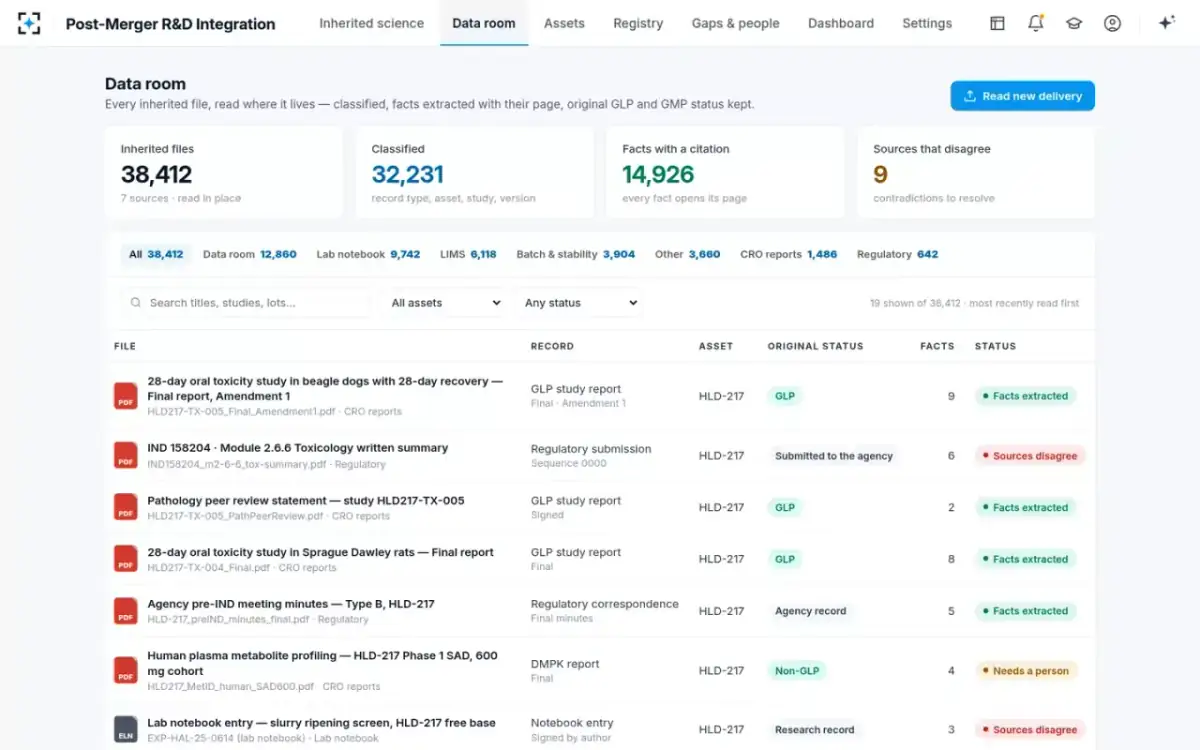
38,412files
inherited from 7 sources, read where they live rather than moved
14,926
facts extracted, each carrying the document, version and page it came from
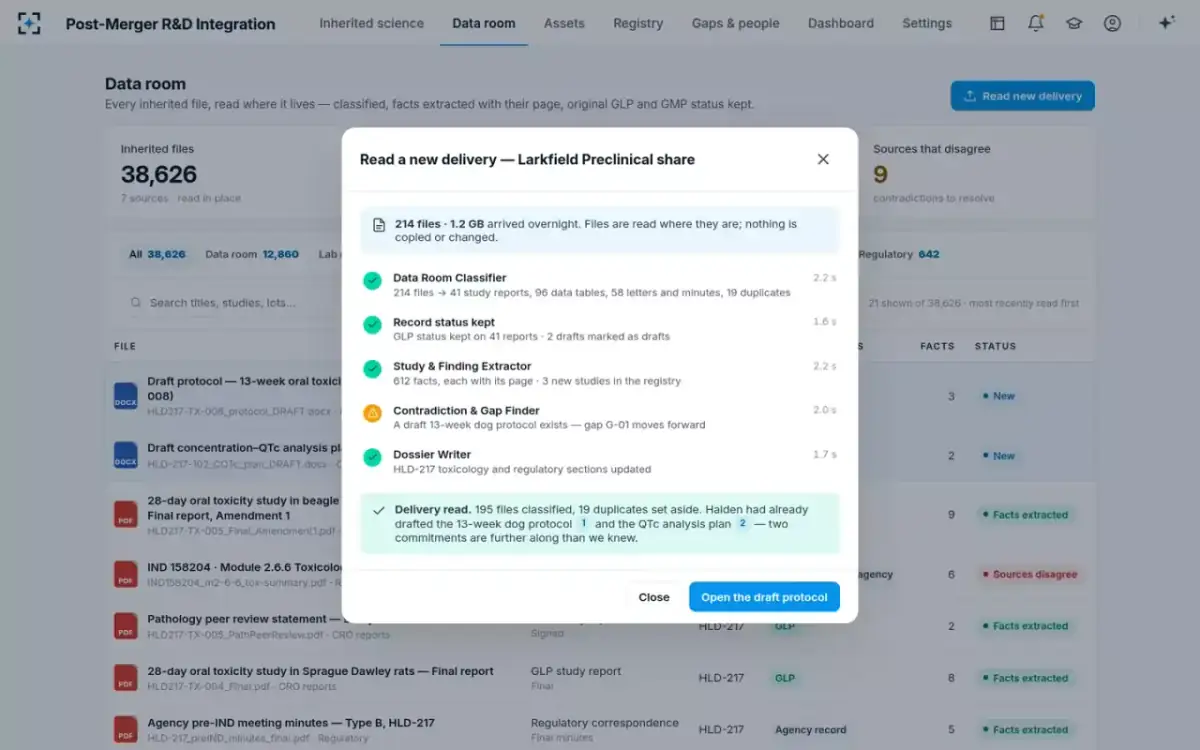
214files
in one overnight delivery from a contract research partner, 612 facts out of it
19
duplicates in that delivery set aside, with the original good laboratory practice status kept on the 41 study reports
Can AI do due diligence on a scientific data room?
It can do the reading. A deal data room is tens of thousands of documents in a dozen formats, and the first honest statement anyone can make about it is that nobody has read it. Software that classifies every file, pulls out the studies, findings, pharmacokinetic parameters, lots and commitments, and records where each one came from turns an unread pile into something a specialist can interrogate in an afternoon. That is a large gain and it is not controversial.
What it cannot do is take over the decisions, and the reason is not squeamishness about machines. It is that the decisions in question are assigned, by regulation and by professional accountability, to named people: the study director who amends a report, the sponsor who carries an obligation, the function head who signs that a section of an integration dossier is sound. A tool that offers to make those decisions is offering to take something it cannot hold.
So the design question for a buyer is where the line sits, and whether the product draws it in the architecture or in the marketing. The rest of this page is about how to tell the difference, starting with what the product actually does.
What the six agents actually do, one by one
Six specialist agents, each with a narrow job and a stated limit. The limits are not advisory copy; they are the reason the design holds together when a dossier section reaches a function head who has to sign it.
The six agents, and the limit each one carries
| Agent | What it does | What it may never do |
|---|---|---|
| Data Room Classifier | Reads every inherited file in place and labels its record type, asset, study, version and original good laboratory or manufacturing practice status; finds duplicates and drafts. | Change an original. It is read-only, it keeps the inherited status rather than re-assigning it, and an unclear version goes to a person. |
| Study & Finding Extractor | Pulls studies, findings, pharmacokinetic parameters, lots, stability results and agency commitments into one searchable set, each with its document, version and page, and a confidence. | Infer a value that is not written. Every fact carries a page, and anything below 0.85 confidence goes to a person instead of into a dossier. |
| Contradiction & Gap Finder | Compares the same fact across versions and sources — draft against final, summary against report, notebook against report — and raises gaps with an owner and an expert who could answer. | Resolve a contradiction. It shows both sources, always, and the section owner decides. |
| Dossier Writer | Drafts each asset dossier section — toxicology, DMPK, CMC, regulatory, IP, clinical — with open questions stated plainly, and rewrites every sentence that used an old value once a contradiction is resolved. | Write a sentence without a citation, or use a value that is not in the extracted set. |
| Expert Interview Planner | Finds who authored what and builds the questions to put to each departing scientist from the open gaps they wrote or know about, then links their answers back to those gaps. | Treat an answer as a source. What an expert says is recorded as an interview, and the agents then look for the file the expert named. |
| Study Reuse Advisor | Answers "has this been done before?" by matching a planned study against the acquired company’s reports and notebooks, and recommends what to reuse. | Leave out an awkward prior result. It cites every one, and says when a study was stopped or inconclusive. |
What none of them may do
Read the third column together and a single rule emerges: no agent changes anything that was inherited, and no agent closes anything that a person is accountable for. Nothing is copied out of the systems it lives in, so no inherited file is rewritten. No agent resolves a disagreement between two sources. No agent signs. No agent files anything with an agency. And because every fact is tied to a page, a reviewer who doubts an output can settle it by opening one document rather than by arguing with a model.
The sequence below is one overnight delivery, start to finish, with the person steps marked. It is worth looking at where the person steps fall: not at the end, as an approval stamp on finished work, but at every point where something would otherwise be decided rather than recorded.
One inherited delivery, from arrival to a cited sentence
Agent
Data Room ClassifierSorts 214 arriving files into 41 study reports, 96 data tables, 58 letters and minutes and 19 duplicates, keeping the original good laboratory practice status on the 41 reports.
Never: Never changes a source record, and never re-labels an inherited status.
Agent
Study & Finding ExtractorPulls 612 facts out of the delivery, each with its document, version and page, and a confidence score.
Never: Never infers a value that is not written on the page.
A person decides
The function specialistTakes the facts the extractor was less than 85 percent confident of, and the versions it could not tell apart.
Agent
Contradiction & Gap FinderCompares each new fact with what the archive already said, and raises a contradiction or a gap with an owner and a date.
Never: Never resolves a contradiction, and never hides the losing source.
A person decides
The section ownerDecides which source stands, on the evidence shown, and records why.
Agent
Dossier WriterRewrites every drafted sentence that used the superseded value, each sentence carrying its citation.
Never: Never writes a sentence without a citation, or a value that is not in the extracted set.
A person decides
The function headSigns the section, with the meaning of the signature stated and a password — and cannot sign one with an open contradiction in it.
A new delivery being read in Post-Merger R&D Integration
What does the FDA guidance on AI say?
In January 2025 the FDA published a draft guidance, Considerations for the Use of Artificial Intelligence To Support Regulatory Decision-Making for Drug and Biological Products. It is a draft, it contains nonbinding recommendations, and the agency says the word should in its guidances means suggested or recommended rather than required. Within those limits it is one of the most concrete things a regulator has published on this subject.
Its subject is narrower than its title suggests. The guidance "discusses the use of AI models in the drug product life cycle, where the specific use of the AI model is to produce information or data to support regulatory decision-making regarding safety, effectiveness, or quality for drugs." Around that it builds a seven-step credibility assessment framework: define the question of interest, define the context of use for the model, assess model risk, plan how credibility will be established, execute the plan, document the results and any deviations, and determine whether the model is adequate for that context of use. The effort spent on each step is meant to be proportionate to the risk.
Two ideas in that list are worth taking even where the guidance does not apply. The first is the context of use: the specific role and scope of the model in answering one question, written down before anyone assesses anything. A buyer who cannot state a tool's context of use in a sentence does not yet know what they are buying. The second is that credibility is established for that context of use and not in general — a model that is excellent at labelling file types has proved nothing about extracting a no-observed-adverse-effect level.
How model risk is judged: influence and consequence
The guidance's definition of model risk is the most portable thing in it. "Model risk is a combination of two factors: (a) model influence, which is the contribution of the evidence derived from the AI model relative to other contributing evidence used to inform the question of interest and (b) decision consequence, which describes the significance of an adverse outcome resulting from an incorrect decision concerning the question of interest." And then, so that nobody mistakes it for a property of the software: "Model risk is the possibility that the AI model output may lead to an incorrect decision that could result in an adverse outcome, and not risk intrinsic to the model."
That sentence reframes the whole purchasing conversation. Risk is not a quality of the model; it is a quality of the arrangement the model sits in. The same extraction engine is low risk when its output is one piece of evidence a specialist checks against an open page, and high risk when its output is the only evidence behind a decision nobody re-reads. Which one a buyer ends up with is decided by the design, not by the accuracy figure in the proposal.
The two axes, applied to four jobs on an inherited data room
Label a file as a study report, a data table or a letter
Low influenceLow consequence
Safe to automate
A wrong label costs a search. A person reading the file sees it immediately, and nothing downstream depends on the label alone.
Extract a number and the page it is printed on
Low influenceHigh consequence
Agent proposes, person checks
The number can end up in a safety argument, so the consequence is real — but the citation makes the output checkable in seconds, which is what keeps influence low.
Decide which of two disagreeing sources is current
High influenceHigh consequence
Keep it with a person
Nothing else would contribute evidence; the output would be the decision. This is the job a named function owner keeps.
Summarise what is missing, for a person to confirm against the files
Mixed influenceHigh consequence
Agent proposes, person checks
A missed gap is expensive, but the list is a starting point a reviewer works from rather than the only evidence behind the conclusion.
The third of those four jobs is the one that decides the architecture. Choosing between a draft report and an amended final is a question where nothing else would contribute evidence, and where being wrong puts a superseded safety number into a submission. Influence high, consequence high. There is no accuracy figure that makes that an acceptable thing to automate, which is why, in this product, only the section owner resolves a contradiction and a section with an open one cannot be signed at all.
What EMA expects of the people using the model
The European Medicines Agency's reflection paper on AI in the medicinal product lifecycle, adopted in September 2024, is not a guideline and does not create requirements. What it states is a principle about responsibility, and it states it without hedging: the sponsor of a trial, the applicant for or holder of a marketing authorisation, or the manufacturer is the one who must make sure every algorithm, model, dataset and data pipeline it uses is fit for purpose and meets legal, ethical, technical, scientific and regulatory standards. Then the sentence most worth reading twice before signing a contract: "Of note, these requirements may in some respects be stricter than what is considered standard practice in the field of data science."
Responsibility does not transfer to a vendor. A sponsor cannot point at a supplier's documentation and consider the question answered, which has a direct consequence for procurement: a buyer needs enough visibility into what the tool did to defend it themselves. The paper also expects, for non-clinical development, that a company's existing standard operating procedures will be extended to cover every AI or machine-learning application in its non-clinical studies, and points to the OECD advisory documents on applying good laboratory practice principles to computerised systems and to data integrity where that series applies.
Read together with the FDA's framing, the two documents say the same thing from different ends. The agency in the United States asks how much a model's output influences a decision and how bad a wrong decision would be. The agency in Europe says that whatever the answer, the sponsor owns it. Neither says anything about whether reading a data room is a good idea, which brings us to the honest part.
Where this guidance does not reach, and why that matters
The FDA's draft guidance excludes two things by name, and one of them covers most of what a tool on a data room does. It sets aside AI used in drug discovery, and AI used for operational efficiencies — the guidance gives internal workflows, resource allocation and drafting a regulatory submission as examples — where the use has no impact on patient safety, drug quality or the reliability of results from a nonclinical or clinical study.
Classifying inherited files, extracting facts with their pages and drafting an internal integration summary sits in that exclusion. So any vendor — including this one — who implies that the framework endorses their product is misreading it. Neither document approves, qualifies or accepts any tool for this work, and the frameworks above are not a seal of approval. They are a way of thinking that a buyer can apply themselves.
But the exclusion has a boundary, and the boundary moves with how the output is used. The moment an extracted number is carried into a submission, an annual report or a safety argument, it is no longer only an operational efficiency: it has begun to affect the reliability of results from a nonclinical study. The guidance itself invites sponsors to engage with the agency early where they are unsure which side of that line they are on. A buyer's practical rule can be simpler — treat the tool as operational, and treat every number that leaves it for a regulated document as a fact a person has checked against its page.
What an agent settles, and what a person settles
The agents: Labels record type, asset, study, version and the original status it arrived with.
A named person: Decides when the version is unclear — the agent hands it over rather than guessing.
The agents: Extracts the value with its document, version, page and a confidence.
A named person: Takes anything below 0.85 confidence, and anything the specialist wants to re-read.
The agents: Shows both, with what each document is and which supersedes which.
A named person: Decides, and the decision is recorded with the evidence and its author.
The agents: Raises a gap, names an owner and names an expert who could close it.
A named person: Confirms it is a gap, ranks it, and asks the question — or books the walkthrough.
The agents: Records it as an interview linked to its gap, then goes looking for the file named in it.
A named person: Decides whether the file found actually answers the question.
The agents: Drafts it, every sentence cited, and rewrites it when a value changes.
A named person: Signs it, with the meaning of the signature stated — and cannot sign one with an open contradiction.
Why every fact has to carry its page
Citation is usually presented as a convenience. In this setting it is the control that keeps model risk low, and it is worth being precise about why. An output with a page attached can be checked by one person in seconds, which means the model's contribution to the evidence is small — a reviewer who disagrees opens the document and the question is over. An output without one can only be trusted or distrusted, which makes the model the evidence. The citation is what moves the job down the influence axis.
It has a second effect that matters more over a year. A cited set can be re-read by the next person, who was not in the room when it was built — the regulatory lead who inherits the IND, the quality reviewer preparing for an inspection, the programme leader who wants to know why a dose was chosen. That is the difference between a tool's output and a record of work, and it is the same reason an inherited archive has to be read with its versions intact rather than flattened. The discipline behind that is the subject of data integrity and ALCOA for records you did not create.
The third effect is the unglamorous one. Where the extractor cannot find a page, it does not produce a fact; it produces a gap, with an owner. A gap stated positively — nothing in 38,412 files says this — is a different object from silence, and it is the thing a diligence summary almost never gives you.
Every inherited file, read where it lives
What to ask a vendor before you put it on a data room
Twelve questions, each with the published expectation behind it. They are written so that a vendor who cannot answer one has told you something useful.
Twelve questions for anyone proposing to read your inherited archive
- State the context of use in one sentence: what role does the model play, in answering which question?
The FDA’s framework starts with the question of interest and the context of use; credibility is established for that context and not in general.
- For each output, how much does it influence the decision, and how bad is a wrong decision?
Those are the two axes of model risk, and the guidance says the effort spent proving credibility should be proportionate to the result.
- Does every extracted value carry the document, the version and the page?
A citation is what lets a reviewer settle a disagreement by opening a file, which is what keeps the model’s influence low.
- What happens when the model is unsure — is there a threshold, and is it the buyer’s to set?
A product that has no uncertain state is claiming something no one can deliver on a thirty-year-old scanned appendix.
- Can it alter, move or re-label anything it reads?
An inherited good laboratory or manufacturing practice record keeps its status, and a correction to a report is an amendment by its study director — not an edit by a buyer’s software.
- Who resolves a disagreement between two inherited sources, and is that configurable to a named person?
This is the highest-risk job on a data room: nothing else contributes evidence, and a wrong answer carries a superseded number forward.
- What is kept about each action, and for how long?
The electronic records rule expects audit trail documentation retained at least as long as the records it describes, and available for agency review and copying.
- What does the tool do when it finds nothing?
A positive statement that nothing in the archive answers a question is more valuable than a confident paraphrase, and much harder to produce.
- How do your own procedures extend to this tool?
The EMA’s reflection paper expects existing standard operating procedures to extend to AI applications in non-clinical studies; buying a tool does not create an exemption.
- What changes when the model changes, and how would we know?
The FDA guidance treats life cycle maintenance as the management of changes to a model, incidental or deliberate, so that it remains fit for use for its context of use.
- What evidence can we show an inspector that we, not the vendor, satisfied ourselves?
Responsibility for models, datasets and pipelines being fit for purpose sits with the sponsor, applicant or manufacturer — it is not transferable by contract.
- Run it on one real asset for a fortnight: how many facts did it produce, how many had pages, and how many survived a specialist’s re-read?
Vendor-supplied validation in isolation from your process and infrastructure is functional verification, not proof it works for your intended purpose.
Twelve questions is a lot for a first meeting, and the last one is worth more than the other eleven together. A fortnight on one real asset, with the acquired company's own documents, will tell a buyer what no proposal can: whether the facts come back with pages, whether the gaps are real gaps, and whether the specialists trust what they see enough to work from it. The same test, applied to the other category of tool a deal team already owns, is set out in M&A integration software and the R&D workstream it leaves out.
And the question a buyer should hold on to through all of it is the one the guidance asks first: what decision is this output going to influence, and who is accountable for getting it right? To see where the line falls in practice — six agents reading, and a named owner at every decision — start from Post-Merger R&D Integration.
Questions people ask
Does the FDA allow AI in drug development?
There is no permission regime to allow or forbid it. The FDA published a draft guidance in January 2025 describing a risk-based credibility assessment framework for AI models used to produce information or data supporting regulatory decisions about a drug's safety, effectiveness or quality. It contains nonbinding recommendations, it does not endorse any particular AI approach or technique, and it explicitly does not address drug discovery or uses that are operational efficiencies not affecting patient safety, drug quality or the reliability of nonclinical or clinical results.
Who is responsible when an AI model is wrong?
The sponsor, applicant, holder or manufacturer. The EMA's reflection paper states it as a key principle: it is their responsibility to ensure all algorithms, models, datasets and data processing pipelines used are fit for purpose and in line with legal, ethical, technical, scientific and regulatory standards — and it notes these requirements may in some respects be stricter than standard data science practice. Responsibility does not move to a vendor because the vendor supplied validation documents.
What can AI read in a data room?
In practice, everything that arrives: deal data room exports, lab notebook and laboratory information management system exports, contract research study reports, batch and stability records, and regulatory correspondence including the IND. What matters more than the formats is what comes back. Useful output is a classified file with its version and original status, and a fact with the document and page it was read from. Output without those is a paraphrase, and a paraphrase cannot be checked.
How do you check an AI model's output in a regulated record?
By making the check cheap. If every value carries its page, a specialist re-reads a sample of them in an hour and knows where they stand. Beyond that, three things are worth measuring on real files: what fraction of facts carry a page, what fraction survive a specialist's re-read, and what the tool does when the answer is not there. The MHRA's point about validation applies: vendor testing in isolation from your process and infrastructure is functional verification, and may not meet what performance qualification requires.
Can AI do due diligence by itself?
No, and the useful version of the answer is structural rather than cautious. Due diligence ends in judgements — whether a programme's safety package is complete, whether a commitment was met, which of two numbers is current — and those judgements are assigned to people who can be held to them. What software can do is make every one of those judgements cheap to reach and easy to check, by reading everything and citing everything. That is the whole of the gain, and it is substantial.
What should an AI tool never do on an acquired archive?
Four things. It should never alter, move or re-label an inherited record, because a correction to a final report is an amendment by its study director. It should never resolve a disagreement between two sources, because that is the highest-influence, highest-consequence decision on the archive. It should never treat what a departing scientist said in an interview as a source record. And it should never sign anything, or produce a sentence that is not traceable to a page.