A transfer of regulatory obligations is a written assignment, by the sponsor of a clinical investigation, of some or all of the duties the regulations place on it — and the single most useful thing to know about the phrase is that people use it for three different acts that are not interchangeable. Handing monitoring or reporting duties to a contract research organization is one thing. Changing the ownership of an approved application when a company is bought is another, written in a different part of the regulations. Changing who reports a registered clinical trial is a third. Each leaves something behind, and an acquirer that files one while believing it has done another inherits obligations nobody is holding. Botminds' Post-Merger R&D Integration reads the inherited correspondence, pulls out every commitment the former sponsor made with the letter or minute it was made in, and raises the ones nobody owns — so the regulatory lead can see the list rather than reconstruct it.
The sample acquisition used for the worked examples is fictional: Northwind Bio's purchase of Halden Therapeutics, four programmes and an inherited data room of 38,412 files. The rules quoted are real and linked where they appear. Nothing here is legal advice, and nothing a regulator receives is ever filed by an agent — in this solution the agents read, extract and raise, and a named person decides.
Three moves that share one phrase, and almost nothing else
| Obligations to a contract research organization | Ownership of an approved application | Responsible party on a registered trial | |
|---|---|---|---|
| Where it is written | 21 CFR 312.52 | 21 CFR 314.72 | 42 CFR part 11 |
| What actually moves | The specific duties named in a written description — and nothing else | Ownership of the application, and with it the former owner’s agreements, promises and conditions | Who is answerable for registering and reporting results for that trial |
| Who acts | The sponsor, by describing the transfer in writing | Both the former and the new owner, each submitting to the application | The entity that becomes the responsible party, in the trial’s registration |
| The document must say | Each obligation being assumed, if not all are transferred | That all rights are transferred; the new owner’s commitment; the effective date; whether it holds a complete copy | Which single entity is the responsible party for that trial |
| What is left with you | Every obligation not described in the writing | Nothing of the application — but the records, archives and people stay where they were | Every other sponsor duty, which this move does not touch |
What is a transfer of regulatory obligations?
In its strict sense, it is the act described in 21 CFR 312.52: "a sponsor may transfer responsibility for any or all of the obligations set forth in this part to a contract research organization. Any such transfer shall be described in writing. If not all obligations are transferred, the writing is required to describe each of the obligations being assumed by the contract research organization."
Three features of that sentence do the work. The transfer is of duties, not of the application and not of sponsorship. It must be in writing. And where it is partial — which it almost always is — the writing has to enumerate what is being assumed, rather than gesturing at a category. That enumeration is the whole mechanism, and it is why the documents are usually long and dull.
The looser sense, which is what most people mean when they search the phrase during a deal, is "the paperwork that moves regulatory responsibility when a company changes hands". That is a reasonable thing to want and it is not what § 312.52 describes. Sorting out which of the three you actually need is a ten-minute conversation at the start of an integration and a six-month archaeology project afterwards.
One question decides which move you are making
1
Are you handing work to a service provider that will run part of a study for you?
Then it is a transfer of obligations under part 312, and only the duties you describe in writing actually move.
2
Has ownership of an approved application changed hands?
Then it is a change in ownership under part 314: two letters, an effective date you choose, and a complete copy you must hold or request.
3
Is a registered clinical trial now going to be reported by someone else?
Then it is a change of responsible party under part 11 of title 42, and it is a separate act from either of the other two.
Transfer to a CRO: what the writing has to say
Where a sponsor hands part of its work to a contract research organization, the written description is the operative document and the contract is not a substitute for it. In practice the description is usually an annex listing duties against a column marked sponsor or organization: protocol design, investigator selection, monitoring, safety reporting, record retention, and so on, each assigned explicitly.
What makes this worth attention in an acquisition is the second half of the rule, which changes who can be acted against: "a contract research organization that assumes any obligation of a sponsor shall comply with the specific regulations in this chapter applicable to this obligation and shall be subject to the same regulatory action as a sponsor for failure to comply with any obligation assumed under these regulations" (§ 312.52(b)). The assuming organization steps into the sponsor's shoes for the duties it took, and it is answerable for them directly.
So on an acquisition, two documents matter equally: the trial contract, which tells you what you are paying for, and the written description of transferred obligations, which tells you who is answerable for what. They are not always consistent with each other, and where they differ, the rule's own test — what does the writing describe? — is the one that decides.
What is not written down is not transferred
The sharpest sentence in this area of the regulations is also the shortest, and it is the one to put in front of anyone who says the transfer was handled:
Any obligation not covered by the written description shall be deemed not to have been transferred.
21 CFR 312.52, Transfer of obligations to a contract research organization
The effect is a default rather than a penalty. There is no gap in which nobody holds a duty: whatever the writing does not name stays with the sponsor. That is reassuring for a regulator and awkward for an acquirer, because the duties that stay are invisible — they are defined by absence, and nobody writes a memo about an obligation that was not transferred.
The practical test on an inherited programme is to read the written description against the full list of sponsor obligations and mark every line that is not mentioned. Those lines are yours. In an integration this is a reading exercise of exactly the kind the rest of the inheritance needs, and it is one of the few that has a definitive answer at the end of it.
What happens to an approved application when the company is sold?
Ownership moves by a pair of submissions, and the rule is specific about both. Under 21 CFR 314.72, "an applicant may transfer ownership of its application", and at the time of transfer "the former owner shall submit a letter or other document that states that all rights to the application have been transferred to the new owner". The new owner submits its own document, and the contents of that one are where the integration work actually sits.
Two practical points often come as a surprise. The first is that the effective date is stated by the parties rather than assigned by the agency — it is a decision your plan makes, and it should be the same date your contracts, your safety reporting and your trial registrations use, because a mismatch between them is the kind of thing that surfaces at an inspection. The second is that this is a rule about applications: new drug applications and abbreviated ones. It is not the rule for an investigational new drug application, and treating it as such is an easy error to make in an integration plan.
For an IND there is no "transfer of ownership" section of the regulations in the way there is for an approved application. The change is made by submitting it to the IND itself, following the agency's current expectations for what that submission contains. People call this an "IND transfer of sponsorship", but no section of the regulations defines that phrase, so there is no rule text to quote for it. Ask your regulatory lead what the current submission should contain, and date it to match the effective date you chose.
The commitments the new owner takes on, word for word
The clause that matters most on an acquisition is the one listing what the new owner must submit: "the new owner's commitment to agreements, promises, and conditions made by the former owner and contained in the application; (ii) the date that the change in ownership is effective" (§ 314.72(a)(2)). Read it as an instruction rather than a formality. You are committing, in writing, to undertakings somebody else made — in meeting minutes, in response to an information request, in a letter you may not yet have read.
That is why a commitments register is the first artefact an inherited regulatory section needs, and why it cannot be built from the study reports alone. Commitments are made in correspondence. In the sample acquisition's inherited data room, 642 of the 38,412 files are regulatory correspondence — a small category carrying a disproportionate share of what the new owner is now answerable for.
A commitments register for one inherited asset
| The commitment | Where it is recorded | Who owns it now | What closes it |
|---|---|---|---|
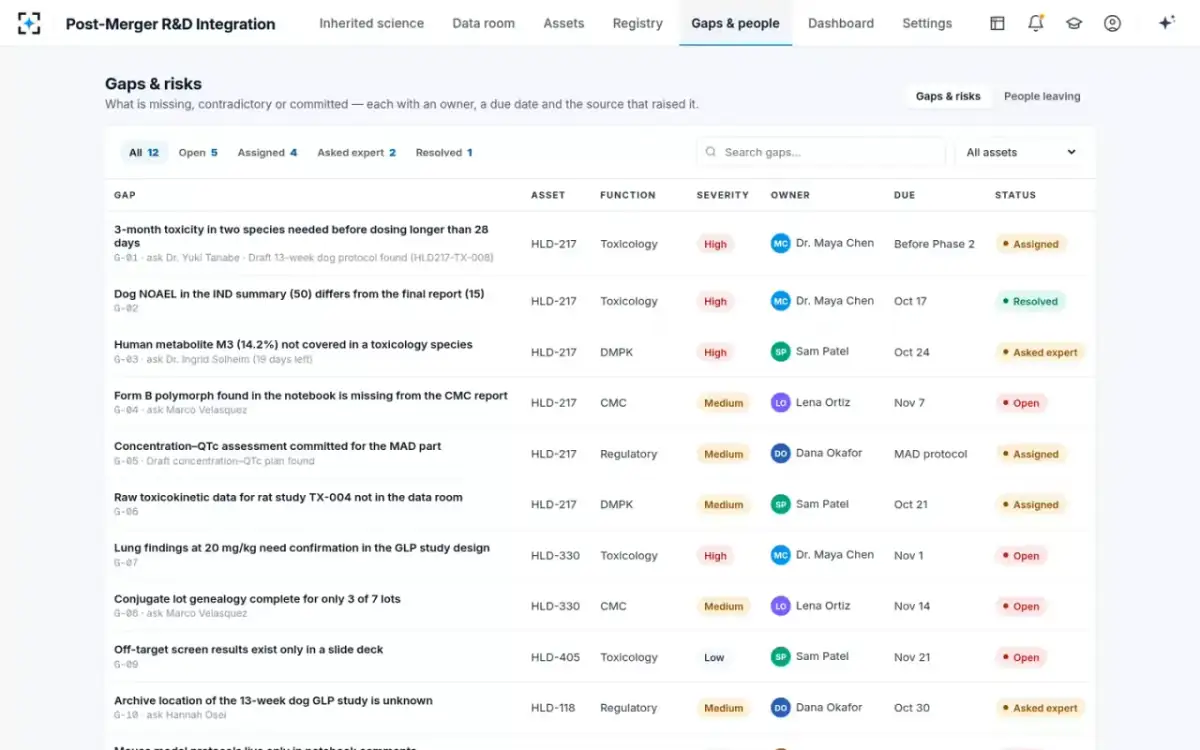
| Three-month toxicity in two species before dosing beyond 28 days | Pre-IND Type B meeting minutes | Head of toxicology | A protocol and a scheduled study — and the acquired company had already drafted a thirteen-week dog protocol at 5, 15 and 45 mg/kg/day, which nobody at the acquirer knew |
| A concentration–QTc assessment for the multiple-ascending-dose part | Agency correspondence on the first-in-human protocol | Regulatory owner | An analysis plan in the next protocol — the acquired company had drafted one of those too |
| Evaluate a human metabolite above the threshold the agency named | Agency correspondence | DMPK lead | Either evidence it was already measured, or a study — the person who knows is leaving in nineteen days |
| Archive location of a thirteen-week dog study under good laboratory practice | Not stated anywhere in the inherited files read so far | Regulatory owner | The named archivist at the contract laboratory, identified and confirmed in writing |
The second column is the one that defeats manual work. A commitment is a sentence inside a document that is mostly about something else, and finding all of them means reading all of the correspondence rather than searching for a word. That is the part the agents do, with the page attached to each one, and the hundred-day plan should assume it is done in weeks two to six rather than by someone skimming on a Friday.
Commitments and gaps, each with an owner, a date and the source that raised it
Does the new owner have a complete copy?
The third thing the new owner's submission must say is whether it holds a complete copy of the approved application, including its supplements and the records required to be kept — or, failing that, it may make "a request for a copy of the application from FDA's files" (§ 314.72(a)(2)(iii)). The option to ask the agency exists precisely because this goes wrong often enough to need a remedy.
It goes wrong in a particular way. The deal data room contains the application as it was assembled for diligence, which is usually the original submission plus whatever the seller gathered. What it frequently lacks is the long tail: supplements, amendments, responses to information requests, and the records kept alongside. Those are the documents that change what the application actually says, and a new owner that states it holds a complete copy on the strength of a data room index has made a statement it has not checked.
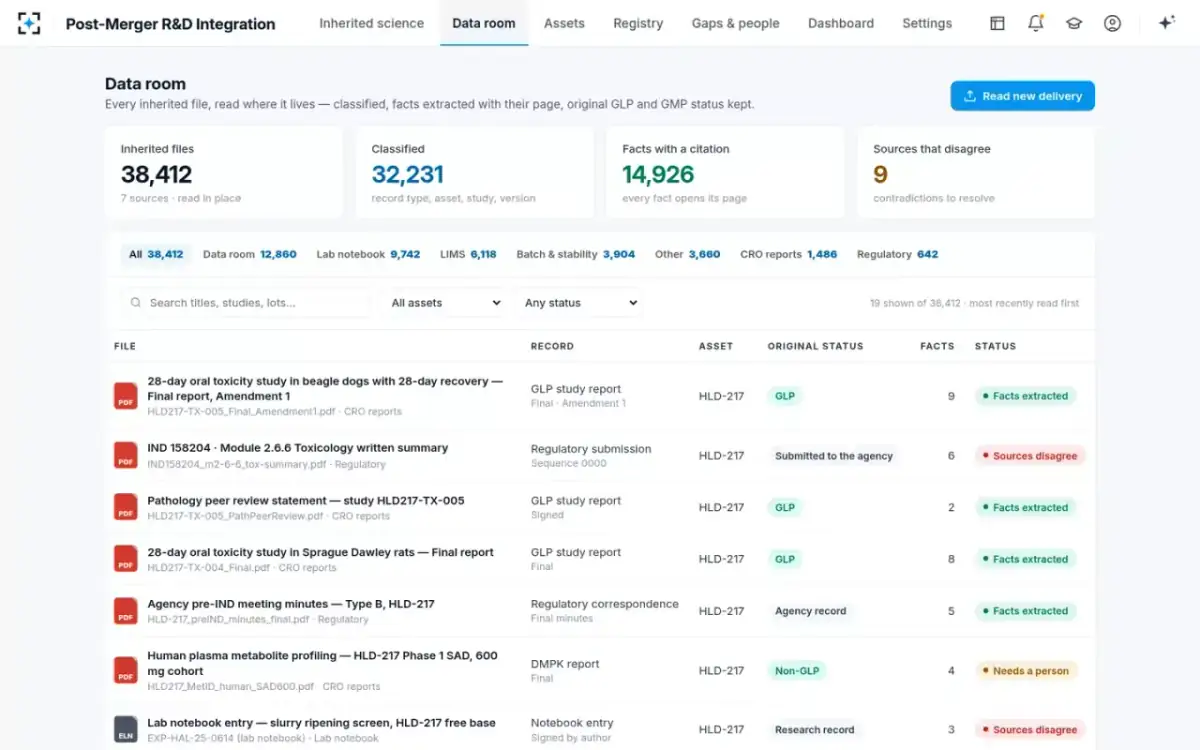
The check is mechanical and worth doing before the letter goes out: list every sequence the application should contain, mark the ones you can open, and treat the gaps as a request rather than an embarrassment. In the sample acquisition's data room, the regulatory submissions carry their sequence numbers, so a missing sequence is visible as a hole in a list rather than as a suspicion.
The inherited record, with its original status kept
Who is the responsible party on a registered trial?
Trial registration has its own rule and its own vocabulary, in title 42 rather than title 21. "For purposes of this part, each applicable clinical trial or other clinical trial must have one responsible party," the rule says, and "the sponsor of the clinical trial will be considered the responsible party unless and until a principal investigator has been designated the responsible party" (42 CFR 11.4(c)).
The link back to the drug rules is made explicitly: "when an applicable clinical trial or other clinical trial is conducted under an investigational new drug application (IND) or investigational device exemption (IDE), the IND or IDE holder will be considered the sponsor" (§ 11.4(c)(1)(i)). So a change in who holds the IND has a consequence for the registration — but it is a consequence that someone has to act on, in the registration itself. It does not follow automatically from a letter filed somewhere else.
This move is easy to miss on an acquisition, because it belongs to nobody's obvious function: the regulatory team is dealing with applications, the clinical team with sites and investigators, and the registration record sits between them with the seller's name still on it. The result is a public record that disagrees with the regulatory one, which is both a reporting problem and an uncomfortable thing to discover during an inspection.
What people assume transfers, and what the text says
The assumption: We filed the transfer, so everything moved with it.
What the regulations actually say: Three separate acts under three separate rules. Filing one does nothing for the other two.
The assumption: The services agreement with the research organization covers who does what.
What the regulations actually say: The written description of transferred obligations is what counts; anything it does not cover is deemed not transferred.
The assumption: A transfer to a research organization makes them the sponsor.
What the regulations actually say: Only the described obligations move. The organization becomes subject to the same regulatory action for those — and the rest stay with the sponsor.
The assumption: The agency tells us when the change takes effect.
What the regulations actually say: The new owner states the date the change in ownership is effective. It is your decision, and it should match everything else you date.
The assumption: The application is in the data room, so we have it.
What the regulations actually say: The statement is about a complete copy including supplements and the records kept with them — or an explicit request to the agency for one.
The assumption: The trial record updates when the sponsor changes.
What the regulations actually say: Each trial has exactly one responsible party, and changing it is a separate act in the registration.
What the sponsor still owes while all this is happening
None of the paperwork pauses the duties. A sponsor's general responsibilities run continuously and include "maintaining an effective IND with respect to the investigations, and ensuring that FDA and all participating investigators are promptly informed of significant new adverse effects or risks with respect to the drug" (21 CFR 312.50). "Promptly" is not suspended for a transition, and a safety signal that arrives in the fortnight when nobody is sure who holds the application is the hardest case an integration can face.
The defence is unglamorous: name the person who holds each duty from the effective date, in writing, before the effective date. That includes the out-of-hours safety contact, the person who can authorise a submission, and the person who will answer the telephone if the agency calls. On the sample acquisition these are settings rather than conventions — each dossier section has a named owner, and who is allowed to decide what is configured before the first draft is written.
Where the records are, and who may inspect them
The last thing a transfer leaves behind is physical. An IND must identify the people who evaluated the nonclinical results and concluded it was reasonably safe to begin: it is "required to include the identification and qualifications of the individuals who evaluated the results of such studies" (21 CFR 312.23(a)(8)), and the same provision requires the application to state where the investigations were conducted and where their records can be inspected.
That last requirement is quietly one of the most useful things in an inherited file. It means the application you just acquired already contains a list of the archives you are going to need, written by people who knew where things were. In the sample acquisition one open gap is exactly this question — where the records of a thirteen-week dog study are archived — and the person who knew has already left, with six of ten consulting hours remaining to spend on finding out.
What a change of ownership does not do is move those records. Raw data, specimens and final reports sit in the archives of the facilities that generated them, under their own retention rules and their own named archivists. Deciding whether to bring any of it anywhere is a separate question with a mostly negative answer; why not to migrate an inherited system takes it up properly.
Documents to have in hand before the effective date
- The written description of obligations transferred to each research organization
Not the services agreement. Anything the description does not name is deemed not transferred, and therefore stays with the sponsor.
- A complete copy of each approved application, with its supplements and the records kept with them
The new owner must either state it holds one or request one from the agency’s files. Check the sequence list before choosing which.
- Every commitment made to the agency, with the letter or minute it was made in
The new owner commits to the former owner’s agreements, promises and conditions. You cannot own a commitment you have not read.
- A single effective date, agreed and used everywhere
It is stated by the parties, not assigned. Use the same date in the ownership letters, the trial registrations and the internal handover.
- The responsible party for each registered trial, after the change
Exactly one entity per trial. Where the trial runs under an IND, the holder is the sponsor for this purpose — but the registration still has to be changed.
- The named safety contact from the effective date, with a telephone number
The duty to inform the agency and the investigators promptly does not pause for a transition, however short the handover is.
Three transfers that looked complete and were not
Three patterns recur, and all three are visible in a week if anyone looks.
The first is the partial CRO transfer read as a total one. The written description assigns monitoring and safety reporting; it says nothing about record retention, so retention never moved, and two years later nobody can say who holds the archive. The second is the application change filed without the commitments register: the letters go in on time, the effective date is clean, and the undertaking made in a meeting eighteen months earlier surfaces when the agency asks about it at the next milestone. The third is the registration nobody changed, where the public record still names a company that no longer exists.
What the three have in common is that the filing was treated as the deliverable. The filing is the easy part. The deliverable is a list — of obligations that did not move, commitments you now hold, and trials whose responsible party has to be changed — and that list is built by reading the inherited correspondence rather than by drafting a letter. To see the commitments register, the gaps and the correspondence they came from on an inherited record, start from Post-Merger R&D Integration.
Questions people ask
How do you transfer an IND to another company?
By submitting the change to the IND itself, with the content the agency currently expects, dated to the effective date the parties have agreed. There is no section of the regulations that governs an IND change of ownership the way 21 CFR 314.72 governs an approved application, which is why the phrase "transfer of sponsorship" has no single defined form for an IND. Ask your regulatory lead what the current submission should contain rather than copying an application template.
Does a CRO become the sponsor when obligations are transferred?
No. It assumes the specific obligations described in writing, must comply with the regulations applicable to those obligations, and is subject to the same regulatory action as a sponsor for failing to comply with what it assumed. Everything not described in the writing is deemed not to have been transferred and remains with the sponsor, so the sponsor does not stop being the sponsor.
What commitments does the new owner inherit?
For an approved application, the agreements, promises and conditions the former owner made and that are contained in the application — which in practice means anything recorded in the submission and the correspondence around it. They are rarely in one place, because commitments are made in meeting minutes and in responses to information requests rather than in study reports. Building the register is a reading exercise, and it should be finished before the new owner's letter is signed.
Who is the responsible party on a registered trial after an acquisition?
Whoever is named as such in the trial's registration after the change is made — and the change has to be made deliberately. Each trial has exactly one responsible party, the sponsor by default unless a principal investigator has been designated, and where a trial runs under an IND the holder of that IND is considered the sponsor for this purpose.
What records must the new owner have?
For an approved application: a complete copy of it, including supplements and the records required to be kept with it — or an explicit request to the agency for a copy from its files. For the underlying studies, what you need is not possession but knowledge of location: where each study was conducted, where its records can be inspected, and who is responsible for the archive that holds them.
Do the agents file anything with a regulator?
No. In this solution the agents read the inherited correspondence, pull out each commitment with the document, version and page it came from, and raise anything that nobody owns or that two sources state differently. Every submission, every decision about which value stands and every signature is a named person's, and a section with an open contradiction cannot be signed at all.