A post-merger integration 100-day plan is the calendar an acquirer runs from the day a deal closes — Day 1 readiness, a plan per function, a review at Day 100 — and almost every template you can find for one was written for finance, people and systems. None of them says what the research workstream owes, and in a life-sciences deal that is the workstream holding the reason the deal was done. The R&D side of the hundred days is the work of reading science nobody at the acquirer has read: tens of thousands of files across a deal data room, notebook and LIMS exports, contract-laboratory study reports, batch and stability records and agency correspondence, turned into something each function owner is willing to put a signature on. Botminds' Post-Merger R&D Integration is built for that job: six agents read the inherited record where it lives, carry every fact back to its page, and leave every judgement to a named person.
The worked example on this page is the sample acquisition the solution ships with. Northwind Bio closed on Halden Therapeutics on 18 August 2026 and inherited four programmes and 38,412 files. Every person, company, programme and study named here is fictional sample data. The rules quoted are real, and each is linked where it appears.
What one inherited pipeline looked like on Day 50
38,412files
inherited from 7 sources and read where they live
sample acquisition
14,926facts
carried back to a document, a version and a page
sample acquisition
19days
left before the only author of the M3 assay notebooks goes
sample acquisition
6days
to a cited dossier draft per asset, against about five weeks by hand
design target
What is a post-merger integration 100-day plan, and what does R&D owe it?
A 100-day plan is a schedule of commitments made before anyone has done the work: who reports to whom from Day 1, which systems are kept, what the combined budget is, and what the board will be shown at the end. Each function writes its own lane. The R&D lane is usually written as three lines — retain the key scientists, decide which programmes continue, integrate the systems — and all three are unanswerable until somebody has read the record.
What R&D actually owes the plan is narrower and harder. First, an inventory: every file that came with the deal, sorted by asset and function, with drafts told apart from finals. Second, a decision record: where two sources of the same fact disagree, which one stands and who said so. Third, one dossier per acquired asset, built of the sections the acquirer's own functions own — toxicology, DMPK, CMC, regulatory, IP and clinical — with every sentence carrying the document, version and page it came from.
That third deliverable is the one the integration office cares about, because it is what lets a function head answer the question the plan is really asking: can we stand behind this, and what would we have to repeat? In the sample acquisition a function lead takes about five weeks per asset to pull that together by hand, which for four programmes is most of the hundred days spent on assembly rather than on judgement.
Three clocks the integration office does not set
The reason an R&D lane cannot simply be dropped into the integration calendar is that three of its deadlines were fixed before the integration office existed, and none of them moves because a deal closed.
The first is the regulator's. An investigational new drug application carries an anniversary, and the sponsor "shall within 60 days of the anniversary date that the IND went into effect, submit a brief report of the progress of the investigation" (21 CFR 312.33). The date does not reset when the sponsor changes. If the anniversary falls inside the hundred days, somebody has to know, by then, what the last year of that programme actually showed — and whether the summary in the file still matches the final report behind it.
The second is the record's. Under the good laboratory practice rules, a study director is responsible for assuring that "all raw data, documentation, protocols, specimens, and final reports are transferred to the archives during or at the close of the study" (21 CFR 58.33(f)). The archive that holds them belongs to the testing facility that ran the study, which is often a contract laboratory that was never party to the deal. A final report and its amendments say what they say; an acquisition does not revise them, and the only way to know what they say is to read them where they are.
The third is the people's. Retention letters were negotiated during the deal and end on dates nobody renegotiates afterwards. In the sample acquisition one scientist leaves on Day 69, another on Day 88 and a third on Day 123 — three weeks after the Day 100 review.
Three calendars on one deal: the plan ends before two of them do
- Day 1Day 1–10
- A plan per functionDay 10–40
- Portfolio and budget decisionsDay 40–75
- Day 100 reviewDay 75–100
- To the IND anniversary, 12 OctDay 55
- The 60 days to the annual report, due 11 DecDay 115
- Hannah Osei, 30 SepDay 43
- Dr. Ingrid Solheim, 26 OctDay 69
- Dr. Brandt, 14 NovDay 88
- Marco Velasquez, 19 DecDay 123
Read the three lanes together and the plan rewrites itself. The only work that genuinely belongs in week one is reading, because the portfolio decision in week eight, the regulatory filing in week eleven and the question you will wish you had asked Dr. Solheim all depend on it.
What can you actually do before the deal closes?
Less than most integration offices assume, and more than most science teams attempt. The limit is not a scientific one. Until the transaction is consummated the two companies are still competitors in the eyes of an antitrust agency: "Right up until consummation, the merger parties are still independent businesses and they must continue to operate independently", the Federal Trade Commission's competition staff wrote, "including safeguarding their competitively sensitive information" (FTC, Bureau of Competition, 20 March 2018). Sharing information in a way that hands the buyer effective control of the seller before closing is the conduct antitrust lawyers call gun jumping, and it is the reason a diligence data room is run by a defined team under a confidentiality agreement rather than by whoever needs an answer.
What that leaves room for is preparation rather than integration. Agree, before closing, the list of what you will ask for on Day 1 and the shape of the dossier each function will sign. Name the six owners. Decide the rule for a draft that disagrees with a final — ours is that final and amended reports stand, and the draft value stays visible so a reader can see what changed. And read what the diligence team was already allowed to see, properly, rather than skimming it twice: a diligence summary written to support a valuation is not an inventory, and it is usually the first document that turns out to be wrong.
Week 1 to 2: find out what you bought, before anyone opens a file
The first fortnight is a request list, not a reading exercise. Most of what makes the next ten weeks possible is administrative, and most of it is obtainable on Day 1 because the law already required somebody to write it down.
What to ask for in week one, and the rule that makes each one answerable
- A complete copy of every approved application, with its supplements and the records kept under § 314.81
On a change in ownership the new owner must either state that it has a complete copy or ask FDA for one from its files (21 CFR 314.72(a)(2)). You cannot make that statement without checking first.
- For every IND, the date it went into effect
The progress report falls within 60 days of that anniversary (21 CFR 312.33), whoever owns the application that year. Two of them may land inside your hundred days.
- Where each study was run, and where its records are available for inspection
An IND is required to state where the investigations were conducted and where the records can be inspected (21 CFR 312.23(a)(8)), so the inherited copy already names the archives you will have to reach.
- The archive custodian for each contract laboratory
Raw data, documentation, protocols, specimens and final reports go to the archives at the close of a study (21 CFR 58.33(f)). Knowing who holds them decides whether week four is reading or chasing.
- Every commitment made to the agency, and the letter or minute it is written in
A new owner commits to the agreements, promises and conditions the former owner made. Nobody can own a commitment they have not been shown.
- The retention letters and their end dates, by person
These set the only deadline in the plan that cannot be extended by anyone in the room, and they usually sit with HR rather than with the science workstream.
Two of these are routinely missed. The archive custodian is missed because everyone assumes the files came with the data room; they did not, and a deal data room holds the reports, not the raw data behind them. The retention end dates are missed because they live in a different function's spreadsheet, and what only one scientist knows is the part of the inheritance that expires.
Week 2 to 6: read the inherited record where it lives
This is the block that decides whether the hundred days produce anything, and the block most plans spend on a system migration instead. The instinct is understandable: two notebook systems and two laboratory systems look like an obvious duplication. But a migration moves the files without reading them, takes a year, and puts a new copy of a GLP record into a system the original study never used. Reading does not need it. Agents can read a data room export, a notebook export, a LIMS extract and a folder of study reports in place, leaving every original untouched. Whether any of those systems ever has to be migrated is a separate question, and week six is a better place to answer it than week two.
The reading itself has a shape. Files are classified first: record type, asset, study, version, and the original GLP or GMP status, with duplicates and superseded drafts set aside rather than deleted. Then facts are pulled out — study designs, findings, no-observed-adverse-effect levels, PK parameters, lots, stability results, agency commitments — each one carrying the document, version and page it came from, and a confidence. In the sample acquisition that produced 14,926 facts from 38,412 files, and anything the agents were less than 85% sure of went to a person instead of into a draft.
Where the five weeks go on one asset, and what the target leaves
By hand · about 25 working days per asset (our estimate)
- Finding and sorting the files · 24%
- Pulling out findings, PK, lots and commitments · 28%
- Checking summaries against final reports · 16%
- Writing the cited sections · 20%
- Finding who knows · 12%
To the 6-day target · the same five jobs
- Finding and sorting · 8%
- Pulling facts out · 17%
- Checking · 17%
- Writing the cited sections · 33%
- Finding who knows · 25%
That reshaping is the argument for doing it this way. The jobs that disappear are the ones nobody was hired for. The jobs that grow as a share are judgement and conversation — which sentence stands, and which scientist has to be asked before they leave.
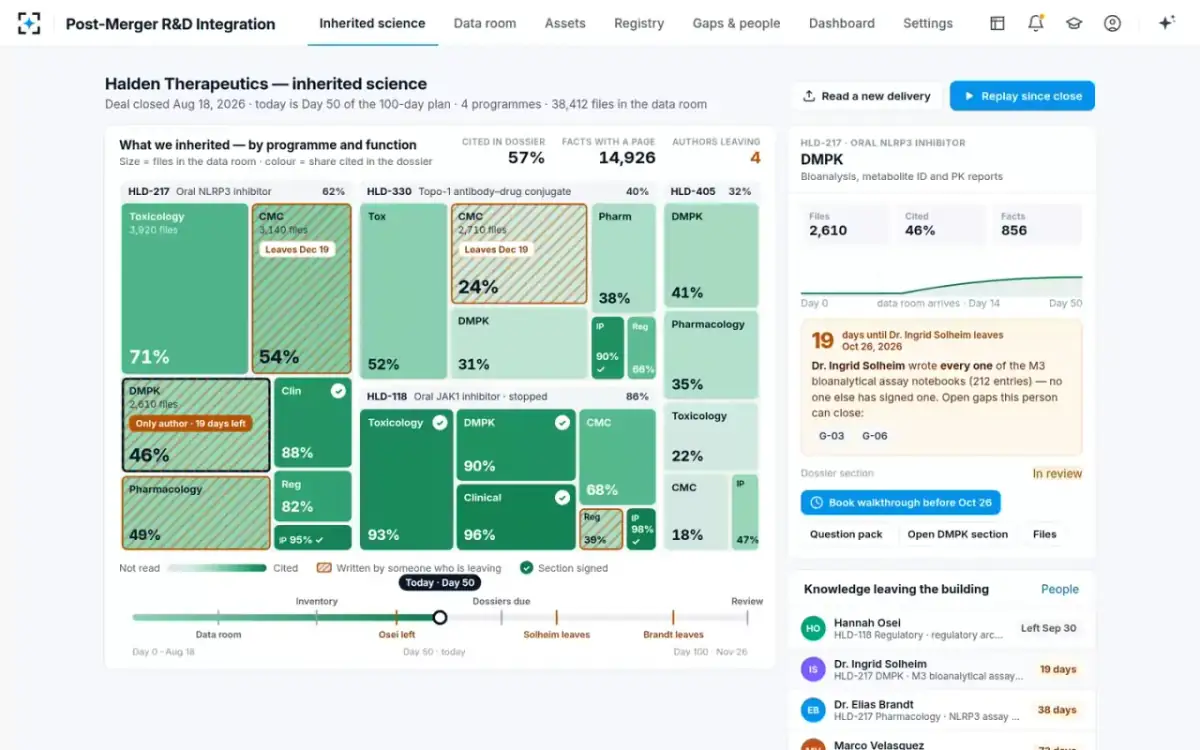
Everything the deal brought, on one map
Week 6 to 10: contradictions, gaps and the people who can close them
By week six there is enough on the map to ask the only question that matters: where does the record disagree with itself? Those disagreements are not rare and they are not usually anyone's fault. A summary is written from a draft report, the final report is amended after a pathology peer review, and the summary is never revisited.
The sample acquisition has a clean example. The IND Module 2.6.6 toxicology summary for HLD-217 gives a dog 28-day no-observed-adverse-effect level of 50 mg/kg/day, taken from a draft report of 2 November 2023. The final report, Amendment 1, gives 15 mg/kg/day after the peer review found minimal liver necrosis at the higher dose. On the final value the exposure margin to the planned 200 mg Phase 2 dose is 1.9×, not 6.2×. That is not a documentation problem; it is a dose-selection problem that the integration office would otherwise have discovered in a Phase 2 planning meeting in month seven.
How one inherited fact becomes a signed sentence
Agent
Data Room ClassifierReads every inherited file where it lives and labels its type, asset, study, version and original GLP or GMP status, setting duplicates and superseded drafts aside.
Never: an original is copied, moved or re-labelled
Agent
Study & Finding ExtractorPulls studies, findings, PK parameters, lots, stability results and agency commitments into one place, each with its document, version, page and a confidence.
Never: a value that is not written down
Agent
Contradiction & Gap FinderCompares the same fact across versions and sources — draft against final, summary against report, notebook against report — and raises each gap with an owner and an expert who could answer it.
A person decides
The function ownerDecides which value stands when two sources disagree, with both sources in front of them, and the decision is recorded against the section.
Agent
Expert Interview PlannerBuilds a short question pack for each departing author from the open gaps only they can close, and books it against their last day.
A person decides
The departing scientist and the gap ownerAnswer the questions in a booked walkthrough. What is said is kept as an interview, linked to its gap — and the agents then go looking for the file the expert named.
Agent
Dossier WriterDrafts each section with every sentence cited, and rewrites every sentence that used a superseded value once the owner has decided.
A person decides
The section ownerSigns, with the meaning of the signature and a password. A section with an open contradiction cannot be signed.
Never: an agent signs a section
Weeks six to ten are also when the departure dates start to bind. A gap that only one person can close is not a documentation task, it is an appointment, and it has to be booked against a last day rather than against the integration calendar. In the sample, Dr. Ingrid Solheim wrote all 212 M3 bioanalytical assay notebook entries and no one else has signed one; her walkthrough is booked for twelve days before she goes, with four questions attached to the two gaps she can close.
Week 10 to 14: a dossier per asset that a function owner will sign
The last block is where the hundred-day plan collides with reality, because a 100-day plan that ends at Day 100 ends two weeks before a toxicology head is willing to sign anything. Week fourteen is the honest date, and saying so in week one is better than discovering it in week thirteen.
What is being signed matters as much as when. The dossier is a research summary of inherited evidence, cited to it. It is not a GLP record, and signing it changes the status of nothing it cites: the final reports stay what they always were, held in the archives of whoever ran them. What the signature means is written on the section — "I reviewed the cited evidence and approve this section for the integration dossier" — and only the named owner of that function can give it. Who holds which seat, and who may sign what, is worth settling before the first draft, not after.
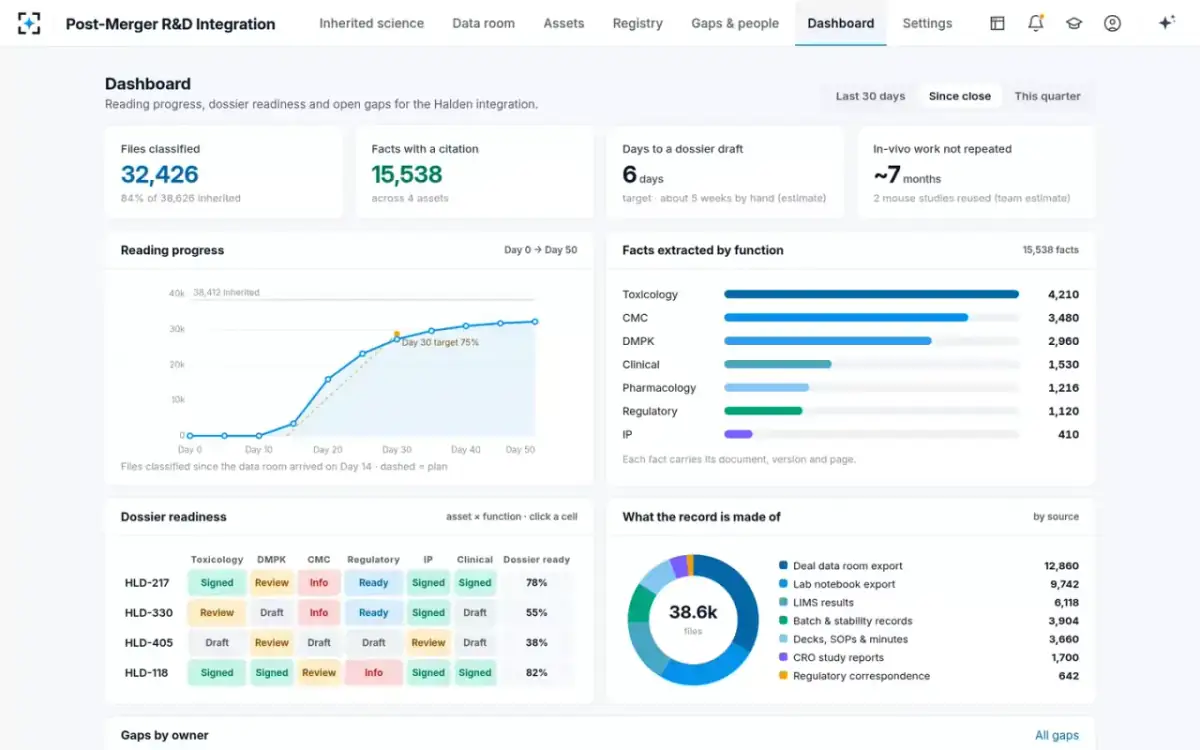
Readiness by asset and by function, at the point a plan is reported on
When must the agency be told about the change in ownership?
When an approved application changes hands, the answer is specific and it is a pair of letters rather than a date on your calendar. Under 21 CFR 314.72 an applicant may transfer ownership of its application, and both sides file at the time of transfer. The former owner writes that all its rights to the application have passed to the new owner. The new owner commits to the agreements, promises and conditions the former owner made, states the date on which the change in ownership takes effect, and either confirms it holds a complete copy of the approved application or asks the agency for one from its files.
Two things in that are easy to get wrong in an integration plan. The effective date is stated by the parties, not assigned by the agency, so it is a decision the plan has to make rather than a deadline it has to wait for. And § 314.72 governs applications — new drug applications and abbreviated ones. It does not govern an IND, where the change is made by submitting it to the application itself, and the responsible party on a registered clinical trial is a third thing again. The three are routinely run together under one phrase; which of the three you are actually doing is a question worth answering before anyone drafts a letter.
What a Day 50 status really looks like
Halfway through the plan, the useful status is not a percentage of tasks completed. It is how much of the inherited science is now cited, where the disagreements are, and which of them has a person attached with a date on them.
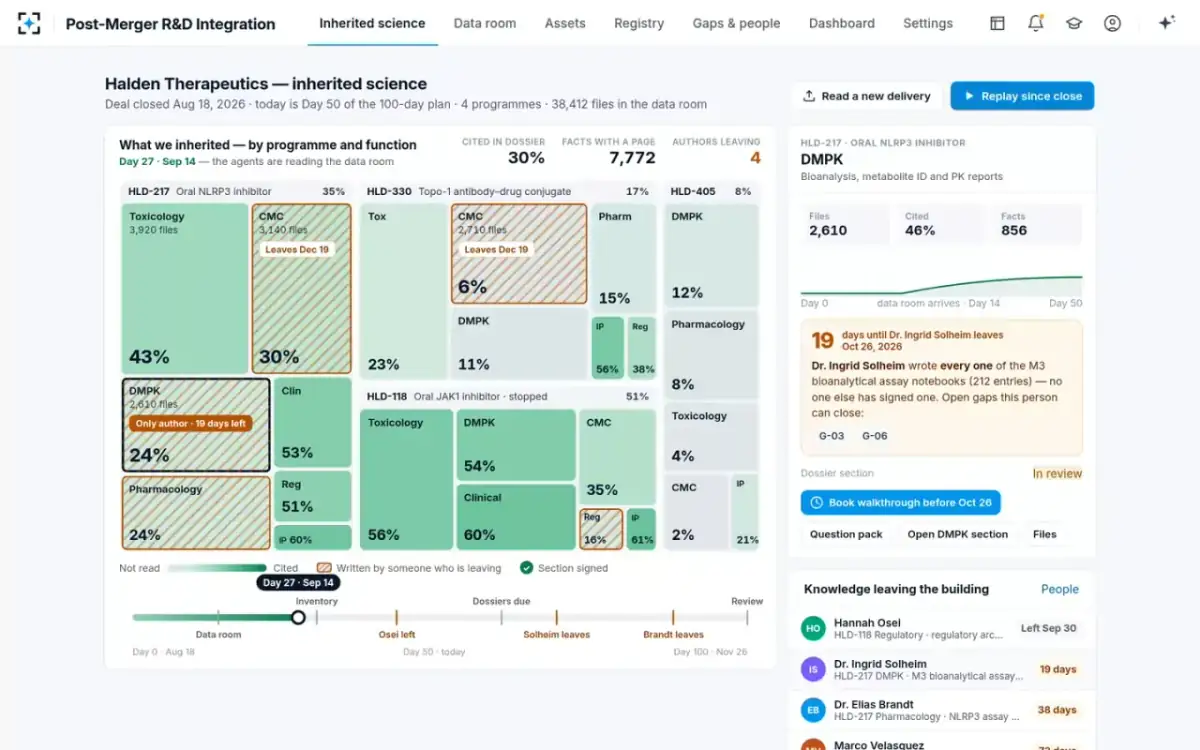
In the sample acquisition, Day 50 reads: 57% of the inherited record cited in a dossier section, 14,926 facts carrying a page, four programmes mapped by function, four authors leaving and one walkthrough booked. Twenty-three days earlier, on Day 27, the same map was at 30% cited and 7,772 facts. The slope between those two points is the only honest projection available in week seven, and it is worth more to a steering committee than a status colour, because it says plainly whether the reading finishes before the retention letters run out.
The same map, replayed from the day the deal closed
The five things that slip, and what each one costs later
Across the research workstreams we have designed for, the same five slips recur, and each has a characteristic week in which it surfaces — always later than the week in which it was caused.
Five slips in an R&D hundred-day plan, their cause and the week the bill arrives
| What slips | Why | When it surfaces |
|---|---|---|
| Reading waits for a systems decision | A notebook or LIMS migration is scheduled early, and the science workstream is told to wait for the target system. The migration takes a year. | Week 8, when the first dossier section has nothing cited behind it. |
| A summary is believed over the report behind it | Summaries are short and searchable; final reports and their amendments are long and sit in an archive nobody has reached yet. | Week 10, at the first function review — or much later, in a dose-selection meeting. |
| The departing author is interviewed last | Retention dates live with HR and never reach the science plan, so the walkthrough is scheduled when the gap is understood rather than while the author is still there. | The week after a last day, when the gap is permanent. |
| A commitment made by the former sponsor is missed | Commitments are made in meeting minutes and letters, not in the study reports everyone is reading. | At the next annual report, or the next meeting with the agency. |
| A study is repeated that was already run | Nobody can search the acquired notebooks, so a planned study is designed from the literature instead of from what the company already owns. | Week 14, when the budget is approved and the work is booked. |
The common thread is that every one of them is a reading failure wearing a scheduling costume. That is also why the R&D answer to why mergers fail is narrower than the usual answer about culture: the leak is specific, it has a date, and it is measurable. To see the map, the contradictions and the walkthroughs on a real data room, start from Post-Merger R&D Integration.
Questions people ask
How long does post-merger integration take in R&D?
Longer than the plan says, and the honest number is about fourteen weeks to a signed dossier per asset rather than ten. The reading itself is the fast part once it is automated — the design target in this solution is six days per asset against about five weeks by hand — but a function head will not sign a section with an open contradiction, and closing one can mean waiting for an archive, a contract laboratory or a person's diary.
What happens to R&D after an acquisition?
Three things at once: the portfolio is re-ranked, the systems are reviewed, and the scientists are put on retention letters with end dates. The published research is blunt about the third — inventors at acquired biotechs leave at measurably higher rates, and the ones who stay patent less, as key person risk after an acquisition sets out. The practical consequence is that the window for asking the acquired company's scientists anything is shorter than the integration calendar.
Who owns the acquired company's studies after closing?
The acquirer owns the data and the rights, but not usually the archive. Raw data, specimens and final reports are archived by the facility that ran the study, which is often a contract laboratory with its own named archivist. What transfers with the deal is ownership and the obligations that go with it; what does not transfer is physical custody, which is why week one asks where the records are and who holds them.
How long must the inherited records be kept?
For an IND sponsor, 21 CFR 312.57(c) requires records and reports to be kept "for 2 years after a marketing application is approved for the drug; or, if an application is not approved for the drug, until 2 years after shipment and delivery of the drug for investigational use is discontinued and FDA has been so notified." Nonclinical records have their own retention periods under the good laboratory practice rules. An acquirer that discontinues a programme still inherits the clock.
Is a 100-day plan the same thing as a Day 1 checklist?
No. A Day 1 checklist is about continuity — payroll, access, who signs what, whether the laboratory keeps running. A 100-day plan is about decisions. For the research workstream the distinction matters because almost nothing on the Day 1 list produces knowledge, and the hundred-day decisions all depend on knowledge nobody has yet.
What goes wrong in the first hundred days of an acquisition?
In the research workstream, the same five things: reading waits for a systems decision, a summary is trusted over the final report behind it, the departing author is interviewed last, a commitment made to the agency by the former sponsor is missed, and a study is repeated that the acquired company had already run. Each is caused in the first fortnight and discovered between week eight and week fourteen.