Metabolites in safety testing is the question of whether the animals used in a drug's toxicology studies were ever exposed to the compounds a human body actually makes from it. It is hard because the answer lives in bioanalytical measurements rather than in conclusions: a metabolite that matters is one measured in human plasma at more than a tenth of the drug-related exposure and barely seen in the test species, and the only proof that someone checked is a number in an assay file. That is why it is the clearest thing an acquirer can inherit without knowing: the threshold is published and precise, the consequence is a nonclinical study that has to be finished before large-scale clinical trials, and the evidence sits several layers below the summary anyone reads during a deal. Botminds' Post-Merger R&D Integration reads an acquired biotech's data room, notebooks and study reports where they live and ties every fact to the page it came from, so a DMPK lead can say which species a metabolite was measured in, at what exposure, and whether anyone ever wrote the answer down.
The programme on this page is sample data: Northwind Bio's acquisition of Halden Therapeutics, four programmes and 38,412 files. Every person, company, programme and study named in it is fictional. The threshold, the studies and the timing come from the agency's and ICH's own documents, linked where they appear.
What the threshold is, and what it sets running
>10%
of total drug-related exposure at steady state, as area under the curve — the level at which a human metabolite can raise a safety concern
2
conditions together: above that level, and at significantly greater levels in humans than the maximum exposure seen in the toxicity studies
Phase 3
the studies, where warranted, are completed and reported before large-scale clinical trials begin
G-03
the open metabolite gap in the sample acquisition, owned by the DMPK lead, answerable by one departing scientist
What are metabolites in safety testing, and why do they matter?
A toxicology package is built on a comparison. Animals are dosed with the parent drug, their exposure is measured, and the findings are read across to humans by comparing systemic exposure in the animal with systemic exposure in the patient. The FDA's guidance describes the assumption that makes this work: the paradigm "usually is sufficient when the metabolic profile in humans is similar to that in at least one of the animal species used in nonclinical studies." When it is not similar, the comparison quietly stops covering part of what the patient is exposed to.
Metabolic profiles differ across species both in kind and in amount. A compound formed only in humans is rare; the guidance says so plainly. The common case is a metabolite formed in humans at higher levels than in the species used to test the parent drug. If that compound carries toxicity of its own, no amount of rigour in the parent-drug studies will have found it, because the animals never saw enough of it.
There is a second reason the question resists shortcuts. Showing that a metabolite does nothing at the drug's target is not an answer. General toxicity studies are designed to catch off-target effects as well, and the guidance is explicit that demonstrating a metabolite is pharmacologically inactive at the target receptor, "or even that it does not meaningfully bind to a receptor or enzyme in a screening test," is not sufficient to conclude it is not toxic. The guidance's own third case example makes the point harder than any argument: a metabolite that was inactive at the therapeutic target, tested in a short-term tolerance study in the dog, "produced unexpected and significant cardiotoxicity at all doses and in all of the dogs."
What is a disproportionate drug metabolite?
A disproportionate drug metabolite is, in the guidance's glossary, "a metabolite present only in humans or present at higher plasma concentrations in humans than in the animals used in nonclinical studies." The glossary then adds the quantitative part: in general these metabolites are of interest if they account for plasma levels greater than 10 percent of total drug-related exposure, measured as area under the curve at steady state.
Two halves, and both matter. "Disproportionate" is about the comparison between species, not about the absolute amount. A metabolite that is 40 percent of drug-related exposure in humans and 40 percent in the dog is not the problem this work is about; the dog study already characterised it. A metabolite at 12 percent in humans and traces in every species tested is.
The guidance also notes where the 10 percent figure came from: the choice "reflects consistency with FDA and Environmental Protection Agency guidances." It is a convention for deciding what to characterise, not a biological constant, and the guidance says in a footnote that a different measure of exposure can be justified, that Cmax is sometimes more appropriate than area under the curve, and that metabolites above 10 percent of urinary excretion or a predominant human fecal metabolite can raise their own localised concerns to be discussed with the review division.
The 10 percent threshold, stated exactly
Anyone who has worked near this subject has heard it compressed to "above ten percent." The compression is where errors start, so here is the sentence the agency actually prints: "Human metabolites that can raise a safety concern are those present at greater than 10 percent of total drug-related exposure at steady state." Three qualifiers travel with the number — greater than, of total drug-related exposure, and at steady state — and the glossary adds the fourth, that the exposure is measured as area under the curve.
ICH M3(R2) states the trigger as a conjunction, and this is the half most often dropped. Nonclinical characterisation of a human metabolite "is only warranted when that metabolite(s) is observed at exposures greater than 10% of total drug-related exposure and at significantly greater levels in humans than the maximum exposure seen in the toxicity studies." A number alone never triggers anything. The threshold and the cross-species comparison are one test, and ICH adds that for drugs dosed below 10 mg a day, greater fractions of drug-related material may be the more appropriate trigger.
Discovering such differences in drug metabolites late in drug development can cause development delays.
FDA, Safety Testing of Drug Metabolites, Revision 2, section III
That sentence is the whole commercial argument for finding this during a deal rather than after one. It is also why the question belongs in the first fortnight of an integration rather than the first year: the delay is not caused by the metabolite, it is caused by the date on which somebody asks.
What ICH M3(R2) says, and when the studies are due
ICH M3(R2) places metabolite work inside the ordinary sequence of pharmacokinetic evidence. In vitro metabolic and plasma protein binding data for animals and humans, and systemic exposure data in the species used for repeated-dose toxicity studies, generally should be evaluated before human trials begin. Fuller absorption, distribution, metabolism and excretion information "should be available before exposing large numbers of human subjects or treating for long duration (generally before Phase III)." Those data are what the cross-species comparison is made from.
The deadline is stated twice, in two documents, in the same place in development. ICH says studies on a disproportionate metabolite "should be conducted to support Phase III clinical trials." The FDA's guidance says that if toxicity studies of a metabolite are warranted, "sponsors should complete studies and provide study reports to the FDA before beginning large-scale clinical trials." Both are recommendations rather than requirements — the FDA guidance says the word should means suggested or recommended, not required — but the practical effect for an acquirer is a date, and the date is the one the deal model has already assumed.
There is one documented relief valve. For serious or life-threatening diseases other than cancer, the number and type of nonclinical studies for a metabolite can be modified case by case, and the guidance tells sponsors to contact the review division. That is a conversation, not a default, and it is worth knowing before a programme's Phase 3 start date is announced to a board.
Which studies the threshold actually triggers
The cost of a metabolite gap depends entirely on which of four study types the answer pulls in, and that depends on the drug's population and duration of use. The guidance also settles the question people ask next: "Good laboratory practice guidelines apply to the nonclinical studies with the drug metabolite designed to evaluate safety (21 CFR part 58)." A metabolite study is not an exploratory experiment that can be run quickly and written up loosely.
What a disproportionate metabolite can require, and what each study depends on
| Study | What the guidance recommends | What decides whether you need it |
|---|---|---|
| General toxicity | Toxicity of the metabolite evaluated at multiples of human exposure, or at least at levels comparable to those measured in humans, by the parent drug’s intended clinical route where possible, with toxicokinetic data gathered to prove exposure. | Always, once direct testing is warranted. Duration follows the ICH M3(R2) recommendations for the parent. |
| Genotoxicity | One in vitro assay for point mutations and another for chromosomal aberrations, to the ICH S2(R1) recommendations. An equivocal or positive result can pull in the complete standard battery. | Always, once direct testing is warranted — and the downside risk is asymmetric: in the guidance’s second case the metabolite was positive where the parent drug was negative. |
| Embryo-fetal development | Studies with the metabolite where the drug is intended for a population that includes women of childbearing potential; one species that forms the metabolite can sometimes be justified. | The intended population. Other reproductive studies are asked for case by case. |
| Carcinogenicity | A single carcinogenicity study or an alternative bioassay, where the metabolite’s carcinogenic potential cannot be adequately evaluated from the studies done with the parent. | Continuous dosing for at least six months, or intermittent use for a chronic or recurrent condition. |
Two of those four — the general toxicity study with toxicokinetics, and a genotoxicity pair — are the realistic floor for a programme that finds a gap. If the indication reaches women of childbearing potential or the dosing is chronic, the floor rises. None of it is exotic work; all of it is work with a calendar, a facility slot and a study director, and none of it can start until somebody has established what the measurements already say.
What a metabolite gap looks like in an acquired file
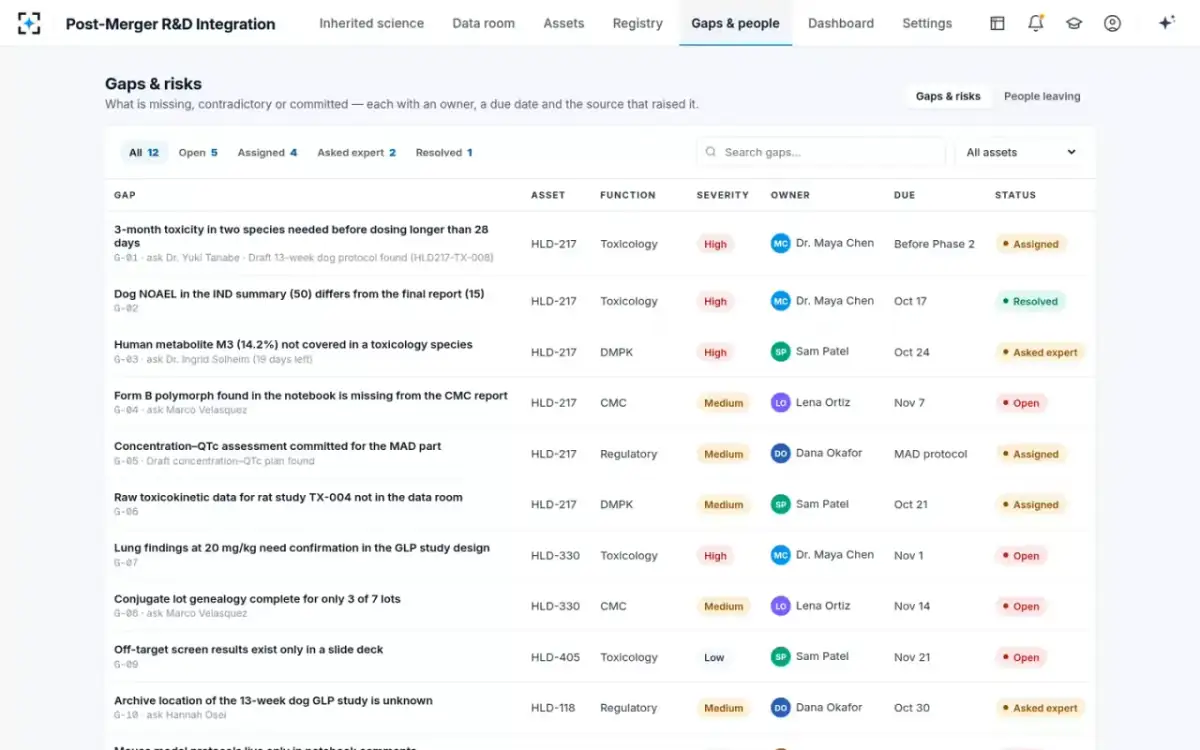
In the sample acquisition the gap is numbered G-03 and sits on the HLD-217 programme. The agency had asked the former sponsor to evaluate a metabolite, M3, that is above the 10 percent level in humans. Halden identified it, raised the question, and the record of what happened next is 212 bioanalytical assay notebook entries, every one of them written by one person: Dr. Ingrid Solheim, head of bioanalysis and DMPK, whose retention contract ends on 26 October. Nobody else has signed a single entry.
That shape is typical, and it is worth naming the three ways it hides. The question can be answered and unwritten, where someone measured M3 in dog plasma, satisfied themselves and never put the result in a report. It can be asked and dropped, where a plan existed and the study slot went to something else. Or it can be answered somewhere unexpected, where the toxicokinetic samples from a rat study were analysed for the parent drug only and the stored plasma could still answer the question. Those three cases have the same appearance in a data room — silence — and completely different costs.
Post-Merger R&D Integration: the open metabolite gap, its owner and the expert who can close it
How do you find out whether it was ever measured in animals?
You find it by going down one level at a time, and by knowing in advance which level can settle the question. A summary can tell you what was concluded. A final report can tell you what was concluded and on what. Only the bioanalytical file can tell you whether a particular compound was measured in a particular matrix in a particular study, and only the raw toxicokinetic file can tell you at what exposure.
Where the answer hides, and what each source can and cannot settle
| Where you look | What it can settle | What it cannot |
|---|---|---|
| The IND nonclinical summary | What the former sponsor told the agency, and when. Under the IND rules it has to describe absorption, distribution, metabolism and excretion "if known". | Whether a value is the current one. A summary written from a draft report keeps the draft’s number until someone rewrites it. |
| The final study report, and its amendments | The study’s design, the species, the doses, the findings and which analytes the report covers. | Whether a compound the report does not mention was measured anyway. Absence in a report is not absence of a measurement. |
| The bioanalytical method and assay notebooks | Whether an assay for the metabolite existed, in which matrix it was validated, and which studies’ samples went through it. | The exposure achieved. A validated assay with no sample set behind it answers nothing. |
| The raw toxicokinetic file | The concentrations and the area under the curve, animal by animal — the only place the cross-species comparison can actually be made. | Nothing, if it is not in the data room. Whether it was transferred is its own question. |
| Agency correspondence and meeting minutes | That the question was asked, by whom, and what the former sponsor undertook to do. | Whether the undertaking was met. A commitment and its evidence are rarely in the same folder. |
This is the order Post-Merger R&D Integration works in. The Study and Finding Extractor pulls each study, finding and pharmacokinetic parameter into one searchable set with its document, version and page attached, and it has two rules that matter for a question like this one: it never infers a value that is not written, and anything it is less than 85 percent confident of goes to a person rather than into a dossier. A gap, in that design, is not a failure to find something. It is a positive statement that nothing in 38,412 files says it.
When the answer is not in the files at all, the next move is a person — and in an acquisition that is a clock, not a calendar entry. The question pack built for Dr. Solheim's walkthrough asks two things in plain words: was M3 measured in any rat or dog plasma sample, and where are the raw toxicokinetic files for rat study TX-004. Both are answerable in a sentence by the one person who knows, and worth a great deal more than the fortnight of searching that would otherwise follow her departure. That whole problem — who knows, and what happens when they go — is the subject of key person risk after an acquisition.
Why the summary is the wrong place to look
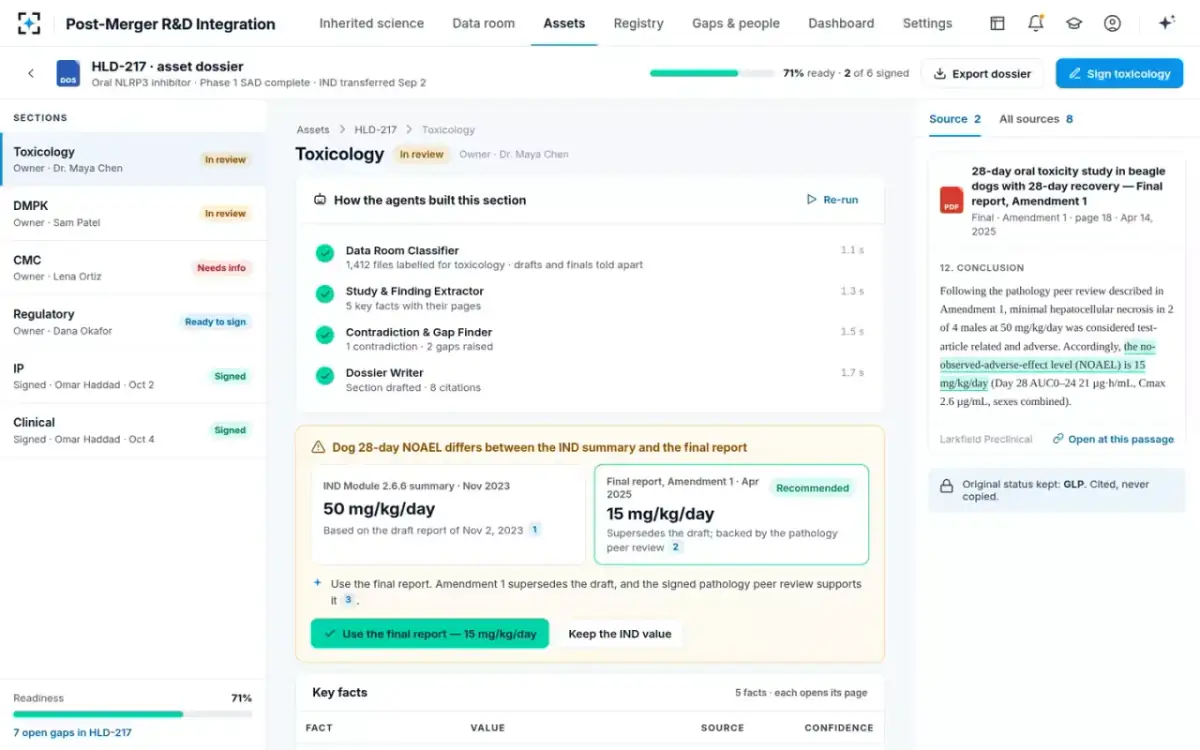
Summaries drift. They are written from whatever existed on the day they were drafted, and when a report is corrected afterwards the summary does not correct itself. The sample acquisition carries a clean example on the same programme: the IND Module 2.6.6 toxicology summary gives a dog 28-day no-observed-adverse-effect level of 50 mg/kg/day, taken from the draft report of 2 November 2023, while the final report's first amendment gives 15 mg/kg/day after a pathology peer review found minimal liver necrosis at the higher dose. Both documents are in the data room. Only one of them is current.
The reason an acquirer cannot simply fix this is a rule about who owns a report. Corrections or additions to a final report are made by amendment, by the study director, identifying what is being corrected and why. Nobody at the acquiring company is that person, for a study the acquired company commissioned. What the acquirer can do is record which value stands, on what evidence and by whose decision — and that is a different discipline, set out in data integrity and ALCOA for records you did not create.
What Post-Merger R&D Integration shows behind one toxicology section
For a metabolite question the same drift runs the other way round. A summary can carry a statement that a metabolite was "adequately characterised in the nonclinical studies" because that was the plan when the summary was written. The study that would have characterised it can then have been descoped, and no document anywhere says so. Only the bioanalytical record settles it, which is why a dossier section built from summaries is worth less than the hours it took.
What it costs to find this after the deal rather than during it
Three costs, and only the first is the one people budget for. The first is the study itself: a general toxicity study with toxicokinetics and a genotoxicity pair, run to good laboratory practice, with a facility slot and a study director.
The second is the Phase 3 start date. Where studies are warranted, the reports go to the agency before large-scale trials begin, so the critical path runs through a facility's calendar rather than the acquirer's. The third is the one nobody writes down: the exposure margin the deal was argued on. On the sample programme, the margin between the final dog finding and the planned Phase 2 dose is 1.9 times rather than 6.2 times, depending on which of two documents you read — sample figures on a fictional programme, but exactly the quantity a metabolite question moves.
One metabolite question, from first raised to found by someone else
- M3 identified above 10 percentidentified
- The agency asks for dataasked
- Assay work: 212 entries, one authorin notebooks only
- Diligence and signingdiligence
- CloseDay 0
- Agents read the data roomreading
- Gap G-03 raised, with an ownerraised
- Walkthrough bookedDay 50
Found during diligence, this is a price question: a known study, a known calendar, a number in the model. Found on Day 50, it is still a price question, and the price is higher because the people who can answer it cheaply are leaving. Found in year two, it is a Phase 3 delay with an audience. Nothing about the science changes between those three; only the date.
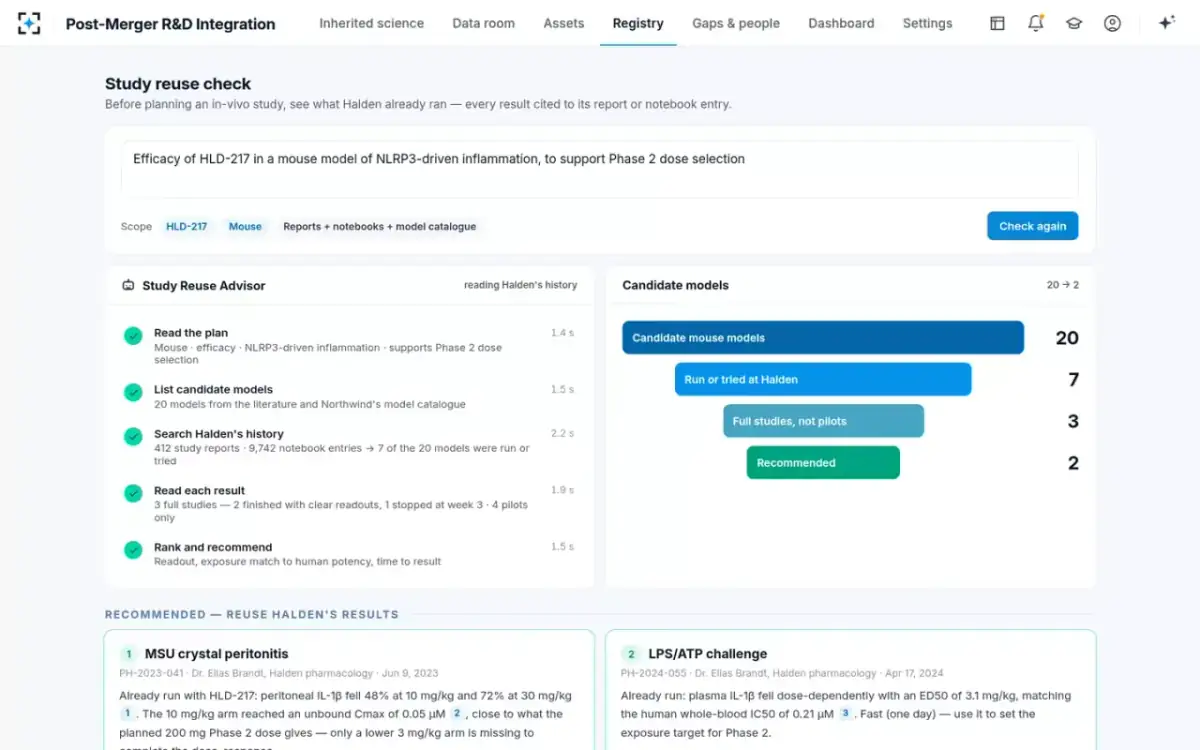
Before anyone books new animals, there is one more thing worth asking: whether the acquired company already ran the study. On the sample acquisition that question, put to the inherited record, narrowed 20 candidate mouse models to two that Halden had actually run with cited results, and flagged a third that was stopped at week three. The same reading that finds the gap finds the work you no longer have to repeat.
Asking the inherited record whether the study has already been run
Six questions to put to an inherited programme's metabolite data
- Which human metabolites were above 10 percent of total drug-related exposure, as area under the curve at steady state, and in which study?
This is the threshold as the FDA guidance states it. A percentage without the denominator, the measure and the steady-state condition is not an answer.
- For each one, what was the maximum exposure seen in the toxicity studies, species by species?
ICH M3(R2) makes characterisation warranted only where the metabolite is also at significantly greater levels in humans than that maximum. Without the animal number there is no test.
- Was there a validated assay for the metabolite, in which matrix, and which studies’ samples went through it?
An assay with no sample set behind it answers nothing, and the guidance notes that exposure can be verified in urine, feces or bile when plasma cannot be measured.
- Are the raw toxicokinetic files in the data room, or referenced somewhere else?
Under the good laboratory practice rules an archive may hold raw data elsewhere provided it refers specifically to those locations. A reference is a lead; an absence is a gap.
- Did the agency ask about this metabolite, and what did the former sponsor undertake to do?
The new owner takes on the commitments the former owner made. A commitment and its evidence are usually in different folders.
- Who wrote the measurements, and when does their contract end?
Where one person authored every entry, the answer has a date on it. Rank the gap by that date, not by its severity alone.
The guidance's own decision path, from a measured human exposure to an answer
Is the human metabolite above 10 percent of total drug-related exposure, as area under the curve at steady state?
No
No further testing needed to evaluate the metabolite.
It is above 10 percent. Is it formed in any animal test species?
No
Nonclinical testing with the drug metabolite.
It is formed in an animal species. Does exposure in the animal studies approach human exposure?
No
Nonclinical testing with the drug metabolite.
Does exposure in the animal studies approach human exposure?
Yes
No further testing needed to qualify the metabolite.
Read as a diligence tool, that path is four questions with a documentary answer each, and an acquirer can work it in an afternoon per programme once the measurements are findable. Read as an integration task, it is the difference between a dossier section a head of toxicology will sign and one she will send back. To see how the reading, the gaps and the walkthroughs fit together on one acquisition, start from Post-Merger R&D Integration.
Questions people ask
What is the 10 percent metabolite rule?
It is the level at which the FDA's guidance says a human metabolite can raise a safety concern: present at greater than 10 percent of total drug-related exposure at steady state, measured as area under the curve. ICH M3(R2) adds the second half of the test — the metabolite must also be at significantly greater levels in humans than the maximum exposure seen in the toxicity studies. Both documents are recommendations rather than requirements, and the FDA guidance says the 10 percent figure was chosen for consistency with its own and the Environmental Protection Agency's guidances.
When do you need to test a metabolite in animals?
When the metabolite is above the threshold and the animal species used for the parent drug did not reach comparable exposure. The guidance describes two ways out of it: find a species routinely used in toxicity studies that forms the metabolite at exposure equivalent to or greater than the human level and study the drug in that species, or synthesise the metabolite and dose it directly. The second route needs an analytical method capable of measuring the metabolite in those studies, and the guidance warns that direct dosing can produce metabolism and toxicities that do not reflect the clinical situation.
When must metabolite studies be completed?
Before large-scale clinical trials. The FDA guidance says sponsors should complete the studies and provide the reports to the agency before beginning them, and ICH M3(R2) says such studies should be conducted to support Phase 3. For serious or life-threatening diseases other than cancer the number and type of studies can be modified case by case, after a discussion with the review division.
Do good laboratory practice rules apply to metabolite studies?
To the safety studies, yes. The guidance states that good laboratory practice guidelines apply to the nonclinical studies with the drug metabolite designed to evaluate safety, citing 21 CFR part 58. The earlier metabolite identification work — in vitro microsome, liver slice and hepatocyte studies, and the in vivo profiling — is characterisation rather than a safety study, and in practice much of it is not run under those rules, which is one reason its records are harder to follow in an inherited archive.
How do you find out whether a metabolite was ever measured in animals?
By reading down, not across. The summary tells you what was concluded, the final report tells you which analytes it covered, the bioanalytical method and assay notebooks tell you whether an assay existed and which samples went through it, and only the raw toxicokinetic file gives the exposure. If none of them answers, the next step is the person who ran the assay — which is why, in an acquisition, the question is worth asking before their retention date rather than after it.
What happens if a metabolite gap is found late?
The guidance names the consequence itself: discovering such differences late in drug development can cause development delays. Concretely, the work is a general toxicity study with toxicokinetics and a genotoxicity pair at minimum, run under good laboratory practice, with embryo-fetal or carcinogenicity work added depending on the population and the dosing duration — and the reports are expected before large-scale trials, so the delay is set by a facility's calendar rather than yours.