An integration management office runs the plan rather than the work: its post-merger integration manager owns the hundred-day calendar, the dependencies between functions, the escalation path and the meeting where a slipping date is confronted. That model works well in finance and in systems, where the integration office can genuinely make the call. It stops working at the edge of the research record, because in a regulated record accountability is already assigned by name: to a study director who is the single point of control for a study, to a unit that must be independent of the people who wrote the report, and to a sponsor with obligations that no slide deck transfers. Botminds' Post-Merger R&D Integration is built around that asymmetry: six agents do the reading and the cross-checking, and every decision stays with the named person whose function owns it.
The people and the company in the worked example are fictional sample data from the solution's own sample acquisition: Northwind Bio's purchase of Halden Therapeutics. The rules are real and linked where they appear.
The same inherited asset, from five seats
Today
“I can’t integrate what nobody has read — and I can’t ask people who have already left.”
With agents
Sees the whole inheritance on one map: what is cited, what disagrees, who is leaving and when.
Still theirs: Owns the plan and the sequence. Decides nothing scientific.
Today
“Show me the final report, not the summary someone wrote from the draft.”
With agents
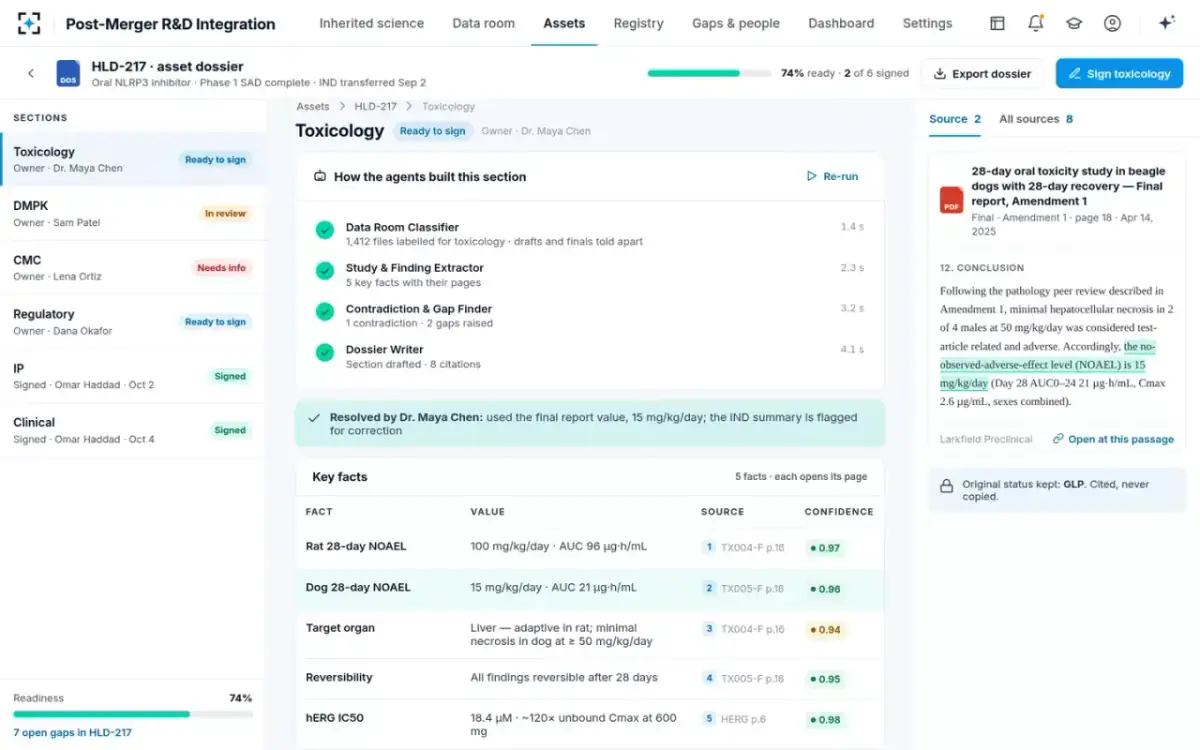
Sees both sources side by side, decides which one stands, and signs a section in which every sentence is cited.
Still theirs: The toxicology decision, and the signature on it.
Today
“Was the M3 metabolite ever measured in rat? Someone at the acquired company knows.”
With agents
Holds two named gaps, their sources and the question pack for the author who can close them.
Still theirs: Which DMPK questions are still open, and which are closed.
Today
“Before we book an animal study, tell me whether they already ran it.”
With agents
Gets twenty candidate models narrowed to two already run, with cited results and one missing dose arm.
Still theirs: The development plan and the dose it rests on.
Today
“Ask me now. After the 26th I am not reachable.”
With agents
Gets four short questions tied to the gaps only she can close, twelve days before her last day.
Still theirs: What she knows, until the date in her letter.
What does a post-merger integration manager do in R&D?
In the research workstream the integration manager does four things, and none of them is a scientific judgement. They set the sequence: what has to be read before the portfolio review can be held. They hold the dependency list: which archive, which contract laboratory, which access request is blocking which section. They watch two calendars the office does not control, the regulator's filing dates and the retention letters, and raise the alarm when the plan crosses one. And they keep a decision moving to the person who is allowed to make it.
That last one is the job. The failure mode of an R&D integration lead is not working too slowly; it is deciding. When a toxicology summary and a final report disagree and the head of toxicology is in a different time zone, the temptation to record "we'll use the final" and move on is enormous, and it is exactly the decision the integration office must not make, because the person who will be asked about it in a regulatory meeting two years later is not the integration office.
The nearest published job description is the one the US Department of Labor keeps for natural sciences managers, whose work includes to "confer with scientists, engineers, regulators, or others to plan or review projects or to provide technical assistance" and to "develop or implement policies, standards, or procedures for the architectural, scientific, or technical work performed to ensure regulatory compliance or operations enhancement" (O*NET OnLine, 11-9121.00). Read that against an acquisition and the integration lead's half is clear enough: convene, sequence, and write down the rule, not supply the answer.
The six seats around an inherited asset
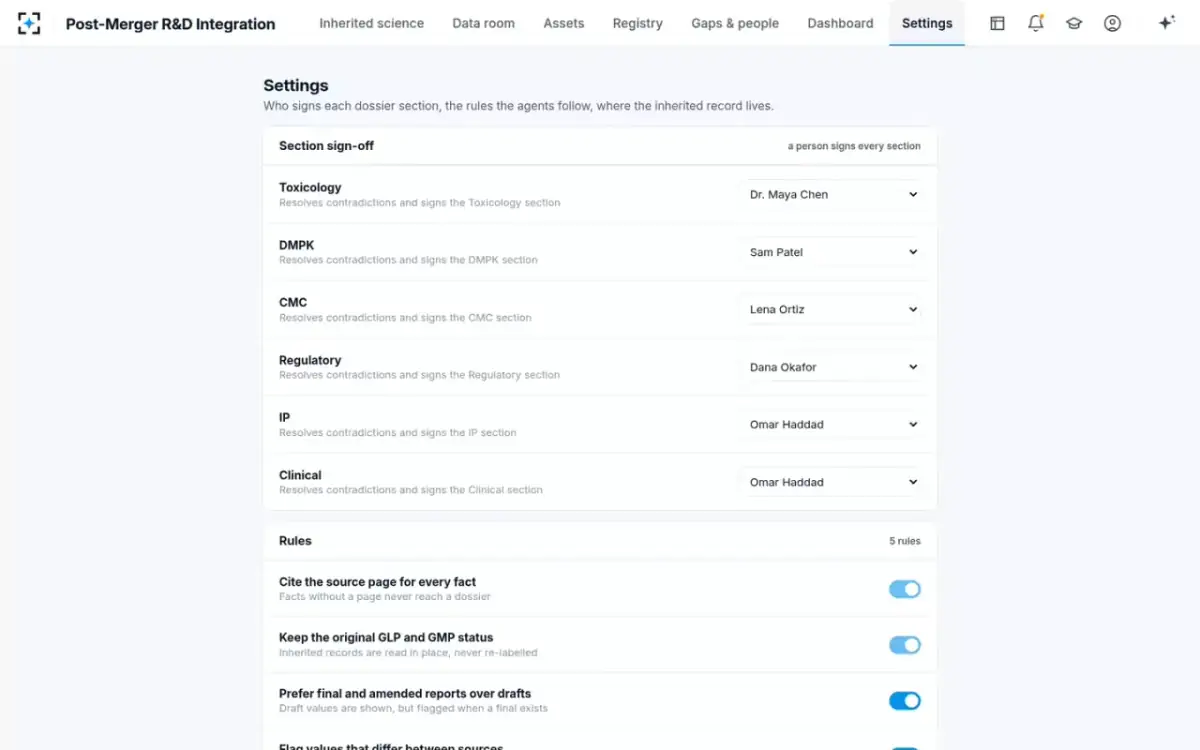
An acquired asset's dossier is usually built in six sections, because that is how the acquirer's own organisation is shaped: toxicology, DMPK, CMC, regulatory, IP and clinical. Each section needs four distinct things done to it, and the common mistake is to let one person do all four.
Who does what to each section of an inherited asset's dossier
| Section | Built mainly from | Checked against | Contradiction resolved by | Signed by |
|---|---|---|---|---|
| Toxicology | GLP study reports and their amendments, and the IND Module 2.6 summaries | The final report, against the summary that quotes it | Head of toxicology | Head of toxicology |
| DMPK | Bioanalytical notebooks, assay validation and toxicokinetic tables | The notebook entry, against the report that cites it | DMPK lead | DMPK lead |
| CMC | Batch records, stability reports and lot genealogy | The batch record, against the summary written from it | CMC owner | CMC owner |
| Regulatory | The IND, meeting minutes and agency letters | Each commitment, against the letter or minute it was made in | Regulatory owner | Regulatory owner |
| IP | Invention records, dated notebook entries and filing correspondence | The dated entry, against what the filing claims | IP owner | IP owner |
| Clinical | Protocols, their amendments and the clinical study reports | The protocol as amended, against the report of it | Programme leader | Programme leader |
Notice what is not in the table. There is no row in which the integration office appears, and nothing an agent does reaches the last two columns. Drafting and checking are reading tasks: compare the same fact across versions and sources, carry each one back to its page, and say where they differ. Resolving and signing are judgements with consequences, and they belong to whoever will answer for them.
What is an integration management office, and what should it not do?
An integration management office is the small central team that runs a merger's hundred days: it holds the master plan, chairs the steering meeting, tracks each function's workstream against its dates, and escalates what is stuck. It is usually a small team, with a lead per function reporting into it. It is a coordination function, and it works because the things it coordinates are mostly schedules.
What it should not do in research is own content. Three specific things belong outside it. It should not own the decision when two sources disagree; that is the function owner's. It should not own the question of whether a study has to be repeated; that is the programme's, informed by what the acquired company already ran. And it should not own the record itself: the inherited files stay where they are, in the systems and archives that hold them, read in place rather than copied into an integration workspace where their original status becomes ambiguous.
The healthiest version of the office in an R&D workstream is a very small one with a single measurable job: reduce the time between a question being raised and the person who can answer it being asked. On the sample acquisition that is literally what the status reports on: open gaps, each with an owner, a severity and a date, rather than a percentage complete.
The study director: one name, one point of control
The reason an acquirer cannot simply reassign accountability for inherited science is that the good laboratory practice rules already assigned it, study by study, before the deal existed. For each nonclinical laboratory study a named scientist is identified as the study director, and the rule makes that one person answerable for how the study was technically run and for how its results were interpreted, analysed, documented and reported: the single point of control for the study (21 CFR 58.33).
That rule binds the testing facility that ran the study, often a contract laboratory the acquirer has never dealt with, and not the acquirer's integration team. This is worth saying plainly, because it is routinely misread in both directions. An acquirer does not appoint a study director for a study that was completed three years ago; nothing in the rules asks it to, and the appointment belongs to the management of the facility that ran the study. What the acquirer inherits is the result: a final report signed off under that person's control, whose interpretation is already on the record, and which the new owner's toxicology head is now reading cold.
The practical consequence is a question to ask of every inherited study: who was its study director, and is that person still reachable? The final report has to name them, along with the other scientists and supervisory personnel involved. The facility also has to hold a current summary of training and experience and a job description "for each individual engaged in or supervising the conduct of a nonclinical laboratory study" (21 CFR 58.29(b)). A diligence team that asks for those two things gets, free, the map of who knows what, which is otherwise reconstructed by hand in week six.
Why the checker is never the writer
The second piece of accountability the acquirer inherits is a separation rule, and it is a good model for how to run the integration itself. For any given study, the quality assurance unit at a testing facility has to stand wholly apart from the people who directed and conducted it (21 CFR 58.35(a)), and one of its duties is to check the final report against the study: that the methods and standard operating procedures are described accurately, and that the results reported are a faithful reflection of the raw data (§ 58.35(b)(6)).
Read that duty slowly and it describes exactly the check an acquirer needs on an inherited summary: does the text accurately reflect the data behind it? Nobody applied that check to the IND summaries, the deal data room decks or the diligence memo, because none of them is a study report. In the sample acquisition the agents apply the same shape of test across versions (draft against final, summary against report, notebook against report), and it is how the toxicology contradiction surfaces: a Module 2.6.6 summary still carrying a dog 28-day no-observed-adverse-effect level of 50 mg/kg/day from a draft, where the amended final report says 15.
The separation matters on our side too. The thing that drafts a section must not also be the only thing that says the section is right, and neither of them may be the thing that signs. That is why the agents draft and check, and a person decides.
One contradiction, from raised to resolved
Agent
Contradiction & Gap FinderFinds the same fact stated two ways across versions or sources, raises it against the section with both sources and their pages attached, and marks which one the house rule prefers (a final or amended report over a draft) without applying it.
Never: one of the two values is hidden
A person decides
The section ownerOpens both sources, chooses the value that stands, and records the reason in their own words against the section.
Never: an agent chooses
Agent
Dossier WriterRewrites every sentence in the section that used the superseded value, and flags the document that still carries it for correction.
A person decides
The section ownerSigns, with the meaning of the signature and a password. A section with an open contradiction cannot be signed.
Never: a section is signed with a contradiction still open
Who signs a dossier section, and what the signature means
A signature is only worth something if its meaning is written next to it. On the sample acquisition the text is short: "I reviewed the cited evidence and approve this section for the integration dossier", and the three things it carefully does not say are as important as what it does.
It does not say the section is a GLP record. The dossier is a research summary of inherited evidence that cites it; signing changes the status of nothing it cites. The final reports stay exactly what they were, in the archives of the facilities that ran them, with their original status intact. It does not say the signer repeated the work, or stands behind the conduct of a study they did not run. And it does not say the section is complete: open gaps stay visible on a signed section, stated plainly rather than smoothed over.
What it does say is that a named person with the standing to do so has read the cited evidence and is content for the acquirer to rely on this section. That is the artefact the hundred-day plan is actually trying to produce, and where it falls in the hundred days is usually two weeks later than the plan assumes.
Sign-off is configuration, not convention
The seat nobody staffs: the person who finds out who knows
Every integration plan has a name against regulatory, toxicology, CMC and the programme. Almost none has a name against the question of who wrote what. It is treated as something that will emerge, and it does emerge, in week nine, after the author has left.
The work is real and it is specific: for every open question, identify the one or two people who could answer it, find out when their retention letter ends, and book a conversation while the answer is still obtainable. In the sample acquisition this is where the departure board comes from (five named scientists, each with the gaps that stand against their name and the date they go), and it is why one author's walkthrough is booked twelve days before her last day with four questions attached rather than a general handover. Ranking the gaps by the date the answer walks out is the whole method, and it is a seat worth staffing on purpose.
In the solution the Expert Interview Planner does the reconstruction (who authored which entries, which gaps name them), but the booking, the conversation and the judgement about whether the answer is good enough are a person's. What is said in a walkthrough is kept as an interview and linked to the gap it answers; it never becomes a source in its own right, and the agents go looking for the file the expert named.
What the acquirer's sponsor responsibilities actually are
Beneath all of this sits the one set of obligations that genuinely does move with the asset. A sponsor of a clinical investigation is "responsible for selecting qualified investigators, providing them with the information they need to conduct an investigation properly, ensuring proper monitoring of the investigation(s), ensuring that the investigation(s) is conducted in accordance with the general investigational plan and protocols contained in the IND" (21 CFR 312.50). Those duties are continuous, not transactional, and somebody at the acquirer has to hold them from the day the change is effective.
That is a different kind of accountability from the dossier's. The dossier says what the acquirer believes about the science it bought. The sponsor duties say what the acquirer must actually do about trials that are running now. The two get confused in integration plans because both arrive in the same week, and because the paperwork that moves the second is routinely described with the same phrase as three other things; which of those three moves you are making is worth settling before anyone signs a letter.
A section owner's decision, recorded on the section
Three handoffs that fail, and how to see them in week two
Accountability rarely fails in the middle of a seat. It fails at the joins, and three joins fail often enough to be worth testing early.
The same week, as the integration office sees it and as the function owner sees it
On the integration status: Toxicology workstream 60% complete, on track for the Day 100 review.
In the function owner's inbox: Two of the five key values in my section come from a summary whose final report I have not seen yet.
On the integration status: The no-observed-adverse-effect question is closed; recorded Tuesday.
In the function owner's inbox: I chose the amended final report over the draft summary. The exposure margin to the planned Phase 2 dose went from 6.2× to 1.9×, so the dose is now a live question.
On the integration status: Blocked: data room access.
In the function owner's inbox: Blocked: an archive at a contract laboratory that was never party to the deal, which holds the raw data behind my section.
On the integration status: Retention: five scientists, three leaving by December.
In the function owner's inbox: One of the three wrote every notebook entry my DMPK colleague’s section rests on.
On the integration status: Section complete.
In the function owner's inbox: Section signed, which means I am the person who answers for it.
The first failing join is the status itself: a percentage complete that counts drafted sections equally with signed ones. The second is the escalation path, when a function owner's blocker is an archive rather than a person and there is nobody in the office who can unblock it. The third is the quiet handoff, where a question is raised against a function, nobody answers it, and it is closed at the Day 100 review because the deadline arrived. Each is visible in week two if the status carries the function owner's column as well as the office's.
Six things to settle before the first dossier section is drafted
- Who owns each of the six sections, by name
Not by title and not by function. A title does not resolve a contradiction; a person does, and a named person can be asked when they are on leave.
- Whether anyone other than the owner may resolve a contradiction
The answer is usually no, and writing it down early stops the integration office being asked to decide at five o’clock on a Friday.
- What the signature means, in one sentence
The meaning travels with the signature and is read by people who were not in the room. "Approved" on its own is not a meaning.
- What stands when a draft and a final disagree
A house rule (final and amended reports stand, the draft value stays visible) decided once, so each contradiction is a judgement about evidence rather than about procedure.
- When a fact goes to a person instead of into a draft
A confidence line, set deliberately. In the sample it is 0.85: anything the agents are less sure of than that is routed to a person before it can be cited.
- How long before a departure a question pack is built
Thirty days by default in the sample, with fourteen and forty-five as the other options. Later than thirty and the diary is already full.
Get the seats right and the hundred days become a sequence of answerable questions rather than a negotiation about who decides. Get them wrong and the dossier is finished on time and signed by nobody who will defend it. To see the sections, the decisions and the sign-off on a real inherited record, start from Post-Merger R&D Integration.
Questions people ask
What skills does a post-merger integration manager need?
Sequencing, dependency management and the discipline not to decide. In a research workstream one more skill matters disproportionately: enough scientific literacy to tell a question that needs a specialist from one that needs a file. An integration lead who can read a study report well enough to know which function owner to ask saves days a week; one who tries to answer it themselves creates work nobody can sign.
Who is accountable for inherited GLP studies?
For the conduct of the study, the testing facility that ran it and the study director it named: that accountability was fixed when the study ran and is not reassigned by an acquisition. For relying on the study, the acquirer: the function owner who reads the final report and decides whether their section can rest on it. The two are often blurred in integration plans, and keeping them apart is what lets a toxicology head sign without claiming authorship of work they never supervised.
How is an integration management office structured?
Typically a small central team (a lead, a planner and a communications seat) with one named lead per function reporting in, and a steering group above it. For research the structure matters less than the boundary: the office holds the plan and the dependencies, each function holds its own content decisions, and the only thing escalated upward is a conflict between dates, never a conflict between sources.
Can an agent decide which value stands when two sources disagree?
No, and in this solution it cannot be configured to. Agents raise the contradiction with both sources and their pages, mark which one the house rule prefers and why, and stop. The decision, the reason and the signature are a named person's, and a section with an open contradiction cannot be signed at all.
Does the acquirer have to appoint a study director for the studies it inherits?
No. The study director is named by the testing facility for a study while it is running, and the role is complete when the study is. What an acquirer should do instead is find out who the study director was on each inherited study, whether they are still reachable, and where the raw data behind their report is archived: three questions that are answerable from the final report itself.