Key person risk is the exposure a business carries when something it depends on is held by one person. Most of what is written about it is about insurance and succession: who signs the cheques, who holds the client relationships, what happens if the founder is hit by a bus. In an acquired research organisation the risk is narrower, more datable and much easier to act on. It is the set of questions about the science you have just bought that exactly one or two people can answer, each with a last working day already written into a retention letter. Botminds' Post-Merger R&D Integration treats it that way: it finds who authored what across the inherited notebooks and reports, attaches each open question to the people who can close it, and ranks the whole queue by the date the answer leaves the building.
The worked example is the solution's sample acquisition — Northwind Bio's purchase of Halden Therapeutics, four programmes, 38,412 inherited files. Every person, company, programme and study named is fictional sample data. The published research and the rules quoted are real, and linked where they appear.
The departure clock on one acquisition, drawn from today
- Walkthrough14 Oct
- To her last day, 26 OctG-03 · G-06
- Walkthrough15 Oct
- To his last day, 14 NovG-11
- Nothing bookedG-04 · G-08
What is key person risk, and what does it look like in a lab?
In the general case, key person risk is the concentration of something essential in one individual — a relationship, an approval, a skill — such that their departure interrupts the business. The standard answers are insurance, documented succession and cross-training, and all three assume you have time.
In a laboratory the concentration is of a different kind, and it is rarely visible in an organisation chart. It sits in the reasons behind decisions that were never written down: why a dose group was dropped after week three, which of two assay methods was used for the archived samples, where the raw data for one study actually went when the contract laboratory reorganised, whether a result that appears only in a slide deck was ever repeated. None of that is a secret. It simply was never anybody's job to record it, and the published work on research practice is blunt about how common that is: "an absence of detailed written protocols and poor documentation of research is common" (Ioannidis and colleagues, The Lancet, 2014).
An acquisition turns that ordinary, tolerable gap into a dated liability, because the people who can fill it are the same people whose contracts end. The right question is therefore not "who is critical?" — everyone looks critical on a leaving slide — but "which of our open questions can only this person answer, and when can we no longer ask them?"
How likely is it that the acquired company's inventors leave?
Likely enough that a plan which assumes otherwise is not a plan. A 2025 study of the biotechnology industry, matching acquired inventors against comparable inventors who were not acquired, reports plainly: "we find that inventors affected by acquisitions are 20% more likely to leave the company" (Humanities and Social Sciences Communications, 3 May 2025). The same paper frames why that matters commercially rather than as an HR statistic — "after an M&A, it is uncertain whether key R&D employees who embody valuable knowledge and potential future innovations can be retained".
A second study, covering 15,318 inventors across 1,375 biotechnology acquisitions, measured both halves of the loss: "acquisitions lead to a 13.5% decrease in inventor retention and a 35% drop in citation-weighted patent productivity post-acquisition" (Verginer and Riccaboni, authors' preprint; published as Journal of Business Research 200, 115573). Note what the second figure is measured on. It is the patenting productivity of inventors, not the output of a firm, and that distinction matters when the number is quoted in a steering meeting.
What the published work measures after a biotechnology acquisition
There is a sting in the second study that argues against the usual comfort. Retention is not the whole answer, because the people who stay are affected too, and the ones most affected are the ones you most wanted:
The productivity decline is more severe for inventors who remain with the acquiring firm, particularly for those whose expertise is closely tied to the target company.
Verginer and Riccaboni, authors' preprint of the study published in the Journal of Business Research
That is the sentence to put in front of an integration steering group. A retention bonus buys presence. It does not buy the conditions under which the person was productive, and the people whose knowledge is most specific to the acquired company — exactly the ones who can answer your questions — are the ones the research says decline most.
Why the loss is not the headcount, it is the unanswered question
Counting departures produces a number that feels like risk and cannot be acted on. Three scientists leaving is not a risk; it is a fact. The risk is the subset of your open questions that only those three can close, and that subset is almost always smaller than the fear and more urgent than the plan.
On the sample acquisition twelve gaps have been raised across four programmes by Day 50. Five of them name a specific person who is leaving. One of those five, the metabolite question, is high severity and has a date: the human metabolite M3 is 14.2% of exposure and is not covered in a toxicology species, and the only person who can say whether it was ever measured in rat or dog plasma is the scientist who wrote all 212 bioanalytical assay notebook entries for it. Nobody else has signed one.
Written as a headcount, that is "one of five scientists leaves this month". Written as a queue, it is "one high-severity question about a dose-limiting metabolite becomes unanswerable on 26 October". The second version gets a meeting booked.
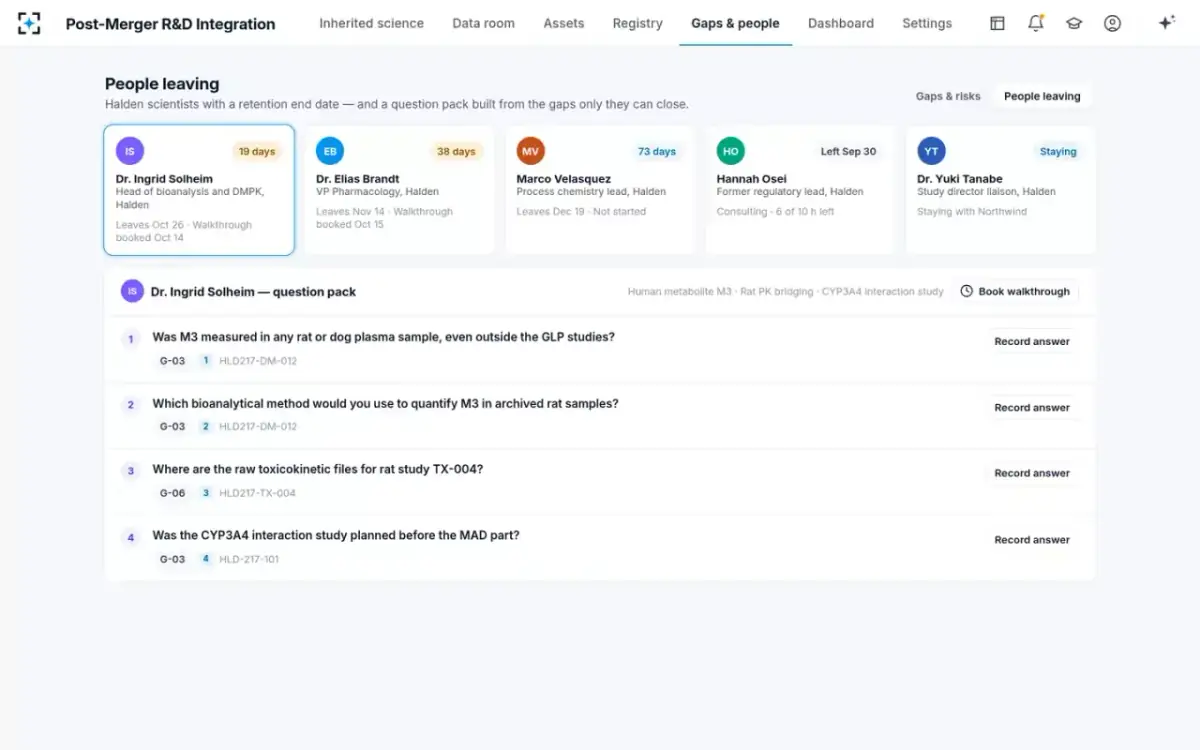
Four people leaving, and what stands against each name
Today
Wrote every one of the 212 M3 bioanalytical assay notebook entries; no one else has signed one.
With agents
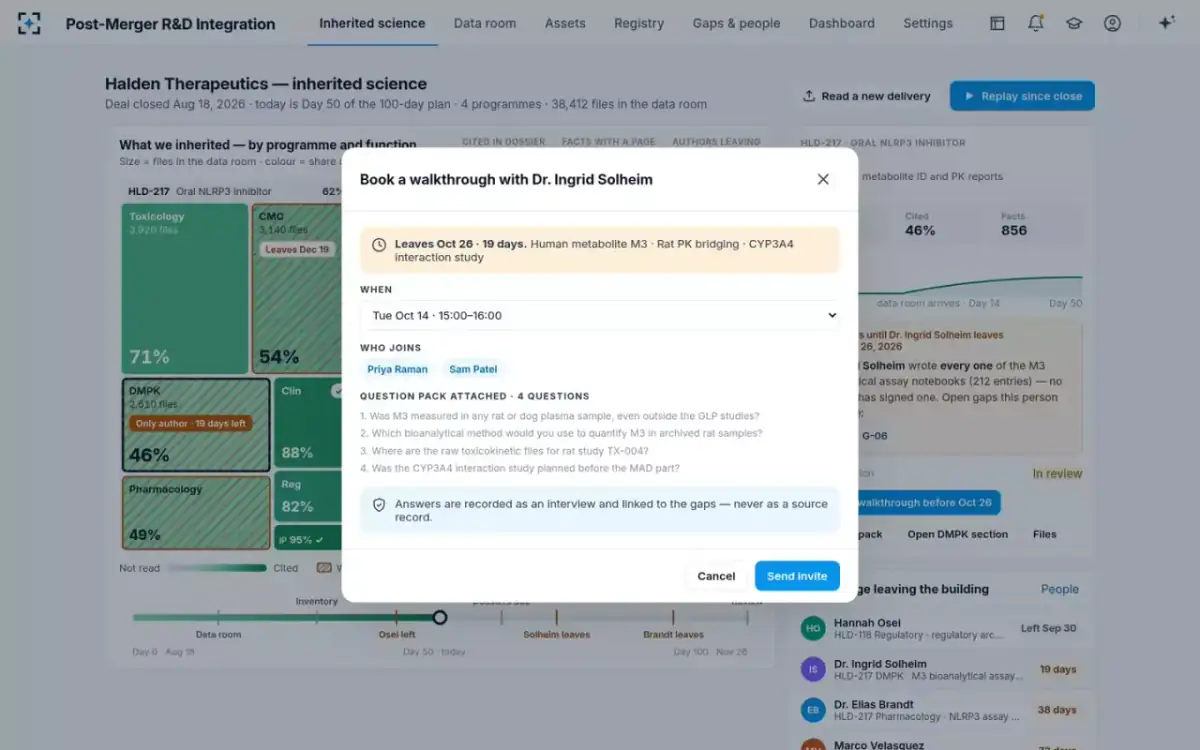
Two gaps attached to her name, a walkthrough booked for twelve days before she goes, and four questions sent with the invitation.
Still theirs: Leaves 26 October — 19 days from today
Today
The mouse model work for the programme sits largely in his notebook comments rather than in a protocol.
With agents
One gap attached, a walkthrough booked the day after his colleague’s, and the models he ran already pulled out of 9,742 notebook entries.
Still theirs: Leaves 14 November — 38 days
Today
Knows why a polymorph seen in the notebook never reached the chemistry report, and how seven conjugate lots relate to each other.
With agents
Two gaps attached and nothing booked — which is the point of showing the queue by date rather than by severity.
Still theirs: Leaves 19 December — 73 days
Today
Knew where the archive for one programme’s thirteen-week dog study is held.
With agents
Already gone, with six of ten consulting hours left; the archive question is the one those hours are being spent on.
Still theirs: Left 30 September
How do you find out who actually wrote something?
Mostly by reading what the record already says, which is more than people expect. Three sources answer the question without anyone being interviewed.
The first is the final report of any nonclinical study, which has to name its study director together with the other scientists, professionals and supervisors who took part (21 CFR 58.185(a)(10)). That one requirement turns a shelf of study reports into an index of who worked on what, and it is already in the data room.
The second is the notebook itself. Entries carry an author and a witness, and the useful question is not who authored the most entries but where authorship is concentrated: a workstream in which one person signed everything and nobody counter-signed is a different exposure from one in which four people share the work. In the sample acquisition that concentration is what makes the hatching on the map meaningful — a workstream is marked not because its author is leaving, but because its author is leaving and nobody else wrote in it.
The third is the archive. For records kept under the good laboratory practice rules, "an individual shall be identified as responsible for the archives" (21 CFR 58.190(c)). That named archivist is usually at a contract laboratory rather than at the acquired company, which means it is one of the few pieces of institutional memory an acquisition does not put at risk — and it is the right person to ask when a report exists but its raw data does not.
Who goes next, and what stands against their name
Ranking the gaps by the date the answer walks out
Most issue lists are ranked by severity, and severity is the wrong first key here. A high-severity gap whose answer sits in an archive can be closed next month. A medium-severity gap whose only answer is in one person's head becomes permanent on a date you already know.
The ordering that works is: first, can anyone else close this? Second, when does the person who can close it leave? Third, how bad is it? On the sample acquisition that reordering moves a medium-severity chemistry question — why a polymorph seen in a notebook never reached the chemistry report — above a high-severity toxicology question whose answer is a study design decision the acquirer's own head of toxicology can make at any time.
It also exposes the uncomfortable case: a person with two gaps against their name, seventy-three days of notice and nothing booked. Seventy-three days feels safe, which is exactly why it is the row that gets forgotten until it is nineteen. The reminder in the solution starts thirty days before a last day by default, with fourteen and forty-five as the alternatives, and a question pack is built automatically as soon as a gap names someone who is leaving.
What to ask a departing expert, and what not to
A general handover meeting with a departing scientist produces a recording nobody watches. Four specific questions, each tied to an open gap and sent before the meeting, produce answers that close gaps. The difference is preparation, and the preparation is mechanical once the gaps are attached to names.
One departing author's question pack, and what each question is for
1
Was M3 measured in any rat or dog plasma sample, even outside the GLP studies?
The human metabolite is 14.2% of exposure and is not covered in a toxicology species. If it was ever measured, the answer may already exist.
G-03
2
Which bioanalytical method would you use to quantify M3 in archived rat samples?
If the answer to the first is no, this decides whether archived samples can be re-analysed instead of a new study being run.
G-03
3
Where are the raw toxicokinetic files for rat study TX-004?
The report is in the data room; the raw data behind it is not, and the person who knows which archive holds it is leaving.
G-06
4
Was the CYP3A4 interaction study planned before the multiple-ascending-dose part?
A sequencing question that changes what the next protocol has to include.
G-03
Three rules make a pack worth sending. Every question names something specific — a study number, a sample set, a date — so it can be answered in a sentence rather than a reminiscence. Every question has a gap behind it, so the answer has somewhere to go. And the pack is short: four questions for an hour, because the fifth question is always the one that turns the meeting into a career retrospective.
What not to ask is equally important. Do not ask a departing scientist to summarise their programme; that is what the reports are for, and a summary from memory is a new source nobody can check. Do not ask them to confirm a value you could read — ask them where the file is. And do not ask them to sign anything: they are leaving, and a signature from someone who will not be there to stand behind it is worth nothing. Who may sign what is settled before the walkthrough, not during it.
A walkthrough booked, with its questions attached
What a walkthrough answer is, and what it is not
This is the boundary that keeps the whole method honest. What a departing scientist says in a walkthrough is recorded as an interview, attributed and dated, and linked to the gap it addresses. It is not a source record, it does not enter the evidence a dossier section cites, and it cannot be used to overrule a report.
The reason is not bureaucratic. Memory is a different class of evidence from a dated record, and the moment the two are mixed, a dossier that was built to be checkable stops being checkable. What an interview is genuinely good for is pointing: "the raw toxicokinetic files went to the contract laboratory's archive under the old study code" is not a fact about the drug, it is a direction to a file. The agents then go and look for the file the expert named, and if they find it, that file — not the recollection — is what the dossier cites.
In practice this makes walkthroughs more productive, not less. A scientist who knows they are being asked where things are, rather than being asked to vouch for them from memory, answers faster and with less hedging. And the gap closes properly: with a document and a page, exactly as every other fact in the dossier does.
The record a departing scientist leaves behind by law
It is worth being precise about what survives a departure without anybody doing anything, because it is more than the pessimistic view assumes and much less than the optimistic one does.
What survives: the final reports, with their named study directors and contributors; the raw data, documentation, protocols and specimens that were transferred to an archive at the close of each study; the named individual responsible for that archive; and the notebook entries themselves, with their authors and dates. In a well-run programme that is a substantial inheritance, and it is why reading the record first — rather than interviewing first — is the right order.
What does not survive: why. Why this dose was chosen, why that cohort was dropped, why the assay was changed between study three and study four, which of two conflicting results the team believed and on what grounds. None of that is required to be written anywhere, and almost none of it is. It is the entire content of a good walkthrough, and it expires on a date in a letter.
How to build a question pack in an afternoon
- List the open questions, not the risks
A question has an answer and an owner. A risk has neither, and cannot be put in front of a departing scientist.
- Against each one, write who could answer it
Start from the final reports, which name the study director and the scientists involved, and from notebook authorship. Most questions resolve to one or two names.
- Mark the ones only a leaver can answer
If an archive, a report or a colleague who is staying can close it, it is not key person risk — it is ordinary work and it can wait.
- Sort by last day, then by whether anyone else can answer
Severity is the third key, not the first. A medium gap that expires in nineteen days outranks a high one that can be closed any time next quarter.
- Write four questions per person, each naming something specific
A study number, a sample set, a date. Specific questions get answers in sentences; open ones get stories.
- Send the questions with the invitation
The hour is then spent answering rather than orienting, and the scientist can look something up before they arrive.
Three gaps that always surface too late
Three kinds of question reliably surface after the person who could answer them has gone, because none of them is visible in a document review.
The first is the result that exists only in a slide deck. Somebody ran an off-target screen, put the numbers in a presentation and never wrote a report; the deck is in the data room and reads as evidence until someone asks for the method. The second is the thing seen once and never followed up — a polymorph in a notebook that never reached the chemistry report, a lung finding at one dose level that the study design did not confirm. The third is the location question: a report that cites raw data nobody can find, where the only person who remembers the archive move is the one who supervised it.
All three are cheap to close while the author is still employed and expensive or impossible afterwards. That asymmetry is the argument for doing the reading early rather than thoroughly: the hundred-day plan's real constraint is not the volume of files, it is the dates in other people's contracts. And it is a large part of why the research side of a merger disappoints even when the science was the reason for the deal. To see the departure board, the gaps and the question packs on a real inherited record, start from Post-Merger R&D Integration.
Questions people ask
How do you assess key person risk in a research organisation?
Not by asking managers who is critical. Start from the open questions — what you cannot yet answer about the science — and work backwards to who could answer each one, using the names in the final reports and the authorship of the notebooks. The questions that resolve to a single person who is leaving are your key person risk, and the list is usually short, specific and datable.
Why do scientists leave after an acquisition?
Some are made redundant where functions overlap; some reach the end of a retention period that was always meant to be temporary; many leave because the conditions that made their work possible — the colleagues, the equipment, the programme priority — changed. The published evidence is that acquired inventors leave at measurably higher rates than comparable inventors who were not acquired, and that those who stay patent less, with the sharpest decline among those whose expertise was most specific to the acquired company.
Does a retention bonus solve key person risk?
It buys time, which is valuable, and it does not buy knowledge transfer. A retention period with no structured questions attached usually ends with the same gaps open on the last day as on the first, because nobody knew what to ask until the reading was done. Treat the retention window as a deadline for questions rather than as a solution.
What is tacit knowledge in research, and can it be captured?
Tacit knowledge is what a researcher knows without having written it: judgement about which result to trust, why a method was changed, where things are. It cannot be captured wholesale, and attempts to do so produce long recordings nobody uses. It can be converted, question by question, into things that are not tacit — a located file, a named method, a recorded reason — which is all a dossier actually needs.
How do you find out who wrote a lab notebook entry?
The entry carries its author and usually a witness, and an export carries both. What matters more than any single entry is concentration: how much of a workstream one person signed and whether anyone counter-signed it. A workstream where one departing author wrote everything is a far sharper exposure than one where four people shared the work, even if both have the same number of entries.
Should answers from a departing expert go into the dossier?
Not as evidence. Keep them as an attributed, dated interview linked to the gap they address, and use them to find the document that settles the question. If the document is found, the dossier cites the document. If it is not, the dossier says plainly that the question is open and what the expert said about it — which is honest, and is also the strongest argument available for commissioning the work that would close it.