M&A integration software is the category of tool that runs the hundred-day plan: workstreams, owners, milestones, dependencies, synergy targets and a status for each. In a life sciences deal it is also where the science workstream goes red and stays red, and the reason is structural rather than a failing of the tools. Tracking software takes the state of the science as an input somebody types in, and after a deal nobody can type it, because nobody has read the tens of thousands of inherited files the status is supposed to describe. Botminds' Post-Merger R&D Integration fills that gap rather than competing with the tracker: six agents read the acquired company's data room, notebooks and study reports where they live, tie every fact to its page, raise what disagrees and who is leaving, and draft a dossier per asset that a function owner resolves and signs.
The acquisition on this page is sample data: Northwind Bio and Halden Therapeutics, four programmes and 38,412 files. Every company and asset named in it is fictional. No product or supplier other than ours is named or characterised anywhere on this page; the comparison is between two categories of tool, described by what they do.
A workstream tracker and a tool that reads the record
Deal integration tracking: Workstreams, owners, milestones, dependencies, risks and synergy targets across every function in the deal.
Reading the inherited record: The acquired company’s files as they are: classified, versioned, and every fact tied to a document and a page.
Deal integration tracking: People. Each workstream lead updates their own status, usually weekly.
Reading the inherited record: The files themselves, read where they live, plus every new delivery as it arrives.
Deal integration tracking: That a task was assigned, chased and closed, and when. That is a real and useful record.
Reading the inherited record: That a specific value appears on a specific page of a specific version of a specific document — or that nothing in the archive says it.
Deal integration tracking: "Is the toxicology package complete?" It can only show you who said it was.
Reading the inherited record: "Is the IT cutover on schedule?" It knows nothing about the other workstreams.
Deal integration tracking: The integration office, by escalation. Judgement sits outside the tool.
Reading the inherited record: A named function owner per section, inside the tool, with both sources shown and the decision recorded.
Deal integration tracking: Running the plan.
Reading the inherited record: Producing the one input the plan cannot generate.
What does M&A integration software do?
It runs the plan. A deal integration tool holds the workstream structure, the owners, the milestones and their dependencies, the risks and the synergy targets, and it gives the integration office one place to see where everything stands. Good ones are genuinely good at this: they make the dependencies visible, they chase, they keep a record of what was decided and when, and they stop twenty functions from maintaining twenty spreadsheets.
Nothing on this page argues against that. If your deal has fifteen workstreams and three hundred milestones, you need something to hold them, and a specialist tool will beat a shared document within a fortnight. The argument is about one specific workstream, and about an input the whole category treats as given.
The input nobody has: the state of the science
Every status in a tracker is a claim somebody makes. "Toxicology integration: amber, 60%." The number is not measured; it is a function lead's honest impression, formed from whatever they have managed to read. In most workstreams that is fine, because the lead can see the thing they are reporting on — the payroll is migrated or it is not, the contracts are novated or they are not.
The science workstream is different, because the thing being reported on is a body of documents nobody has read. An acquirer inherits the data room, lab notebook and sample-system exports, contract research study reports, batch and stability records and the regulatory correspondence, and by our estimate a function lead spends about five weeks per asset pulling that record together by hand before they can say anything defensible. Until then, the status is a guess with a colour on it.
Where a function lead's five weeks go on one acquired asset
Read the chart as a buyer rather than as a practitioner. Thirteen of the twenty-five days are finding files and pulling values out of them — work with no judgement in it that nevertheless has to happen before any judgement can. That is the block a tracker cannot touch, because a tracker has no access to the files, and it is the only block in the chart that software can honestly claim.
Two categories, not two competitors
Put plainly: one category runs the plan, the other produces the plan's hardest input. A buyer who already has a tracker and whose science workstream is red does not need a second tracker, and a buyer with no tracker and four workstreams does not need one at all. The question to ask of any tool offered for this problem is the simplest one on this page — does it read the files? — and the follow-ups are about what it does with what it reads.
There is also a sequencing point that belongs before any of this. Before the deal closes, what the two companies may share with each other is constrained: the Federal Trade Commission's Bureau of Competition has written about how pre-merger information sharing can contribute to unlawful "gun jumping" under the premerger notification rules, and the waiting period is not the moment to start moving an archive around. That sequencing, and what can honestly be done in each week after close, is the subject of the R&D 100-day plan.
What to ask before you buy either one
Fourteen questions. The first five apply to a tracker, the rest to anything that proposes to read your inherited record, and each one exists because a published rule or a published expectation makes it worth asking.
Fourteen questions for the two tools on your shortlist
- Where does each status in the tracker come from, and who typed it?
A status with no source behind it is an impression. Knowing which ones are measured and which are reported is the whole value of the board.
- Can the tracker hold a dependency on something outside itself?
The science workstream depends on reading that happens elsewhere; if the tool cannot represent that, the dependency will be invisible until it slips.
- Does it carry the regulatory clock as well as the plan?
A change of ownership of an approved application has its own notification requirements, and the new owner takes on the former owner’s commitments.
- Who can see what, before close and after?
Pre-merger information sharing is constrained, and an integration tool is one of the places that constraint is most easily forgotten.
- What happens to the plan record when the integration office stands down?
The decisions made in the first hundred days are the ones nobody can reconstruct in year two.
- Does it read the acquired company’s files, in the systems they live in?
The dividing question between the two categories. Everything below assumes the answer is yes.
- Does every fact it produces carry the document, the version and the page?
A citation is what lets a specialist settle a disagreement by opening a file instead of trusting a tool.
- Does it tell a draft from a final, and an amendment from both?
Corrections to a final report are made by amendment by the study director; a tool that flattens versions destroys the only evidence of which value is current.
- Does it keep the inherited good laboratory and manufacturing practice status rather than assigning its own?
An inherited record keeps the status it was made under. Re-labelling it is not a feature.
- When two sources disagree, who resolves it — and is that configurable to a named person?
This is the highest-consequence decision on an inherited archive, and the one most worth keeping with a function head.
- What does it do when the answer is not in the files?
A positive statement that nothing in the archive answers a question is worth more than a confident paraphrase, and is much harder to produce.
- Whose rules are the rules — can you set the signer, the confidence threshold and the version preference?
Responsibility for models, datasets and pipelines being fit for purpose sits with the sponsor or applicant, so the settings had better be yours.
- What can you show an inspector that you, not the vendor, satisfied yourself?
Vendor-supplied validation in isolation from your process and infrastructure is functional verification, and may not meet what performance qualification requires.
- Will they run it on one of your real assets, with the acquired company’s own documents, before you commit?
Everything above is answerable on paper. Only this one is answerable in evidence.
Why vendor validation data is not enough on its own
Every supplier in this market will offer you validation documentation, and it is worth having. It is also, by itself, the wrong kind of evidence, and the MHRA says why in a sentence written for exactly this situation: computerised systems "should be validated for their intended purpose which requires an understanding of the computerised system's function within a process. For this reason, the acceptance of vendor-supplied validation data in isolation of system configuration and users intended use is not acceptable."
The distinction it then draws is the one to carry into a procurement meeting: "In isolation from the intended process or end-user IT infrastructure, vendor testing is likely to be limited to functional verification only and may not fulfil the requirements for performance qualification." Functional verification shows the software does what the manual says. Performance qualification shows it does what you need, on your data, inside your process. A supplier can only deliver the first; the second is yours.
The European Medicines Agency's reflection paper points the same way from the responsibility side: ensuring that the algorithms, models, datasets and pipelines used are fit for purpose sits with the sponsor, applicant or manufacturer, not with whoever supplied them. That is not a reason to avoid tools. It is a reason to insist on a trial you run yourself, which is what the rest of this page is about.
What you need from the acquired company to start
Six inputs, and only two of them come from the data room. The list is short on purpose: a trial that waits for a complete handover will never start, and a trial run on the data room alone will flatter any tool, because a data room is a tidy selection.
What a buyer brings to a trial on one asset, and who holds it
The data room export for one asset
The deal team, who already have it
Without the files there is nothing to read. A selection made for the transaction is enough to start and not enough to finish.
The study report list, with storage locations
The acquired company’s study monitor or archivist
A final report has to state the locations where specimens, raw data and the report are stored — that line is the map to everything the data room left out.
The IND or marketing application, and its correspondence
The regulatory lead now carrying the obligation
An application names where the investigations were conducted and where the records are available for inspection, and the new owner has to hold a complete copy or request one.
Notebook and sample-system exports for that asset
The acquired company’s informatics lead
Authorship and sample-level results are where the hard questions get settled, and neither is reliably in a data room.
Your own dossier template and the name of each section owner
Your function heads
The output is a section somebody signs. If nobody is named, the trial has no end state.
Retention end dates for the acquired company’s scientists
Your HR or integration office
They set the order the questions have to be asked in, and they are the one input no software can derive.
The second row is the one that repays the effort. A final report states the locations where the specimens, the raw data and the report itself are stored, and that line is the only systematic pointer an acquirer has to everything the data room did not include. The sixth row is the one that decides whether the trial is worth anything: retention end dates set the order the questions have to be asked in, and they are the input no software can derive. Why they matter so much is the subject of key person risk after an acquisition.
A two-week test on one real asset
Ten working days, one asset, the acquired company's own documents, and a result that is either evidence or a reason to stop. Run it the same way for any tool that claims to read the record, including this one.
Ten working days, and what to measure at the end of each week
- Point it at the filesDay 1
- Classified, with versionsDays 2–3
- Extracted, with pagesDays 4–5
- A specialist re-reads a sampleDays 6–7
- The section owner reviewsDays 8–9
- The function head decidesDay 10
Four numbers decide it. What share of the facts carry a document, version and page. What share survive a specialist's re-read against the page. How many of the contradictions it raised were real rather than noise. And whether the function head who would have to sign the section says yes. A tool that scores well on the first three and fails the fourth has produced a good extraction and a bad dossier, which is a different problem and worth knowing about in week two rather than month six.
What a trial should measure, and what each number is
38,412files
read in the sample acquisition across 7 sources — demo, from the working sample data
14,926
facts extracted, each carrying its document, version and page — demo
6days
to a cited dossier draft for each acquired asset — a design target, measured in the live solution
≈ 5weeks
for the same asset by hand — our estimate of the baseline, not a measured customer result
Whose rules the reading follows
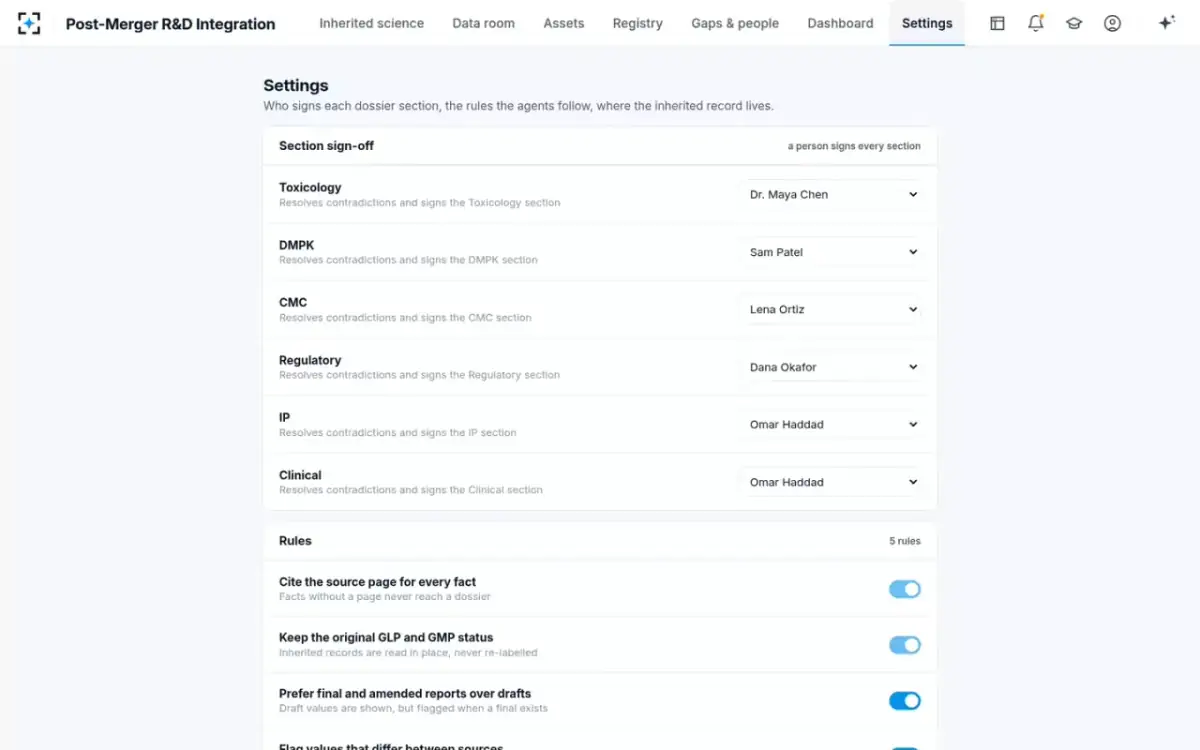
Go-live: how long does it actually take?
Honest answer: not on a date anyone should promise you in a sales meeting. The solution is built and deployed from a buyer's own requirements and documents — the dossier template, the function owners and a sample of the acquired record — and it goes live only once every quality check has passed. A supplier who gives you a go-live date before seeing your documents is giving you a number they made up.
What you can pin down is the trial, because the trial is bounded by your own inputs: ten working days on one asset, with the six items above in hand. That is also the right thing to put in the plan, because it has an owner, a date and a measurable end, which a go-live promise does not.
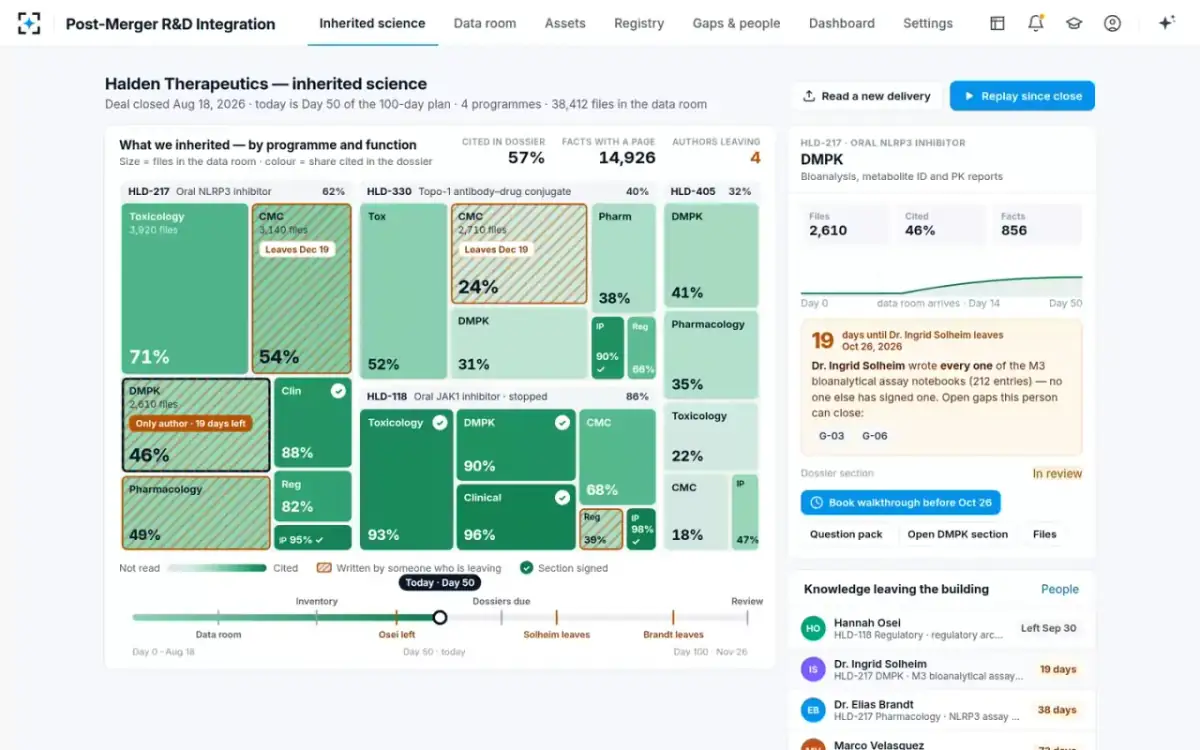
What the integration lead sees on one page
Which deals this is for, and which it is not
It fits where the deal thesis rests on science the acquirer has not read, and where somebody will have to sign for it: biotech and pharmaceutical acquisitions, licensing deals with a data transfer, and asset purchases where an IND or a marketing application changes hands. It fits badly where the acquired company's value is a customer list or a manufacturing line, because then the files are not the problem.
It also does not replace the tracker. It produces the status the tracker is asking for — what share of each programme's inherited science is now cited, which sections are signed, which gaps are open and when their expert leaves — and the integration office still needs somewhere to run the other workstreams. The sensible arrangement is both, with the reading tool feeding the board rather than duplicating it.
One more boundary worth stating plainly. Reading an archive does not satisfy a retention obligation. The underlying records still have to be kept for the periods the regulations set — for a nonclinical study submitted in support of an IND, at least five years after its results were submitted (21 CFR 58.195) — and in the systems or archives that can still produce them. What a reading tool changes is whether anyone knows what is in them. The systems question is its own decision, and it is better taken second.
The board the integration office actually wants
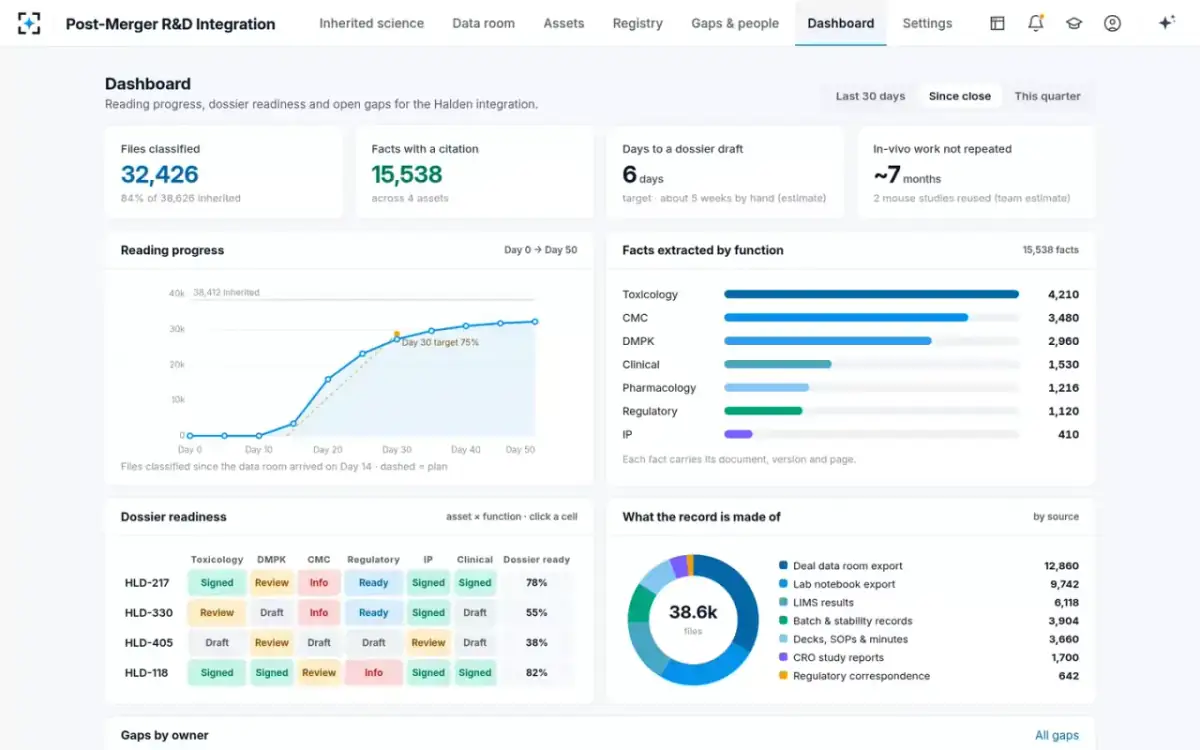
To see the reading, the contradictions, the departures and the signed sections on one acquisition, start from Post-Merger R&D Integration.
Questions people ask
Do you need integration software for an acquisition?
For the plan, it depends on size: fifteen workstreams and three hundred milestones need a tool, four workstreams do not. For the science, the question is different and does not scale the same way — a single acquired asset can carry tens of thousands of files, and the work of reading them is the same whether the deal is large or small. A useful test is whether anyone can say, with a page to point at, what the acquired company's safety package actually contains. If not, the gap is reading, not tracking.
What should an R&D integration tool do?
Read the inherited files where they live without altering them; classify each one by record type, asset, study, version and the status it arrived with; extract each fact with its document, version and page; compare the same fact across versions and sources and raise what disagrees; say plainly when nothing in the archive answers a question; identify who authored what; and draft sections that a named function owner resolves and signs. Anything it does beyond that is a bonus; anything it misses from that list leaves the workstream where it was.
How do you choose integration software?
Separate the two jobs first, then test the one that matters on real evidence. For the tracker, the questions are about where its statuses come from and who can see what before close. For the reading tool, run it for a fortnight on one real asset with the acquired company's own documents, and count four things: facts carrying a page, facts that survive a specialist's re-read, contradictions that were real, and whether the function head would sign the drafted section. Vendor validation in isolation from your process is functional verification, not proof it works for your purpose.
What do you need from the acquired company to start?
The data room export for the asset, the study report list with the storage locations the reports themselves state, the application and its correspondence, the notebook and sample-system exports, your own dossier template with a named owner per section, and the retention end dates of the acquired company's scientists. The last one is the input nothing can derive and the one that sets the order of everything else.
How long does an R&D integration tool take to go live?
It is built and deployed from your requirements and documents — your dossier template, your function owners, a sample of the acquired record — and goes live once every quality check has passed, so the honest answer is that it depends on what you bring and no supplier should promise you a date before seeing it. What is bounded is the trial: ten working days on one asset, with six inputs in hand and four numbers at the end.
Can one tool do both the plan and the science?
In principle, but it is worth asking why you would want it to. The two jobs have different users, different cadences and different sources of truth: a tracker is updated weekly by people, and a reading tool is updated whenever a delivery arrives, from the files. What matters is that the reading tool's output reaches the board as a counted figure rather than a typed one. Insisting on a single supplier for both is a procurement preference, not an architectural requirement.