A product quality complaint is a communication — written, electronic or spoken — alleging that something is wrong with the product itself after it left the company: its identity, quality, durability, reliability, safety, effectiveness or performance. Three words in that sentence do the work. Alleging: the caller does not have to be right, and the company does not have to agree. The product itself: a complaint about a late delivery or a rude call handler is not one. After it left: a deviation caught on the line is a manufacturing problem, not a complaint. The difficulty is that the decision is made at the moment the words are spoken, by whoever is listening — usually a medical information specialist with a queue behind them and forty more calls to take. Medical Inquiry Intake & Triage is Botminds' agentic solution for that moment: it reads every inquiry from every channel, recognises the defect in the sentence that mentions it, captures lot and expiry while the caller still has the pen, and drafts the complaint for a person to confirm.
The examples on this page come from a sample medical information desk inside the solution. Northwind Bio, its products, its lot numbers and its callers are fictional. The rules and the study are linked where they appear.
What the definition rests on, and what the record has to hold
None
the drug rules require the complaint procedure but never define the word
§ 210.3 defines 22 terms; “complaint” is not one
5fields
the drug rule requires in the written record of a complaint, where known
21 CFR 211.198(b)(1)
1 year
past the expiry date, or past the date the complaint arrived — whichever is longer
the drug retention floor, 21 CFR 211.198(b)
16
observations in fiscal 2025 that a drug complaint-handling procedure was not written or followed
Form FDA 483, drug inspections
What is a product quality complaint?
The sentence almost every complaint procedure quotes was written for devices, and until 2 February 2026 it was federal law at 21 CFR 820.3(b). It is still the clearest definition in print, and it is worth reading slowly because each clause excludes something.
Complaint means any written, electronic, or oral communication that alleges deficiencies related to the identity, quality, durability, reliability, safety, effectiveness, or performance of a device after it is released for distribution.
21 CFR 820.3(b), 2024 edition — the definition that governed devices until February 2026
"Any written, electronic, or oral communication" settles the channel question before it is asked: a phone call is a complaint if what it alleges is a complaint. "Alleges deficiencies" settles the certainty question: nobody has to prove anything, and the company opening the complaint is not conceding that its product failed. The list that follows — identity, quality, durability, reliability, safety, effectiveness, performance — is deliberately wide, and includes performance, which is how "the pen did not click" becomes a complaint without anyone being hurt. "After it is released for distribution" is the last fence: the same defect found before release is a nonconformity for manufacturing, under different rules.
For medicines there is no equivalent sentence at all. The general definitions section of the drug CGMP rules, § 210.3, defines twenty-two terms — batch, component, drug product, lot, quality control unit, strength and the rest — and "complaint" is not among them (21 CFR 210.3). What the drug rules define is not the word but the duty, which is why pharmaceutical procedures often import the device wording and apply it to medicines. That is a sound practice, and worth saying out loud in the procedure rather than leaving the reader to guess which definition the desk is using.
The rule in one sentence: written and oral, both
The drug rule's opening sentence puts spoken complaints on exactly the same footing as written ones, and it is the sentence everything on this page hangs from: a company must set up, and then follow, written procedures for handling every complaint about a drug product, whether it was written down or spoken (21 CFR 211.198(a)). Three things follow from it that procedures often miss.
First, the classifier is whoever hears the words. If a spoken complaint counts the moment it is spoken, then the judgement about whether this call is a complaint is made at the contact centre, not in quality — quality's judgement is the later one, about investigation. Second, the record of a spoken complaint has no evidence of its own. An email carries its own text; a call carries whatever the specialist wrote down, which is why the caller's own sentence, not a category code, is the thing worth keeping. Third, the rule's own enforcement reflects it. In fiscal 2025 FDA cited drug firms sixteen times under this paragraph for a complaint handling procedure that was not written or not followed, with a further five under a sibling citation for the same paragraph's "established, written, followed" limb.
Which team owns the other side of the line
A complaint about the product is one thing. A report that a patient was harmed is a different thing, owned by a different team under different rules, and the drug rule's own third sentence requires a procedure to provide for a review that asks whether the complaint is also "a serious and unexpected adverse drug experience" reportable under §§ 310.305 and 514.80. One call can be both, and often is.
So that there is no doubt about what the solution on this page does: Medical Inquiry Intake & Triage routes product complaints to quality and access requests to patient support, and it does not classify, assess or report adverse events — that is the safety team's own work, under their own rules and clocks. Intake's duty at the boundary is to notice and to hand over, not to decide. How the two are told apart, and why the same sentence can start both, is set out in product complaint versus adverse event.
The fields a complaint record must carry, and where each comes from
For medicines the written record must hold five things "where known": "the name and strength of the drug product, lot number, name of complainant, nature of complaint, and reply to complainant" (21 CFR 211.198(b)(1)). For devices the list is seven, and it applies to complaints that are reportable to FDA under part 803, complaints the manufacturer decides to investigate, and complaints it investigated anyway. The useful way to read either list is not as a form but as a map of where each fact lives in the world.
Each required field, where it actually comes from, and how it goes wrong
| The field | Where it comes from | Where it goes wrong |
|---|---|---|
| Name and strength of the product | The caller names it, often by a nickname, a misspelling or the device rather than the molecule. | Two products whose names sound alike; a dictionary that only knows the label spelling. |
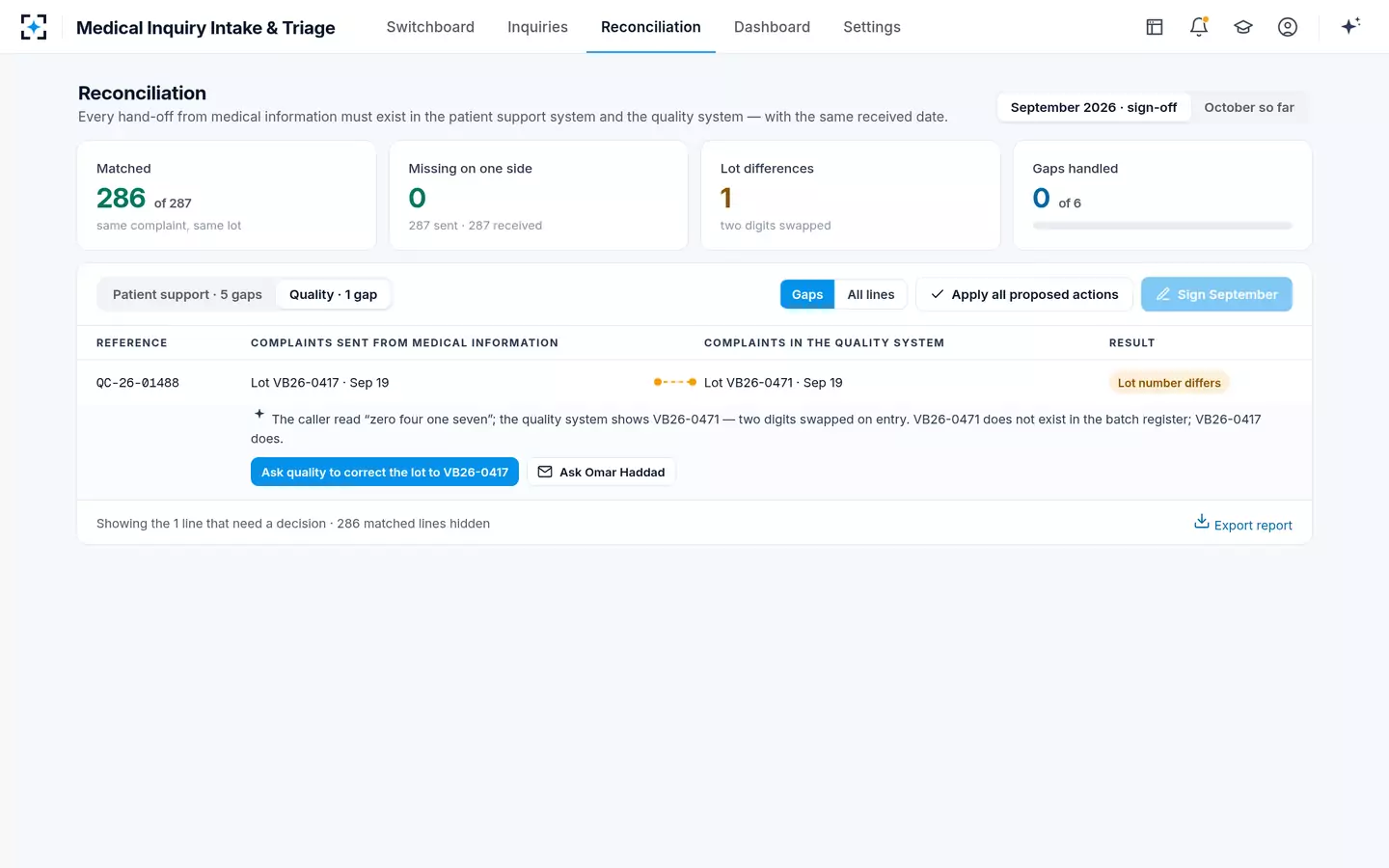
| Lot number | Read aloud from the pen, the carton or the blister while the caller is holding it. | "Zero four one seven" entered as 0471 — a lot that exists in no batch register. |
| Name of the complainant | Asked for during the call, or carried by the web form. | A form submitted with no email and no phone, so the complaint can never be replied to. |
| Nature of the complaint | The caller’s own sentence, kept verbatim. | Replaced by a category code at entry, after which nobody can tell what was alleged. |
| Reply to the complainant | Written when the answer goes out, days later. | Sent from the answer queue and never linked back to the complaint record. |
| Date the complaint was received (device) | The moment anyone working for the company first had it. | Booked as the day the complaint form was opened, which can be a working day later. |
| UDI or UPC and other identification (device) | The carton, the label or the device itself. | Gone with the packaging; the caller has the pen but not the box. |
| Name, address and phone of the complainant (device) | Asked for in the call. An electronic address is acceptable where part 803 allows one. | A name without a route back, which also blocks the follow-up questions quality will have. |
| Any correction or corrective action taken (device) | Quality, after the investigation closes. | Recorded in the corrective-action system and never written back into the complaint record. |
Read down the middle column and the pattern is hard to miss: the facts that are hardest to recover come from the person on the phone, not from a system. That is the whole argument for opening the complaint during the call rather than after it, and it is the one the fields themselves make.
The complaint opened on the way out of a dosing call
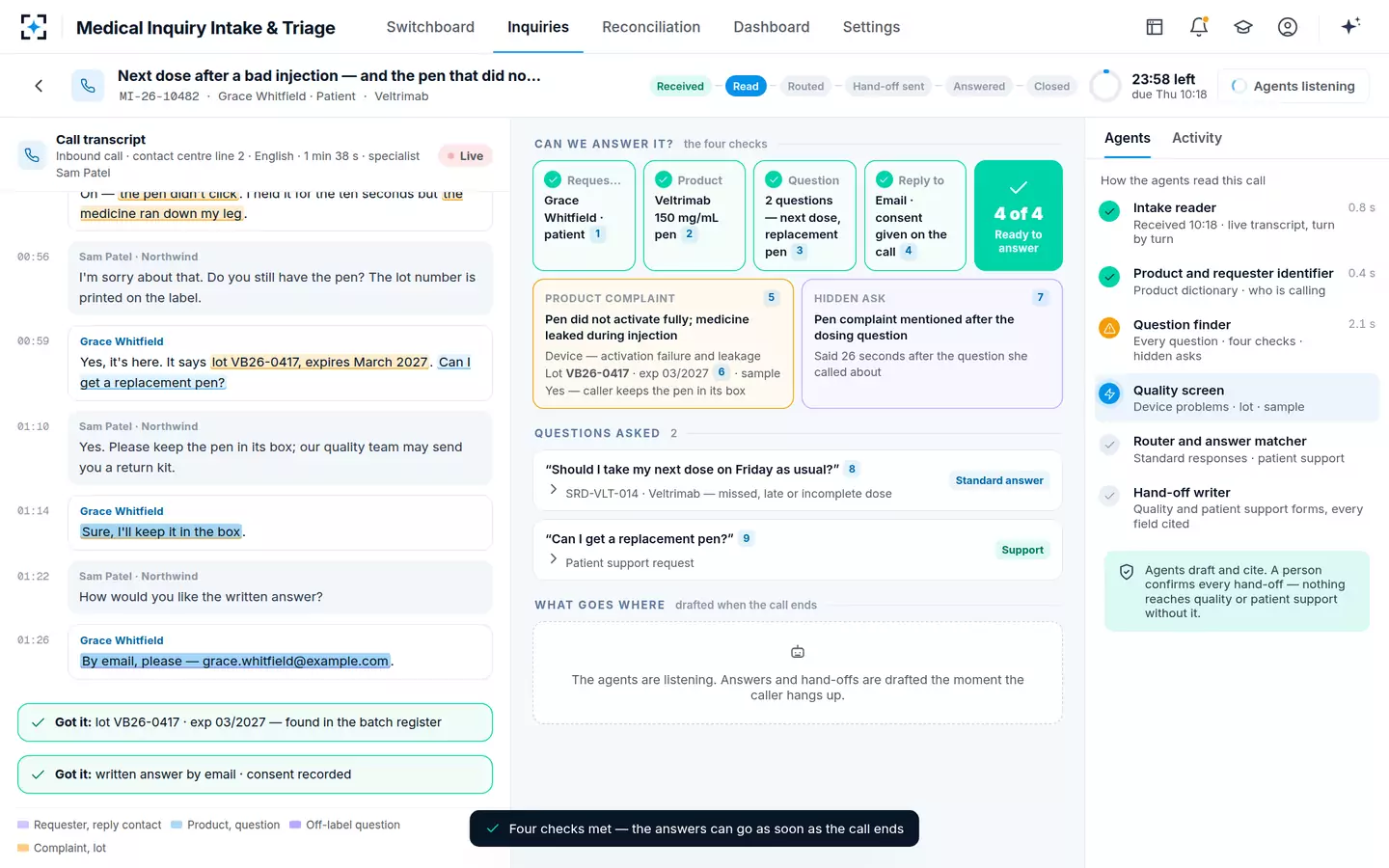
Is a storage mistake a product complaint? Storage, handling and user error
Usually not — and this is the judgement the definition makes hardest. The test is what is alleged about the product, so a caller who says "I left it in a hot car for two days, is it still safe to use?" has asked a question about storage and is owed an answer, not a complaint record. A caller who says "I left it in a hot car and now it will not inject" has described a failure of performance, and the fact that they also described a possible cause does not unmake the allegation. Causation is quality's job after the complaint is open, not the specialist's job before it.
The quality screen on the sample desk is bound by exactly that rule: storage errors by the user are answered rather than filed, unless a defect is described. It is a limit, not a shortcut — it stops the complaint file filling with questions, and it stops a real defect being written off because the caller volunteered an explanation for it.
What the caller said, and whether it opens a complaint
Opens a complaint: "I held it the full ten seconds and the medicine ran down my leg." A performance failure is alleged.
Answered, not filed: "I pressed it against my arm before I removed the cap — did I waste the dose?" A handling question, with no defect alleged.
Opens a complaint: "It was in the fridge the whole time and the liquid has gone cloudy." A change in the product is alleged.
Answered, not filed: "It was out of the fridge overnight — can I still use it?" A storage question about an undamaged product.
Opens a complaint: "There are black specks in three of the tablets in this blister." Particles are a defect.
Answered, not filed: "I split the tablet and it crumbled." The label may not permit splitting; the issue is the instruction, not the batch.
Opens a complaint: "The box says 10 mg and the blister inside says 5 mg." A labelling or packaging deficiency.
Answered, not filed: "The leaflet is hard to read without my glasses." A comment, and worth logging as feedback, but nothing is alleged to be deficient.
Opens a complaint: "The second pen did the same thing." A repeat failure, and evidence quality will want.
Answered, not filed: "It stung more than usual." A tolerability question for the medical answer, and a safety hand-over if symptoms are described.
Questions of this kind are not rare, and the "not a complaint" column is where much of a medical information desk's work lives. In a study of 767 queries put to Sweden's drug information centres between January 2023 and May 2024, 60 were specifically pharmaceutical — about formulation, lookups or pharmacy practice rather than clinical use — and of those, crushing or splitting a medicine accounted for 13 (22%) and alternative routes of administration for 12 (20%) (Asker et al., Basic & Clinical Pharmacology & Toxicology, 2025). Those centres answer clinicians, not a manufacturer's callers, so the mix is not a company's mix — but it is a fair picture of how often the question is about handling the product rather than a fault in it.
Who decides whether a complaint needs an investigation?
The quality control unit, and the drug rule says so directly: the quality control unit must review any complaint that a drug product may have failed one of its specifications, and decide whether it needs an investigation under § 211.192. Two things in that sentence are easy to skate over. The trigger is a possible failure, so the threshold for sending a complaint to quality is low on purpose. And the determination is a decision by a named person, not a status a record drifts into.
On the device side the February 2026 text reaches the same place by a different route, and adds a sanctioned way to say no: an investigation already performed for a similar complaint can stand in for a new one, provided the manufacturer keeps records justifying the decision. Either way, "no investigation" is an outcome that has to be written down with a reason and a name — which is the subject of the next section, and something complaint forms are often not designed to capture.
One sentence in a call, and what has to happen to it
Agent
The sentence is foundEvery sentence that asks for something or alleges something is picked out of the inquiry with the caller’s exact words, including the one said on the way out.
Never: dropping a second request because the first one was answered
Agent
Defect or questionA described defect — no activation, a leak, a bent needle, particles, discolouration — opens a complaint; a storage or handling question is routed to an answer instead.
Never: filing a storage error as a complaint when no defect is described
Agent
The identifiers are capturedLot and expiry are asked for while the caller has the product, the lot is checked against the batch register, and the caller is asked whether a sample can be returned.
Never: accepting a lot number that matches no batch without flagging it
A person decides
A specialist or the intake lead confirmsReads the drafted complaint with each field citing the passage it came from, and sends it. Choosing not to send needs a reason, which is kept.
A person decides
Quality reviews and determinesThe quality control unit reviews the alleged specification failure and decides whether an investigation is required — or records the reason it is not, and who decided.
Devices and pens: the second rulebook for the same call
A prefilled pen, an autoinjector, an inhaler and an on-body infusor are devices as well as medicines, and the same call therefore answers to a second rulebook. Since 2 February 2026 the device requirement lives at § 820.35(a), which lists the information a complaint record must carry — seven items: which device it was; when the complaint came in; its UDI or UPC and any other identification; the complainant's name, address and phone number; what the complaint is, in detail; any correction or corrective action; and any reply sent. What changed in the move, and what did not, is covered in the QMSR and complaint handling.
The device rules also explain why "the pen did not click" is taken so seriously by quality even when nobody was hurt. A reportable event for a manufacturer includes a device that "has malfunctioned and that the device or a similar device marketed by the manufacturer or importer would be likely to cause or contribute to a death or serious injury if the malfunction were to recur" (21 CFR 803.3). The limb has no injury in it. A pen that fails to deliver a dose of a medicine that matters is a malfunction whose recurrence could matter a great deal, and that assessment is made from the complaint record — from the lot, the words and the question about whether the device can be returned.
One housekeeping rule is worth knowing because it shapes how the two files sit together. FDA's December 2025 technical amendments confirm that a manufacturer "may maintain MDR event files as part of your complaint file, under part 820 of this chapter, if you prominently identify these records as MDR reportable events" (90 FR, 4 December 2025). One file is permitted; indistinguishable records in it are not.
Saying no: recording why a complaint was not investigated
Most complaints do not become investigations, and the rules are comfortable with that as long as the file says so. The drug rule requires the written record to include the reason an investigation was found not to be necessary and the name of the responsible person who made that determination. It is a two-field requirement hiding in a sentence, and complaint forms built around the yes case tend to offer a status instead of either field.
The equivalent discipline at intake is the reason for not sending something onward. On the sample desk a hand-off that is not made needs a reason, which is kept and surfaced again in the monthly reconciliation, so the quiet non-decision — the complaint somebody meant to raise and did not — has nowhere to hide. The inspection record shows why that matters: FDA's drug citations for this section include a limb specifically for complaint records that do not state the reason an investigation was not conducted.
How long must complaint records be kept, and where they have to live
A drug complaint record is kept for at least a year past the product's expiry date, or a year past the date the complaint came in, whichever runs later. For certain over-the-counter products that carry no expiration date because they meet the exemption at § 211.137, the period is three years after distribution. Those are floors, not targets; a product with a five-year shelf life and a long tail of distributed lots will hold its complaint file far longer in practice.
Where the file lives is also specified, and it catches companies that have centralised everything into one system: the file belongs at the site where the product was made, processed or packed — or at another facility, provided the records can be produced there for inspection without delay. A central complaint database is fine. A central complaint database that nobody at the manufacturing site can produce for an inspector is not.
The month after: two systems, one complaint, two lot numbers
A definition is only useful if the person who needs it has it in the call. Give the specialist the three-clause test — alleged, about the product, after release — and the rest of the procedure has something to work on. For the document that puts that test in writing, read the complaint handling procedure, and for the clock the hand-off is running against, read the field alert reporting requirements. To see a complaint opened in a live call, start from Medical Inquiry Intake & Triage.
Questions people ask
What counts as a complaint under GMP?
Any communication that alleges a deficiency in the product after it was released — by letter, email, web form, chat or voice. The drug CGMP rules never define the word, so companies apply the device definition from 21 CFR 820.3(b) to medicines as well; what the drug rules do define is the duty, which is a written procedure covering all written and oral complaints and a quality control unit review of anything that may be a specification failure.
Does a verbal complaint count as a complaint?
Yes. "All written and oral complaints" is the drug rule's own phrase, and the device definition names oral communications as well. The consequence is practical rather than philosophical: an oral complaint exists only as whatever the person taking the call records, so the caller's own words, the lot number and a way to reply back have to be captured while the caller is still there.
Is a labelling or packaging problem a product quality complaint?
Yes. The device rule names "a device, labeling, or packaging" in the same phrase when describing complaints about a possible failure to meet specifications, and on the drug side a carton that could cause one product to be mistaken for another is exactly the kind of information that a field alert report exists for. Treat a mismatch between the carton, the blister and the leaflet as a complaint, not as a printing query.
Does opening a complaint mean the company agrees something is wrong?
No. The definition turns on what is alleged, not on what is proven, and a complaint that is investigated and found to have no product cause is a correctly opened complaint. The asymmetry matters: nothing is lost by opening one that closes cleanly, while a defect left unrecorded is invisible to trending, to the batch review and to the investigation that a later complaint on the same lot would have joined.
Who can make a product quality complaint?
Anyone, from any source. Patients, caregivers, prescribers, pharmacists, nurses, wholesalers and a company's own field staff all generate them, and the UK medicines regulator's guidance expects representatives to pass the safety information they receive to the scientific service the licence holder runs. The complaint does not have to come through a channel the company designated; it has to be recognised wherever it lands.
What is a device complaint, and how is it different?
It is the same allegation about a product that happens to be a device — a pen, an autoinjector, an inhaler — and the difference is in what the record must carry and what it may trigger. Seven fields instead of five, including the received date and the unique device identifier, and a reporting assessment whose malfunction limb needs no injury at all: it asks whether the same malfunction recurring would be likely to cause or contribute to a death or serious injury.