Medical information outsourcing usually means handing first-line calls, emails and web forms to a contact centre that answers under your name, from your approved responses, and passes anything it cannot answer back to you. It is a common arrangement: of the companies in a 2025 published benchmark that provide medical information to patients, 92% use a contact centre to do it, whether their own or a vendor's. What outsourcing does not move is the clock, the complaint file or the duties that come with receiving information about your medicines — so the comparison that decides a three-year budget is not the price per inquiry but which model leaves accountable work undone. Botminds' Medical Inquiry Intake & Triage is a third option on that table: your own specialists, with agents doing the reading, splitting and drafting that a vendor is usually hired for. It routes product complaints to quality and access requests to patient support, and does not classify, assess or report adverse events — the safety team keeps that.
Every cost figure below is ours, built from two published wage medians and the solution's own estimated hours, with the arithmetic on the page. None of it is a customer's measured saving, and the screens are the product's sample data on fictional people and medicines.
What a medical information function is made of, and what its hours cost
25and 13
internal and external full-time staff on average, both excluding the contact centre
92%
of the companies that provide medical information to patients use a contact centre for it
23 of 25 such companies
$140,910
median annual wage for pharmacists, May 2025 — $67.75 an hour
$44,770
median annual pay for customer service representatives, 2025 — $21.53 an hour
Should medical information be outsourced?
The defensible answer is: the first-line handling, often; the accountable work, never. A contact centre is good at coverage — nights, weekends, languages, volume spikes — and a specialist team is expensive to staff for a queue that is idle most of the week. What a contract cannot buy is the thing an inspector asks for, which is evidence that your company knew, acted, and can show the file.
That split is why the decision often gets made on the wrong number. A bid arrives priced per inquiry or per seat; it is compared with a salary line; the cheaper one wins. Neither figure contains the cost of the work that stays behind, and neither contains the cost of what gets lost in the hand-over — which is often the second question in the inquiry and the lot number nobody asked for.
What does it cost to run a medical information call center? Three models
Start with the function, not the call. In the 2025 benchmark, "The average number of internal employees was 25 FTEs, whereas external employees accounted for an average of 13 FTEs, both excluding contact center" (DeLuca et al., 2025). Twenty-five internal full-time staff at the published pharmacist median of $140,910 is about $3.5 million of wages a year before benefits, overhead, systems or the contact centre itself. The thirteen external are headcount, not price: what they cost depends on the rate your vendor charges, which is the number you negotiate.
Below the headcount sits the comparison that actually differs between models — who does which part of one inquiry, and who is left holding the duty.
One inquiry, three staffing models, read down the eight questions a contract has to settle
Who takes the call
In-houseYour own specialists, on your own lines.
OutsourcedThe vendor’s contact-centre staff, under your script.
With agentsYour specialists, with the agents reading the live transcript beside them.
Who finds the second question
In-houseThe specialist, if the queue allows.
OutsourcedWhoever writes up the call, against a script that may not mention it.
With agentsAn agent, on every inquiry, with the sentence quoted.
Who drafts the hand-off
In-houseThe specialist, retyping from notes.
OutsourcedThe vendor, into your form or theirs.
With agentsAn agent, each field carrying the words it came from.
Who confirms it before it is sent
In-houseA specialist or the intake lead.
OutsourcedUsually the vendor, under a service level.
With agentsA specialist or the intake lead — no agent can send.
Who holds the complaint file
In-houseYou.
OutsourcedYou, wherever the vendor keys it.
With agentsYou.
When does the clock start
In-houseAt first receipt.
OutsourcedAt first receipt — the vendor’s receipt is yours.
With agentsAt first receipt, stamped by the agent that read it.
Who signs the month
In-houseYour intake lead.
OutsourcedYour intake lead, on the vendor’s report.
With agentsYour intake lead, on a match run across both receiving systems.
What the price covers
In-houseSalaries, systems, management.
OutsourcedA rate per inquiry or per seat, including the vendor’s overhead and margin.
With agentsYour specialists’ time, plus the system.
What does it cost per inquiry? A model built in the open
Here is a cost model with every input on the page, so you can change the ones you disagree with. It prices one compound inquiry — a question that also carries a product complaint and an access request — because that is the inquiry where the three models differ. It is not the average inquiry, and a desk's ordinary dosing question costs a fraction of this.
Two inputs are published. A pharmacist's median wage is $67.75 an hour (BLS, Pharmacists, May 2025) and a customer service representative's is $21.53 (BLS, Customer Service Representatives, 2025). Both are wages: benefits, overhead, systems and management sit on top, and they sit on top of all three models, so leaving them out understates every column by roughly the same proportion.
The third input is the solution's own estimated split of the handling work for one compound inquiry: 0.5 hours writing up the call after the caller hangs up, 0.5 finding every question and the complaint in those notes, 0.75 retyping the complaint with lot, expiry and sample, 0.5 retyping the patient support request, and 0.5 checking and sending both — 2.75 hours of someone's time. The estimate excludes the two hours the inquiry spends waiting in a queue, because nobody is paid for those. With the agents the same five steps come to 0.16 hours, of which 0.06 is the person who checks and sends.
The labour in one compound inquiry, divided by who does each step
In-house · 2.75 h at $67.75 = $186.31
- Writing up · 0.5 h · $33.88 · 18.2%
- Finding every question · 0.5 h · $33.88 · 18.2%
- Retyping the complaint · 0.75 h · $50.81 · 27.3%
- Retyping the support request · 0.5 h · $33.88 · 18.2%
- Checking and sending · 0.5 h · $33.88 · 18.1%
Outsourced · 1.75 h at $21.53 plus 1.0 h at $67.75 = $105.43
- Vendor writes up and retypes both hand-offs · 1.75 h · $37.68 · 35.7%
- Your specialist finds every question · 0.5 h · $33.88 · 32.1%
- Your specialist checks and sends · $33.88 · 32.2%
Your desk with agents · 0.06 h at $67.75 = $4.07, plus the system
- A person checks and sends · $4.07 — the agents do the rest · 100%
The third row is where a buyer should stop and do one more sum. If the labour in the agent-assisted model is $4.07, then the system has to cost more than $101.36 per compound inquiry before the outsourced model is cheaper on labour, and more than $182.24 before the in-house model is. Those two numbers, not a vendor's rate card, are the comparison to put in front of a procurement committee — and they are the reason the question "what does the software cost" has to be answered per inquiry, at your volume, rather than as an annual licence.
Annual labour, by model, at 20,000 compound inquiries a year
How much of medical information work is outsourced?
The published benchmark does not measure it directly, but two of its figures point the same way. It reports 13 external full-time staff on average against 25 internal, both excluding the contact centre — so roughly a third of the named headcount is already somebody else's employee before the contact centre is counted at all. And the patient-facing side has grown quickly: "Twenty-five of the 34 companies (74%) responded that they provide medical information to patients. This is a significantly higher number compared with 2018, when only 13 of the 27 companies (48%) responded to these inquiries" (DeLuca et al., 2025).
Those two facts point the same way. More inquiries are arriving from patients and caregivers, who are the requesters least likely to ask one clean question, and more of the first contact is being taken by people who do not work for you. That is a reasonable operating decision and an uncomfortable evidence position, and the contract is the only place to fix it.
Every inquiry, every channel, in one list the desk owns
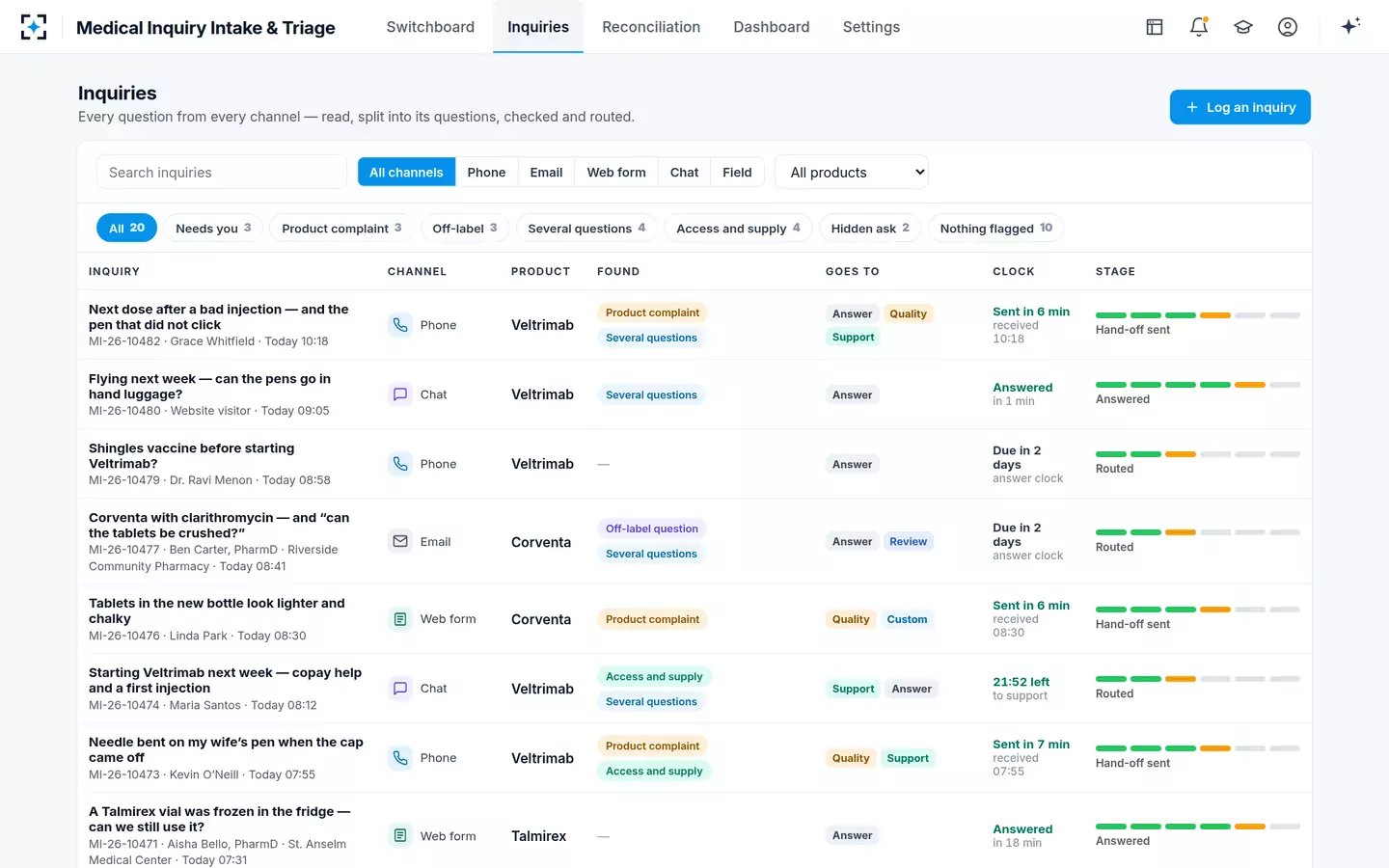
The duties that do not transfer
Several duties stay with the company whatever the contract says, and one moves only on a condition. Most are written down in a rule or guidance a reviewer will already know.
Each duty, whether it can be contracted out, and the rule or code that decides it
Taking first-line calls, emails and forms
Contract it out?Yes
What decides itCommon practice: of the companies that provide medical information to patients, 92% use a contact centre to do it.
Writing up the inquiry and drafting hand-offs
Contract it out?Yes
What decides itA contracted task. The quality of it is a service level, not a rule.
The moment the clock starts
Contract it out?No
What decides itFDA: if a contract laboratory finds a sterility failure, that day is day 0 for a field alert. The vendor’s receipt is your receipt.
Holding the complaint file for inspection
Contract it out?Partly
What decides itThe file may sit at another facility only if the written records are readily available for inspection there.
The scientific service for your medicines
Contract it out?No
What decides itIn the UK the regulator’s guidance refers to scientific services set up by the licence holder under the medicines regulations — the company’s own, whoever staffs its phones.
Passing on safety information that is received
Contract it out?No
What decides itThe UK guidance says representatives must report the safety information they receive to the licence holder’s scientific service, and the company’s clocks run from first receipt.
Approving a custom or off-label answer
Contract it out?No
What decides itIt belongs to your medical reviewer; a vendor can prepare it, not approve it.
Signing the monthly reconciliation
Contract it out?No
What decides itThe signature says the company has checked. A vendor cannot sign that it checked itself.
The scientific service is the one most easily assumed away. The UK regulator's guidance says representatives "must also report all information relating to the safety of a product which they receive from healthcare professionals directly to scientific services set up by the licence holder under the Regulations" (MHRA Blue Guide, section 6.13). The service is the licence holder's. A vendor can staff a phone line; it cannot be your scientific service, and it cannot pass on something it never recognised.
Read that as the test of an outsourcing arrangement: an inquiry sitting in a vendor's queue for a nightly batch is information your scientific service has not received, while every clock that runs from first receipt has already started.
Does outsourcing change the regulatory clock?
No, and FDA says so with an outsourcing example. On the three-day field alert window, it says the clock runs wherever the qualifying information first surfaces — so if a contract laboratory finds a sterility failure, that day is day 0 and the report is due by close of business on day 3 (FDA, Field Alert Report Submission: Q&A, July 2021). The contractor's Monday is your Monday.
The device rules draw the same line from the other side. Under 21 CFR 803.3(b), a company becomes aware when one of its employees has information that reasonably suggests a reportable adverse event has happened — and for a manufacturer, for the thirty-day reports, that means any employee at all (21 CFR 803.3, 2024 CFR edition). That duty belongs to the safety team, not to a triage desk — but the drafting choice is instructive: awareness is pinned to a person, on a date. A contract that leaves the date of first receipt in the vendor's system, uncopied, has made your own clock unprovable.
In the product the time of first receipt is stamped by the agent that reads the inquiry, in the desk's own system, whatever channel it arrived through, and no later step can change it. The clock on each question runs from there, including at weekends.
Who is accountable when an outsourced centre misses a complaint?
You are, and the complaint file has to prove what happened. For drugs, the rule even anticipates that the file may live somewhere else: "The file regarding such drug product complaints shall be maintained at the establishment where the drug product involved was manufactured, processed, or packed, or such file may be maintained at another facility if the written records in such files are readily available for inspection at that other facility" (21 CFR 211.198, 2024 CFR edition). Readily available for inspection is a high bar for a vendor's system you do not administer, and it is worth testing before the contract is signed rather than during an inspection.
Accountability also has a measurement problem. If the vendor reports what it sent, and you count what you received, the two agree by construction — a missing hand-off appears in neither. The only count that finds it is a match against the systems that were supposed to receive it, which is why what inspectors actually cite on complaint handling is so often about the file rather than the investigation.
The month seen as numbers, not as a vendor report
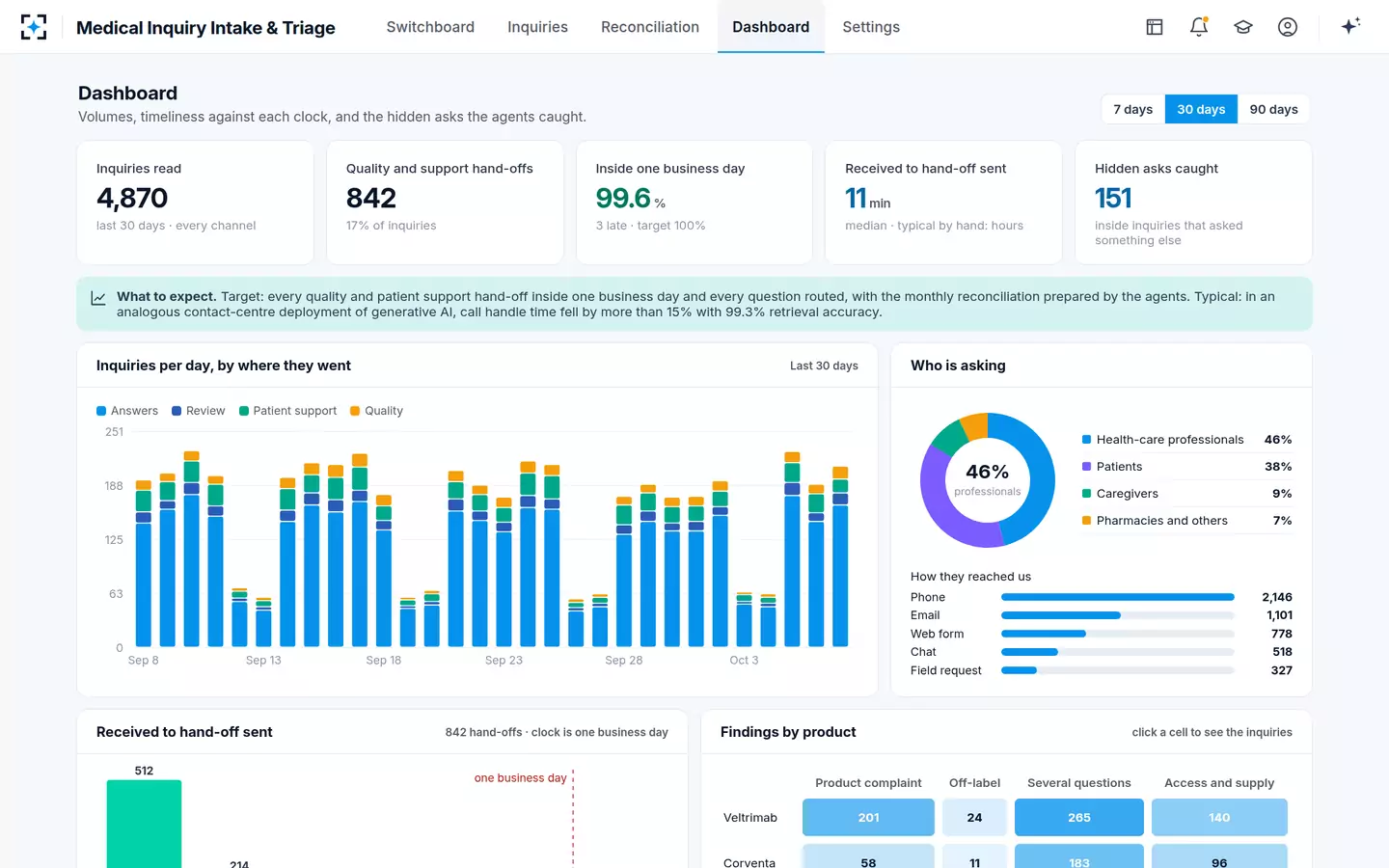
What a contract has to say about the second question
Contact-centre contracts rarely mention it, and it is one of the things most likely to go wrong. A script that captures the reason for the call will reliably capture one request. The second request — the pen that did not click, the cost problem, the off-label question in the second paragraph — is invisible to a service level measured on first call resolution and answer time, because an inquiry that was never recognised as holding two things looks like a success on both.
The comparison a bid invites, and the comparison that decides the next three years
What the bid is priced on: Inquiries handled per month.
What to write into the contract instead: Requests identified per month, and the rate at which inquiries held more than one.
What the bid is priced on: Average speed to answer; abandonment rate.
What to write into the contract instead: Time from first receipt to the hand-off reaching quality or patient support, measured in your system.
What the bid is priced on: A monitoring score on a sample of calls.
What to write into the contract instead: The share of hand-offs that arrived complete: lot, expiry, consent, reply contact, the requester’s own words.
What the bid is priced on: A monthly activity report from the vendor.
What to write into the contract instead: A match between the vendor’s hand-offs and what the receiving systems actually hold, signed by your intake lead.
What the bid is priced on: The date the vendor opened the ticket.
What to write into the contract instead: The date and minute the inquiry was first received by anyone working for you, copied into your system.
What the bid is priced on: Notice period and transition fee.
What to write into the contract instead: Your data, your standard responses and your product dictionary returned in a usable form, with the audit trail.
Ten clauses to settle in a medical information contact-centre contract
- Where the time of first receipt is recorded, and who can change it.
It must land in a system you administer. A clock you cannot evidence is a clock you have not met.
- The duty to split an inquiry into every request it holds.
Name it explicitly. Nothing else in a standard contract asks for it, and nothing else measures it.
- What the hand-off must contain to be accepted.
Lot, expiry, sample availability, consent, reply contact, the requester’s words. An incomplete hand-off is a rework cost you pay.
- The route for anything outside the label.
It goes to your medical reviewer, unanswered, with the requester’s own sentence and the record that the request was unsolicited.
- Who confirms a hand-off before it is sent, and who may decline one.
Declining is a decision with a reason, kept where you can read it. An undocumented non-decision is the hardest kind to find.
- A monthly match against the receiving systems, not a vendor activity report.
The only count that can find a hand-off that was sent and never arrived.
- Inspection access to the file, on your premises.
The drug rule allows a file to live elsewhere only if the records are readily available for inspection there. Test it.
- Weekend and holiday coverage, stated as clock behaviour.
Not "office hours": say whether a Friday-evening inquiry starts its clock on Friday or Monday, because the rule does not pause.
- Return of your own material at exit.
Standard responses, product dictionary, inquiry history and audit trail, in a form you can load somewhere else.
- The right to replay a sample of closed inquiries.
Your own quality check on the vendor’s output, run the way you would run a system evaluation.
Reading the three-year cost against the three-year risk
Put the two halves of this page together and the decision stops being a price comparison. On labour alone, at 20,000 compound inquiries a year, the three models cost roughly $3.73 million, $2.11 million and $0.08 million plus the system. On duty, the three are identical: the clock, the file, the scientific service and the signature stay with you in every column. The only thing that changes between models is how much of the evidence is produced by someone you manage.
That is the question to take into the room. Not which model is cheaper, but which one leaves you able to show, on any inquiry picked at random, what was asked, when you first knew, what you did about the part that was not the question, and who checked. If a model cannot do that, its price is incomplete. A two-week replay on inquiries you have already closed is how to find out which one can, before a contract commits three years to the answer.
Questions people ask
What can a medical information vendor not do for you?
It cannot be your scientific service, which UK guidance treats as the licence holder's own. It cannot approve a custom or off-label answer, which belongs to your medical reviewer. It cannot start your regulatory clock later than its own receipt. And it cannot sign your monthly reconciliation, because that signature says you have checked.
How many FTEs does a medical information department need?
The published benchmark average is 25 internal and 13 external full-time staff, both excluding the contact centre, across the companies surveyed. Treat it as a scale marker rather than a target: the survey spans companies of very different sizes and portfolios, and it says nothing about how many inquiries those staff handle. The number that actually sizes a desk is inquiries a day and the share of them that carry more than one request.
What should a medical information outsourcing contract require?
Three things contracts often leave out. That every inquiry is split into each request it holds, and that the rate of multi-request inquiries is reported. That the time of first receipt lands in a system you administer and cannot be rewritten. And that each month is closed by matching the vendor's hand-offs against what the quality and patient support systems actually hold, rather than against the vendor's own activity report.
Who holds the complaint file if the contact centre is a vendor?
The company does. For drugs the rule allows the file to be kept at another facility only if the written records in it are readily available for inspection at that facility — which is a question about access and administration, not about where a database happens to be hosted. In practice the safest arrangement is that the vendor's output lands in your own system at the moment it is created.
Does an outsourced desk make a regulatory deadline later?
No. FDA's field alert guidance gives the example directly: a sterility failure found by a contract laboratory starts the clock that day, and the report is due by close of business three working days later. The principle generalises to the commitments a medical information desk sets itself — a one-business-day hand-off to quality runs from when anyone working for the company first received the inquiry, including a contracted contact centre, and including a Saturday.
How do you compare a vendor rate with a software price?
Per inquiry, at your own volume. Reduce each model to the labour it still needs — on the figures in this guide that is about $105 of wages per compound inquiry outsourced and about $4 with agents doing the drafting — and then ask what the system costs per inquiry at your volume. If it is less than the difference, the agent-assisted model is cheaper on labour; if it is more, it is not. An annual licence quoted without a volume cannot be compared with anything.