The difference between a product complaint and an adverse event is the difference between an allegation about the product and something that happened to a person. A product complaint says the pen did not fire, the tablet had specks in it, the carton contradicted the blister. An adverse event says a patient had an unwanted medical experience while using the product — and under the drug rules that holds "whether or not considered drug related". They are not two answers to one question, which is the mistake the phrase "complaint vs adverse event" invites: one sentence from a caller can be both at once, and when it is, two teams have to act on two different clocks. The hard part is that nobody gets to think about it at leisure. The decision is made by whoever is listening, in a conversation that was about something else. Medical Inquiry Intake & Triage is Botminds' agentic solution for that moment: it finds every request and every allegation in an inquiry, routes product complaints to quality and access requests to patient support, and shows the specialist what it found in the caller's own words.
One boundary, stated once and plainly: this solution does not classify, assess or report adverse events. Pharmacovigilance is the safety team's own work, under its own procedures and clocks, and nothing on this page shows the solution doing it. What follows is the distinction as the regulations draw it, and what a medical information desk owes each side.
Four clocks that can start from one phone call
15days
calendar days to report a serious and unexpected adverse drug experience
21 CFR 314.80(c)(1)(i) — the safety team’s clock
30days
calendar days for a manufacturer’s device malfunction report
21 CFR 803.50(a)
3working days
to evaluate a complaint and file a field alert report if it qualifies
21 CFR 314.81(b)(1)
5days
calendar days to pass the information to the other applicant on a combination product
21 CFR 4.103(a)
What is the difference between a product complaint and an adverse event?
The two definitions do not overlap in their subject matter, which is what makes them easy to tell apart once they are read side by side. A product quality complaint is a communication alleging a deficiency in the product — what it is, or its quality, durability, reliability, safety, effectiveness or performance — after it was released for distribution. An adverse drug experience, in the drug rules' own words, is "any adverse event associated with the use of a drug in humans, whether or not considered drug related", and the definition then lists what it includes: an event in professional practice, an event from overdose whether accidental or intentional, from abuse, from withdrawal, "and any failure of expected pharmacological action" (21 CFR 314.80(a)).
That last clause is the one worth memorising on an intake desk, because it is where the two definitions meet. A pen that fails to deliver its dose is a device malfunction, which is the complaint; the dose that never reached the patient is a failure of expected pharmacological action, which is on the safety side of the line. Nobody has to be injured for both of those sentences to be true about the same forty words from a caller.
The vocabulary is also worth getting right, because three near-synonyms are in daily use and only one of them is a legal term in each rulebook. For medicines the term of art is adverse drug experience; the report that follows a serious and unexpected one is a fifteen-day alert report. For devices it is an MDR reportable event, under medical device reporting. "Adverse event" is the everyday word that covers both, and a procedure that uses it loosely will produce a complaint record that quality cannot act on and a case the safety team cannot assess.
The complaint rule's own instruction to screen for the other thing
The clearest evidence that these are two duties and not one choice is that the complaint rule itself orders the second look. The same paragraph that demands a written procedure for all written and oral complaints adds a third sentence that is easy to read past.
Such procedures shall include provisions for review to determine whether the complaint represents a serious and unexpected adverse drug experience which is required to be reported to the Food and Drug Administration in accordance with §§ 310.305 and 514.80 of this chapter.
21 CFR 211.198(a) — the complaint rule’s own third sentence
Read it as a design instruction and it says something specific: the complaint procedure has to contain a step that looks at the complaint and asks whether it is also something else. It does not say the complaint handler makes the reporting decision — the cross-references point at the safety reporting rules, which belong to another team. It says the screen must exist, and that it is part of the complaint procedure. A desk with no such step is non-compliant on the complaint rule, whatever its safety procedures say.
The same logic runs the other way for devices. FDA's December 2025 technical amendments confirm that a manufacturer may keep medical device reporting files inside the complaint file, provided those records are prominently identified as reportable events — one filing cabinet is allowed, but the two kinds of record may not become indistinguishable.
Can one phone call be both a product complaint and an adverse event?
Yes, and a procedure which treats the two as a choice will silently drop one of them whenever it happens. The research on how people actually ask is unambiguous. In a study of consumer requests to the US National Library of Medicine's Genetic and Rare Diseases Information Center, 1,467 requests decomposed into 2,937 separate questions, and the authors note that "consumer health requests often contain multiple questions, with significant amounts of co-reference and ellipses" (Roberts et al., AMIA Annual Symposium Proceedings, 2014). Those were written requests from consumers rather than calls to a manufacturer, but the shape of the problem is the same: one message, several asks, and the later ones leaning on the earlier ones for their meaning.
The pattern holds for professional queries too. Among 767 queries to Sweden's drug information centres, the 60 specifically about pharmaceutical matters showed that "Thirty-two queries (53%) concerned two or more drugs" (Asker et al., Basic & Clinical Pharmacology & Toxicology, 2025) — again a neighbouring service, a hospital-facing one rather than a company desk, but a useful reminder that one query often carries more than one subject.
What the caller said, and what each side of the line does with it
| What the caller said | The complaint side | The safety side |
|---|---|---|
| "I held it for the full ten seconds and the medicine ran down my leg." | A device complaint: activation failure and leakage. Capture lot, expiry and whether the pen can be returned. | Nothing happened to the patient, but the malfunction question is still live: would a recurrence be likely to cause or contribute to a serious injury? |
| "The pen did that twice, so I missed two days and ended up in hospital." | Still a complaint — the allegation about the product has not changed at all. | Now also a case for the safety team: an outcome, and a failure of expected pharmacological action. Their assessment, their clock. |
| "There are black specks in three of the tablets." | A complaint. The blister is the sample quality will want. | Nothing to report unless somebody took them and something followed. |
| "I took one of the speckled tablets and was sick all night." | Still a complaint, and now an urgent one for the batch. | An adverse drug experience with an outcome. Whether it is serious and unexpected is the safety team’s judgement, not the desk’s. |
| "The carton says 10 mg and the blister inside says 5 mg." | A labelling complaint, and the kind of information a field alert report exists for. | Depends entirely on what was taken, and by whom — which is the next question to ask. |
| "It made me drowsy — that is in the leaflet, isn’t it?" | Not a complaint: nothing is alleged to be wrong with the product. | An adverse event all the same. Being listed in the labelling changes which report is owed, not whether the safety team hears about it. |
Is a device malfunction an adverse event? The limb that needs no harm
Under the device rules a malfunction can be reportable with nobody harmed at all, which is perhaps the most counter-intuitive thing about this boundary. A manufacturer's reportable event includes a marketed device that has malfunctioned where that device, or a similar one the company sells, would be likely to cause or contribute to a death or serious injury if the malfunction happened again (21 CFR 803.3). The test is hypothetical and forward-looking: not what happened, but what a repeat of it would be likely to do.
"Malfunction" has its own definition — "the failure of a device to meet its performance specifications or otherwise perform as intended", where performance specifications "include all claims made in the labeling". So a pen that does not deliver a full dose has malfunctioned even if the patient noticed and took another one. Whether that malfunction is reportable depends on the medicine it was supposed to deliver and what missing it would be likely to do, which is an assessment for the people who hold the product's safety profile.
For the desk, the consequence is narrow and practical. The facts the reporting assessment needs — what the device did, which lot, when it happened, whether the unit can be examined — are all complaint fields, and they are captured at intake or not at all. Getting them right is the desk's contribution to a decision it does not make.
Do the complaint clock and the reporting clock start at the same time?
They start from the same event, and that event is earlier than procedures often assume. For devices the rules define the moment: a manufacturer is "considered to have become aware of an event when any of your employees becomes aware of a reportable event that is required to be reported within 30 calendar days" (21 CFR 803.3(b)). Any employee. The contact centre specialist taking the call is an employee, so the thirty days begin while the caller is still talking — not when a safety database receives a case.
On the drug side the field alert window is three working days from the day the applicant received the information, and the fifteen-day alert report runs from initial receipt of the information by the applicant. Each window is measured from receipt, not from triage, which is why an intake desk that takes a day to pass something on has not used a day of its own time: it has spent a third of one statutory window, or a fifteenth of another. The arithmetic of that, with FDA's own worked example of a Friday that becomes a Wednesday, is in the field alert reporting requirements.
Four federal windows from one call, drawn to scale
- Evaluate and file3 days
- Tell the other applicant5 days
- The safety team’s alert report15 days
- From any employee’s awareness30 days
A pen is two products: the reports one call can start
A prefilled pen is a combination product, and part 4 says in terms which reports its applicant owes: "Five-day report is a report as described in §§ 803.3 and 803.53 of this chapter … Malfunction report is a report as described in § 803.50 of this chapter … Field alert report is a report as described in § 314.81 of this chapter" (21 CFR 4.102). One call about one pen can therefore touch the device reporting rules, the drug reporting rules and the field alert rules at once, each with its own window.
Part 4 adds a duty that catches companies by surprise, because it is owed to another company rather than to a regulator. Where the constituent parts have different applicants, information about a death or serious injury, or an adverse experience, must reach the applicant for the other constituent part within five calendar days of receiving it, and the records of that exchange must show the date the information came in (21 CFR 4.103). The received date is not a convenience field. It is a regulated data point in a transfer between two companies, and it comes from the call.
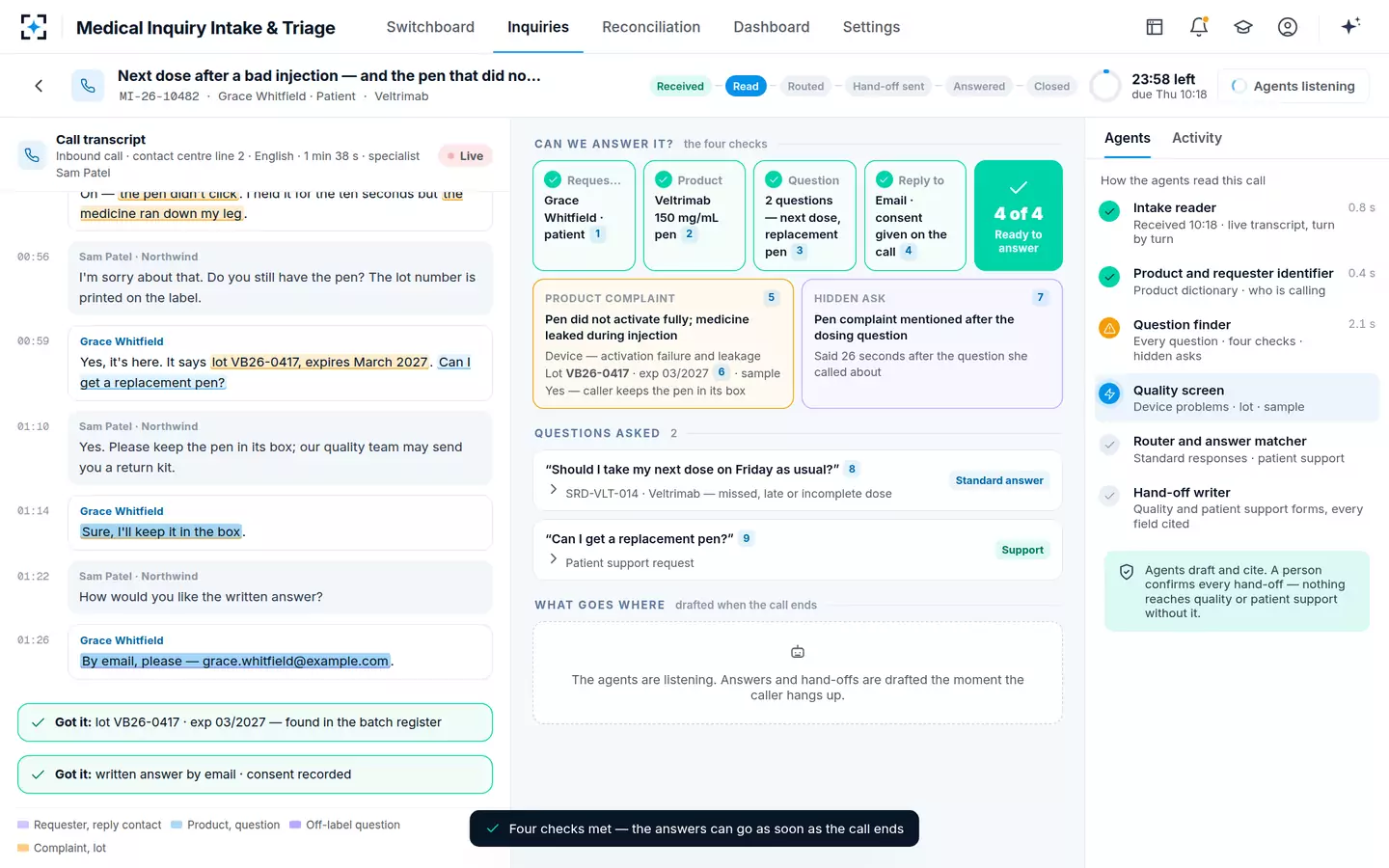
A device complaint opened in the call, with the lot checked
Who decides whether a complaint is reportable, and who it goes to
Three different people decide three different things, and conflating them is how the boundary fails in practice. The person on the phone decides what was said and gets it to the right places — that is a routing decision, not a regulatory one. The quality control unit decides whether a complaint alleging a possible specification failure needs an investigation, and records the reason and its own decider's name when it does not. The safety team decides whether what the caller described is an adverse event, whether it is serious, whether it is unexpected, and which report is owed.
Writing it that way makes the intake desk's duty small and testable: notice, capture, hand over, and do not adjudicate. A specialist who tries to work out whether a case is serious and unexpected is doing someone else's job with the wrong information, and a procedure that asks them to is building a bottleneck into a fifteen-day clock.
A complaint and a safety report, side by side
Product quality complaint: An allegation about the product — what it is, or its quality, durability, reliability, safety, effectiveness or performance — after release.
Safety report: Any adverse event associated with the use of the product in a human, whether or not anyone thinks the product caused it.
Product quality complaint: Quality, once the medical information desk has handed it over.
Safety report: The safety team, under its own procedures. The medical information desk hands over; it does not assess.
Product quality complaint: No. Seriousness is not part of the definition, and a complaint with no patient in it is still a complaint.
Safety report: Yes, and in a defined way: death, life-threatening, hospitalisation or its prolongation, persistent or significant disability, congenital anomaly — or an important medical event on medical judgement.
Product quality complaint: Product and strength, lot, the complainant, what was alleged in their own words, the reply — plus the device fields where one applies.
Safety report: A description of the experience relating to an individual patient, which the drug rules call an individual case safety report.
Product quality complaint: A company target — one business day to quality on the sample desk — plus the three-working-day field alert evaluation where the complaint qualifies.
Safety report: 15 calendar days for a serious and unexpected adverse drug experience; 30 calendar days for a device malfunction report, from the day any employee became aware.
Product quality complaint: The reason an investigation was not conducted and the name of the person who decided it go into the record.
Safety report: A case assessed as not reportable is still collected and kept by the safety team; what changes is which report is owed.
What this solution does with each, and what it does not do
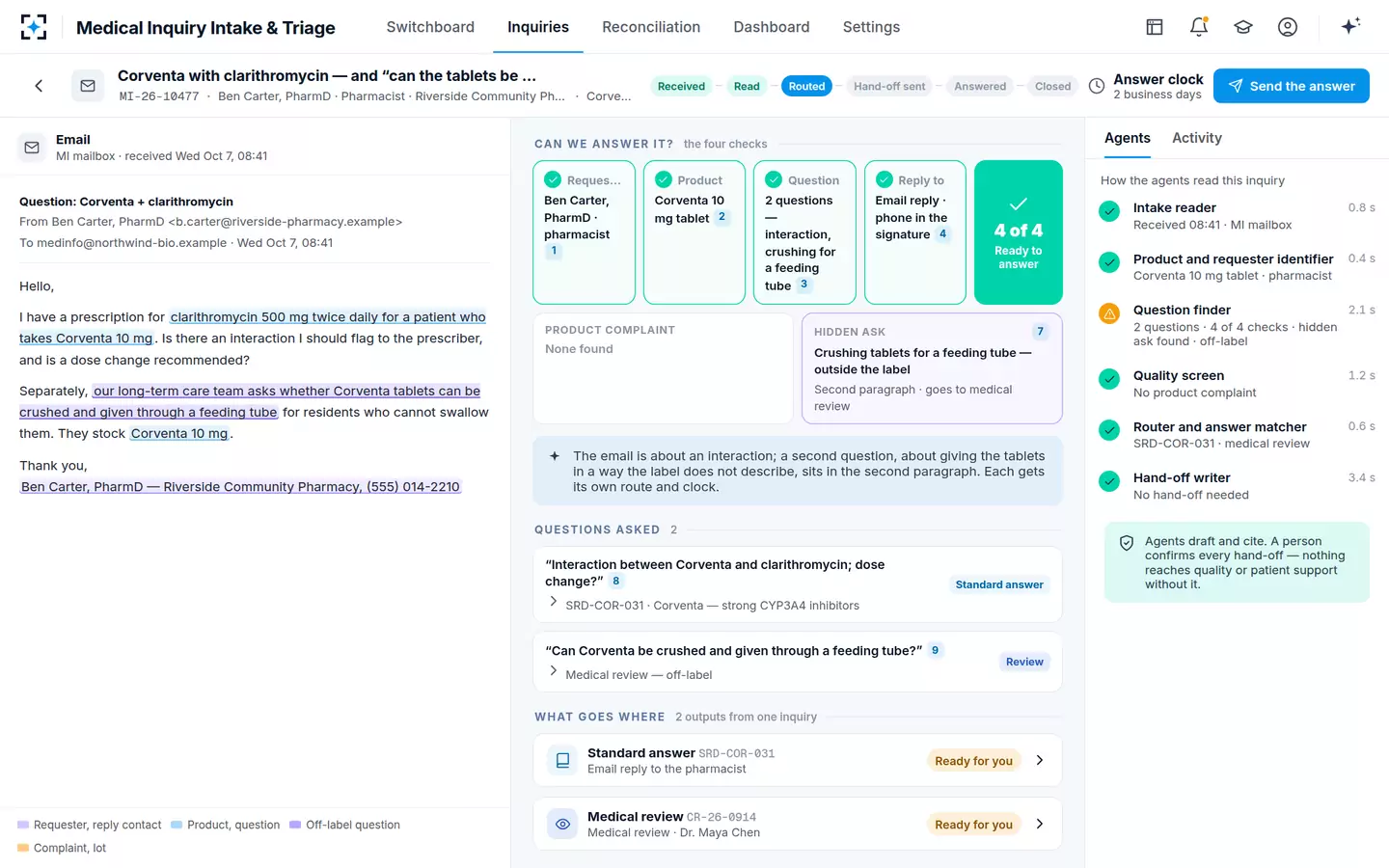
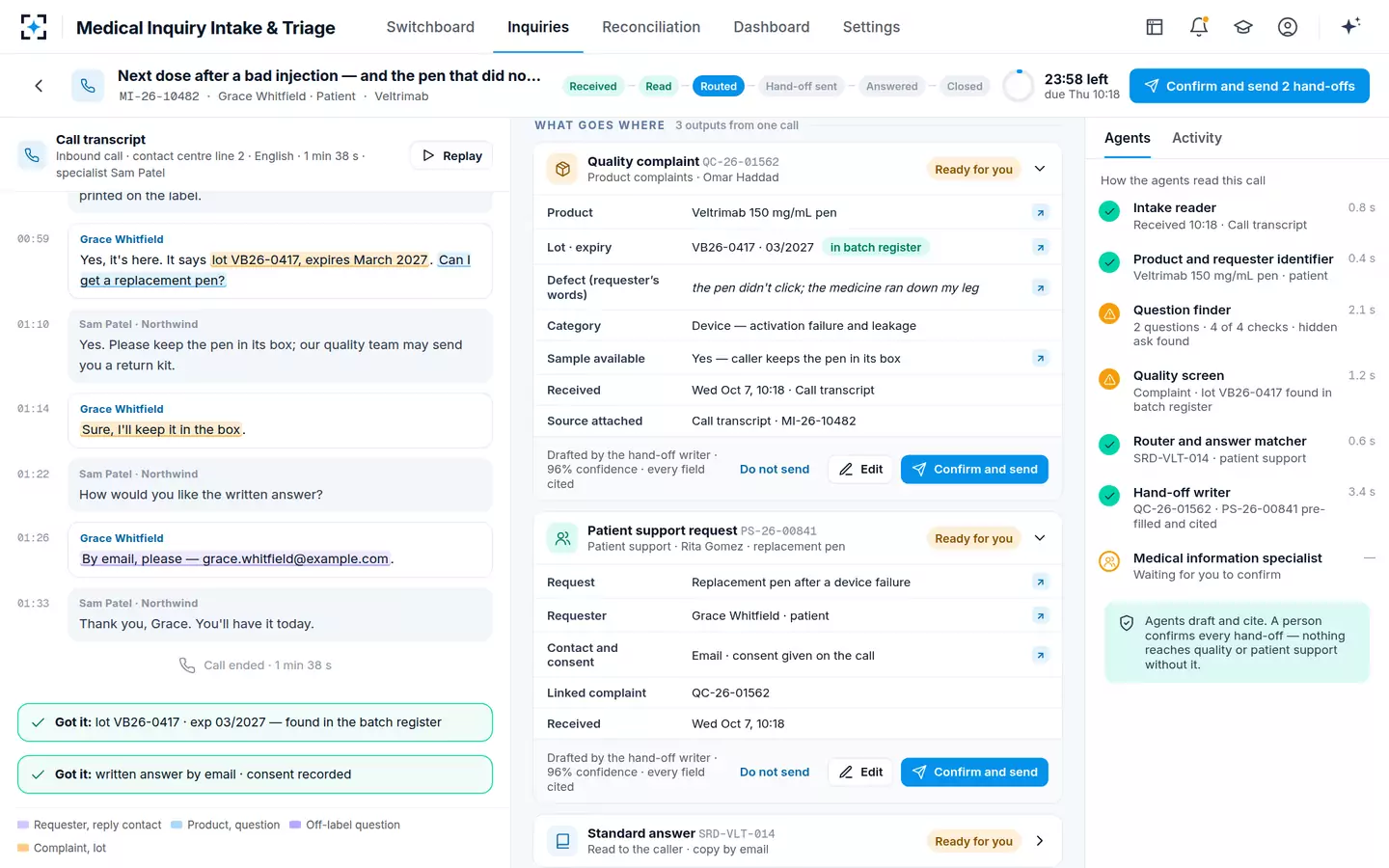
Medical Inquiry Intake & Triage reads every inquiry from phone, email, web form, chat and field medical, splits it into every question and request it holds, and gives each one its own route and clock. Product complaints are drafted for quality with lot, expiry, the defect in the requester's words and whether a sample can be returned. Access, supply and cost requests are drafted for patient support with the caller's consent and contact details. Questions about use outside the label go to the medical reviewer. A person confirms every hand-off before it is sent, and choosing not to send one needs a reason that is kept.
What it does not do is pharmacovigilance. It does not decide that something is an adverse event, it does not assess seriousness or expectedness, and it does not write or submit a safety report. Where a caller describes what happened to a patient, that is the safety team's own work under their own procedure, and the desk's job is to make sure they have it, with the words the caller used and the time the company first heard them.
One sentence, two routes — and the step this solution does not take
Agent
Every request is foundThe inquiry is split into each question and request it holds, each kept with the exact words — including the one mentioned on the way out.
Never: dropping a second request because the first one was answered
Agent
The quality screen reads the allegationA described defect — no activation, a leak, a bent needle, particles, discolouration — opens a complaint with lot, expiry and the sample question.
Never: deciding whether what it heard is an adverse event
Agent
The hand-off is drafted and citedThe complaint for quality and the request for patient support are pre-filled field by field, each field carrying the passage it came from.
Never: sending anything without a person
A person decides
The specialist or intake lead confirmsReads the cited fields, confirms the hand-offs, and passes anything describing what happened to a patient to the safety team under its own procedure.
A person decides
The safety team assesses and reportsDecides whether the description is an adverse event, whether it is serious and unexpected, and which report is owed. This work sits outside this solution.
Two asks in one email, each on its own route
What is an MDR reportable event? The three facts that settle it at intake
A reportable event, for a manufacturer, is an event that reasonably suggests one of its marketed devices may have caused or helped cause a death or serious injury, or has malfunctioned in a way that would be likely to cause or contribute to one if it recurred. "Serious injury" is defined too: an injury or illness that is life-threatening, results in permanent impairment of a body function or permanent damage to a body structure, or necessitates medical or surgical intervention to preclude such permanent impairment or damage.
None of that is decided at intake. What intake settles are the three facts without which it cannot be decided at all: what the device did, in the caller's words rather than a category; when the company first heard it, because that is day zero for the thirty days; and whether the device itself can be recovered, because an assessment made from a description is weaker than one made from the pen. A desk that reliably delivers those three has done the whole of its part.
Both hand-offs drafted, every field citing its source
The line is simpler than the phrase "complaint vs adverse event" makes it sound, as long as it is drawn as two parallel duties rather than a fork. Capture what was alleged about the product, capture what happened to the person, give both to the teams that own them, and record the time the company first heard either. For the definition the specialist applies on the complaint side, read what a product quality complaint is; for the document that has to carry the screen, read the complaint handling procedure. To see one call split into its routes, start from Medical Inquiry Intake & Triage.
Questions people ask
Does a product complaint have to name a patient harm?
No. The complaint definition turns on what is alleged about the product, and seriousness appears nowhere in it. A pen that failed to fire in an empty kitchen with nobody hurt is a complete product complaint, and on the device side a malfunction can be reportable with no injury at all — the test asks what a recurrence would be likely to cause, not what this one did.
Who reports an adverse event at a pharmaceutical company?
The safety or pharmacovigilance function, under the postmarketing reporting rules. A medical information desk, a contact centre, a field medical team or a sales representative can all receive one, and the European pharmacovigilance guidance counts the day any company personnel, medical representatives included, first have the information as day zero — but receiving is not reporting, and the assessment of seriousness and expectedness belongs to the safety team.
What happens when a complaint is also reportable to FDA?
Both duties run, and neither waits for the other. The complaint is reviewed by the quality control unit and investigated or justifiably not; the safety report is assessed and filed on its own clock by the safety team; and where the complaint suggests a significant change or deterioration in a distributed batch, the three-working-day field alert evaluation runs as well. The device rules allow the reporting files to live inside the complaint file, provided those records are prominently identified as reportable events.
Does the medical information desk decide whether something is reportable?
No, and a procedure that asks it to has put a regulatory decision inside a queue. The desk decides what it heard and where it goes. On the sample desk that means a complaint drafted for quality, a request drafted for patient support, a question routed to medical review when it concerns use outside the label, and anything describing what happened to a patient passed to the safety team under their own procedure.
Why does the received date matter so much on this boundary?
Because three different windows are measured from it and none of them is measured from triage. The device thirty days run from the moment any employee became aware; the drug alert report runs from initial receipt by the applicant; and on a combination product with two applicants, the five-day transfer to the other applicant has to be recorded with the date the information came in. One wrong date understates every window at once.
If one call is both, does it get one record or two?
Two, with a link between them. The complaint record has to carry the complaint fields and the quality review; the safety case has to carry the description of what happened to the patient. Keeping them as one entry loses whichever set of fields the other form does not have, and on the device side the rules go out of their way to require that reporting records inside a complaint file stay prominently identifiable as what they are.