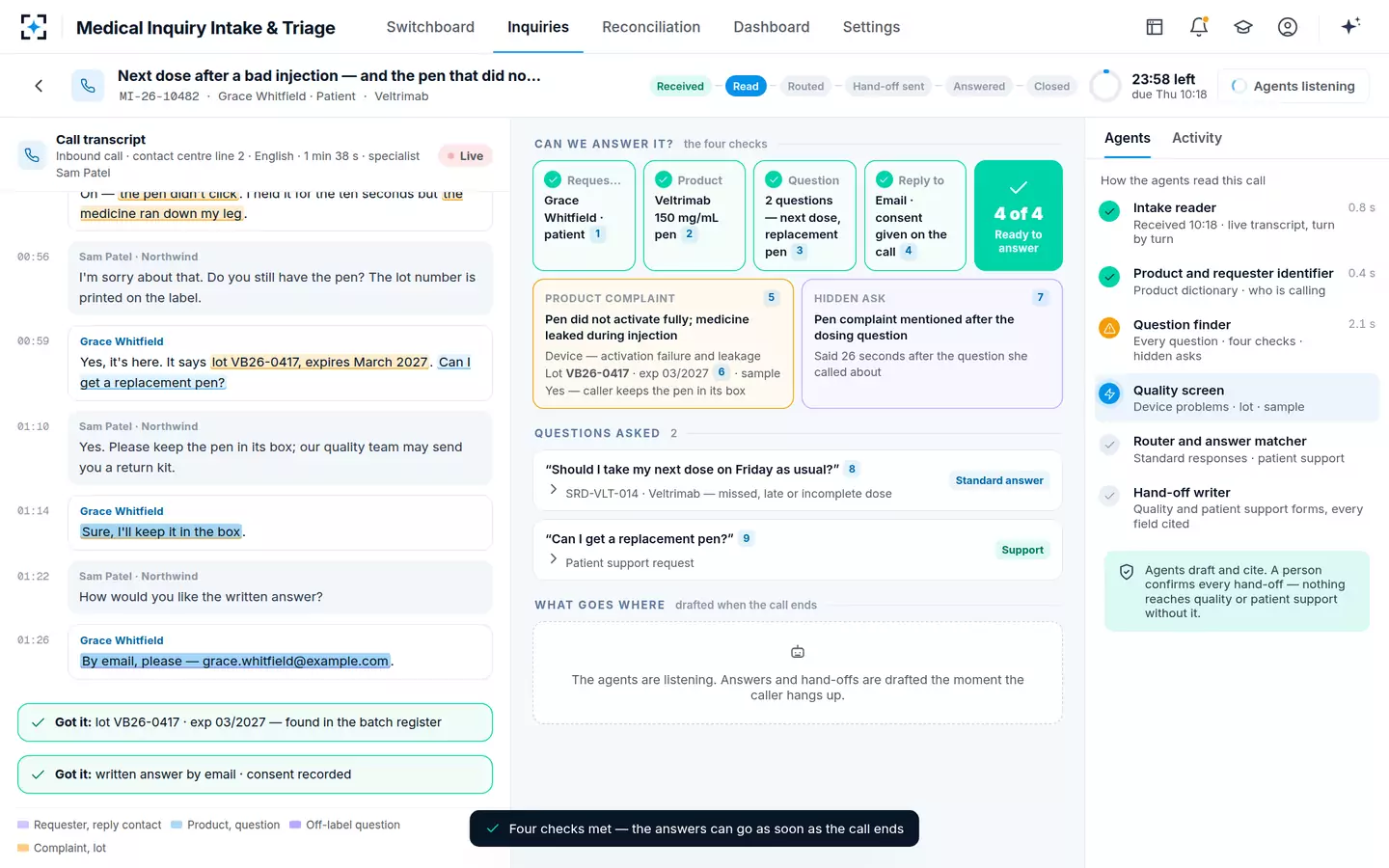
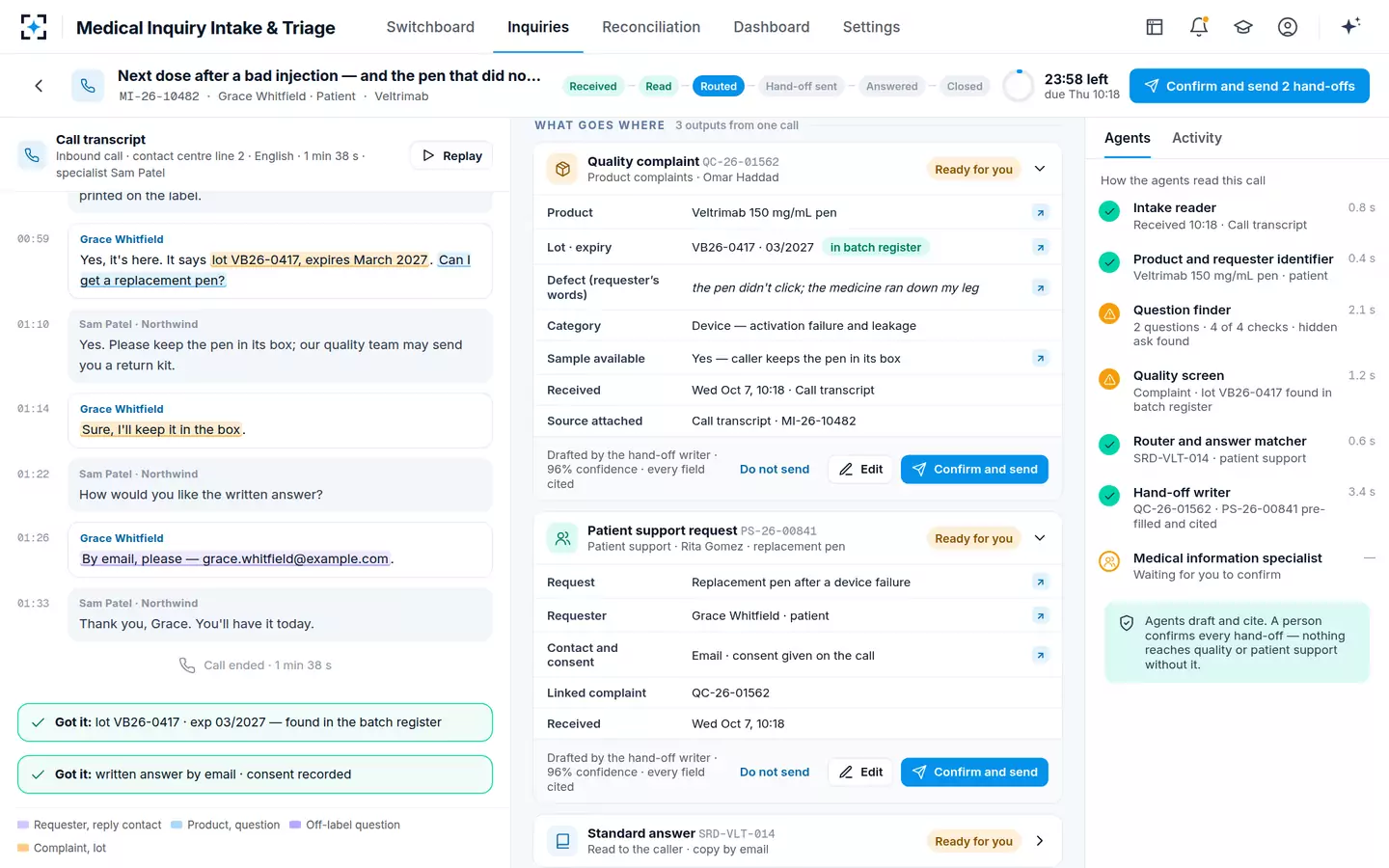
The QMSR final rule — formally the Quality Management System Regulation, published at 89 FR 7496 on 2 February 2024 and effective exactly two years later — replaced the United States device quality system regulation with ISO 13485 incorporated by reference, plus a small number of federal additions. For complaint handling the change is easy to state and easy to underestimate: the prescriptive section everyone's procedure cites, 21 CFR 820.198, is gone, and in its place are Clause 8.2.2 of the standard and a seven-item record list at § 820.35(a). The duties survived the move almost intact. What did not survive is the federal sentence that said oral complaints must be documented upon receipt — the clearest instruction the old rule ever gave to a contact centre. Medical Inquiry Intake & Triage is Botminds' agentic solution for that end of the work: it reads the call as it happens, opens the complaint in the caller's own words, captures the lot against the batch register and stamps the moment the company first had the information, so the fields the new list requires exist before anyone opens a form.
The sample desk below, its people and its lot numbers are fictional. ISO 13485 is a purchased standard and is not quoted here; where this page describes Clause 8.2.2, it describes what the Federal Register says the clause covers.
The rule, the record, and what inspections were finding before it landed
2 Feb 2026
the day the quality management system regulation replaced the old quality system regulation
89 FR 7496, published 2 February 2024
3of 7
fields in the new complaint record that only the person taking the call can capture
+20
more observations on the complaint-procedure citation in fiscal 2025 than in fiscal 2024 — 211 against 191
286
observations in fiscal 2025 across every limb of the old complaint-files section
from 791 device Form 483s issued that year
What is the QMSR final rule, and when did it take effect?
It is the rule that harmonised the US device quality requirements with the international standard. FDA incorporated ISO 13485 by reference into 21 CFR part 820, kept a handful of federal requirements that the standard does not carry, and set a two-year transition: "This rule is effective February 2, 2026." The regulation's own name changed with it — part 820 is now the quality management system regulation, and the old quality system regulation is the thing it replaced.
A second document matters for anyone updating a procedure. On 4 December 2025 FDA published technical amendments, also effective 2 February 2026, which tidied the cross-references left behind in other parts of the chapter. Among them: the class I classification regulations that exempted devices from most of the old rules "except" §§ 820.180 and 820.198 were updated, the amendment "updates the references to the non-exempted activities for these devices from §§ 820.180 (Records—General requirements) and 820.198 (Records—Complaint files) in the QSR to the equivalent requirement in the QMSR", which is § 820.35, Control of Records (90 FR, 4 December 2025). If a procedure quotes an exemption, that quote has moved too.
Twenty-four months from publication to the day it applied
- Transition period22 months
- Amended2 mths
What happened to 21 CFR 820.198?
It was removed, and its duties were redistributed. The old section was unusually prescriptive for a quality regulation: it required a formally designated unit, and required the procedures to ensure that "all complaints are processed in a uniform and timely manner", that "oral complaints are documented upon receipt", and that complaints are evaluated for reportability under part 803 (21 CFR 820.198, 2024 edition). It then set out the review-and-evaluate duty, the no-investigation record, the specification-failure investigation with its similar-complaint exception, the separate handling of reportable events, and an eight-item record of investigation.
Almost all of that still has to happen. The investigation duty and the similar-complaint exception are written into § 820.35(a) in close to the old words. The reportability screen lives in part 803. Uniform, timely handling is in Clause 8.2.2 of the standard. The no-investigation record survives through both the clause and FDA's own reading of it. What changed is the shape: a reader can no longer find the whole of complaint handling in one federal section, and a procedure that was written by transcribing that section has lost its spine.
One duty really did leave the federal text. Nothing in part 820 now says that oral complaints must be documented upon receipt. For a combination product the drug rule still covers it — "all written and oral complaints" has long been in 21 CFR 211.198(a) — but a device-only manufacturer that deleted its contact-centre clause along with the section number has removed the only sentence that ever told the phone what to do.
What complaint fields does the QMSR require? The seven § 820.35(a) names
In addition to Clause 8.2.2 in ISO 13485, Complaint Handling, the manufacturer shall maintain records of the review, evaluation, and investigation for any complaints involving the possible failure of a device, labeling, or packaging to meet any of its specifications.
21 CFR 820.35(a), as made by the QMSR final rule
The seven fields follow that sentence, and the sentence that introduces them is as important as the list: they must be recorded "for complaints that must be reported to FDA under part 803 of this chapter, complaints that a manufacturer determines must be investigated, and complaints that the manufacturer investigated regardless of those requirements". So the list does not apply to every complaint — it applies to the ones that matter most, and a desk cannot know in advance which of today's calls those will be. The practical answer is to capture the seven on everything, because the three hardest of them cannot be retrieved later.
The seven fields, who can produce each, and the moment it has to be captured
| The § 820.35(a) field | Who produces it | The moment it has to exist |
|---|---|---|
| (1) The name of the device | The caller, through the product dictionary — nicknames and misspellings included. | In the call, or recoverable afterwards from the inquiry. |
| (2) The date the complaint was received | Whoever first received it: the contact centre, the mailbox, the web form, the field. | At receipt. It cannot be reconstructed, and it is day zero for the thirty-day reporting clock. |
| (3) UDI or UPC and other device identification | The carton, the label or the device in the caller’s hand. | In the call. Once the packaging is in the bin, it is gone. |
| (4) The name, address and phone number of the complainant | The caller, if someone asks. | In the call. A complaint with no route back also has no follow-up questions answered. |
| (5) The nature and details of the complaint | The caller’s own sentence, kept as spoken. | In the call. A category code chosen afterwards is not the details. |
| (6) Any correction or corrective action taken | Quality, after the investigation. | Later — and then written back into the complaint record, not only into the corrective-action system. |
| (7) Any reply to the complainant | The medical information desk, when the answer goes out. | Later, linked to the complaint it answers. |
Three of the seven can only be captured at intake
The received date, the complainant's contact details and the nature and details of the complaint are facts about a conversation, not facts about a product, and that is why a rule written for manufacturing landed on a contact centre. A device name can be looked up. A corrective action is decided later by people who keep their own records. But nobody can go back and discover what time the company first heard something, or what the caller actually said before it became a category.
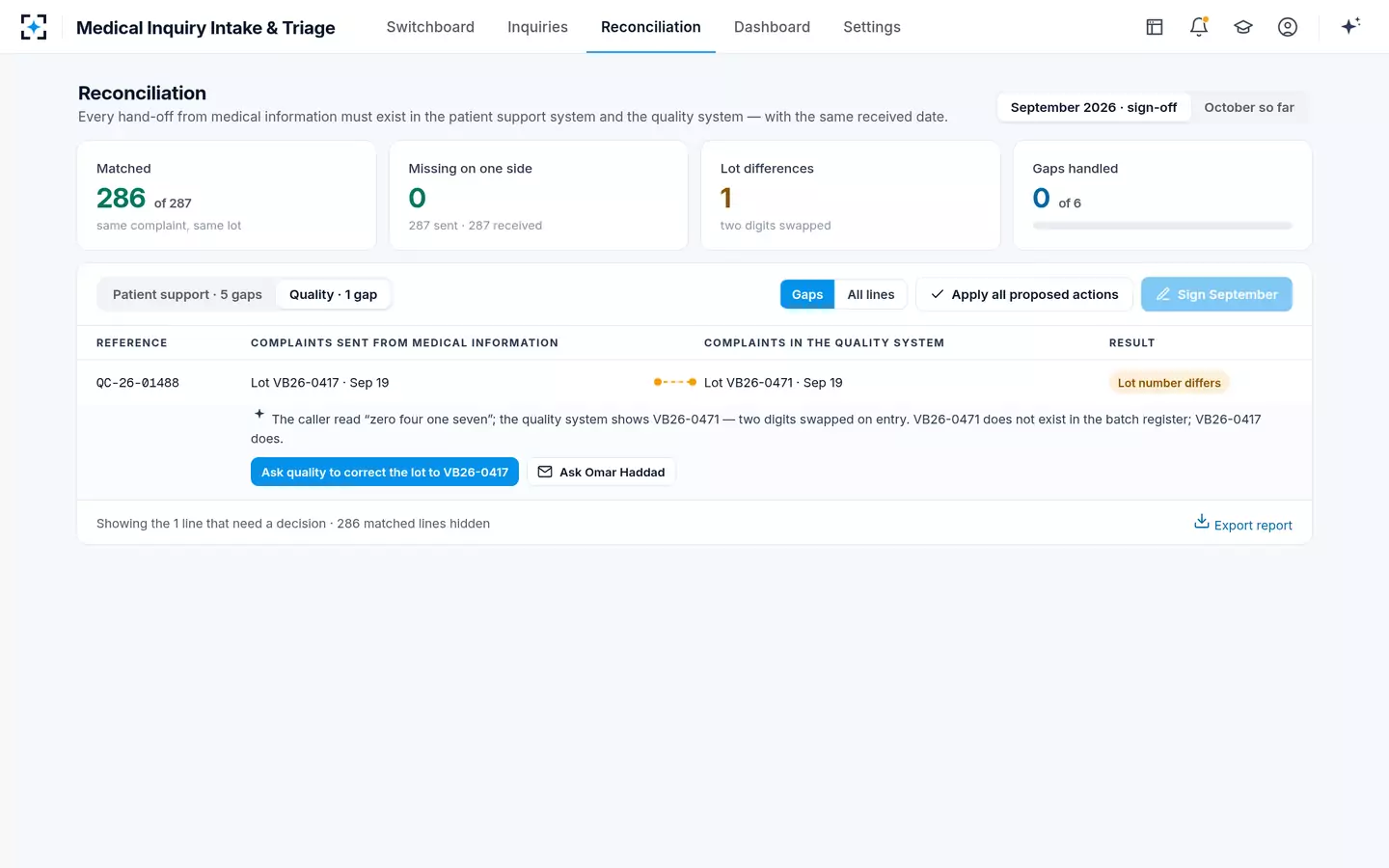
The received date is the one with teeth beyond the complaint file, because the device reporting rules measure from it: a manufacturer counts as aware of an event from the moment any of its employees knows of it (21 CFR 803.3). Booked as the day the complaint form was opened, it silently shortens a thirty-day window — and in a monthly reconciliation it shows up as the only visible symptom, a date that differs between two systems. The arithmetic of those windows is worked through in the field alert reporting requirements.
The complaint written while the caller still has the pen
Clause 8.2.2, and what the Federal Register says it covers
ISO 13485 is a purchased standard, so its text is not reproduced here. What can be said is what FDA says about it. The agency describes Clauses 8.2.2, 8.5.2 and 8.3.1 of the standard as addressing "investigations of complaints, sharing relevant information between the organization and any external party involved in the complaints, determining the need to investigate nonconformities and any need to notify an external party responsible for a nonconformity, and evaluating any need for actions to ensure that nonconformities do not recur". Elsewhere the preamble puts it more briefly: "complaint handling shall be conducted in accordance with the requirements set forth at 8.2.2".
Two consequences for a procedure. First, the clause has to be bought and read — a complaint SOP cannot be written to a standard the author has only seen summarised. Second, the federal additions at § 820.35(a) are additions: they sit on top of the clause rather than replacing it, and the phrase that introduces them, "in addition to Clause 8.2.2", is doing real work.
Do you have to investigate every complaint under the QMSR?
No, and the rule says so in the same breath as it says when you do. Complaints involving the possible failure of a device, its labelling or its packaging to meet specifications are to be reviewed, evaluated and investigated — with one express exception: "If an investigation has already been performed for a similar complaint, another investigation is not necessary, and the manufacturer shall maintain records documenting justification for not performing such investigation."
FDA also explained why the final text reads as it does, which is useful when defending a procedure: "To provide additional clarity regarding complaint handling, we have revised § 820.35(a) to describe the circumstances under which an investigation of a complaint must be initiated and records related to that complaint must be retained." The change between proposal and final rule was towards being more explicit about when an investigation is owed, not less.
What the exception needs from a procedure is a definition of "similar" that was written before it had to be used. Same failure mode, same device family, same lot or production window — whatever the definition is, it has to be one an inspector can apply to the file in front of them without the author in the room.
Writing down why you did not investigate
The old section required a record with "the reason no investigation was made and the name of the individual responsible for the decision not to investigate". The new arrangement keeps the duty and FDA states it plainly: "Clause 8.2.2 and § 820.35(a) require that if any complaint is not investigated, the firm shall document the reason it has not investigated that complaint."
The preamble then covers the case most forms have no field for — the complaint that could not be investigated because the facts never arrived: "if the information required for an investigation cannot be obtained, then the manufacturer must document the efforts it made to ascertain the information." Those efforts are made at the channel. Asking for the lot while the caller is holding the pen, asking whether the unit can be returned, asking for an address to reply to: on the sample desk, a missing reply contact is shown to the intake lead as a named gap with two options, ask the clinic through the directory or close the inquiry with a recorded reason. Either way there is something to point at.
The old section against the new arrangement, line by line
21 CFR 820.198, until Feb 2026: A procedure for receiving, reviewing and evaluating complaints, run by a formally designated unit.
§ 820.35(a) with Clause 8.2.2: No federal designated-unit wording. FDA expects the procedure to name the one group or unit that coordinates all complaint handling.
21 CFR 820.198, until Feb 2026: "Oral complaints are documented upon receipt" — a federal sentence in its own right.
§ 820.35(a) with Clause 8.2.2: Not in the federal text any more. For a combination product the drug rule still names written and oral complaints together.
21 CFR 820.198, until Feb 2026: "All complaints are processed in a uniform and timely manner."
§ 820.35(a) with Clause 8.2.2: Carried by Clause 8.2.2 of the standard, which FDA describes as addressing investigations of complaints and the sharing of relevant information.
21 CFR 820.198, until Feb 2026: Procedures must ensure complaints are evaluated for reportability under part 803.
§ 820.35(a) with Clause 8.2.2: Part 803 still requires it, and the reporting records may sit inside the complaint file if they are prominently identified as such.
21 CFR 820.198, until Feb 2026: Possible failure to meet specifications is reviewed, evaluated and investigated, unless a similar complaint already was.
§ 820.35(a) with Clause 8.2.2: The same duty and the same exception, now with an express requirement to keep the justification.
21 CFR 820.198, until Feb 2026: A record with the reason no investigation was made and the name of the individual responsible.
§ 820.35(a) with Clause 8.2.2: The firm must document the reason, and the efforts made where information could not be obtained.
21 CFR 820.198, until Feb 2026: Eight items in the record of investigation, including the dates and results of that investigation.
§ 820.35(a) with Clause 8.2.2: Seven items at § 820.35(a), for complaints that are reportable, that must be investigated, or that were investigated anyway. Three of them come from the call.
What an inspection now asks for, and what it still asks for
The inspection data most procedures quote describes the old world, and it is worth being precise about that. FDA's observation file for fiscal 2025 covers inspections ending between 1 October 2024 and 30 September 2025 — months before the QMSR applied. In it, the citation "Lack of or inadequate complaint procedures" under 21 CFR 820.198(a) was written 211 times, up from 191 the year before, and every limb of the old complaint-files section together accounted for 286 observations against 791 device Form 483s issued. Those are observations under a regulation that no longer exists, and the figures tell you what investigators looked for, not what they will cite next year.
What they looked for is the useful part, because the duties moved rather than lapsed. The most-cited limb by a wide margin was the procedure itself, not the records: the observation records that the firm had not adequately set up procedures for a formally designated unit to receive, review and evaluate complaints. The equivalent question under the new arrangement is whether the procedure implements Clause 8.2.2 and the § 820.35(a) additions, and whether it names the unit that coordinates. A company whose answer to the old question was weak has not been helped by the renumbering.
Every field carrying the passage it came from
Updating a procedure that cites a dead section number
A find-and-replace will not do it, because the old section's clauses did not all land in the same place. The work is to take each sentence of the old procedure, find where its duty now lives — the standard's clause, the federal record list, part 803, or the drug rule for a combination product — and decide which seat performs it. The list below is the order that produces the fewest second passes.
Ten changes to make in a complaint procedure written to the old section
- Replace the citation, not just the number
Every reference to 21 CFR 820.198 becomes a reference to Clause 8.2.2 of ISO 13485 together with § 820.35(a) — and the two have to be named together, because the federal list is expressed as an addition to the clause.
- Keep the oral-complaint clause even though the rule dropped it
The sentence requiring oral complaints to be documented upon receipt is no longer federal device text. Deleting it removes the only instruction the procedure ever gave the telephone.
- Name the coordinating unit
FDA expects the procedure to say which one group or unit is ultimately responsible for coordinating all complaint handling, and warns that a system allowing multiple interpretations would be unacceptable.
- Rewrite the record section from seven fields, not eight
The old eight-item list described a record of investigation. The new seven-item list describes a complaint record, and the trigger for it is different: reportable, determined to need investigation, or investigated anyway.
- Say where the received date comes from
Not the day a form was opened. Define it as first receipt by anyone working for the company, weekends included, and say so in words rather than in a system field name.
- Define “similar complaint”
The exception that lets an earlier investigation stand in is only usable if the test was written before it was needed, and the justification has to be kept.
- Give the no-investigation decision a form field and a name
The reason, the person, and — where the facts could not be obtained — the efforts made to get them.
- Check the exemptions you quote
The December 2025 technical amendments moved the class I cross-references from §§ 820.180 and 820.198 to § 820.35. A procedure quoting the old exemption text is quoting something that no longer reads that way.
- Decide where reporting records live
They may sit inside the complaint file provided they are prominently identified as reportable events. Say which arrangement you have chosen, and make the identification visible in the system, not only in the procedure.
- Read the combination-product column
For a pen or an autoinjector, part 4 names complaint handling among the device provisions a drug-based operating system must add, and the drug rule’s own complaint section continues to apply in full.
Proving the two systems agree, a month at a time
Read the old section once more before filing it, as a checklist of duties rather than as a citation. Everything in it still has to happen; what changed is who to cite and, for the three fields that leave with the caller, how much earlier the work has to be done. For the definition those fields describe, read what a product quality complaint is, and for the document that has to carry all of it, read the complaint handling procedure. To see the fields captured in a call, start from Medical Inquiry Intake & Triage.
Questions people ask
What is the difference between the QMSR and ISO 13485?
The QMSR is ISO 13485 incorporated by reference into US federal regulation, plus the federal requirements FDA kept. For complaint handling that means the clause of the standard applies as written, and § 820.35(a) adds a record list, an investigation duty with its similar-complaint exception, and the requirement to keep the justification when an earlier investigation is relied on. Conformity with the standard alone does not discharge the additions.
Does the QMSR change anything for a drug complaint?
Not directly — 21 CFR 211.198 is untouched and still requires written procedures for all written and oral complaints, a quality control unit review, and the record of why an investigation was not conducted. It matters for combination products, where part 4 names complaint handling among the device provisions a drug-based operating system must add, so a pen complaint answers to both texts at once.
What complaint fields does the QMSR require?
Seven: the name of the device; the date the complaint was received; any unique device identifier or universal product code and other device identification; the name, address and phone number of the complainant; the nature and details of the complaint; any correction or corrective action taken; and any reply to the complainant. They are required for complaints that must be reported under part 803, complaints the manufacturer determines must be investigated, and complaints investigated anyway.
Do complaint records still have to be kept separately from reporting records?
They have to be distinguishable rather than separate. FDA's December 2025 amendments confirm that reporting files may be maintained as part of the complaint file provided those records are prominently identified as reportable events, and that an explanation must be kept where required information could not be submitted or obtained, along with the evaluation of each event.
Our SOP cites 820.198 throughout. How bad is that?
Bad as a citation, not necessarily as a procedure. The duties largely survived, so a procedure built on the old section usually describes compliant work under a dead number — but three things need real attention: the record section, which was written around an eight-item investigation record rather than a seven-item complaint record; the oral-complaint sentence, which has no federal device equivalent any more; and any exemption language, whose cross-references moved in December 2025.
Did FDA make complaint handling stricter or looser?
Neither, on the face of the text. FDA said it revised § 820.35(a) to give additional clarity about when an investigation must be initiated and which records must be retained, and the investigation duty, the similar-complaint exception and the document-the-reason rule all came across. The real change is organisational: the duties are now spread across a purchased standard, a federal list and part 803, so a procedure has to assemble them rather than copy them.