The field alert reporting requirements are short enough to quote in full and easy to under-read. An NDA or ANDA applicant must submit information of specified kinds about distributed drug products "to the FDA district office that is responsible for the facility involved within 3 working days of receipt by the applicant", and the kinds are a product or its labelling being mistaken for another article, and any bacteriological contamination or significant chemical, physical or other change or deterioration in a distributed product — including any failure of distributed batches to meet their specification (21 CFR 314.81(b)(1)). The phrase that does the damage is "of receipt by the applicant", because receipt happens at a channel — a phone line, a mailbox, a web form — and not in quality. Medical Inquiry Intake & Triage is Botminds' agentic solution for that channel: it stamps every inquiry with the moment the company first had it, opens the complaint in the call, and drafts the hand-off to quality with every field citing the words it came from, so the window that quality inherits is as close to a full one as it can be.
The sample desk, its people, its products and its lots are fictional, and the hours below are estimates and design targets, labelled as such. The regulations and FDA's own guidance are linked where they appear.
The window, and what the first hours of it usually cost
Day 0
is the day the information is identified — day 1 is the first working day after it
FDA field alert Q&A, July 2021
3working days
to evaluate the complaint and submit a field alert report if it qualifies
21 CFR 314.81(b)(1)
4.75hours
estimated by hand, from receipt to a hand-off sent, for one call that holds a question and a complaint
our estimate, not a measurement
11min
median from receipt to the hand-off sent, with the agents doing the mechanical part
the design target for the solution
What are the field alert reporting requirements?
A field alert report is the fast lane between a company and the FDA district office responsible for the facility that made the product. It exists for information that cannot wait for a periodic report, and it has four features worth holding in mind. It is owed by the application holder, not by whoever found the problem. It is owed within three working days of receipt. It may go by telephone or other rapid means with prompt written follow-up. And it is owed on information — not on a conclusion, and not on a completed investigation.
The two limbs are narrower than "anything bad". The first covers "any incident that causes the drug product or its labeling to be mistaken for, or applied to, another article" — mix-ups, mislabelling, a carton that contradicts its blister. The second covers "any bacteriological contamination, or any significant chemical, physical, or other change or deterioration in the distributed drug product, or any failure of one or more distributed batches of the drug product to meet the specification established for it in the application". Particles, discolouration, a dissolution failure found on stability, a sterility failure at a contract laboratory.
Responsibility does not move with the work, either. FDA's guidance is explicit that a contractual arrangement for manufacturing, holding, packaging, labelling or distribution leaves the applicant owing the report, and advises that the agreement "should establish a procedure that those entities follow for notifying you of reportable information in a timely manner". The same logic applies inside a company to an outsourced contact centre.
Day zero: when the clock actually starts
The applicant shall submit information of the following kinds about distributed drug products and articles to the FDA district office that is responsible for the facility involved within 3 working days of receipt by the applicant.
21 CFR 314.81(b)(1) — the sentence an intake target has to be read backwards from
FDA's guidance removes any doubt about where the information has to be for the clock to run: "This time frame applies regardless of where the information meeting the criteria requiring a FAR is identified. For example, the day a contract lab learns of a sterility failure is day 0, and you must submit the FAR by close of business on day 3." A contract laboratory is further from the applicant's quality unit than its own contact centre, and it is still day zero.
That has a consequence hand-off service levels rarely state out loud. A complaint that sits in a queue over a weekend has not used the contact centre's time; it has used the applicant's statutory window. The same is true of the device side, where the rules treat a manufacturer as aware of a reportable event as soon as any one of its employees is. Any employee. The specialist on the headset is an employee, and so is the person reading the medical information mailbox on a Saturday.
How working days are counted for a field alert report, with a Friday example
Working days are counted the way a payroll clerk would count them, and FDA says so: "We consider working days to be any day from Monday through Friday, excluding U.S. Federal holidays. For example, if information meeting the criteria requiring a FAR is identified on Friday (day 0), then day 1 begins on the first working day after the information is identified (Monday), and you must submit the FAR by close of business on Wednesday (day 3)." Two things follow. Three working days can span five calendar days, or six across a federal holiday. And the generosity of the weekend is paid for in advance, because nothing moves during it.
A Friday complaint, counted twice: by the rule, and by a late received date
- Fri · day 0day 0
- Sat–Sunweekend
- Mon · day 1day 1
- Tue · day 2day 2
- Wed · day 3due
- UnrecordedFri–Sun
- Mon · “day 0”day 0
- Tue · “day 1”day 1
- Wed · “day 2”day 2
- Thu · filedlate
The lower lane is the failure mode worth designing against, because it is invisible from inside. Every internal service level is met, the dashboard is green, and the only artefact of the error is a date field that differs by three days from the one in another system. That is precisely what a monthly reconciliation between the two systems is for, and why the gap it reports is worth more than the count of matches above it.
Does a consumer complaint trigger a field alert report?
Not by itself — but it starts the clock in which that question has to be answered, which is the part procedures often get wrong. FDA's guidance puts both halves in one answer: "No, not every consumer or other customer complaint warrants submission of a FAR. Such complaints should be evaluated within 3 working days to determine if the information provided in the complaint meets the criteria outlined in § 314.81(b)(1)." The evaluation is inside the window, not before it.
Read that against the way a complaint actually arrives and the arithmetic is uncomfortable. The three working days have to cover the contact centre noticing and passing the complaint on, quality receiving and evaluating it, a judgement about whether the criteria are met, and the submission itself with whatever district-office contact that involves. A company that gives the contact centre one business day of that window has given away a third of it before quality has read a word.
Where the hours go by hand, between the call and the hand-off being sent
The queue bar is the one to argue with first, because it is the only one that is pure waiting. Everything below it is work somebody has to do; the two hours at the top are the complaint existing, somewhere, unread. A desk that cannot shorten that bar is spending its statutory window on nothing at all.
One business day of the window, before and after
By hand: getting one call’s complaint into the forms
- Spent before the hand-off is sent · 59%
- What is left of the day · 41%
With the agents doing the mechanical part
- Receipt to a confirmed hand-off · 2%
- What is left of the day · 98%
What “become aware” means in medical device reporting, and the thirty-day clock
A pen complaint runs a second clock with a different shape. A manufacturer must report within 30 calendar days of the day it receives, or otherwise becomes aware of, information from any source that reasonably suggests one of its marketed devices may have caused or contributed to a death or serious injury, or has malfunctioned in a way likely to do so if it recurred (21 CFR 803.50). Calendar days, not working days, so weekends and holidays are inside the window rather than outside it.
"Become aware" is defined, and the definition is the reason a contact centre matters to a reporting function: a manufacturer counts as aware from the moment any one of its employees learns of a reportable event. There is no clause making the clock wait for a designated unit. The thirty days begin at the headset.
There is also a five-work-day report that many medical information teams never meet and should know exists. It is owed "no later than 5 work days after the day that you become aware" that a reportable event necessitates remedial action to prevent an unreasonable risk of substantial harm to the public health, or that FDA has made a written request for one (21 CFR 803.53). When that clock is running, a day held at intake is a fifth of the whole window.
What a combination product adds: a third clock and another company
A prefilled pen, an autoinjector or an on-body infusor is a combination product, and part 4 names the reports its applicant owes: five-day reports, malfunction reports, correction or removal reports on the device side; field alert reports and fifteen-day reports on the drug side (21 CFR 4.102). One call about one pen can be inside three different windows at once.
Where the constituent parts belong to different applicants, there is also a duty to another company: information about a death or serious injury, or an adverse experience, must go "to the other constituent part applicant(s) for the combination product no later than 5 calendar days of your receipt of the information", and the record of that exchange must include "the date the information was received by you" (21 CFR 4.103). A received date booked three days late is therefore not only an internal inaccuracy; it is a wrong number sent to a partner who is counting their own five days from it.
Each report, what starts it, how long, and where day zero is
| The report | What starts it | How long | Day zero |
|---|---|---|---|
| Field alert report | A mix-up or mislabelling, bacteriological contamination, or a significant change, deterioration or specification failure in a distributed batch. | 3 working days | Receipt by the applicant. Working days are Monday to Friday, excluding federal holidays (21 CFR 314.81(b)(1)). |
| Device malfunction report | A marketed device that may have caused or contributed to a death or serious injury, or that malfunctioned in a way likely to do so if it recurred. | 30 calendar days | The day any employee becomes aware of the event (21 CFR 803.50, 803.3(b)). |
| Five-day report | A reportable event that needs remedial action to prevent an unreasonable risk of substantial harm, or a written request from FDA. | 5 work days | The day you become aware (21 CFR 803.53). |
| Information to the other applicant | A death or serious injury, or an adverse experience, associated with a combination product whose parts have different applicants. | 5 calendar days | Your receipt of the information, which must itself be recorded (21 CFR 4.103). |
| Serious and unexpected adverse drug experience | An adverse drug experience that is both serious and unexpected — the safety team’s assessment, not the desk’s. | 15 calendar days | Initial receipt of the information by the applicant (21 CFR 314.80(c)(1)(i)). |
The received date, and the three places it can be wrong
A received date goes wrong in three recognisable ways, and only one of them looks like a mistake at the time. The first is the opened-form date: the complaint is stamped when somebody opened a record for it, which can be a working day or a weekend later than the call. The second is the forwarded date: an email reaches a shared mailbox on Friday evening, is forwarded into quality on Monday, and the forwarding time becomes the receipt. The third is the field one: a representative is told something at a Thursday clinic visit and files the note the following week, although the company received the information — through its own employee — on the Thursday.
All three produce the same artefact: two systems holding two dates for one event. On the sample desk the monthly reconciliation is built to surface exactly that. In its September run, 544 of 548 patient support hand-offs matched their request with the same received date. Among the gaps, one hand-off had gone to a backup mailbox that bounced, one request had no hand-off record until the agents found the inquiry behind it, and one had arrived on a Friday evening but was recorded by the receiving team on the Monday — three different shapes of the same error.
Every inquiry with the clock it started, the moment it arrived
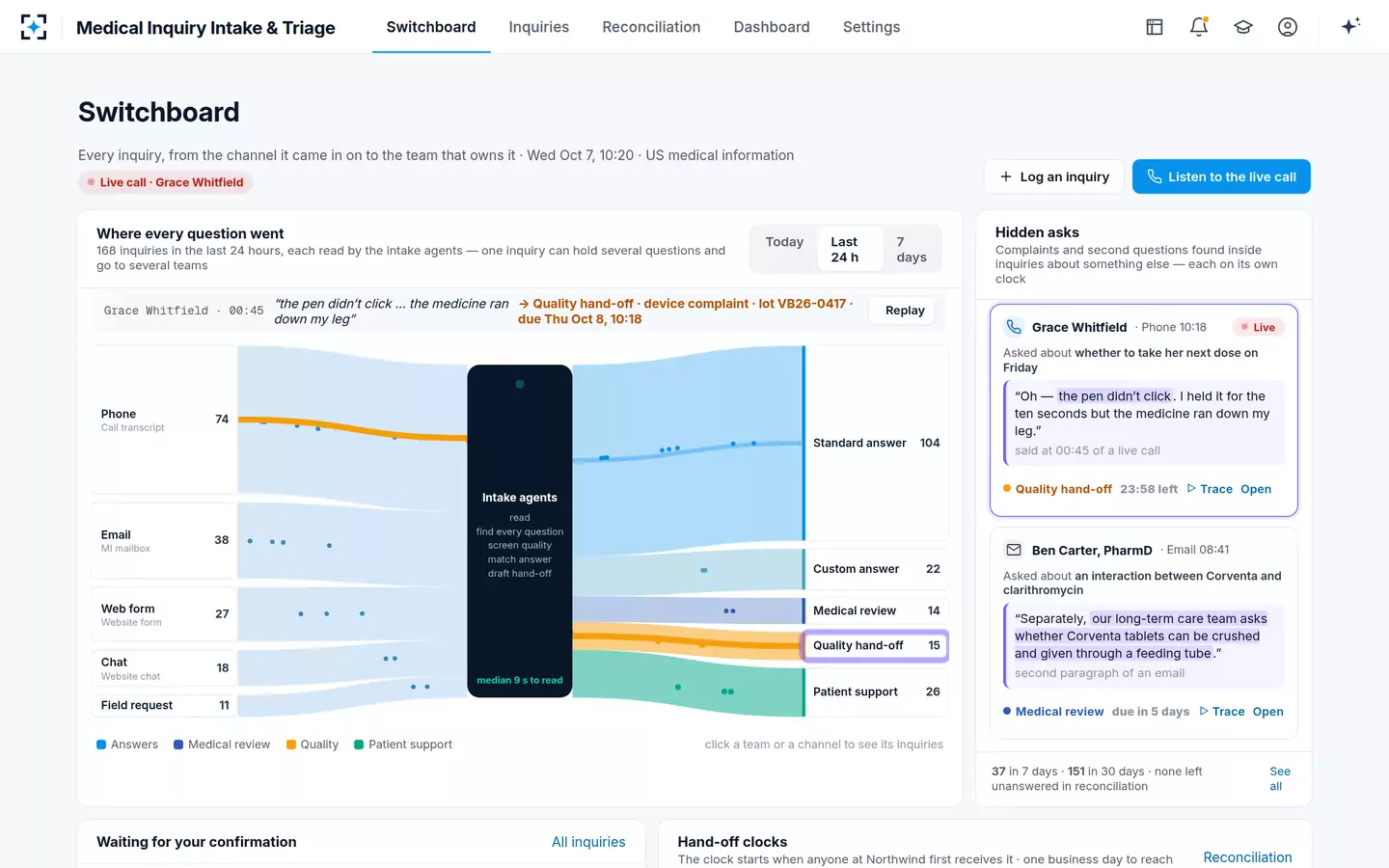
What happens if you miss a field alert report: the Form 483 line
FDA sets out the consequence plainly. Failing to submit a required report inside the window puts a company "at a minimum" in violation of § 314.81(b)(1) and of section 505(k) of the Federal Food, Drug, and Cosmetic Act, and violating section 505(k) is a prohibited act. The obligation does not lapse: "You must still submit a required FAR even if you fail to do so within the time frame of the regulation."
Then the sentence that gets quoted in quality meetings: "We may include any failure to submit a FAR as an observation on Form FDA 483, Inspectional Observations." The guidance adds that a finding of failure to submit may lead to regulatory action whether or not it was written on a 483 at the time. A late report is not a private matter settled inside the quality system.
The hand-off drafted while the window is still whole
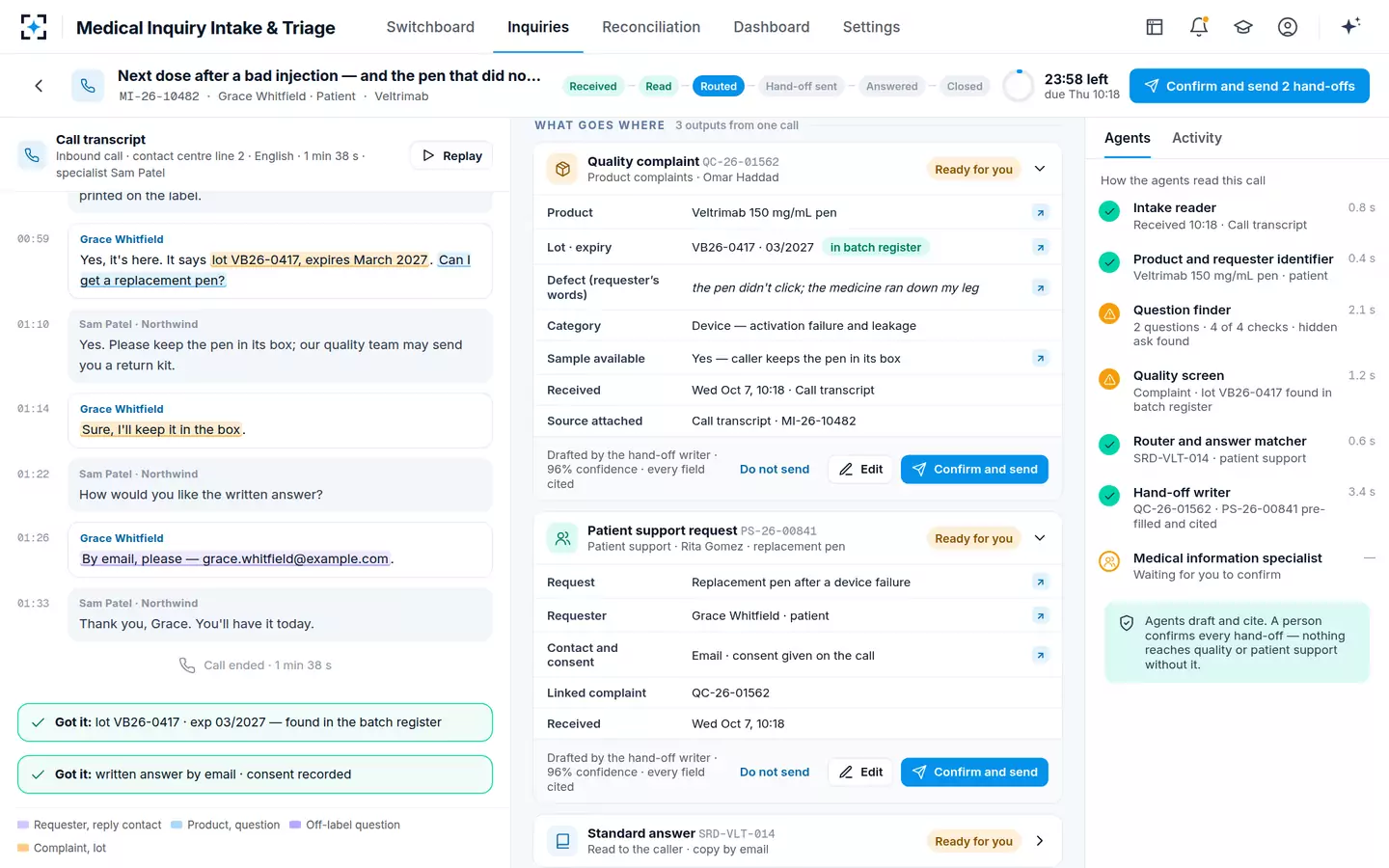
Reading the two clocks backwards into one intake target
A hand-off target is usually set by negotiation between two internal teams. It is better derived, and the derivation is short. Start with the shortest window the complaint can be inside — three working days for a field alert, five work days if remedial action is in play. Subtract what quality needs to evaluate, decide and submit, which is the part of the window that cannot be compressed by anyone else. What is left is the intake budget, and on many desks it comes out well under a day.
Then test the target against the worst arrival time rather than the average one. A complaint that arrives at 17:40 on the Friday before a federal holiday has consumed none of its working days and all of its calendar comfort; a one-business-day target met on Tuesday morning has spent a third of the window on a queue. Designing for that arrival rather than for a Tuesday mid-morning call is what turns a target into a control.
The last piece is proving that the date you recorded is the date the other system holds. That is a monthly, not a daily, discipline, and it is the one that catches the error no dashboard shows. How a complaint comes to exist at all, and the fields that have to be captured in the call for quality to use the window well, are set out in what a product quality complaint is and in the complaint handling procedure.
Two systems, one event, two received dates
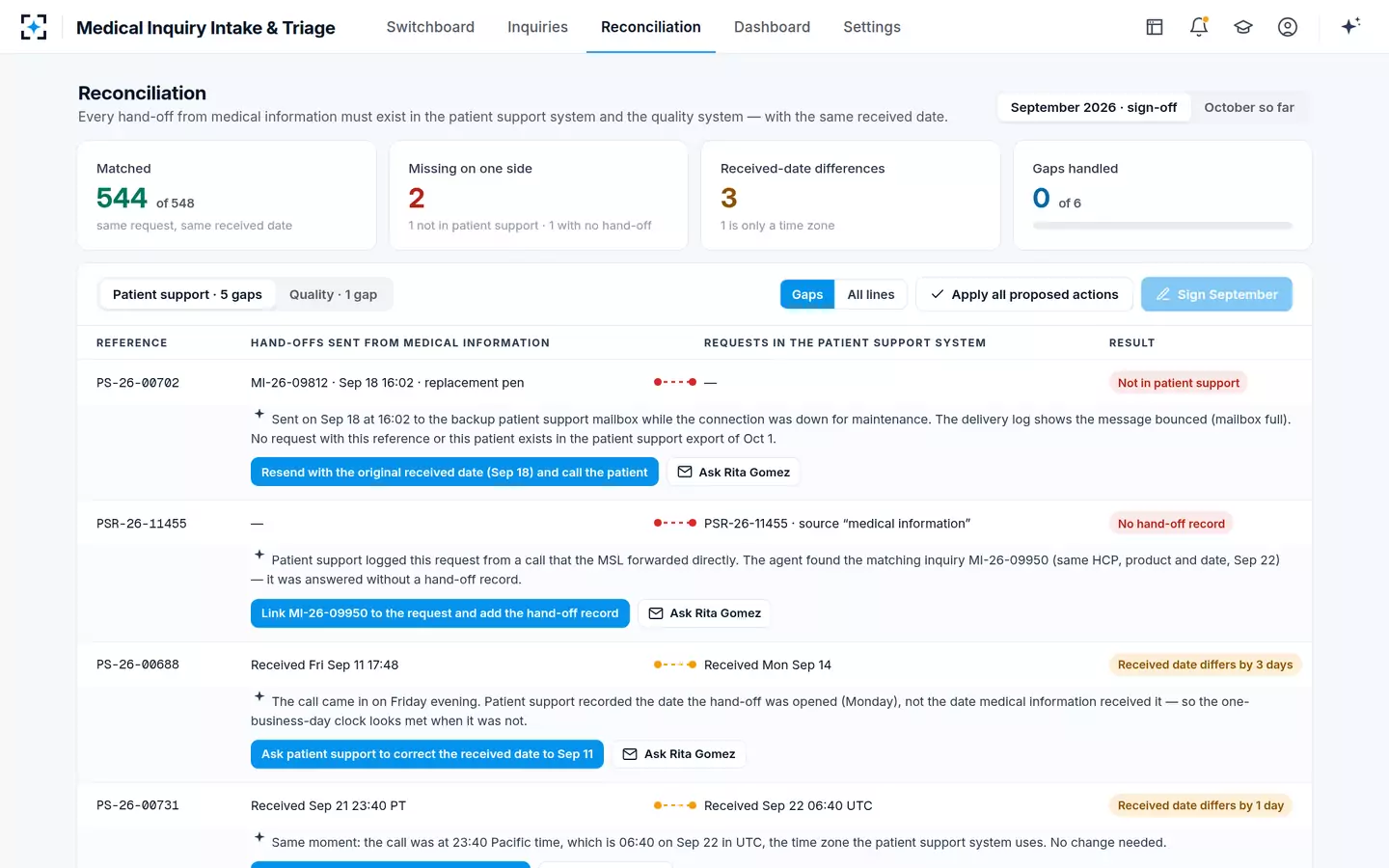
To see the clocks start at the channel rather than at a form, start from Medical Inquiry Intake & Triage, and read product complaint versus adverse event for the other window the same call can open.
Questions people ask
Do weekends count in the field alert clock?
Not as working days — FDA counts Monday to Friday excluding federal holidays — but they are not free either. The clock starts on the day the information is identified, so a Friday complaint has already used its day zero before the weekend begins, and nothing in the rule pauses the device thirty-day clock, which runs in calendar days throughout.
Who decides whether a complaint qualifies for a field alert report?
The applicant's quality unit, inside the three working days. The guidance expects every consumer or customer complaint to be evaluated within that window against the criteria in § 314.81(b)(1), so the decision is a scheduled piece of work rather than something that happens when a case is picked up. The medical information desk's part is to deliver the complaint with the lot, the words and the right received date early enough for the evaluation to be unhurried.
What is the received date on a complaint?
The date the company first had the information, not the date a record was created from it. On the device side the rules say a manufacturer becomes aware when any employee becomes aware; on a combination product with two applicants the exchange record must carry "the date the information was received by you". A received date that reflects when a form was opened will be wrong in exactly the direction that flatters the company.
Does a field alert report mean a recall?
No. A field alert report is information given early, when the picture is still incomplete, and FDA's guidance expects a preliminary determination in the initial report to be updated in a follow-up or final one. A recall is a separate action under its own rules, and FDA's guidance says a field alert is still owed if the information behind a recall meets the criteria, alongside the recall notification.
How long should a medical information team have to pass a complaint to quality?
Less than it usually gets. Derive it instead of negotiating it: take the shortest window the complaint can sit inside — three working days, or five work days where remedial action is in play — subtract the time quality needs to evaluate, decide and submit, and set the intake target from what is left. Then test it against a Friday-evening arrival rather than a Tuesday one.
What proves the received date was right?
A match between the two systems that hold it. Each month the hand-offs sent are matched against the records in the quality and patient support systems by reference, requester, product and date, and each difference is explained from the delivery log with a proposed correction. It is the only check that catches a date which is internally consistent and externally wrong.