A complaint handling procedure is the written document that says how a company receives a complaint about one of its products, who reviews it, what the record must hold, when an investigation has to be opened and what is written down when one is not. For a medicine, 21 CFR 211.198(a) demands it in its first sentence: "Written procedures describing the handling of all written and oral complaints regarding a drug product shall be established and followed" (21 CFR 211.198). For a device — a pen, an autoinjector, an inhaler — the quality management system regulation that took effect on 2 February 2026 routes the same duty through Clause 8.2.2 of ISO 13485 and a seven-field list at § 820.35(a). The hard part is not the drafting. It is that these procedures are written in quality and handed to a contact centre, and the complaint arrives at the contact centre: three of the five fields the drug rule names can only be captured while the caller is still on the line. Medical Inquiry Intake & Triage is Botminds' agentic solution for that first hour — seven agents that read every inquiry from every channel, open the complaint in the call, and draft the hand-off field by field for a person to confirm.
The screens and figures below come from a sample medical information desk running inside the solution. Northwind Bio, its products, its lots and the five people named are fictional, and the sample data is there to show the procedure working, not to report anyone's measured result. The regulations and the surveys are linked where they appear.
What the procedure is held to, and where the complaints come from
Oral
complaints sit in the drug rule’s first sentence, beside written ones
21 CFR 211.198(a)
7fields
the device rule names for the record of a complaint that must be investigated or reported
21 CFR 820.35(a)(1)–(7), effective 2 Feb 2026
211
observations in fiscal 2025 that complaint procedures were not adequately established
Form FDA 483, device inspections
63%
of medical information inquiries at surveyed companies arrived through the call centre
32 US companies, June 2022
What does a complaint handling procedure have to cover?
A complaint handling procedure has to cover eight things, and the federal text names every one of them: how complaints are received, in writing and by voice; what the written record must hold; the quality control unit's review of any complaint that alleges a product failed a specification; the determination of whether an investigation is needed; what is written down when an investigation is not conducted, including who decided that; the separate review that asks whether the same complaint is also a safety report; where the file lives; and how long it is kept. Everything else in a good procedure — categories, severity, trending, acknowledgement wording — is the company's own choice layered on those eight.
The order matters more than drafts tend to admit. Four of the eight happen before quality sees anything: receiving, capturing the record, screening for the second thing, and deciding where it goes. If the procedure describes only what quality does once a form arrives, it has described the back half of its own subject and left the front half to whatever the contact centre happens to do.
The clauses a complaint procedure must carry, and why each one is there
- Every channel named, the phone first
The drug rule covers "all written and oral complaints" in one sentence. A procedure that routes only email and post has excluded the channel most medical information inquiries arrived on in a survey of US companies.
- A definition the person answering the phone can apply
The decision is made in the call, so the test has to be short enough to hold in one hand: does the caller allege something wrong with the product itself?
- The received date, written as a rule
Say in words whose receipt counts and that weekends do not pause it, or two systems will hold two different dates for the same complaint.
- The fields to capture while the caller is still there
The drug rule names the product and its strength, the lot number, the complainant, the nature of the complaint and the reply to the complainant. Three of those five leave with the caller.
- The sample question
Whether the unit can be returned decides whether quality can examine anything. Nobody can ask it after the pen has gone in the bin.
- The quality control unit’s review
Any complaint alleging that a product may have failed a specification goes to the quality control unit — that is the rule, not a convention.
- Who determines the need for an investigation
The drug rule ties the determination to § 211.192; the device rule describes when an investigation must be initiated. Name the role, not the department.
- What is written when there is no investigation
The reason, and the name of the responsible person who decided it. On the device side the firm must also document the efforts it made to get information it could not obtain.
- The screen for the other thing
The drug rule’s own third sentence orders a review to see whether the complaint is also a serious and unexpected adverse drug experience, which belongs to the safety team, not to quality.
- One unit that coordinates it all
FDA’s QMSR preamble: a company may run several complaint handling units, but "a system that would allow multiple interpretations of handling, evaluating, categorizing, investigating, and following up, would be unacceptable."
What the two rulebooks actually demand of the procedure
Read side by side, the drug rule and the device rule ask for the same work in two different registers. The drug rule is prescriptive and short. It demands the written procedure, then adds two review duties in the same paragraph: "Such procedures shall include provisions for review by the quality control unit, of any complaint involving the possible failure of a drug product to meet any of its specifications and, for such drug products, a determination as to the need for an investigation in accordance with § 211.192." The second duty is the one procedures often under-describe, because a determination is a decision somebody has to make and sign.
The device rule since February 2026 works by reference. § 820.35(a) builds on Clause 8.2.2 of ISO 13485: on top of the clause, the manufacturer must keep records of how it reviewed, evaluated and investigated any complaint about a device, its labeling or its packaging possibly failing a specification. It then lists the seven fields that must be recorded for complaints reportable under part 803, complaints the manufacturer determines must be investigated, and complaints it investigated anyway. What changed, and what did not, is the subject of the QMSR and complaint handling.
A combination product — a prefilled pen is the everyday example — answers to both. Part 4 lists complaint handling among the device provisions a drug-based operating system must add, naming "Clause 8.2.2 and § 820.35(a)" directly. In practice that means one procedure, written once, that satisfies the stricter of the two on every clause: oral complaints from the drug rule, the seven fields from the device rule, and one received date that both sides can defend.
Who is responsible for complaint handling in a pharmaceutical company?
Three different answers are all correct, and conflating them is how procedures go wrong. The quality control unit is responsible for the review and for the determination of whether to investigate — the drug rule says so in terms. The medical information or contact-centre team is responsible for receiving, for the record of what the caller said, and for getting the complaint to quality. And one named unit must be responsible for coordinating the whole of it, which is FDA's expectation in the QMSR preamble: "Each manufacturer should establish in its procedures which one group or unit is ultimately responsible for coordinating all complaint handling functions."
In the United Kingdom the same question has a different anchor. The medicines regulator's guidance says that representatives must pass any safety information they hear from healthcare professionals straight to the scientific service the licence holder has set up under the Regulations (MHRA Blue Guide, section 6.13). The scientific service that receives that information is, on many organisation charts, the medical information desk — which is why the desk ends up holding the first minute of a complaint whether or not its procedure says so.
The staffing is not trivial, either. Across all 35 member companies of the phactMI benchmarking survey published in 2025, the average medical information function ran 25 internal full-time staff and 13 external, both figures excluding the contact centre (DeLuca et al., Therapeutic Innovation & Regulatory Science, 2025). The people who take the calls are counted separately from the people who own the procedure, in the survey and usually in the building.
The five seats one complaint passes through, and what each owes the next
A complaint handling procedure is a hand-off document. It is worth drafting it as one: five seats, and for each, the thing the next seat cannot do without.
One complaint, five seats, and what each owes the next
Today
Answers the question that was the reason for the call, then writes the notes up afterwards. "When they say ‘oh, and…’ that’s usually the real question."
With agents
Is prompted while the caller is still on the line — ask for the lot number, ask how they want the written answer — and hangs up to a drafted complaint.
Still theirs: The conversation, and the judgement about what the caller actually means
Today
"I worry about the things people mention on the way out." Checks what the queue let through, late.
With agents
Sees every request found inside an inquiry about something else, confirms the cited hand-offs and decides the borderline ones.
Still theirs: Confirming the hand-off, and signing the month
Today
"No lot number, no investigation." Lot numbers retyped from call notes arrive with digits swapped.
With agents
Receives the lot checked against the batch register, the expiry, and whether a sample can be returned.
Still theirs: The review, and the determination of whether to investigate
Today
Replacement requests arrive as retyped notes, without consent to share or a way to call back.
With agents
Receives each request with the caller’s consent, the contact details, the linked complaint and a received date that matches the call.
Still theirs: What the patient is actually offered
Today
"Balanced, sourced, and only when they asked." Sees the questions somebody remembered to escalate.
With agents
Receives questions about use outside the label in the requester’s own words, including the ones found in a second paragraph.
Still theirs: The content of a custom or off-label answer
Written this way, the procedure's weakest joint is obvious. Everything the quality seat needs — the lot, the expiry, the defect in the caller's own words, whether a sample exists — is produced by the specialist seat, in a conversation that is over in six minutes. A procedure that specifies the quality seat in detail and the specialist seat in a sentence has specified the wrong half.
Does the procedure have to cover verbal complaints?
Yes, and explicitly. The drug rule's phrase is "all written and oral complaints", and FDA's own inspection-observation wording for the citation is blunt about what it looks for: "Procedures describing the handling of written and oral complaints related to drug products are [not written or followed] [deficiently written or followed]." The bracketed alternatives are FDA's, not ours; they are the forms the observation takes. A procedure that is silent on the telephone is deficiently written, and one that covers the telephone but is not followed there is no better.
There is a practical reason the voice channel is where procedures fail. A written complaint arrives with its own evidence: the words are already fixed, the sender's address is in the header, and an attachment often carries the lot. A spoken complaint has to be captured by the person hearing it, in the order the caller chooses, inside a conversation that was about something else. The medical information literature treats that capture as a discipline in its own right — the DRESS process puts "define the question" first of five steps, and warns that "the MI scientist realizes that the query may not have been asked very concisely or clearly" (Albano et al., 2022). A complaint mentioned on the way out is the extreme case of a query not asked concisely.
Who reviews a product complaint, and when an investigation is required
The quality control unit reviews any complaint that alleges a product may have failed one of its specifications, and the same procedure must provide for a determination of whether an investigation under § 211.192 is needed. Two details are worth writing into the text. The trigger is the allegation, not its proof: a caller saying a pen did not activate is a complaint about a possible specification failure even if the pen turns out to be fine. And the determination is a named decision, which is why the rule asks for the decider's name when the answer is no.
On the device side the February 2026 text adds an exception and a duty in the same breath: where a similar complaint has already been investigated, a new investigation is not needed — but the manufacturer must keep a record of why it did not investigate again. Reusing an earlier investigation is permitted; doing it silently is not. The practical consequence for the procedure is that "similar" needs a definition — same defect, same product, same lot family — written before anyone has to lean on it.
Three clocks, one call: what the procedure sets running at the same instant
- First receipt to the hand-off sent1 business day
- First receipt to the answer sent2 business days
- First receipt to the reviewed answer5 business days
What happens when a complaint is not investigated
Nothing, procedurally, unless the reason is written down — and then the absence of an investigation becomes a defensible decision instead of a gap. The drug rule is precise about what the file must then hold: where no investigation under § 211.192 is carried out, the record must give the reason one was judged unnecessary and the name of the person responsible for that decision (21 CFR 211.198(b)(3)). Two elements, both of them easy to leave out of a form that was designed for the yes case.
The device side says the same thing through the standard. FDA's preamble reads the clause and § 820.35(a) together as requiring a written reason for every complaint that is not investigated. It then adds the case procedures forget — the complaint nobody could investigate because the information never arrived. Where the facts an investigation needs cannot be got, the manufacturer has to record what it did to try to get them.
That last sentence is an intake requirement wearing a quality uniform. The efforts to obtain information are made at the channel, by the person who still has the caller, and they are the same efforts the solution prompts for: ask for the lot number while the pen is in the caller's hand, ask whether the unit can be returned, ask for an address to reply to. On the sample desk a missing reply contact is not quietly dropped — the intake lead is shown which of the four checks is missing and chooses between asking the clinic for a contact through the directory and closing the inquiry with a recorded reason.
The three fields only intake can fill
The drug rule names five things the written record must hold "where known": the drug's name and strength, its lot, who complained, what the complaint was, and the answer sent back. Two of the five can be reconstructed afterwards from the product dictionary and the reply that was sent. Three cannot. The lot number is printed on the pen the caller is holding. The complainant's name and contact exist only if someone asked. And the nature of the complaint — in the caller's words, not a category — is gone the moment the call ends and becomes a paraphrase.
"Where known" is not an escape clause, because knowing was possible while the caller was there. The three fields are where the sample desk's reconciliation finds its gaps: a lot read aloud as "zero four one seven" entered as VB26-0471, a lot that does not exist in the batch register when VB26-0417 does. The complaint was real, the investigation was willing, and the identifier pointed at nothing.
Every inquiry from its channel to the seat that owns it
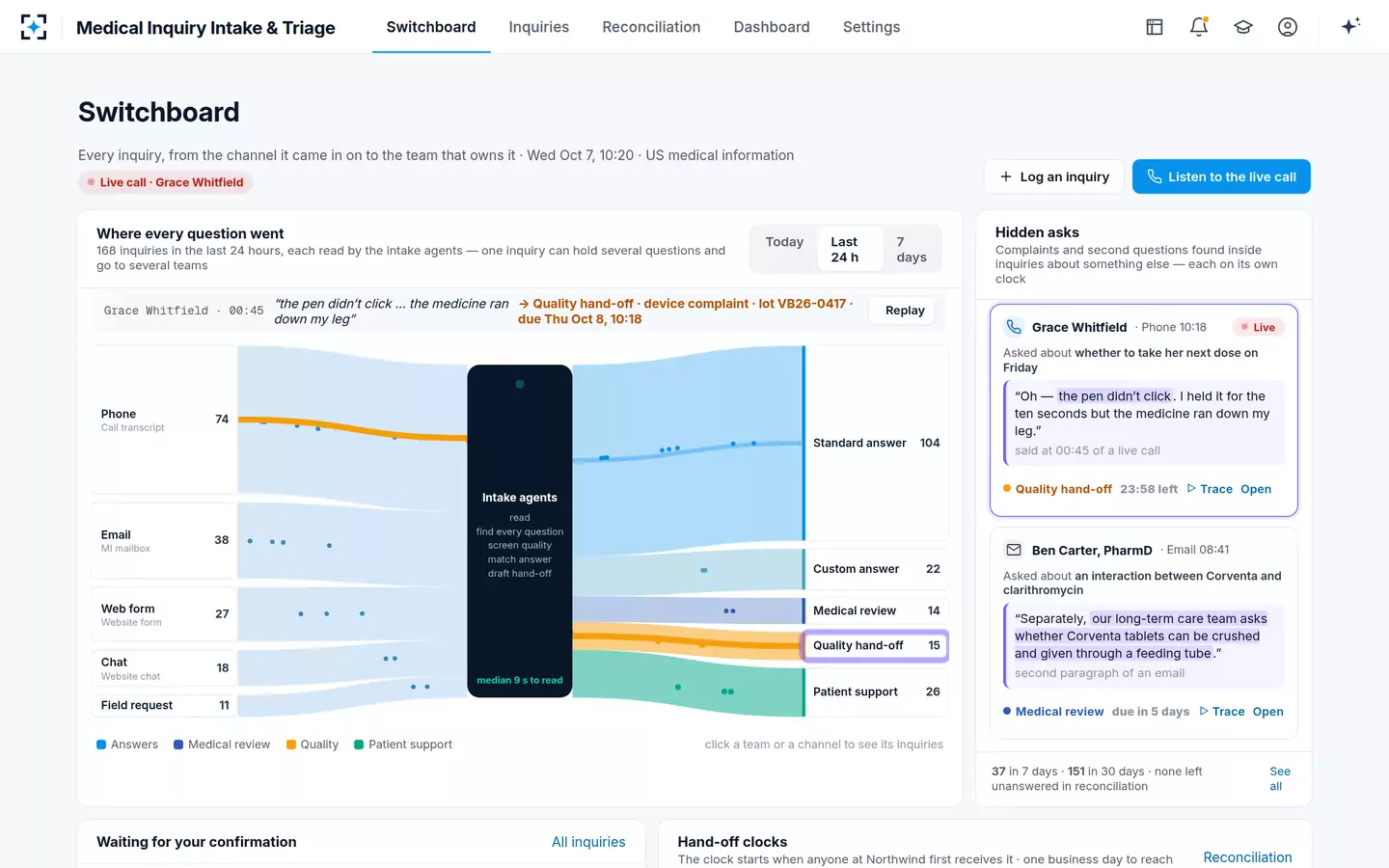
Where agents change the procedure, and what stays a person's decision
The procedure does not change shape when agents are added to it; the same eight duties are owed to the same regulator. What changes is which steps are mechanical. Reading every sentence of an inquiry, recognising a product through a misspelling, checking a lot against the batch register and pre-filling a form field by field with the passage each field came from are mechanical. Deciding that a complaint needs no investigation, deciding what a patient is offered, and approving an answer about use outside the label are not, and the rules name a person for each of them.
That split is also the economic argument, and it is worth stating in money rather than in adjectives. The US median wage for a pharmacist was $140,910 in May 2025 (BLS Occupational Outlook Handbook), and medical information specialists are often pharmacists. Retyping a lot number from call notes into a complaint form is not what that salary is for; deciding whether a caller has described a defect or a storage error is exactly what it is for. A procedure that spends the pharmacist's minutes on transcription has mispriced its own staff.
The chain a complaint procedure has to describe, marked agent or person
Agent
Intake readerTakes the inquiry from phone, the mailbox, the web form, chat or field medical and stamps the moment anyone at the company first had it.
Never: starting the clock when the form is opened
Agent
Question finderFinds every question and request the inquiry holds, each with the exact words, and checks four things: who is asking, the product, the question and where to reply.
Never: dropping a second request because the first one was answered
Agent
Quality screenRecognises a product defect — a pen that did not activate, a leak, a bent needle, particles — and captures lot, expiry and whether a sample can be returned, checking the lot against the batch register.
Never: filing a storage error by the user as a complaint unless a defect is described
Agent
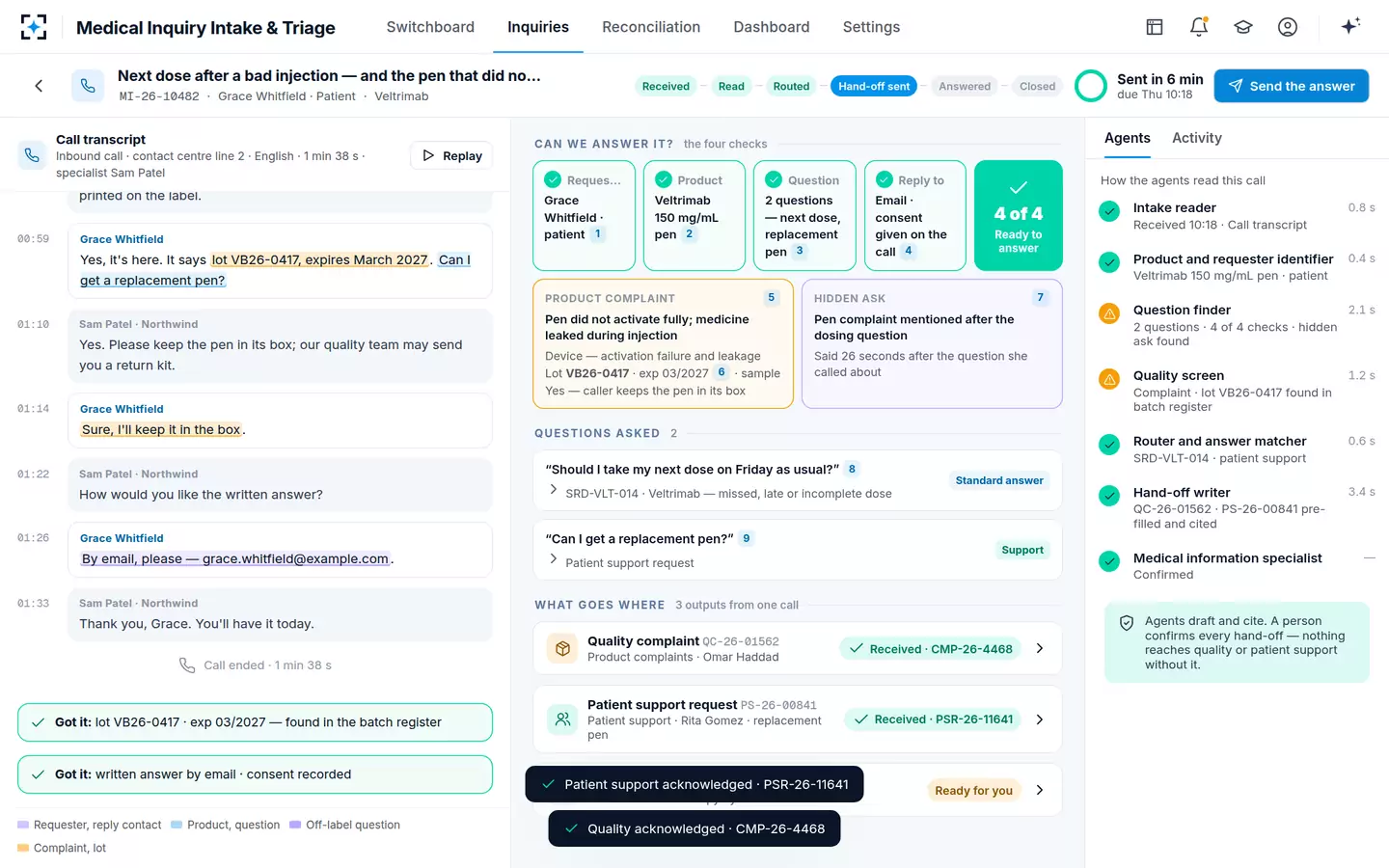
Hand-off writerPre-fills the complaint for quality — product, lot, expiry, the defect in the requester’s words, category, sample — with the source passage attached to every field.
Never: sending anything on its own
A person decides
The specialist or the intake lead confirmsReads the cited fields and confirms. Not sending a hand-off needs a reason, which is kept and shown in the monthly reconciliation.
A person decides
Quality reviews and determinesThe quality control unit reviews the alleged specification failure and decides whether an investigation is required — or records why it is not, and who decided.
One boundary has to be stated plainly, because the procedure's third review duty points straight at it. Medical Inquiry Intake & Triage routes product complaints to quality and access requests to patient support; it does not classify, assess or report adverse events, which are the safety team's own work under their own rules and clocks. The procedure's job at the channel is to notice that a second thing may have been said and get it to the people who own it. Where the line falls, and why one sentence from a caller can be on both sides of it, is the subject of product complaint versus adverse event.
A procedure written from the quality mailbox, against one written from the call
From the mailbox: At the complaint form in the quality system, once somebody opens one.
From the call: At the channel — phone, email, web form, chat, field medical — the moment the inquiry lands.
From the mailbox: The day the form was opened, which is the only date the quality system can see.
From the call: The moment anyone working for the company first had it, weekends included.
From the mailbox: Written up later from call notes, by someone who has taken forty more calls since.
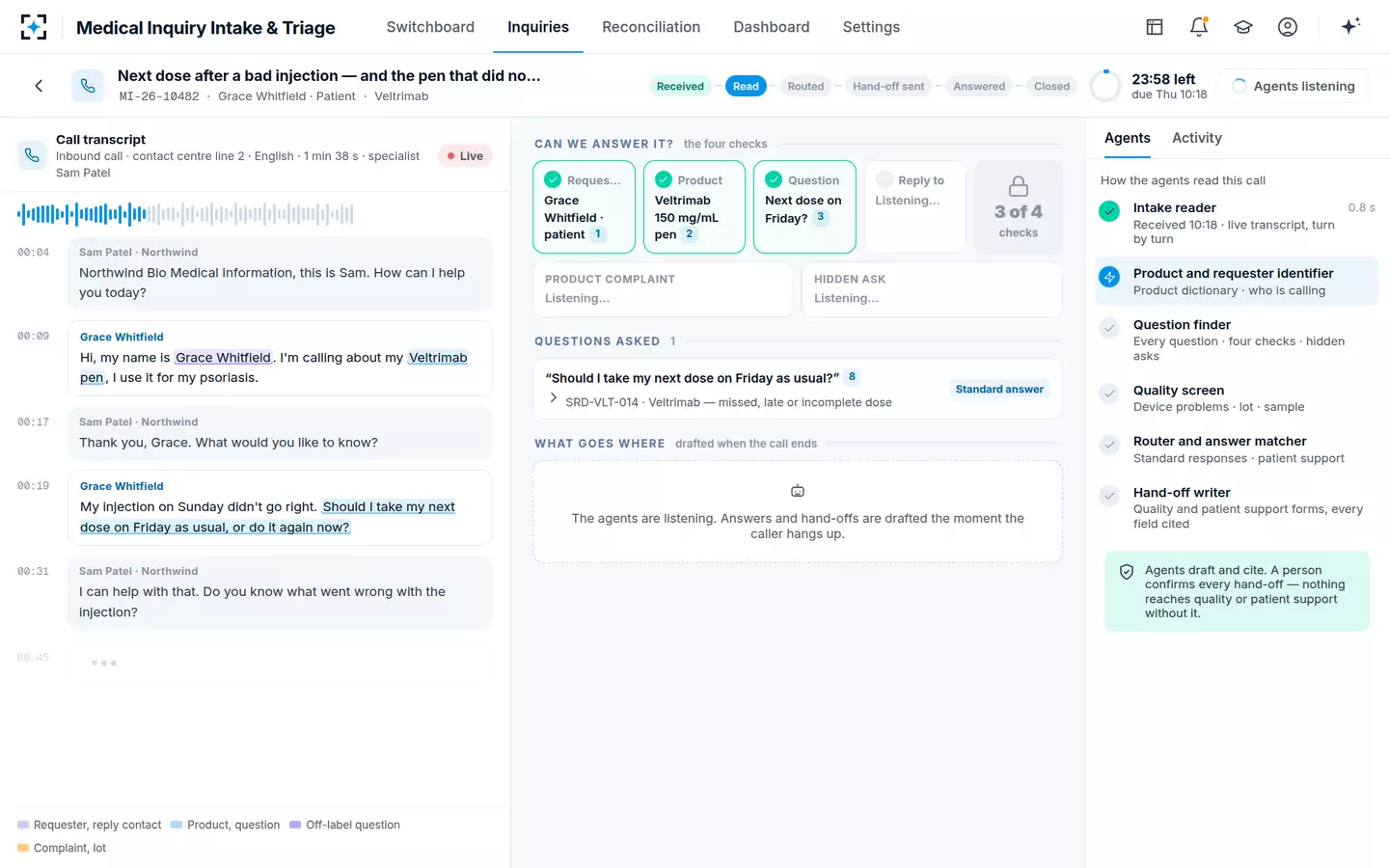
From the call: Opened during the call, in the caller’s own words, with the words kept.
From the mailbox: Retyped from notes: "zero four one seven" becomes 0471 and matches no batch.
From the call: Asked for while the caller is holding the pen, then checked against the batch register.
From the mailbox: Depends on the specialist remembering it after the answer is given.
From the call: Every sentence that asks for something gets its own route and its own clock.
From the mailbox: Decided in quality; the reason is sometimes implicit in the file.
From the call: The reason and the responsible person are part of the record, as the rule requires.
From the mailbox: The form, and the call notes if they survived.
From the call: Each field with the passage it came from, and a signed monthly reconciliation against the quality system.
The complaint opened while the caller is still on the line
Confirmed by a person, then acknowledged by quality
What a procedure cannot do is make the first hour someone else's problem. The desk that takes the call is where the lot number, the sample question and the caller's own words either get captured or get lost, and no amount of rigour downstream recovers them. Write the procedure from the channel inwards, and read what a product quality complaint is for the definition the person on the phone has to be able to apply. To see the chain running end to end, start from Medical Inquiry Intake & Triage.
Questions people ask
Does a complaint handling procedure have to be one document?
No. FDA's QMSR preamble accepts that a company may run different complaint handling units for different products or sites, but it requires the corporate procedure to "clearly describe and define" how they work, and warns that "a system that would allow multiple interpretations of handling, evaluating, categorizing, investigating, and following up, would be unacceptable." One coordinating unit must be named. Several documents are fine if they cannot be read against each other.
How long must a drug complaint record be kept?
Until at least one year after the drug product's expiration date, or one year after the date the complaint was received, whichever is longer. For certain over-the-counter products that carry no expiration date because they meet the exemption in § 211.137, the record is kept for three years after distribution. The file lives at the establishment where the product was made, packed or processed, unless it is held elsewhere and is readily available there for inspection.
Who signs off a complaint record?
The rules name a person in one place and imply one in several. The drug rule requires the name of the responsible person who determined that no investigation was necessary. On the device side FDA notes that where ISO 13485 says "approved", it means the record "has a signature and date", and that an electronic signature meeting the agency's requirements counts. Many procedures add a second signature for the monthly reconciliation of what was sent against what the receiving system holds.
How do you write a complaint handling SOP for a contact centre?
Start from the call, not the form: name the channels, give a one-line test for what a complaint is, say which fields are asked for while the caller is on the line, and say what to do when one of them cannot be obtained. Then state the received-date rule in words, the hand-off target, who confirms, and what is recorded when a hand-off is not made. The quality clauses — review, investigation determination, retention — follow unchanged from the main procedure.
Does the procedure have to say what happens to a complaint that is also a safety report?
Yes. The drug rule's own third sentence requires the procedure to check whether a complaint is also a serious and unexpected adverse drug experience that must be reported under §§ 310.305 and 514.80. That review is not the complaint investigation and it does not belong to the complaint file; the procedure's job is to name who screens for it and who it goes to. In the sample desk that is a hand-over to the safety team, whose assessment and reporting the solution does not do.
How many people does a complaint pass through?
On a desk organised like the sample one, five: the specialist who takes it, the intake lead who confirms the hand-off, the quality colleague who reviews it and determines whether to investigate, the patient support lead if the caller also asked for something, and the medical reviewer if a question about use outside the label came with it. Only two of those five are named by the regulations — the quality control unit and the responsible person who decides against an investigation. The other three are the company's own design, and the procedure is where that design is written down.