The most common FDA 483 observations on complaint handling are about the procedure and the file, not the investigation. In FDA's own fiscal year 2025 observation file, 21 CFR 820.198(a), "Lack of or inadequate complaint procedures", was cited 211 times — second among 185 cited device areas, behind only corrective and preventive action procedures at 279 — and every limb of the complaint section together accounts for 286 of 2,660 device citations, or 10.8%. For drugs the equivalent count is far smaller, 36 of 2,837, and this guide explains why that is not the comfort it looks like. Almost every one of these citations is about what was written down when the complaint arrived, which is why the file that survives an inspection is built at intake, by whoever takes the call.
That is the work Botminds' Medical Inquiry Intake & Triage does: reading each inquiry, finding the product problem inside it, capturing lot and expiry while the caller is still on the line, and handing a cited complaint to quality within the desk's own commitment. It routes product complaints to quality and access requests to patient support, and it does not classify, assess or report adverse events — that is the safety team's own job. The counts on this page are FDA's own, or our arithmetic over FDA's published files, and the screens are the product's sample data on fictional people and medicines.
Complaint handling in FDA's fiscal year 2025 device observations
211
observations on inadequate complaint procedures, 21 CFR 820.198(a)
2nd
of 185 cited device areas, behind corrective and preventive action at 279
286
citations across all nine cited limbs of the complaint section
791
device Form 483s issued from the system in the fiscal year
What are the most common FDA 483 observations on complaint handling?
Across the device file, the ranking is stable and it is short. Inadequate complaint procedures sits at number two in the whole device programme, ahead of purchasing controls, nonconforming product and process validation. The other eight limbs of the complaint section are small individually and large together.
The ten most-cited device areas, fiscal year 2025 — complaint procedures second
Two of the top six are about what a firm does after a customer says something is wrong. That may be a larger share of an inspector's attention than a medical information team assumes, and it is attention paid to paperwork they help create without ever seeing the quality system it lands in.
Where does FDA publish inspection observation data, and what it leaves out
FDA publishes a spreadsheet per fiscal year on its Inspection Observations page: "Spreadsheets summarizing the areas of regulation cited on FDA's system-generated 483s are available by fiscal year on the menu links on this page" (FDA, Inspection Observations, content current as of 16 December 2025). Each workbook has a sheet per programme — devices, drugs, foods, biologics and the rest — and each row is one area of regulation with FDA's own short and long description and the number of times it was cited.
Read the caveats before quoting any of it. The file carries its own footnote: the table is not every Form 483 issued in the year, because some were prepared by hand and never entered in this format. The same footnote explains the other arithmetic trap: a single Form 483 can carry citations in more than one programme area, so the programme totals add to 4,912 while the actual number of Form 483s in the system for fiscal year 2025 is 4,862.
Three further limits matter for anyone building a case from this data. It names no company, so it cannot tell you who was cited or what happened next. It counts citations, not inspections, so one badly run complaint system can contribute several rows. And it is an observation, not a finding of violation — the investigator's judgement at the end of a visit, which the firm answers in writing. What the file is genuinely good for is proportion: which areas of regulation draw attention, year after year.
Devices: second place, two years running
The fiscal year 2024 file tells the same story with different numbers. Complaint procedures was cited 191 times against corrective and preventive action's 254 — second again — and all the limbs together came to 271 of 2,383 device citations, 11.4%. Two years running, roughly one device observation in nine is about complaint handling.
Each cited limb of 21 CFR 820.198, fiscal year 2024 against fiscal year 2025
FY 2024 (inspections to 30 Sep 2024): 191 citations, second of 174 cited device areas
FY 2025 (inspections to 30 Sep 2025): 211 citations, second of 185 cited device areas
FY 2024 (inspections to 30 Sep 2024): 39 citations
FY 2025 (inspections to 30 Sep 2025): 32 citations
FY 2024 (inspections to 30 Sep 2024): 17 citations
FY 2025 (inspections to 30 Sep 2025): 16 citations
FY 2024 (inspections to 30 Sep 2024): 6 citations, plus 6 on the missing device identifier
FY 2025 (inspections to 30 Sep 2025): 8 citations, plus 4 on the missing device identifier
FY 2024 (inspections to 30 Sep 2024): 6 citations
FY 2025 (inspections to 30 Sep 2025): 5 citations, plus 2 on incomplete reportable investigations
FY 2024 (inspections to 30 Sep 2024): 4 citations, plus 1 on a missing rationale for not investigating
FY 2025 (inspections to 30 Sep 2025): 4 citations
FY 2024 (inspections to 30 Sep 2024): 271 of 2,383 device citations — 11.4%
FY 2025 (inspections to 30 Sep 2025): 286 of 2,660 device citations — 10.8%
The movement between the two years is small and in one direction: procedure citations up, file-maintenance citations down slightly, everything else flat. A reader looking for a trend in two years of counts will not find one. A reader looking for a constant will: the same limb is at the top both years, and it is the limb about having a procedure that covers receiving, reviewing and evaluating, performed by a formally designated unit.
Drugs: a much smaller count, and why that is not comfort
On the drugs sheet the complaint section barely registers. All seven cited limbs of 21 CFR 211.198 together drew 36 citations of 2,837 in fiscal year 2025 — 1.3% — led by 211.198(a), "Complaint Handling Procedure", at 16, ranked 42nd. In fiscal year 2024 the total was 43 of 2,483, with 211.198(a) at 24 and ranked 22nd.
The explanation is in the next section of the same regulation. Investigations of discrepancies and failures, 21 CFR 211.192, drew 236 drug citations in fiscal year 2025 across its five cited limbs — second only to the quality control unit's own responsibilities — including 32 for an incomplete written investigation and 22 for no written investigation at all. A complaint about a drug that reveals a possible batch failure does not usually get cited as a complaint problem. It gets cited as an investigation problem, because that is the duty 211.198(a) points to. The complaint file is where the trail starts; 211.192 is where an inspector finds it broken.
A second route out of the complaint section is the field alert. FDA's guidance on field alert reports says plainly that a failure to submit a field alert can itself be written up as an observation on Form 483 (FDA, Field Alert Report Submission: Q&A, July 2021). The three-working-day evaluation that decides whether a complaint becomes a field alert starts from the complaint, and the clock on that decision is set out separately.
What complaint handling problems do inspectors find? The observation text
FDA's own wording is the most useful part of the file, because it is close to what appears on the form. The table below gives every cited limb of the device complaint section in fiscal year 2025, FDA's description of the problem, the two years' counts, and the question to put to your own file.
Every cited limb of 21 CFR 820.198, FDA's own words, and what to check in your file
820.198(a)Lack of or inadequate complaint procedures
What the observation saysProcedures for receiving, reviewing, and evaluating complaints by a formally designated unit have not been [adequately] established.
FY24 / FY25191 / 211
Ask of your own fileDoes one written procedure cover receiving, reviewing and evaluating — and name the unit that does it?
820.198(a)Complaints
What the observation saysComplaint files are not [adequately] maintained.
FY24 / FY2539 / 32
Ask of your own fileIs there one place every complaint lands, including the ones first heard on a medical information call?
820.198(c)Investigation of device failures
What the observation saysComplaints involving the possible failure of [a device] [labeling] [packaging] to meet any of its specifications were not [reviewed] [evaluated] [investigated] where necessary.
FY24 / FY2517 / 16
Ask of your own fileCan you show the review for each complaint that described a device not doing what it should?
820.198(e)Records of complaint investigation
What the observation saysRecords of complaint investigations do not include required information.
FY24 / FY256 / 8
Ask of your own fileDoes every investigation carry the name, the dates, the device and the outcome, not just a conclusion?
820.198(d)Evaluation, timeliness, identification
What the observation saysComplaints representing events that are MDR reportable were not [promptly reviewed, evaluated, and investigated by a designated individual] [maintained in a separate portion of the complaint files] [clearly identified].
FY24 / FY256 / 5
Ask of your own fileAre reportable events marked as such on the day they arrive, by a named person?
820.198(b)Review and evaluation for investigation
What the observation saysNot all complaints have been [adequately] reviewed and evaluated to determine whether an investigation is necessary.
FY24 / FY254 / 4
Ask of your own fileIs the decision whether to investigate taken on every complaint, and visible?
820.198(e)Maintained
What the observation saysRecords of complaint investigations are not maintained by the formally designated unit.
FY24 / FY251 / 4
Ask of your own fileDo the files live with the designated unit, or in a mailbox somewhere?
820.198(e)Records of complaint investigation — UDI
What the observation saysRecords of complaint investigations do not include required information, including any unique device identifier (UDI) or universal product code (UPC).
FY24 / FY256 / 4
Ask of your own fileIs the device identifier captured at intake, while the caller still has the box?
820.198(d)Records of MDR Investigation
What the observation saysInvestigation records of MDR reportable complaints do not include required information.
FY24 / FY250 / 2
Ask of your own fileDo reportable investigations carry everything the separate file needs?
820.198(b)Rationale documented for no investigation
What the observation saysA rationale was not documented for a complaint that was not investigated.
FY24 / FY251 / 0
Ask of your own fileWhen you decide not to investigate, is the reason written down, with who decided?
Read down the middle column and a pattern appears that has nothing to do with investigation science. "Have not been established." "Are not maintained." "Do not include required information." "Were not clearly identified." These are citations about writing things down, in a named place, by a named unit, at the time. Every one of them is decided before any investigator arrives, at the moment someone takes a call.
The adjacent citations: reporting procedures and timeliness
Complaint handling does not get read alone. The reporting rules sit beside it, and in the device file Part 803 drew 141 citations across 16 areas in fiscal year 2025, led by 803.17, "Lack of Written MDR Procedures", at 63 — the sixth most-cited device area overall. In fiscal year 2024 it was 129 across 15 areas, with 803.17 at 54.
Those citations attach to the same moment as the complaint ones. A written reporting procedure is judged by whether it tells a person what to do when a complaint arrives that might be reportable, and 820.198(d) covers the other half: that such complaints are "promptly reviewed, evaluated, and investigated by a designated individual", kept in a separate part of the files, and clearly identified. Prompt, designated, separate, identified — four properties of a file, all set at intake.
Where a device Form 483 observation lands, fiscal year 2025
All 2,660 device citations
- Complaint section · 286 · 10.8%
- Reporting · 141 · 5.3%
- Everything else · 2,233 · 83.9%
All 2,837 drug citations
- Complaint files and the investigations they feed · 272 · 9.6%
- Everything else · 2,565 · 90.4%
How often is complaint handling cited, as a share of all observations?
Take the two programmes together and the honest answer is: often enough that it is never a surprise, and in devices often enough to plan for. One device citation in nine comes from the complaint section in both published years. One drug citation in seventy-seven does — but add the investigation section that complaints feed and the drug figure becomes closer to one in ten.
What the share cannot tell you is your own risk, because the denominator is every inspected firm. The share is useful for arguing a budget: a desk that is cited this often across an industry is not a quiet corner of the quality system, and the cheapest hour to spend on it is the first one, while the caller is still on the phone.
How do you prepare a complaint file for an inspection?
By making the file at the moment the complaint is described, rather than reconstructing it afterwards from notes. Each item below comes from one of the cited limbs above, and each is something a medical information team either does on the call or cannot do later.
Nine things to look for in your own complaint file, each drawn from a cited observation
- One written procedure covering receiving, reviewing and evaluating.
The most-cited limb both years. Three verbs: a procedure that covers only logging leaves two of them unwritten.
- A formally designated unit, named.
The same citation names the unit. A procedure that says "the relevant team" has not designated anyone.
- Every complaint in one place, including those first heard elsewhere.
Complaint files not maintained drew 32 and 39 citations. A defect described on a medical information call is a complaint from the moment it is described.
- The lot or device identifier, captured while the caller has the box.
Four and six citations name the missing unique device identifier. Nobody can supply it a week later.
- The complainant's own words, not a paraphrase.
The investigation is judged against what was actually reported. A summary written after the call loses the detail an engineer needs.
- A received date that is the date of first receipt.
Timeliness citations are judged from when the firm became aware, not when a form was opened.
- Reportable events marked and separated on arrival.
820.198(d) asks for prompt review by a designated individual, a separate part of the file, and clear identification.
- The decision whether to investigate, taken on every complaint.
Not all complaints reviewed and evaluated to determine whether an investigation is necessary is a citation in its own right.
- The reason, when the answer is no.
Both the drug rule and the device rule require the rationale in writing. It is the subject of the next section.
What goes into the file at intake: every field with the words it came from
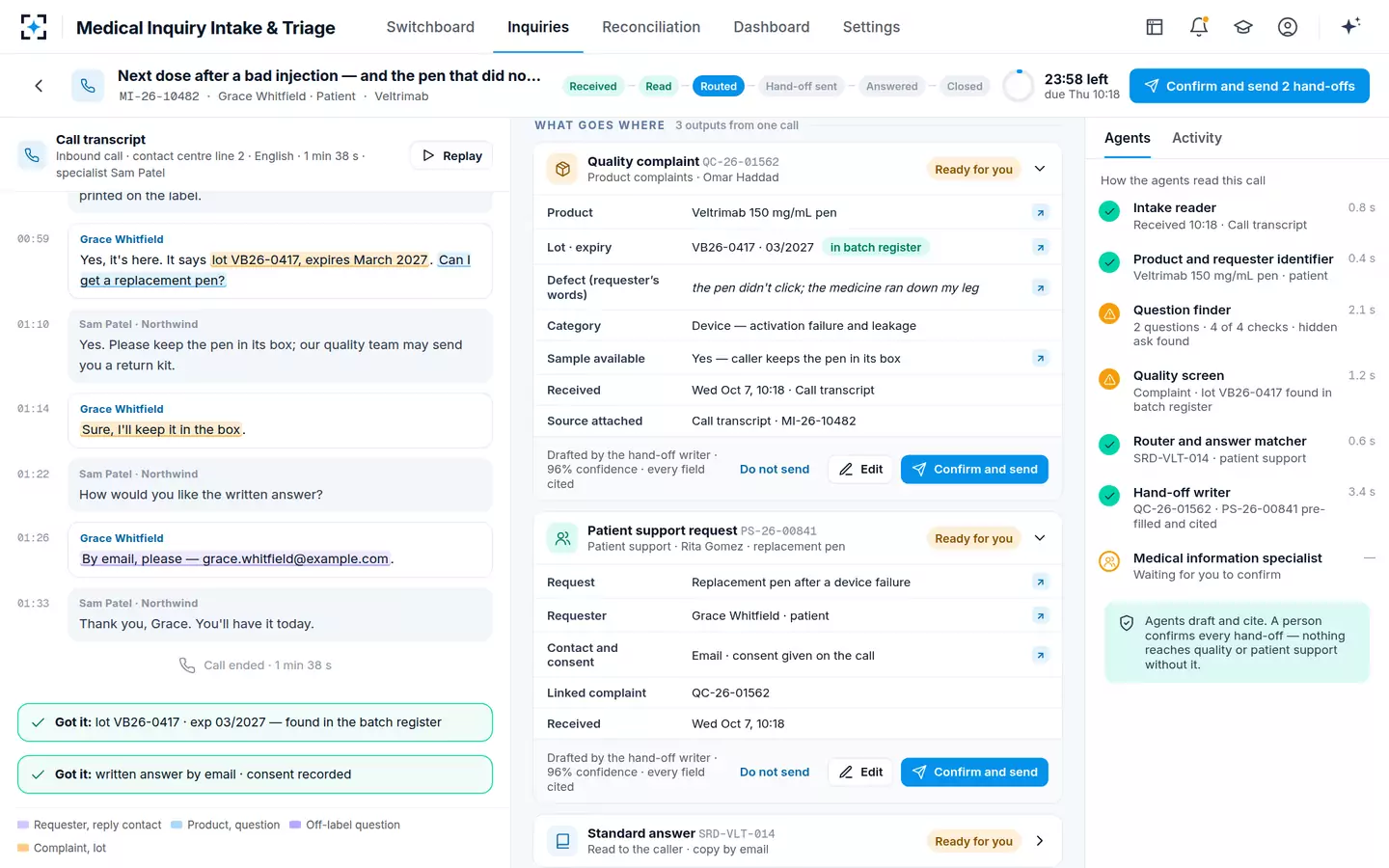
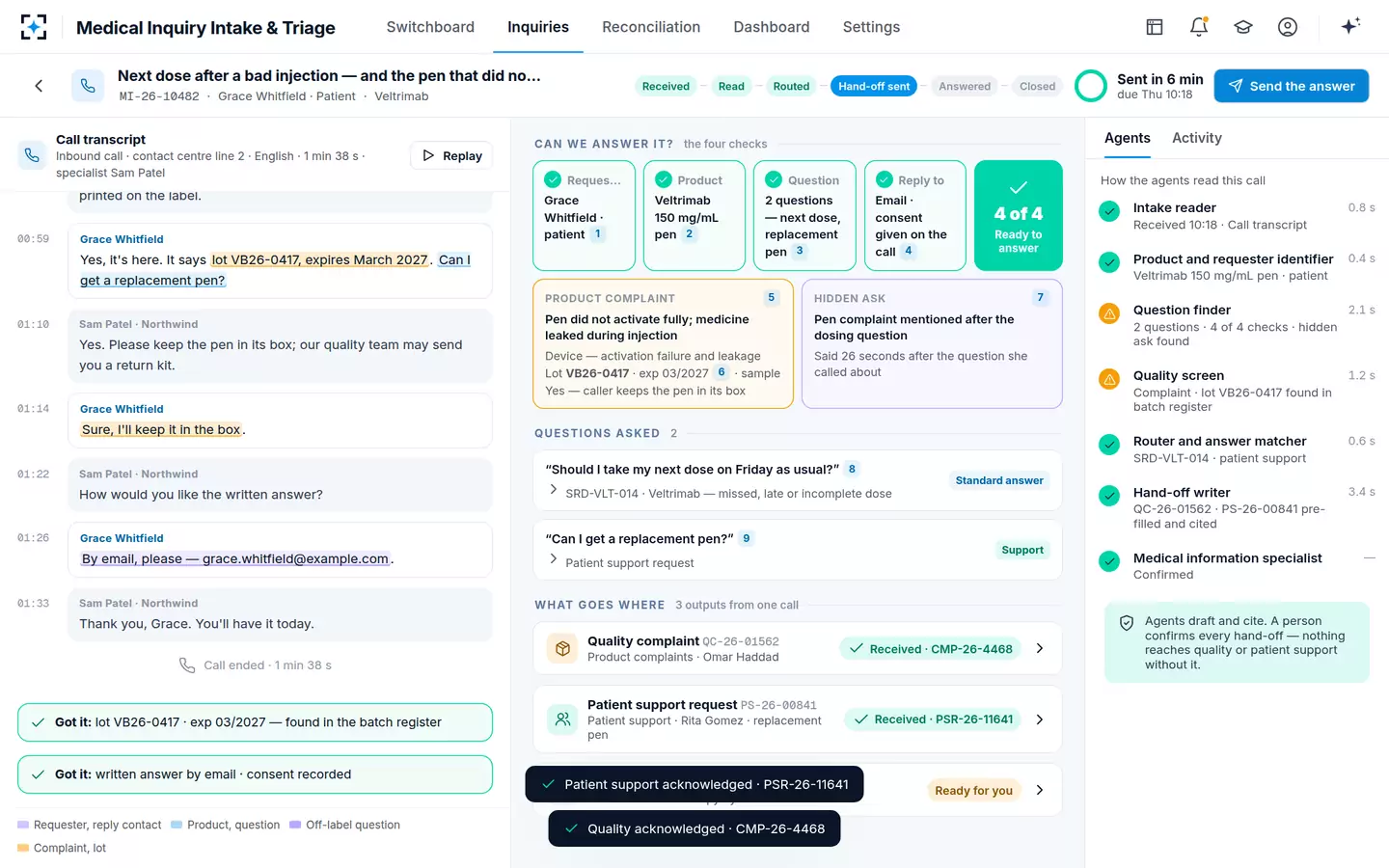
The second screen is the one an auditor asks for: the same two hand-offs after a person has read them. Confirmation is the step that turns a draft into something another department acts on, and it is the step that carries a name and a time.
Confirmed by a named person, acknowledged by the receiving systems
The decision not to act, and why it must be written down
The citation that catches the most careful teams is the one about doing nothing. Both regimes require a reason. For drugs, where an investigation under § 211.192 is not conducted, the record has to say why an investigation was judged unnecessary and name the person who made that call (21 CFR 211.198, 2024 CFR edition). For devices, FDA said the same when it folded ISO 13485 into the quality system rule — under the clause and § 820.35(a) together, a firm that does not investigate a complaint must write down why (89 FR 7496, 2 February 2024). What else the final rule changed for complaint handling is covered separately.
In the fiscal year 2024 file there is a single citation whose short description is exactly this — a rationale not documented for a complaint that was not investigated — and a single drug citation for the reason not given for not conducting a complaint investigation. One each. They may be rare because the decision is rarely visible rather than because it is rarely missing: an investigator who never sees the decision has nothing to cite.
This is why, in the product, declining to send a hand-off is a deliberate step with a reason attached rather than an absence. The reason is kept in the audit trail and reappears in the monthly reconciliation, so a month in which nothing was declined and a month in which three were declined for stated reasons look different on the page the intake lead signs.
The month signed, with the meaning of the signature recorded
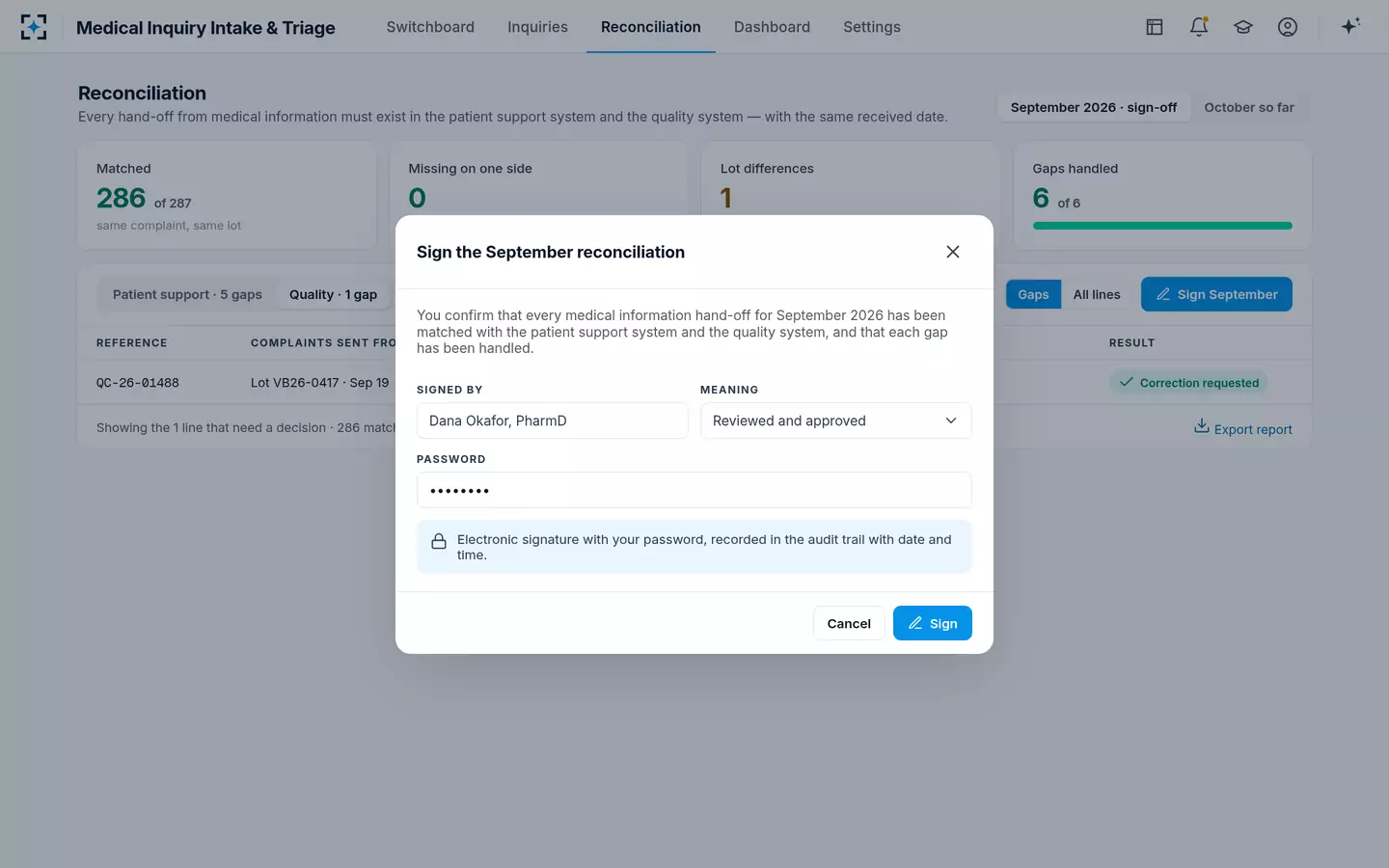
One more habit is worth borrowing from outside the medicines rules. NIST's AI risk framework asks that regular assessments and updates involve people who did not build the system day to day — internal experts from elsewhere, independent assessors, or both (NIST AI 100-1, MEASURE 1.3, January 2023). Applied to a complaint desk with or without agents, it means the person who checks the month is not the person who processed it. In the product, hand-offs are confirmed by specialists and the month is signed by the intake lead, and the counts the lead signs were prepared by matching both receiving systems rather than by asking the desk what it sent.
Questions people ask
What is a Form FDA 483 observation?
It is a written observation an FDA investigator leaves at the end of an inspection, listing conditions that in the investigator's judgement may indicate a regulated product is in violation of FDA's requirements. It is not a final agency determination, and the firm responds in writing. FDA publishes the areas of regulation cited on its system-generated forms, by fiscal year, with no company names attached.
How many Form 483s does FDA issue in a year?
For fiscal year 2025 the published file records 4,862 forms generated from FDA's electronic inspection tools, of which 791 cited device areas and 713 cited drug areas; in fiscal year 2024 the totals were 4,056, 672 and 561. These are not complete counts: FDA's own footnote says some forms were manually prepared and are not in the file, and one form can appear under more than one programme area.
What is the most cited device quality system regulation?
In both published years it is 21 CFR 820.100(a), corrective and preventive action procedures — 279 citations in fiscal year 2025 and 254 in fiscal year 2024. Complaint procedures under 820.198(a) is second in both, at 211 and 191. The two are related in practice: a corrective action programme is only as good as the complaints feeding it.
What evidence should a complaint record carry?
Enough for someone who was not there to judge the decision. That means the complainant's own description rather than a paraphrase, the product and the lot or device identifier, the date the firm first became aware, whether the event was reviewed for reportability and by whom, the decision whether to investigate, and — when the answer is no — the reason and the name of the person who decided. Several of the cited limbs above are simply one of these items missing.
Why do the device and drug counts differ so much?
Because the two programmes cite different sections for the same underlying failure. On devices, a complaint not reviewed or a file not maintained is cited under 820.198. On drugs, a complaint that should have triggered an investigation is usually cited under 211.192, investigations of discrepancies and failures, which drew 236 citations in fiscal year 2025 against the complaint section's 36. The drug complaint file is where the trail starts rather than where it is scored.
Is a Form 483 observation the same as a warning letter?
No. The observation is the investigator's list at the close of an inspection; a warning letter is a later agency communication that follows a review of the inspection and the firm's response. The published observation files cover only the first of these, and they record areas of regulation and counts, not outcomes, so they cannot tell you what any particular inspection led to.