AI in medical information today does the reading, not the answering. A medical information desk takes dosing, interaction, storage, travel and access questions from patients, caregivers, physicians, pharmacists and nurses across phone, email, web form, chat and field medical, and the hard part is not writing a reply — the approved reply usually already exists — but hearing everything that was asked, naming the medicine and the person, catching the product problem mentioned on the way out, and starting each clock at the minute of first receipt. Botminds' Medical Inquiry Intake & Triage puts seven agents on exactly that work and keeps the sending, the approving and the signing with named people. The test that separates a useful system from a liability is not how much of the desk it answers. It is what it does when it does not know.
The screens and the people on this page are sample data in the product: Northwind Bio, its medicines Veltrimab and Corventa, and the specialists named here are invented. The research figures come from regulators and peer-reviewed studies, linked where they appear. One boundary matters before anything else: this work routes product complaints to quality and access requests to patient support, and it does not classify, assess or report adverse events — that is the safety team's own job, and the medical information desk hands over to it.
What the agents are counted on for, and what the published evidence says about machine triage
7agents
read, split, route and draft; two people decide and sign
4
checks an answer needs: who is asking, the medicine, the question, where to reply
92.4%
of cases triaged correctly by frontier language models in a published comparison
133 of 144 cases
63%
of medical information inquiries arrive through the contact centre
chat accounts for 2%
Can AI answer medical information inquiries?
Partly, and the part matters. An agent can read an inquiry in any of the desk's channels, decide how many separate requests it holds, identify the medicine and the requester, match a question to an approved standard response, and pre-fill a complaint or a support request with every field tied back to the sentence it came from. What it cannot do, in a desk anyone would sign off, is decide that an unapproved answer is good enough, write a new answer for a question outside the label, or send anything to another department on its own.
That division is not a product preference; it tracks what FDA has told firms for years about answering off-label questions. The agency's draft guidance says the answers should come from medical or scientific staff who are independent of sales and marketing (FDA, Responding to Unsolicited Requests, section V, recommendation 5). A drafting agent is not medical or scientific personnel. It can assemble what those personnel need, cited, in seconds instead of an afternoon — which is the whole gain.
The same guidance also pins down the step agents are genuinely good at. Before answering, it says, a firm should gather the background it needs to work out what is actually being asked — and where a question is broad, the firm should narrow it. Obtaining the background data and narrowing the question is reading work, done once per inquiry, under time pressure, by a human being who is also talking to a worried caller. It is among the most mechanical duties on the desk and among the first a queue sacrifices.
Seven agents, and the one job each has
An inquiry meets the agents in order, and each hands on a single thing it is responsible for. Reading the chain downward is the fastest way to see where a machine helps and where the design deliberately stops it.
One inquiry through six agents and two people, and what each is barred from
Agent
Intake readerTakes the call, the mailbox, the web form, chat and a field medical request and makes one clean item with its channel and the minute it was first received. On a live call it reads the transcript turn by turn.
Never: Never times an inquiry from when the form was opened
Agent
Product and requester identifierRecognises the medicine, misspellings included, and who is asking — patient, caregiver, physician, pharmacist or nurse — with the contact given and the consent to reply.
Never: Never picks between two possible medicines: it asks
Agent
Question finderFinds every question and request in the inquiry, including the one mentioned on the way out, flags anything outside the label, and tests the four things an answer needs.
Never: Never drops a second question because the first was answered
Agent
Quality screenSpots a product defect — a pen that did not activate, a leak, a bent needle, particles — and captures lot, expiry and whether a sample can come back, checking the lot against the batch register.
Never: Never files a storage mistake as a defect unless a defect is described
Agent
Router and answer matcherSends each question to an approved standard response, a custom answer, medical review when it is outside the label, or patient support for access, supply and cost — and starts each clock from first receipt.
Never: Never proposes an answer that is not approved and current
Agent
Hand-off writerPre-fills the quality complaint and the patient support request, every field carrying the passage of the call or email it came from.
Never: Never sends one
A person decides
Specialist or intake leadReads the cited fields, confirms or corrects each hand-off, decides the borderline cases, and gives a reason when a hand-off is not sent.
Never: The only step that can release anything
A person decides
Medical reviewerApproves custom answers and anything outside the label, balanced and sourced, with the requester’s own words in front of them.
Never: No agent writes in their place
Two things in that chain are worth stopping on. The first is that six of the seven agents produce a draft, not an action: the only outputs that leave the desk are released by a person. The second is that every one of them carries a stated limit, and the limits are not caveats added afterwards — they are the reason the chain is split this finely. A single model asked to "handle the inquiry" has no place to put a limit. Seven narrow agents each have one.
The four checks, and what happens when one is missing
Before an answer can go anywhere, four things have to be known: who is asking, which medicine, what was actually asked, and where the reply should go. Each is held against the requester's own words — the sentence in the email, the turn in the transcript — rather than a box somebody ticked.
The useful behaviour is at three of four. A nurse at a cardiology clinic asks on a web form whether patients should stop a medicine before a dental extraction and leaves no email and no phone number. Three checks close; the reply contact does not. A system built to be helpful would answer to the form's sender address, or to the clinic's switchboard, and call the inquiry closed. This one drafts the answer, says which check is open, and offers the intake lead two routes: ask the clinic for a reply contact, booking a call-back through the directory of healthcare professionals, or close it without a reply — which requires a reason that stays in the audit trail.
Three of four checks, and a decision that stays with a person
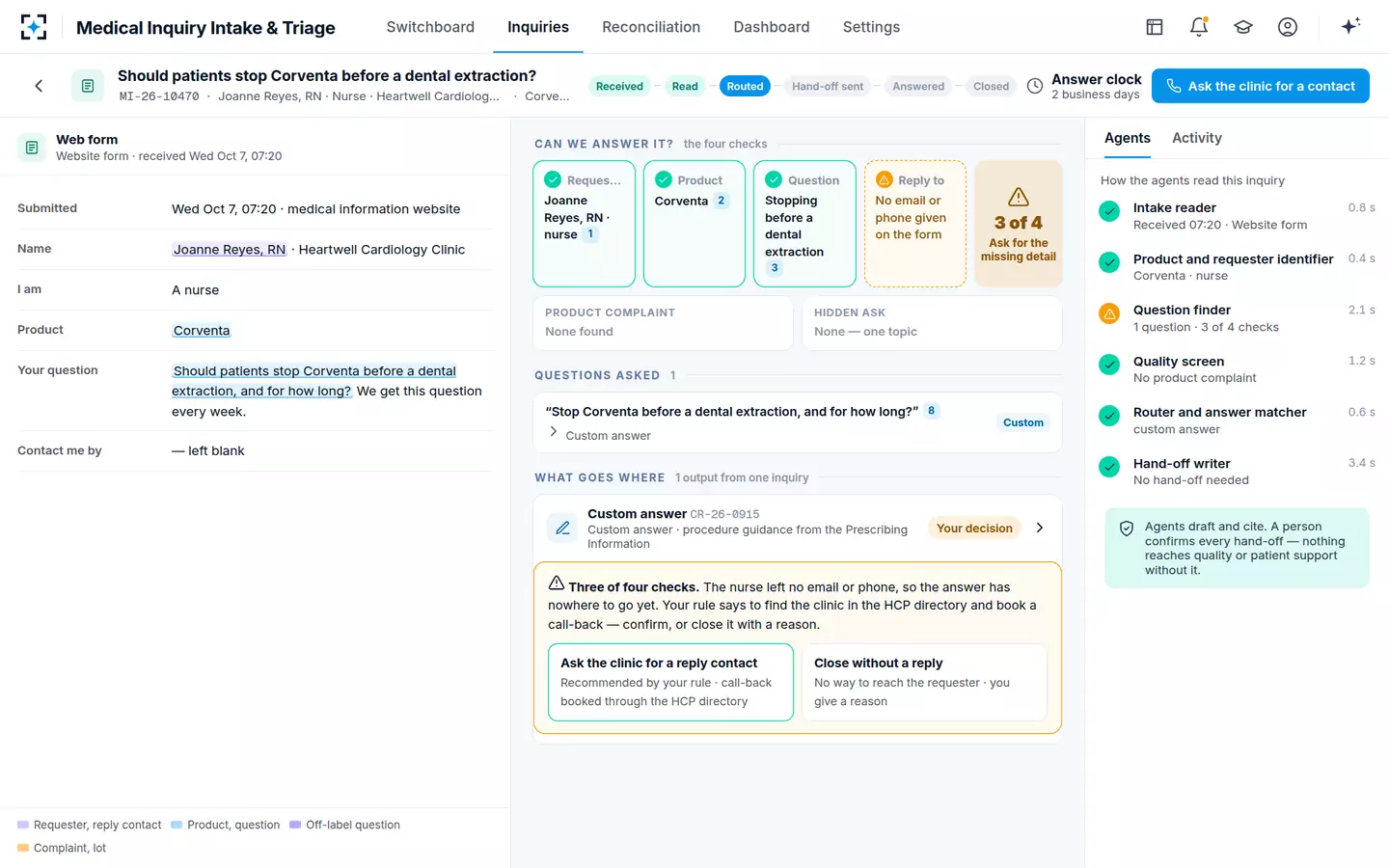
Writing an answer and having nowhere to send it feels like a failure. It is the opposite. An answer sent to a switchboard is an answer to a question nobody will see, and a clock marked met that was not. Naming the open check turns a silent mistake into a thirty-second decision by the person who is accountable for it.
What is the difference between a chatbot and an AI agent in medical information?
A chatbot is a channel; an agent is a step in the work. The chatbot sits where the requester is, holds a conversation and closes it — and on the published evidence it is a small channel: across all 32 phactMI member companies surveyed in June 2022, "63% of inquiries were received through the Medical Information Call Centers, followed by 10% from the website, 2% from chatbot, 1% from a medical information app, and 24% from other channels" (Dupuy et al., 2023). Two per cent is not where a medical information desk's risk lives. The agents on this page read all of the channels, including the 63% that arrive as a human voice.
The deeper difference is what each does with doubt. A conversational system is rewarded for producing a fluent next sentence, which means an unanswerable question still gets an answer. An agent in a regulated process has to be able to produce nothing and say why.
The same four hard moments, handled by guessing and by asking
A system that fills the blank: Replies to the sender address, or to the clinic switchboard. The inquiry closes; nobody at the clinic sees the answer.
A system that names the blank: Drafts the answer, marks the fourth check open, and offers a call-back through the directory or a closure with a reason.
A system that fills the blank: Picks the likelier one. The answer is about a medicine the caller is not taking.
A system that names the blank: Stops and asks the specialist, with both candidates and the words the caller used.
A system that fills the blank: Writes the number as heard into the complaint. Quality investigates a batch that does not exist.
A system that names the blank: Flags that the lot is unknown and prompts the specialist to have the caller read it from the label again.
A system that fills the blank: Answers the first question. The second leaves no trace at all.
A system that names the blank: Splits it out, gives it its own route and its own clock, and sends anything outside the label to medical review.
What happens when the AI is not sure: three cases from one morning
Three of the four rows above happened within three hours on one sample morning.
At 07:20 came the nurse with no reply contact, described above. At 08:41 a pharmacist emailed about an interaction between two medicines and, in his second paragraph, asked on behalf of his long-term care team whether tablets could be crushed and given through a feeding tube. The first question matched an approved response; the second is a route of administration the label does not describe, so it went to medical review with his own sentence attached, flagged as a request the company did not solicit. At 10:18, mid-call, a caller said her pen had not clicked and read out a lot number; the digits she read matched the batch register, so the complaint carried a verified lot — and had it not matched, the specialist would have been prompted to ask her to read it again rather than file the number as heard.
A second question in the second paragraph, routed on its own clock
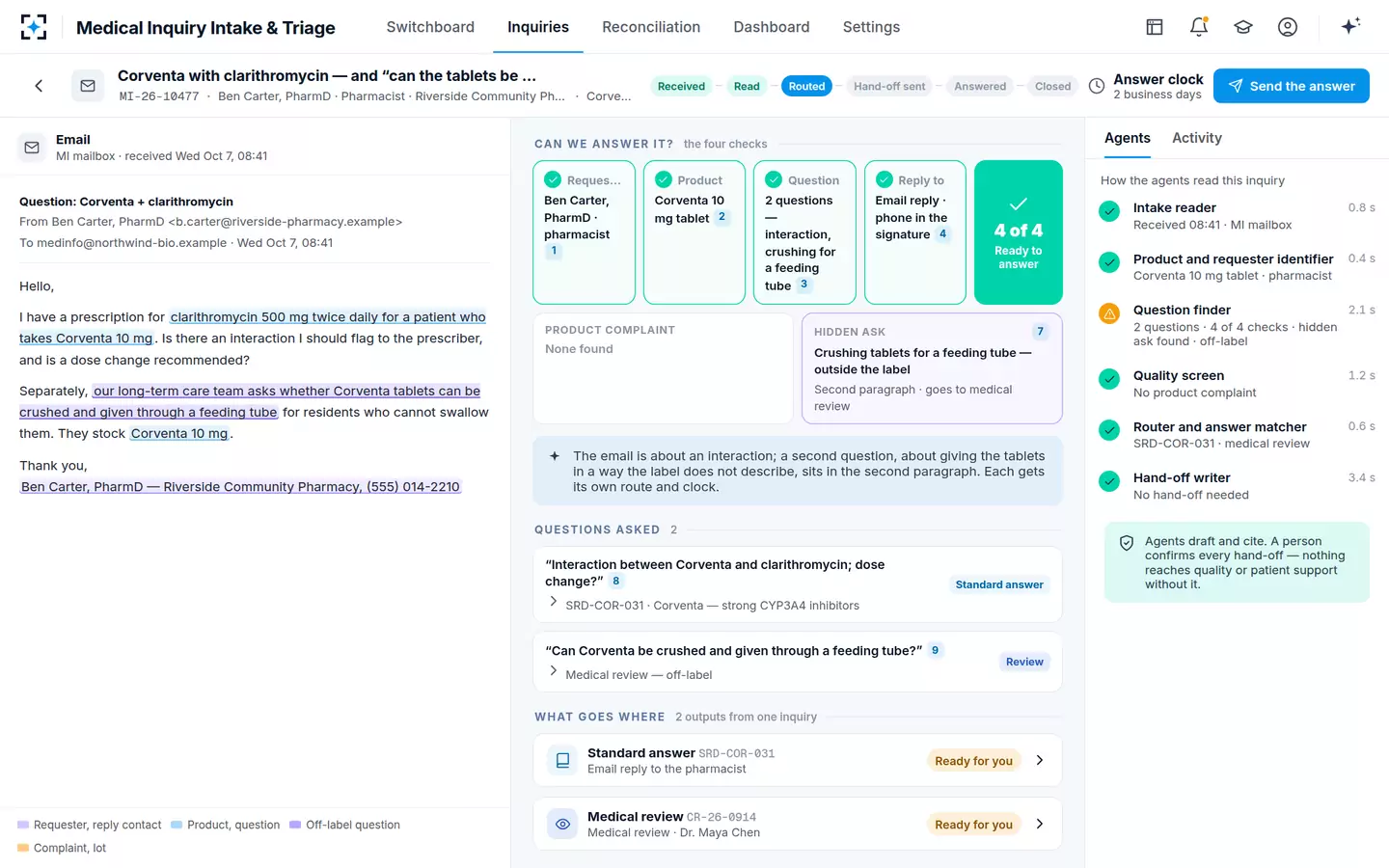
The published research suggests the second question is a normal case, not an edge case. An analysis of consumer health requests by researchers at the U.S. National Library of Medicine found that such requests often pack several questions into one message, leaning heavily on words that point back to something said earlier and on words left out altogether (Roberts et al., 2014) — and the decomposition in that study is a measurement anyone can borrow: it turned 1,467 requests into 2,937 separate questions, almost exactly two apiece. A desk that answers one question per inquiry may be answering only half of what it is asked. What that looks like minute by minute on a single call is worked through separately.
The one thing none of the seven may do alone
Send. Not draft, not route, not score — send. Every quality complaint and every patient support request is written by an agent and released by a medical information specialist or the intake lead, and declining to send one also takes a person and a reason, which stays in the audit trail and reappears in the monthly reconciliation. The same rule covers answers to requesters: only approved, current standard responses can be proposed, and anything custom or outside the label goes to the medical reviewer.
Each agent's decision, the decision it is barred from, and who closes the gap
Intake reader
DecidesThe channel, and the minute of first receipt
May never decideCannot change a received time once it is set
Who closes the gapThe intake lead, with a reason kept in the audit trail
Product and requester identifier
DecidesOne medicine, one requester type, the contact given
May never decideCannot choose between two plausible medicines
Who closes the gapThe specialist picks, on the caller’s own words
Question finder
DecidesHow many questions the inquiry holds, and which are outside the label
May never decideCannot declare a missing reply contact unnecessary
Who closes the gapThe intake lead asks for one or closes it with a reason
Quality screen
DecidesDefect or no defect, the lot, the expiry, the sample
May never decideCannot invent a lot the batch register does not hold
Who closes the gapThe specialist asks the caller to read it again
Router and answer matcher
DecidesWhich approved response fits, and which clock runs
May never decideCannot write a new answer, or use a withdrawn one
Who closes the gapThe medical reviewer writes a custom answer
Hand-off writer
DecidesEvery field of the draft, and the passage behind it
May never decideCannot send to quality or patient support
Who closes the gapA person confirms, always
Reconciler
DecidesWhich hand-offs match the other systems, and how each gap arose
May never decideCannot sign the month
Who closes the gapThe medical information intake lead signs
A buyer can read that middle column as a cost: seven places where the machine stops and a person is needed. It is cheaper to read it the other way. Each stop is a defect that never reaches another department's system, and a defect caught at intake costs a thirty-second question to the caller still on the line. The same defect caught at month end costs a correction in two systems, an explanation, and a complaint file an inspector will read line by line.
What regulators say about AI in a regulated process
There is no rule yet about using language models to triage a medical information queue. There are two recent documents that a quality colleague will already know, and both are about the medicines lifecycle and regulatory decision-making rather than contact-centre work — they are frameworks to argue inside, not requirements that bind this desk.
The first is the ten guiding principles issued jointly by the European Medicines Agency and FDA in January 2026. Principle 1 is the one that decides the shape of a system like this.
It asks, in a single short sentence, that AI be developed and used in line with ethical values that put people at the centre (EMA and FDA, guiding principles, January 2026, principle 1).
Principle 4 is the practical twin: "AI technologies have a well-defined context of use (role and scope for why it is being used)." Seven narrow agents, each with a named job and a named limit, is a context of use written down. One general assistant pointed at the mailbox is not — and that is a reviewable difference, not a stylistic one.
The second document is FDA's January 2025 draft guidance on AI supporting regulatory decision-making, which is where the most useful idea in this subject sits.
Model risk read the right way round: influence times consequence
FDA's draft puts it plainly. Model risk, it says, comes from two things together: model influence — how much the model's output counts compared with the other evidence behind a decision — and decision consequence — how bad the outcome is if that decision is wrong (FDA, draft guidance, January 2025, step 3).
Apply it to this desk and the picture inverts. Drafting a complaint has high consequence and almost no influence, because a specialist reads every cited field before it goes; the model's contribution to the final decision is a first draft. Sending a complaint without that reading has the same consequence and total influence, and it is the configuration this product does not offer. Deciding how many questions an inquiry holds sits in between: moderate consequence, high influence, which is why that agent cites a passage for every one of its four checks — the influence stays high but the evidence behind it is checkable in seconds.
The guidance's definition of the context of use is worth reading next to it. It sets out exactly what job the model does and where its job ends, and its description should say in detail both what is being modelled and how the model's outputs will be used. Most evaluations of AI in medical information skip the second half. What will be modelled is easy to describe. How the outputs will be used — drafted and confirmed, or generated and sent — is the whole risk.
Six questions to ask a vendor about what its agents do when they are unsure
- Show me an inquiry with a missing reply contact.
Watch whether the system names the gap or fills it. A product built on guessing cannot show you this case at all, because it has no state for it.
- Show me a lot number that is not in the batch register.
The right behaviour is a flag and a prompt to the caller. Writing the number as heard puts an unverifiable lot into a complaint file.
- What happens to the second question?
Ask to see an inquiry that held two separable requests and confirm each got its own route and its own clock, not one combined answer.
- Which outputs can leave without a person?
Get this in writing, per output: the answer to the requester, the quality complaint, the patient support request. "Configurable" means it can be switched off.
- What is written down as the context of use?
Ask for the role and scope of each model in one page, in the terms FDA's draft guidance uses. A vendor who has never written it will say so by improvising.
- How is the whole system assessed, not just the model?
The joint EMA and FDA principles ask for performance assessed across the complete system including human-AI interactions. Accuracy on a benchmark does not answer it.
Does AI replace medical information specialists? Where judgement stays
No, and the published accuracy figures show why the question is the wrong one. In a peer-reviewed comparison of frontier language models against physician performance on clinical vignettes, "Triage was correct for 92.4% (133/144; frontier LLMs) and 92% (44/48; LLM collaboration) of cases" (Sorich et al., 2024). Better than many readers expect. Now read the next sentence in that paper: "The most common error was overestimating the urgency."
Those two sentences together describe the system a desk actually gets. Nine times in ten the machine routes correctly; when it is wrong it tends to err towards alarm, which is the survivable direction. Neither sentence licenses sending anything unread, and neither was measured on medical information inquiries — the vignettes are clinical cases, not calls about a missed dose. What they support is an argument about where to put the person: not reading every inquiry, which the agents now do in seconds, but deciding the one in ten that is genuinely contested.
The joint principles say the same thing about measurement. Principle 8 asks that performance be assessed according to risk, across the whole system — people and AI working together — with data and measures suited to the intended use, and with predictive performance validated through testing designed for the purpose. The unit of assessment is the desk, agents and specialists together — not the model's score on someone else's benchmark.
What the specialist reads before confirming: every field with the sentence behind it
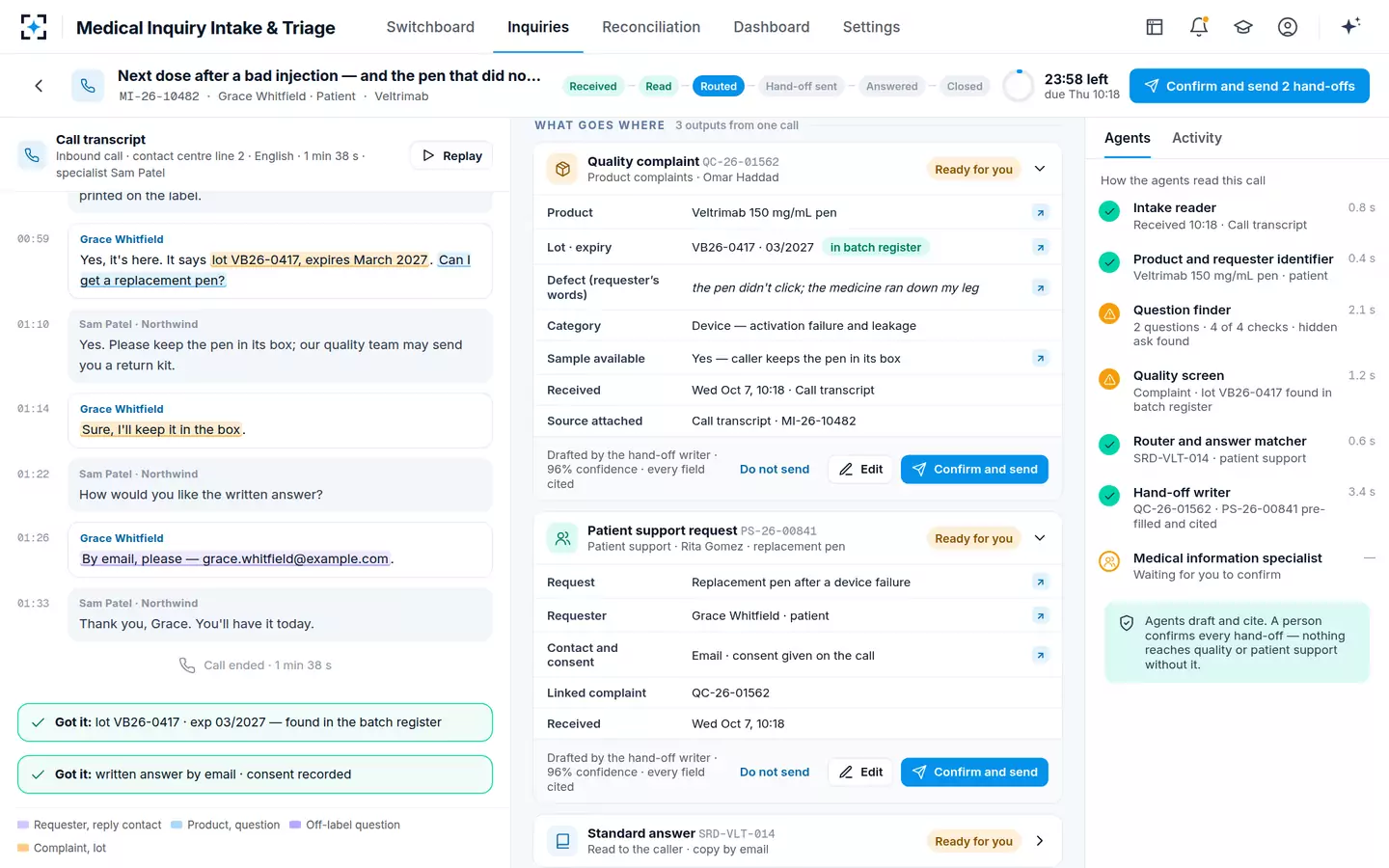
What the specialists lose is the retyping: writing up call notes after the caller has gone, hunting the complaint back out of those notes, keying a lot number twice, keying a support request a third time. What they keep is every judgement — which medicine, whether a defect was described, whether a question belongs to the reviewer, whether an inquiry can be closed with no reply. The desk's own design target is a median of 11 minutes from receipt to a confirmed hand-off; it is a design goal in the product, not a measured result, and a two-week replay on your own closed inquiries is the way to find out what it would be on yours.
Questions people ask
What do AI agents do in a medical information team?
They read every inquiry from every channel, decide how many separate requests it holds, identify the medicine and the requester, spot a described product defect and capture its lot and expiry, match each question to an approved standard response or route it to a custom answer, medical review or patient support, and pre-fill the hand-offs with each field tied to the passage it came from. The deciding, approving, sending and signing stay with the specialists, the medical reviewer and the intake lead.
Can AI detect a product complaint in a call?
It can detect that a defect was described, which is the part that gets missed. In the product's sample call the sentence "the pen didn't click" arrives after the dosing question has been answered, and the quality screen opens a device complaint for activation failure and leakage from it. Two limits are built in: a storage mistake by the user is answered rather than filed unless a defect is actually described, and the complaint is a draft until a person confirms it.
Can AI send a response to a healthcare professional?
Not on its own in this product. Agents propose only approved, current standard responses, and anything custom or outside the label goes to the medical reviewer. FDA's draft guidance on unsolicited off-label requests expects answers to come from medical or scientific staff who stand apart from sales and marketing, which an agent is not; what it can do is assemble the background and narrow the question before those personnel start.
What does FDA expect of AI used in a regulated process?
There is no rule covering contact-centre triage. FDA's January 2025 draft guidance on AI supporting regulatory decision-making asks for a written context of use and a risk assessment built from model influence and decision consequence, and the January 2026 principles issued jointly with the European Medicines Agency ask for human-centric design, a well-defined context of use and performance assessed across the complete system including human-AI interactions. A quality team can hold a triage system to those without claiming they bind it.
How does AI handle an off-label question?
By recognising it and declining it. A question about a population, dose or route of administration the label does not describe is flagged and routed to the medical reviewer with the requester's exact words and the fact that the request was unsolicited. In the sample data this is how a feeding-tube question buried in an interaction email reaches a reviewer at all — the agent that found it is not permitted to answer it.
What happens to a question the agents cannot match to an approved answer?
It becomes a custom answer for the medical reviewer, on a longer clock than a standard response — five business days against two in the product's settings — and the requester's own sentence travels with it. Nothing is answered from an unapproved or withdrawn document, and nothing waits silently: the question carries its own clock from the minute of first receipt, so an unmatched question is visible as a question, not as an inquiry that looks closed.