A medical information call center is the desk a patient, caregiver, physician, pharmacist or nurse reaches when they have a question about a medicine: dosing, interactions, storage, travel, supply, cost. The specialist's job on the call is to hear the question, give an approved answer or route it to someone who can, and write down enough for anyone who reads it later. The job is harder than it sounds for one reason: a single call often holds more than one request, and the second one tends to arrive after the first has been answered and the specialist has started typing. Botminds' Medical Inquiry Intake & Triage reads the call while it is still happening, so the second request gets its own answer, its own route and its own clock. This page follows one call from the first ring to the month that was signed four weeks later.
Everyone and everything in that call is sample data in the product: Grace Whitfield, Northwind Bio, the medicine Veltrimab and the lot on the pen are invented, as are the specialists. The research figures are from peer-reviewed studies and are linked where they appear. One boundary first: this work routes product complaints to quality and access requests to patient support, and it does not classify, assess or report adverse events — that stays with the safety team the desk hands over to.
What the published evidence says about the calls a desk takes
2,937
separate questions decomposed from 1,467 consumer health requests
almost exactly two per request
53%
of the pharmacy-specific queries to Sweden’s drug information centres concerned two or more medicines
32 of 60 such queries
67%
of calls to a medical centre’s drug information service finished within five minutes
168
inquiries read by the agents in 24 hours, median 9 seconds each
sample data in the product
What happens in a medical information call center?
Four things happen on every call, in roughly this order: the specialist works out who is asking and about which medicine; hears what is actually being asked; gives an approved answer, or says who will; and captures enough that the call can be acted on by someone who was not there. The last of these is where the work splits in two. Some of it has to happen while the caller is on the line — the lot number on the pen, the spelling of a clinic's name, the consent to pass a request to patient support, how they want the written answer — and the rest can be done afterwards, which is exactly why it often is not done at all.
The channel still dominates. Across the medical information function, the contact centre "accounts for nearly two-thirds of inquiries" (Guillot et al., 2023), and in a two-year survey of 8,558 questions at one medical centre, "Telephone was the main route" of advice (Hou et al., 2018). Whatever a digital roadmap says, most of what a medical information desk knows about its medicines in use still arrives as a voice.
10:18 to 10:24: one call, minute by minute
Wednesday 7 October, 10:18. Grace Whitfield calls the Northwind Bio patient line about her Veltrimab pen. What follows is the product's sample call, drawn from first receipt to the moment both hand-offs were acknowledged by the departments that received them.
The call, and everything it started, across six minutes
- Requester, medicine, questionfrom 10:18
- Lot, consent, four of four checkson the call
- Three draftsshe hangs up
- Confirmed, sent, acknowledged+6 min
Read the lane as two halves. Everything up to the fourth block happened while Grace was still on the line, and none of it could have happened afterwards: the lot number, the consent, the channel for the written answer. Everything after it is work that used to take the rest of the shift.
The call read turn by turn, while the caller is still talking
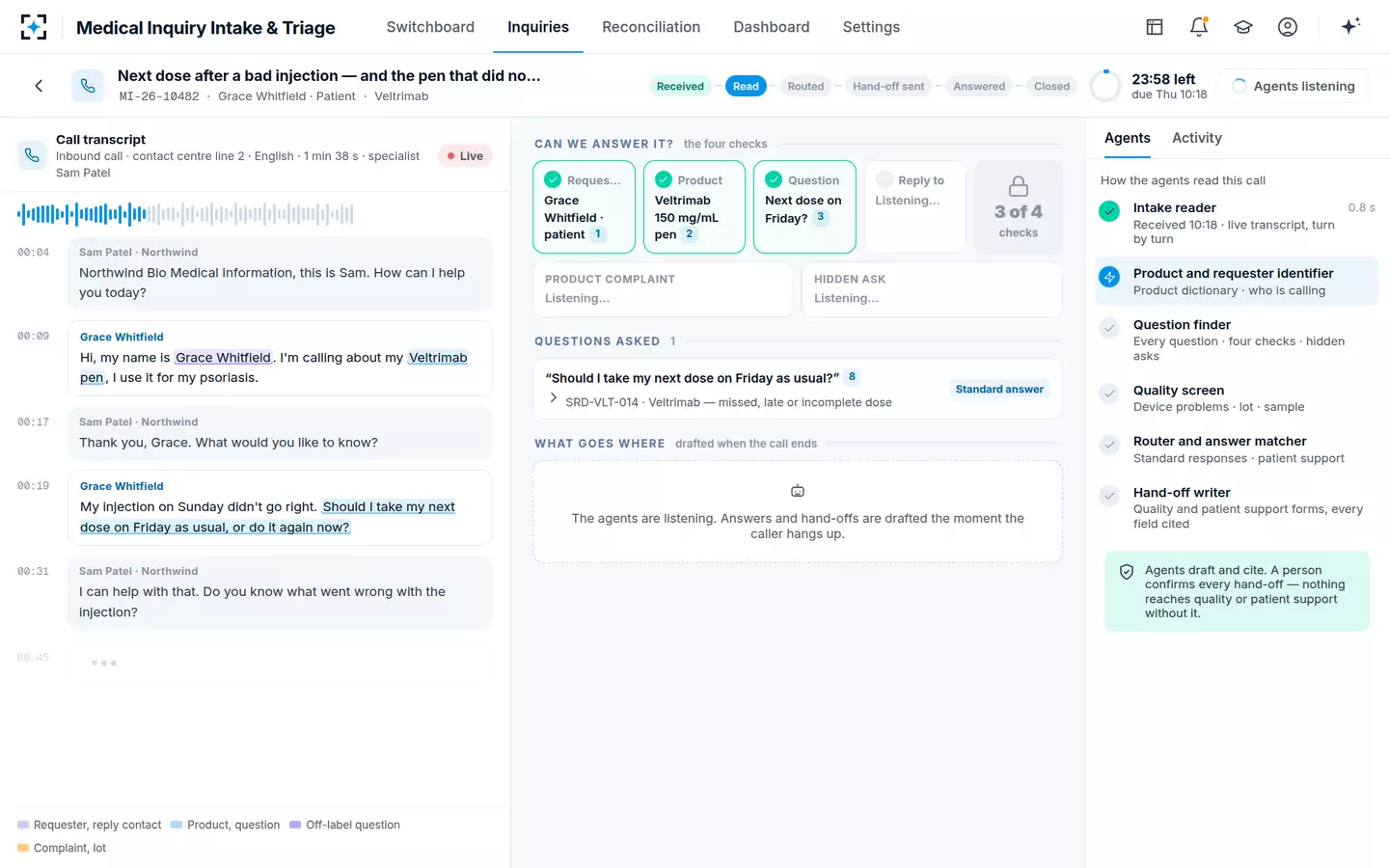
How many questions does one inquiry actually contain?
About two, on one published measurement. Researchers at the U.S. National Library of Medicine broke a set of consumer health requests into their component questions and reported that "This decomposition process results in 2,937 questions from the 1,467 GARD requests" (Roberts et al., 2014) — an average of 2.0 questions per request.
The pattern holds in professional queues too. In an analysis of 767 queries sent to Sweden's drug information centres between January 2023 and May 2024, of the sixty queries judged specifically pharmaceutical, 32 — just over half — were about two or more drugs (Asker et al., 2025). More than one medicine usually means more than one answer, and sometimes more than one owner.
Against that, a desk measured on first call resolution is being measured on the first question. Nothing in the metric notices the second one, which is why a desk can post excellent numbers and still be leaking work into other departments.
The ask on the way out, and why the queue buries it
At 45 seconds, with her dosing question answered and the specialist already typing, Grace said the sentence the whole call turns on.
Oh — the pen didn’t click. I held it for the ten seconds but the medicine ran down my leg.
Grace Whitfield, the product’s sample call — a fictional caller
Nothing about that sentence announces itself as a complaint. It begins with "oh", it arrives as an aside, and it comes after the part of the call the specialist has already written down. Under queue pressure it is heard, acknowledged sympathetically, and then lost between the end of the call and the next one ringing — because the only place it exists is the specialist's short-term memory, and the notes get written after the caller has gone.
What the system does with it is unglamorous: it opens a device complaint for activation failure and leakage, right then, from her words, and turns the call towards quality while she is still able to answer questions about it. The sympathetic acknowledgement still happens. It is just no longer the only thing that happens.
A complaint opens mid-call, and the fourth check closes
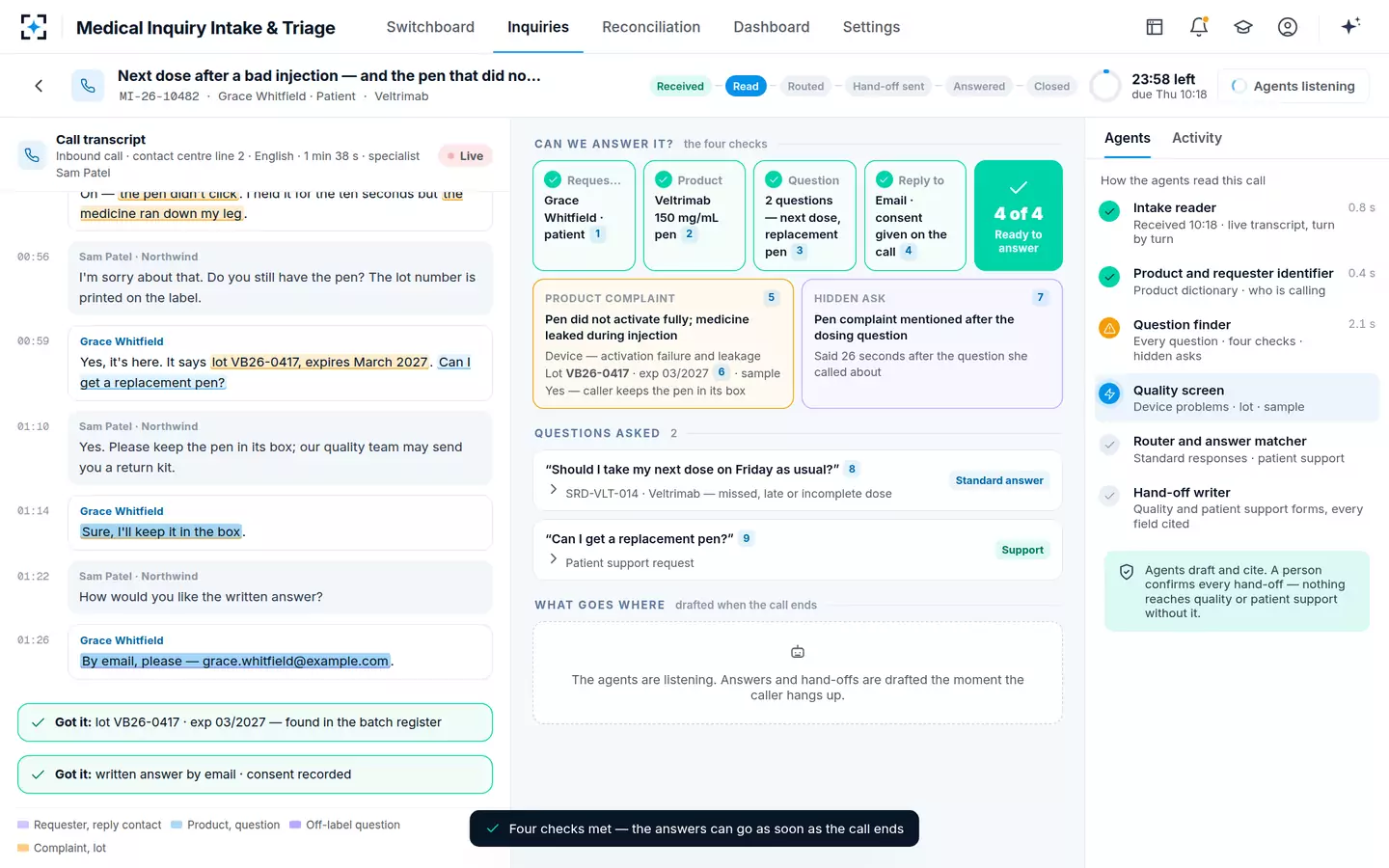
Hearing a lot number read aloud
A lot number is a string of digits spoken over a phone by someone who may be upset, and it is one of the most valuable things a quality investigator will ask for. "Zero four one seven" becomes VB26-0471 in a hurried transcription as easily as VB26-0417, and the two differ by a transposition nobody can detect by reading the complaint afterwards.
So the number is checked while the caller still has the pen. In this call the lot and expiry were found in the batch register before the complaint draft existed, and a lot that did not match would have produced a prompt to have her read it again rather than a complaint carrying an unverifiable number. The cost of getting it right is one question on a call that is already happening. The cost of getting it wrong turns up a month later, as a complaint filed against a batch that was never made, and a real defect on a real batch that nobody can see.
The four checks, closed while the caller is still listening
Four things have to be true before an answer can go anywhere: who is asking, which medicine, what was asked, and where to reply. Three of them are usually settled in the first half-minute of a call. The fourth — where to reply — is the one that tends to be assumed, and it is the one that quietly decides whether the answer ever arrives.
On this call Grace asked for a replacement pen and for the written answer by email, which closed the fourth check and recorded her consent to be contacted and to have the request passed to patient support, in one sentence. On a different inquiry the same morning a nurse left no email and no phone at all, and the desk had to decide rather than guess — what the agents do when they are not sure is a question worth its own page.
Three outputs from one call, and the clock on each
One short conversation produced three separate pieces of work for three different teams, each with its own commitment. The table below takes three lines of what was actually said and shows what each filled in and what each started.
Three sentences from one call, the fields they filled, and the clocks they started
“Should I take my next dose on Friday as usual, or do it again now?”19 seconds in
What it filled inThe question itself, matched to the approved standard response on a missed, late or incomplete dose. Requester and medicine were already confirmed from the first seconds of the call.
What it startedThe standard answer clock — two business days in this desk’s settings, counted from 10:18.
“Oh — the pen didn’t click. I held it for the ten seconds but the medicine ran down my leg.”45 seconds in
What it filled inA device complaint: activation failure and leakage, with the defect written in her words rather than a category someone chose afterwards.
What it startedThe hand-off clock to quality — one business day, due the next morning at 10:18, because the clock runs from the call and not from the form.
The lot number read off the pen label, and “can I have a replacement, and the answer by email?”on the same turn
What it filled inLot and expiry, checked against the batch register before anything was written; her consent to be contacted, the channel she wants, and the replacement request.
What it startedThe hand-off clock to patient support — one business day — and the reply contact check, the fourth of four.
The three outputs went to three places: a quality complaint for the product complaints team, a patient support request for the replacement pen, and the approved answer read to Grace on the call and sent to her by email. Each carries the passage of the transcript it came from, so the person receiving it can see what was actually said rather than a summary of it. What quality then does with the complaint — including the three-working-day evaluation that decides whether it becomes a field alert — belongs to quality, and that clock is set out separately.
What happens after a medical information call ends, and what month end finds
Traditionally, this is where the hours go. The call ends, the notes get written, the complaint is retyped into the quality system, the support request is retyped into a third system, and someone checks and sends both — and all of it sits behind a queue, which is where much of the elapsed time accumulates.
Where the handling time for one call goes, by hand and with the agents
By hand · about 4.75 hours of elapsed handling
- Waiting in the queue before anyone writes it up · 2 h · 42.1%
- Writing up the notes after the caller hangs up · 0.5 h · 10.5%
- Finding every question and the complaint in the notes · 0.5 h · 10.5%
- Retyping the complaint with lot, expiry and sample · 0.75 h · 15.8%
- Retyping the patient support request · 0.5 h · 10.5%
- Checking and sending to both teams · 0.5 h · 10.6%
With the agents · about 0.16 hours, roughly ten minutes
- Writing up · 0.02 h · 12.5%
- Finding every question · 0.02 h · 12.5%
- Drafting the complaint · 0.03 h · 18.8%
- Drafting the support request · 0.03 h · 18.8%
- A person checks and sends · 0.06 h · 37.4%
Four weeks later the same call shows up again, in the monthly match between what the desk sent and what the two receiving systems hold. That match is where the differences surface, and they are rarely dramatic: a hand-off that went to a backup mailbox which bounced on 18 September and never arrived; a request sitting in patient support with no matching hand-off on the desk's side; a hand-off sent on a Friday evening that patient support recorded as arriving on the Monday, which makes a one-business-day clock look met when it was not. On the quality side, a complaint entered as lot VB26-0471 — a lot the batch register does not contain — against a call in which the caller had read out VB26-0417.
Both hand-offs confirmed by a person, and acknowledged by the teams that got them
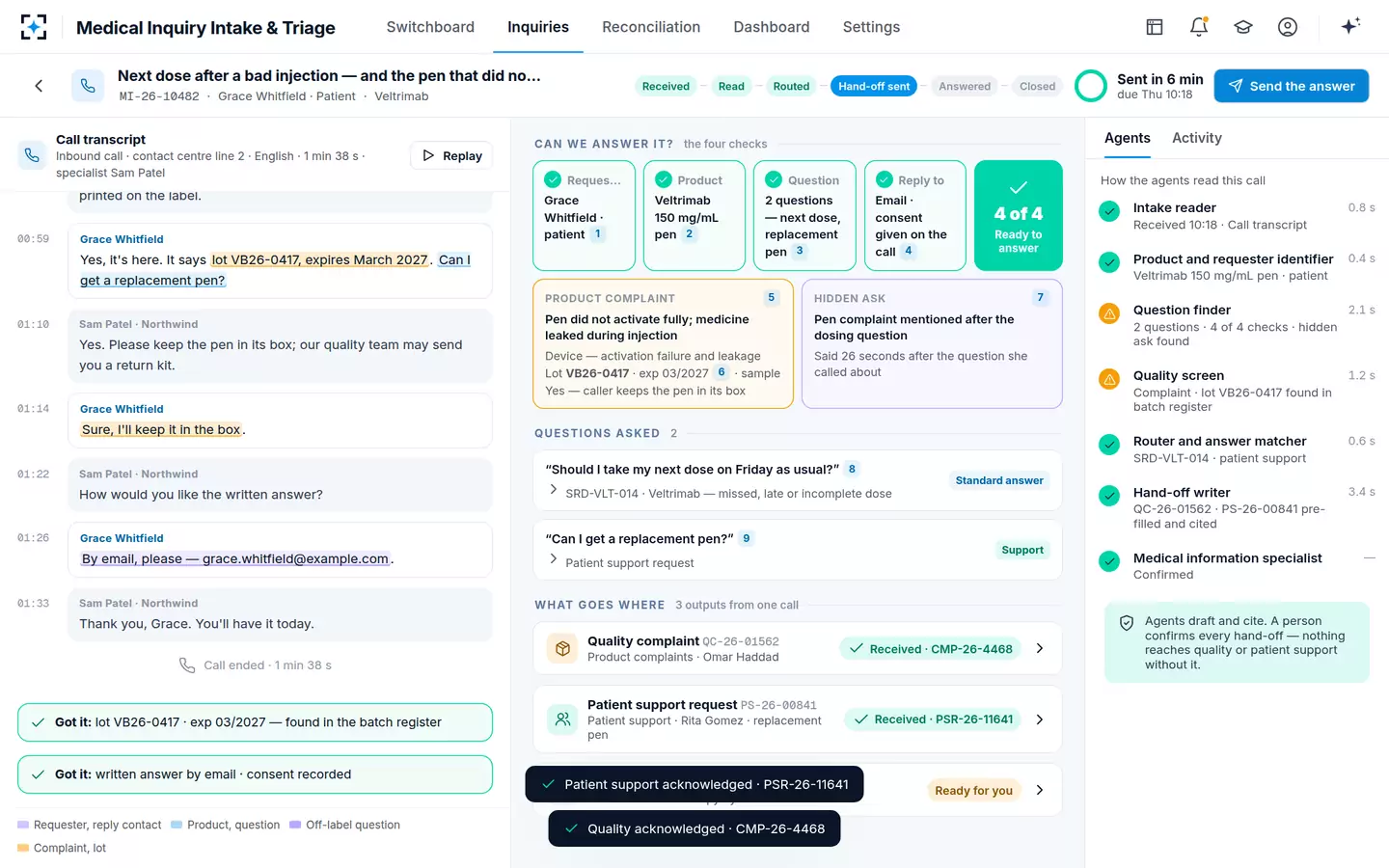
Each difference comes with the evidence from the delivery log and a proposed correction, and the intake lead signs the month with the meaning of the signature recorded. None of those differences could have been found by asking the desk what it sent, because the desk's own view is exactly the one that is wrong.
What changes for the specialist, and what does not
What changes is the typing. The specialist no longer writes up the call after the caller has gone, no longer re-reads their own notes hunting for the complaint, and no longer keys a lot number into a second system. What stays is the call itself — the listening, the judgement about whether a defect was really described, the decision about whether a question belongs to the medical reviewer, and the human part that the published research says the caller actually notices.
That last point is measurable. An analysis of more than 4,484 medical information contact-centre telephone interactions over six and a half years scored the agent behaviours that correlate with the caller's experience; for the skill of taking the lead in the conversation, "Demonstration of this skill was correlated to a CX score of 90% compared with 72% when not demonstrated" (Guillot et al., 2023). Eighteen points, on a behaviour that needs the specialist's attention to be on the caller rather than on a form. The agents are not an answer to that problem, but they do remove the thing competing for the attention.
The desk's own target is a median of eleven minutes from receipt to a sent hand-off. It is a design goal in the product rather than a figure measured on anyone's live desk, and the honest way to find out what it would be on yours is a replay on calls you have already closed.
Questions people ask
How long does a medical information call take?
Most are short. In a two-year survey of 8,558 questions at one medical centre's drug information service, 67% of calls were completed in five minutes. That is the answering time, not the handling time: the writing up, the complaint, the support request and the sending all come afterwards, and in the product's own estimate they account for several times the length of the call itself.
What happens if a caller mentions a product problem?
It becomes a complaint for the quality team, and the useful question is when. If it is captured during the call, the lot number, the expiry, the defect in the caller's words and whether a sample can be returned all come from the person holding the pen. If it is reconstructed afterwards from notes, each of those is either missing or remembered. In the product the complaint opens mid-call and a person confirms it before it is sent.
What is a hidden ask in a medical inquiry?
A request the caller never put up front: a complaint after a dosing question, an off-label question in the second paragraph of an email about an interaction, a cost problem mentioned while thanking you. It is not hidden deliberately — it simply is not the reason they made contact. The published decomposition of consumer health requests into roughly two questions apiece suggests they are common.
Who listens to medical information calls?
The specialist on the line; a quality monitoring reviewer afterwards, on a sample; and, in a desk like this one, the agents reading the live transcript turn by turn. The last of those changes what the first can do, because a prompt to ask for the lot number arrives while it is still useful. It does not change who is accountable: a person confirms every hand-off before it leaves the desk.
What is first call resolution in medical information?
Answering the caller's question during the first contact, without a call-back or a hand-off. It is a reasonable measure of an answer desk and a poor measure of an intake desk, because it counts the question that was asked and is silent on the one that was mentioned on the way out. A desk that is measured only this way has no incentive to find the second request, and no record of having missed it.
What does a medical information call center do that patient support does not?
Medical information answers questions about the medicine — dosing, interactions, storage, administration — from approved, current responses, and refers anything outside the label to a medical reviewer. Patient support handles access: replacement product, copay, coverage, supply. One call can need both, which is why the consent to pass a request across, and the contact details to act on it, have to be captured on the call rather than assumed afterwards.