A medical information letter carries the signature of a medical information specialist, the person who reads healthcare professionals' questions about a company's medicines, finds the approved and published evidence that answers them, writes or checks the reply, and signs it. The signing is the part of the job that is hard to delegate and easy to underrate. Everything that happens before it — the split of a question into its parts, the search, the drafting, the balance, the references — exists so that one named person can put their name to a sentence that says the reply is accurate, balanced and specific to what was asked. Botminds' Medical Information Response is built around that fact: seven agents read, route, retrieve, draft, guard and check, and none of them signs. A medical information specialist does, and a medical reviewer adds a second signature whenever any part of the letter is off-label.
The four people on this page are a fictional sample desk's: Northwind Bio Medical Information, with Priya Raman, Omar Haddad, Dana Okafor and Maya Chen. The people, products and figures from their screens are invented. The signature rule and the departmental hours come from the sources linked under each figure.
What does a medical information specialist do all day?
Four things, in roughly descending order of time. Reading questions and working out what is actually being asked — which part of a multi-part question the label speaks to, which it does not, and whether the question is clear enough to answer at all. Finding the evidence: the current standard response, the labeling in force for the requester's country, data on file approved for external use, and the published literature, including what does not support the use asked about. Writing or checking the reply so that every factual sentence is traceable to a passage. And signing it, or routing it to the person who will.
Two things the job is not. It is not customer service, though it sits on the same channels — phone, portal, e-mail, chat and the field team: it answers scientific questions for a company whose commercial side it must stay apart from, which is a different job with a different standard. And it is not medical writing: a medical writer produces documents, while a specialist produces answers to questions that have already been asked, which is a narrower and more constrained task.
What the day actually feels like is a queue with clocks on it. On the sample desk the inquiry list carries thirteen open questions at once, five of them ready for the specialist, three with the agents drafting, one in medical review and four sent — each with a product, a channel, a route, a label status, a stage and a due time. Some will be answered in the conversation; some need a standard response sent unchanged; some need a letter written from scratch.
Who may answer an off-label question — and who may not
FDA is specific about the staffing of this work, and it is one of the few places where guidance names a reporting line. "Responses to unsolicited requests for information should be generated by medical or scientific personnel independent from sales or marketing departments." The agency goes further and describes the training it expects those personnel to have: "specialized backgrounds in responding to unsolicited requests for information, including important training, such as appropriately narrowing questions, tailoring responses only to the specific questions being asked, providing unbiased responses, and properly documenting responses."
Because sales and marketing personnel are focused by training and experience on promoting a firm's products, FDA recommends that sales and marketing personnel have no input on the content of responses to unsolicited questions or requests for off-label information.
FDA, Responding to Unsolicited Requests for Off-Label Information, December 2011
The sentence to notice is "no input on the content". Not no involvement in the process: no input on the content. A representative may pass a question on. A commercial colleague may not suggest a phrase, propose an emphasis or ask for a paragraph. That is the line the independence requirement actually draws, and it is why companies commonly place the medical information function outside the commercial reporting line.
The field medical role sits in an awkward middle. A medical science liaison is medical or scientific personnel, so nothing forbids one from discussing scientific data. But FDA's Example 5 makes clear what happens when a liaison or a paid speaker presents off-label data at a company-sponsored promotional event and attendees then ask for more: those requests are solicited. The liaison's answer is governed by how the conversation started, not by the liaison's job title. In practice the clean arrangement is the one the sample desk uses — the liaison relays the question, medical information answers it in writing, and the request is confirmed with the prescriber first.
Three desks a healthcare professional's question can land on, and what each may do
| Desk | Who they are | What they may do with an unapproved use | What they sign |
|---|---|---|---|
| Medical information | Pharmacists and scientists in a department independent of sales and marketing, answering questions the company was asked. | Answer an unsolicited question in writing, with the disclosure, the balance, the references and the labeling, privately to the requester. | The response letter, attesting that it is accurate, balanced and specific to the question asked. |
| Field medical | Medical science liaisons who meet prescribers in person, also outside the commercial line. | Discuss published science within the rules that govern how the conversation began — and relay a question to medical information rather than answer it in writing. | Nothing that goes to the prescriber as a company answer; the written reply comes from medical information. |
| Pharmacovigilance intake | The safety function, which takes reports of adverse events and product complaints. | Nothing. Its job is capture and assessment of a safety report, not an answer about a use. | The safety record, on its own regulated timetable. |
The four people behind one letter
One letter on the sample desk passes four pairs of hands, and each pair answers for something different. Reading them as four accountabilities rather than four job titles is what makes the structure legible: the specialist answers for the reply, the medical reviewer for the unapproved part of it, the manager for the system that produced it, and the standard response owner for the wording it reused.
Four desks, one letter: what each person answers for
Today
Searches the library, the label and the literature, pastes paragraphs into the template and checks every claim by hand. "I don't need a faster writer. I need to see where every sentence came from."
With agents
Opens a composed letter with a source on every paragraph and the passage one click away, decides the checker's findings, and signs.
Still theirs: the signature on every letter, and the judgement about whether the answer is specific to what was asked
Today
Reads every off-label letter looking for advice that should not be there. "If a letter about an unapproved use tells a doctor what to do, it is promotion."
With agents
Sees the disclosure, the balance, the references and any sentence the guard struck, with its reason, before he adds the second signature.
Still theirs: the second signature on anything off-label, and the decision to restore a struck sentence
Today
Owns the clocks and the country templates, and watches the same question get answered differently. "The same question comes in six times and gets six different letters."
With agents
Sees volume, turnaround, citation coverage and field-submitted request checks on one screen, and the recurring questions that need a standard response.
Still theirs: the clocks, the templates and who may sign what
Today
Approves new and updated standard responses for her products. "A retired standard response must never come back through an old letter."
With agents
Only current versions are cited; wording reused from a retired version is flagged sentence by sentence, and new drafts arrive cited for her approval.
Still theirs: approval of every version of the documents she owns
What a signature on a medical information letter actually means
Under the FDA electronic-records rule, a signature is not a mark but a record of three things. A signed electronic record has to show, clearly, the signer's printed name, the date and time the signature was made, and what the signature means — review, approval, responsibility or authorship (21 CFR 11.50). The rule adds that all three must appear in any readable form of the record, so they have to appear on the printout, not only in a database.
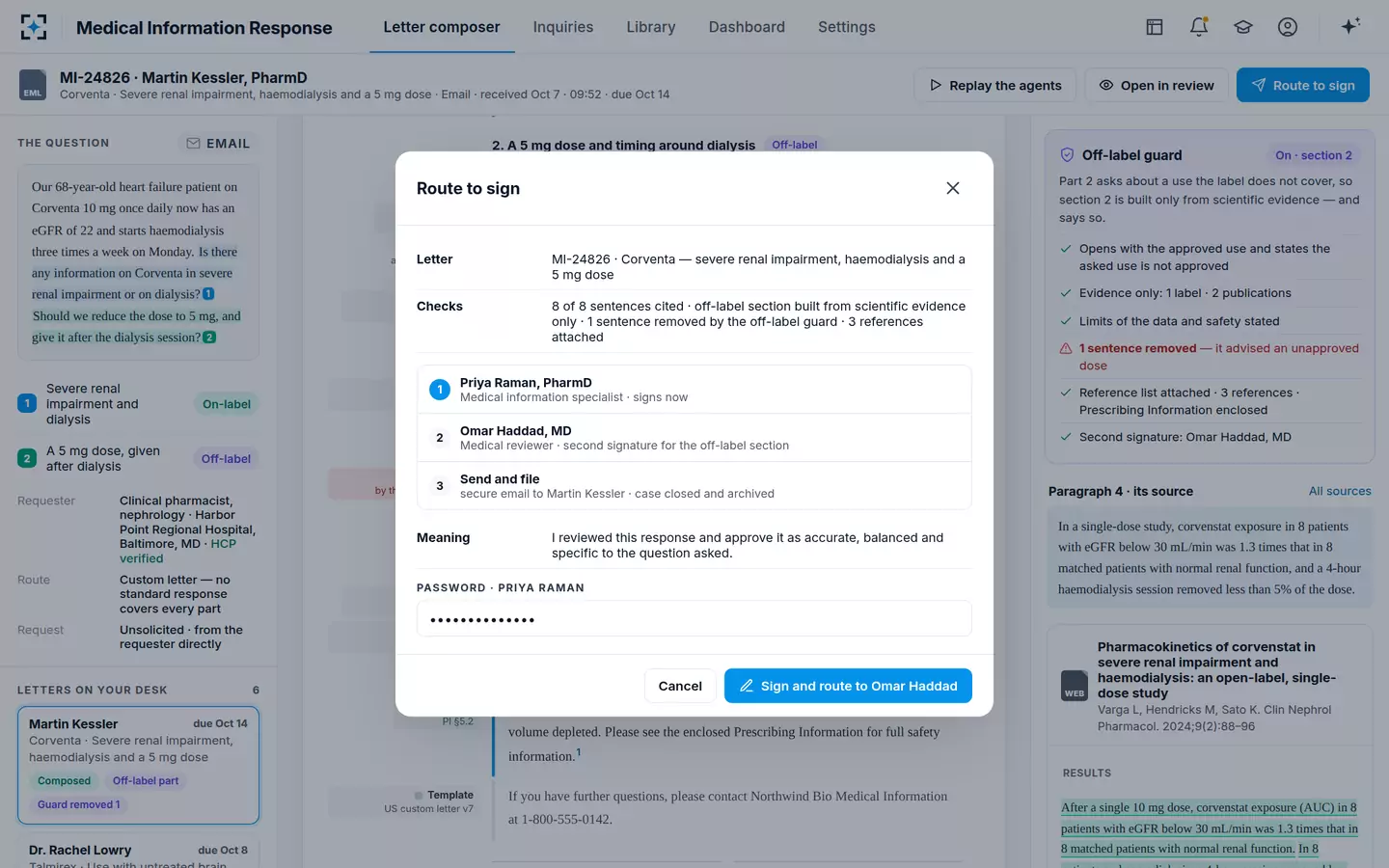
The third item is the one systems most easily get wrong. "Signed by Priya Raman at 10:24" records a name and a time and says nothing about what she was asserting. A signature whose meaning is not stated cannot be relied on later, because nobody can say whether it meant she wrote the letter, read it, or approved it as accurate. On the sample desk the meaning is printed on the signing dialog in the specialist's own words: "I reviewed this response and approve it as accurate, balanced and specific to the question asked."
What the signature records, and what each of the two signatures asserts
| What is recorded | The rule | In the sample letter |
|---|---|---|
| The printed name of the signer | 21 CFR 11.50(a)(1) | Priya Raman, PharmD, then Omar Haddad, MD. |
| The date and time the signature was executed | 21 CFR 11.50(a)(2) | Oct 7 at 10:24 for the first signature; the second follows before the letter is sent at 10:47. |
| The meaning associated with the signature | 21 CFR 11.50(a)(3) | First: "I reviewed this response and approve it as accurate, balanced and specific to the question asked." Second: medical review of the off-label section, against five named attestations. |
| All three in any human-readable form of the record | 21 CFR 11.50(b) | Name, time and meaning appear on the signing screen, on the letter and in the archived file. |
| Who may give each signature | Not a regulation — a company control | A setting: custom letters signed by any medical information specialist, or by medical information pharmacists only; a second signature required on letters with off-label content. |
The checks, the route, and the meaning of the signature, on one screen
When does a letter need a second signature?
Whenever any part of it is off-label — and the trigger is a property of a part rather than of the letter. A question with an approved first half and an unapproved second half produces a letter that needs two signatures, because the second section does. On the sample desk that is a setting the manager owns: a second signature on letters with off-label content, with the second signer named by role.
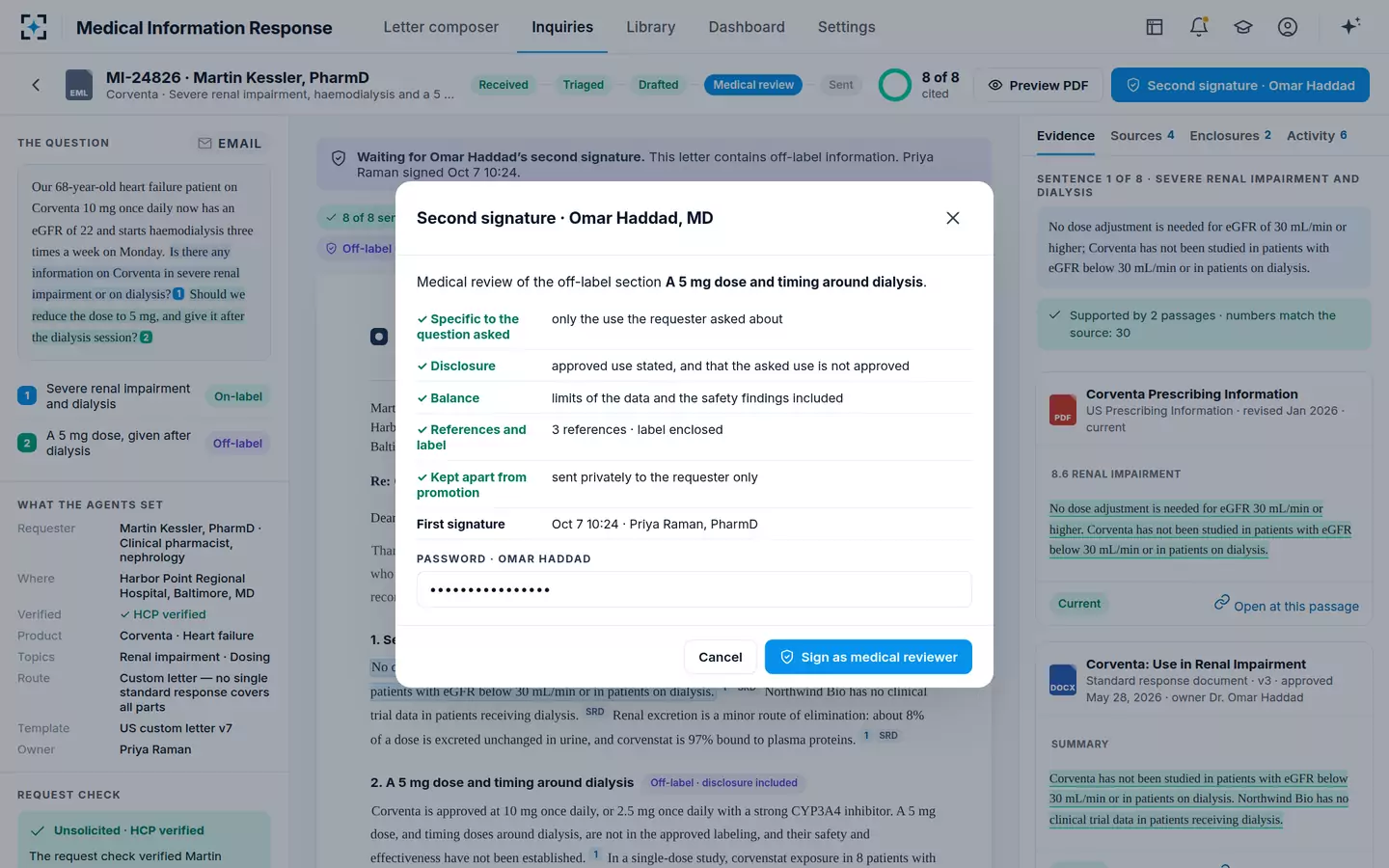
What the second signature is for is narrower than a second opinion. The medical reviewer is not re-checking the arithmetic; he is answering for the five things that make an off-label section lawful rather than promotional. His screen lists them, and he signs against the list rather than against a general impression of the letter.
What the medical reviewer answers for on an off-label section
- Specific to the question asked
Only the use the requester asked about — not the adjacent use the evidence would also support.
- Disclosure
The approved use stated, and the plain statement that the asked use is not approved, in front of the evidence rather than after it.
- Balance
The limits of the data and the safety findings included, including what does not support the use.
- References and label
The references attached in full and the labeling enclosed — on this letter, three references and the Prescribing Information.
- Kept apart from promotion
Sent privately to the requester only, with nothing promotional travelling alongside it.
- And every sentence the guard struck, with its reason
A removed sentence returns only with the medical reviewer's signature, so the reviewer sees what was taken out as well as what remains.
The second signature: an attestation, not a countersignature
Must the person who signs be a pharmacist?
No rule requires it. FDA asks for "medical or scientific personnel" with specialised backgrounds and the training it lists; it does not name a credential. In practice many departments recruit from pharmacy — PharmD graduates, drug information residents and hospital pharmacists — because the work is drug information work, and because a pharmacist has already been trained to answer a clinical question from the literature and the label rather than from experience. Physicians, PhDs and nurses do the job too, and the medical reviewer who gives a second signature on an off-label section is often a physician, as on the sample desk.
Where a credential does become a rule is inside a company's own controls. On the sample desk, who may sign a custom letter is a setting with two positions: any medical information specialist, or medical information pharmacists only. That is a real decision with a real cost — the narrower setting slows the queue — and it is the kind of control that is easier to defend than to undo, which is why it belongs to the manager and sits on the audit trail with everything else.
What the desk costs, and where the hours go
The published figures on this are departmental rather than per-person, and they are about standard responses rather than letters: an average of 8.3 hours to create a new standard response document and 3.8 hours to update one, across 614 new documents and 1,352 revisions in a year, from a survey of phactMI member companies published in JMIR AI in 2025. The survey's small number of respondents — 16 companies took part — makes those numbers an order of magnitude rather than a benchmark.
What the same survey says about where the hours go is the more useful finding, because it is about the nature of the work rather than its volume. Asked which steps take the longest and which are the most tedious, respondents gave two overlapping answers, and the overlap is the whole point: the slowest part of the job and the part people most dislike are the same part, and it is not the thinking.
The slowest work and the most tedious work are the same work
Most time-consuming, ranked: Paraphrasing study content.
Most tedious, ranked: Paraphrasing article content.
Most time-consuming, ranked: Checking the data integrity of the paraphrased text against the source publications.
Most tedious, ranked: Writing citations.
Most time-consuming, ranked: Checking the data integrity of the document itself — that the text is cited to the correct publications.
Most tedious, ranked: Editorial changes.
Five of those six entries are transcription and verification: restating what a paper says, checking that the restatement still matches it, and getting the citation right. None of them is the judgement a specialist is employed for. That is the argument for automating this part of the work, and it is also the argument against automating the next part — because the only reason the verification matters is that somebody is about to sign for it.
What the signing seat asks for
The seat asks for something specific. A clinical degree, usually; the ability to read a clinical paper critically and summarise it without changing what it says; the discipline to narrow a question rather than widen an answer; and a tolerance for the particular kind of care that this work needs, where a sentence that is true and well-sourced can still be wrong because its source was retired in June. FDA's own list of the training it expects is a fair job description on its own: narrowing questions appropriately, tailoring responses only to what was asked, giving unbiased responses, and documenting them properly.
What changes when agents draft and a person signs
The mechanical work moves and the accountability does not. On the sample desk the specialist no longer searches three systems and pastes paragraphs into a template; she opens a letter that is already composed, with a source tag on every paragraph and the passage one click away, and spends her time on the two things only she can do — deciding whether the answer is specific to what was actually asked, and deciding each of the checker's findings. The citation checker never accepts its own finding. It proposes, with the passage it relies on, and a person accepts or rejects.
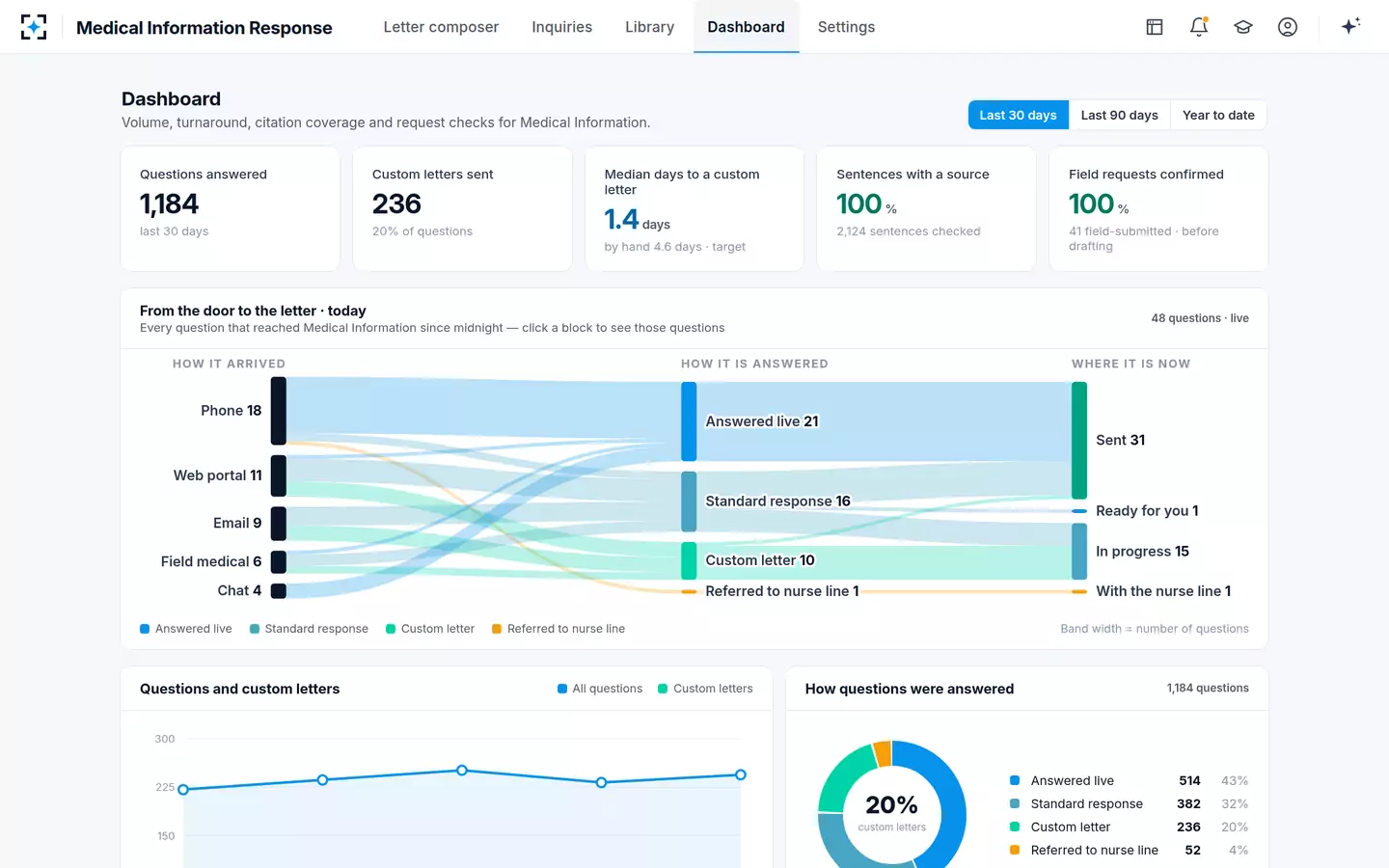
The manager's job changes more than the specialist's. What a dashboard of 1,184 questions in thirty days, 236 custom letters, every one of 2,124 checked sentences carrying a source, and all 41 field-submitted requests confirmed before drafting gives Dana Okafor is not speed — the solution's 1.4-day median is a design target, not something she has measured. It is the ability to answer a question an auditor will ask — what proportion of your letters cite their sources, and how do you know — with a number rather than an assurance.
The desk a manager can answer for: volume, turnaround and citation coverage
What has not moved is the part that carries the company's name. A letter about an unapproved use that tells a prescriber what to do is promotion, whoever or whatever wrote the sentence, and the only reliable defence is a person who read it and said so. Where the authority boundary should sit between a chatbot, an agent and a person is the argument behind that design, and the anatomy of the letter itself is what the signature is given over. To see the signing route and both signatures, start from Medical Information Response.
Questions people ask
Who signs a medical information response letter?
A medical information specialist signs every letter, and where any part of it concerns an unapproved use a medical reviewer adds a second signature for that section. Neither signature is a formality: under 21 CFR 11.50 each has to record the signer's printed name, the date and time it was executed, and the meaning associated with it, and all three must appear in any human-readable form of the record.
What does a signature on a medical information letter mean?
Whatever the system says it means — which is why the meaning has to be stated. The electronic-records rule gives examples of meanings a signature can carry: review, approval, responsibility or authorship. On the sample desk the first signature's meaning is printed in the signing dialog: "I reviewed this response and approve it as accurate, balanced and specific to the question asked." A signature recorded with only a name and a timestamp cannot be relied on later, because nobody can say what was asserted.
When does a medical information letter need a second signature?
When any part of the letter contains off-label content. The trigger is a property of a section, not of the whole letter, so a question with one approved part and one unapproved part produces a letter that needs two signatures. The second signer answers specifically for the off-label section: that it is specific to the question asked, carries the disclosure, is balanced, has its references and the labeling, and is kept apart from promotion.
Can a medical science liaison answer an off-label question?
A liaison is medical or scientific personnel, so the discussion itself is not forbidden — but what governs the answer is how the conversation started. FDA's Example 5 treats requests that follow a liaison or paid speaker presenting off-label data at a company-sponsored promotional event as solicited. The defensible arrangement is that the liaison relays the question, medical information answers it in writing, and the request is confirmed with the prescriber as their own before anything is drafted.
What is the difference between medical information and pharmacovigilance intake?
Medical information answers a question about a product; pharmacovigilance captures and assesses a report about a patient. A single call can contain both, which is why the handover between them is a design question rather than a detail — an inquiry that also describes an adverse event has to reach the safety function on its own regulated timetable regardless of what happens to the answer. The two functions keep separate records and separate signatures.
How does the job change when AI drafts the letter?
The assembling moves and the attestation does not. The published survey's own ranking of the slowest and most tedious steps — paraphrasing study content, checking the paraphrase against the source, writing citations, checking the citations — describes work that is transcription and verification rather than judgement. What stays with the specialist is deciding whether the answer is specific to what was actually asked, deciding each of the checker's findings, and signing. A draft nobody signs is not a response.