An unsolicited request for off-label information is a question about an unapproved use that someone outside the company asked first, with no prompting from the company or anyone acting for it. FDA's long-standing position is that a firm may answer one: it may send truthful, balanced, non-misleading, non-promotional scientific information that is responsive to the specific request, even when answering means describing an unapproved use. The difficulty is that almost every word in that sentence is a test a reviewer has to apply to the reply in front of them, and a single question often contains an approved part and an unapproved part at once. Botminds' Medical Information Response answers healthcare professionals' questions with agents that read the question, split it into parts, set on- or off-label status for each part, confirm the request was unsolicited, and draft a letter in which every factual sentence links to the passage it came from — for a medical information specialist to sign.
The screens and letters on this page come from a fictional sample desk as it runs through the solution: Northwind Bio Medical Information, its products Corventa, Veltrimab and Talmirex, and the people who answer for the letters. The people, products and companies are invented. The rules are quoted from the regulators who wrote them, linked under each figure.
What FDA asks of one answer to an off-label question
7rules
recommendations FDA makes to a firm answering a private off-label question
5items
that must accompany the answer, from the labeling to a complete reference list
3records
to keep: the request and who made it, what was sent, and any follow-up
1recipient
the answer may go to — the individual who asked, one to one
What makes a request unsolicited?
FDA's test is about who started it, not about who asked or what was asked. "Unsolicited requests are those initiated by persons or entities that are completely independent of the relevant firm," the draft guidance says, and the independence is read widely: health care professionals, health care organisations, academics, formulary committees and consumers all qualify. The second half of the same paragraph is the operative one: "Requests that are prompted in any way by a manufacturer or its representatives are not unsolicited requests" (FDA, December 2011). The phrase to read twice is in any way.
A solicited request is not, by itself, an offence. FDA's position is narrower and more awkward than that: such a request "may be considered evidence of a firm's intent that a drug or medical device be used for a use other than that specifically approved or cleared by FDA." Elsewhere in the same document the agency puts it in one line — "Such activity would not constitute a per se violation of the law, but could potentially be introduced as evidence of a new intended use." The prompt does not create the violation. It creates the exhibit.
That is why the only honest place to settle the question is at intake, before anyone writes anything. By the time a letter is drafted the question has been paraphrased, split and routed, and the trace of how it arrived is the hardest thing to reconstruct. A desk that cannot say, three years later, whether a particular question came from the prescriber or from the representative who was in the room is a desk that cannot defend the off-label section it sent.
From inbox to answer: the four decisions that set the route
Agent
Who asked, and are they a healthcare professional?Reads the question from the portal, e-mail, call log, field medical or chat and verifies the requester against the professional directory. A patient is never answered with a letter written for a prescriber.
Never: answers a patient with a letter built from a professional template
Agent
Was it prompted?Records how the question arrived and who submitted it. When a field team submitted it for a prescriber, the requester is asked to confirm the question was their own before any drafting starts.
Never: writes an off-label section for a request it cannot show was unsolicited
Agent
Public or private?A private one-to-one question can be answered in full, privately. A question asked where a broad audience can read it gets a public reply that carries contact details and no off-label content.
Never: posts off-label detail in the forum the question was asked in
Agent
On or off the label — per partSplits the question into its parts and sets product, indication, topic, country and label status for each part separately, because one e-mail routinely contains both.
Never: sets one label status for a whole question
A person decides
The specialist decides and signsReads the draft, opens the passage behind any paragraph, accepts or rejects each finding, and signs with a signature that states its own meaning.
Never: is skipped — agents draft and a named person signs
Non-public and public requests: why the difference decides the channel
FDA splits unsolicited requests in two. "A non-public unsolicited request is an unsolicited request that is directed privately to a firm using a one-on-one communication approach" — a phone call, a letter, an e-mail, or a form on the firm's own site that only the firm can read. A public unsolicited request is "made in a public forum, whether directed to a firm specifically or to a forum at large."
The firm's obligations diverge sharply from there, and the reason is the audience rather than the content. FDA's concern with public answers is that detailed off-label information posted in a forum reaches "individuals who have not requested such information", and that it stays there: the agency notes the "enduring nature of detailed public online responses to off-label questions because specific drug or device information may become outdated (e.g., new risk information may become available)."
So the recommended public reply is deliberately thin. A firm should respond publicly only when the question names its own product and not solely a competitor's; the public response "should be limited to providing the firm's contact information and should not include any off-label information"; it should say that the question concerns an unapproved use and give the medical or scientific department's contact details; and whoever answers should disclose that they work for the firm. Only after the person has come back privately does the detailed answer follow, by the private route, under the full set of rules below. A specific question — FDA's Example 13 is "Can Drug/Device X be used for Condition Y" — can be acknowledged. A general one such as "What drug can be used for Condition Y", asked where the firm's product is not approved for Condition Y, should not be answered at all.
Eleven of FDA's own examples, sorted into unsolicited and solicited
The draft guidance is unusually generous with worked cases, and they are more useful than the definition. Examples 1 to 3 are unsolicited, and sort the request by where it was asked. Examples 4 to 11 are the ways a firm's own conduct turns a later question into a solicited one. Read them as a list of things a commercial team can do that will cost the medical information desk its ability to answer.
Eleven worked examples from FDA, and the verdict each one gets
Example 1
Someone calls or e-mails the medical information staff asking about an off-label use. Neither question nor answer is visible to anyone else.
Unsolicited · non-public
Example 2
At a live presentation, an attendee asks a firm representative about an off-label use, and the room hears it.
Unsolicited · public
Example 3
Someone posts the question on a firm-controlled website or a third-party forum that a broad audience can read.
Unsolicited · public online
Example 4
A sales representative mentions a use that is not in the approved labeling and invites the prescriber to ask for more.
Solicited
Example 5
A medical science liaison or paid speaker presents off-label data at a company-sponsored promotional dinner; attendees then ask for more.
Solicited
Example 6
Business reply cards, a promotional claim about trials "in a broad range of conditions" with a call-us line, or an exhibit sign reading "Coming Soon, a new use".
Solicited
Example 7
A phone number, e-mail address, URL or username whose wording implies off-label information is available.
Solicited
Example 8
A firm asks users to post videos about their own uses of the product, and the postings provoke off-label questions.
Solicited
Example 9
A firm sends packets to bloggers and encourages them to write about an off-label use, which starts a discussion.
Solicited
Example 10
A firm posts study results on a microblogging service and suggests an off-label use is safe and effective.
Solicited
Example 11
A website lets viewers pull up prepared standard responses from fixed menus of disease states, including off-label ones.
Solicited
Example 11 is the one that catches software. A website that lets a visitor pull prepared standard responses out of fixed menus of disease states, including off-label ones, makes the resulting requests solicited — and so does a search box on such a site that can "generate standard responses that go beyond the scope of the product information being requested." A self-service answer library, built with the best intentions, converts an entire channel from unsolicited to solicited. The useful design consequence is that a professional-facing portal should take a question and route it to a person, not hand back an off-label answer from a menu. What a medical information chatbot may answer, and what it may not, follows that argument to its conclusion.
What an answer to an off-label question may contain
Five properties have to hold at once, and FDA states each as its own recommendation. The answer goes only to the individual who asked, as a private one-to-one communication. It is "tailored to answer only the specific question(s) asked" — and where the question is broad, "the firm should appropriately narrow the question" rather than widen the answer. It is truthful, non-misleading, accurate and balanced, which the agency spells out as providing "applicable data that are not supportive or that cast doubt on the safety or efficacy of that use", and sending representative publications that reach contrary conclusions where the literature is split. It is scientific in tone and presentation, and must not travel alongside promotional material. And it is written by medical or scientific staff who are independent of sales and marketing.
A response should provide non-biased information or data relating to the particular off-label use that is the subject of the request, including applicable data that are not supportive or that cast doubt on the safety or efficacy of that use.
FDA, Responding to Unsolicited Requests for Off-Label Information, December 2011
Two practical rules sit underneath the balance requirement. The first is about what gets attached: the response "should include complete copies of scientific reprints, technical literature, or other scientific and medical information responsive to the request, not just summary documents or abstracts prepared by the firm", and the firm should rely "to the greatest extent possible" on published peer-reviewed articles, medical texts or independent data. Unpublished data on file may go in if it answers the question, supporting or not. The second is about risk from adjacent uses: if there is information about known or suspected risks tied to another condition that is also relevant to the one asked about, it belongs in the answer even though nobody asked for it.
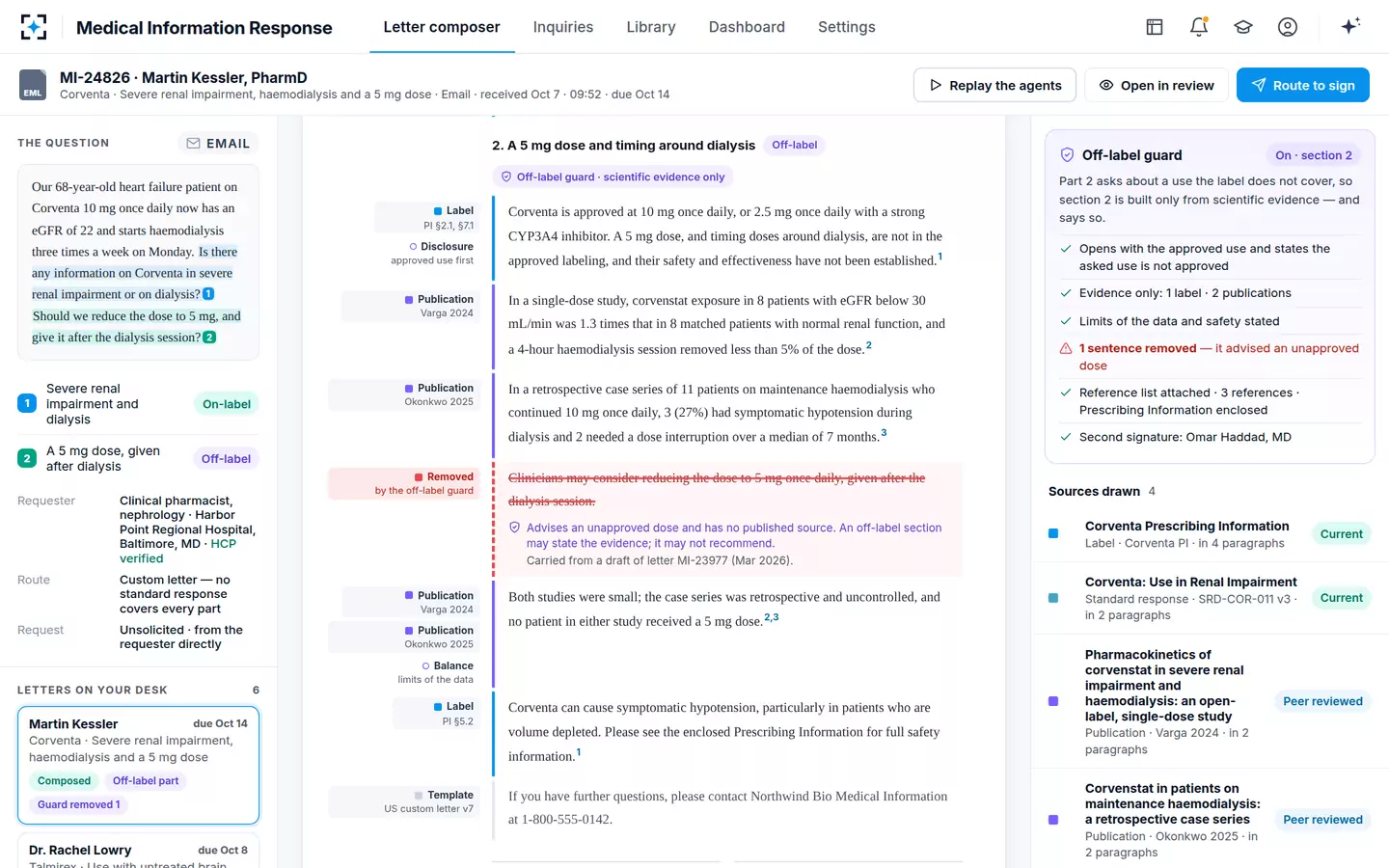
In the sample letter on the screen below, the off-label section opens with the approved dose, states plainly that the dose and timing the prescriber asked about are not in the approved labeling, gives the two published studies with their size and design, then the limits — both studies small, the case series retrospective and uncontrolled, no patient in either study given the 5 mg dose — and the hypotension warning from the label. One sentence that had been carried over from an earlier draft letter, advising a 5 mg dose after dialysis, is struck with its reason: it advises an unapproved use and has no published source.
The off-label section, in order, with the advisory sentence struck
The five things that must travel with the answer
FDA's sixth recommendation is a packing list, and it is a part of the rule that is easily half-done. Each of the five items is there to stop a specific reading of the response as promotion: without the labeling the reader has no approved reference point, without the not-approved statement the answer reads as an endorsement, without the approved indications the unapproved one stands alone, without the safety information the balance is missing, and without the reference list the claims cannot be traced.
The five things FDA says must accompany an off-label answer
- A copy of the FDA-required labeling, if any
The approved package insert — and for a consumer, the approved patient labeling, or for new animal drugs the approved client information sheet.
- A prominent statement that FDA has not approved or cleared the product for the use addressed
The disclosure belongs with the material provided, not buried in a footer. "Prominent" is FDA's word, repeated for each of the next three items.
- A prominent statement disclosing the approved or cleared indications
The reader has to be able to see what the product is for, beside what they asked about.
- A prominent statement of all important safety information, including any boxed warning
Not the safety relevant to the asked use only: all of it, and the boxed warning if there is one.
- A complete list of references for everything in the response
FDA names what it covers: peer-reviewed publications and medical or scientific texts, and citations for data on file, summary documents or abstracts.
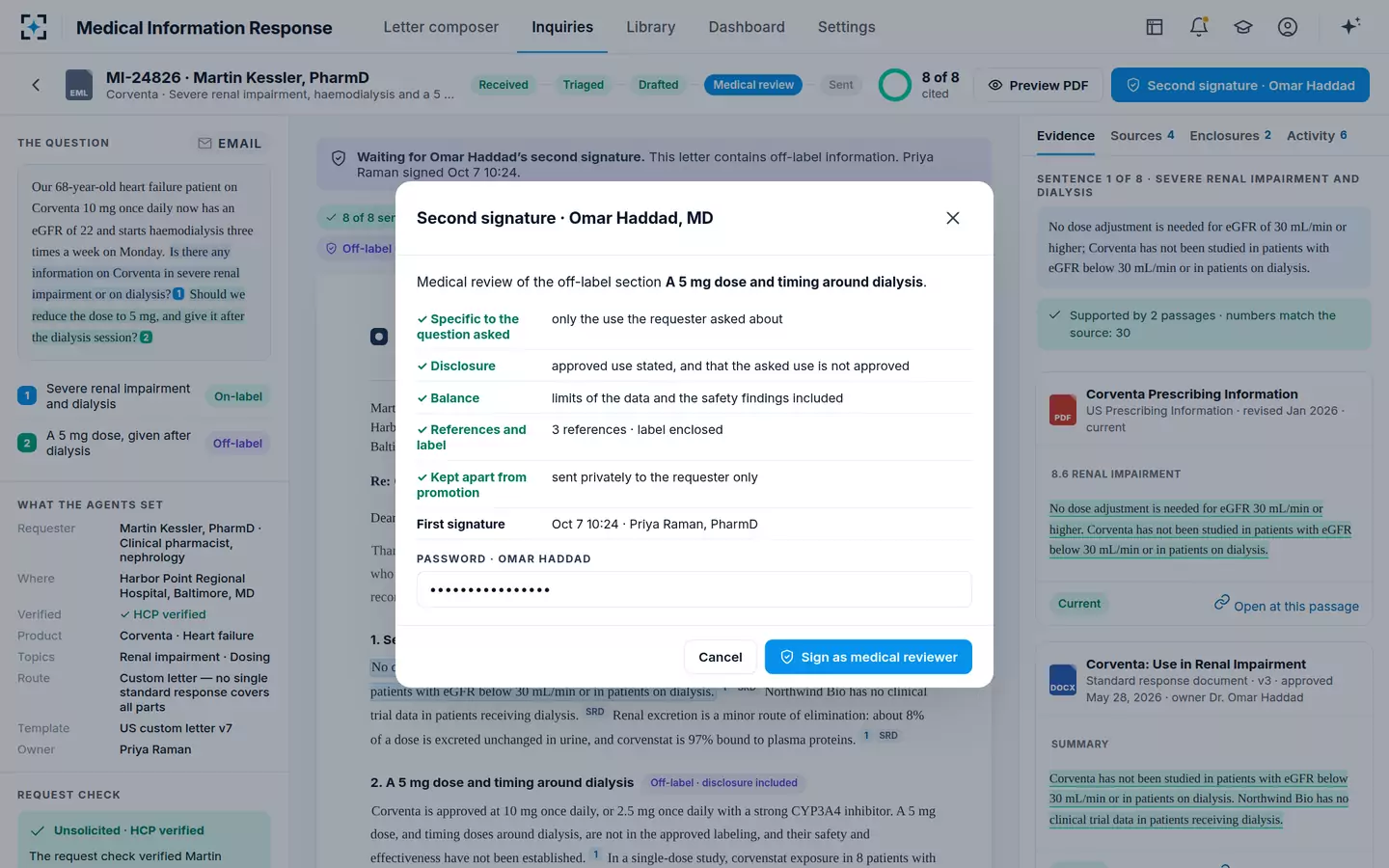
In the solution these five are not a reviewer's memory test. The off-label guard checks the section in order — disclosure, evidence, limits, safety — attaches the reference list and the label, and routes the letter for a second signature; the sample letter goes out with three references and the Prescribing Information enclosed. The medical reviewer's own screen lists what he is attesting to, item by item, rather than asking him to recall the list.
What the second signature attests to, item by item
What records do you have to keep about a request?
Three, and FDA's seventh recommendation names them. They are short enough to look trivial and specific enough to be the thing a firm cannot produce two years later, because the facts they ask for are known at intake and nowhere else.
The three records FDA asks a firm to keep, and what each one proves later
| What to keep | FDA's words | What it proves |
|---|---|---|
| The request, and who made it | "The nature of the request for information, including the name, address, and affiliation of the requestor" | That the requester was independent of the firm, and that they were the person the answer went to. |
| What was sent | "Records regarding the information provided to the requestor" | That the answer was tailored to the question asked, carried the five accompaniments, and said what the firm says it said. |
| Any follow-up | "Any follow-up inquiries or questions from the requestor" | That the exchange stayed a private one-to-one communication rather than becoming a campaign. |
The consequence the guidance attaches to all seven recommendations is worth stating in full, because it is the whole return on the work: if a firm answers private unsolicited requests in the manner described, FDA "does not intend to use such responses as evidence of the firm's intent that its product be used for an unapproved or uncleared use", and the responses "would not be expected to comply with the disclosure requirements related to promotional labeling and advertising." The records are what turns that intention into something a firm can rely on.
Does the January 2025 FDA guidance change how you answer a question?
Not for an unsolicited request, and the confusion is worth clearing up because the two documents are often merged. In January 2025 FDA published revision 2 of its guidance on communications from firms to healthcare providers regarding scientific information on unapproved uses — SIUU communications. That guidance is about firm-initiated communication: a company deciding to put scientific information about an unapproved use in front of prescribers. Its key tenet is that any "individual firm-initiated communication of scientific information about unapproved use(s)" should be truthful, non-misleading and should "provide and appropriately present all information necessary for HCPs to understand and evaluate the strengths and weaknesses, validity, and clinical utility of the scientific information".
The 2025 guidance says what governs the other case in its own footnotes: FDA "issued a draft guidance with recommendations for firms on responding to unsolicited requests for information about unapproved uses of approved medical products … When final, that guidance will represent FDA's current thinking on this topic." Fifteen years on, the December 2011 document is still a draft, and it is still the reference. The 2025 guidance was also issued carrying, on its pages, the line "Not for Current Implementation—see PRA statement in section VI", because its information-collection provisions were then under review at the Office of Management and Budget.
Answering a question and starting the conversation: two documents, two rulebooks
Responding to unsolicited requests (December 2011 draft): Someone completely independent of the firm, with no prompting from it.
Scientific information on unapproved uses (January 2025, revision 2): The firm. Every recommendation is written for a firm-initiated communication.
Responding to unsolicited requests (December 2011 draft): Only the individual who asked, as a private one-to-one communication.
Scientific information on unapproved uses (January 2025, revision 2): Healthcare providers, as an audience the firm chooses to address.
Responding to unsolicited requests (December 2011 draft): Five accompaniments: the labeling, the not-approved statement, the approved indications, all important safety information, and a complete reference list.
Scientific information on unapproved uses (January 2025, revision 2): A longer list, adding the labeling limitations for the unapproved use, contraindications, serious risks known to the firm, any REMS, and the firm's employees or paid contributors among the publication's authors.
Responding to unsolicited requests (December 2011 draft): Published peer-reviewed articles, medical texts or independent data to the greatest extent possible; complete reprints, not firm-written summaries.
Scientific information on unapproved uses (January 2025, revision 2): Source publications describing studies "that are scientifically sound", with all material limitations of design, method and results, and any conflicting conclusions from other sound studies cited.
Responding to unsolicited requests (December 2011 draft): Not distributed with promotional material, and scientific in tone and presentation.
Scientific information on unapproved uses (January 2025, revision 2): "SIUU communications should be separate from promotional communications about approved uses of medical products."
Responding to unsolicited requests (December 2011 draft): Still a draft, fifteen years on, and still what FDA points to for unsolicited requests.
Scientific information on unapproved uses (January 2025, revision 2): Issued as final guidance, but marked "Not for Current Implementation" while its information-collection provisions were under review.
The practical reading for a medical information desk is that the 2025 guidance is a useful standard of care for what a scientific answer should disclose, and not a new rule for the inbox. A letter that answers a question the firm was asked already satisfies most of it, and nothing in it licenses a firm-initiated follow-up to someone who asked once.
The same question in the UK and in Canada
Two other regulators a global desk will meet reach the same answer by different routes, and each adds a detail the US guidance leaves out. The UK's Blue Guide excludes the reply from the definition of an advertisement at all. Health Canada works from the other end, listing the two circumstances in which a reply becomes promotional.
One off-label question, three regulators
| Rulebook | What it says about answering | The detail it adds |
|---|---|---|
| FDA, December 2011 draft guidance (US) | A firm may answer with truthful, balanced, non-misleading, non-promotional scientific information responsive to the specific request. | Five accompaniments, three records, one recipient, and medical or scientific staff with no input from sales or marketing. |
| MHRA Blue Guide (UK) | "Correspondence, possibly accompanied by material of a non-promotional nature, to answer a specific unsolicited question about a medicinal product" is not an advertisement. | The prohibition on advertising unlicensed medicines "does not prevent a factual answer to an unsolicited question" about an unlicensed medicine or an off-label use — but "any activity that appeared to be designed to solicit such questions would be likely to be considered promotional". |
| Health Canada, advertising and other activities (Canada) | A reply to a request for information may be considered promotional in two cases. | It is promotional if "the inquiry has been encouraged in any way by the manufacturer", or if an answer about unauthorised products or indications "is communicated by sales or marketing personnel". |
Two details change drafting rather than policy. The UK's warning is about the activity around the answer: anything that appears designed to solicit off-label questions is likely to be treated as promotion, so the helpful extra paragraph that invites the next question is the risk, not the answer itself. And Health Canada's second condition is about who speaks, not what is said — the same sentence is non-promotional from the medical information desk and promotional from a representative. A global desk that writes one letter per country template, each tagged with the country whose label it quotes, is answering three regulators with one piece of work. The solution's templates are per country for exactly this reason, and a letter cites the label for the requester's own country first.
Where a question a field team submitted fits
This is the hardest case on a real desk, and the one the rules leave to the firm. A medical science liaison visits a prescriber, the prescriber asks something the liaison cannot answer, and the liaison submits it to medical information. Nothing has been prompted — but the paper trail now has a company employee's name on the request, and FDA's Example 5 makes clear that a liaison presenting off-label data and then taking questions has solicited them.
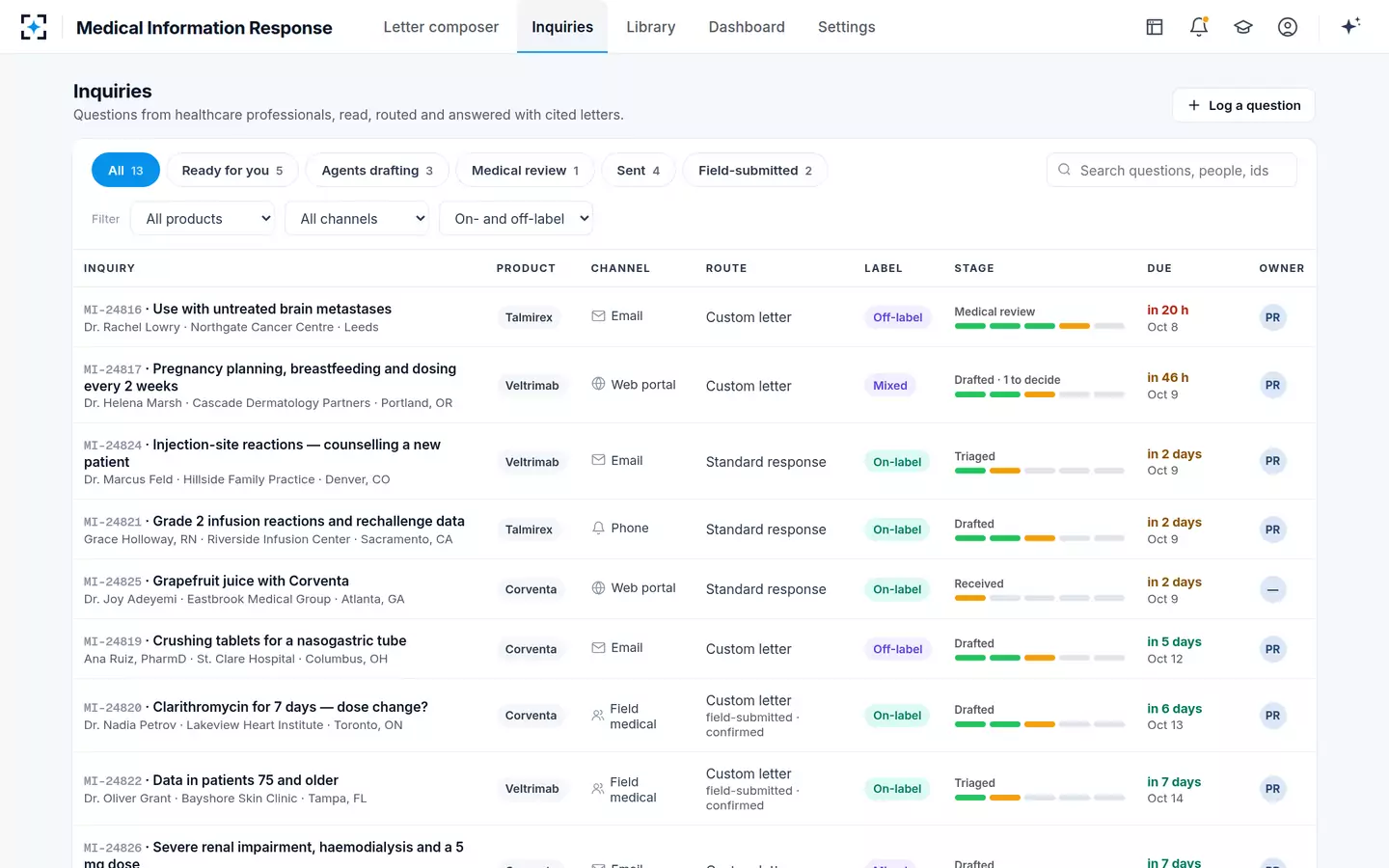
The distinction that holds is whether the question was the prescriber's own. The practice that makes it auditable is to go back and ask. In the solution a request submitted by a field team is confirmed with the requester before any drafting starts, inside one business day, a clock the desk's own settings cannot change; the inquiry list marks those requests "field-submitted · confirmed" beside the route. On the sample desk's last thirty days, all 41 field-submitted requests were confirmed with the requester before drafting. Where the origin is unclear, the request check asks rather than assumes, and a question that was prompted by a representative never receives an off-label section at all.
Every question with its channel, route and label status — including the field-submitted ones
What all of this adds up to is a desk that can answer the awkward question honestly. The alternative some desks fall into is a blanket refusal to discuss anything off-label, which is not what any of the three regulators requires and which leaves the prescriber to find the information somewhere with no label and no balance. What belongs in each section of the letter itself takes the next step, and who signs it, and for what covers the people whose names go on it. To see the route, the guard and the signatures together, start from Medical Information Response.
Questions people ask
Can a pharmaceutical company answer an off-label question?
Yes, if the question was unsolicited. FDA's long-standing position, restated in its December 2011 draft guidance, is that firms can respond to unsolicited requests "by providing truthful, balanced, non-misleading, and non-promotional scientific or medical information that is responsive to the specific request, even if responding to the request requires a firm to provide information on unapproved or uncleared indications or conditions of use." The UK's Blue Guide reaches the same answer by excluding such replies from the definition of an advertisement.
What makes a request solicited instead of unsolicited?
Any prompting by the firm or anyone acting for it. FDA's wording is that requests "prompted in any way by a manufacturer or its representatives are not unsolicited requests", and its examples run from a sales representative inviting a question to a website that serves prepared off-label answers from a menu. A solicited request is not in itself a violation of the law, but FDA says it "could potentially be introduced as evidence of a new intended use."
Does the answer have to go only to the person who asked?
Yes. Whether the original question was asked privately or in public, FDA says a firm that chooses to respond "should provide the final response containing the requested off-label information about its product only to the specific individual who requested the information as a private, one-on-one communication." A public question gets a public reply carrying only the firm's contact details, and the substantive answer follows privately.
Can you answer an off-label question posted publicly online?
You can acknowledge it, but not answer it in the forum. FDA recommends responding publicly only where the question names the firm's own product, and limiting the public response to contact information for the medical or scientific department, with a statement that the question concerns an unapproved use and a disclosure that the responder works for the firm. The detailed answer goes by private one-to-one communication once the person follows up.
Can a sales representative ask medical information a question for a doctor?
A question relayed by a company employee is not automatically solicited, but it has to be verified rather than assumed, and FDA is explicit that sales and marketing personnel should have no input on the content of the answer. The defensible practice is to confirm with the prescriber that the question was their own before drafting anything, and to keep that confirmation with the request. Where a representative prompted the question, no off-label section should be written at all.
Can you answer an off-label question in the UK or Canada?
Yes, with limits of their own. The MHRA's Blue Guide says the prohibition on advertising unlicensed medicines "does not prevent a factual answer to an unsolicited question" about an off-label use, while warning that activity designed to solicit such questions would likely be promotional. Health Canada treats a reply as promotional if the inquiry was encouraged by the manufacturer, or if an off-label answer is communicated by sales or marketing staff.