A medical information management system is the system of record for healthcare professionals' questions: it holds the inquiry, the requester, the channel it arrived through, the product and topic, the promised date, the handoffs to safety and quality when an adverse event or a product complaint appears, and the closure. An AI drafting layer does not replace it and should not try. What a department is usually missing is not another database but the step between the record and the reply — finding the passages, composing the letter, tagging each paragraph with its source, guarding the off-label part and checking every sentence. Botminds' Medical Information Response is that layer, and because it is a layer, the joins rather than the features decide whether the project works.
The decision is easier than it looks once the boundary is drawn. One system owns the truth about the inquiry. The other owns the draft and the evidence behind each sentence, and hands both back. Everything else in this guide is detail about that handback: which fields, when, signed by whom, and provable to whom afterwards.
Four numbers that shape the join, not the feature list
6
systems a drafting layer has to join, and none of them is replaced
3records
FDA asks a firm to keep about every request: the request and who made it, what was sent, and any follow-up
7fields
the drafting layer writes back to the case record, each at the moment it happens
1business day
for a requester to confirm a field-submitted question was their own, before any off-label section is drafted
What a medical information management system is for
Three jobs, and a good one does all three well. It is the record: every question with who asked, how it arrived, what product and topic it concerns, and what was promised. It is the clock: the promised date, the escalation, the report that says whether the department met it. And it is the handoff: an adverse event or a product complaint mentioned inside a question has to leave the medical information process immediately and arrive somewhere else, with a time on it.
Those three jobs are why replacing the system is a bad trade. They are validated, audited, connected to safety reporting and understood by everyone in the department. The cost of moving them can be a year or more of work and a new set of risks, in exchange for nothing a healthcare professional would notice.
What it does badly, and why that is not its fault
It does not answer the question. A case system records that a custom letter is owed by Thursday; it does not know which standard response is current, which label applies to the requester's country, which published papers bear on the second half of the question, or which sentence in the draft rests on which passage. Those were never its job.
The consequence is a gap that many departments fill with a word processor. The specialist searches the library, opens the label, reads two papers, pastes paragraphs into the country template, checks every claim by hand and routes the document for signature — then attaches the finished file back to the case. The system of record ends up holding a PDF and no account of how it was made. The work that took the hours left no trace, which is also why it has to be redone from scratch when a reviewer asks where a sentence came from.
One inquiry across two systems: who does what, and where it goes back
A person decides
The desk, on the case systemA question arrives by portal, email, call, field medical or chat and is recorded with the requester, the channel, the product and the promised date.
Never: Never replaced — this stays the record of truth for the inquiry
Agent
Inquiry readerReads the question, splits it into parts and sets product, indication, topic, country and on- or off-label status for each part, then chooses the route.
Never: Never sets off-label status for the question as a whole
Agent
Request checkVerifies the requester in the directory, records how the question arrived and who submitted it, and confirms with the requester when a field colleague relayed it.
Never: Never allows an off-label section on a request that was prompted
Agent
Evidence finderDraws the passages: current standard responses first, then the label for the requester’s country, data on file approved for external use and peer-reviewed literature.
Never: Never retrieves a retired version as current
Agent
Letter writerComposes in the country template, one section per part in the order asked, linking every factual sentence to the passage it came from.
Never: Never writes a factual sentence without a source
Agent
Off-label guardChecks the off-label section in order — disclosure, evidence, limits, safety — and removes any sentence that advises an unapproved use or has no scientific source.
Never: Never lets advice on an unapproved use through
Agent
Citation checkerRe-reads every sentence against its passages for support, numbers, version, balance and promotional wording, and offers corrected wording.
Never: Never accepts its own finding
A person decides
Medical information specialistDecides each finding, reads the letter, and signs with an electronic signature recording the meaning, the name and the time.
Never: Never delegated to an agent
A person decides
Medical reviewerAdds the second signature to any letter containing off-label content, attesting to specificity, disclosure, balance, references and separation from promotion.
Never: Never skipped when an off-label section is present
Agent
Back to the case systemWrites the sent letter, its sources, every decision and both signatures to the case record, and closes it.
Never: Never keeps a second record of truth of its own
Which systems does a drafting layer have to join?
Six, and the direction each one runs is as important as its presence. Two are read-only, three are read-and-write, and one is a confirmation loop with a clock on it.
The six joins, what they carry, and which way they run
| The join | What the layer takes | What it returns | Direction |
|---|---|---|---|
| Inquiry records | The question as asked, the requester, the channel, the product, the promised date. | The split into parts, the route, the drafted letter, the sources, the decisions, both signatures and the closure. | Both ways |
| Standard response library | The current approved version of each standard response, with its owner and review date. | A draft standard response when a topic reaches four or more custom letters in 90 days with none in place — for its owner to approve. | Both ways |
| Labels | The current revision of the USPI, SmPC or Product Monograph for the requester’s country. | Nothing. A label is never written to. | Read only |
| Literature and data on file | Peer-reviewed articles from your subscription and reports approved for external use, with the section and page the passage sits on. | Nothing, but the passages used are recorded against the sentences that rest on them. | Read only |
| Letter templates | The template for the requester’s country — US, Canada in English and French, UK. | The composed letter in that template, with the label enclosed where required. | Both ways |
| Requester directory and consent register | Verification that the requester is a healthcare professional, their consent to reply and how they want the answer. | The confirmation that a field-submitted question was the requester’s own, recorded with a time. | Both ways, with a clock |
What has to be written back to the case record
Everything a reviewer or an inspector would later ask for, at the moment it happens rather than at closure. The test to apply is simple: if the drafting layer were switched off tomorrow, could the department still answer every question about a letter it has already sent, using the case system alone? If not, something is being kept in the wrong place.
Field by field: what the drafting layer writes back, and when
| What is written | When | Why it has to be on the case record |
|---|---|---|
| The split into parts, with on- or off-label status on each | As soon as the question is read, before drafting | It is the decision that governs everything after it, and the one a reviewer will question first. |
| The origin of the question, and the requester’s confirmation where a colleague relayed it | At the check, with a time | The protection for an off-label answer rests on the request being unsolicited. An assertion is not evidence; a timed confirmation is. |
| Each passage used, with its version and section | As the letter is composed | This is the mapping that makes a sentence checkable later without re-deriving it. |
| Every sentence removed, with its reason and where it came from | At removal | A removal is a decision. Without the reason, the only thing on the record is a shorter letter. |
| Each finding, and whether a person accepted or rejected it | At the decision, with the name | A rejected finding is as important as an accepted one, and it is the rejections an auditor will sample. |
| Both signatures, with the meaning, the name and the time | At signature | Required of a signed electronic record, and the thing a second signature is worthless without. |
| The letter as sent, its references and the label enclosed | At send | The record has to hold what the requester actually received, not the last draft. |
Audit trail, signatures and validation evidence
Where records are kept electronically and signed electronically, the expectations are written down and are worth reading as a specification for the join. The controls for closed systems ask for a system validated to be accurate and reliable, to perform consistently as intended and to spot records that are invalid or have been altered; for complete, accurate copies of records the agency can inspect, in both readable and electronic form; and for records protected so they can be retrieved accurately and quickly for as long as they must be kept (21 CFR 11.10).
Clause (e) of the same section is the one to read slowly. It asks for secure audit trails, generated by the computer and stamped with the time, that independently record when an operator entered something or took an action that created, changed or deleted a record — and it says a change must not hide what was recorded before (21 CFR 11.10(e)).
Two ideas in that clause decide an architecture. That the trail records independently means the trail is not a field the application writes when it remembers to. That a change must not hide what came before means an edit adds rather than overwrites — so the sentence as drafted, the finding against it, the decision and the final wording all survive, instead of the last version replacing the story. A layer that edits a draft in place and writes one entry at the end satisfies neither.
The linkage requirement is the other one to put in a scoping document: an electronic signature must be tied to its own record so firmly that it cannot be cut out, copied or moved onto another record by ordinary means to falsify it (21 CFR 11.70). In a two-system design this is where projects go wrong — the letter is signed in one system and stored in the other, and the link between the signature and the exact bytes signed is quietly a filename.
The validation and audit evidence to ask for before go-live
- A written context of use, naming what the layer does and does not do
One page: the layer drafts, cites, guards and checks; it does not sign, does not decide a finding, does not answer a patient and does not hold the record of truth. Everything else in the pack is evidence for that statement.
- Evidence that an edit adds rather than overwrites
Ask to see one letter’s full history: drafted sentence, finding, decision, final wording, each with a time and a name. If the earlier text is gone, the trail obscures previously recorded information.
- A human-readable export of one complete letter and its history
Not a database dump and not a screen. A document a reviewer could hand to an inspector, containing the letter, the sources, the decisions and both signatures.
- The signature linkage, demonstrated
Change one character in a signed letter and show what happens. The right answer is that the signature no longer holds; the wrong answer is that nothing happens.
- Access and authority checks, per role
Who can draft, who can decide a finding, who can sign, who can add the second signature, and who can change a setting — with the evidence that the boundaries are enforced rather than documented.
- Retention that matches your longest obligation
The audit trail has to be retained at least as long as the records it describes. Set it against your longest market obligation, not your shortest.
- A life-cycle maintenance plan for the models
Planned activities to monitor performance over time, because of what FDA calls “the potential for the model’s performance to change over time or across deployment environments”. Name who looks, how often, and what they would act on.
- The list of what stays manual, signed by the same people
The exclusions are part of the evidence. A pack that claims the layer does everything is a pack nobody can validate.
Who owns the clocks, the templates and the approvers after go-live
Your MI manager, and the test of a drafting layer is whether that stays true without a release. These are procedures, and procedures change more often than software: a new market, a new second signer, a clock shortened after an audit, a decision to stop citing congress abstracts.
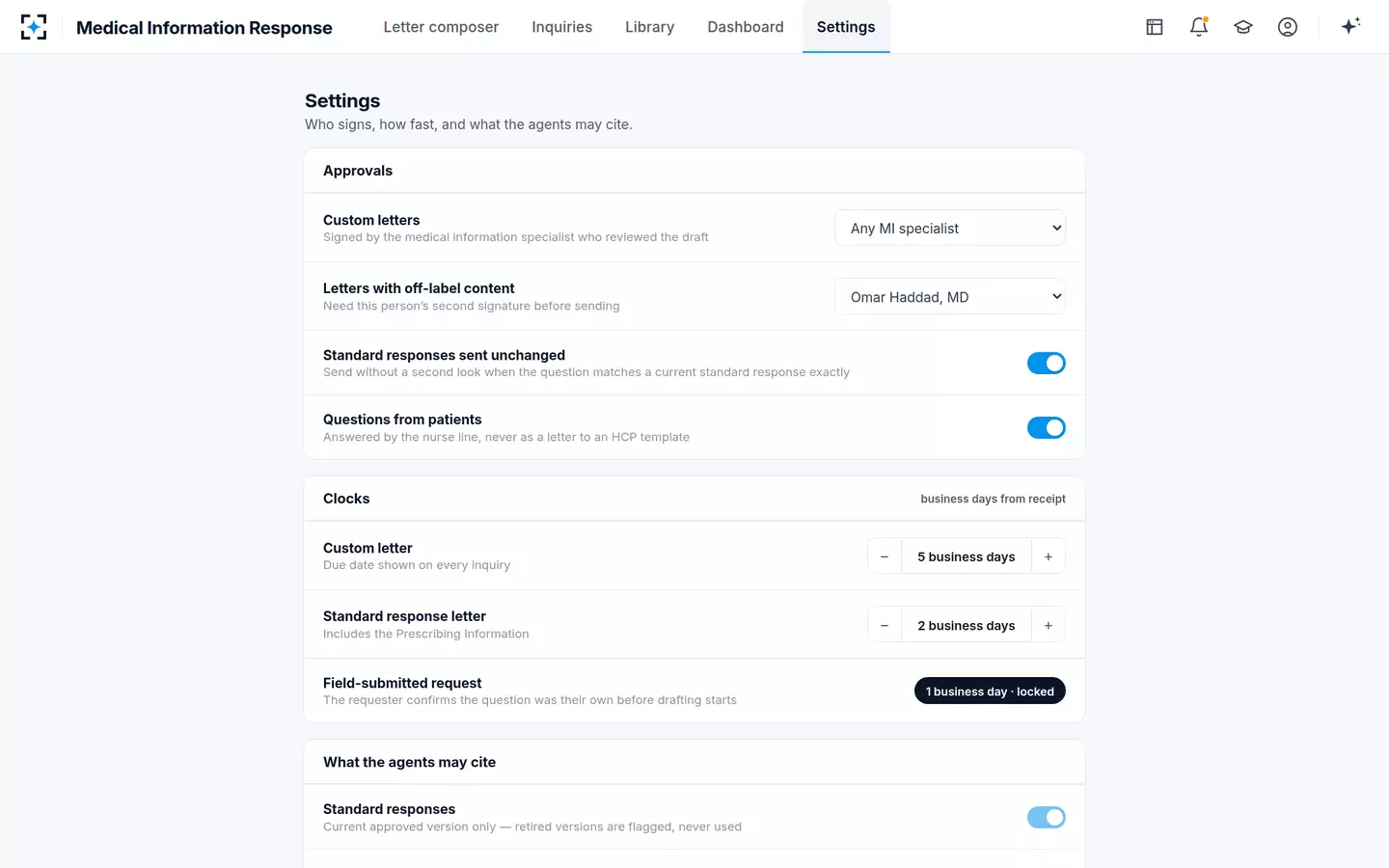
On the sample desk they are settings rather than code. Custom letters are signed by any MI specialist, with MI pharmacists only as the alternative. Letters containing off-label content go to a named medical reviewer for a second signature. Standard responses matching a question exactly are sent unchanged, without a second look. Questions from patients are answered by the nurse line and never on a template written for a healthcare professional. The custom letter clock is five business days and the standard response letter clock two, with the Prescribing Information included, each steppable one business day at a time. Congress abstracts are off, with the option to turn them on with a note that the data are not peer reviewed. And the one-business-day window for a requester to confirm a field-submitted question was their own is locked, because it is the control the off-label protection rests on.
Rules can also be added in plain words — “flag any cited article published more than five years ago”, for instance — and the new rule is recorded on the audit trail like any other change. The people, products and letters in these examples are fictional sample data in the solution, not a customer's results.
Who signs, how fast, and what may be cited — as settings
What should stay manual on purpose
Four things, and naming them is part of the validation evidence rather than an admission.
The signature stays manual. Agents draft and never sign; a specialist reviews and signs every letter, and the medical reviewer adds a second signature to anything with off-label content. The decision on a finding stays manual: the checker offers corrected wording and a person accepts or rejects it, and a sentence the guard removed returns only with the medical reviewer's signature. Approving a new or revised standard response stays manual — the library keeper drafts from signed letters and their sources, and the owner approves. And anything unclear stays manual: a question the reader cannot split confidently goes to a person rather than being guessed at.
There is a fifth that belongs to the case system rather than the layer. An adverse event or a product complaint inside an inquiry should move on the path your safety procedures already define, at the speed they already require. Routing it through a drafting step adds latency to the one thing that must not have any.
Does it need your literature subscription?
Yes, and the licensing question is worth settling before the technical one. A drafting layer that cites a publication must be able to read the passage it cites, which means your subscription has to permit the retrieval, storage and internal reuse the layer performs. Three practical points: the join should return a passage with its section rather than a whole document, because sentence-level citation is impossible otherwise; data on file must be marked as approved for external use, since not everything in the repository may be sent; and congress abstracts should be a deliberate setting rather than an accident of what the index happens to contain, since they are not peer reviewed.
The volume behind this is real. Surveyed medical information departments reported that 87% of respondents included content from at least four studies in documents summarising clinical trial data (JMIR AI 2025) — so a single standard response reaches into the subscription several times over, and a custom letter built from it inherits every one of those reaches.
Keeping medical information apart from the commercial systems
This is a join you deliberately do not build. FDA's guidance recommends that answers to unsolicited requests be written by medical or scientific staff who are independent of sales and marketing, and that sales and marketing staff have no say in what those answers contain (FDA draft guidance, December 2011). A drafting layer that reads from or writes to a commercial system makes that separation an assertion rather than a property of the architecture.
Three concrete consequences for a scoping document. The requester directory the layer verifies against should be the medical one, not a commercial contact database. No part of the letter's content should be reachable from a commercial system, and no commercial record should be updated when a letter is sent. And where a field colleague relayed a question, the layer should treat that as a flag requiring confirmation from the requester rather than as a routine channel.
Do you have to replace your medical information system to use AI?
No. The two routes are set out below, and the right one is usually the second.
Replace it, or sit on it
Replace the case system: Years of inquiry records, attachments and clocks move. Historic cases have to remain retrievable in their original form throughout.
Sit on it, and write back: None. The record of truth does not move, and historic cases are untouched.
Replace the case system: The whole system of record is re-validated, including the safety handoffs that had nothing to do with the reason for the change.
Sit on it, and write back: The layer is validated for what it does — drafting, citing, guarding, checking — against a stated role, with the case system unchanged.
Replace the case system: Adverse event and product complaint routing is rebuilt and re-tested. This is the part easiest to leave out of the budget.
Sit on it, and write back: Untouched, because they stay where they are.
Replace the case system: One system, eventually, with the drafting problem solved somewhere inside it.
Sit on it, and write back: The drafting problem solved, with the sentence-to-passage mapping and the decisions written back to the record you already trust.
Replace the case system: A second migration.
Sit on it, and write back: Switch the layer off. The case system still holds every letter, its sources, its decisions and its signatures.
Where the boundary sits, and who owns each side
The system of record — your case system
- The inquiry as asked, the requester and the channel
- The clocks and the escalations
- Adverse event and product complaint handoffs
- The letter as sent, with its references and the label
- Every decision, removal and signature, with who and when
- Closure and retention
Record of truth. Unchanged by the project.
The drafting and checking layer
- Reading and splitting the question into parts
- Confirming the request was unsolicited
- Finding passages, with version and section
- Composing in the country template, source per paragraph
- Guarding the off-label section
- Checking every sentence against its passage
Drafts and evidence. Holds nothing a reviewer would need on its own.
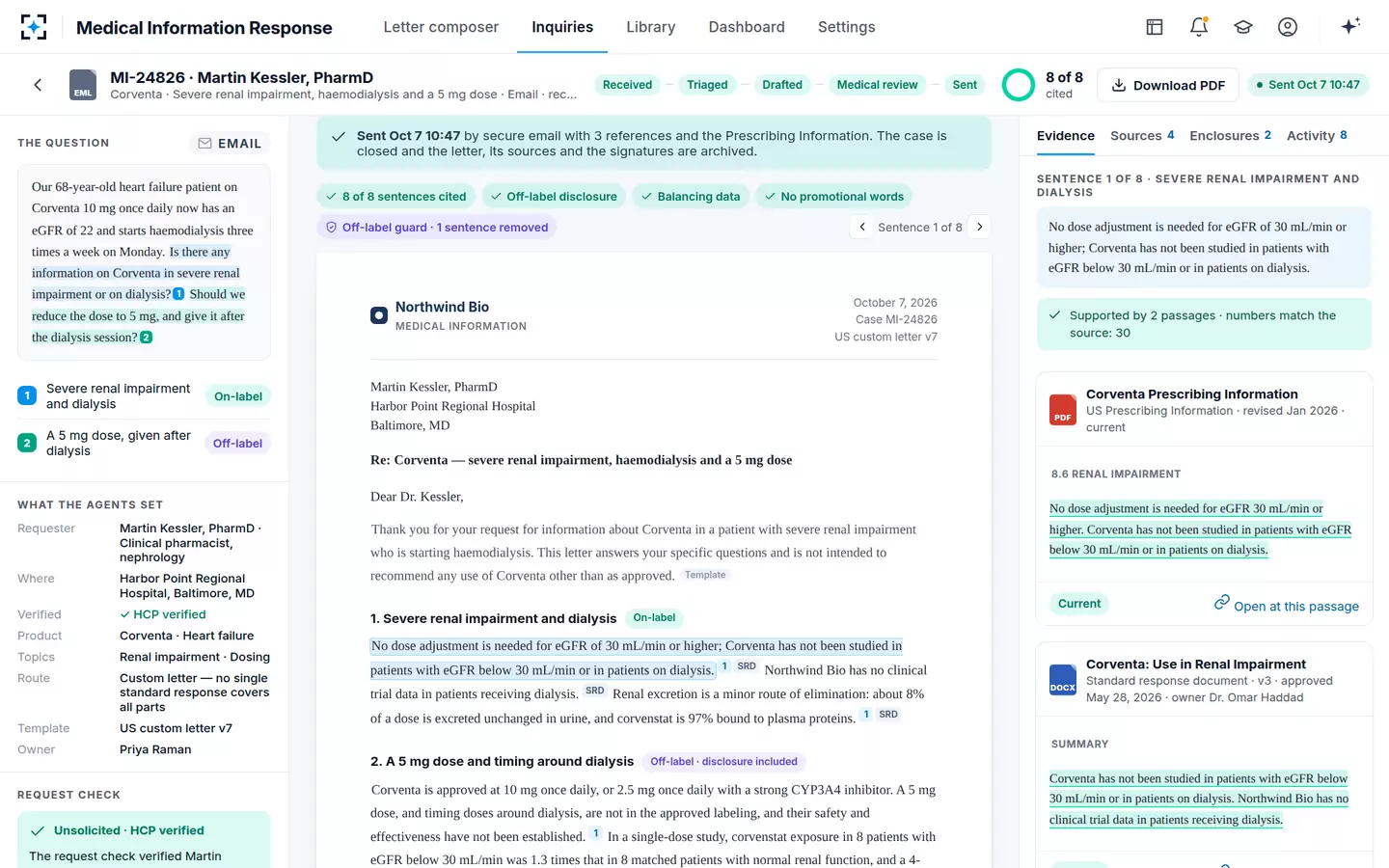
The case closed, with the letter, its sources, the decisions and both signatures
If the joins above describe systems you already run, the shortest way to test the boundary is on your own material — a sample of past inquiries, your standard responses and your templates. Start from Medical Information Response, and how to pilot it and go live sets out what the trial has to establish first.
Questions people ask
What is a medical information management system?
The system of record for healthcare professionals' questions: it holds the inquiry, the requester, the channel, the product and topic, the promised date, the handoffs to safety and quality, and the closure. It records and tracks the work; it does not find the evidence, compose the reply or establish what each sentence rests on. That gap is what departments often fill with a word processor.
What integrations does an AI drafting layer need?
Six: the inquiry records, the standard response library with its versions, the labels for each country you answer in, literature and data on file approved for external use, the letter templates per country, and the requester directory and consent register. Two of those are read-only. The literature join is the one easiest to underestimate — if it returns documents rather than passages with their section, sentence-level citation is not possible whatever else is built.
What audit trail does a regulator expect?
Where electronic records are used, the expectation is secure, computer-generated, time-stamped trails that independently record the date and time of entries and actions creating, modifying or deleting records, and that do not obscure previously recorded information — retained at least as long as the records they describe. In practice that means the drafted sentence, the finding against it, the decision and the final wording all survive with names and times, rather than the last version replacing the story.
Who owns the templates and clocks after go-live?
Your MI manager, as settings rather than as a change request. Who signs custom letters, the second signer for off-label content, whether standard responses go unchanged, how patient questions are handled, both letter clocks and what may be cited should all be editable by the department and recorded on the audit trail. One window is worth locking: the time a requester has to confirm that a field-submitted question was their own, because the off-label protection rests on it.
What should stay manual on purpose?
The signature on every letter and the second signature on anything off-label; the decision on each checker finding; approval of a new or revised standard response; and any question the reader cannot split confidently. Adverse events and product complaints should also continue to move on your existing safety path at its existing speed, rather than through a drafting step. Naming these is part of the validation evidence, not an admission.
How do you keep medical information data away from sales systems?
By not building the join. Verify requesters against the medical directory rather than a commercial contact database, keep letter content unreachable from commercial systems, update no commercial record when a letter is sent, and treat a question relayed by a field colleague as a flag requiring the requester's confirmation rather than as a routine channel. The guidance asks that answers come from medical or scientific staff who stand apart from sales and marketing, and that commercial colleagues shape none of the content — an architecture makes that checkable, a policy only asserts it.