A medical information chatbot that answers a healthcare professional's question about a medicine directly, in the conversation, is the wrong shape for this work — not because the models are bad at language, but because the reply it sends is unreviewed, unsigned and unrecorded, and because the single most consequential judgement on this desk is whether a question concerns an approved use or an unapproved one. That judgement belongs to a part of a question, not to the conversation it arrived in, and nothing in a chat transcript records which way it went. Botminds' Medical Information Response takes the opposite shape: agents read the question, split it, set the status of each part, retrieve the passages, compose a letter with a source on every paragraph and check every sentence against it — and then stop. A medical information specialist signs, and a medical reviewer adds a second signature on anything off-label.
The published studies on this page measured general and clinically-focused chatbots against real drug information questions; each is linked under the figure that uses it. The screens are a fictional sample desk's inside the solution — Northwind Bio Medical Information, with invented people, products and publications.
What happened when 50 real drug information questions went to a chatbot
13of 50
answers with correct content and enough information to act on with no risk of patient harm
38%
of answers were false; another 36% were partly correct
26%
of cases carried a high likely risk of patient harm; 28% a low risk
0refs
no references were provided with any of the answers
Can a chatbot answer a healthcare professional's question about a medicine?
It can produce an answer. Whether it may send one is a different question, and in a regulated medical information department the answer is no — for two reasons that have nothing to do with how good the writing is. The first is procedural: an answer that leaves a company about one of its own medicines is a communication the company is accountable for, and FDA's position is that answers to unsolicited requests should come from medical or scientific staff who are independent of sales and marketing, sent privately to the person who asked, with the labeling, the disclosures and a complete reference list. A chat reply satisfies none of those conditions, and a chat reply about an unapproved use satisfies none of them emphatically.
The second is measured. In a real-world test, 50 questions that had actually arrived at a hospital drug information service were put to ChatGPT and the answers assessed by pharmacists: "only 13 of 50 answers provided correct content and had enough information to initiate management with no risk of patient harm." The majority "were either false (38%, n=19) or had partly correct content (36%, n=18) and no references were provided", and a high risk of patient harm was judged likely in 26% of cases (Morath et al., 2024). That study used one general-purpose model, and the tools have moved since; what has not moved is the shape of the failure. The answers read well and were wrong, and nothing in them let a reader tell which was which.
What has actually been measured on drug information questions
Three studies are worth reading before anyone signs off a chatbot, and together they say something more precise than "AI is unreliable". A 2026 comparison took 30 drug information questions previously answered by drug information pharmacy faculty and put them to four clinically-focused chatbots and to ChatGPT, scoring the answers with three faculty assessors on the validated 25-point CLEAR framework — completeness of content, lack of false information, evidence supporting the content, appropriateness and relevance. OpenEvidence scored highest at 17.82 of 25, followed by ChatGPT at 15.72, both landing in the framework's "average" band; "when compared with faculty responses, all AI chatbots had statistically lower scores", and "few question responses from any chatbot were rated in the 'very good' content category" (Ipema et al., 2026).
The best clinically-focused tool tested scored 17.82 of 25 — inside the “average” band
The third study is the one that complicates the picture usefully. A real-world comparison in a tertiary care hospital found that "some AI tools demonstrated performance comparable with pharmacists for routine drug information questions, while others showed lower reliability, particularly for clinically nuanced responses" — and reported that agreement between its own evaluators was very low, a Fleiss' kappa of 0.015 (Alzahrani et al., 2026). Two conclusions follow. On routine questions the gap is closing. And judging the quality of an answer to a nuanced clinical question is itself hard enough that trained assessors disagree, which means a pilot that scores a tool on a handful of questions with one reviewer has measured very little.
Read together the three say: the tools are adequate on easy questions, measurably worse than specialists on hard ones, weakest exactly where the evidence behind the answer has to be shown, and difficult to evaluate. The questions that reach a medical information desk tend to be the harder ones — many easy ones are answered by the label — so this is the part of the distribution that matters.
Three things a chatbot cannot do on this desk
Not three things it does badly: three things the shape of a chat reply makes impossible. It cannot show a reviewer the passage behind a sentence before the sentence is sent, because there is no before — the reply is the send. It cannot give a signature that records a name, a time and a meaning, because there is nobody to whom the meaning attaches. And it cannot keep a record of the three things FDA asks a firm to keep about every request: the nature of the request with the requester's name and affiliation, what was provided, and any follow-up. A transcript is not that record; it is a conversation that happens to have been stored.
There is a fourth that is specific to this desk. A chatbot cannot refuse usefully. A medical information specialist faced with an unclear question asks what the prescriber means, and a question that turns out to have been prompted by a representative gets no off-label answer at all. A conversational model's instinct is to produce the best available answer to the question as asked, which is the right instinct almost everywhere and the wrong one here.
Where should the authority boundary sit?
Step by step, rather than tool by tool. The question "should we use AI in medical information" has no answer; the question "who may do each of the nine steps between an inbox and a sent letter" has nine. Setting the boundary at sending and signing, rather than at drafting or retrieving, is what lets a department take the benefit of the machine on the mechanical work without transferring any accountability to it.
Nine steps from inbox to signed letter, and who may do each one
Read the question
Chatbot that replies✓
Agent that drafts✓
The person✓
WhyReading is not answering. Nothing is at stake until something is sent.
Split it into its parts
Chatbot that replies✓
Agent that drafts✓
The person✓
WhyOne e-mail routinely contains an approved part and an unapproved one.
Set on- or off-label status per part
Chatbot that replies✕
Agent that drafts✓
The personmust confirm
WhyA conversational reply has no place to record the status it assumed, and no person checks it.
Retrieve the passages that answer it
Chatbot that replies✓
Agent that drafts✓
The person✓
WhyRetrieval from the current label and library is the one thing software does better than a person.
Draft the reply
Chatbot that replies✕
Agent that drafts✓
The person✓
WhyThe difference is not who writes it. It is whether what is written is sent or reviewed.
Cite each sentence to its passage
Chatbot that replies✕
Agent that draftsmust
The personchecks
WhyA citation a reviewer cannot open to the passage is a decoration.
Check every sentence against its source
Chatbot that replies✕
Agent that draftsproposes
The persondecides
WhyThe agent offers a finding with the passage behind it; a person accepts or rejects each one.
Send it to the requester
Chatbot that replies✕
Agent that drafts✕
The personmust
WhySending is the act the rules attach to: privately, to the one person who asked.
Sign for it
Chatbot that replies✕
Agent that drafts✕
The personmust
WhyA signature records a name, a time and a meaning. None of those is available to software.
The line falls in the same place in each of the rulebooks these guides read, for the same reason: the obligations attach to the act of sending and to the person who stands behind what was sent. Everything above that line is preparation, and preparation can be delegated to anything that does it well. What the signature at the foot of a letter actually asserts sets out what is being delegated and what is not.
Drafting is not answering: what an agent may do
An agent that drafts is doing the work of a junior colleague whose output is read before it leaves. In the solution seven of them split the job, and each carries limits that are part of its definition rather than a setting a customer can change. The inquiry reader sets label status per part, never per question; it never answers a patient with a letter written for a prescriber, and unclear questions go to a person. The evidence finder never retrieves a retired version as the current one, and every passage it returns keeps its version and section. The letter writer writes no sentence without a source, stays specific to the question asked, and drafts only. The off-label guard never lets advice on an unapproved use through, and a sentence it removes returns only with the medical reviewer's signature. The citation checker cites the passage behind every finding it raises, and a person accepts or rejects each one.
Seven agents, each one visible, none of them sending anything
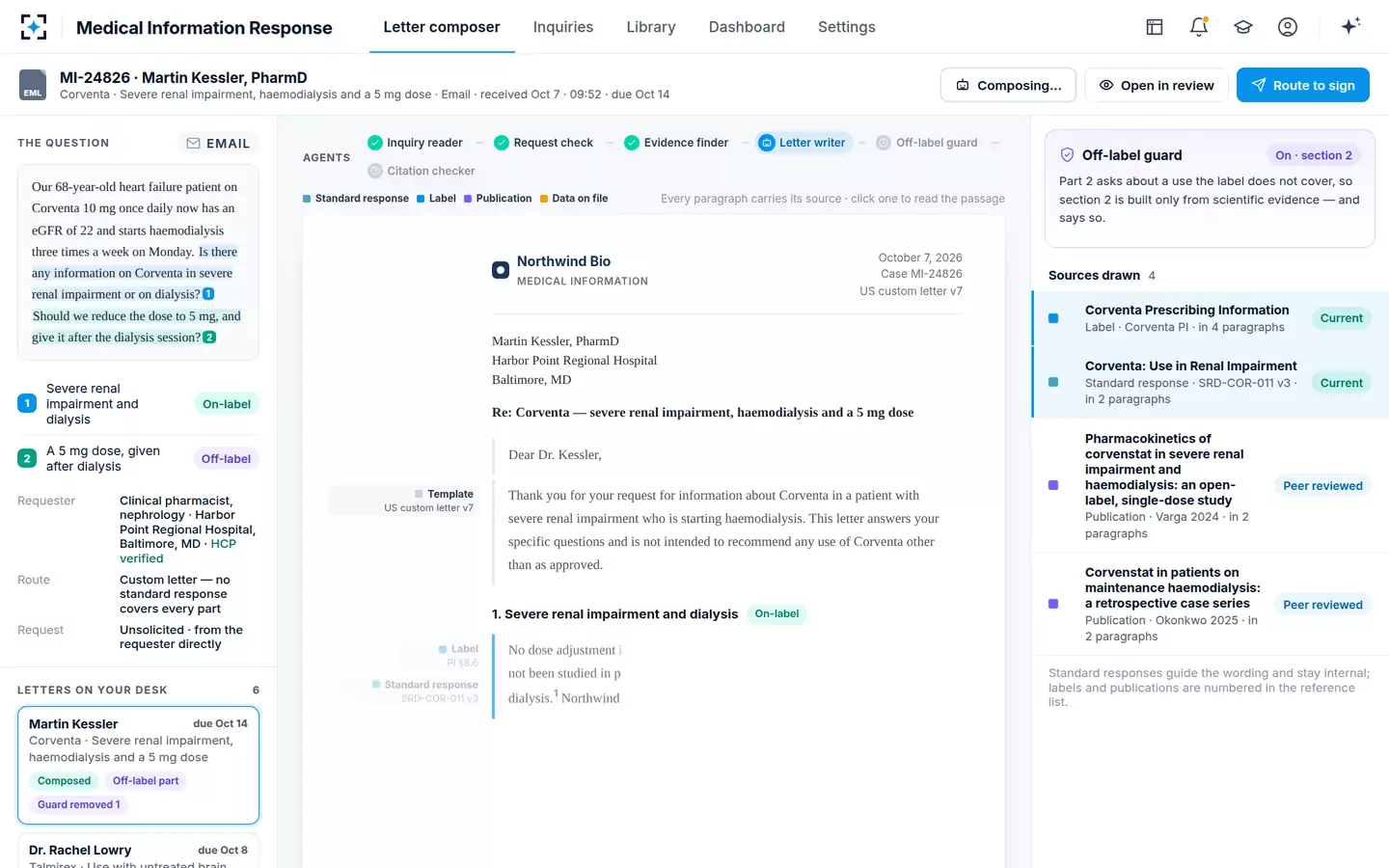
The practical difference between this and a chatbot is visible in one place — what a reviewer is given. A chatbot hands a reviewer an answer. An agent hands a reviewer an answer, the passages behind each of its sentences, the version and section each passage came from, a list of what it removed and why, and a set of findings it is not permitted to resolve itself. The first invites a judgement about plausibility; the second invites a judgement about evidence.
The same question, answered two ways
A chatbot replies: A reply in the conversation, immediately.
Agents draft, a person signs: A letter, privately, with the labeling and the reprints enclosed — on the sample desk, the same morning.
A chatbot replies: Whatever the model produces. In the published real-world test of 50 questions, no references were provided at all.
Agents draft, a person signs: Every factual sentence tagged to the passage it came from, with the version and section, and a numbered reference list.
A chatbot replies: Nobody. The status was assumed somewhere inside the reply and recorded nowhere.
Agents draft, a person signs: An agent set it per part, and a person confirmed it before the letter was routed.
A chatbot replies: Nobody. There is no name, no time and no stated meaning.
Agents draft, a person signs: A medical information specialist, with a stated meaning; a medical reviewer too, on any off-label section.
A chatbot replies: A transcript.
Agents draft, a person signs: The request and who made it, what was sent, the sources, every removed sentence with its reason, each finding decision, and both signatures.
A chatbot replies: The prescriber has it. The correction chases the answer.
Agents draft, a person signs: The finding is raised before sending, and a person decides it — the sample letter lost one sentence that way.
Off-label is a property of a sentence, not of a conversation
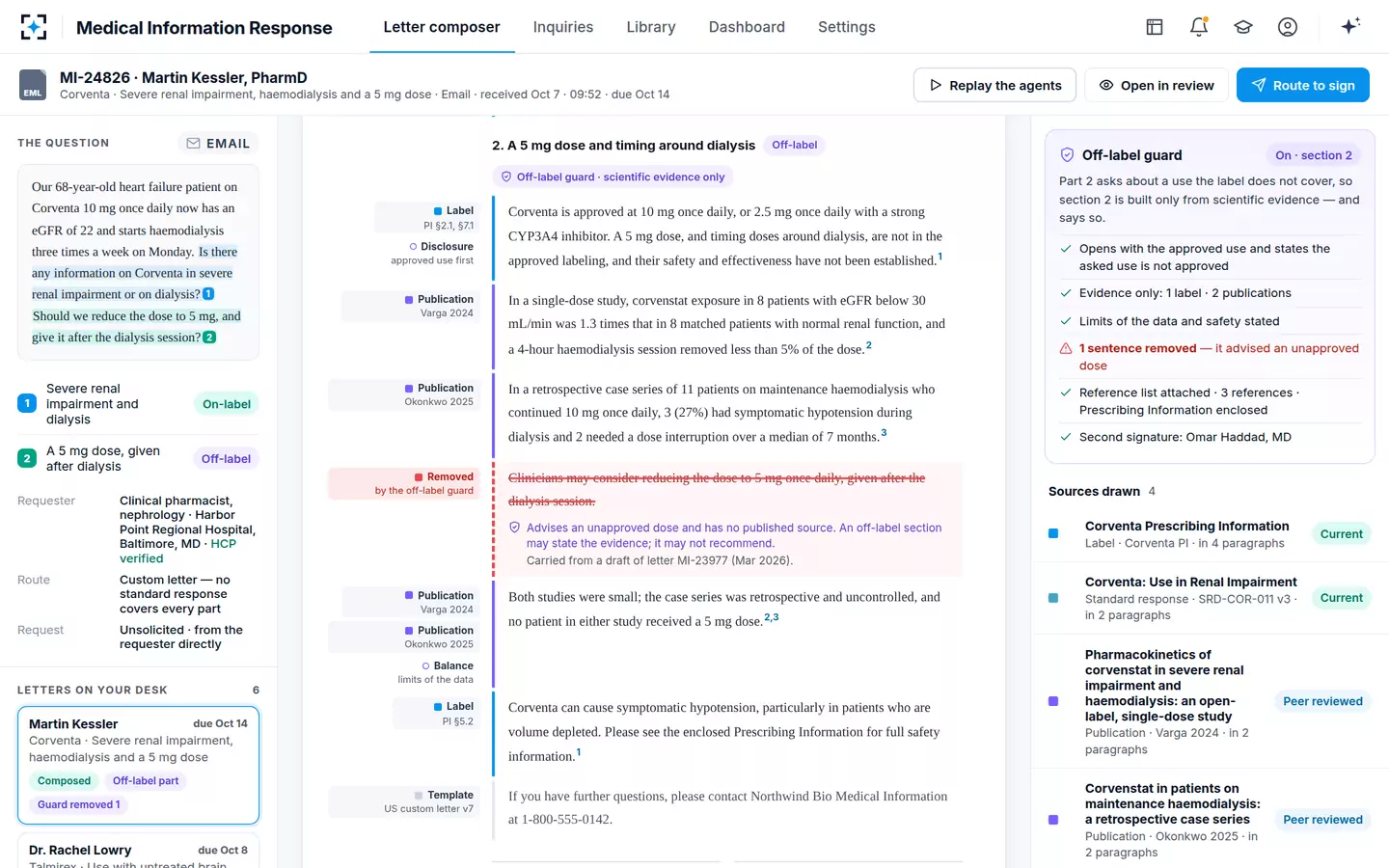
This is the argument underneath all of it. A prescriber's e-mail is not an approved question or an unapproved one; it is a paragraph that may contain both, and the obligations differ completely between the two. The sample question is the ordinary case rather than an edge case: a clinical pharmacist asked what is known about a product in severe renal impairment and on dialysis, which the label speaks to, and whether the dose should be reduced to 5 mg and given after the session, which it does not. The first part is answered from the labeling and a standard response. The second needs the disclosure, the evidence, the limits, the safety information, a second signature and a private channel.
One question, four decisions, and the point where a person takes over
Agent
Split the question into its partsTwo parts out of one paragraph: severe renal impairment and dialysis, and a 5 mg dose given after dialysis.
Never: treats a multi-part question as one question with one status
Agent
Set the status of each partPart one on-label; part two off-label. Product, indication, topic and country are set per part too.
Never: infers a status it cannot record
Agent
Choose the route from coverage, not topicA custom letter, because no single current standard response covers every part.
Never: sends a standard response that answers only some of the parts
Agent
Escalate what is unclearAn ambiguous question goes to a person; a question a field team submitted is confirmed with the requester before drafting.
Never: guesses at what was meant in order to answer
A person decides
Decide, then signReads the draft and the passage behind each paragraph, resolves each finding, and signs with a stated meaning. A second signature follows on the off-label section.
Never: is bypassed when the answer looks obvious
A conversational interface can be told to do the first two steps, and it may do them well. What it cannot do is keep the result: there is no field in a chat reply that says "this clause was treated as concerning an unapproved use", no place to attach the disclosure to that clause rather than to the whole message, and nobody who confirmed it. Two years later, when somebody asks how the company handled that question, the honest answer is that nobody knows.
The status set per part, and the guard working on the off-label part only
What happens when the question is also a safety report
Some of the questions that arrive at a medical information desk also describe something that happened to a patient, and when they do a second obligation starts on its own clock, in a different function, with different records. This is a design question rather than a product feature, and it is worth being clear about what the solution does and does not do: it routes questions, drafts answers and keeps the record of the request and the reply. Nothing in it detects an adverse event or files a safety report, and a department should not assume otherwise.
What the design question comes down to is whether the handover is a branch or a fork. A branch sends the inquiry to safety instead of answering it, which loses the prescriber's question. A fork does both: the safety function receives what it needs on its timetable, and medical information still answers the question that was asked. The second is usually right, and it only works if the two paths keep separate records and separate signatures — which is why trying to make one conversational interface do both jobs tends to produce a system that does neither well. On the sample desk the related control is narrower and more tractable: questions from patients are answered by the nurse line and never with a letter written for a prescriber, and 52 of 1,184 questions in thirty days went that way.
How do you test an AI tool before a prescriber sees it?
By replaying questions the department has already answered and signed, and scoring the new answers against what was actually sent — not by asking a vendor's demonstration twenty questions. The Alzahrani study's very low inter-rater agreement is the warning here: if trained pharmacists disagree about the quality of an answer, a small panel scoring a small sample has measured noise. A replay against signed letters replaces judgement about quality with comparison against a known answer, which is both cheaper and harder to argue with.
What to test before a prescriber sees anything
- Replay 50 or more signed letters, and compare sentence by sentence
Not whether the new answer is good, but whether each sentence says what the signed letter said, with the same numbers and the same source. The signed letters are the truth set.
- Score the split of multi-part questions separately
Count the questions where the parts and their label statuses came out as a person set them. This is the judgement that matters most and the easiest to measure.
- Check every citation opens to the passage it claims
Open them. A citation that names a real paper but not the sentence inside it is the failure mode that reads best and verifies worst.
- Count what was removed and what should have been
Plant advisory sentences in the replay set — the ones your own guard struck last year — and check they are struck again, with a reason.
- Test the refusals, not only the answers
Ambiguous questions, questions from patients, questions a field team relayed, questions about a competitor's product. The right output is an escalation, and a tool that answers them all has failed.
- Use more than one assessor, and record their disagreement
Published work on this has reported agreement low enough to make a single-assessor score meaningless. If your reviewers agree, say so with a number; if they do not, that is the finding.
- Pilot in parallel, with people signing everything
The tool drafts, the specialists work as they always did, and the two are compared on real questions before anything the tool produced reaches a prescriber.
Who is responsible if an AI answer is wrong?
The company, and within the company the person who signed. That is not a legal subtlety; it is the design constraint that produces everything above. There is no arrangement in which responsibility for a communication about a company's medicine rests with a tool, and any system whose answer to the question is "the model" has not answered it. Which is why the useful question for a buyer is not how accurate the tool is but what it hands the person who will be accountable: if the answer is "a reply", the accountability is unsupported; if it is "a draft, the passage behind every sentence, what was removed and why, and a set of findings it cannot resolve itself", the person can discharge it.
Pharmacist expertise, as the 2026 CLEAR comparison concluded, "remains essential for ensuring answers to DI questions are of high quality." The design question is not whether to keep that expertise in the loop. It is whether to spend it on paraphrasing and citation-chasing or on the two judgements only it can make. How the library those answers are drawn from stays current and what may be sent in answer to an off-label question are the two rails this sits on. To see the agents, the guard and the signatures, start from Medical Information Response.
Questions people ask
How accurate is ChatGPT on drug information questions?
In the published real-world test, not accurate enough to act on. Fifty questions that had reached a hospital drug information service were put to ChatGPT and assessed by pharmacists: 13 of 50 answers had correct content and enough information to initiate management with no risk of patient harm, 38% were false, 36% were partly correct, and no references were provided. In a separate 2026 comparison on the 25-point CLEAR framework it scored 15.72, inside the "average" band and statistically below the pharmacy faculty answers.
Can AI answer off-label questions?
It can draft an off-label section; it should not send one. An answer about an unapproved use has to open with the approved use and a statement that the asked use is not approved, carry the evidence with its limits and the safety information, enclose the labeling and a complete reference list, be reviewed, be signed, and go privately to the person who asked. Those are properties of a sent letter, not of a chat reply, which is why the defensible arrangement is drafting for review rather than answering.
Should a medical information chatbot be on the company website?
A professional-facing portal should take a question and route it, not serve an answer from a menu. FDA's own example treats a website that lets viewers pull prepared standard responses from fixed menus of disease states — including off-label ones — as making the resulting requests solicited rather than unsolicited, which changes the rules that apply to the whole channel. A form that captures a question and hands it to the medical information department does not have that problem.
Does an AI answer count as promotional labeling?
It can. FDA's position is that a response to an unsolicited request that is truthful, balanced, non-misleading, non-promotional and responsive to the specific question is not expected to meet the requirements for promotional labeling or advertising — but that protection depends on conditions an unreviewed chat reply does not meet: the disclosures, the reference list, the private one-to-one channel, and medical or scientific authorship independent of sales and marketing. A reply that fails those is a company communication about an unapproved use without them.
What if the question also contains an adverse event?
It starts a second obligation in a different function, on its own regulated timetable, and the handover should be a fork rather than a branch: the safety function gets what it needs and the prescriber still gets an answer to the question they asked. Note what this solution does not claim — it routes questions and drafts answers; it does not detect adverse events or file safety reports, and a department evaluating any tool should ask for that boundary to be stated plainly rather than implied.
Who is responsible if an AI answer is wrong?
The company, and the person who signed it. No tool can hold that responsibility, so the question that matters when comparing tools is what each one gives the person who will: a finished reply invites a judgement about whether it sounds right, while a draft with the passage behind every sentence, a list of what was removed and why, and findings the tool is not permitted to resolve itself invites a judgement about evidence. Only the second can actually be discharged.