A medical information response letter is the written answer a company's medical information department sends a healthcare professional who asked a question its standard responses do not cover. This guide is a worked example: one letter, taken apart block by block, with the rule each block serves set beside it. The reason to read it that way is that nothing in the letter is stylistic. The restated question is there because FDA expects the answer to cover only the specific questions asked; the first sentence of the off-label section is there because the approved use must be disclosed prominently; the reference list is there because a complete one is required. Botminds' Medical Information Response composes that letter from the country template with a source on every paragraph, strikes any sentence in an off-label section that advises rather than states, and hands it to a medical information specialist to sign.
The letter on this page comes from a fictional sample desk running through the solution: Northwind Bio Medical Information, a question from Martin Kessler, PharmD, a clinical pharmacist in nephrology at Harbor Point Regional Hospital, and the products Corventa, Veltrimab and Talmirex. The people, products, companies and publications are invented. Every rule quoted is from the regulator that wrote it, linked under the figure that uses it.
The sample letter at a glance
8of 8
sentences linked to the passage they came from, in this one letter
1sentence
struck before signing, for advising an unapproved dose
3refs
attached in full, with the Prescribing Information enclosed
2sections
one per part of the question, in the order the prescriber asked them
What a medical information response letter is, and what it is not
Regulators define it by exclusion, which tells you more than a definition would. The UK's Blue Guide lists "correspondence, possibly accompanied by material of a non-promotional nature, to answer a specific unsolicited question about a medicinal product" among the things that are not advertisements for the purposes of the medicines regulations (MHRA Blue Guide). FDA reaches the same place by saying a firm "should respond with material that is scientific in tone and presentation", and that the material "should not be distributed along with other material or information that is promotional in nature or tone."
So the letter is correspondence that stops being correspondence the moment it exceeds the question. That is the single idea the whole structure below protects. It is not a reprint carrier, not a leave-behind, and not a vehicle for anything the firm would have liked the prescriber to know. Its value to the prescriber depends on that separation from the commercial side of the company, and so does its standing with a regulator.
One custom letter, block by block: what each part contains and the rule it serves
Letterhead and case line
What it containsThe medical information department, the date, the case number and which country template was used.
RuleSeparation from promotion
The sentence it forbidsA product logo, a strapline or anything the commercial team would recognise as branding.
Addressee
What it containsThe requester by name, with their institution — the one person the answer is for.
RuleOne recipient
The sentence it forbidsA distribution list, a copy to the account team, or a second reader who did not ask.
Re: line
What it containsThe subject restated in the requester's own terms, part by part.
RuleTailored to the question
The sentence it forbidsA subject wider than the question, which licenses a wider answer.
Opening paragraph
What it containsThanks for the request, the question restated, and a plain statement that the letter answers the specific questions asked and does not recommend any use other than as approved.
RuleScope and intent
The sentence it forbidsAny sentence that frames the letter as helpful information the firm wanted to send.
One section per part
What it containsA numbered section for each part of the question, in the order it was asked, marked on- or off-label.
RuleSpecificity, per part
The sentence it forbidsA single narrative that answers an approved and an unapproved use in one breath.
The off-label section's first sentence
What it containsThe approved use and dose, then the plain statement that the asked use is not in the approved labeling and its safety and effectiveness have not been established.
RuleDisclosure, prominently
The sentence it forbidsEvidence before the disclosure, or a disclosure moved to a footer.
Evidence, then its limits
What it containsThe studies that answer the question, their size and design, the data that do not support the use, and the relevant safety information.
RuleBalance
The sentence it forbidsA recommendation, a comparison, or a conclusion the cited papers do not reach.
Close and contact
What it containsAn offer to answer further questions, with the department's own contact details.
RuleOne-to-one channel
The sentence it forbidsA representative's number, or an invitation to ask about other uses.
References and enclosures
What it containsEvery publication and label section cited, numbered, with the reprints and the Prescribing Information enclosed.
RuleComplete reference list
The sentence it forbidsA firm-written summary standing in for the paper it summarises.
The request, restated: why the letter quotes the question back
The restated question is the letter's scope statement, and it does two jobs at once. It shows the requester what was understood, so a misreading surfaces before the evidence is gathered rather than after. And it fixes, in writing, the boundary every later sentence is judged against — which is why FDA's recommendation on specificity is phrased as a duty to narrow rather than a duty to be thorough.
If an unsolicited question is broad in nature, the firm should appropriately narrow the question.
FDA, Responding to Unsolicited Requests for Off-Label Information, December 2011
In the sample letter the Re: line reads "Corventa — severe renal impairment, haemodialysis and a 5 mg dose", and the opening paragraph is three clauses long: thanks for the request, the question restated in clinical terms, and the sentence that does the real work — "This letter answers your specific questions and is not intended to recommend any use of Corventa other than as approved." Nothing in that paragraph is courtesy. The last clause is the firm declining, in advance, the reading that the letter is advice.
There is a drafting trap on the other side of the same rule. FDA also says that where there is information about known or suspected risks tied to another condition that is relevant to the one asked about, the firm "should provide such information to ensure a complete and accurate presentation of the risk issues associated with the requested use." Narrowing the question does not license narrowing the risk. The scope rule cuts the helpful extra paragraph; it does not cut the inconvenient one.
The letter composed, with every paragraph carrying its source
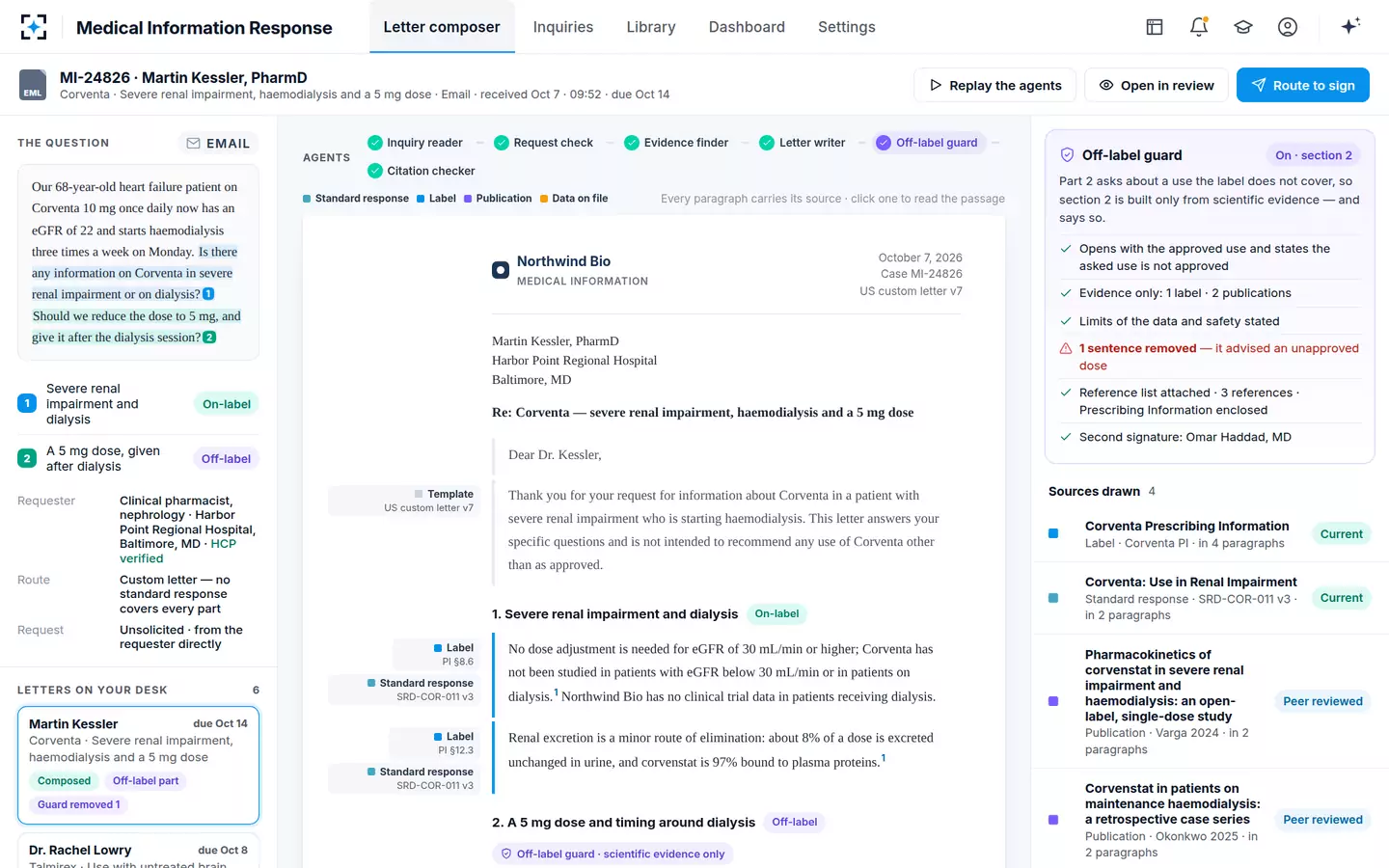
The on-label section: the label for the requester's own country, first
The first section answers the part of the question the approved labeling speaks to, and it leads with the label rather than the literature. The ordering matters because the label is the only document in the letter that is itself a regulatory act; a published paper is evidence about the product, while the labeling is the terms on which it was approved. In the sample letter, section 1 opens with the Prescribing Information at §8.6: no dose adjustment is needed at an eGFR of 30 mL/min or higher, and the product has not been studied below 30 mL/min or in patients on dialysis. The second paragraph adds §12.3 — renal excretion is a minor route of elimination, about 8% of a dose is excreted unchanged in urine, and the molecule is 97% bound to plasma proteins.
Which label, though, is a question with a wrong answer. A desk that works from the label it knows best will send a prescriber in Toronto a letter quoting the US Prescribing Information, and the two can differ on exactly the point asked about. The rule a global department writes into its procedures is that the letter cites the labeling in force in the requester's own country, and the template is per country for the same reason. The sample letter is built from the US custom letter v7 template and cites the US Prescribing Information, revised January 2026, because the requester practises in Baltimore.
The third element in section 1 is the one with no external source at all: the statement that the firm holds no clinical trial data in patients receiving dialysis. An absence is a fact about the company, and nobody else can supply it. Saying it plainly is also the honest alternative to padding the section with adjacent data, which is how a narrow answer becomes a wide one.
Why does the off-label section have to open with the approved use?
Because the disclosure has to be prominent, and the first sentence is the only position in a document where prominence is not arguable. FDA's packing list requires a prominent statement that the product has not been approved or cleared for the use addressed, and a prominent statement of the approved indications; the January 2025 guidance on scientific information about unapproved uses asks for the same two plus "any limitations of use specified in the FDA-required labeling" and the labeling's cautions and precautions about the unapproved use (FDA, January 2025). A disclosure in a footer satisfies the letter of that and not its purpose.
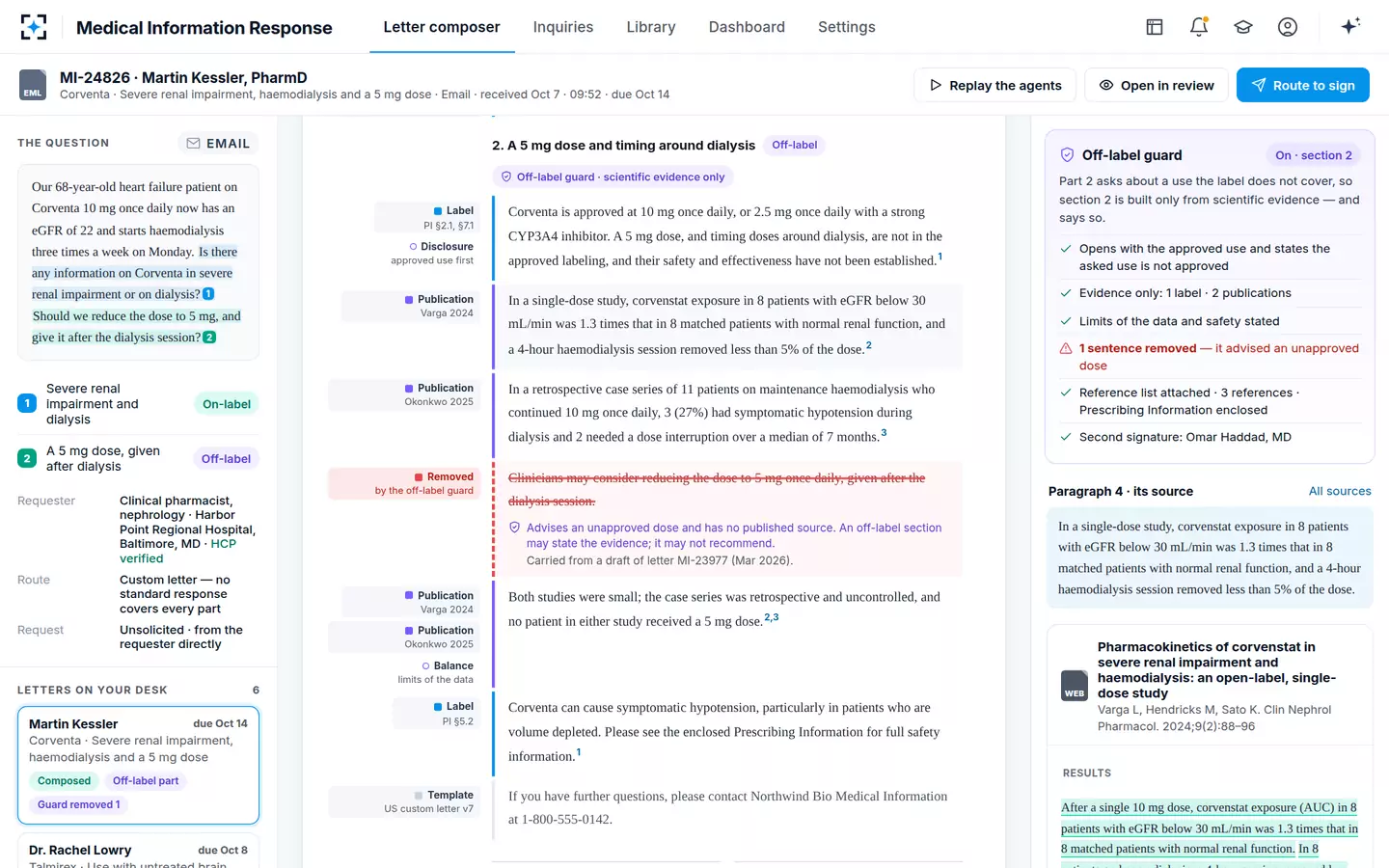
In the sample letter section 2 opens with the approved dose — 10 mg once daily, or 2.5 mg with a strong CYP3A4 inhibitor — and then the plain statement that a 5 mg dose, and timing doses around dialysis, are not in the approved labeling, and that their safety and effectiveness have not been established. Only then does the evidence arrive: a single-dose study in which exposure in eight patients with an eGFR below 30 mL/min was 1.3 times that in eight matched patients with normal renal function, and a four-hour dialysis session removed less than 5% of the dose; then a retrospective case series of eleven patients on maintenance dialysis who continued 10 mg once daily, of whom three had symptomatic hypotension during dialysis and two needed a dose interruption, over a median of seven months.
Then the limits, in their own sentence: both studies were small, the case series was retrospective and uncontrolled, and no patient in either study received the 5 mg dose the prescriber asked about. Then the safety information from the label. What the section never reaches is a recommendation, and the sample letter shows what that costs. A sentence carried over from an earlier draft — "Clinicians may consider reducing the dose to 5 mg once daily, given after the dialysis session" — was struck before signing, with its reason recorded: it advises an unapproved dose and has no published source. An off-label section may state the evidence; it may not recommend. What you may send in answer to an off-label question works through the rest of that rule.
One paragraph, and the exact passage it came from
What must be enclosed with a medical information letter, every time
Five things, on FDA's list, and the sample letter's envelope maps onto them one for one. The list is worth reading as five different failure modes rather than five attachments: each item is the thing whose absence lets the answer be read as an endorsement.
What went in the envelope with the sample letter, and the rule each item answers
| In the envelope | In this letter | The rule it answers |
|---|---|---|
| The FDA-required labeling | The Corventa US Prescribing Information, revised January 2026, enclosed in full. | "A copy of the FDA-required labeling, if any, for the product." |
| The not-approved statement | In the first sentence of section 2: the asked dose and timing are not in the approved labeling and their safety and effectiveness have not been established. | A prominent statement that FDA has not approved or cleared the product for the use addressed. |
| The approved indications | The approved dose and the strong-CYP3A4 adjustment, stated before the evidence. | A prominent statement disclosing the indications for which the product is approved. |
| The safety information | The hypotension warning from the label, with the instruction to see the enclosed Prescribing Information for the full safety information. | A prominent statement of all important safety information, including any boxed warning. |
| The reference list | Three references, attached as complete reprints and numbered in the letter. | A complete list of references for all of the information disseminated in the response. |
One item on that list is easily sent in a form that does not satisfy it. A firm-written summary of a paper is not the paper, and FDA is explicit: the response should carry full copies of the reprints and other material that answer the request — not just summaries or abstracts the firm wrote itself Sending the summary and citing the paper is the shortcut; it leaves the prescriber unable to check the one thing the letter asks them to accept.
The references: what may be cited, and what may not
FDA sets a hierarchy rather than a list. "To the greatest extent possible, a firm should rely on published peer-reviewed journal articles, medical texts, or data derived from independent sources." Unpublished data on file may be included where it answers the specific question, "either supporting or casting doubt on the safety or efficacy of the off-label use" — the balance rule reaching into the firm's own drawer. And where reprints are sent, they "should be from journals that have a publicly stated policy, to which the organization adheres, of full disclosure of any conflict of interest or biases for all authors, contributors, or editors."
Two sources sit awkwardly in that hierarchy. A conference abstract is published and citable — FDA's reference-list item expressly covers "citations for data on file, for summary documents, or for abstracts" — but it is also, by construction, a summary that has not been through peer review, and the same guidance tells firms not to let summaries stand in for the work. The defensible position is that an abstract may be cited as what it is, and may not be the only support for a claim about an unapproved use. In the solution, congress abstracts are off by default among the sources the agents may draw from, and turning them on is a decision a department makes once, deliberately.
The second is the standard response document itself. It is the department's own approved wording, and it guides the letter — but it is internal, so it does not belong in a reference list sent to a prescriber. The sample letter resolves this the way a careful desk does: section 1 is tagged internally to both the Prescribing Information and standard response SRD-COR-011 v3, while the numbered references the prescriber receives are the label and the two publications. The standard response shaped the sentence; the label and the papers support it. How a standard response is written, versioned and retired follows that document's own life.
How long should a medical information response letter be?
No rule sets a length, and that is the answer. The only length constraint in the guidance is a scope constraint — tailored to the specific questions asked, and narrowed if the question is broad. A letter is therefore as long as the parts of the question multiplied by the evidence that answers each part, and no longer. Length is an output, not a target.
What that produces in practice is short. The sample letter answers two parts in eight factual sentences across two sections. A second letter on the same desk, answering a dermatologist's three-part question on pregnancy planning, breastfeeding and dosing interval, runs to eleven sentences across three sections. Both would be unusual at three pages. A letter that runs long is usually answering a question nobody asked, and the reviewer's job is to find the paragraph that wandered rather than to compress the ones that did not.
Standard response letter and custom letter: when each is right
Standard response letter: A current, approved standard response covers every part of the question.
Custom letter: No single standard response covers every part — the sample question needed the label, a standard response and two publications.
Standard response letter: Nothing. The approved document is sent unchanged, which is a setting a department can lock.
Custom letter: A new letter from the country template, one section per part, in the order asked.
Standard response letter: A medical information specialist, against a document whose own approval is on file.
Custom letter: A medical information specialist; a medical reviewer adds a second signature when any part is off-label.
Standard response letter: Two business days on the sample desk, with the Prescribing Information included.
Custom letter: Five business days on the sample desk, and a median of 1.4 days with the agents drafting, against 4.6 by hand.
Standard response letter: The cost sits upstream, in writing and revising the document: a small published survey averaged 8.3 hours to create one and 3.8 to update it.
Custom letter: The cost sits in the letter: searching, drafting, citing each claim, and checking every sentence, number and version.
Standard response letter: A retired version reaching a prescriber because an old letter reused its wording.
Custom letter: A sentence carried over from an earlier letter that advises an unapproved use.
Where a custom letter's days go, by hand and with the agents drafting
By hand · 4.6 days
- Logging, reading and routing · 11%
- Searching the library, the label and the literature · 26%
- Drafting and citing each claim · 24%
- Checking every sentence, number and version · 17%
- Medical review and the second signature · 15%
- Sending, closing and archiving · 7%
With the agents drafting · 1.4 days
- Logging, reading and routing · 4%
- Searching the library, the label and the literature · 7%
- Drafting and citing each claim · 21%
- Checking every sentence, number and version · 25%
- Medical review and the second signature · 39%
- Sending, closing and archiving · 4%
What a reviewer reads for, sentence by sentence
A reviewer is not proofreading. Each sentence is checked against the passage behind it on five separate questions, and a sentence can pass four and fail the fifth. The order below is meant to catch the most with the least rework: there is no point checking the balance of a paragraph whose numbers do not match its source.
Five questions to put to every factual sentence in a custom letter
- Is it supported by the passage it cites?
Not supported by the paper in general — by the sentence or table the claim was taken from. A claim with a citation and no passage is a claim with a decoration.
- Do the numbers match the source?
Doses, intervals, sample sizes, percentages and units, read against the source rather than against the previous letter.
- Is the source current?
The label edition in force, and the current approved version of any standard response. A retired version can arrive invisibly, through wording reused from an older letter.
- Is the off-label disclosure present, and in front?
The approved use and the not-approved statement before the evidence, not after it, and in the letter rather than in an attachment.
- Is it balanced, and free of promotional wording?
Data that do not support the use, the limits of the studies cited, and no verb that advises, suggests or compares.
The third check is the one hand review tends to lose first, because it asks about a document rather than a sentence. On the sample desk a letter about pregnancy planning carried a sentence suggesting that patients stop Veltrimab fifteen weeks before a planned conception, reused from a letter signed in March 2026 that followed version 4 of the relevant standard response. Version 4 was retired in June; version 5 removed that sentence, because the Prescribing Information sets no such period. The sentence had a source, the numbers matched it, and it was wrong — the only check that catches it is the one that asks whether the source is still current.
A worked example: two questions in one email
The letter in this guide began as an email at 09:52 on a Tuesday. A clinical pharmacist's 68-year-old heart-failure patient, on 10 mg once daily with an eGFR of 22, starts haemodialysis three times a week on the Monday. He asked two things in one paragraph: is there any information on the product in severe renal impairment or on dialysis, and should the dose be reduced to 5 mg and given after the session. The first part the label speaks to. The second it does not. No single standard response covered both, so the route was a custom letter.
One question, from the inbox to a sent letter in fifty-five minutes
- Split, verified, sourced, composed and guarded; read and first signature09:52–10:24
- Medical review, second signature and secure send10:24–10:47
What the morning shows is where the time goes once the searching and the drafting stop being the long part. Twenty-three of the fifty-five minutes belong to the medical review of the off-label section alone, and that is the right shape: a letter that answers for a company about an unapproved use should spend a large part of its life in front of the two people who sign it. The sample desk's thirty-day view shows the volume behind it — 1,184 questions answered, 236 of them by custom letter — and the solution's design target is a median of 1.4 days to a sent custom letter, against an estimated 4.6 by hand.
Sent the same morning, with the references and the label enclosed
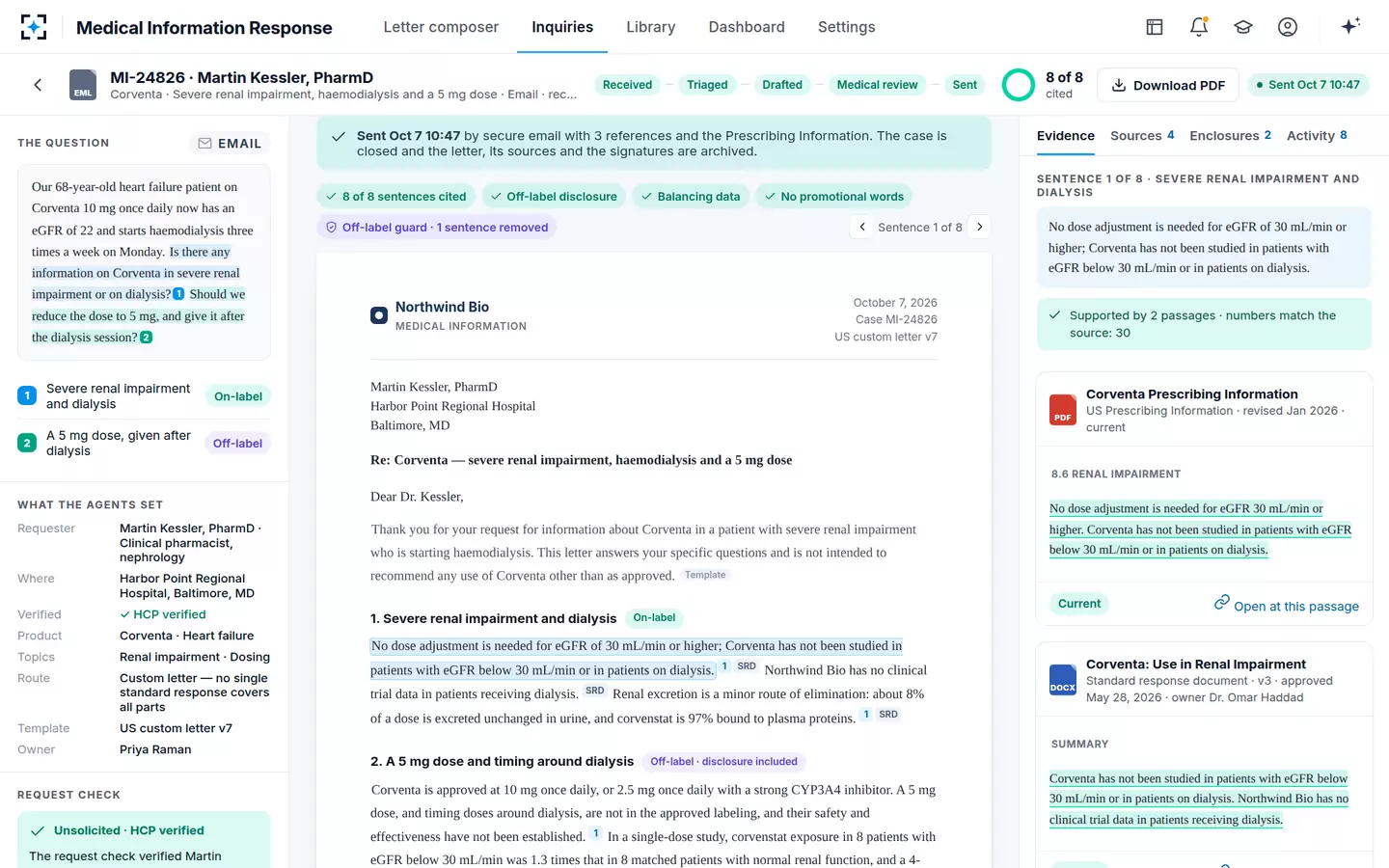
Every part of the letter you have just read exists because a rule asks for it, and every rule is about the same thing: an answer to a question the firm was asked, not a communication the firm chose to make. What the people around the letter sign for covers the two signatures the sample letter waited on. To see the composer, the source behind each paragraph and the signing route, start from Medical Information Response.
Questions people ask
What does a medical information response letter look like?
A letterhead from the medical information department with a case number and a date; the requester's name and institution; a Re: line restating the subject; an opening paragraph that restates the question and says the letter answers only what was asked; one numbered section per part of the question, in the order asked and marked on- or off-label; a close with the department's own contact details; and a numbered reference list with the reprints and the labeling enclosed. The sample letter on this page runs to eight factual sentences across two sections.
How do you answer a question that has an on-label and an off-label part?
In separate sections, each labelled, in the order the requester asked them. Label status is a property of the part, not of the question: the sample letter's first section answers from the Prescribing Information and a standard response, while the second opens with the approved dose and the statement that the asked dose is not in the approved labeling, then gives the evidence, its limits and the safety information. Mixing the two in one narrative is what turns a scientific answer into something that reads as advice.
What is the difference between a standard response letter and a custom letter?
A standard response is an approved document, sent unchanged, for a question it already covers; a custom letter is written for a question no single standard response answers. The cost sits in different places: a published survey of medical information departments put the average at 8.3 hours to create a standard response and 3.8 to update one, while a custom letter spends its hours on searching, drafting, citing and checking. On the sample desk the clocks differ too — two business days for a standard response, five for a custom letter.
Can you cite a congress abstract in a medical information letter?
It can be cited as what it is, but it should not be the only support for a claim about an unapproved use. FDA's reference-list item covers citations for abstracts, while the same guidance tells firms to send complete reprints rather than summaries or abstracts the firm prepared itself, and to rely on peer-reviewed articles, medical texts or independent data to the greatest extent possible. An abstract has not been through peer review, so treat it as the weakest thing in the list.
Does the letter have to enclose the Prescribing Information?
For a response containing off-label information, FDA's list begins with a copy of the FDA-required labeling, if any — the approved package insert, or the approved patient labeling where the response goes to a consumer. The sample letter encloses the Corventa Prescribing Information in full alongside its three reprints, and the body of the letter points the reader to it for the complete safety information rather than reproducing it.
Who reviews a medical information letter before it is sent?
A medical information specialist reads and signs every letter. Where any part is off-label, a medical reviewer adds a second signature attesting that the section is specific to the question asked, carries the disclosure, is balanced, has its references and the label, and is kept apart from promotion. FDA's own recommendation is that medical or scientific staff who stand apart from sales and marketing write the answer, and that commercial colleagues shape none of it.