Medical information software is a label that four quite different products wear. A case and inquiry management system records the question and tracks it to closure. A searchable library holds the standard responses, labels and literature a specialist answers from. A chatbot generates an answer from a question. Drafting agents compose the letter from approved sources with a source on every paragraph and hand it to a person to sign. Each one removes a different part of the work, and a comparison that treats them as four versions of the same thing will buy the wrong one. Botminds' Medical Information Response is the fourth kind, and the honest way to compare it is to put one real inquiry through all four and count what a reviewer still has to do.
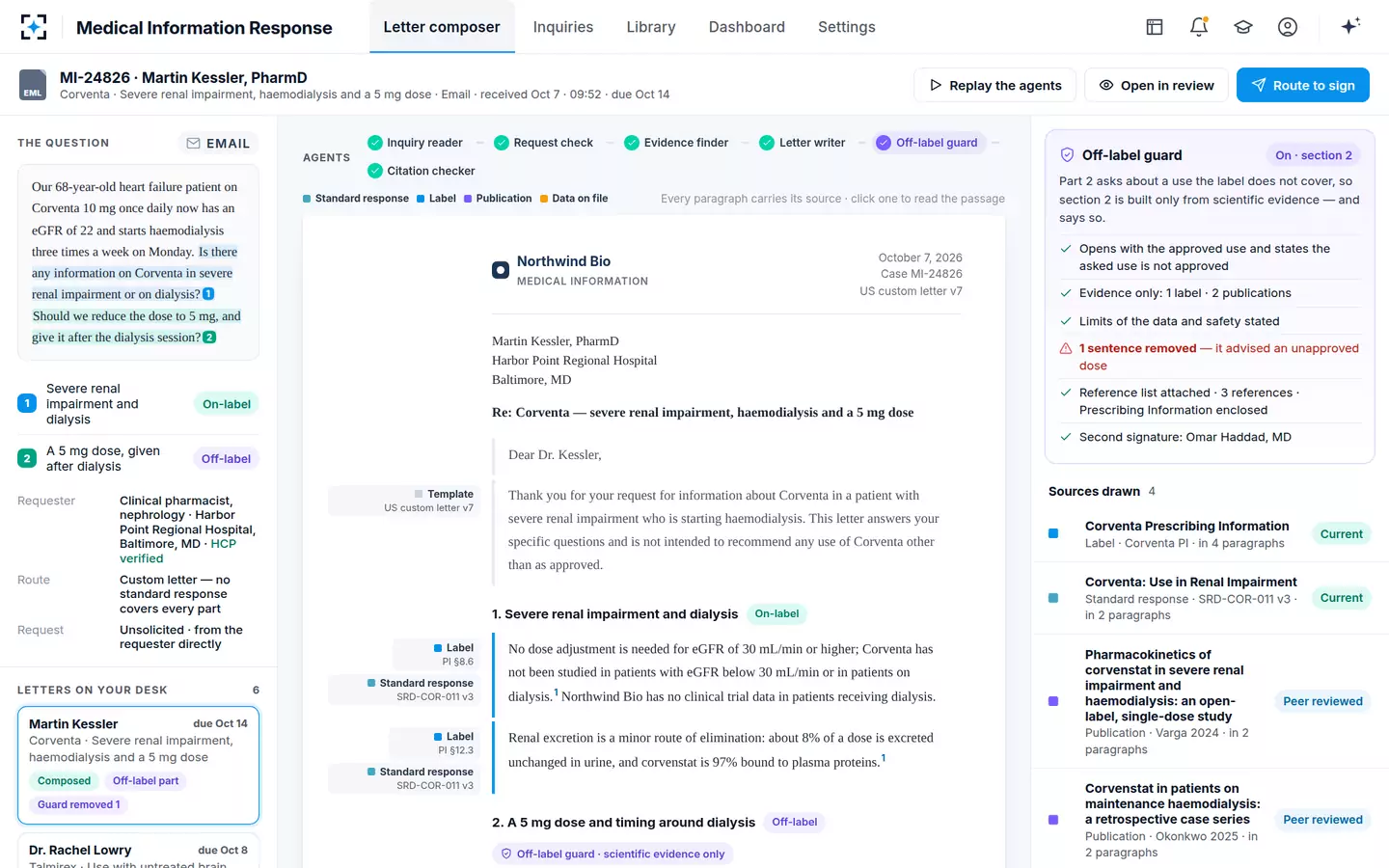
Use a two-part question, because that is the shape of the hard ones: a part the label speaks to and a part it does not. The working example throughout is the sample inquiry in the solution — a nephrology pharmacist asking about a heart-failure patient on a fictional product who starts haemodialysis on Monday, where the label covers severe renal impairment and says nothing about a halved dose given after a session. The people, products and letters in these examples are fictional sample data in the solution, not a customer's results.
Four numbers to carry into a vendor meeting
3of 12
repeated answers from a general chatbot that came back identical when the same question was asked again
87%
of surveyed medical information departments put content from four or more studies into one response document
12–18of 25
the “average” content band both leading answer tools landed in on a validated scoring framework
4
kinds of system sold as medical information software, each solving a different part of one job
What people mean by medical information software
Often they mean whichever part of the job hurts most in their department. An operations lead often means the case system: the record of who asked, through which channel, what was promised and whether the clock was met. A specialist usually means the library: finding the current standard response and the right country label without opening six folders. A compliance officer usually means the controls: the disclosure, the second signature, the audit trail. A sponsor who has been reading about AI usually means a chatbot.
All four are real needs, and conflating them produces the familiar bad outcome — a system bought to fix the clocks, with a search box bolted on, used by specialists who still write every letter by hand in a word processor and paste it back in. Before comparing products, write down which of the four parts of the work you are trying to change, and what you would accept as evidence that it changed.
Which four kinds of system are being sold?
The table below is the comparison that matters, because the last column is the one you pay for afterwards. A system that produces a draft nobody can trace leaves the whole checking job behind.
One inquiry through four systems: what each produces, and what the reviewer still does
| The kind of system | What it does with the two-part question | What the reviewer still has to do | What is kept afterwards |
|---|---|---|---|
| Case and inquiry management | Records the question, the requester, the channel and the promised date; routes it to a specialist and tracks it to closure. | All of the answering: find the standard response, the label and the papers; decide the off-label split; draft; check; route for signature. | A complete record of the inquiry and its handling, and the letter as an attachment. |
| A searchable library | Returns candidate standard responses, label sections and papers for each part of the question. | Judge which results are current; read the passages; decide the off-label split; draft the letter; cite each claim; check every sentence. | Search history at best. The link between a sentence and the passage behind it is not recorded. |
| A chatbot over documents | Produces a fluent answer to the whole question, often with a reference list beneath it. | Establish what each sentence rests on, because the mapping was not kept; re-derive the off-label split; rewrite anything advisory; check numbers and versions. | The answer. Whether the same question would produce the same answer tomorrow is usually untested. |
| Drafting agents with sources attached | Splits the question into parts, sets on- or off-label status for each, retrieves passages, composes from the country template with a source on every paragraph, guards the off-label section and re-checks every sentence. | Decide the findings, read the off-label section, and sign. Judgement, not reconstruction. | The letter, the passage behind each sentence, every removed sentence with its reason, each finding decision, and both signatures. |
Where the hours go in each option
A useful way to make the table concrete is to count jobs rather than hours. The sample inquiry needs seven distinct pieces of work done before a letter can be signed: read and split the question, verify the requester and the origin of the question, find the passages, compose from the country template, guard the off-label section, check every sentence against its source, and feed the library for next time. Count how many of the seven each option leaves on a person's desk.
Of seven jobs on one inquiry, how many the reviewer still does
The chatbot row is the one that tends to surprise buyers. It produces the most visible output and removes the least work, because fluent text with a reference list underneath still has to be traced claim by claim before anyone will put their name on it. That is not a criticism of the technology; it is a consequence of not keeping the mapping. What a medical information chatbot may and may not answer goes into the boundary in detail.
What to ask about sources, versions and citations
“Cited” is the word that does the most work in a demonstration and the least work in a contract. Before accepting it, make the vendor show you five things on one sentence that you choose, not one they choose.
What “cited” has to mean before you accept it
The passage
Not the paper. The sentences the claim rests on, highlighted inside the source, openable from the sentence.
What falls short: “Varga 2024” printed under the paragraph.
The version
Which revision of the standard response or the label, and whether it is the one currently approved.
What falls short: A document name with no revision, so a retired version reads as current.
The section
Where in the source — a labelled section of the Prescribing Information, the results of a named cohort.
What falls short: A link to the top of a 40-page document.
The sentence it belongs to
The mapping runs sentence to passage, so a reviewer can check one claim without re-reading the letter.
What falls short: A reference list at the foot of the letter.
The country
The label for the requester’s country and its current revision, not whichever label the index returned.
What falls short: One label for every market.
Why versions carry so much weight here: a department that keeps every revision of every standard response can have a great many superseded sentences in circulation inside old letters. A system that retrieves by document name rather than by approved revision will cheerfully cite a retired version, and the citation will resolve. That single behaviour is the difference between a library that protects you and one that launders old wording.
What to ask about off-label handling
The off-label part is where the categories separate most sharply, because it is the part with rules attached. FDA's draft guidance expects a response to an unsolicited request to answer only the specific questions asked; to travel with the FDA-required labeling, a prominent statement that FDA has not approved or cleared the product for the use discussed, and a complete reference list; and to be written by medical or scientific staff who are independent of sales and marketing (FDA draft guidance, December 2011).
Every one of those is a question for a vendor with a right answer and a wrong one. Can the system set on- or off-label status per part of the question rather than per question — because a two-part inquiry answered as one letter fails the tailoring expectation whichever way it errs. Does it attach the label and the disclosure automatically to any letter containing an off-label section. Does it record who submitted the question and, where a field colleague relayed it, confirm with the requester that the question was their own. Can it show, for a given sentence, that no sales or marketing colleague touched it. What one sentence costs when an answer reads as promotion sets out what sits behind those questions.
The question split into parts, with on- or off-label status on each
Does it replace the case system you already have?
It should not, and a vendor who says it will is selling you a migration you did not ask for. The case system is the system of record: it holds the inquiry, the requester, the channel, the clocks, the adverse event and product complaint handoffs and the closure. Replacing it means re-validating a system that already works and moving years of records for no clinical benefit.
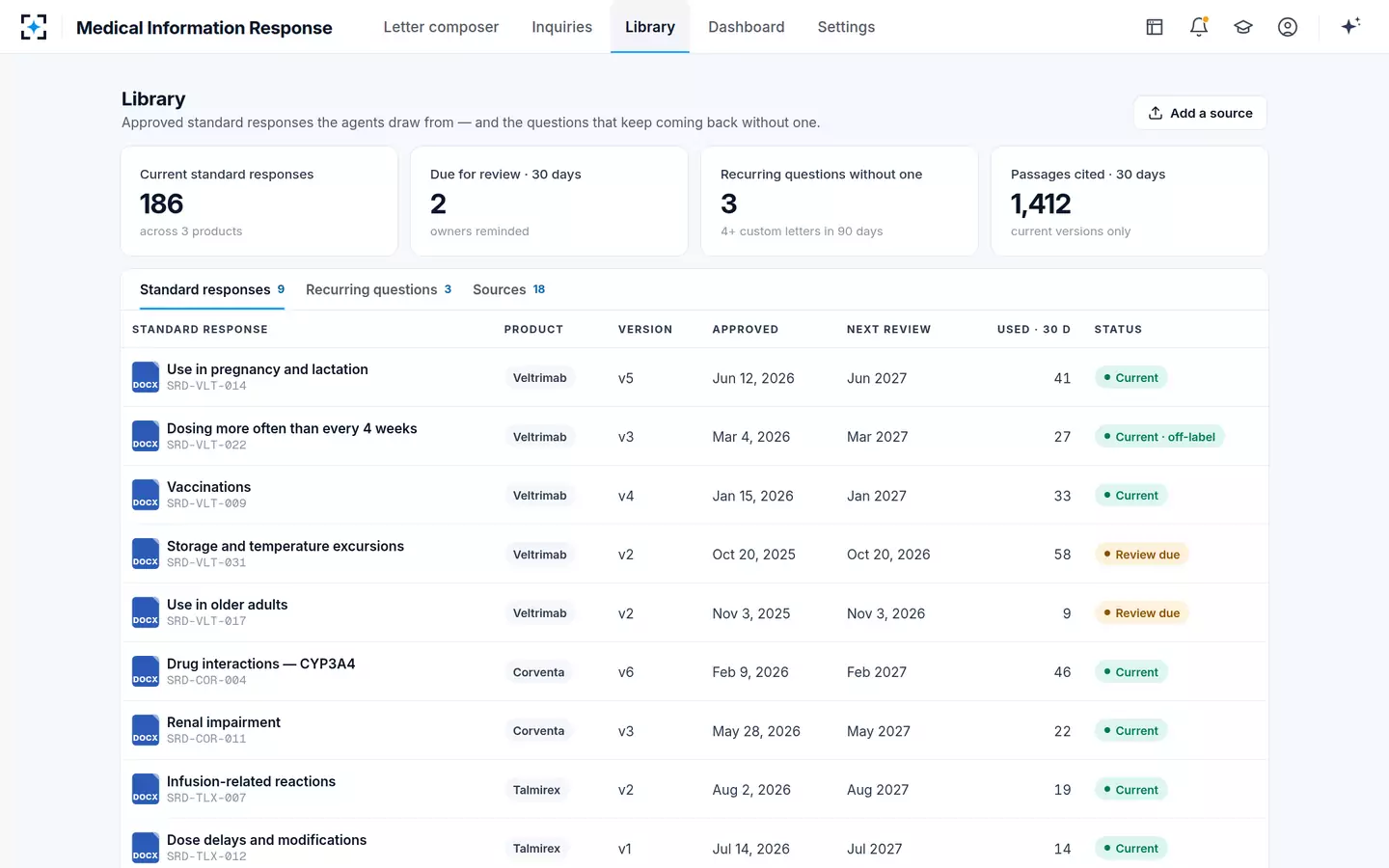
What is missing in many departments is not another database but the drafting and checking layer that sits on top and writes back. The join list is short and testable — inquiry records, the standard response library with its versions, the labels for each country, literature and data on file, the letter templates, the requester directory and consent register. Whether an AI layer replaces your medical information management system works through the joins one by one.
What a trial has to prove before you buy
Not that the system can answer a question. That the system can answer your questions, from your library, in a way your reviewers will sign. The most direct design that establishes this is a replay. Take fifty inquiries you have already answered and signed, give the system the same sources that were available at the time, and compare its draft with what was sent, sentence by sentence.
A vendor's demonstration, and a replay on your own signed letters
What a demonstration shows: The vendor’s sample content, curated and clean, usually one product and one country.
What a replay settles: Your standard responses with their real version history, your labels for every market you answer in, and the gaps between them.
What a demonstration shows: Questions chosen because the system answers them well.
What a replay settles: The questions you actually received, including the badly worded ones and the ones with three parts.
What a demonstration shows: A clean example where the off-label part is obvious.
What a replay settles: Whether the split matches what your specialists decided at the time, on the questions where it was arguable.
What a demonstration shows: Time to a draft, usually from a cold start with nothing to check.
What a replay settles: Sentences whose source and numbers match what was sent, and the number a reviewer still has to decide per letter.
What a demonstration shows: An impression, formed by whoever was in the room.
What a replay settles: A disagreement rate against your own signed work, which your reviewers can argue about with the evidence in front of them.
Two measures belong in every trial, whichever category you are testing. The first is reproducibility. When researchers re-entered the same drug information questions to a general chatbot on day 1, day 2, week 2 and week 3, “only three out of 12 answers were identical, showing no reproducibility to low reproducibility” (Eur J Hosp Pharm 2024). Ask the same question twice in your trial, a fortnight apart, and compare. A system whose answer moves on its own is not a system you can validate.
The second is who holds the ceiling. In a comparison of several health-focused answer tools scored on a 25-point framework, mean totals were categorised as “poor” content at 5 to 11 points, “average” at 12 to 18 and “very good” at 19 to 25 — and the authors record that hardly any chatbot answer reached the top band (J Am Coll Clin Pharm 2026). The conclusion for a buyer is not that the tools are bad. It is that the pharmacist is still the quality ceiling, so the system worth buying is the one that gets the pharmacist to the judgement faster, not the one that tries to replace it.
How do you compare medical information systems?
Score them on what remains rather than on what they produce. The twelve questions below are the ones that separate the categories; each has an answer that should stop the conversation.
Twelve questions for a vendor, and the answer that should worry you
- Show me the passage behind this sentence — one I pick
Worrying answer: “the references are listed at the end”. The mapping either exists or it does not.
- Which version of that standard response, and is it the current one?
Worrying answer: a document name without a revision. Retired wording returns through old letters, so the version check cannot be skipped.
- Can on- or off-label status be set per part of a question?
Worrying answer: “the question is classified on intake”. A two-part inquiry answered as one letter fails the tailoring expectation.
- What happens to a sentence that advises an unapproved use?
Worrying answer: “the reviewer will catch it”. Ask to see a struck sentence, its reason, and what it takes to put it back.
- Who confirms the question was the requester’s own?
Worrying answer: “the record shows who logged it”. Where a field colleague relayed the question, the requester has to confirm it before an off-label section is written.
- Ask it the same question again in two weeks. Identical?
Worrying answer: “the model improves over time”. Improvement you cannot schedule is drift you cannot validate.
- Which label did it use, and for which country?
Worrying answer: one label for every market. USPI, SmPC and Product Monograph differ on exactly the points that get asked about.
- Does the second signature exist as a step, or as a policy?
Worrying answer: “our customers handle approvals in their own system”. Then the attestation is not evidence of anything.
- What is written back to the case record, and when?
Worrying answer: a PDF attachment at the end. The letter, its sources, the decisions and the signatures all belong on the record.
- Can I change the clocks, templates and approvers myself?
Worrying answer: a change request and a release. These are procedures, and they change more often than software does.
- Show me everything that happened to this letter, with names and times
Worrying answer: a last-modified date. Every agent step, removed sentence, edit, finding decision and signature should be there.
- What do you not do?
Worrying answer: “everything”. A vendor who cannot name the boundary has not thought about who signs.
One frame worth borrowing, with a caveat. FDA's draft guidance on AI used to support regulatory decision-making is built around two ideas a buyer can use: a stated context of use — the specific role and scope the model plays — and credibility evidence gathered for that role in particular. The caveat is that, on its face, it does not govern this work: the guidance says plainly that it does not cover AI used for operational efficiency, such as internal workflows or drafting a submission, where that use does not affect patient safety, drug quality or the reliability of study results (FDA draft guidance, January 2025). Borrow the shape — name the role, gather evidence for that role — and do not cite it as a requirement for a medical information letter, because it is not one.
How to score the four options
Weight the score by what is irreversible. A clock you can change next quarter is worth little in the scoring; a drafting layer that does not keep the sentence-to-passage mapping is worth a great deal, because you cannot add it afterwards. Our suggested weighting, offered as a starting point rather than a standard: traceability of each sentence 30%, off-label handling 25%, fit with the case system and the library 20%, reviewer effort remaining per letter 15%, and configurability of clocks, templates and approvers 10%. Price belongs outside the score, compared against the reviewer hours each option leaves behind.
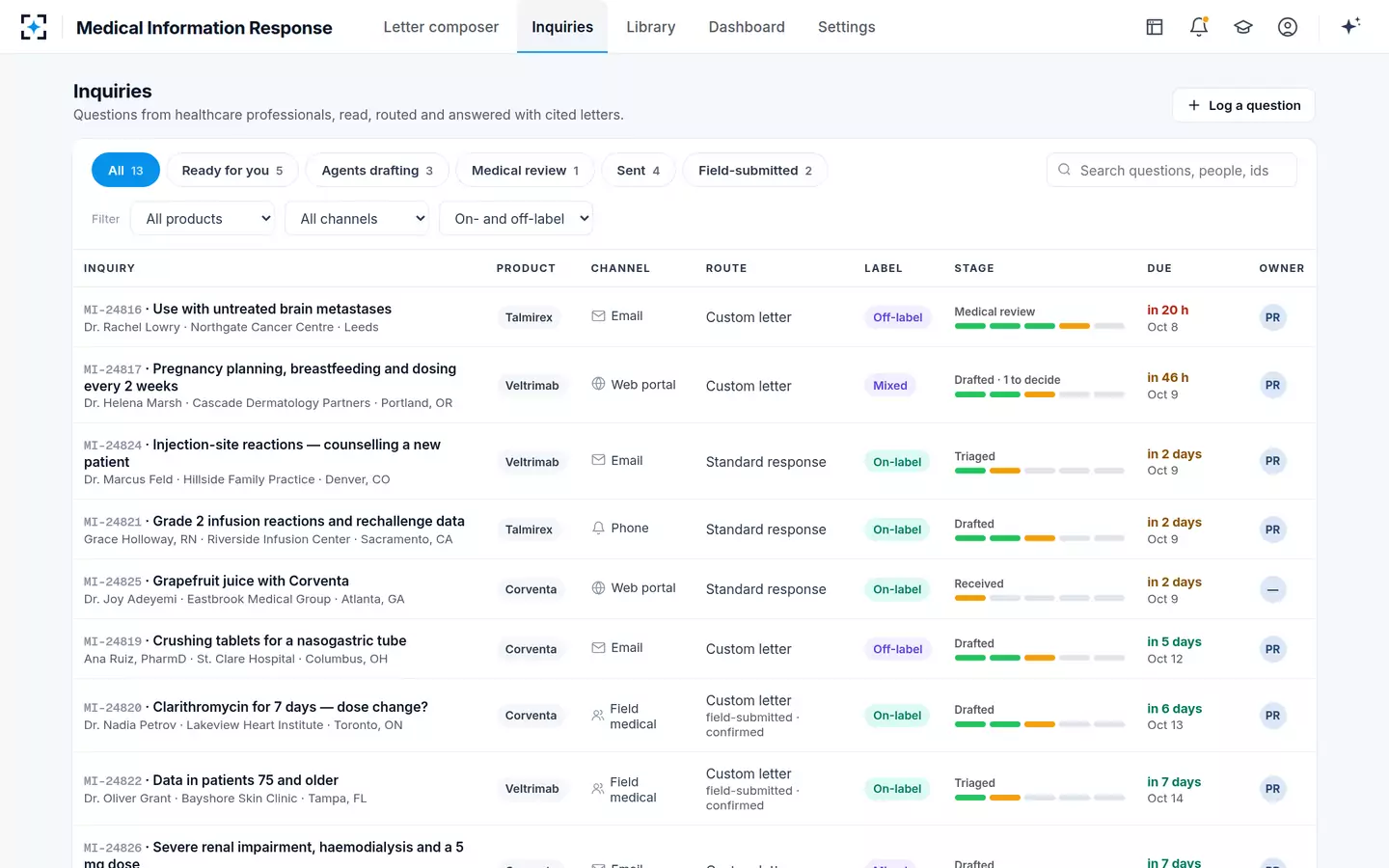
And measure the thing you are actually buying, which is the shape of the specialist's day. On the sample desk the measures are volume, turnaround, the share of letters that needed a custom answer, the share of sentences carrying a source, and the field-submitted requests confirmed before drafting — the last of which is a compliance measure disguised as an operational one.
The inquiry list, and the library behind it
Standard responses, with their versions and review dates
If you want the fourth row of the comparison tested on your own material rather than described, that is what a replay is for: a sample of past inquiries and the standard responses behind them. Start from Medical Information Response.
Questions people ask
What is medical information software?
Any system that helps a medical information department take a healthcare professional's question from arrival to a signed reply. In practice four different categories carry the name: case and inquiry management, a searchable library of standard responses and labels, a chatbot that generates answers, and drafting agents that compose a letter from approved sources with a source on every paragraph for a specialist to sign. They remove different parts of the work, so the useful comparison is of what remains, not of what each produces.
Is a chatbot enough for medical information?
Not on its own, for two measured reasons. Answers are not reproducible — when the same drug information questions were re-entered over three weeks, only three of twelve answers came back identical — and the quality ceiling sits with the pharmacist: in a scored comparison of several health-focused tools, few responses from any of them reached the top content band. A chatbot can help a specialist search and think. It cannot be the thing that composes a letter somebody signs, because the sentence-to-passage mapping it does not keep is the thing the reviewer needs.
Do we need a case management system or a knowledge base?
Many departments need both, and they answer different questions. The case system answers “what happened to this inquiry, and did we meet the clock”. The library answers “what is the current approved thing we say about this”. Neither one drafts, cites or checks a letter, which is why departments with both still have specialists writing by hand. Decide which of the three jobs — recording, finding, drafting — you are actually trying to change.
Does medical information software handle off-label questions?
It varies more than anything else on the list, and it is the right place to concentrate a trial. The behaviours to test are whether status can be set per part of a question rather than per question, whether the label and the disclosure attach automatically, whether a sentence that advises an unapproved use is removed with a reason that is recorded, whether the origin of the question is confirmed when a colleague relayed it, and whether an independent second signature is a step in the system rather than a line in a procedure.
What does medical information software cost to run?
The licence is the smaller half. The running cost is reviewer time per letter, and it is the number to compare: how many sentences a specialist still has to trace, how many letters need a second pass, and how much of the library has to be re-checked when a standard response is revised. A system that produces drafts nobody can trace increases that cost while reducing the drafting time, which is why it can feel faster and cost more.
What should you ask a medical information vendor first?
Pick a sentence from their demonstration — ideally one in the off-label part — and ask for the passage behind it, the version of that source, the section it came from and the country whose label was used. Four answers, a few seconds each. If the mapping is kept, it is immediate. If it is being reconstructed, you will see that too, and you have learnt the most important thing about the product in the first ten minutes.