A pharmacist's or physician's written question about a medicine lands on a small medical team at the drug company, which has to answer in writing, from the label (the drug's approved instructions) and the published evidence, with a named person's signature underneath. If part of the question goes beyond what the drug is approved for, the reply may report what studies found and must stop short of advice. This guide explains how those letters are built, what FDA's guidance asks of them, and how to judge software that drafts them.
Written for medical information specialists and managers, medical reviewers, standard response owners, medical affairs leaders, and anyone in compliance or IT asked to weigh in. No background needed. It covers one job at a medical information desk: the written answer to a scientific question.
Imagine you are a medical information specialist at a mid-sized drug company that makes Dravenzo, a heart failure tablet. An email arrives on Wednesday, October 7, 2026, at 9:52 a.m., from Martin Kessler, PharmD, a kidney care (nephrology) pharmacist at a Baltimore hospital. His 68-year-old patient takes 10 mg once daily, has an eGFR (a measure of kidney function) of 22, and starts hemodialysis, where a machine filters the blood, three times a week on Monday.
He asks two things in one breath. Is there any information on Dravenzo in severe kidney impairment or on dialysis? And should he cut the dose to 5 mg, given after the session?
Part 1 · the label speaks to it
Asked
Severe impairment, dialysis
Source
Label section 8.6, a standard response
You
Report what it says
Part 2 · outside the label
Asked
5 mg, after dialysis
Source
Two small studies, neither at 5 mg
You
Evidence only, no advice
One emailtwo parts, two sets of rulesthe same letter holds a plain answer and a section that needs a second signature.
You reuse wording from an older letter to save time. One carried-over sentence reads: "Clinicians may consider reducing the dose to 5 mg once daily, given after the dialysis session." It sounds helpful, and a pharmacist would welcome it. No published source supports it, and no patient in either study received 5 mg.
What the work catches: the one sentence that turns a scientific reply into advice on an unapproved dose, before anyone signs it.
How a drug company answers a health care professional's question, and why the reply is written so carefully
What a medical information letter is, what FDA's two guidance texts ask of it and how settled they are, what makes a request unsolicited, how a standard response library decays, and how desks work today, explained without selling anything. If you are new to medical information, start here.
01 · In plain words
A pharmacist's dialysis question, from his email to a signed reply
Labels leave gaps, and the people who prescribe and dispense a medicine run into them. A cardiologist has a patient starting an antibiotic that may interact. A dermatologist wonders what is known about breastfeeding. A hospital pharmacist needs to give a tablet through a feeding tube. These people are health care professionals, HCPs in the trade, and when the label alone does not give the answer, they turn to the company that makes the drug.
Inside the company, those questions go to Medical Information, or MI, a small scientific group staffed by pharmacists, physicians and nurses, which sits apart from the people who sell the drug. In the EU the law requires a company to have such a service: a "scientific service in charge of information about the medicinal products" it sells.1 Many questions are answered on the phone from an approved text. Others need a letter, written for that one person, built from the label, from the company's stored answers and from published papers.
The letter is harder than it looks, because a drug company may not promote a use the FDA has not approved, and doctors may lawfully use drugs in those ways all the same.2 One national study put off-label use at 21% of mentions for commonly prescribed drugs in 2001, and at 46% for cardiac drugs outside two classes.3
So the questions keep coming, and the company has to answer truthfully without encouraging anything. A paragraph reporting a study is allowed. A sentence telling a pharmacist what to do with the dose can become evidence that the company meant its drug to be used that way.
That is why the work comes down to single sentences. Each one has to trace back to a passage in a current source, say no more than that passage says, and leave the decision about the patient with the person treating the patient. Medical information response automation is software built around that discipline: it drafts the reply with its sources attached, for a person to check and sign. This guide explains the rules and the craft first, then how to judge such software.
One email about Dravenzo and dialysis, in five steps
The question arrivesMartin Kessler, PharmD, emails at 9:52 a.m. with two questions about one patient on Dravenzo 10 mg who starts hemodialysis on Monday.
Someone reads and splits itPart 1 is on the label. Part 2, a 5 mg dose after dialysis, is off-label. No single standard response covers both, so it needs a custom letter.
The letter is built, sentence by sentenceFrom the label, a standard response and two small studies, each sentence tied to its passage. This is the step this guide is about.
Named people signThe specialist signs. In this desk's rules, a medical reviewer adds a second signature because part of it is off-label.
It goes to him alone, and the record staysSent privately with its references and the label. What was asked, what was sent and who signed stay on file.
The people, products, publications and figures in this example are fictional.
Why a helpful sentence is the risk, and three more facts about these letters
The most helpful sentence is the riskiest
Pharmacists ask what to do. A letter on an unapproved use can report data and may not recommend. A true sentence can still fail: FDA's advertising rule lists quotes "out of context" and a study presented as "larger or more general experience" than it was among the ways to mislead.4
FDA's main text on replying is a 2011 draft
It has never been finalized. FDA's 2025 guidance still calls it "the draft guidance", and adds that "when final" it will represent the agency's thinking.5,6 It is still FDA's fullest text on the reply, so desks work from it.
Updating outweighs writing
Companies in one industry survey reported 614 new standard responses a year and 1,352 updated or revised, on average. Checking paraphrased text against the source papers ranked among the three slowest steps.7 The survey is small, and section 6 says how small.
No current published benchmark for a letter
We found no current public figure for how long a custom letter takes, how many questions a company receives or how often sent letters contain errors. A 2025 survey of 35 US companies reports none of these.8 You will have to measure your own.
On-label, off-label, standard response and unsolicited, in plain terms
On-label, off-label
On-label means within what the FDA-approved label says. Off-label means a use, patient group, dose or route the label does not cover.
Standard response
A pre-approved written answer to a question the company expects again. Also called a standard response document (SRD) or a standard response letter.
Custom letter
A reply written for one person's question when no stored answer fits. It is approved as a letter, after the question was asked.
Unsolicited request
A question "initiated by persons or entities that are completely independent of the relevant firm". Anything prompted "in any way" does not count.2
Live answers, standard response letters and custom letters, and how one question can need two sets of rules
In shortA desk has three ways to answer: on the call, with a stored letter, or with a letter written for this person. Label status belongs to each part of a question, and one sentence of a question can be on-label while the next is off it. Reading the whole question as one status is the first mistake a desk can make.
Route
When it fits
Where the words come from
When the words were approved
Answered live
A simple fact on a call or in chat: storage, a missed dose, what a label section says
The label and an approved reference text
Before the call, as a source. The call is then logged.
Standard response letter
The question matches a stored answer
A standard response, sent as it stands, with the label
Before anyone asked
Custom letter
No stored answer covers every part
Standard response paragraphs, label sections, data on file (the company's unpublished data) and published papers, assembled for this question
After the question, by the person who signs
On the guide's sample desk, one question in five needs a custom letter
1,184 questions answered in 30 days at the fictional desk in this guide
Answered liveStandard responseCustom letterReferred to nurse line
30 days of questions514382236
Fictional example from this guide
Show the numbers
Answered live
Standard response
Custom letter
Referred to nurse line
30 days of questions
514
382
236
52
Read that chart as a picture of the sorting. Your own mix may differ, and we found no public figure for what is typical. On this sample, live answers are the largest share at 514 of 1,184, and each custom letter takes far more skilled time than a live answer.
Why label status belongs to each part of the question
A question usually comes with a story, and the story holds more than one question. Dr. Kessler's email has two. Dr. Helena Marsh, a dermatologist in the same sample, asks three in one web form: pregnancy data, breastfeeding and dosing every 2 weeks. The first two are answered from the label's sections on those subjects. The third is outside the approved dose.
So one letter holds on-label sections and an off-label section, each under its own rules. FDA's 2011 draft is itself limited this way: it "does not address requests for information about approved or cleared indications", so it governs only the off-label part.2
The same drug can land on every route: what decides is the part of the question being asked
Typical handling at a desk, drawn from the fictional queue in this guide. Your procedures decide the details.
NoSometimesYes
On-label?Answer liveStandard responseCustom letterOff-label rules applyA pen left out of the fridge for 3 daysSometimesYesSometimesNoNoWhat the label says about a missed doseYesYesSometimesNoNoGrapefruit juice with the tabletYesSometimesYesNoNoA strong interacting antibiotic for 7 daysYesSometimesSometimesYesNoCrushing a tablet for a feeding tubeNoNoSometimesYesYesA 5 mg dose after dialysisNoNoNoYesYesDosing more often than the label saysNoNoYesSometimesYes
The two sentences that sound alike, on either side of the line
What the letter says
What it does
Fit for an off-label section?
"A 5 mg dose and timing doses around dialysis are not in the approved labeling, and their safety and effectiveness have not been established."
States the limit of the label plainly
Yes. It belongs first.
"In a retrospective case series of 11 patients who continued 10 mg, 3 (27%) had symptomatic hypotension during dialysis."
Reports a study, with its size and design
Yes, with its limits beside it.
"Clinicians may consider reducing the dose to 5 mg once daily, given after the dialysis session."
Suggests a course of action no study tested
No. It advises an unapproved dose.
All three sentences come from the guide's fictional letter. The studies behind them are sample text.
03 · FDA's texts and status
FDA's unsolicited-request draft and its scientific information guidance, each with its status in November 2026
In shortTwo FDA documents get confused. The December 2011 draft covers a firm's reply to a question someone else asked, and it is still a draft. The January 2025 guidance covers information a firm decides to share on its own, and it is final with an unclear implementation status. Neither binds anyone by itself, and neither replaced the other. A third, the July 2024 draft on misinformation, is about something else.
FDA's position on replying has barely moved since 1982, while its text has stayed a draft since 2011
Apr 1982Letter to industry
Unsolicited requests are treated as personal communication between requester and firm, as quoted in the 2011 draft.
Nov 1994Federal Register statement
Firms may respond with "responsive, nonpromotional, balanced scientific information".
Sep 2006Section 557 expires
The section of federal drug law that spoke to replies to practitioners lapses.
Dec 2011Draft on unsolicited requests
Seven recommendations for private requests. Still a draft, with no final version found.
Dec 2012Caronia
A federal appeals court sets aside a sales representative's conviction resting on truthful off-label speech.
Jun 2018Consistent with the label
Final guidance on communications that go beyond the label's words without leaving its conditions of use.
Aug 2021Intended-use rule revised
Oral or written statements still count. Knowledge of off-label use alone does not.
Jul 2024Misinformation redraft
Revises and replaces a 2014 draft on third-party misinformation. Unsolicited requests are not its subject.
Jan 2025Scientific information on unapproved uses
Final, Revision 2, marked not for current implementation.
Jul 2025OMB approves the information collections
Approved without change July 29; FDA's page keeps the January wording.
FDA draft, Responding to Unsolicited Requests for Off-Label Information About Prescription Drugs and Medical Devices, December 2011
Draft. FDA's page, content current April 17, 2020, read November 3, 2026, says "Not for implementation" under Docket FDA-2011-D-0868, its public file number, and mentions no replacement. No final version found.2,5
The working text for this job. Its contents are recommendations, and it says so: "should" means "suggested or recommended, but not required". See section 5.
FDA final guidance, Communications From Firms to Health Care Providers Regarding Scientific Information on Unapproved Uses, January 2025, Revision 2, often called the SIUU guidance
Final. It said it was "not for current implementation" until FDA published the decision of the White House Office of Management and Budget (OMB) on its information collections, the federal term for the disclosures and records an agency asks of firms.6,14
OMB approved them without change on July 29, 2025, and an FDA notice of September 25, 2025 lists the approvals and names this guidance's docket, FDA-2008-D-0053, among its dockets, without naming the guidance.13,15 FDA's page and the guidance itself, read November 3, 2026, still carry the January wording, and we found no FDA statement lifting it, so its status is unclear.16
Covers "firm-initiated" sharing of reprints (copies of published papers) and clinical references with HCPs. It does not govern a reply to a question. Its footnote points to the 2011 draft for that.6
FDA revised draft, Addressing Misinformation About Medical Devices and Prescription Drugs, July 2024
Draft, "Not for implementation", Docket FDA-2014-D-0447. It "revises and replaces" a June 2014 draft on third-party misinformation.12
About a firm correcting false claims made by others. Neither its page nor its text mentions unsolicited requests, and it did not replace the 2011 draft, though some summaries say so.
FDA final guidance, consistent with the label, June 2018
Helps sort what stays within a label's conditions of use from what leaves them, on factors such as dosing and patient population. Useful when setting a part's status.
21 CFR 201.128, intended uses
In force. The 2025 edition carries the 2021 wording.11
Intent "may, for example, be shown by labeling claims, advertising matter, or oral or written statements" by the firm or its representatives. A letter is a written statement.
Written for advertising. Reviewers borrow its list of ways a true sentence can mislead. See section 8.
"Scientific exchange" is the field's phrase, and neither FDA text on this work uses it
People in medical affairs, the part of a drug company that houses MI, say "scientific exchange" for any non-promotional talk about data, including a field scientist's conversation and a reply letter. A full-text search of the 2011 draft and the 2025 guidance finds the phrase in neither. FDA's own term in 2025 is "scientific information on unapproved uses". We keep FDA's words here, because a reader who thinks the 2025 guidance covers a reply will apply the wrong list.
The 2011 draft and the 2025 guidance cover opposite starting points
Our reading of each text. Neither is binding on its own, and both say so.
NoUnclearYes
Someone asked firstThe firm starts itSent to one personFinal textCurrently marked for useDecember 2011 draft on unsolicited requestsYesNoYesNoNoJanuary 2025 guidance on scientific informationNoYesNoYesUnclearJuly 2024 draft on misinformationNoYesNoNoNo
The return on all this care is one sentence. If a firm answers a private unsolicited request in the manner described, FDA "does not intend to use such responses as evidence of the firm's intent that its product be used for an unapproved or uncleared use".2
A firm may choose another way. Doing so "would not constitute a per se violation of the law, but could potentially be introduced as evidence of a new intended use". So the draft marks out a protected place to stand, and a company's counsel decides how close to stay to it.
Courts add a limit from the other side. In Caronia (2012) a federal appeals court set aside a conviction resting on truthful speech about off-label use, and in Amarin (2015) a federal district court granted a preliminary injunction on truthful statements. Commentary on both stresses that false or misleading claims stay unprotected.10 Most desks treat these cases as limits on the government and keep their procedures in place.
04 · What counts as unsolicited
What makes a question unsolicited, in FDA's own eleven examples
In shortThe test is who started it. Prompting "in any way" by the firm or its representatives makes a request solicited, and FDA says that may be evidence of intent. Three of FDA's examples are unsolicited, and eight show how a firm's own conduct spoils a later question. The fact is known at intake and hard to rebuild later, so it has to be recorded when the question arrives.
Eight of FDA's eleven examples show a firm's own conduct making a later question solicited
Unsolicited (Examples 1 to 3)Solicited (Examples 4 to 11)
1. An individual calls or emails medical information staff about an off-label use
Unsolicited, non-public
2. At a live presentation, someone asks a firm's representative, and others hear it
Unsolicited, public
3. Someone posts the question on a firm's website or a third-party forum
Unsolicited, public online
4. A sales representative mentions an unlabeled use and invites a request
Solicited
5. A medical science liaison or paid speaker presents off-label data at a promotional dinner, and attendees ask
Solicited
6. Reply cards, a promotional piece with a call-us line, or an exhibit sign reading "Coming Soon"
Solicited
7. A phone number, address, URL or username whose wording implies off-label information
Solicited
8. A firm encourages users to post videos of their own uses, and off-label questions follow
Solicited
9. Packets sent to bloggers to encourage writing about an off-label use
Solicited
10. A short online post announcing study results and suggesting an off-label use is safe and effective
Solicited
11. A website serving prepared standard responses from menus of disease states, or a search box that goes beyond the product information requested
Solicited
Example 11 matters for anyone building self-service. A public page that lets a visitor pull a stored off-label answer from a menu turns the resulting requests into solicited ones.2 A portal can take a question and route it to a person, and a Canadian benchmark suggests few would use it for stored answers anyway: standard responses viewed on company websites came to about 0.5% of annual inquiries.17
The hard case: a question passed on by the company's own field team
A medical science liaison, or MSL, is a scientific field employee who talks with doctors about data. A doctor asks an MSL something. The MSL sends it in. Nothing was prompted, as far as anyone knows, and yet the paper trail shows a company employee's name on the request.
FDA's Example 5 makes the setting decisive, and the draft says nothing specific about relaying a question. Some desks therefore go back to the doctor and ask. That confirmation is a company control, and it gives a later reader a record of whose question it was.
A field-submitted question gets an extra step before anyone drafts an off-label section
A common desk procedure, built on FDA's draft. Turnaround clocks and wording are your own.
1Field staff pass it on
The MSL records the doctor's own words and how the question came up.
Field medicalSame day
2Desk records who submitted it
Requester, submitter, channel, date, wording.
Medical InformationAt intake
3Desk asks the doctor
"Was this your own question, and would you like a written answer?"
Medical InformationYour clock
4Answer or stop
Confirmed: draft. Not confirmed, or prompted: no off-label section, and the desk reviews what happened.
The MSL records the doctor's own words and how the question came up.
Field medical
Same day
Desk records who submitted it
Requester, submitter, channel, date, wording.
Medical Information
At intake
Desk asks the doctor
"Was this your own question, and would you like a written answer?"
Medical Information
Your clock
Answer or stop
Confirmed: draft. Not confirmed, or prompted: no off-label section, and the desk reviews what happened.
Specialist
On the reply
Public questions get a thin public answer
A question posted where others can read it follows different recommendations. A firm should respond only if the question is about its own named product. The public response "should be limited to providing the firm's contact information and should not include any off-label information". The response says the question concerns an unapproved use and gives the medical department's contact details, and the person responding discloses who they work for. The detailed answer follows privately, once the person writes in.2
FDA's Example 13 sets the test: "Can Drug/Device X be used for Condition Y" may get that reply, while "What drug/device can be used for Condition Y", where the firm's product is not approved for it, should get none.
05 · What FDA asks of a reply
The seven recommendations for a private off-label reply, and what each one means on the page
In shortFDA's draft lists seven recommendations for a private reply: who gets it, how narrow it is, how balanced, what tone, who writes it, what travels with it, and what records stay. Each maps to something a reviewer can check on one letter. A second signature appears nowhere in the list. Where a company requires one, that is the company's own control, and we found no published count of how many do.
#
What FDA's draft recommends
What a reviewer looks for
1
Provide it "only to the individual making the request directly to the firm as a private, one-on-one communication"
One addressee. No copy to a sales colleague, no group list.
2
"Tailored to answer only the specific question(s) asked." If a question is broad, "appropriately narrow" it. Add known or suspected risks from other conditions if they are relevant to this one (Example 12).
Nothing the person did not ask, apart from relevant risk information. A note if the desk called back to narrow it.
3
"Truthful, non-misleading, accurate, and balanced", including data "that are not supportive or that cast doubt". "To the greatest extent possible", rely on published peer-reviewed sources. Include "complete copies" of reprints, beyond any summary or abstract the firm prepares.
The unhelpful study is there. Limits sit beside results. Reprints go out, and data on file is used only if responsive.
4
"Scientific in nature", and not sent along with promotional material
No brand language, no comparison the evidence does not support, no promotional insert.
5
"Generated by medical or scientific personnel independent from sales or marketing departments", trained in narrowing, tailoring and documenting. Sales and marketing have "no input on the content".
Who wrote and edited it, and that nobody commercial did.
6
Accompanied by five items, set out below
All five present and prominent.
7
Keep records of the request (with "name, address, and affiliation of the requestor"), of what was provided, and of "any follow-up inquiries or questions"
A record someone can produce years later.
Quotations are from FDA's December 2011 draft, section V, which is a draft and nonbinding.2
The five items that travel with an off-label letter
1 · The label
A copy of FDA-required labeling
The approved package insert, if any. It gives the reader the approved reference point.
2 · Not approved
A prominent statement
FDA "has not approved or cleared the product as safe and effective for the use addressed".
3 · What is approved
A prominent statement of the indications
What FDA did approve or clear the product for.
4 · Risk
All important safety information
A prominent statement "including, if applicable, any boxed warning".
5 · References
A complete list
A bibliography for all of the information sent, including data on file.
Not in FDA's list
A second signature
Companies add it as their own control. Say so when you describe it to anyone.
A strong off-label section reads in a fixed order, so a reviewer can see at once if a step is missing
A common drafting order, built from FDA's draft. Your template sets the wording.
1Approved use first
What the product is approved for, and at what dose, stated plainly.
Disclosure
2Not approved
The use asked about is not approved, and its safety and effectiveness have not been established.
Disclosure
3The evidence
Each study with its design and size, including what does not support the use.
Evidence
4Its limits
Small, retrospective, uncontrolled, or at a different dose: say which.
Balance
5Risk from the label
Important risk information and any boxed warning.
Balance
6References and label
Full list attached, label enclosed, reprints included.
What the product is approved for, and at what dose, stated plainly.
Disclosure
Not approved
The use asked about is not approved, and its safety and effectiveness have not been established.
Disclosure
The evidence
Each study with its design and size, including what does not support the use.
Evidence
Its limits
Small, retrospective, uncontrolled, or at a different dose: say which.
Balance
Risk from the label
Important risk information and any boxed warning.
Balance
References and label
Full list attached, label enclosed, reprints included.
Enclosures
Who may sign, and what the signature records
FDA's draft asks for "medical or scientific personnel" and names no credential. Companies often hire pharmacists, because a drug information pharmacist is trained to answer from the literature, and many use a physician as the medical reviewer.
The signature itself is a separate question. Where FDA's electronic records rule, 21 CFR Part 11, applies, a signed record must show "the printed name of the signer", "the date and time" and "the meaning (such as review, approval, responsibility, or authorship)", and those must appear in any readable form of the record, with the signature linked so it cannot be copied to another record.19,20 The same rule asks for validated systems and audit trails on closed systems.21
Does that rule reach a reply letter? Part 11 applies to records kept "under any records requirements set forth in agency regulations", and to records submitted to the agency.22 FDA's records list for a reply is a draft recommendation. So whether your letters are Part 11 records is a question for your counsel. Some desks hold to the same three items in any case, because a signature with no stated meaning leaves nobody able to say what the signer vouched for.
06 · The standard response library
How a standard response library is written, kept current and retired, and why old wording comes back
In shortA standard response is a concise, approved summary of the evidence on one question. Published survey means put updates at more than twice the count of new documents. The slow part is proving each paraphrase still matches its paper. A retired version does not disappear: its sentences live on in every letter that quoted it, ready to be reused.
Departments in the survey update more than twice as many standard responses as they create
Means a year per company. Ranges ran up to 2,676 new and 6,057 updated.
Do not read that fall as a measured gain. The paper's own Results give 8.3 hours and its Discussion 8.7, the 2018 survey covered 27 US departments, and the two may count different steps and different people. The authors themselves warn of limited external validity, and phactMI, the industry group behind the survey, and Microsoft sponsored the work.
Respondents named the three slowest steps: paraphrasing study content, checking paraphrased text against the source publications, and checking the document's data integrity.7 In other words, the expensive part of a revision is proving that every sentence still matches the paper it came from.
The main published benchmark rests on 13 completed surveys, so read it as a rough guide
The one question it answers, and what it leaves out
Sending it for a question it does not cover
Background, then the data
Relevant background, clinical data and balanced references. In the survey, 87% (14 of 16) drew on at least 4 studies.7
An answer resting on one favorable paper
The search strategy and date
The terms, the databases and the day it ran
A reviser starting over instead of reading only what is new
Version, owner, approval, next review
The control fields
Nobody knowing which copy is current
How a retired sentence gets back into a letter
We found no FDA rule that sets a review interval for a standard response. Some desks set a yearly date at approval and review early when a label changes or a material paper appears.
Retiring a version is the easy half. The harder half is that a letter signed last spring still sits in the archive, and it is the most convenient source for this week's letter.
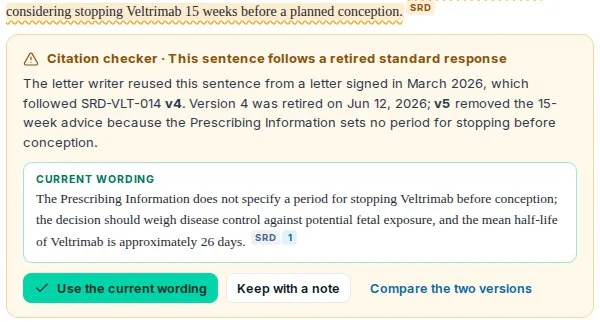
In the sample used in this guide, a letter signed in March 2026 followed version 4 of a pregnancy response. Version 4 was retired on June 12, 2026. Version 5 removed a 15-week stopping suggestion because the label sets no such period. An October draft picked up the old sentence through the March letter. It has a source and reads well, and its source is no longer valid.
Check the version as well as the name"SRD-014" is correct on the page. Version 4 is the problem.
Check reused letters as sourcesA signed letter is evidence of what was said then. It is no source for what may be said today.
Count how often it is usedUse and review status are separate facts. The most used document may be the one due for review.
Watch for repeatsSix custom letters on one question in 90 days means a standard response is missing, and six chances for six different answers.
07 · The numbers in a letter
Reading "3 of 11": working through the numbers an off-label letter has to state exactly
In shortA medical information letter is mostly small numbers from small studies. The job is to state each exactly, with its denominator and its limits, and never to carry one a step further than the study did. Here is the guide's fictional letter, worked through, including the tempting sum nobody should send.
The two sample studies, and what each number allows you to say
The passage says
The sum
Fine to write
Drifted, so strike it
Exposure in 8 patients with eGFR below 30 was 1.3 times that in 8 matched patients with normal kidney function
1.3 × = 30% higher
"1.3 times", with the 8 and 8
"About a third higher", "modestly raised"
A 4-hour hemodialysis session removed less than 5% of the dose
5% of 10 mg = 0.5 mg at most
"Less than 5% of the dose", after a single dose in 8 patients
"Negligible", "not dialyzable"
3 of 11 patients continuing 10 mg had symptomatic hypotension during dialysis; 2 needed a dose interruption; median 7 months
3 ÷ 11 = 27%
"3 (27%) of 11", retrospective, uncontrolled
"About a quarter of patients", with no denominator
With 11 patients, a count of 3 could fit a true rate anywhere from 6% to 61%
Exact 95% confidence interval for 3 of 11, our arithmetic on the fictional case series. A letter would state the count and the design, and leave this range out.
Lowest rate that fits 3 of 116%
What the letter reports27%
Highest rate that fits 3 of 1161%
Fictional example from this guide
Show the numbers
Item
Value
Lowest rate that fits 3 of 11
6%
What the letter reports
27%
Highest rate that fits 3 of 11
61%
That width is why "27%" alone misleads. Showing the count with its denominator lets a reader see the size of the study at once. FDA's advertising rule names the error on the other side: presenting a study "in a way that implies that the study represents larger or more general experience with the drug than it actually does".4
The tempting sum a letter must not make
A pharmacist reading "1.3 times the exposure" may do the arithmetic at once. 10 mg gives 1.3 times normal exposure, so 5 mg might give about 0.65 times normal, if exposure scales with dose.
That sum may be sound pharmacology, and the pharmacist is free to make it. The company cannot, because no patient in either study received 5 mg, and no study tested the sum. In the fictional letter, the sentence reporting the limits says so in those words: "no patient in either study received a 5 mg dose". The reader gets the facts and keeps the decision.
Counting the fictional letter, sentence by sentence
Eight sentences, three kinds of source: the sample letter leans on the label, then the two papers
Primary source of each sentence in the fictional Dravenzo letter, counted from the screens
LabelStandard responsePublication
Letter MI-24826413
Fictional example from this guide
Show the numbers
Label
Standard response
Publication
Letter MI-24826
4
1
3
Eight sentences, four sources drawn and three references. The label and the two papers go on the reference list. The standard response is an internal source, so it does not. A letter's checks come out as counts like these: sentences with a source, sentences removed, references attached. Clocks, the turnaround targets a desk sets itself, count too. The email arrived on Wednesday, October 7. Five business days later is Wednesday, October 14, and that is the due date a desk with a five-day custom letter clock would set.
08 · What goes wrong
Nine ways a medical information letter goes wrong, and why a read-through misses most of them
In shortFew errors are false statements. Most are true sentences in the wrong frame: too strong for the evidence, missing a limit, tied to the wrong reference or to a retired version. A reviewer who reads the whole letter and agrees with it can approve an unsupported sentence without ever disagreeing with anything.
Error
How it happens
What catches it
An advisory sentence
Wanting to help; carried over from a draft
A check for "may consider", "should", "we suggest" in every off-label section
A retired source
Copying from an earlier letter
Comparing reused wording against the current version
A number that drifted
Each rewrite rounds a little
Reading sentence and passage side by side, digit by digit
The right paper, the wrong sentence
Two sentences swap references during an edit
Rechecking every pairing after every edit
The unhelpful study left out
Searching for support; a short deadline
A saved search strategy, and asking what the search found and left out
The answer wider than the question
Pasting a whole standard response
Mapping each section to a part of the question
The wrong country's label
A global library, a local requester
Requester's country on the case; one template per country
A solicited request treated as unsolicited
How it arrived was not recorded
A required field at intake, and a confirmation step for field-submitted questions
A missing enclosure
Hand assembly under a deadline
A checklist tied to the off-label flag
The errors that matter most are the ones a read-through catches least
Placement is a judgment; plot your own from a sample of 50 signed letters
Cost if it reaches a prescriber →
Check sentence by sentence
Keep reviewers alert
Tidy up with a template
Fix with a checklist
Advice on an unapproved doseRetired wordingDrifted numberSolicited requestUnhelpful study missingWrong country's labelAnswer wider than askedMissing enclosure
How easily a read-through catches it →
Illustrative · replace with your own numbers
Show the numbers
Item
How easily a read-through catches it (0–1)
Cost if it reaches a prescriber (0–1)
Advice on an unapproved dose
0.42
0.78
Retired wording
0.14
0.72
Drifted number
0.20
0.54
Solicited request
0.10
0.63
Unhelpful study missing
0.36
0.62
Wrong country's label
0.62
0.56
Answer wider than asked
0.72
0.32
Missing enclosure
0.76
0.20
The advertising rule's list works as a reviewer's checklist
21 CFR 202.1(e)(6) is written for advertising, and FDA's draft says a reply made in the manner it describes is not expected to meet advertising disclosure rules. Even so, its list of ways to mislead reads like an editor's marking guide, and reviewers can use it that way.
The rule names a "quote or paraphrase out of context", literature "that purport to support" a claim "but in fact do not support the claim", and "favorable information or opinions about a drug previously regarded as valid but which have been rendered invalid by contrary and more credible recent information".4 None of these needs a false statement, which is why the review has to move from the letter to the sentence.
A person misses them for ordinary reasons. Letters are built from earlier letters, and a sentence approved once arrives looking settled. Volume pushes the reviewer to trust what looks familiar. And checking, as the survey respondents said, is among the slowest parts of the work.7
09 · What it can cost a company
From one advisory sentence to intended-use evidence, untitled letters and False Claims Act cases
In shortA reply that strays loses the draft's protection and can be read as evidence of a new intended use. FDA's letters on promotion jumped in 2025, and past off-label settlements ran into billions; the 11 that the Government Accountability Office (GAO) counted for 2003 to 2007 began with sources other than FDA. We found no public FDA letter aimed at a private reply. The practical cost is more often the rework of a desk that cannot show what it sent.
FDA's promotion office sent 63 untitled letters in 2025, 52 of them on one day, against 5 the year before
Letters by letter date. 2026 runs through September 28. An untitled letter is FDA's notice for a violation below a warning letter's threshold.
These letters concern promotion. They matter here for two reasons. They show FDA's attention on how companies describe their drugs, across a large volume: GAO counted over 68,000 final promotional submissions in 2007, and FDA reports over 70,000 in 2024.24,25 And they let you read the agency's recent reasoning on promotional claims, in its own words.
We found no public FDA letter aimed at a private medical information reply. None of the 119 untitled letters on FDA's table, dated 2017 through September 28, 2026, contains the words "unsolicited", "medical information" or "standard response", and two web searches for warning letters and older letters found none. We did not read FDA's warning letters one by one, so this is no proof none exists, and these replies are private.
Four settlements that included off-label promotion ran from about $1.4 billion to $3 billion
Each resolved allegations including off-label promotion; most also covered other conduct. Read each record before quoting it.
from Department of Justice (DOJ) cases involving off-label promotion, 2003 to 2007, begun by sources other than FDA, which referred none of its 42 letters' violations to DOJ.24
GAO, July 2008
7 months
on average for FDA to issue those letters from first draft, then about 4 months for companies cited for more serious violations to take the corrective action.24
GAO, July 2008
$28,619
top of the per-claim penalty range under the False Claims Act, the federal law on false claims for government payment ($14,308 to $28,619) for penalties assessed after July 3, 2025, with no increase for 2026.29,30
DOJ, Federal Register
How the record protects a desk, or fails to
GAO's finding that other sources started those cases points to the file. In enforcement, the internal record is what gets read: who asked, what they asked, who passed it on, what was sent and who approved it.
Companies under integrity agreements, the compliance terms attached to some federal settlements, have had this spelled out. Novartis's 2010 agreement with the inspector general of the US health department (HHS) required a database of inquiries with six named items: date, form, the name of the requesting professional or institution, the nature and topic including "exact language" if written, the nature and form of the response, and the name of the Novartis representative who interacted with the requester, if known.18 That list is a good starting point for anyone designing intake today.
What a wrong or late letter means for the pharmacist and the patient on Monday
The legal language serves a plain purpose. A pharmacist reading a letter is about to do something for a patient on Monday. A wrong number, a drifted claim or a stale recommendation reaches a decision the company will never see. A slow letter fails too: the question gets answered somewhere else, without the label beside it.
In a survey of professionals who had just used these services, 246 responded. Of the 222 who answered on patient care, 39% said the reply helped them educate patients and 32% said it enhanced treatment efficacy.31 Those are self-reports to a survey whose authors work for or are paid by drug companies and their industry group, and they point to what a reply is for.
10 · Outside the US
Answering an off-label question in the UK, the EU and Canada: the same reply by different legal routes
In shortEach of these treats a reply to a specific question as something other than advertising, on conditions. The UK says activity designed to solicit questions is likely promotional. Canada says a response on off-label uses from sales or marketing staff may be promotional. So a global desk writes one letter per country, each citing that country's label, with one discipline underneath.
Four authorities agree on the reply and differ in what they spell out
Our reading of each text. A cell marked not addressed does not mean permitted: the text read does not take up the point directly.
Not addressedImpliedStated
Reply is outside advertisingPrompting spoils itNames who may answerRecords or disclosures listedUS, FDA draft 2011StatedStatedStatedStatedEU, Directive 2001/83/ECStatedNot addressedImpliedNot addressedUK, Blue Guide and ABPI CodeStatedStatedImpliedNot addressedCanada, Health Canada guidanceImpliedStatedStatedNot addressed
Directive 2001/83/EC, Article 86(2): the advertising title does not cover "correspondence, possibly accompanied by material of a non-promotional nature, needed to answer a specific question about a particular medicinal product". Article 98(1) requires a "scientific service".1 The EU pharma package that would replace this text is not yet law: the Council adopted its position on September 28, 2026, and Parliament's file reads "Awaiting Parliament 2nd reading".35
A legal duty to have the function at all, which the US text lacks. National rules and industry codes add detail.
UK
MHRA's Blue Guide excludes correspondence "to answer a specific unsolicited question". It allows "a factual answer to an unsolicited question" about use outside the license, and warns that "any activity that appeared to be designed to solicit such questions would be likely to be considered promotional".32 The ABPI Code 2024: an unsolicited enquiry is one "without any prompting from the company".33
A clear warning on conduct around the reply, such as a paragraph inviting the next question.
Canada
Health Canada: a response may be promotional if "the inquiry has been encouraged in any way by the manufacturer", or if a response on off-label uses "is communicated by sales or marketing personnel".34
The same sentence can be non-promotional from the medical team and promotional from a representative.
The label differs by country: US Prescribing Information, the UK and EU Summary of Product Characteristics (SmPC), the Canadian Product Monograph. A use that is on-label in one may be off-label in another, so the status of a part depends on where the requester practices. Letters need a template per country, and in Canada often a version in French.
Patient details in a question also travel differently. In the US, a drug maker is generally outside the definition of a covered entity, the kind of organization the health privacy law HIPAA regulates directly, though the hospital is inside it (our reading of 45 CFR 160.103).36 European desks work under data protection law. Ask your counsel, and collect no more about a patient than the question needs.
11 · The teams, in numbers
How large medical information teams are, what else they do and how questions reach them
In shortPublic numbers on this work are few, and they come from the industry's own surveys. A 2025 survey of 35 US companies gives staffing and services. A Canadian benchmark gives channels. We found no current published figure for inquiry volumes per company, cost per letter or market size, so we show what you can measure instead.
25 + 13
average internal and external full-time staff per company, not counting contact centers. External staff averaged 35 at large companies, 9 at small and 5 at midsize.8
phactMI, 35 US companies, 2022 data
90%+
of requests in Canada came by phone, email or company representatives, and about half by phone, in a survey of 17 companies.17
DIA Global Forum, November 2023 issue
0.5%
of annual HCP inquiries in Canada: the rough share made up of standard responses viewed or downloaded on company websites.17
DIA Global Forum, November 2023 issue
Most medical information teams now do far more than answer questions
Share of phactMI's US member companies reporting each activity, 2022 data; denominators vary by question
That chart explains why the desk's time is under pressure. Answering questions is one job among many: the same teams review promotional pieces, train field teams and support labeling. The survey gives median hours of about 16 a week reviewing promotional materials before meetings and 6 in review committee meetings.8
Numbers we could not find published, and how to get yours
You might want
Public figure
Measure instead
Inquiries per company, per year
None found
Count from your case system, the software that logs each question, by product and route
Days to a custom letter
None current found. Ask any vendor claiming a figure for its method.
Median and slowest tenth, receipt to send, over a quarter
Error rate in sent letters
None found. No independent audit of manufacturers' letters turned up.
Re-check 50 signed letters against their sources, sentence by sentence
Market size for this software
None we would trust
Your own spend: staff, outsourcing, literature, case system
The trend is easier to state. In the 2025 survey, authors reported that "the majority are evaluating or in the process of adopting" AI, without percentages, and they named oversight of AI in the insights process as one of three priorities.8 Vendors now sell response automation as a category. Treat every speed claim as a question to test on your own letters.
12 · What AI changes
AI on drug questions: chatbot test scores, invented references and how far the rules reach a reply letter
In shortGeneral chatbots answering drug questions on their own have mixed published results, poor in the earlier tests, and their references have often been invented or wrong. A tool that writes only from retrieved sources fails more quietly, with a real paper attached to a sentence it never says. No regulator has written a rule for AI in this job. The sound design has software draft and check, and has named people decide, sign and answer for the result.
On 50 real drug questions, one general chatbot was fully right and usable 13 times
Six senior hospital pharmacists rated one chatbot's answers, 2024. No references were given, and only 3 of 12 repeated answers were identical.
Correct, enough to act on, no riskPartly correctFalse
Why "it searches before it writes" is only part of the answer
Newer tools retrieve first, and they do better on invented references. They still fail. Stanford and Yale researchers found that three legal research tools, from two providers whose claims they tested, each gave a false or wrongly sourced answer 17% to 33% of the time.39
On drug questions, one 2026 study put 30 questions answered by drug information faculty to four clinically focused chatbots and one general one. The best scored 17.82 out of 25, and all were statistically below the faculty's answers. "Lack of false information" scored highest and "evidence supporting the content" lowest.40
A second 2026 study, at one hospital, found two tools, GPT-4o and Medical Chat, with composite scores comparable with pharmacists', two others lower, and low agreement among the raters (kappa 0.015, on a scale where 0 means chance agreement and 1 means perfect), which itself tells you how hard this is to judge.41
Read together, those studies disagree on how good the answers are. The 2026 faculty comparison does show where to look: its raters scored the evidence behind an answer lowest, and only the source can settle that. These are hospital drug information tests, a neighbor of manufacturer letters and no measure of them. A company's reply has added duties those studies never tested: label status, balance, tailoring and enclosures.
Where software fits in the work, and where people stay
Step
Software can
People keep
Read and split
Propose parts and label status per part
Correct a wrong split; handle a question that is unclear
Check the requester
Look up a directory; record how it arrived; send a confirmation request
Decide when the origin stays unclear
Find the evidence
Retrieve current passages, with versions and sections, including unfavorable data
Judge relevance and quality; run a search when the library falls short
Draft
Compose from a template, a source on each sentence
Edit; own the wording
Check
Compare sentence to passage, numbers, version, promotional wording
Accept or reject each finding
Sign and send
Prepare the route, the enclosures and the record
Sign. Nothing leaves without a person.
What regulators and standards say, and how far each reaches
Leaves out AI for "operational efficiencies" that do not affect patient safety, drug quality or study reliability. A reply letter is outside its examples (our reading). Promotion and intended-use rules still apply to what goes out.
EMA reflection paper and joint EMA-FDA principles
Paper adopted September 2024; principles first published January 14, 2026.43
Written for the medicine lifecycle. Useful for the habits they ask for, such as human oversight and documented purpose.
EU AI Act
The AI Omnibus, in force July 27, 2026, moved Annex III high-risk rules to December 2, 2027 and Annex I product rules to August 2, 2028.44
Have counsel classify your use; a drafting tool with human sign-off is unlikely to sit in those annexes (our reading).
Draft EU GMP Annex 22, and Annex 11
Still drafts. EudraLex Volume 4 lists Annex 11 at its January 2011 revision and no Annex 22. The draft says generative AI and LLMs "should not be used in critical GMP applications".45,46
Manufacturing only: GMP means good manufacturing practice. Neither reaches this work, and quoting them here would mislead.
FDA Computer Software Assurance
Final, February 2026, superseding the September 24, 2025 version.47
Scope is computers and automated data processing in medical device production or the quality system. It does not reach a medical information desk, though its risk-based thinking is worth borrowing.
Data integrity (ALCOA+), and the ISPE GAMP AI guide
MHRA guidance, March 2018; ISPE guide, July 2025.48,49
Written for GxP work, the good-practice rules on regulated activities. Letters may sit outside GxP, depending on your quality system. The vocabulary still helps: attributable, legible, contemporaneous, original, accurate.
13 · How desks work today
How a custom letter gets written by hand today: the people, the hand-offs and the days in each step
In shortA custom letter passes through a specialist, sometimes a contact center first, a reviewer when it is off-label, and a standard response owner when the library falls short. On the guide's sample desk, most of the elapsed time goes to searching, drafting and checking, and to waiting. Teams run this in house, outsourced or in a mix, on a case system that holds the record.
A specialist, a medical reviewer, a manager and a response owner: who answers for what
MI
Medical information specialist
Often a PharmD. Reads the question, finds the evidence, writes or checks the letter and signs it.
"I need to see where every sentence came from."
MR
Medical reviewer
Often a physician. Answers for off-label content where the company requires a second look.
"If a letter about an unapproved use tells a doctor what to do, it is promotion."
MG
Medical information manager
Owns templates, clocks, staffing and the health of the library.
"The same question comes in six times and gets six different letters."
SO
Standard response owner
A medical director for the therapy area. Approves new and updated standard responses.
"A retired standard response must never come back through an old letter."
CC
Contact center staff
Answer the phone and chat from approved text, in house or outsourced, and pass on what they cannot answer.
FM
Medical science liaison
A scientific field employee who passes a doctor's question to the desk, in the doctor's words.
A custom letter crosses five hand-offs before it reaches the person who asked
The usual path by hand; your steps may differ. Times are rough examples, since we found no public benchmark.
1Log and read
Case opened; the question read and split; requester checked.
Contact center or specialistHours
2Search
Library, label for the country, data on file, literature.
SpecialistHours
3Draft and cite
Paragraphs pasted into the template and references typed.
Case opened; the question read and split; requester checked.
Contact center or specialist
Hours
Search
Library, label for the country, data on file, literature.
Specialist
Hours
Draft and cite
Paragraphs pasted into the template and references typed.
Specialist
2 to 4 hours of work on the sample desk
Check
Every claim and number against its source.
Specialist
Often the slowest part
Review and sign
Second look on off-label parts; then signature.
Medical reviewer
Waits in a queue
Send and file
Secure send, enclosures, case closed, archived.
Specialist
Minutes
Searching and drafting take half of a custom letter's 4.6 days on the sample desk
Estimated split at the guide's fictional desk, by hand. Replace with your own: we found no public figure.
Log and routeSearchDraft and citeCheckReview and send
4.6 days by hand0.5 d1.2 d1.1 d0.8 d1 d
Fictional example from this guide
Show the numbers
Log and route
Search
Draft and cite
Check
Review and send
4.6 days by hand
0.5 d
1.2 d
1.1 d
0.8 d
1 d
In house, outsourced or with software: three ways desks are built
In house
Your own specialists
Closest to the science and the medical reviewers. Cost scales with headcount, and small product teams struggle with hours and languages.
Outsourced
A contact center partner
Covers phones, hours and languages, and answers from your approved text. The survey shows large companies averaging 35 external full-time staff before contact centers.8 Custom letters often still come back to your team.
With software
A case system, a library and drafting help
The case system is the record. Newer layers read, retrieve and draft on top of it. Keep the record where it is; add drafting and checking beside it.
Part B · See it working
One dialysis question through Botminds Medical Information Response, and the desk around it
Part A described the work without naming a product. This part shows how Botminds does it, at a fictional drug company, Northwind Bio, with three products and a US desk that also answers Canada and the UK. Every company, hospital, person, case number, publication and figure in the screens is sample data, and the label text is written for these fictional drugs.
14 · One letter, screen by screen
Martin Kessler's dialysis question, from the inbox to the medical reviewer's signature
In shortThe question splits into an on-label part and an off-label part. The letter assembles paragraph by paragraph, each tagged with its source, and one click opens the passage. The off-label guard strikes a sentence that advises an unapproved dose. Priya Ranvelle, the specialist, signs, Dr. Omar Haddad, the medical reviewer, adds the second signature, and the letter goes to one person with its references and the label.
The sample letter goes from email to sent in one morning, with two named signatures on the way
October 7, 2026, on the fictional desk. The design target for a custom letter is a median of 1.4 days.
9:52 a.m.The email arrives
Two questions about one patient on Dravenzo 10 mg.
By secure email, with 3 references and the Prescribing Information.
Fictional example from this guide
Show the numbers
When
What
9:52 a.m.
The email arrives
Next
The agents run
10:24 a.m.
Priya Ranvelle signs
Then
Dr. Omar Haddad reviews
10:47 a.m.
Sent and filed
1
The question, split into two parts with a status on each
On the left, Dr. Kessler's own words, with each question highlighted and numbered. Part 1, severe renal impairment and dialysis, is marked on-label. Part 2, a 5 mg dose after dialysis, is marked off-label. Below that sit the requester ("HCP verified"), the route ("Custom letter: no standard response covers every part") and the request ("Unsolicited, from the requester directly").
In the center is the letter itself, on paper, with a tag in the margin beside every paragraph: Label, Standard response, Publication or Template. On the right, the off-label guard's checklist and the sources drawn.
The letter composer. Question and status on the left, the letter with its source tags in the center, the guard and sources on the right. All sample data.
2
"Replay the agents": the letter assembling in view
Priya can watch the run again at any time. Each agent, a software worker with one narrow job, lights in turn along the top of the page: inquiry reader, request check, evidence finder, letter writer, off-label guard, citation checker. Sources light up as they are drawn. Paragraphs appear one by one, each with its tag.
The replay shows that nothing happened out of sight. The same steps are on the case's audit trail afterward.
The agents composing. A track across the top shows which step is running. The letter builds below it.
3
One click from a paragraph to the passage behind it
Priya clicks the paragraph on the single-dose study. The right panel changes to that paragraph's source: Varga 2024, a sample publication, with the passage highlighted. Exposure 1.3 times higher in 8 patients with eGFR below 30, and less than 5% of the dose removed by a 4-hour session. The numbers in the sentence and the passage match, digit by digit.
This is the change a reviewer feels most: the letter becomes a set of sentences to confirm.
A paragraph and its passage. The publication shown is sample text, written for this fictional drug.
4
The off-label guard strikes one sentence, with its reason and origin
Section 2 opens with the approved dose, 10 mg once daily or 2.5 mg with a strong CYP3A4 inhibitor (a medicine that slows the body's breakdown of certain drugs), and says the asked dose and timing are not in the approved labeling. It reports the two studies, then their limits: both small, one retrospective and uncontrolled, and no patient given 5 mg. Then the label's warning on hypotension.
The letter writer had carried over a sentence from a draft of letter MI-23977. The guard struck it and says why: "Advises an unapproved dose and has no published source. An off-label section may state the evidence; it may not recommend." It stays on screen, struck through, and comes back only with the medical reviewer's signature.
Check your own template against FDA's draft. This sample section states the approved dose and points to the enclosed label for full risk information. The draft's list also names a prominent statement of the approved indications and of important risk information.2
The off-label guard. Disclosure, evidence, limits, and one sentence removed. The struck sentence shows its reason and where it came from.
5
Priya signs with a stated meaning, and the route is on the screen
The checks sit on one line: 8 of 8 sentences cited, off-label section built from scientific evidence, 1 sentence removed by the guard, 3 references attached. The route has three stops: Priya signs now, Dr. Haddad adds the second signature, then send and file.
The meaning of her signature is written out: "I reviewed this response and approve it as accurate, balanced and specific to the question asked." That wording, her name and the time go on the record, the three items 21 CFR 11.50 names.19
Route to sign. Checks, route and meaning in one place. Signing needs the signer's password.
6
Dr. Haddad signs against a list, for the off-label section
Because part of the letter is off-label, it waits. His screen lists what he is attesting to: specific to the question asked, disclosure, balance, references and label, and kept apart from promotion, sent privately to the requester only. Priya's first signature, October 7 at 10:24 a.m., sits beside it.
The second signature is your company's control, set in Settings. It lines up with FDA's recommendations and comes from none of them.2
The second signature. Five things to attest, the first signature, and a password.
7
Sent to one person, with the case closed and archived
The letter's PDF is built with its 3 references and the Prescribing Information enclosed, then sent by secure email. The case closes and the letter, sources, decisions and signatures are archived. The library keeper notes 4 dialysis dosing questions this quarter and suggests an off-label standard response to its owner.
Send and file. Each step records what it did. The address is a sample.
15 · The rest of the desk
A retired pregnancy sentence, a field-submitted question, the library and the manager's dashboard
In shortThe same discipline runs across the desk. The citation checker catches a sentence following a retired standard response, and a person decides. A question sent in by a medical science liaison is confirmed with the doctor before anyone drafts. The library shows what is due and what keeps coming back. The manager sees volume, turnaround and citation coverage on one page.
1
A sentence from a retired standard response, caught and explained
Dr. Helena Marsh, a dermatologist, asks about Veltrimab and pregnancy planning, among other things. Ten of the eleven sentences check out. The eleventh reads: "Northwind Bio suggests considering stopping Veltrimab 15 weeks before a planned conception."
The citation checker explains: it was reused from a letter signed in March 2026, which followed SRD-VLT-014 v4. Version 4 was retired on June 12, 2026, and v5 removed the advice because the Prescribing Information sets no such period. It offers the current wording. Priya can use it, keep the original with a note the reviewer will see, or compare the two versions. The checker never accepts its own finding.
A retired sentence, found. Cropped to the finding. The label wording and version history are sample text.
2
A question a field team sent in, confirmed before drafting
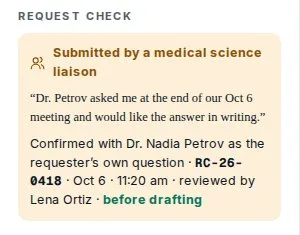
Dr. Nadia Petrov, a cardiologist in Toronto, asked a liaison about Dravenzo with clarithromycin at the end of a meeting. The request check keeps the liaison's note of how it came up, records that the question was confirmed with her as her own, and shows who reviewed that confirmation, all before drafting. The clock for this is one business day, and it is locked. In the sample's last 30 days, all 41 field-submitted questions were confirmed first.
The same check gives an answer when the origin is unclear: it asks the requester. A question prompted by a sales representative gets no off-label section.
The request check. Who submitted it, in whose words, and when it was confirmed.
3
Every question in one list, with its route, label status and clock
All open and recent inquiries, filterable by product, channel and label status, each showing its route, stage and time to due. "Field-submitted · confirmed" sits beside the route where it applies.
All inquiries. Read, routed and on the clock, across three products and five channels.
4
The standard response library, with versions, owners and use
186 current standard responses across three products. Each row shows its version, approval date, next review, how often it was used in 30 days, and its status. Two are due for review. One of those, storage and temperature excursions, is the most used of the nine shown, at 58 uses in 30 days. Only current versions can be cited, and an owner gets a reminder 30 days before a review.
The library. Use and review status side by side, so the busiest document never goes stale unnoticed.
5
The questions that keep coming back without an answer on file
Three questions drew 4 or more custom letters in 90 days and have no standard response: giving Dravenzo through a feeding tube (6), a washout when switching from another biologic (5), and Talvoren with untreated brain metastases (4). One click drafts a standard response from the signed letters and their sources. It is a draft. Its owner approves it.
Recurring questions. Six letters on one question means six chances to differ.
6
The desk at a glance, from the door to the letter
Dana Okafor, the MI manager, sees 1,184 questions answered in 30 days and 236 custom letters. All 2,124 sentences checked have a source, on this sample. A flow shows today's 48 questions from how they arrived to how they were answered and where they are now. Below that, turnaround against the by-hand baseline, and the topics people ask about.
The dashboard. A plain page for one manager. The 1.4 days is marked as a target; every figure is sample data.
7
Turnaround against the by-hand baseline, and what people ask
Custom letter turnaround, with the by-hand 2025 baseline beside it, and the top topics. Pregnancy and lactation lead, followed by dosing and administration, and drug interactions. Off-label use is its own topic, at 71. Topics are how a manager decides which standard response to write next.
Turnaround and topics. Sample data throughout.
8
Signers, clocks and sources are settings your manager owns
Who may sign custom letters, who gives the second signature, whether exact-match standard responses go without a second look, and where patient questions go. Clocks for custom letters (5 business days) and standard response letters (2) can step up or down. The field-submitted clock is locked. Rules added in plain words sit here too, all on the audit trail.
Signers and clocks. Your procedures, changed by your manager and recorded.
9
What the agents may cite, and which template each country uses
Current approved standard responses and current labels are switched on and locked. Data on file counts only if approved for external use. Peer-reviewed literature can be cited, and abstracts from medical congresses can be allowed with a note. Each letter template shows its version and who approved it, and US, Canadian and UK versions sit side by side.
What may be cited. Source rules and country templates.
Phone carries the most questions today on the sample desk, across five channels
48 questions since midnight on the sample dashboard
48questions
Phone18
Web portal11
Email9
Field medical6
Chat4
Fictional example from this guide
Show the numbers
Part
Value
Phone
18
Web portal
11
Email
9
Field medical
6
Chat
4
16 · Who drafts, who signs
From inquiry reader to library keeper: the letter's seven agents, and the specialist and medical reviewer who sign
In shortSeven agents each do one narrow job, and each has things it never does. None of them signs. A medical information specialist signs every letter, and a medical reviewer adds a second signature to any letter with an off-label part. Each finding is decided by a person.
Inquiry reader
Reads each new question from the portal, email, call log, field medical or chat. Splits it into parts and sets product, topic, country and on- or off-label for each, then chooses the route.
Never sets status for a whole question when its parts differ, and never answers a patient with an HCP letter.
Request check
Verifies the requester in the directory, records how the question arrived and who submitted it, and confirms a field-submitted question with the requester before drafting.
Never lets an off-label section be written for a request not confirmed as unsolicited. When the origin is unclear, it asks.
Evidence finder
Finds the passages that answer each part: current standard responses first, then the label for the requester's country, approved data on file and peer-reviewed literature, including data that do not support an off-label use.
Never retrieves a retired version as current.
Letter writer
Writes from the country template, one section per part in the order asked, tying each factual sentence to its passage, and adds references and the label.
Never writes a sentence with no source, and never signs.
Off-label guard
Checks each off-label section in order, disclosure, evidence, limits and risk, and removes any sentence that advises, has no scientific source, or uses promotional or comparative wording.
Never lets advice on an unapproved use through. A removed sentence returns only with the medical reviewer's signature.
Citation checker
Re-reads each sentence against its passages: claim, numbers, version, disclosure, balance, promotional words. It offers corrected wording from current sources.
Never accepts its own finding. A person accepts or rejects each one.
Library keeper
Groups signed letters by product and topic. When a topic reaches 4 or more custom letters in 90 days with no current standard response, it drafts one from them. It reminds owners 30 days before a review.
Never approves. Owners do.
Four people who answer for a letter, and what each signs or owns
Signs every letterMedical information specialistReviews the draft, decides each finding, and signs with name, time and meaning.
Second signature on off-labelMedical reviewerAttests to five things, item by item, for the off-label section.
Approves the libraryStandard response ownerApproves new and updated standard responses. Agents only draft them.
Owns the rulesMI managerSets signers, clocks, sources and templates. Every change is on the audit trail.
Roles follow your organization. On the screens: Priya Ranvelle, PharmD, specialist; Omar Haddad, MD, medical reviewer; Dana Okafor, manager; Dr. Maya Chen, Veltrimab standard response owner. The controls here are meant to support your compliance; the product is never itself "compliant" or "certified". Botminds' own credentials are SOC 2 Type II audited and information security managed to ISO 27001.
17 · What it connects to
Inquiry records and standard responses going in, signed letters and a full record coming out
In shortYour case records, standard responses, labels, literature and country templates go in. A letter with a source on each paragraph, a status per part, a reference list and an audit record come out. Your case system stays the system of record. Design targets are labeled as targets.
Questions and evidence
Inquiry records from your medical information or CRM case system
Standard response documents, every version kept
US Prescribing Information (USPI), SmPC and Product Monograph, by country and revision
Published literature and data on file approved for external use
Your rules
Letter templates per country
Who signs, clocks and what may be cited
HCP directory and consent register
Agents read, find, compose, guard and checkEvery question and every sentence, under the rules your manager set
A person signs every letter
Second signature on off-label parts
For the requester
A reply letter with references
The label enclosed
Sent privately, by secure email
For the desk
On- and off-label status per part
Signed letter, second signature, full audit record
Recurring questions and draft standard responses
The case system, library, literature and directory you keep
Your medical information case system
Stays the record. Questions come from it, and letters, status and decisions go back to it.
Your document management system
Holds approved standard responses, with their versions and owners.
Your literature subscriptions
Peer-reviewed articles come through the access you already pay for.
Your HCP directory and consent register
Verify each requester, and record consent to reply and how they want the answer.
Your secure email and identity
Letters go by your secure route. Roles and sign-in come from your identity provider, with maker-checker enforced.
Your audit needs
Each agent step, removed sentence, edit, decision and signature is recorded with who and when, and can be exported. Medical information content is kept apart from sales and marketing systems.
The design target takes a custom letter from 4.6 days to 1.4, with most of the gain in search and drafting
Days. The by-hand column is the sample desk's estimated 2025 split. The second is the solution's design target, to be measured in your own pilot.
By handDesign target
Log, read and route0.5 d0.05 d
Search1.2 d0.1 d
Draft and cite1.1 d0.3 d
Check0.8 d0.35 d
Medical review and second signature0.7 d0.55 d
Send, close and archive0.3 d0.05 d
Fictional example from this guide
Show the numbers
By hand
Design target
Log, read and route
0.5 d
0.05 d
Search
1.2 d
0.1 d
Draft and cite
1.1 d
0.3 d
Check
0.8 d
0.35 d
Medical review and second signature
0.7 d
0.55 d
Send, close and archive
0.3 d
0.05 d
1.4 days
median to send a custom letter, against 4.6 by hand on the sample desk.
Design target
100%
of sentences in every letter linked to the passage they came from.
Design target
50%
less time drafting each custom letter, from 2 to 4 hours to 1 to 2.
Our estimate; test it on your letters
Medical review barely moves in that target, and it should barely move. Faster review would raise a fair question about what the reviewer is doing. The gain is in everything before it.
Part C · Are you ready to automate?
Medical information response automation: pricing slow letters, estimating your return and testing a vendor
You run a medical information desk, or you sign its letters, or you hold the budget. This part helps you size the problem from your own files, estimate a return you can defend, check your readiness, question any vendor, including us, and plan a pilot.
18 · What it costs you
What slow letters, drifted wording and re-checking cost your medical information desk
In shortYour cost sits in skilled hours, spread across drafting, checking and keeping a library current. The public figures give the shape only. Your case system and one week of sampling will give you the real numbers. Keep rare and large costs, such as an enforcement matter, in your risk discussion and out of your business case.
10,234 hours
a year if your library matches the survey's means: 614 new at 8.3 hours, plus 1,352 updated at 3.8 hours. The arithmetic is ours, and the survey is small.7
phactMI survey, JMIR AI 2025
38 staff
on average per US company, 25 internal and 13 external, before counting contact centers.8
phactMI, 2022 data
$14,308+
per claim at the low end of the False Claims Act penalty range, up to $28,619, where a case arises.29,30
DOJ, in effect in 2026
On these illustrative inputs, keeping the library current takes more hours than writing custom letters
Hours a year: 2,832 custom letters at 3 hours each; survey means for the library; 30% off-label at 45 minutes of review. Replace with your own.
Standard response library10,234 h
Custom letters, drafting and checking8,496 h
Medical review of off-label letters637 h
Illustrative · replace with your own numbers
Show the numbers
Item
Value
Standard response library
10,234 h
Custom letters, drafting and checking
8,496 h
Medical review of off-label letters
637 h
Finding your own letter, library and review numbers in a week
Cost
Where it hides
How to find your number in a week
Hours per custom letter
Inside "handling time", split across days
Ask five specialists to log 20 letters, by step. Take the median, and the slowest tenth.
Elapsed days
Waiting for literature, a reviewer, a signature
Your case system: receipt to send, last quarter, custom letters only.
Re-checking
Reviewers repeating checks already done
Time a reviewer on five letters. Ask how many sources they reopened.
Drift and stale wording
Sent letters, unseen
Re-check 50 signed letters, sentence by sentence, against the sources current on the day they were signed.
Repeated custom letters
The same question answered many ways
Group a quarter's custom letters by topic. Count topics with 4 or more and no standard response.
Library upkeep
Owners' and writers' calendars
Documents created and revised last year, times hours each. Add overdue reviews.
Records you could not produce
Nobody knows until asked
Pick 10 off-label letters from last year. Produce the request, how it arrived, what was sent and who signed.
What a late or inconsistent letter costs beyond your hours
The patient waiting on MondayA late letter means the decision happens without it.
The answer found elsewhereA clinician who stops writing to you turns to sources with no label attached.
Six letters, six answersInconsistent wording is hard to defend and harder to find afterward.
Specialists' judgment spent on typingHours on paraphrase and references are hours away from the hard question.
TurnoverScientific staff hired to think tend to leave jobs built on copying.
19 · Your return
Your return on medical information automation: custom letters, library upkeep and review time
In shortSix things create value here, and three are easy to price. The calculator counts specialist hours on custom letters, library hours and reviewer hours. It counts nothing for risk avoided or for clinicians answered sooner, so weigh those separately, and count only the hours you would redeploy.
Drafting
A cited first draft
Search, paste and citation typing shrink. Judgment stays.
custom letters × hours saved each × loaded cost
Checking
Passages one click away
Reviewers confirm a sentence against its passage without hunting for it.
letters × minutes saved in review × reviewer cost
Library
Drafts from signed letters
New and updated standard responses start from checked wording and sources.
A standard response for a recurring question replaces repeated custom work.
letters moved to a standard response × hours each × cost
Speed
Answers sooner
Elapsed days fall. The value sits with the clinician and patient, so report it without pricing it.
median days before − median days after
Evidence
A record you can produce
Audit preparation gets shorter when each letter carries its sources and decisions.
(audit hours before − audit hours after) × cost
Your hours back on custom letters, standard responses and review
Few public benchmarks exist for these inputs. Defaults marked illustrative are assumptions, so use your own. Library defaults are published survey means with very wide ranges.7
The formulas: letter hours = letters × (today − with help). Library hours = (new × hours + updated × hours) × share saved. Reviewer value = letters × off-label share × (today − with help) × cost. Default letters are the sample desk's 236 in 30 days × 12. Default 3 hours sits within the sample desk's 2 to 4, and 1.5 within its estimated 1 to 2. The 25% library share and the review minutes are assumptions, and small companies should expect much smaller library numbers than these means. Risk avoided counts for nothing here, and hours count only if you would redeploy them.
20 · Readiness check
Scoring your readiness for letter automation: request records, standard response versions and who signs
In shortEight questions score your records, your library, your rules and your people, 0 to 2 each. A ninth is for reflection. Nothing you choose leaves this page. Your band suggests the next step.
1
Standard responses for one product
Can you pull every current standard response for one product, with version, owner and next review, today?
Why it mattersDrafting from a messy library spreads the mess faster.
A strong answer"Yes, from one system, with retired versions marked."
2
How each request arrived
Does every case record who asked, how it arrived, who submitted it and the exact words?
Why it mattersFDA's draft turns on who started it, and that is known only at intake.2
A strong answer"Required fields, and field-submitted questions are confirmed before drafting."
3
Written rules for off-label sections
Do you have a written order and wording for an off-label section, with the items that must travel with it?
Why it mattersSoftware applies your rules. It cannot supply them.
A strong answer"A procedure mapped to FDA's seven recommendations, and templates that carry it."
4
Who signs, and what the signature means
Have you defined who signs, who gives a second signature, and what each signature means?
Why it mattersA signature with no stated meaning leaves nobody able to say what was vouched for.
A strong answer"Named roles, written meaning, and counsel has a view on Part 11."
5
A baseline for letters
Do you know hours per custom letter, days to send, and how many are repeats?
Why it mattersWe found no current public benchmark, so your own number is the only comparison.
A strong answer"Median and slowest tenth by product, last quarter, from the case system."
6
Access to the literature and data on file
Can software reach the full text you are licensed to use, and the data on file approved for external use?
Why it mattersAbstracts alone cannot support a sentence, and license terms may limit AI use.
A strong answer"Our subscriptions allow it, in writing, and data on file carries an approval flag."
7
Medical, legal, compliance and quality at the table
Have these teams agreed, in writing, what a pilot may do and how past letters may be used?
Why it mattersA project that surprises them ends fast. Past letters also hold patient details.
A strong answer"All helped write the test set and the pass rules."
8
A named owner, with time
Is one person accountable for what the tool drafts, what it flags and how its rules change?
Why it mattersFindings, gaps and rule changes need someone to decide them, every week.
A strong answer"The MI manager, with time set aside, and medical review as co-signer."
9
The one-letter test · for reflection
Take an off-label letter you signed last year. If asked tomorrow, could you show where each sentence came from, which version it was, and who asked?
Why it mattersYour answer lists the gaps, and some of them are jobs software can take on.
A strong answerA short, specific list: "the request, how it arrived, the sources at that version, the edits, and both signatures."
0–6
Explore
Build the base first: one clean library for one product, written off-label rules mapped to FDA's draft, and a week's measurement of 20 custom letters.
7–11
Ready to pilot
Run a measured pilot on one product, starting with past signed letters. Count missed advice and wrong citations before you count speed.
12–16
Ready to implement
Plan products, countries, roles, the case system link and the library review, with a named owner and a monthly look at findings.
21 · Questions for vendors
Fifteen questions for any medical information AI vendor, on citations, advice and signatures (ask us too)
In shortA demonstration on a vendor's own letters proves little. Test on your label, your questions and your awkward past letters. Ask for evidence on these five themes, and watch for the warning signs beside each answer.
A
Whether each sentence traces to a passage
A1
Does every factual sentence open to the exact passage and version behind it?
Why it mattersA reference at the end of a paragraph does not tell a reviewer which claim it supports.
Strong answer · warning sign
One click, passage highlighted, version shown.
A list of references at the end.
A2
How do you catch a real paper attached to a sentence it never says?
Why it mattersOne 2026 study scored the evidence behind answers lowest, and lack of false information highest.40
Strong answer · warning sign
A separate check per sentence, with its miss rate measured on your letters.
"We use retrieval, so it can't hallucinate."
A3
What happens to reused wording from a retired standard response?
Why it mattersOld letters are the easiest source and the stalest.
Strong answer · warning sign
It is flagged sentence by sentence, and a person decides.
"We only load current documents."
B
Keeping advice out of off-label sections
B1
Can we plant advisory sentences in 100 past letters and see how many you catch?
Why it mattersA missed one is your costliest error.
Strong answer · warning sign
Yes, with counts of missed and false flags.
One overall accuracy number.
B2
Is status set for each part of a question? How do we correct it?
Why it mattersA wrong status moves a section under the wrong rules.
Strong answer · warning sign
Per part, shown to the specialist, correction recorded.
One tag for the whole case.
B3
Does it find unfavorable data, or only what supports the use?
Why it mattersFDA's draft asks for data "that are not supportive or that cast doubt".2
Strong answer · warning sign
A test set with known contrary papers, and results shown.
"It finds the most relevant."
C
Showing a request was unsolicited
C1
What does the record show about who asked, and who passed it on?
Why it mattersFDA's draft and past integrity agreements name these items.2,18
Strong answer · warning sign
Date, form, requester, exact words, response, and any field colleague.
A free-text note.
C2
How is a field-submitted question handled, and can that step be skipped?
Why it mattersThis is where a solicited question slips in.
Strong answer · warning sign
Confirmed with the requester before drafting, on a locked rule.
"Reps tick a box."
C3
How is content kept away from sales and marketing?
Why it mattersFDA's draft says they should have "no input on the content".2
Strong answer · warning sign
Separate roles and systems, tested, with access on the record.
Shared workspaces with the brand team.
D
Signatures, separation of duties and the record
D1
Can anything go out without a person's signature?
Why it mattersAn unsigned reply about your drug is your reply.
Strong answer · warning sign
No. Name, time and meaning on every letter, and exact-match sends only if you turn them on.
"Auto-send above 95% confidence."
D2
How do you stop one person from signing twice, or reviewing a document they own?
Why it mattersA second signature means little if it is the same mind.
Strong answer · warning sign
Maker-checker enforced by role, with exceptions recorded. Ask this of us too: decide how you want an owner who also reviews handled.
"Your SOP covers that."
D3
What credentials do you hold?
Why it mattersSoftware can't be certified compliant with GxP or Part 11, so such claims are a warning.
Strong answer · warning sign
Named audits, such as SOC 2 Type II, and a clear list of controls that support your compliance.
"We are Part 11 certified."
E
Running it across products and countries
E1
How does it work with our case system, and does that system stay the record?
Why it mattersReplacing a validated system is a separate, far larger project.
Strong answer · warning sign
Connects to it, and writes back letters, status and decisions.
"Migrate to ours first."
E2
How are country labels and templates kept apart?
Why it mattersA use on-label in one country may be off-label in another.
Strong answer · warning sign
The requester's country sets label, status and template.
One global answer, translated.
E3
Where does the data go, and what about patient details in a question?
Why it mattersQuestions carry details about real people, and license terms may limit what happens to full-text papers.
Strong answer · warning sign
Your data stays yours, no shared model training, in the contract.
Vague policy language.
22 · A pilot plan
Piloting letter drafting on one product: signed letters first, then live questions in shadow
In shortStart with one product. Have medical review and compliance pick past signed letters and plant known errors before anyone sees the tool. Then run live questions in shadow, with specialists still writing their own, and only then let drafts reach a signer. Decide on missed advice and wrong citations first, speed second, and set your pass rules before you see any result.
Ten weeks: the test set first, live drafts only after misses are measured
Your teamVendor
Pick 200 past letters; plant known errors; set pass rules
Load one product's library, labels and templates
Score the test set; medical review reads every miss
Shadow: live questions drafted, specialists still write
Live drafts to signers, on one product
Decide: scoreboard, cost, next products
Week 0246810
Illustrative · replace with your own numbers
Show the numbers
Activity
From
To
Pick 200 past letters; plant known errors; set pass rules
0
2
Load one product's library, labels and templates
1
3
Score the test set; medical review reads every miss
3
4
Shadow: live questions drafted, specialists still write
4
6
Live drafts to signers, on one product
6
9
Decide: scoreboard, cost, next products
9
10
The letter pilot's scoreboard: missed advice, wrong citations, signer trust
Measure
What to count
Set your pass rule before you start
Missed advice
Planted or real advisory sentences that reach a signer unflagged
Zero tolerated; every miss read by the medical reviewer
Unsupported sentence
Sentences whose passage does not say what they say
Zero in signed letters; a measured rate in drafts
Retired source
Planted retired wording that goes unflagged
Zero tolerated
Wrong status
Parts marked on-label that are off-label, and the reverse
Off-label marked on-label: zero tolerated
False findings
Flags the specialist rejects
A rate your specialists will accept; ask them
Missing evidence
Known contrary papers left out
Each one reviewed, with a fix
Hours and days
Specialist hours per letter; median and slowest tenth to send
Better than your baseline, with quality held
Signer trust
Sources opened per letter, and sentences edited
Watch for rubber-stamping: opens falling to zero is a warning
The working-session questions for medical, legal, compliance and quality
Bring the MI manager, medical review, legal, compliance, quality, field medical and IT into one room. These often take longer than the software.
Is FDA's 2011 draft our written standard for off-label replies? Where do we go further, and who decided?2
How do we read the January 2025 guidance's status, and does any of our firm-initiated sharing rely on it?6
Do we treat letters as Part 11 records? What does counsel advise?22
Who gives the second signature, and may that person also own the standard response being cited?
What does a field colleague do with a question, and who confirms it with the requester?
May we send standard responses unchanged on an exact match with no second look, and who decides what "exact" means?
Do our literature licenses allow this use of full text? Who checks each publisher?
What may a past letter be used for, given the patient details in the questions?
How long do we keep a letter, its sources as they stood, and its drafts?
Who approves a rule change, and how is it logged?
23 · Questions people ask
Medical information letters and unsolicited requests: what teams ask most
In shortEach answer stands alone, in plain words, with status as of November 2026. This is general information, so ask your own counsel before relying on it.
What is medical information response automation?
Medical information response automation is software that helps a medical information team answer a health care professional's question. It reads and splits the question, finds the passages that answer it, drafts the reply with a source on each sentence, and checks the result. A named person reviews and signs. It sits beside the case system a team already uses.
What is a standard response letter or document?
A standard response document, or SRD, is a concise, pre-approved summary of the evidence on one question a company expects to be asked again. It is approved before anyone asks, and sent as it stands. A custom letter, by contrast, is written for one person's question and approved after it arrives.
Can a pharmaceutical company respond to an unsolicited off-label request?
Yes. FDA's December 2011 draft guidance says firms can respond to an unsolicited question with truthful, balanced, non-misleading, non-promotional scientific information responsive to the specific request. The draft is nonbinding and has never been finalized. It says that if a firm responds as it describes, FDA does not intend to use the response as evidence of a new intended use.
When is an off-label request unsolicited under FDA's draft?
A request is unsolicited when it starts with someone completely independent of the firm. FDA's draft says requests "prompted in any way by a manufacturer or its representatives" are solicited, and that they may be evidence of intent. Its examples run from a sales representative inviting a question to a website serving prepared off-label answers from a menu.
Is FDA's 2011 guidance on unsolicited requests still a draft?
Yes. FDA's page, content current April 17, 2020 and read November 3, 2026, says "Not for implementation" under Docket FDA-2011-D-0868, and no final version was found. FDA's January 2025 final guidance still refers to it as a draft. A July 2024 revised draft on misinformation replaced a 2014 draft on that subject, and it did not replace this one.
Does FDA's January 2025 guidance apply to a medical information letter?
FDA's January 2025 guidance covers communication a firm starts on its own, about scientific information on unapproved uses, such as sharing a reprint. A reply to someone's question falls under the 2011 draft instead. It is final and marked "not for current implementation". OMB approved its information collections on July 29, 2025, and FDA's page still carries the old wording, so its status is unclear.
What must go with an off-label response letter?
FDA's 2011 draft recommends five items: a copy of the FDA-required labeling, a prominent statement that FDA has not approved the use, a prominent statement of the approved indications, all important safety information including any boxed warning, and a complete reference list. It also recommends complete copies of reprints. These are recommendations, and your counsel decides how you apply them.
Who signs a medical information letter?
Usually a medical information specialist, often a pharmacist, and some companies add a medical reviewer's second signature on off-label content. FDA's draft asks that replies come from medical or scientific staff independent of sales and marketing, and names no credential or second signature. Those are company controls. Where Part 11 applies, a signature must show name, date and time, and meaning.
Can a sales rep answer an off-label question?
FDA's 2011 draft recommends referring such questions to a medical or scientific department, with "no input" on the content from sales and marketing. Some company policies have reps pass the question on in the asker's words and say nothing about the use. Canada's guidance says a response on off-label uses from sales or marketing staff may be considered promotional.
How long should a custom medical information letter take?
We found no current public benchmark; a 2025 survey of 35 US companies does not report turnaround. Desks set their own clocks. Measure the median and the slowest tenth from receipt to send on your own custom letters, then set a target. Ask any vendor claiming a figure for its method, and test it on your letters.
How often should a standard response be reviewed?
We found no FDA rule that sets an interval. Some desks set a yearly review date at approval, and review early when a label changes or a material new paper appears. A survey of phactMI member companies reported an average of 1,352 updates a year against 614 new documents, so plan for upkeep first.
Can ChatGPT answer medical information questions?
Not to the standard this work needs, on published tests. In one, ChatGPT gave fully correct, usable answers to 13 of 50 real drug questions, with no references. In a 2026 comparison, all chatbots tested scored below drug information faculty, though another 2026 study, at one hospital, found GPT-4o comparable with pharmacists on composite score, with low agreement among raters. A company's reply also needs balance, tailoring, enclosures and a named signer, and a chat reply provides none of them.
Is medical information software certified for Part 11?
No product can hold such a certification. FDA does not certify software against Part 11, and the rule applies to how you use a system for records under its scope. Look for controls that support your compliance: name, time and meaning on signatures, signatures linked to records, and audit trails. Botminds' own credentials are SOC 2 Type II audited and information security managed to ISO 27001.
24 · One-page summary
The medical information letter from start to finish: the method, FDA's status as of November 2026 and 14 terms
Print this page
In shortThe whole guide on one screen: the method, the status of the rules, the readiness scale and the terms.
The method
Read the question and split it. Set on- or off-label for each part.
Check who is asking, how it arrived and who submitted it. Confirm field-submitted questions first.
Find current sources: standard response, the requester's label, data on file, literature, including what does not support the use.
Write only what was asked, with a source on each sentence.
In an off-label section: approved use, not-approved statement, evidence, limits, risk, references and label. No advice.
Check each sentence against its passage, including version and numbers.
A person signs. A medical reviewer adds a second signature to off-label parts if your rules say so.
Send privately to the person who asked. Keep the record. Turn repeats into standard responses.
Readiness: score 0–2 on eight questions: 0–6 explore · 7–11 pilot · 12–16 implement.
As of November 2026: FDA's unsolicited-request text is a December 2011 draft, "Not for implementation", no final found · the January 2025 guidance on unapproved uses is final, OMB approved its information collections in July 2025, and FDA's page still says not for current implementation · the July 2024 misinformation draft replaced a 2014 draft and left this one standing · 21 CFR 201.128 counts written statements · FDA's AI draft leaves out operational uses without impact on patient safety, drug quality or study reliability · Annex 22 is still a draft and concerns manufacturing · the EU pharma package is not yet law.
14 terms
Medical Information (MI)
The company's scientific team that answers questions about its products.
HCP
Health care professional: a physician, pharmacist, nurse or similar.
On-label · off-label
Inside, or outside, what the approved label covers.
Unsolicited request
A question started by someone independent of the firm, with no prompting.
Standard response (SRD)
A pre-approved answer to an expected question.
Custom letter
A reply written for one question, approved after it arrives.
Data on file
A company's unpublished data, used in replies if approved for that use.
USPI · SmPC · Product Monograph
The label in the US, the EU and UK, and Canada.
SIUU
Scientific information on unapproved uses, FDA's term in its 2025 guidance.
Intended use
What a firm means its product to be used for, shown by its words and acts.
MSL
Medical science liaison, a scientific field employee kept apart from sales.
Untitled letter
FDA's notice of a violation below a warning letter's threshold.
Part 11
FDA's rule on electronic records and signatures, 21 CFR Part 11.
eGFR
Estimated glomerular filtration rate, a measure of kidney function.
25 · Sources
Sources
Accessed November 2026. Regulatory status statements are as of November 2026. Publications quoted inside the fictional example, such as Varga 2024 and Okonkwo 2025, are sample text and do not appear here.
Directive 2001/83/EC, consolidated text of January 1, 2022, Articles 86(2) and 98(1), as served by the EU Publications Office. publications.europa.eu
FDA, Responding to Unsolicited Requests for Off-Label Information About Prescription Drugs and Medical Devices, draft guidance, December 2011. fda.gov
Radley DC, Finkelstein SN, Stafford RS. Off-label prescribing among office-based physicians. Arch Intern Med 2006;166(9):1021-6. PubMed
FDA, guidance page for the December 2011 draft, Docket FDA-2011-D-0868, "Not for implementation", content current April 17, 2020, read November 3, 2026. fda.gov
FDA, Communications From Firms to Health Care Providers Regarding Scientific Information on Unapproved Uses of Approved/Cleared Medical Products: Questions and Answers, January 2025, Revision 2 (Docket FDA-2008-D-0053); its text says not for current implementation. fda.gov
Lau J, Bisht S, Horton R, et al. Creation of Scientific Response Documents for Addressing Product Medical Information Inquiries: Mixed Method Approach Using Artificial Intelligence. JMIR AI 2025;4:e55277. PubMed Central
DeLuca MJ, Rai R, Pandya K, et al. Benchmarking Medical Information Services Beyond the Unsolicited Requests: A phactMI Benchmarking Survey. Ther Innov Regul Sci 2025;59(4):848-858. PubMed Central
FDA, Medical Product Communications That Are Consistent With the FDA-Required Labeling: Questions and Answers, June 2018. fda.gov
Mintz, First Amendment protects truthful off-label speech (Amarin v. FDA and United States v. Caronia), August 17, 2015. mintz.com
21 CFR 201.128, Meaning of "intended uses", 2025 edition (revised as of April 1, 2025). govinfo.gov
FDA, Addressing Misinformation About Medical Devices and Prescription Drugs: Questions and Answers, revised draft guidance, July 2024 (Docket FDA-2014-D-0447), page content current July 8, 2024; the text does not mention unsolicited requests. fda.gov
OIRA, history of OMB Control Number 0910-0686 (and 0910-0485). reginfo.gov
FDA, notice of availability of the January 2025 final guidance and submission to OMB, Federal Register, January 7, 2025, 90 FR 1146 (FR Doc. 2024-31539). govinfo.gov
FDA, Agency Information Collection Activities; Announcement of Office of Management and Budget Approvals, 90 FR 46225, September 25, 2025 (FR Doc. 2025-18653). govinfo.gov
FDA, guidance page for the January 2025 final guidance, content current January 6, 2025, read November 3, 2026. fda.gov
Noué MA, Rizos J, Quinn D, Wong JK. Canadian Medical Information Benchmarking Survey: MILE Framework for Digital Provision of Medical Information. DIA Global Forum, November 2023 issue. diaglobal.org
HHS Office of Inspector General and Novartis Pharmaceuticals Corporation, Corporate Integrity Agreement, 2010. justice.gov
FDA, Untitled Letters (Office of Prescription Drug Promotion table), content current October 16, 2026; counts by letter date, and the word search of all 119 letters, are ours. fda.gov
US Government Accountability Office, Prescription Drugs: FDA's Oversight of the Promotion of Drugs for Off-Label Uses, GAO-08-835, July 2008. gao.gov
FDA Office of Prescription Drug Promotion, The Brief Summary, 2024 metrics. fda.gov
US Department of Justice, Fact Sheet: Significant False Claims Act Settlements & Judgments, Fiscal Years 2009-2016. justice.gov
US Attorney's Office, District of Massachusetts, on the GlaxoSmithKline sentencing, July 2012. justice.gov
US Department of Justice, Eli Lilly and Company agrees to pay $1.415 billion to resolve allegations of off-label promotion of Zyprexa, January 15, 2009. justice.gov
US Department of Justice, Civil Monetary Penalties Inflation Adjustments, final rule, 90 FR 29445, July 3, 2025. govinfo.gov
US Department of Justice, notice of no 2026 adjustment, 91 FR 43405, July 15, 2026. govinfo.gov
Jindia L, Keane S, Wnorowski S, Hermes-DeSantis ER. Enhancing Patient Care II: The Clinical Impact of Medical Information Services. Ther Innov Regul Sci 2022;56(3):483-491. We read the abstract and conflict of interest statement, not the full text. PubMed
MHRA, The Blue Guide: Advertising and Promotion of Medicines in the UK, Third Edition, third revision, November 2020. gov.uk
Association of the British Pharmaceutical Industry, Code of Practice 2024, Clause 1.17 and its supplementary text. pmcpa.org.uk
Health Canada, Guidance on distinction between advertising and other activities for health products, "Responses to inquiries", August 2023 (supersedes the 2005 policy). canada.ca
European Parliament, Legislative Observatory, procedure file 2023/0132(COD), read November 3, 2026. europarl.europa.eu
Morath B, Chiriac U, Jaszkowski E, et al. Performance and risks of ChatGPT used in drug information: an exploratory real-world analysis. Eur J Hosp Pharm 2024;31(6):491-497. PubMed
Bhattacharyya M, Miller VM, Bhattacharyya D, Miller LE. High Rates of Fabricated and Inaccurate References in ChatGPT-Generated Medical Content. Cureus 2023;15(5):e39238. PubMed Central
Magesh V, et al. Hallucination-free? Assessing the reliability of leading AI legal research tools. Stanford and Yale, arXiv 2405.20362, 2024. arxiv.org
Ipema H, Munir F, Sarna K, et al. Evaluation of Clinically-Focused Artificial Intelligence Chatbots for Answering Drug Information Questions. J Am Coll Clin Pharm 2026;9(6):e70231. PubMed
Alzahrani L, Alkhalaf A, Almehizia R, et al. Comparison of Drug Information Questions' Responses Between Drug Information Pharmacists and Artificial Intelligence Technologies. J Am Coll Clin Pharm 2026;9(4):e70208. PubMed
FDA, Considerations for the Use of Artificial Intelligence to Support Regulatory Decision-Making for Drug and Biological Products, draft guidance, January 2025. fda.gov
European Medicines Agency, Artificial intelligence: the reflection paper adopted September 2024 and the guiding principles with FDA, first published January 14, 2026. ema.europa.eu
European Commission, AI Act regulatory framework page: the AI Omnibus in force July 27, 2026. ec.europa.eu
PIC/S and European Commission, draft EU GMP Annex 22, consultation July 7 to October 7, 2025. picscheme.org
European Commission, EudraLex Volume 4, read November 3, 2026: Annex 11 at its January 2011 revision and no Annex 22. ec.europa.eu
FDA, Computer Software Assurance for Production and Quality Management System Software, final guidance, February 2026. fda.gov
MHRA, GXP data integrity guidance and definitions, March 2018. gov.uk
International Society for Pharmaceutical Engineering, ISPE GAMP Guide: Artificial Intelligence, July 2025. ispe.org
Next step
See it on your own inquiries.
Explore the solution, or bring your standard responses, your country templates and a sample of past questions. We will run them and show you every letter, every source passage and every sentence the guard would strike, for your specialists and medical reviewers to judge.
We use essential cookies to make this site work, and cookieless, anonymised analytics to understand how it's used. "Accept all" also turns on Google Analytics, which sets cookies. Privacy policy