Off-label promotion is a company telling anyone that its medicine works for a use the regulator has not approved, and in the United States FDA treats it as making the product misbranded. The False Claims Act enters later and from a different direction: if promotion of an unapproved use caused prescriptions that federal health programmes then paid for, the government can treat those payments as false claims. Between the two sits the work this guide is about — a medical information department answering a doctor's question in writing, where a single advisory sentence can turn a scientific response into evidence of promotion. Botminds' Medical Information Response puts that sentence in front of a named person before anyone signs.
The usual way of describing this risk — nine-figure settlements — is the least useful. Settlements are rare and slow. The cost a medical information team actually meets is the letter the regulator writes, the corrective communication it asks for, and the months of re-reading every letter already sent. That cost is reachable from one sentence, and so is the control that prevents it.
Five years of federal action on off-label promotion, counted
42
regulatory letters asking companies to stop violative off-label promotions, 2003–2007
7months
average from first drafting a letter to issuing it
4months
average for a company to take the corrective action requested
11
civil and criminal settlements by DOJ over the same five years, none referred by FDA
When does answering a question become promotion?
It does not, if the answer stays inside four conditions. FDA's draft guidance on unsolicited requests sets them out: the request came unprompted, the response goes privately to the person who asked, it answers only what was asked, and it is produced by medical or scientific staff with the label and references attached. Meet those and, in the agency's words, FDA does not intend to treat such responses as evidence that the firm meant its product to be used for an unapproved use (FDA draft guidance, December 2011).
Miss them and the position is not that you have broken a rule; it is that the protection goes away. The same guidance is blunt about what replaces it: a firm may answer differently, and answering differently would not in itself break the law, but could be put forward as evidence of a new intended use. The sentence becomes evidence. It is kept, read later, and set beside whatever else the company said about that use.
Three things commonly take an answer outside the conditions, and all three are editorial rather than legal. The answer drifts past the question that was asked — FDA recommends that a response answer only the specific questions asked. The answer advises rather than reports. Or the answer is assembled with help from people who are not supposed to touch it: FDA recommends that sales and marketing staff have no say in what the answer to an off-label question contains. What you may send in reply to an unsolicited request works through the conditions in full.
The regulation that catches a quotation
The specific text that catches a wrong sentence is not in the guidance; it is in the advertising regulation, 21 CFR 202.1(e). It is worth reading as a specification rather than as law, because every clause describes an editing failure that a reviewer can look for in a draft.
21 CFR 202.1(e), clause by clause, and the sentence each one catches
| Clause | What it says | The sentence it catches in a drafted answer |
|---|---|---|
| (e)(5)(ii) — fair balance | Effectiveness presented in “greater scope, depth, or detail” than required, not fairly balanced by a summary of true information on side effects and contraindications. | Three paragraphs on the supporting study, one clause on the warning. Nothing in it is untrue. |
| (e)(5)(iii) — material facts | Fails to reveal facts “material in the light of its representations or material with respect to consequences that may result from the use of the drug as recommended or suggested”. | The result is given; the fact that the cohort was single-dose, or that the trial stopped early, is left out. |
| (e)(6)(iii) — superseded data | Favourable information “previously regarded as valid but which have been rendered invalid by contrary and more credible recent information”. | Wording reused from a letter sent two years ago, whose source has since been revised or withdrawn. |
| (e)(6)(v) — one study, broad claim | Presents information from a study “in a way that implies that the study represents larger or more general experience with the drug than it actually does”. | “Patients on dialysis tolerated…” where the evidence is one small case series. |
| (e)(6)(vii) — laboratory to clinic | Favourable data from nonclinical studies presented “in a way that suggests they have clinical significance when in fact no such clinical significance has been demonstrated”. | An in vitro finding written as though it tells a clinician what to expect in a patient. |
| (e)(6)(viii) — the half-quoted authority | A favourable statement by a recognised authority that “fails to refer to concurrent or more recent unfavorable data or statements from the same authority”. | The author’s positive conclusion quoted; their caveat in the next paragraph omitted. |
| (e)(6)(ix) — out of context | Uses “a quote or paraphrase out of context to convey a false or misleading idea”. | An accurate sentence lifted from a discussion section where it was framed as a hypothesis. |
| (e)(6)(x) — the reference that does not support | Uses references “that purport to support an advertising claim but in fact do not support the claim or have relevance to the claim”. | Cited, resolvable, and about a different population or dose than the sentence it is attached to. |
| (e)(6)(xi) — the reference that recommends | Uses references “for the purpose of recommending or suggesting conditions of drug use that are not approved or permitted in the drug package labeling”. | The literature assembled so that the reader is led to an unapproved dose the letter never states. |
Read down the right-hand column and a pattern appears: not one clause requires a false statement. Every failure is a true sentence in the wrong frame — too strong for its evidence, missing its limit, lifted from its context, or attached to a reference about something else. That is exactly the category of error a sentence-level review is built for, which is why checking an answer sentence by sentence and the promotion rules are the same piece of work seen from two sides.
What does the FDA say in an untitled letter?
It says what the company published, why the agency considers it false or misleading, which clause it falls under, and what it wants done. The letters are public, and reading three of them teaches more about the line than any summary of the law.
Take the warning letter sent to ImmunityBio, Inc. on 13 March 2026 about Anktiva. The agency's determination is one sentence: “FDA has determined that the TV ad and podcast are false or misleading.” The reasoning is specific about scope, and it is the scope reasoning that a medical information desk should read twice: “Anktiva is not approved as a treatment for ‘all cancers’ or lung cancer after failure of checkpoint inhibitors, nor is it approved for any form of cancer prevention.”
By failing to disclose the full indication associated with Anktiva, the TV ad and podcast create a misleading impression about the FDA-approved indication for Anktiva.
FDA, Office of Prescription Drug Promotion, warning letter to ImmunityBio, Inc., 13 March 2026
That quotation is about a broadcast advertisement, not a letter to a doctor, and the difference matters. But the mechanism is the one a medical information letter has to defend against: the full indication existed, the company knew it, and the communication created a misleading impression by leaving part of it out. The agency even addresses the obvious defence — the full indication did appear at the end of the television advertisement, after the screen faded to black, and the letter says that placement “does not mitigate the misleading impression”. Disclosure that arrives after the reader has stopped reading is not disclosure.
The closing section names the cost. The company is asked to respond within 15 working days, and the submission is expected to include “a comprehensive plan of action to disseminate truthful, non-misleading, and complete corrective communication(s)”, sent to the audiences that received the original. The expensive part is not the letter. It is finding everyone who received the communication and going back to them.
Reading the public letters as a checklist
The agency keeps an index of every untitled letter its promotion office has sent, with the date, the company and the product. Counted on 28 October 2026, the index held 119 letters — and the distribution across years is the fact worth having.
Untitled letters on the agency's own index, by year of issue
Two readings are available and only one of them is safe. The unsafe one is that promotional violations rose thirteen-fold in a year. The safe one is that the agency's output of letters did, which may reflect enforcement priorities, resourcing or a backlog as much as behaviour. Either way, the practical consequence for a medical information department is the same: the published corpus of what the agency objects to is now large and recent, and the letters are specific enough to read as a checklist. Pull the last twenty, list the objection in each, and you have the review criteria your own reviewers should be applying — written by the regulator, about this year.
How does a letter become a False Claims Act case?
Through a chain, and not usually through the agency that wrote the letter. The False Claims Act makes it unlawful to cause a false claim to be presented to the federal government for payment. The theory applied to off-label promotion is that a company promoted an unapproved use, prescriptions followed, and federal health programmes paid for prescriptions the government says it would not otherwise have covered. The promotion is the conduct; the paid prescriptions are the claims.
What is striking in the record is how rarely the regulator starts it. Over calendar years 2003 to 2007 the GAO found that FDA “did not refer any of these violations to DOJ for enforcement action”, while over the same period DOJ settled civil and criminal cases that at least partly involved off-label promotion — those actions “were initiated as a result of violations identified by sources other than FDA and resulted in 11 settlements” (GAO-08-835). Other sources means, in practice, people inside companies.
For a medical information department two things follow. First, the internal record is the evidence: who asked, what was asked, who the question really came from, what was sent, who approved it and what was removed. Second, the exposure is created by patterns rather than by single letters — the same advisory sentence appearing in thirty replies is a pattern; one letter that a reviewer caught is not. A department that can search its own sent letters by sentence can answer a question about a pattern in an afternoon. One that cannot will answer it by re-reading everything.
How long enforcement takes, and what it asks for
Slowly, and for work rather than for money. GAO measured an average of seven months from the agency first drafting a regulatory letter to issuing it, and a further four months on average for companies cited for more serious violations to complete the corrective actions requested. The ImmunityBio letter asks for a response in 15 working days and a corrective communications plan after that. Nothing in that sequence is fast, and none of it is over when the letter arrives.
The reason the agency is slow is volume, and it says so. GAO reported that FDA “is unable to review all submissions because of the volume of materials it receives and prioritizes its reviews in order to examine those with the greatest potential impact on human health” — against roughly 277,000 final promotional materials submitted over the five years studied, and about 150 complaints a year received and investigated. A department should not read that as safety. It should read it as a long tail: material is reviewed late, if at all, and a letter can arrive about something sent years earlier, by which time the corrective communication has to reach an audience that has moved on.
Why doctors ask the question at all
Because a great deal of prescribing happens outside the label, and the clinician asking is usually the one with the patient in front of them. A study of office-based prescribing found the practice concentrated in particular classes: off-label use made up 21% of the use of the medicines sampled, and was most common among cardiac medications (46%, excluding antihyperlipidemic and antihypertensive agents) and anticonvulsants (46%), while among individual medicines gabapentin reached 83% and amitriptyline hydrochloride 81% (Archives of Internal Medicine 2006).
Those shares explain the shape of a medical information inbox. The questions that arrive are not idle; they come from prescribers already treating a patient in a way the label does not describe, who want to know what the evidence says. Refusing to answer is not neutral — the company usually holds the best information about its own product. The guidance recognises that too, noting that firms “are capable of responding to requests about their own named products in a truthful, non-misleading, and accurate manner” and that it “can be in the best interest of public health” for them to do so. The task is therefore to answer well, not to answer less.
The same evidence, written twice: what changed is one verb
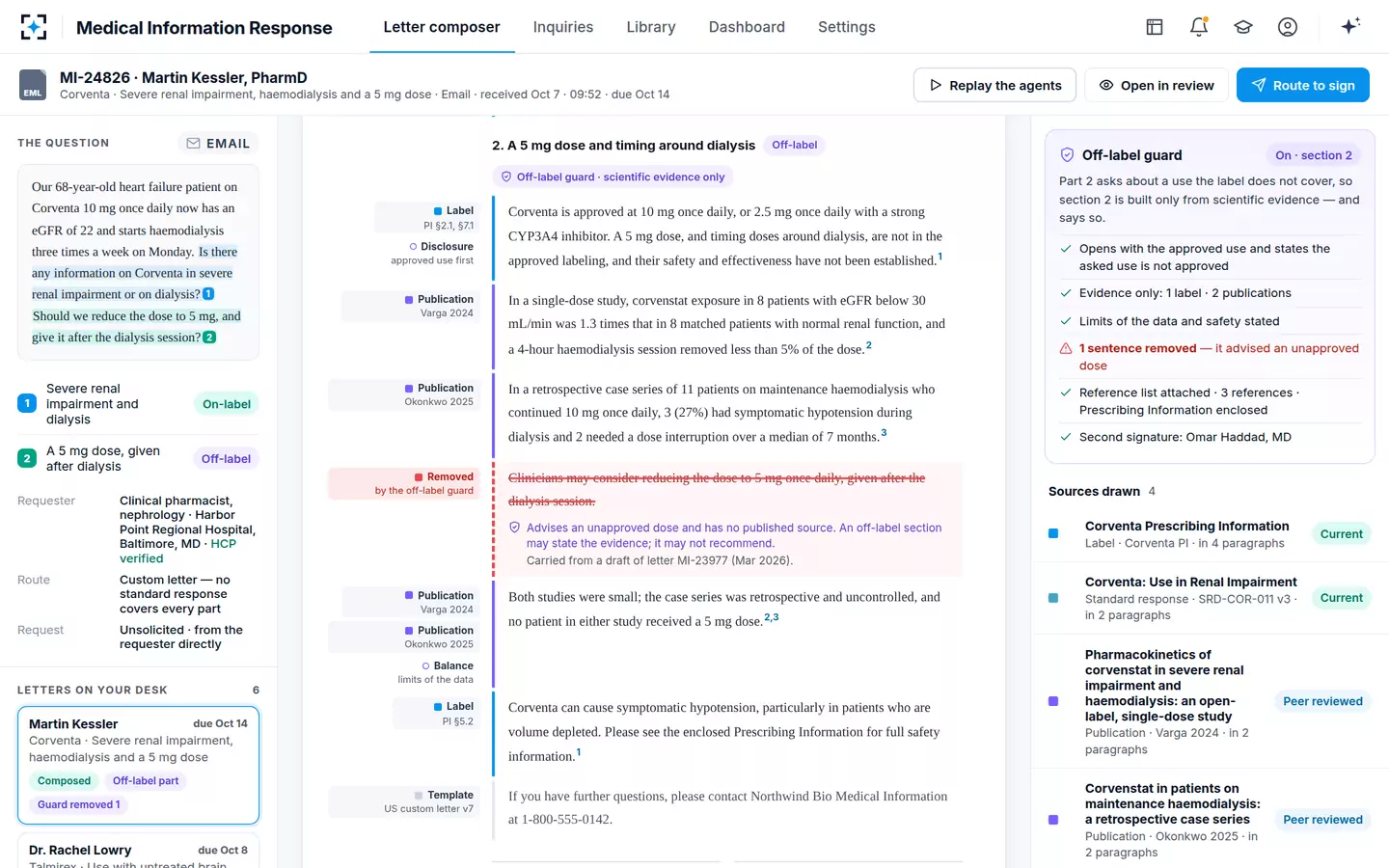
A scientific answer: In a single-dose study, exposure in eight patients with an eGFR below 30 was 1.3 times that in eight matched patients with normal renal function. The study was small.
A sentence that reads as promotion: Exposure is only modestly increased in renal impairment, so the product is well suited to these patients.
A scientific answer: In the same study, a four-hour haemodialysis session removed less than 5% of the dose. A separate case series in patients on maintenance dialysis was small, retrospective and uncontrolled.
A sentence that reads as promotion: Dialysis does not remove a meaningful amount of the drug, so no adjustment is needed around sessions.
A scientific answer: The approved dose is 10 mg once daily, or 2.5 mg with a strong CYP3A4 inhibitor. A dose of 5 mg and timing around dialysis are not in the approved labeling.
A sentence that reads as promotion: Clinicians may consider reducing the dose to 5 mg once daily, given after the dialysis session.
A scientific answer: The hypotension warning in the Prescribing Information applies, and the enclosed label sets out the monitoring it requires.
A sentence that reads as promotion: Tolerability was comparable in the studied patients.
Can a quotation from a journal article be promotional?
Yes, and that is the least intuitive part of the regulation. Three of the clauses in the table above are about references rather than claims: a quote used out of context, references that purport to support a claim and do not, and references used for the purpose of suggesting an unapproved use. None of them requires the quotation to be altered. A verbatim sentence from a peer-reviewed paper, accurately attributed, can still fall under all three if the surrounding letter uses it to do something the paper does not.
The practical test is to ask what the reader is meant to take away, and whether the cited passage supports that rather than something adjacent. A result observed at steady state does not support a sentence about a single dose. A finding in patients with moderate impairment does not support a sentence about severe impairment. And a selection of three supportive papers, each accurately quoted, can mislead by omission if the letter leaves out the study that found nothing — which is what the fair balance and material facts clauses are for.
The sentence the off-label guard struck, with its reason
Four controls that pay for themselves
None of the four is novel; all four are cheap compared with a corrective communications programme, and each one prevents a specific finding from the clauses above.
Four controls, and the finding each one prevents
- Set on- or off-label status per part of the question, not per question
A two-part question answered as one letter either over-discloses on the approved part or under-discloses on the unapproved one. Splitting the question is what makes answering only the questions asked checkable rather than aspirational — and it prevents the material facts finding.
- Record who really asked, and confirm it when a colleague submitted it
The protection in the guidance depends on the request being unsolicited. A question relayed by a field team is a common failure point: confirm with the requester that the question was their own before any off-label section is drafted, and keep the confirmation. This is the control that answers the first question an investigator is likely to ask.
- Hold every factual sentence to a passage, with its version
The three reference clauses — out of context, does not support, suggests an unapproved use — all resolve to the same test: does this passage say this sentence. A letter where every paragraph carries its source turns that test into a comparison instead of a search.
- Put a second, independent signature on anything off-label
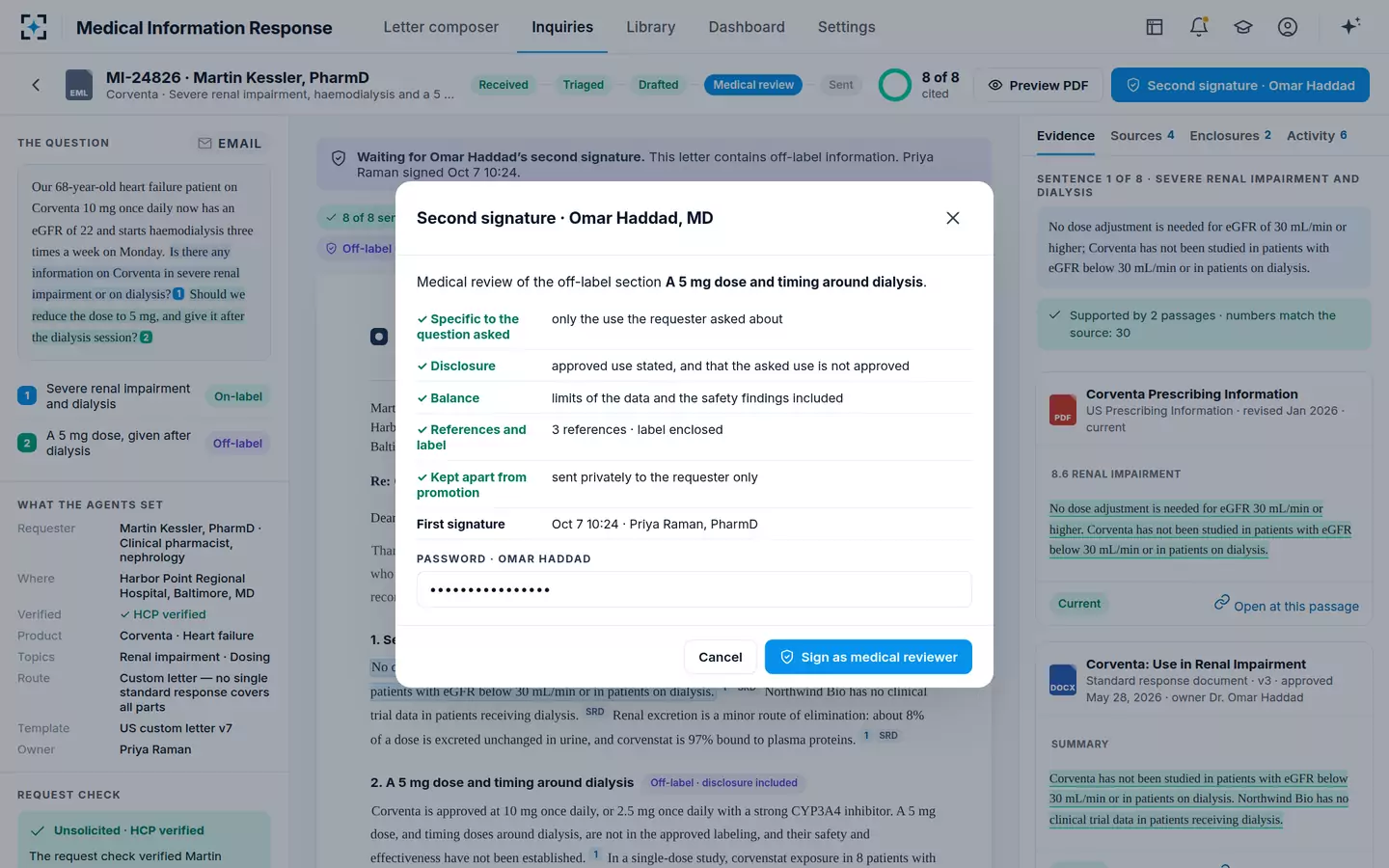
A medical reviewer reading only for advice that should not be there catches what a specialist reading for accuracy does not. The attestation should be explicit — specific to the question asked, disclosed, balanced, referenced, and sent privately to the requester alone.
The sample letter shows the fourth working. Because the letter contained off-label information it waited for a second signature from Omar Haddad, MD, whose screen lists what he is attesting to: specific to the question asked, the disclosure present, the balance, three references with the label enclosed, and kept apart from promotion — sent privately to the requester only. The people, products and letters in these examples are fictional sample data in the solution, not a customer's results.
The second signature, and what it attests to
What a medical information department is buying here is not protection from a settlement. It is the ability to say, about any letter it has sent, who asked, what was sent, which passage each sentence rests on, what was removed and who agreed to remove it — and to say it in an afternoon. Who signs a medical information letter, and what they are signing for follows the signature itself. To see the guard and the second signature on your own letters, start from Medical Information Response.
Questions people ask
Is off-label promotion illegal?
Promoting a medicine for a use FDA has not approved makes the product misbranded under the Federal Food, Drug, and Cosmetic Act, and that is the basis on which the agency acts. Off-label prescribing is not unlawful: a clinician may prescribe an approved medicine as their judgement directs. The line sits at what the company says, not at what the doctor does — and answering an unsolicited question in the manner the guidance describes is not promotion.
What does it cost to correct a letter that has already been sent?
More than the letter cost to write, because correction is a programme rather than a document. The ImmunityBio warning letter asks for a response in 15 working days and “a comprehensive plan of action to disseminate truthful, non-misleading, and complete corrective communication(s)”, delivered to the audiences that received the original. For a medical information department that means identifying every recipient of the wording, drafting a correction, getting it approved, and sending it — then establishing that the same sentence is not in anything still in circulation.
How long does FDA take to act on a promotional violation?
In the period GAO measured, an average of seven months from first drafting a regulatory letter to issuing it, with companies cited for more serious violations taking a further four months on average to complete the corrective actions requested. The agency also reports being unable to review everything submitted to it, so the gap between a communication going out and a letter arriving can be far longer than that.
Which controls actually prevent an off-label promotion finding?
Four: setting on- or off-label status for each part of a question rather than for the question as a whole; recording and confirming who really asked, so the unsolicited condition can be proved and not assumed; holding every factual sentence to a passage with its version; and an independent second signature on any letter with off-label content. The first two are procedural and cheap. The third is what turns the reference clauses from a worry into a check.
Does answering an off-label question put the response on the record as intent?
Only if the conditions are not met. FDA's guidance says that where a firm responds in the manner described, the agency does not intend to treat such responses as evidence that the firm meant its product for an unapproved use. Responding differently is not automatically a violation, but the guidance is explicit that such activity could be offered as evidence of a new intended use. The protection is behavioural, so it has to be demonstrable on each letter.
Can a sales representative pass on a doctor's question?
They can carry the question, but the answer must not involve them. FDA recommends that off-label questions be referred to the firm's medical or scientific department, that the answer be written by medical or scientific staff who sit outside sales and marketing, and that sales and marketing staff play no part in what it says. The practical control is to record who submitted each question and confirm with the requester that it was their own before an off-label section is written — a question prompted by a representative is not unsolicited.