AI citation verification, for a medical information team, starts with what a hallucinated citation is: a reference an AI model attaches to a sentence that the reference does not support. It is tempting to picture an invented paper, and with a general chatbot writing from memory that is common: in one study nearly half its references were fabricated. A drafting tool that writes only from retrieved, approved sources fails differently and more quietly — a real paper, correctly named, carrying a sentence it never says. In a medical information answer that distinction matters, because the sentence is read by a pharmacist deciding what to do about a patient on Monday. Botminds' Medical Information Response drafts those answers from approved sources and then re-reads its own draft: every factual sentence against the passage it claims, with the finding offered to the medical information specialist, never applied by the agent that wrote the sentence.
The work is hard because the unit of error and the unit of review do not match. A medical information letter is approved as a document. The failure happens in one sentence, often the shortest and most useful one on the page. A reviewer who reads the letter as a whole, agrees with it as a whole and signs it as a whole can approve an unsupported sentence without ever disagreeing with anything.
115 references from a general chatbot, checked one by one
47%
of the references were fabricated outright
46%
were authentic but inaccurate
7%
were both authentic and accurate
93%
of papers carried a reference with an incorrect PMID — the most frequent single error
What a hallucinated citation looks like in a medical answer
In a medical information letter, six failures all present as “cited”. They differ in what a reviewer has to do to catch each one, which is why a single instruction to “check the references” catches only the first.
Six ways a citation fails, and what catches each one
The reference that does not exist
Plausible authors, a real journal, a year, and an identifier that resolves to nothing — or to a different paper altogether.
Resolve every identifier. A citation you cannot open is not a citation.
The reference that exists and says something else
A real paper, correctly described in general, attached to a claim it never makes — a different dose, a different population, a different endpoint.
Read the passage, not the title. The abstract is not the claim.
The right reference on the wrong sentence
Two sentences swap their sources during an edit, so each is cited and neither is supported.
Check the pairing, sentence by sentence, after every edit.
The number that drifted
A 1.3-fold exposure becomes “around a third higher”; “less than 5% removed” becomes “negligible”. Each step is small and the last one is wrong.
Compare the figure in the sentence with the figure in the passage, digit by digit.
The sentence from a version that has gone
Wording copied from an earlier letter that followed a standard response since retired, so the citation is live and the claim is not.
Check the version of the source, not only its name.
The sentence nobody sourced
A helpful bridging line — a dose, a timing, a reassurance — carried over from a draft with no passage behind it at all.
Count the factual sentences and count the sources. The two numbers must match.
Only the first of the six is a fabrication in the ordinary sense. The other five are what reviewers call drift: a sentence that was true of some passage at some version, edited until it is no longer true of the passage still attached to it. Drift survives spell-checks, style guides and a confident read-through, because nothing on the page looks wrong.
How often does AI make up citations?
Often enough that the question is not whether to check but how. When four researchers asked a general chatbot to write short medical papers and then verified every reference it produced, 47% of the 115 references were fabricated and 46% were real but inaccurate; only 7% were both. The errors also ran inside the references. “Among the seven components evaluated for each reference,” they report, “an incorrect PMID number was most common, listed in 93% of papers. Incorrect volume (64%), page numbers (64%), and year of publication (60%) were the next most frequent errors” (Cureus 2023). The mean number of inaccurate components was 4.3 of seven per reference.
Two things follow for a medical information desk. First, a reference list that looks tidy tells you little: only one reference in fourteen was both real and accurate, and the identifier — the part that pins down the actual paper — was the part most often wrong. Second, the rate is a property of a general chatbot writing from memory. A drafting tool that retrieves an approved passage, keeps its identifier and writes only from what it retrieved has a different failure mode — not invention but misuse of something real. That is good news for the reference list and bad news for the reviewer, because misuse is the harder of the two to see.
The research literature agrees on where the weakness sits. When pharmacy faculty scored answers from several health-focused answer tools, they used a framework with five parts, and the parts did not score alike. Three pharmacy faculty scored each answer on their own, using a validated 25-point framework that rates completeness, the absence of false information, the evidence behind the content, and appropriateness and relevance. Their finding on the parts is the one to take away: “Of the individual components of the CLEAR score, lack of false information consistently had the highest scores across AI chatbots, while evidence supporting the content had the lowest” (J Am Coll Clin Pharm 2026).
ChatGPT, like any LLM, can hallucinate and produce content based on its prediction without logic or fact-checking abilities.
Lau et al., JMIR AI 2025
Read the two findings together and the shape of the problem is clear. The text is rarely false in a way a clinician would catch. It is unsupported in a way only the source can settle. The authors of that last paper, writing about how pharmaceutical medical information departments build their scientific response documents, notes that large language models “are unable to determine the credibility of their information sources” and that their use “often results in the original authors and sources not being cited, leading to the misattribution of information”. Misattribution, not fabrication, is the thing to measure.
Why document-level review misses an unsupported sentence
A letter is signed once and read once. The reviewer forms a view of the whole — is this the right answer to this question, is it balanced, does it say what we are allowed to say — and the view is usually correct. An unsupported sentence does not contradict that view. It agrees with it, fluently, and adds one claim nobody checked.
Three structural reasons make this predictable rather than careless. The first is reuse: letters are built from earlier letters, and a sentence that was checked in 2024 arrives in 2026 with its approval attached and its source moved. The second is volume: a department answering hundreds of questions a month cannot easily re-derive every claim, so it trusts the parts that look settled. The third is that the hardest part of the work is exactly the checking, not the writing. Surveyed medical information professionals ranked the job of confirming that paraphrased text still matches the source papers among the three most time-consuming steps in building a response document — above drafting it.
So the review has to move down a level. Not “is this letter right” but “does this passage say this sentence”, asked once per factual sentence, with the passage on the screen. That is a different piece of work, and it is mechanical enough to give to an agent and consequential enough to keep the decision with a person.
What should you check on every sentence?
Five checks, in a fixed order, each with its own failure. They are ordered so that the cheapest disqualifier runs first: a sentence with no passage behind it never reaches the balance check.
The five checks on one sentence, and what a failure looks like
| The check | What it compares | What a failure looks like |
|---|---|---|
| 1. Support | The claim in the sentence against the passage cited for it, including the population and the dose it was observed in. | The passage supports a weaker claim — in healthy volunteers, at a different dose, as a single dose rather than at steady state — and the sentence states the stronger one. |
| 2. Numbers | Every figure, unit, interval and denominator in the sentence against the figure in the passage. | A fold-change rendered as a percentage, a confidence interval dropped, “less than 5%” softened to “negligible”, a per-session figure read as a per-day figure. |
| 3. Version | The version and section of the source cited against the version currently approved. | The wording follows a standard response that has been superseded, or a label section that has since been revised. The citation resolves; the claim is retired. |
| 4. Balance | What the letter says for a use against what it says about the limits and the safety of that use. | The supporting study is described in detail and the data that do not support the use, or the warning that qualifies it, are summarised in a clause or omitted. |
| 5. Wording | The verbs and comparatives in the sentence against what a scientific response may say. | A sentence that advises (“clinicians may consider…”), recommends a dose, or compares favourably with another product where the evidence does not. |
Check 5 is the one with a published rule behind it. Prescription-drug advertising regulation names the specific misuse of a reference that a scientific answer has to avoid: an advertisement is misleading if it lifts a quotation or paraphrase out of context so that it gives a false idea, if it cites material that appears to back a claim but does not support it or has no bearing on it, or if it uses cited material to recommend or suggest a use of the drug that the labeling does not approve or permit (21 CFR 202.1(e)(6)(ix)–(xi)). A medical information letter is not an advertisement, and a well-run response is outside promotion altogether — what you may send in reply to an unsolicited request sets out why. But the clauses describe, precisely, the three ways a sentence can be cited and still be wrong, which makes them a specification you can check against rather than a risk you can only worry about.
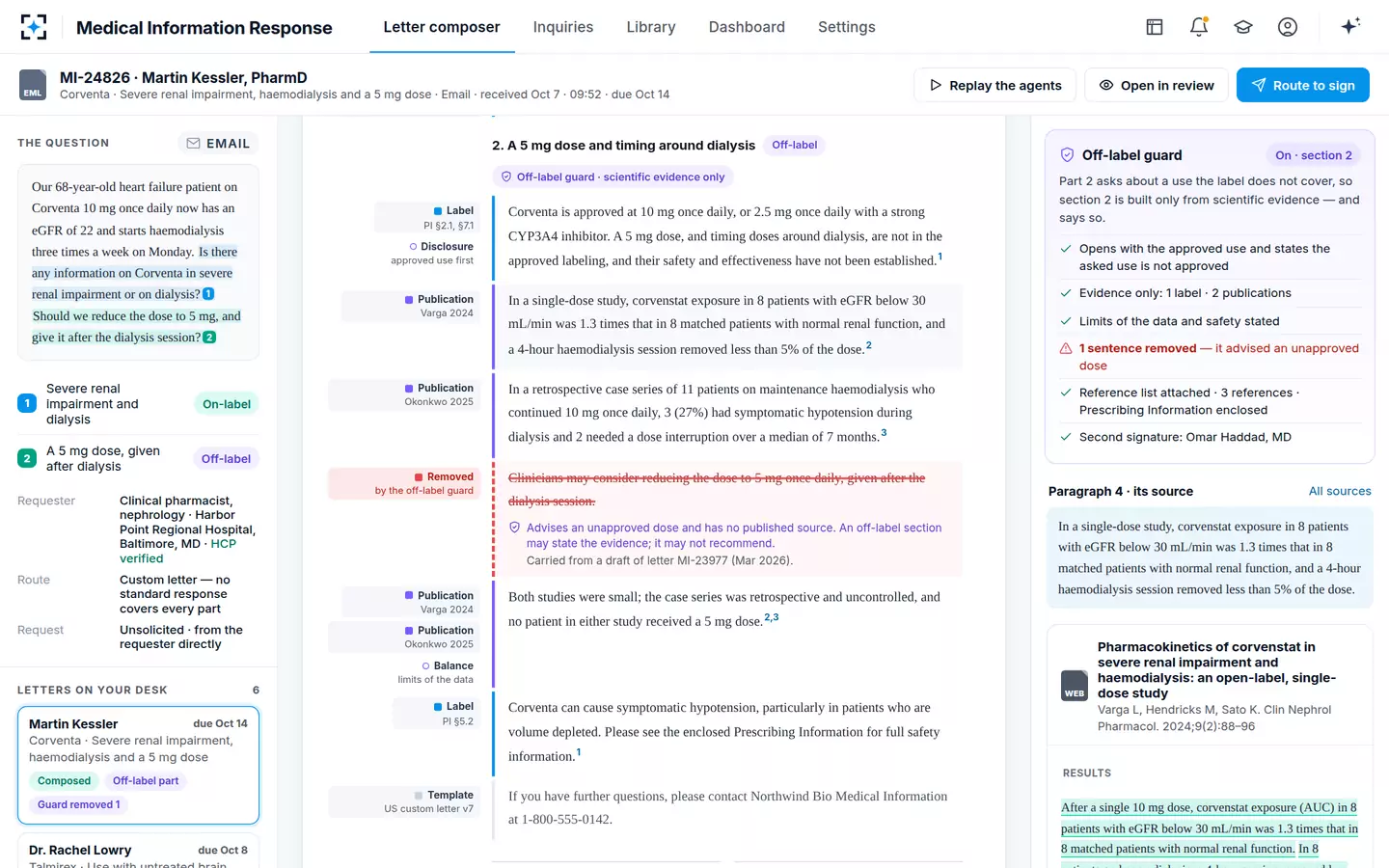
One paragraph, and the passage it came from
Building a truth set from letters you have already sent
Before any of this can be measured, you need an answer key. The cheapest one is already in the archive: letters your own specialists wrote, checked and signed, with the sources they used attached. A sample of those is a truth set that reflects your products, your library, your templates and your house style — which no vendor's demonstration can.
Building a truth set from fifty signed letters
- Sample across the work, not across the easy parts
Stratify by product, by country template, by channel and by on- or off-label content. A set drawn only from standard-response replies measures nothing: those sentences were never drafted.
- Mark the factual sentences
A greeting, a signpost and an offer to send more are not factual. A dose, a rate, an interval, a limit, a date or a comparison is. This count is the denominator for everything that follows.
- Attach the passage, not the paper
For each factual sentence, record the section and the version it rests on. “Varga 2024” is not an answer key; “Varga 2024, results, single-dose cohort” is.
- Keep the sentences that were struck, and why
The letters that went through a second signature hold the most useful rows: a sentence someone removed, with the reason. Those are the cases a checker has to find, not the ones it finds easily.
- Record the version the letter was signed under
A sentence that was correct against v3 and is wrong against v5 is a true positive for the checker and looks like a false positive to anyone comparing against the signed letter. Date each row.
- Have two people mark a shared subset
Not to average them, but to find out how often your own reviewers disagree. That number is the ceiling on any score you report afterwards.
- Freeze it before you look at any tool
A truth set edited while a tool is being evaluated measures the editing.
The last item is not a formality. When researchers in a tertiary care hospital scored answers to drug information questions from three AI tools against pharmacist answers, the reviewers themselves barely agreed: inter-rater agreement was low, with a Fleiss' kappa of 0.015. Their conclusion is the practical one — “variability among tools and low rater agreement highlight the need for cautious interpretation and continued pharmacist oversight when using AI in drug information practice” (J Am Coll Clin Pharm 2026). If your own reviewers disagree on a tenth of the rows, a tool reported at 95% and a tool reported at 90% are not distinguishable, and you should stop reporting the difference.
Scoring support, numbers, version, balance and promotion
The score worth keeping is a ratio over sentences, not a percentage over letters. Letters differ in length; sentences are comparable. And the useful denominator is not every sentence but every factual one.
The sentence-level support rate, and the number a signer actually uses
Factual sentences
every sentence that asserts something checkable
The denominator. A greeting, a signpost or an offer to send the label is not factual. A dose, a rate, an interval, a limit, a date or a comparison is.
Fixed once, in the procedure
Supported sentences
the passage says it, of this population, at this dose
The numerator. A passage that supports a weaker claim does not support this sentence; a passage in healthy volunteers does not support a sentence about dialysis.
The reviewer who accepts the finding
Support rate
supported ÷ factual
Read per letter, not per department. A desk at 96% is a desk with four unsupported sentences in every hundred, and nobody knows which four.
The MI manager
Sentences to decide
factual − supported
The only figure that changes what happens next: how many sentences a named person has to accept, reject or rewrite before signing.
The specialist signing
Report the last column, not the third. “Eleven factual sentences, ten supported, one to decide” tells a specialist what to do this morning. “A 91% support rate” tells nobody anything, and it averages away the single letter where the one unsupported sentence was the dose.
It is worth being honest about how much of this a machine can settle. The same medical information working group trained sentence-level classifiers to sort scientific text into the categories a response document needs, over 3,187 sentence data points, and the accuracy varied sharply by what was being identified.
What a classifier could tell about a sentence, by what it was asked to find
Read the bars as a budget for trust. Finding which sentences carry treatment data or adverse events is close to reliable; deciding which sentence is an endpoint claim, at an AUC of 0.67, is much weaker. A checker built on this evidence should surface and compare, and should not be the thing that closes the question — which is the next section.
Who decides a finding, and why it cannot be the model
Every finding on a sentence is a proposal, and somebody has to take it. The reason that somebody cannot be the agent that drafted the sentence is not caution, it is arithmetic: a model scoring its own output shares the error that produced it, so a self-accepted finding measures agreement rather than support.
The medical information working group whose framework is quoted above builds the same separation into the authoring process. Their approach, as they describe it, sets points along the way in AI-assisted drafting of a standard response where a human writer can step in and make the content more credible. The checkpoint is not a sign-off at the end. It is a place where a person can see what was proposed, see what it was proposed against, and say no.
In Medical Information Response the division is explicit. The letter writer drafts and links every factual sentence to the passage it came from. The citation checker re-reads each sentence against those passages and offers corrected wording drawn from current sources. Every finding cites the passage it relies on, and a person accepts or rejects each one. A sentence the off-label guard removed comes back only with the medical reviewer's signature. Agents draft; the specialist signs; the decision has a name against it.
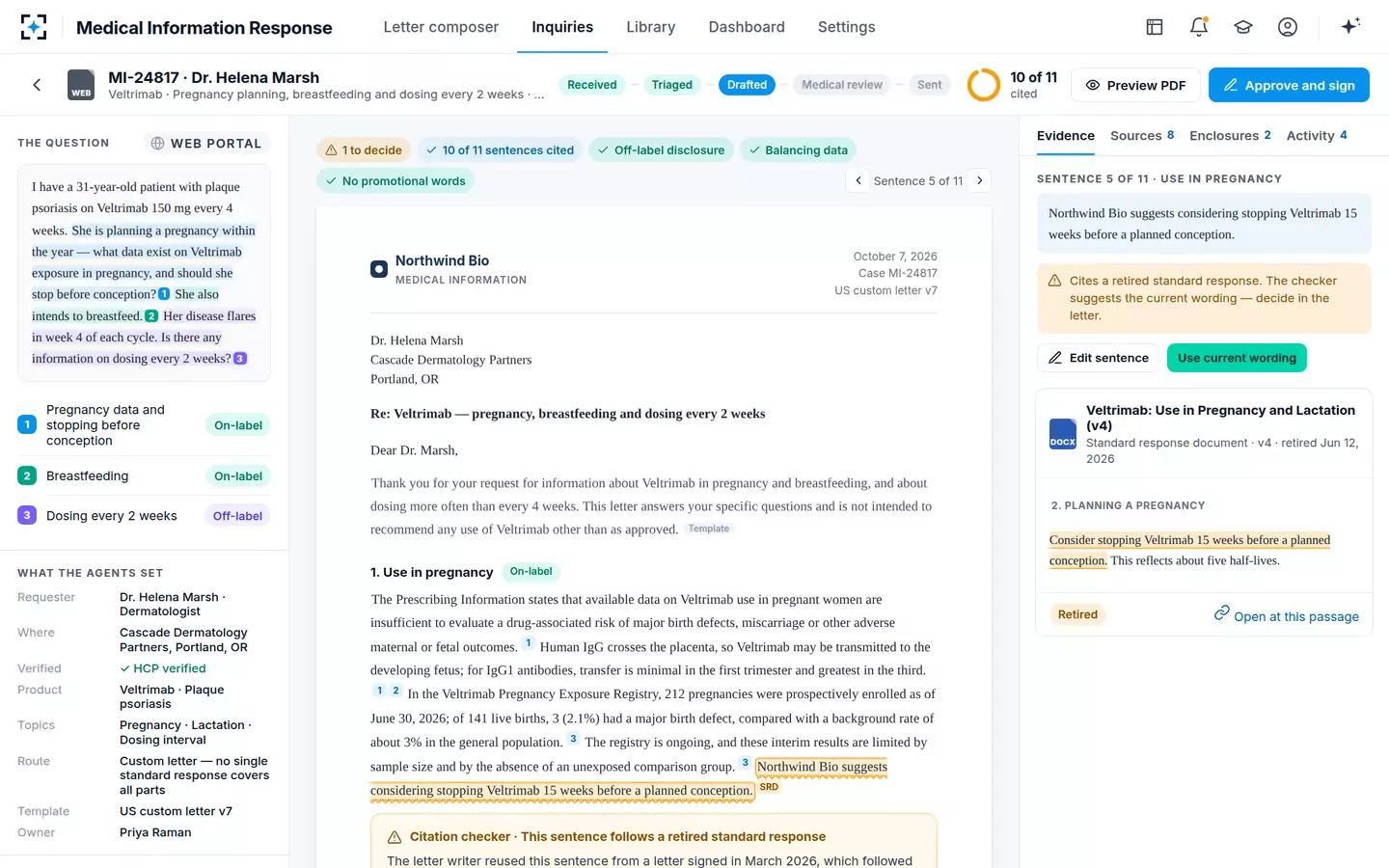
The sentence whose source was retired
The hardest case is not an invented reference. It is a sentence that was right, cited, approved and sent — and whose source has since changed. Take the sample letter in the solution: Dr. Helena Marsh, a dermatologist in Portland, asks about Veltrimab in pregnancy planning, breastfeeding and dosing every two weeks. Her draft has eleven sentences and one to decide: “Northwind Bio suggests considering stopping Veltrimab 15 weeks before a planned conception.” The wording came from an earlier letter that followed standard response SRD-VLT-014 v4, retired on 12 June 2026; v5 removed the sentence because the Prescribing Information sets no period for stopping before conception. The people, products and letters in these examples are fictional sample data in the solution, not a customer's results.
Notice what each check does with that sentence. Support passes: there was a passage, and it said this. Numbers pass: fifteen weeks is what the retired version said. Version fails, and it is the only check that can fail here, which is why it cannot be folded into the others. The checker offers the current wording; the specialist decides. Keeping the sentence is a legitimate outcome — with a note the medical reviewer sees, so the decision travels with the letter instead of disappearing into it.
One sentence, its passage and the verdict
The sentence as drafted
“Northwind Bio suggests considering stopping Veltrimab 15 weeks before a planned conception.”
Sentence 7 of 11. Carried over from an earlier signed letter on the same question.
The passage behind it
SRD-VLT-014 v4 — retired 12 June 2026. v5 removed the wording; the Prescribing Information sets no period for stopping before conception.
The citation resolves. The version does not.
What the five checks return
Support pass · Numbers pass · Version fail · Balance pass · Wording pass
One finding, with the current wording offered. A person accepts it, or keeps the sentence with a note the medical reviewer sees.
What this looks like in Medical Information Response
On the sample desk, the checker runs on every letter before it is routed for signature, and the result is a line rather than a report: for the letter to Dr. Martin Kessler, eight of eight sentences cited and checked, the off-label section built from scientific evidence, one sentence removed by the guard, three references attached. Over thirty days of sample data the dashboard counts 2,124 checked sentences, each carrying a source. Those are demonstration figures on fictional inquiries, and the per-letter counts are one sample letter each — not an accuracy rate, and not a claim about how often this solution would be wrong on your library.
The useful product of the checker is therefore not a score. It is a shorter decision: the specialist opens a letter in which every factual sentence already has its passage attached, and spends the review on the one or two sentences that need a judgement. What a finished letter looks like, section by section shows the document those checks run over, and how a standard response is written, versioned and retired explains why the version check cannot be skipped.
The checker's finding on a sentence that followed a retired standard response
To see the five checks run on a letter of your own, start from Medical Information Response — a sample of past inquiries and the standard responses behind them is enough.
Questions people ask
How do you check whether a citation is real?
Resolve the identifier first: a PMID or DOI that does not open, or opens on a different paper, settles it immediately — and identifiers were the most frequently wrong component in the Cureus 2023 analysis, incorrect in 93% of papers. But resolving it is only the first check. Most failures in a drafted medical answer are references that resolve perfectly and do not support the sentence they are attached to, which can only be settled by reading the passage against the sentence.
Can an AI check another AI's citations?
It can propose findings, and that is worth a great deal, because the work of putting each sentence next to its passage is mechanical and slow. It cannot close them. A model that accepts its own findings measures its agreement with itself, and the evidence on sentence-level classification is mixed by category — area under the curve ran from 0.67 to 0.85 across data types in the JMIR AI 2025 work. Every finding should cite the passage it rests on and be accepted or rejected by a named person.
What do you do with a sentence whose source has been retired?
Treat it as a finding, not an error. The sentence may still be accurate, or the retirement may be exactly why it must change. The checker should name the version, say what the current version says instead, and offer the replacement wording; the specialist either takes it or keeps the sentence with a note that travels to the medical reviewer. What should never happen is the sentence passing because its citation resolves.
How do you measure whether a drafted answer is supported?
Count factual sentences, count how many are supported by the passage cited for them, and report the difference rather than the ratio. “Eleven factual sentences, one to decide” is actionable; a 91% support rate is not, and it hides the letter where the unsupported sentence was a dose. Measure on a frozen sample of your own signed letters, and have two reviewers mark a shared subset so you know how much of any difference is your own disagreement.
Why does a reviewer re-check sentences that were already approved?
Because reuse moves faster than review. Letters are assembled from earlier letters, and a sentence approved two years ago arrives with its approval attached and its source possibly superseded. When every paragraph carries the passage and version behind it, re-checking stops being a re-read of the whole letter and becomes a comparison of two things on one screen.
Is a reference list enough evidence that an answer is sourced?
No. A list shows that references exist; it does not show which sentence rests on which passage, and that mapping is where the failures live — the right reference on the wrong sentence, or a figure that drifted during an edit. The test to apply to any tool is whether it can show, for one sentence you choose, the passage it used, the section and the version, without you going to look it up.