A standard response document is a pharmaceutical company's pre-approved written answer to a question its medical information department expects to be asked again — the drug's use in pregnancy, its storage excursions, its interaction with a common co-medication. Writing one is the part everybody plans for. Keeping the library current is the part that consumes the year: departments report revising more than twice as many documents as they create, and a retired version does not disappear when it is superseded, because its wording lives on inside every letter that already quoted it. Botminds' Medical Information Response treats the library as the first place a question is answered from, cites only current approved versions, flags reused wording that follows a retired one, and drafts a new standard response when a question keeps coming back without one — for the owner to approve.
The library on this page is a fictional sample desk's inside the solution: Northwind Bio Medical Information, with 186 current standard responses across its three products Corventa, Veltrimab and Talmirex. The documents, versions and people are invented. The published figures come from a survey of medical information departments and from FDA, linked under the figures that use them.
A year of standard responses, and the hours inside it
614new
standard responses a medical information department creates in a year, on average
1,352revised
updated or revised in the same year — 2.2 revisions for every new document
8.3hours
to create one new standard response, on average
3.8hours
to update one — about 5,100 hours a year on each side of the library
What is a standard response document?
It is a concise, approved summary of the evidence on one question about one product, written to be sent as it stands. The survey's own description of what medical information departments produce is a serviceable definition: departments "develop SRDs that provide concise summaries consisting of relevant background information, search strategies, clinical data, and balanced references."
The names vary and the thing does not. Standard response document, standard response letter, scientific response document, SRD, standard response — all describe an approved answer held in a library and reused. What distinguishes it from a custom letter is not length or tone but when the approval happened: the standard response was approved as a document, before anybody asked, and the custom letter is approved as a letter, after somebody did. That distinction is why the library can be sent unchanged in two business days on the sample desk while a custom letter takes five.
What goes inside one, part by part
Six or seven parts, and three of them are not about the medicine at all. The content parts answer the question; the control parts — version, owner, approval and review date — are what make the document safe to reuse. A document with excellent content and no version is not a standard response; it is a draft that somebody is sending.
The parts of a standard response document, and what each one is for
| Part | What it holds | Why it is there |
|---|---|---|
| Background | The clinical context of the question: the condition, the population, what the label says. | So the answer can be read by a prescriber who asked a narrow question about a wide problem. |
| Search strategy | How the evidence was found: the databases, the terms, the date of the search. | It is the only part that lets a later reader judge whether the evidence is complete, and the only part that tells the next reviser where to start. |
| Clinical data | The studies that answer the question, with their design, size and results. | The substance. On an off-label topic it carries the data that do not support the use as well as the data that do. |
| Balanced references | Every publication cited, and the labeling sections relied on. | FDA asks a response to carry "a complete list of references for all of the information disseminated in the response". |
| Version and status | The version number, and whether it is current, due for review or retired. | A letter has to be able to say which version it quoted. Without it, a correction cannot find the letters it needs to reach. |
| Owner and approval | The named person who approves the content, with the date and time of the signature. | Approval is an act by a person, and under the electronic-records rule the signature has to record its own meaning. |
| Review date | When the document must next be re-read against the current evidence and labeling. | Evidence moves. A document with no review date silently becomes a claim about the state of knowledge on the day it was written. |
The search strategy is a part easily dropped, and it is the one that makes the difference between a document that can be revised and a document that has to be rewritten. A reviser who can see the terms and the date of the last search can run it again from that date and read only what is new. A reviser who cannot starts from the beginning — which may be part of why the survey's 3.8 hours to update is less than half of the 8.3 to create — and why, on a badly kept library, an update can cost as much as starting again.
Who owns a standard response, who writes it and who approves it
Three roles, and conflating any two of them is a common failure. The owner is a named person with the clinical authority to stand behind the content — on the sample desk, the medical director for the product's therapy area. The writer is a medical information specialist or medical writer who assembles the evidence and drafts the wording. The approver signs, and under 21 CFR 11.50 that signature has to carry the signer's printed name, the date and time it was executed, and what the signature means — review, approval, responsibility or authorship (21 CFR 11.50). "Approved" has to mean something specific and be recorded as meaning it.
The role that no rulebook names, and that a working library needs, is the librarian: whoever notices that a document is due, that a question keeps arriving without one, and that two documents now answer the same question differently. On the sample desk that work is done by an agent that groups signed letters by product and topic and reminds owners thirty days before a review is due — but it drafts and reminds only. Owners approve.
How many does a medical information department write in a year?
The published figure is 614 new documents and 1,352 revisions a year, from a survey of phactMI member companies published in JMIR AI in 2025. Both numbers come with very wide ranges — the survey reports new documents ranging up to 2,676 and revisions up to 6,057 — and they rest on a small number of respondents: 21 of 33 member companies opened the survey, 16 took part, and 13 completed it. The paper's own discussion also notes that an earlier benchmark had reported far longer times to create and revise a document. Read them as the shape of the work rather than a benchmark to be measured against.
A department revises more than twice as many documents as it writes
The two level bars are the reason this guide is about version control rather than authoring. A department that plans its year around writing new documents has budgeted for half its library work. And the hours are not necessarily spent where a manager might assume: asked which steps of developing a standard response took the most time, respondents named paraphrasing study content, "checking the data integrity of the paraphrased text versus the source publications", and checking the data integrity of the document itself. The expensive part of a revision is not deciding what the new evidence means. It is proving that every sentence still matches the paper it came from.
How often should a standard response document be reviewed?
No regulation sets an interval. What forces one is that the document makes claims about a body of evidence and about a label, and both move: a new trial publishes, a label is revised, a safety signal changes a warning. A workable practice, and the sample desk's, is an annual review date set at approval, with an out-of-cycle review triggered by a label revision or a material new publication on the same question.
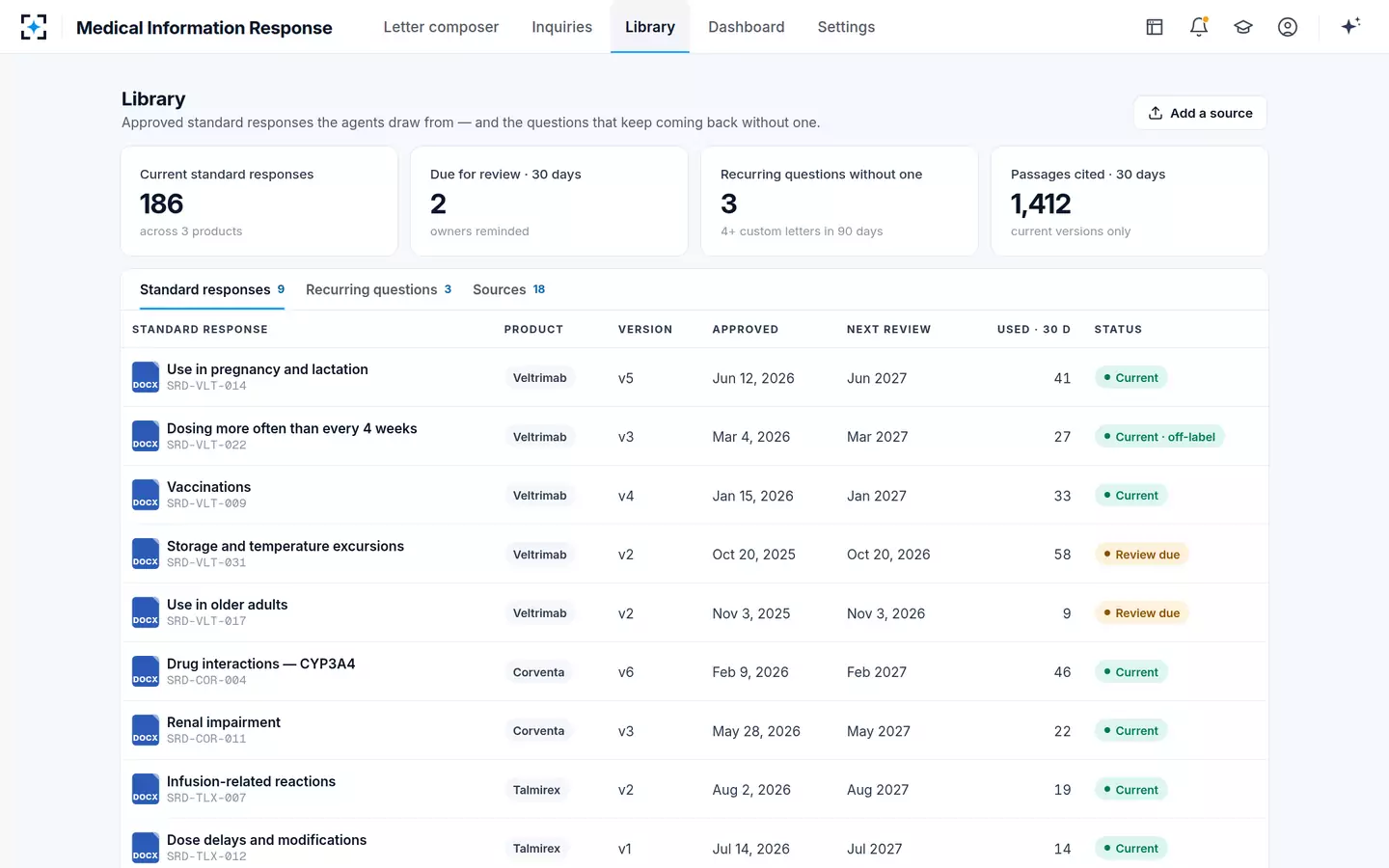
The sample library shows what an annual cycle looks like once a library has size. Of 186 current standard responses across three products, two fall due for review inside thirty days — both approved in October and November 2025 — and one of them is the most used document in the library, quoted in 58 letters in the last thirty days. That combination is the one to watch for: usage and review status are independent, so the document most likely to reach a prescriber this week is not necessarily the one whose evidence was last checked.
186 standard responses, with the two that are due and the three questions with none
What happens when a standard response document is retired?
Retirement means the version stops being citable, and it comes in two flavours that need to be distinguished in the record. A document is superseded when a new version replaces it on the same question: the topic is still answered, and the new version is what a letter must cite. A document is withdrawn when the question is no longer answered from the library at all — the product is discontinued, or the topic has moved into the label. The practical difference is what happens to a question that arrives the next day: a superseded document routes to its successor, and a withdrawn one routes to a person.
What retirement does not do is remove the wording from circulation. On the sample desk, version 4 of the Veltrimab pregnancy and lactation document was retired on 12 June 2026 and version 5 approved the same day. Version 5 removed one sentence — a suggestion to consider stopping the product fifteen weeks before a planned conception — because the Prescribing Information sets no such period. Every letter signed before June that quoted version 4 still contains that sentence, sitting in an archive that the next letter writer can search.
One library, two live versions of the same question: which letters cited which
Use in pregnancy and lactationSRD-VLT-014
Versionv5
WhenApproved Jun 12, 2026
Where it is in use41 letters in 30 days
StatusCurrent
Use in pregnancy and lactationSRD-VLT-014
Versionv4
WhenRetired Jun 12, 2026
Where it is in useStill quoted by letters signed before June
StatusRetired
Dosing more often than every 4 weeksSRD-VLT-022
Versionv3
WhenApproved Mar 4, 2026
Where it is in use27 letters in 30 days
StatusCurrent · off-label
Storage and temperature excursionsSRD-VLT-031
Versionv2
WhenApproved Oct 20, 2025
Where it is in use58 letters in 30 days — the most used of all
StatusReview due
Use in older adultsSRD-VLT-017
Versionv2
WhenApproved Nov 3, 2025
Where it is in use9 letters in 30 days
StatusReview due
Renal impairmentSRD-COR-011
Versionv3
WhenApproved May 28, 2026
Where it is in use22 letters in 30 days
StatusCurrent
The life of one standard response, from draft to superseded
- Drafted8.3 h
- Approvedsigned
- In use12 months
- Review due30 days
- Revised3.8 h
- v5 approvedJun 2026
- v4 in old lettersno end
The retired wording that comes back through an old letter
This is the failure that version control alone does not catch, because nothing in the library is wrong. A letter writer answering a new question on the same topic searches the archive of signed letters — the obvious thing to do, and often the right one, since those letters were approved and their wording was cleared. The sentence they lift was approved. It was approved against a version that no longer exists.
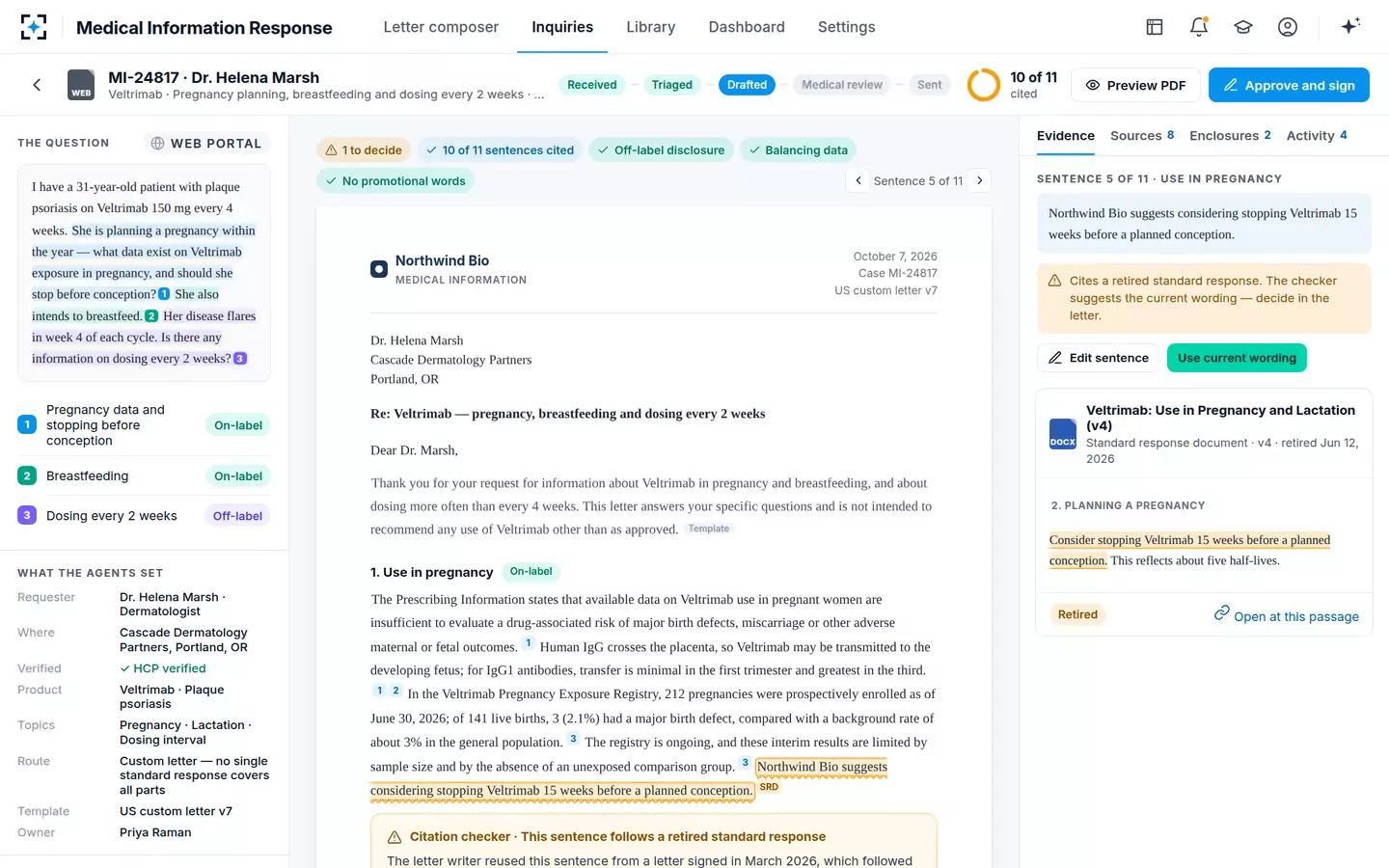
On the sample desk the case is a dermatologist's three-part question about pregnancy planning, breastfeeding and dosing interval. The drafted letter had eleven sentences, ten cited and one to decide — a sentence suggesting that patients consider stopping Veltrimab fifteen weeks before a planned conception. It had come from a letter signed in March 2026 that followed version 4. The finding names what is wrong with it — it cites a retired standard response — and offers the current wording from version 5 beside it. The agent does not accept its own finding: a person reads the sentence, the retired passage and the current one, and decides.
Catching it requires reading at the level of the sentence rather than the document, and comparing each sentence against the version of the source that is current now rather than the version that was current when the sentence was first written. That is a different check from the one that keeps the library tidy, and it is the only one that reaches wording already in circulation.
A sentence that follows a retired version, caught before signing
When a recurring question deserves a standard response of its own
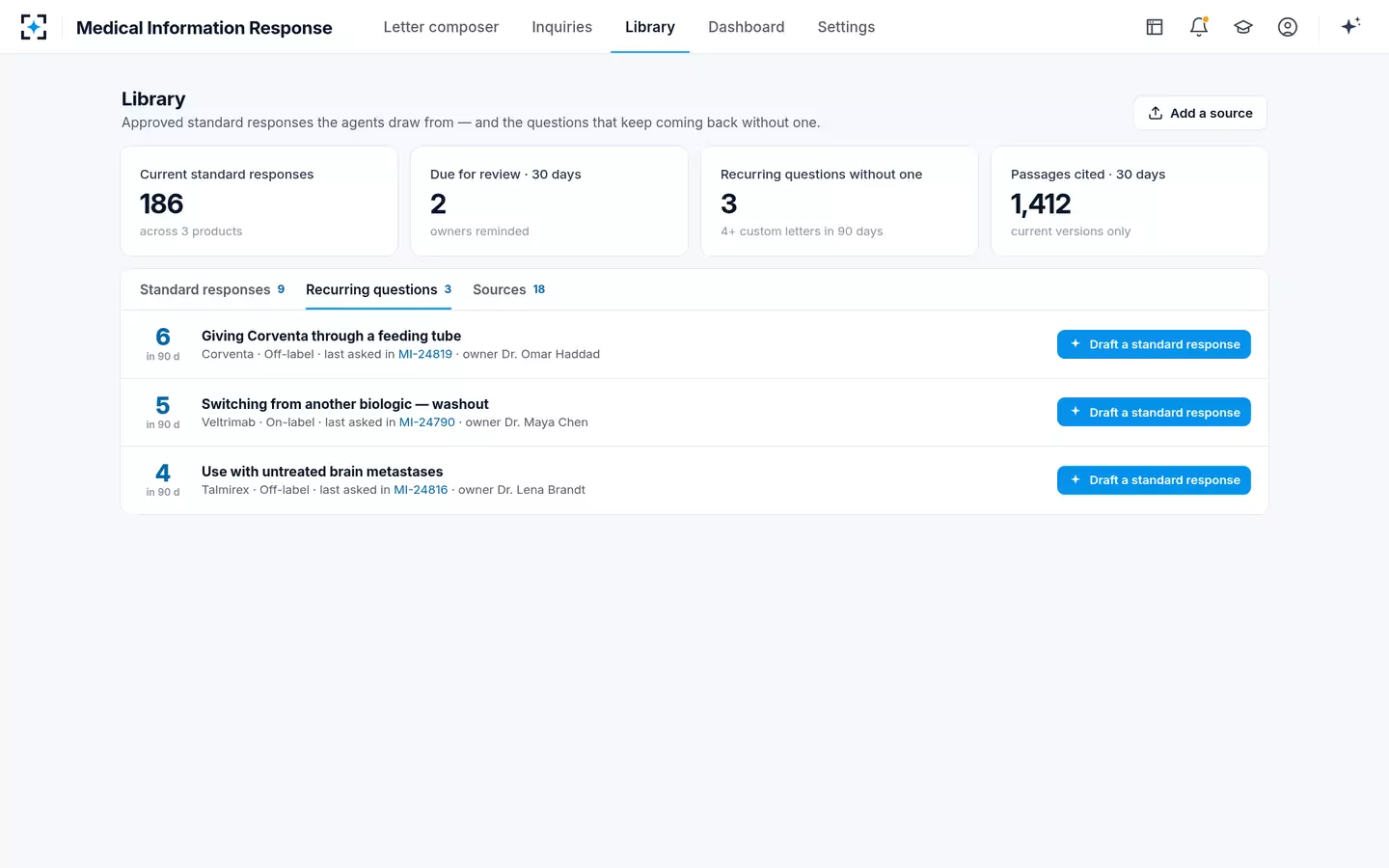
The signal is not that a question is interesting. It is that the department has already written the same answer several times from scratch, which means it has paid the custom-letter price repeatedly for work the library could have done once. A workable threshold is a count over a window: four or more custom letters on the same topic in ninety days, with no current standard response covering it.
On the sample desk three topics meet that test. Giving Corventa through a feeding tube has had six custom letters in ninety days, a washout when switching from another biologic five, and the use of Talmirex in patients with untreated brain metastases four. Each has a named owner, and each carries the identifier of the most recent letter that asked it, so the owner can read the question in its own words before deciding whether the library should answer it.
Two of those three topics are off-label, which is where the threshold earns its keep and also where it needs care. A standard response on an off-label topic is legitimate — the sample library has one, on dosing more often than every four weeks, marked current and off-label — but it is only ever sent in answer to an unsolicited question, and a library a prescriber can browse converts the channel into a solicited one. FDA's own example is a website serving prepared standard responses from fixed menus, which makes the resulting requests solicited. What makes a request unsolicited, and what you may send works through why that distinction decides the whole answer.
Three questions asked four or more times in 90 days with nothing in the library
From standard response to sent letter: the two routes
A library only pays for itself if the question that it answers actually reaches it. On the sample desk, of 1,184 questions answered in thirty days, 382 were answered by sending a current standard response and 236 needed a custom letter; 514 were answered live, in the conversation, and 52 were referred to the nurse line because they came from patients rather than professionals. The library's share is the one that scales: every question it answers is a question that did not cost five days.
How 1,184 questions were answered in thirty days
The sample desk, last 30 days
- Answered live, in the conversation · 43%
- A current standard response, sent unchanged · 32%
- A custom letter, written and signed · 20%
- Referred to the nurse line · 4%
The route is set once, at intake, and it is set by coverage rather than by topic: a standard response route means a current approved document covers every part of the question. The sample letter in the anatomy of a custom letter went the other way precisely because one of its two parts was not covered. A library that answers four parts of a five-part question does not save the letter; it saves the four paragraphs.
What an approver checks before signing a revision
A revision is the riskier signature, because the reader starts from a document that has already been approved and reads for what changed. The checks below put the dangerous things first: what was removed, and who is still relying on it.
Seven checks before approving a revision
- What changed, sentence by sentence, against the approved version
Including deletions. A removed sentence is the change most likely to matter and the one a reader scanning for new text will miss.
- Why each change was made, with the evidence or label revision behind it
A revision with no stated cause is an edit, and an edit to an approved document is the thing version control exists to prevent.
- That every sentence still matches the passage it cites
The step surveyed departments named among the most time-consuming: checking the data integrity of the paraphrased text against the source publications.
- That the labeling cited is the edition now in force, for each country the document serves
A label revision is a common reason a correct document becomes wrong without anybody editing it.
- That the balance still holds after the change
Removing an unsupportive study to make room for a supportive one changes the balance even when every remaining sentence is true.
- Which sent letters quoted the version being retired
The answer decides whether a correction has to go further than the library — and whose letters need re-reading.
- That the signature records its meaning, name and time
Under the electronic-records rule a signed record has to show the printed name of the signer, when the signature was executed, and what it means.
The sixth check is the one that distinguishes a library from a folder. Knowing which letters cited the version you are retiring is only possible if letters cite versions, which is a decision made long before the revision — at the moment a letter is drafted, when the paragraph is tagged with the document and the version it came from rather than with the document alone. On the sample desk 1,412 passages were cited in thirty days, all of them from current versions, and each sent letter keeps the version it quoted. Who signs a letter, and what the signature means, follows the people on the other end of those approvals. To see the library, the review dates and the recurring questions together, start from Medical Information Response.
Questions people ask
What is the difference between an SRD and a scientific response document?
None that matters. SRD is the abbreviation most departments use, and it stands for standard response document in some companies and scientific response document in others; the published literature uses "scientific response documents" for the same artefact that practitioners call standard responses. What does differ is the scope a company gives the term: some reserve it for documents answering off-label questions and call the on-label ones standard letters. Check which convention a department means before comparing counts.
Who approves a standard response document?
A named owner with the clinical authority to stand behind its content — often the medical director for the product or therapy area, not the writer. Where the approval is an electronic signature on a record kept under FDA requirements, 21 CFR 11.50 requires it to show the signer's printed name, the date and time, and the meaning of the signature. Whatever the system, the approval should say who approved what, when, and what that approval asserts.
How many standard responses does a medical information team write a year?
A survey of phactMI member companies published in JMIR AI in 2025 reported an average of 614 new documents and 1,352 revisions a year, with ranges extending to 2,676 and 6,057. The averages rest on 13 to 16 responding companies, so treat them as the order of magnitude of a department's workload rather than a benchmark. The useful figure in them is the ratio: more than two revisions for every new document.
How long does it take to write a standard response document?
An average of 8.3 hours to create one and 3.8 hours to update one, in the same survey. The respondents named the most time-consuming steps as paraphrasing study content, checking the paraphrased text against the source publications, and checking the document's own data integrity — so most of those hours go on verification rather than composition, which is also why a document whose search strategy was recorded is much cheaper to revise than one whose was not.
How do you stop an old letter reusing retired wording?
By checking letters at the level of the sentence rather than the document, and by comparing each sentence against the version of its source that is current now. A sentence lifted from an approved letter can be true, cited and correctly transcribed and still follow a version that has since been retired — which is what happened to a pregnancy-planning sentence on the sample desk, reused from a March letter that followed a version retired in June. Letters have to cite versions, not just documents, for the check to be possible at all.
When should a recurring question become a standard response?
When the department has answered it from scratch enough times that writing it once would have been cheaper. A usable threshold is four or more custom letters on the same topic within ninety days with no current document covering it — the test the sample desk uses, which currently flags three topics, two of them off-label. An off-label standard response is legitimate but must still only be sent in answer to an unsolicited question, and should not sit in a library a prescriber can browse.