Regulation Z trigger terms are the four kinds of credit detail that, once an ad mentions them, oblige it to state the full terms. For closed-end credit, under 12 CFR 1026.24(d), they are the amount or percentage of a down payment, the number of payments or period of repayment, the amount of any payment, and the amount of any finance charge. Mention one and the ad must also state the down payment, the terms of repayment and the annual percentage rate, and say whether the rate can rise. Lending marketers break this rule mostly by accident, in a headline written before anyone thought about disclosures. Botminds' Marketing Compliance Review reads every ad, page, email, post and script as it is submitted, marks each trigger, and writes the required wording from the live rate sheet. This guide is the rule itself, element by element, for the people who write the copy.
Each trigger term, and what it pulls into the ad
| If the ad states… | Example | It must also state |
|---|---|---|
| A down payment, in dollars or per cent (credit sales only) | “Only 5% down”; “80 percent financing available” | The down payment, the terms of repayment and the APR |
| The number of payments or the period of repayment | “30-year mortgage”; “for 20 years” | The down payment, the terms of repayment and the APR |
| The amount of any payment | “$500,000 loan for just $1,650 per month” | The down payment, the terms of repayment and the APR |
| The amount of any finance charge | “$50,000 mortgages, 2 points to the borrower” | The down payment, the terms of repayment and the APR |
| A rate of finance charge | “6.49% fixed” | The rate as an “annual percentage rate”, and that it may increase if it can |
What are the triggering terms in mortgage advertising?
In a mortgage or home equity loan ad, the working triggers are three: a payment amount, a number of payments or repayment period, and a finance charge. The fourth, the down payment, is narrower than it looks. Comment 24(d)(1)-1.i says that "by virtue of the definition of downpayment in § 1026.2, this triggering term is limited to credit sale transactions", meaning sales in which the seller is also the creditor. A bank or mortgage company lending against a home the borrower buys from someone else is not making a credit sale.
The trigger list is short, and it reaches implied terms as well as stated ones. The Official Interpretations say the rule applies "even if the triggering term is not stated explicitly but may be readily determined from the advertisement" (comment 24(d)-1). Their example is "80 percent financing available", which tells the reader a 20% down payment is required. "$1,200 balance payable in 10 equal installments" states a payment amount without printing one. Copywriters who avoid the number but keep the arithmetic have not avoided the trigger.
The rate rule is separate and stricter. Under §1026.24(c), "If an advertisement states a rate of finance charge, it shall state the rate as an 'annual percentage rate,' using that term." For credit secured by a dwelling, the ad may show a simple annual interest rate only "in conjunction with, but not more conspicuously than, the annual percentage rate". A rate set in bold type with the APR in a footnote fails on prominence even though both numbers appear.
Take the post that runs through every guide in this series, a fictional sample from a fictional lender, Pellmore Home Lending, as it arrived at the solution for review: "Guaranteed approval in 24 hours. Borrow up to $150,000 at just 6.49% fixed — payments as low as $387/month for 20 years. No closing costs." In 33 words it states a rate without an APR, a payment amount and a repayment period. That is two triggers plus the rate rule, before anyone asks whether the guarantee or the closing-cost claim is true. Those two are a different kind of problem, and the annotated review of that post takes all seven issues in turn.
How close must the disclosure be to the trigger term?
For a home-secured ad that states a rate or a payment, the disclosure must sit immediately next to, directly above or directly below the trigger, in the same type size, with nothing between; elsewhere it must be clear and conspicuous. A triggered closed-end ad must state three things: the down payment, the terms of repayment and the APR. The terms of repayment must "reflect the repayment obligations over the full term of the loan, including any balloon payment" (§1026.24(d)(2)). The regulation lets the ad use "an example of one or more typical extensions of credit", which is why compliant mortgage ads read "per $50,000 borrowed": a representative example instead of every possible loan.
Ads for credit secured by a dwelling carry more. If the ad states a payment, §1026.24(f)(3) requires "the amount of each payment that will apply over the term of the loan" and the period each applies, with equal prominence and in close proximity to the advertised payment. For a first-lien loan it also requires "the fact that the payments do not include amounts for taxes and insurance premiums, if applicable, and that the actual payment obligation will be greater." The interpretations define the two spatial words exactly. Text in the same type size as the triggering payment is "deemed to be equally prominent", and text "immediately next to or directly above or below" it, "without any intervening text or graphical displays", is in close proximity (comment 24(b)-2).
Online, the disclosures must not be "obscured by techniques such as graphical displays, shading, coloration, or other devices" (comment 24(b)-3). That rules out grey six-point type on a photo of a kitchen. Spoken disclosures must come "at a speed and volume sufficient for a consumer to hear and comprehend them" (comment 24(b)-5), which rules out the fast mumble at the end of a radio spot.
The compliant post is more than twice as long, and most of the new words are required
As submitted · 33 words
- Copy and claims · 100%
Cleared · 78 words
- Copy and claims · 31%
- APR with the rate · 8%
- Payment terms · 31%
- Fee and closing costs · 16%
- Licensed name, NMLS ID, equal housing · 14%
The split shows why disclosures are cheaper to write in than to bolt on. A headline built around "$387/month" commits the ad to a sentence of repayment terms next to it, of equal size, with nothing between. Writers who know that from the start choose between keeping the payment and carrying the sentence, or dropping the payment and keeping the headline. Either is fine. The rework comes from discovering the choice at review.
Regulation Z advertising examples: one payment, written three ways
The repayment terms a trigger demands can be written as a unit cost, as a representative loan, or as a full schedule, and each suits a different ad. The Official Interpretations allow "a unit-cost approach", giving the example "48 monthly payments of $27.83 per $1,000 borrowed" (comment 24(d)(2)-2). They also allow "examples of typical transactions", provided each is "labeled as such" and reflects "representative credit terms made available by the creditor" (comment 24(d)(2)-5). What no form may do is describe only the cheap part of the loan: repayment terms "must reflect the consumer's repayment obligations over the full term of the loan, including any balloon payment".
Take the sample post's payment and write it each way. At the 6.49% note rate on the current sheet, a 20-year loan costs $7.45 a month per $1,000 borrowed, or $372.49 per $50,000 (our arithmetic). The original headline, "$387/month", was neither: it was the August sheet's payment at 6.99%, a term the lender no longer offered. That is a second problem, under the actually-available rule in §1026.24(a), on top of the missing terms.
Three ways Regulation Z lets an ad state repayment terms, and one it does not
| Form | As written in the ad | Where it fits |
|---|---|---|
| Unit cost | “240 monthly payments of $7.45 per $1,000 borrowed at 6.59% APR” | Rate tables and web pages where the loan amount is unknown |
| Representative example | “240 monthly payments of $372.49 per $50,000 borrowed at 6.59% APR” | Social posts, mailers and banners built around one figure |
| Full schedule, payment changes | “$600 a month for six months, then $1,500 a month, then a $30,000 final payment” | Any home-secured loan whose payment steps up or ends in a balloon |
| Not accepted | “Payments as low as $387/month” | An amount with no term, no APR, and here from an expired sheet |
The third row is where home-secured ads differ most from other credit ads. Under §1026.24(f)(3), every payment that will apply over the term must be shown, with its period, "with equal prominence and in close proximity" to the advertised one, and the creditor "must assume that the consumer makes the lower series of payments for the maximum allowable period of time". An interest-only teaser therefore cannot be advertised alone: the payment that follows it, and any balloon, travel with it.
Is “no closing costs” a trigger term? Words that look like triggers and are not
No: "no closing costs" is not a Regulation Z trigger term, though it is still a claim that has to be true. Some phrases that sound like credit terms do not trigger the closed-end rule, and some that sound harmless do. The interpretations are specific. "No closing costs" is a statement "that there is no particular charge for credit" and is "not" a triggering term (comment 24(d)(1)-4). "No downpayment" does not trigger either, because the rule "applies only if a downpayment is actually required". "Pay weekly" and "take years to repay" do not state a period. "30-year mortgage" does.
Five phrases a reviewer sees every week, sorted by what they trigger
Not a closed-end trigger: “No down payment required.” The rule applies only when a down payment is actually required. And for a lender that is not the seller, even “only 3.5% down” falls outside the trigger, which comment 24(d)(1)-1.i limits to credit sales.
A trigger, or caught by another rule: “Only 3.5% down” is still a claim about a term: Regulation N and the CFPA’s deception standard apply, and many compliance teams treat it as a trigger by policy and add the terms and APR.
Not a closed-end trigger: “Take years to repay.” No period of repayment is indicated.
A trigger, or caught by another rule: “30-year mortgage” or “for 20 years.” A trigger.
Not a closed-end trigger: “Monthly payments to suit your needs.” No amount is stated.
A trigger, or caught by another rule: “Payments as low as $387/month.” A trigger, and on a dwelling-secured loan the full payment schedule.
Not a closed-end trigger: “No closing costs” does not trigger Regulation Z.
A trigger, or caught by another rule: It is still a claim. Regulation N bans misrepresenting “that no fees are charged”, so a $395 fee makes it false.
Not a closed-end trigger: An APR stated alone is not a trigger.
A trigger, or caught by another rule: “6.49% fixed” must be shown as an APR, and the APR must be at least as prominent.
The fourth row is where the most experienced writers get caught. "No closing costs" passes the trigger check and still has to be true. On the sample post it was not: a $395 origination fee applied. Regulation N lists misrepresentations about "the existence, nature, or amount of fees or costs to the consumer… including but not limited to misrepresentations that no fees are charged" (12 CFR 1014.3(c)). The trigger rules decide what an ad must add. The misrepresentation rules decide what it may say at all, and the compliance checklist guide explains why a reviewer needs both lists.
Seven practices banned outright in home-secured ads
Ads for credit secured by a dwelling face seven named prohibitions in §1026.24(i), and no disclosure cures them. The headings are: misleading advertising of "fixed" rates and payments; misleading comparisons; misrepresentations about government endorsement; misleading use of the current lender's name; misleading claims of debt elimination; misleading use of the term "counselor"; and misleading foreign-language advertisements.
Each has a characteristic sentence. "Save $300 per month on a $300,000 loan" is a comparison under comment 24(i)-1. "Wipe-Out Personal Debts!" is one of the interpretations' own examples of a misleading debt claim. "Fixed" on a loan whose payment can rise is allowed only with the period it is fixed for and a statement that it may change after that. The foreign-language rule catches a familiar pattern: the trigger term translated, the disclosure left in English.
A trigger term is a promise of a sentence. Write the sentence before the headline, and the headline will fit.
What are trigger terms for home equity loans and HELOCs?
A home equity loan with a fixed term is closed-end credit and uses the §1026.24 triggers above; a home equity line of credit is open-end and follows §1026.16(d), where any plan fee, rate or payment term stated "affirmatively or negatively" is a trigger. The difference matters because lenders market both in the same campaign, often on the same page, and a reviewer has to know which rulebook each sentence answers to.
A triggered HELOC ad must state any loan fee that is a percentage of the credit limit and an estimate of the other opening fees "as a single dollar amount or a reasonable range", the periodic rate as an APR, and "the maximum annual percentage rate that may be imposed in a variable-rate plan". The Federal Reserve's examiners put the negative-statement point plainly: "negative as well as affirmative statements trigger the requirement for additional information" (Consumer Compliance Outlook, 2021). A HELOC ad that says "no annual fee" owes the disclosures that "no closing costs" on a closed-end loan does not.
A HELOC ad: what each statement brings with it
| If the line’s ad says… | It must also say | Rule |
|---|---|---|
| Any fee, rate or payment term, including “no annual fee” | Opening fees (percentage of the line plus a dollar estimate), the APR, the maximum APR if variable | §1026.16(d)(1) |
| An introductory rate below the index-plus-margin rate | How long it lasts and the APR that applies after it, equally prominent and close by, at each mention | §1026.16(d)(2), (d)(6) |
| A minimum payment that may leave a balloon | That a balloon may or will result, and its amount and timing if it will | §1026.16(d)(3) |
| That interest is or may be tax deductible | Nothing misleading; if the line may exceed the home’s value, that interest above it is not deductible and to consult a tax adviser | §1026.16(d)(4) |
| “Free money”, or an APR called “fixed” | Banned, unless “fixed” states the period it is fixed for | §1026.16(d)(5), (f) |
The promotional-rate row is the one review catches most often in a home equity campaign. In the sample lender's calendar, a holiday HELOC mailer was held for exactly this: an introductory rate printed without the rate that follows it. The cure is a sentence, but it has to appear beside every listing of the introductory rate, not once in the footer.
Deposit ads and radio spots follow their own versions
Deposit ads use Truth in Savings, and broadcast ads may swap the full disclosures for an APR and a phone number. Deposit ads run under Truth in Savings. A stated rate of return must be an "annual percentage yield", and an account may not be called "free" or "no cost" "if any maintenance or activity fee may be imposed" (12 CFR 1030.8). Radio and television ads for closed-end credit may use the broadcast alternative in §1026.24(g): state the APR, and give a toll-free number "that such number may be used by consumers to obtain additional cost information". In the sample campaign, the 30-second radio spot was held for exactly that: a spoken payment without the APR and the number.
The phone line itself is part of the disclosure. The number must come with words "indicating that disclosures are available by calling", such as "call 1-(800) 000-0000 for details about credit costs and terms", and if the line plays a recording with several options, the option for credit terms "should be provided early in the sequence" (comments 24(g)-1 and 24(g)-2). The broadcast alternative also exists only for radio and television: a podcast read or a streaming pre-roll that a lender treats as "radio" should be checked against the medium the rule actually names.
Can a web ad put the disclosures behind a link?
Partly. An electronic ad may gather the required terms in one table or schedule, and a trigger elsewhere in the ad is then lawful if it "clearly refers to the page or location where the table or schedule begins" (§1026.24(e)). The interpretations give the example of "a link that directly takes the consumer to the additional information" (comment 24(e)-4). For home-secured ads, compliance with that rule is deemed to meet the clear-and-conspicuous standard for rates and payments (comment 24(b)-2).
The limits are in the details. The table must cover "a representative scale of amounts", not only the cheapest loan. A rate built from an index and margin must be "reasonably current": for a website, in effect within 30 days of when it is viewed, and for direct mail within 60 days before mailing (comment 24(f)-6). Whether a paid social post and the landing page it links to count as one electronic ad is something the rule's words do not settle; the cautious reading puts the payment example on the creative itself, which is what the sample post's rewrite does. The HELOC rules make one explicit exception: the promotional-rate disclosures of §1026.16(d)(6) do not apply to "a banner advertisement or pop-up advertisement linked to an application or solicitation provided electronically".
Writing a rate ad: the order that avoids the second round
- Decide which terms the ad will state
Rate, payment, term, down payment, fee. Each one you keep commits you to its disclosures; each one you drop frees space.
- Take every number from the rate sheet in force on the run dates
A payment from last month’s sheet is a term the lender may no longer offer. Note the sheet’s number beside the draft.
- Put the APR beside any rate, at least as large
For a dwelling-secured loan, only a simple annual rate may appear with it, and never more conspicuously.
- Write the repayment example next to the payment
Same type size, directly above, below or beside, with no graphic between. On a first-lien ad, add the taxes-and-insurance statement.
- Test every absolute against the file
“Guaranteed”, “no closing costs”, “lowest”, “fixed”, “pre-approved”. Each needs proof, or a different word.
- Add the licensing line for every state the ad runs in
State law, not Regulation Z, decides its wording and whether a profile page can carry it.
- Check the medium’s own rule
Radio and television: the broadcast alternative, spoken clearly. Lines of credit: §1026.16. Deposits: APY and the “free” rule.
How Marketing Compliance Review writes the disclosure into the ad
The solution's trigger term checker finds each trigger and checks the disclosures it requires and their prominence, under §1026.24 for closed-end credit, §1026.16 for lines, and the broadcast alternative for radio and television. A separate rewrite writer then drafts the shortest compliant wording that keeps the marketer's intent, using only the lender's approved disclosure library and the live rate sheet. It may not invent a rate, a fee or a claim, and it does not approve its own work: a compliance reviewer accepts, edits or dismisses each rewrite. Why the writer is never the approver is a guide of its own.
On the sample post, "6.49% fixed" became "6.59% APR (6.49% fixed interest rate)", with the APR first. "$387/month for 20 years" turned out to be the August rate sheet's payment at 6.99%; it became "240 monthly payments of $372.49 per $50,000 borrowed at 6.59% APR", from the sheet in force, with a statement that taxes and insurance are not included. "No closing costs" became "We pay third-party closing costs up to $2,500; a $395 origination fee applies." Every number came from one rate sheet, RS-2026-41, and every sentence from the approved library.
The same post in Marketing Compliance Review, every trigger answered beside it
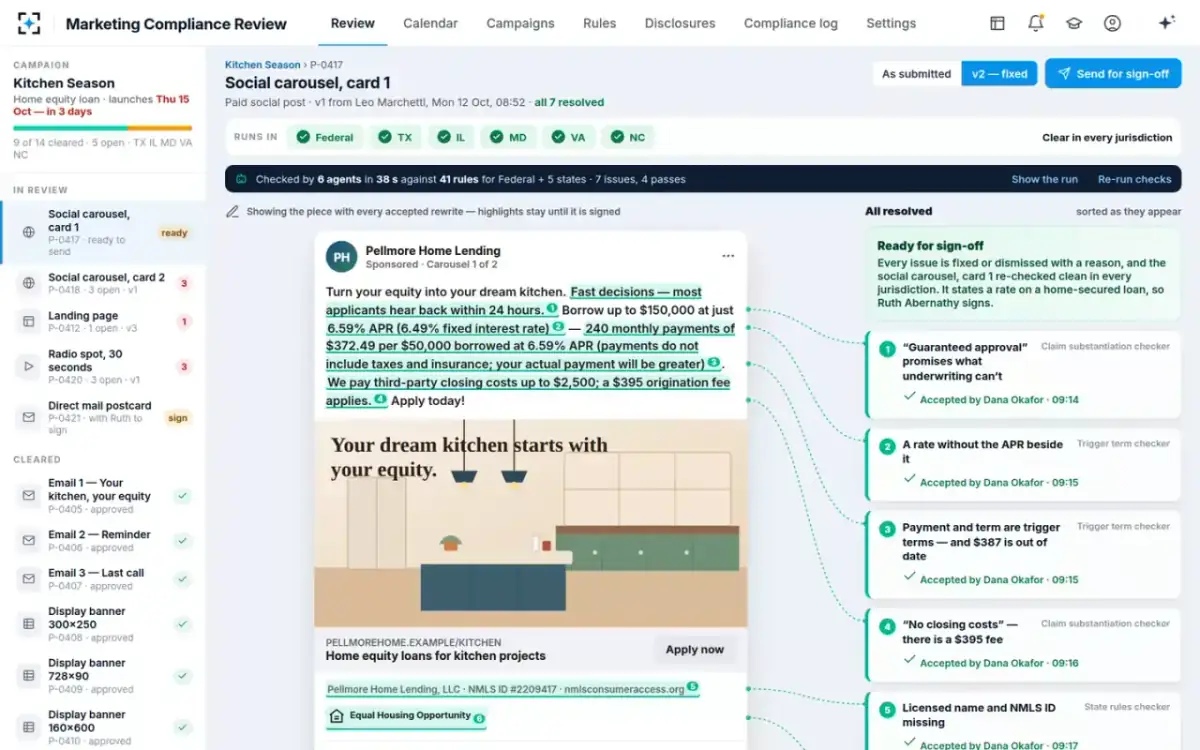
Look at line 3: the payment example sits directly after the rate, in the same type, with nothing between.
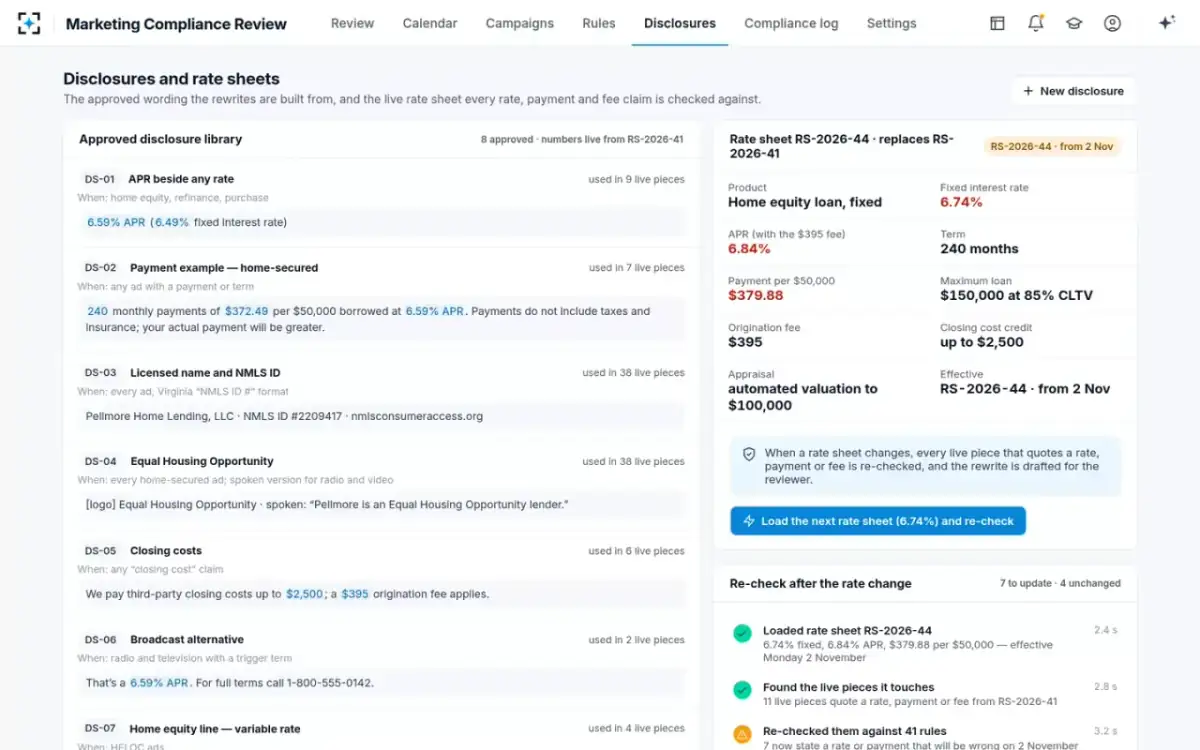
The library is what makes the next ad faster. The approved wording for "APR beside any rate", the home-secured payment example, the closing-cost line and the broadcast alternative are stored once, with their numbers linked to the live sheet. When the sheet changes, every live piece that quotes it is checked again. That matters more than it sounds, because a correct disclosure becomes an incorrect one the morning the rate moves, as the rate-sheet guide shows. The Marketing Compliance Review page shows the whole review, from submission to signature.
One approved sentence per disclosure, its numbers tied to the sheet
Questions people ask
Does a mortgage ad have to show the APR?
Only if it states a rate or a trigger term. Any stated rate of finance charge must appear as an "annual percentage rate", and a dwelling-secured ad may show the simple interest rate only beside the APR and no more conspicuously. An ad that states a payment or a term but no rate still needs the APR, because those are triggers.
Is APR a trigger term?
No. Comment 24(d)(1)-4 says "statements of the annual percentage rate" are not triggering terms, so "6.59% APR" can stand alone without repayment terms. The abbreviation is enough: the advertised APR "may be expressed using the abbreviation APR" (comment 24(c)-1), with a statement that it may increase if it can.
Is “no down payment” a trigger term?
No. The down-payment trigger "applies only if a downpayment is actually required", and "no downpayment or no trade-in required" are the interpretations' own examples of statements that do not trigger (comment 24(d)(1)-1.ii). The claim must still be true for every borrower the ad addresses, or it misstates a term under Regulation N.
Do Spanish-language mortgage ads need the disclosures in Spanish?
If the ad gives some terms in Spanish, it should give the matching disclosures in Spanish too. §1026.24(i)(7) bans giving some trigger terms or disclosures only in a foreign language while giving others "only in English, in the same advertisement". The usual failure is a translated rate with an English-only APR line.
Do Regulation Z trigger terms apply to business loans?
No. Regulation Z does not cover credit extended "primarily for a business, commercial or agricultural purpose" (12 CFR 1026.3(a)), so a small-business loan ad is outside §1026.24. The deception standard of the Consumer Financial Protection Act and the FTC Act, and state advertising rules, can still reach it.
Does a social media post count as an advertisement?
Yes, when it promotes credit. The FFIEC's social media guidance treats marketing on social media as advertising subject to the same laws, and Texas defines an advertisement to include "messages or posts made on a social media site". The loan officer's own account is where this is most often missed, which the loan officer guide covers.