Regulation Z lets a mortgage ad state only actually available terms: terms the lender is prepared to give, on every day the ad runs. Bait and switch with mortgage rates means advertising a rate to win the call, then steering the borrower to a worse one; deliberate or not, an advertised rate the lender will not give breaks the rules. Must the rate in a mortgage ad be available? Yes, for as long as the ad runs. Regulation Z says an ad that states specific credit terms "shall state only those terms that actually are or will be arranged or offered by the creditor", and Regulation N forbids misrepresenting any rate, payment or fee in any commercial communication. Rate sheets change on the pricing team's schedule, not the campaign's: an ad cleared against Monday's rate sheet can quote a rate, an APR and a payment that the lender stops offering a week later, while the ad keeps running. Approval is a judgement about one day; compliance is required on all of them. Botminds' Marketing Compliance Review ties every rate, payment and fee in a live piece to the rate sheet it came from, and when a new sheet loads it re-checks every piece that quotes the old one and drafts the corrected wording for a reviewer. This guide is about that window between approval and expiry.
Half the campaign's flight runs on a rate sheet that did not exist when the post was signed
- RS-2026-41 · 6.59% APR16 days
- Between sheets2
- RS-2026-44 · 6.84% APR14 days
- True: $372.49 per $50,00016 days
- Stale2
- Wrong: quotes terms no longer offered14 days
What are actually available terms under Regulation Z?
They are terms the lender is prepared to give a qualified borrower on the day the ad is seen. The rule is one sentence, and its commentary tells you how strict it is. Under §1026.24(a), an ad "shall state only those terms that actually are or will be arranged or offered by the creditor" (12 CFR 1026.24). The Official Interpretations explain that an ad "may state only those terms that the creditor is actually prepared to offer. For example, a creditor may not advertise a very low annual percentage rate that will not in fact be available at any time" (comment 24(a)-1).
The same comment gives the way out. The rule "is not intended to inhibit the promotion of new credit programs", and "a creditor may advertise terms that will be offered for only a limited period, or terms that will become available at a future date." A lender that says when a rate is available is on firm ground. A lender that quotes a rate with no date and keeps running it after the rate is gone is not.
"A creditor may not advertise a very low annual percentage rate that will not in fact be available at any time."
Regulation Z Official Interpretations, comment 24(a)-1
Regulation N applies the same idea to every term in every commercial communication, banning material misrepresentation of "the interest charged", "the annual percentage rate, simple annual rate, periodic rate, or any other rate" and "the existence, nature, or amount of fees or costs" (12 CFR 1014.3). Virginia goes further on the face of the ad: any ad that contains a rate must say "that the stated rate may change or not be available at the time of loan commitment or lock-in" (10VAC5-160-60).
Is bait and switch illegal for mortgage rates? What the rules actually prohibit
Yes. Classic bait and switch is deceptive under federal law, and a mortgage ad does not need the "switch" or the intent to break the narrower rules written for credit. The FTC's Guides Against Bait Advertising define it as "an alluring but insincere offer to sell a product or service which the advertiser in truth does not intend or want to sell", whose purpose is to switch consumers "to sell something else, usually at a higher price" (16 CFR 238.0). The Guides add a line that fits the rate call exactly: "the law is violated if the first contact or interview is secured by deception", even when the true terms come out later. The FTC's deception statement lists "use of bait and switch techniques" among practices found deceptive (FTC, 1983).
The credit rules go further, because they do not ask about intent. Regulation Z's §1026.24(a) is breached by any advertised term the creditor is not "actually prepared to offer", whether the lender meant to switch anyone or simply forgot the ad was still running. Regulation N bans material misrepresentation of the rate, the APR and the fees, and the Consumer Financial Protection Act bans deception by banks and nonbanks alike. That is the useful distinction for a lender: deliberate bait is rare, but a stale rate produces the same thing a borrower experiences as bait.
Three things a borrower may call bait and switch, and how the rules sort them
| What happened | Is the ad the problem? | Which rule decides |
|---|---|---|
| The ad’s rate was never on offer, or only for a profile nobody fits | Yes | Regulation Z §1026.24(a); Regulation N §1014.3(b); FTC bait guides; CFPA |
| The rate was on offer when the ad ran but the market moved before the borrower locked | Not if the ad was true on the day it was seen and said when its rate applied | Regulation Z §1026.24(a) and comment 24(a)-1; the Loan Estimate’s rate-lock statement |
| The ad still runs after the lender stopped offering its rate | Yes, from the day the rate went | Regulation Z §1026.24(a); Regulation N §1014.3 |
What happens to a live mortgage ad when the rate sheet changes?
Nothing, unless someone acts: the ad keeps running with the old numbers, and from the first day they are no longer offered it states terms the lender is not prepared to give. An approved ad goes wrong in one of two ways: the market moves, or the ad outlives its sheet. Both are ordinary. Pricing teams publish new rate sheets on their own schedule, while marketing calendars plan a campaign for weeks. A post approved on a Monday with the week's APR has no way to know that its numbers expired on Friday.
The Federal Reserve's examiners describe how it happens with nobody intending it: a home equity line advertised with a discounted floor rate that "borrowers did not actually receive", traced to "staff turnover within the loan administration area, human error, and misinterpreting procedures" (Consumer Compliance Outlook, 2021). The same article notes that examiners "continue to find violations related to rate sheets, print advertisements, and web pages". There was no switch, and the consumer still saw a term the lender would not give.
The sample post shows the same drift in a draft. Its payment, $387 a month, was the August rate sheet's figure at 6.99%. By the October review the sheet in force gave $372.49 per $50,000 at 6.59% APR, so the draft quoted a payment on no loan the lender was then offering. The fix was not a disclosure; it was a different number.
How did the CFPB treat VA loan ads with rates the lender would not offer?
As deception, with penalties: its sweep of VA-loan mailers ended in nine cases and more than $4.4 million in civil money penalties, and the last, against Low VA Rates in 2020, turned on an advertised APR the company would not give. The Bureau found the ads "misrepresented the credit terms of the advertised mortgage loan by stating credit terms that the company was not actually prepared to offer to consumers, including misrepresenting the annual percentage rate" (CFPB, 26 October 2020). That is the regulatory name for what borrowers call bait and switch.
The Bureau had said as much eight years earlier, announcing a joint sweep with the FTC of about 800 mortgage ads: "Baiting consumers with false ads to buy into mortgage products would be illegal" (CFPB, 19 November 2012). Two details of that sweep matter to lenders today. Some of the ads reviewed "came to the attention of the CFPB and the FTC from consumers who complained about them", and the FTC looked beyond lenders to "home builders, realtors, and lead generators". A rate quoted by a partner on the lender's behalf is still a rate someone will be asked to honour.
Eleven live pieces, one new rate sheet: the Marketing Compliance Review re-check
When the next sheet arrives, the work is to find every live piece that quotes the old one, decide which numbers change, and rewrite only those. In the sample lender's case, rate sheet RS-2026-44 takes effect on 2 November. The solution finds the 11 live pieces that quote RS-2026-41 and re-checks each against 41 rules. Seven state a rate or payment that will be wrong on 2 November; their rewrites are drafted with the new numbers. Four quote only the origination fee and the closing-cost credit, which did not change, and carry over.
What one rate sheet change does to a live campaign
11
live pieces quoting the outgoing rate sheet
7
that would state terms no longer offered on 2 November
4
that quote only the fee and closing credit, and carry over
0
changes made until a reviewer accepts each rewrite
Which numbers move when the sheet changes, and which pieces follow
| Term | RS-2026-41 | RS-2026-44, from 2 Nov | Pieces that quote it |
|---|---|---|---|
| Fixed interest rate | 6.49% | 6.74% | Rewrite: any piece stating a rate |
| APR, with the $395 fee | 6.59% | 6.84% | Rewrite: the APR must match the new rate |
| Payment per $50,000, 240 months | $372.49 | $379.88 | Rewrite: the repayment example |
| Origination fee | $395 | $395 | Carry over |
| Closing-cost credit | up to $2,500 | up to $2,500 | Carry over |
Load the next sheet in Marketing Compliance Review and see which live pieces it touches
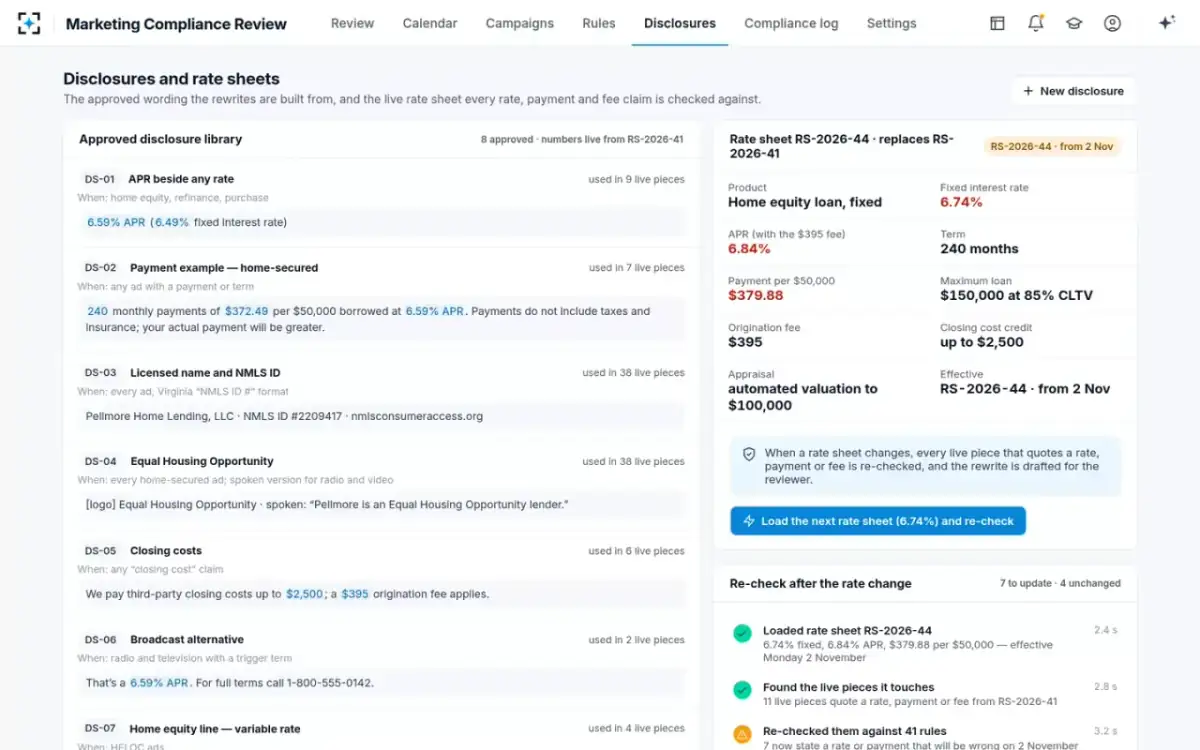
Read the re-check panel at the bottom right: the solution counts the pieces before anyone edits one.
Rate sheets are part of the advertising file, under Regulation N
The rate sheet is not only the source of the ad's numbers; it is the evidence that they were true. Regulation N's recordkeeping rule requires every advertiser it covers to keep, for 24 months, both "copies of all materially different commercial communications" and "documents describing or evidencing all mortgage credit products available to consumers during the time period in which the person made or disseminated each commercial communication… including but not limited to the names and terms of each such mortgage credit product" (12 CFR 1014.5).
Read together, those two items let an examiner do exactly what this guide describes: lay the ad beside the terms on offer on each day it ran. A file that keeps the ad but not the sheet, or the sheet but not the run dates, cannot answer the question. In the solution, each approval records the rate sheet the piece quotes, and the re-review date is set to the day that sheet changes or expires.
The day a rate sheet expires, on the same calendar as the launches

Can a lender advertise a rate that is only available for a limited time?
Yes, if the ad says so: comment 24(a)-1 lets a creditor advertise "terms that will be offered for only a limited period", so a dated offer is the tool for a rate ad that must outlive one sheet. Some ads need never be touched when rates move, and the cheapest way to manage rate risk is to write more of those. Others should state a rate, because the rate is the offer. For those, the comment's own allowance for "terms that will be offered for only a limited period" is the tool: say when.
Rate ads that stay true for their whole flight
- Ask whether the piece needs a rate at all
Fee, credit and speed claims carried over untouched in the sample; rates and payments did not.
- Note the sheet and its dates beside every number
An ad that cannot say which sheet its APR came from cannot be re-checked when the sheet changes.
- Match the flight to the sheet
If the ad runs past the sheet’s expiry, date the offer or plan the rewrite before launch.
- Add the state’s rate caveat where required
Virginia requires a statement that the rate may change or not be available at commitment or lock-in.
- Re-check every live piece when a sheet loads
Find what quotes the old sheet, rewrite what changed, carry over what did not, and keep both versions.
- Keep the sheet with the ad
Regulation N asks for the products available while each ad ran, not only the ad.
What is a "rate may change" statement in a mortgage ad?
It is a line telling the reader that the advertised rate may not be the one they get, and in Virginia it is required: any ad containing a rate must state "that the stated rate may change or not be available at the time of loan commitment or lock-in" (10VAC5-160-60). Elsewhere it is common practice rather than a rule. Either way, it explains a true rate's limits; it does not make an unavailable rate available.
The difference matters because the caveat is fine print and the rate is the headline. The FTC's view is that "written disclosures or fine print may be insufficient to correct a misleading representation", and Regulation Z's rule is about the terms stated, not the caveats around them. A "rates subject to change" line on an ad quoting last month's sheet tells the reader the rate might change; it has in fact already gone. The accurate version pairs the caveat with a date: "6.59% APR as of 12 October; rates may change and may not be available when you lock."
Borrowers meet the same idea again on the Loan Estimate, which must say whether the rate is locked and, if not, "that the interest rate, any points, and any lender credits may change unless the interest rate has been locked" (12 CFR 1026.37(a)(13)). An ad that promised a rate and a Loan Estimate that shows a higher, unlocked one is the moment a borrower decides the ad was bait. Keeping the ad true on its run dates is how the lender makes sure it was not.
The re-check is the part people skip, because it has no trigger in a manual process. In the solution, a new sheet is the trigger: nothing changes on a live piece until a reviewer accepts the drafted rewrite, but every affected piece is found and drafted the moment the sheet loads. The sample compliance log already shows the failure it prevents: a summer refinance email flagged for re-review because its rate sheet expired on 4 October. The compliance checklist puts this check in context with the others, and the cost guide prices what it guards against. The Marketing Compliance Review page shows the rest of the review.
Questions people ask
Is "rates as low as" bait and switch?
Not by itself. "As low as" is lawful when the lowest rate is one the lender is actually prepared to offer to borrowers who qualify, and the ad carries the APR and any terms its triggers require. It becomes a problem when almost nobody can qualify, or when the quoted rate comes from a sheet no longer in force.
Is it bait and switch if the rate rose before the borrower locked?
Usually not, if the ad was true on the day the borrower saw it: rates move daily, and until a rate is locked the Loan Estimate must say it may change. It is a problem if the ad's rate was never available, or the ad kept running after the lender stopped offering it.
Can an ad quote a rate that only some borrowers get?
The rule asks whether the lender is "actually prepared to offer" the terms, not whether every applicant qualifies. A rate offered to qualified borrowers is available; stating the qualifying conditions, and keeping the representative example realistic, keeps the overall impression honest under Regulation N.
Does a lender have to pull an ad the day rates rise?
The ad must not state terms the lender is not prepared to offer while it runs. Dating the offer, matching the flight to the sheet, or rewriting before the new sheet takes effect are the ways to meet that; leaving the old numbers up is not.
Where can a borrower complain about a misleading mortgage rate ad?
To the CFPB through its complaint portal, and to the state regulator that licenses the lender, which NMLS Consumer Access identifies. Lenders read those complaints too: a cluster about one advertised rate can be the first sign a live ad has outlived its sheet.