Advertising compliance software for a lender earns its keep only if it reads what a reviewer reads, and on a paid social post that is four things, not one: the copy, the text in the image, the fine print and link card, and the audience the post will be shown to. Each answers to different law. The copy and image answer to Regulation Z's advertising rules, Regulation N's ban on mortgage misrepresentations and the federal ban on unfair, deceptive or abusive acts. The fine print answers to each state's licensing rules, and the audience to fair lending law. Botminds' Marketing Compliance Review is software that runs that reading on every piece the moment it is submitted, with six agents and a person deciding each change. This page follows one fictional post through it, then turns the post into a test any buyer can run on any tool, for the compliance officers who choose the software and the reviewers who will live with it.
One carousel card on a Monday morning
33words
of copy, plus an image, a link card and an audience
14
claims and numbers the solution’s reader listed
7issues
found, five of them high, each tied to its rule
27min
from submission at 08:52 to the signature at 09:19
What does an advertising compliance review check on a paid social post?
It checks every claim against evidence, every rate and payment against the disclosure rules and the live rate sheet, the licensing line against each state in the audience, and the audience itself against fair lending law.
Here is the post. It is card 1 of a sponsored carousel for a home equity loan, submitted at 08:52 on Monday 12 October by the lender's marketing manager for a campaign launching Thursday in Texas, Illinois, Maryland, Virginia and North Carolina. The copy reads: "Turn your equity into your dream kitchen. Guaranteed approval in 24 hours. Borrow up to $150,000 at just 6.49% fixed — payments as low as $387/month for 20 years. No closing costs. Apply today!" Below it, an illustrated kitchen with the line "Your dream kitchen starts with your equity", a link card and an Apply button.
From a copywriter's chair this is a good ad. It names a benefit, a speed, an amount, a rate, a payment and a cost saving in five short sentences. From a reviewer's chair, four of those six are promises the law treats as specific credit terms or factual claims, each with its own test. The ad set behind it adds a seventh issue, which a reader of the creative alone would never see: "Homeowners · ages 35–64 · 181 ZIP codes · excludes 31 ZIP codes in Cook County, IL".
Marketing Compliance Review marks every claim, numbered, with its rule beside it
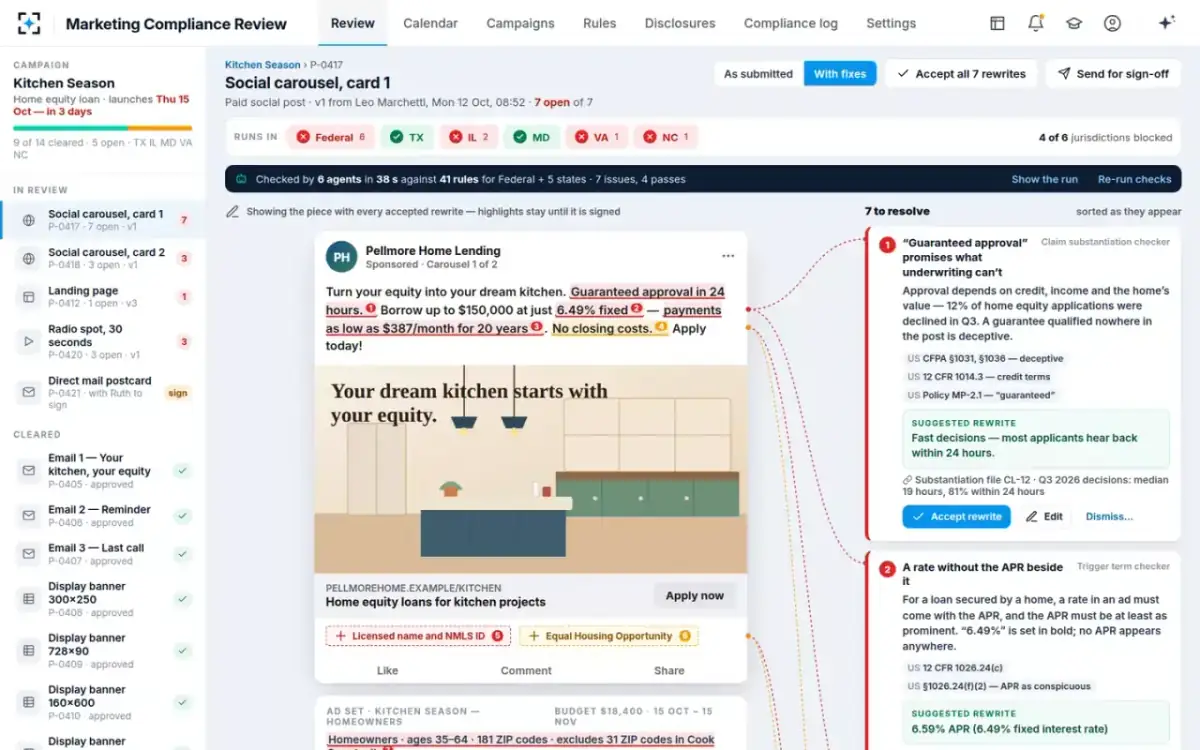
Look at the two dashed boxes under the link card: issues 5 and 6 are things the post leaves out, not things it says.
The seven issues on one home equity post, rule by rule
The seven issues fall into four families: claims that are not true, rates and payments missing their required disclosures, a missing licensing line, and an audience that could exclude people on a prohibited basis. Each needs a different kind of evidence, which is why one person reading the post once tends to miss at least one family.
Seven issues, the rule each breaks, and the wording that cleared it
| Issue | As submitted | Why it fails | Cleared as |
|---|---|---|---|
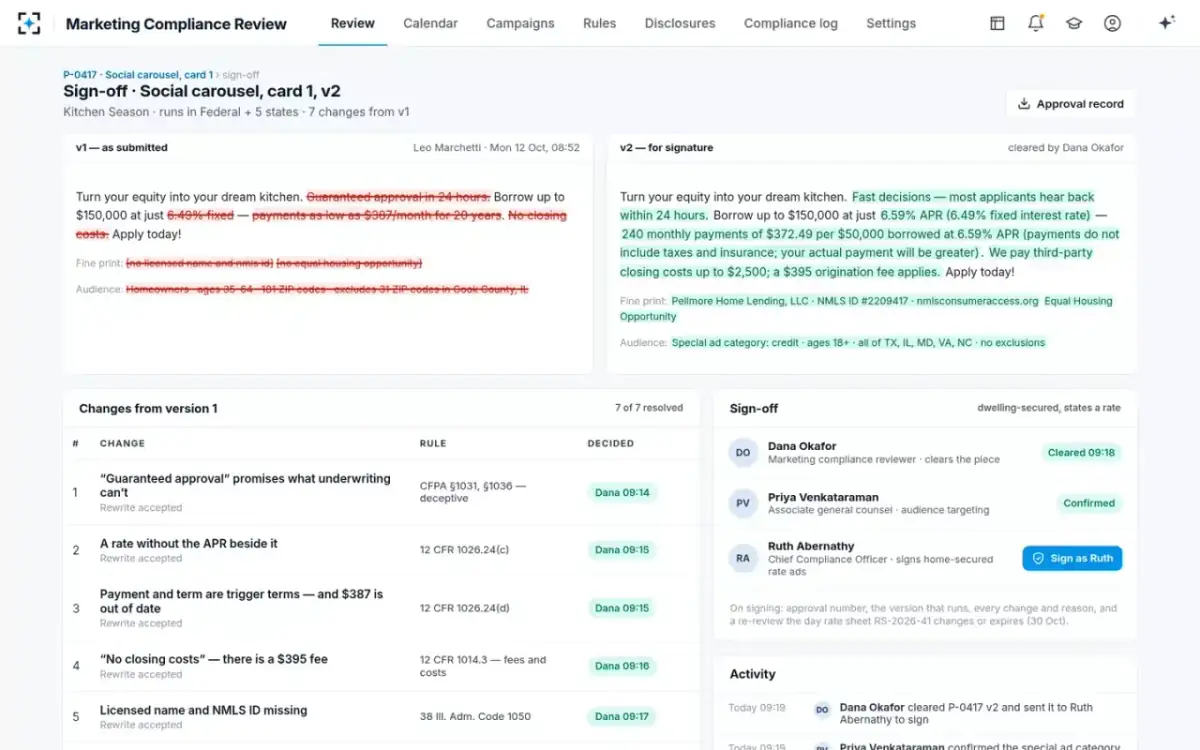
| 1 · Guarantee | “Guaranteed approval in 24 hours.” | Approval depends on credit, income and the home’s value; 12% of the lender’s home equity applications were declined last quarter. Deceptive under the CFPA, and Regulation N names misrepresenting whether a consumer is “guaranteed” a product. | “Fast decisions — most applicants hear back within 24 hours.” Backed by the lender’s own decision times: median 19 hours, 81% within 24. |
| 2 · Rate | “6.49% fixed” | A stated rate must be an APR, and on a dwelling-secured loan the interest rate may not be more conspicuous than the APR. No APR appears. | “6.59% APR (6.49% fixed interest rate)” |
| 3 · Payment and term | “payments as low as $387/month for 20 years” | Payment and term are triggers. And $387 was the August rate sheet’s payment at 6.99%, a term no longer offered. | “240 monthly payments of $372.49 per $50,000 borrowed at 6.59% APR”, with a statement that taxes and insurance are not included |
| 4 · Closing costs | “No closing costs.” | A $395 origination fee applies. Regulation N bans misrepresenting “that no fees are charged”. | “We pay third-party closing costs up to $2,500; a $395 origination fee applies.” |
| 5 · Licensing | Nothing | Illinois, Virginia and North Carolina need the licensee’s NMLS identifier in the ad itself; their rules carry no profile-page exception. | The licensed name, NMLS ID and the NMLS Consumer Access address |
| 6 · Equal housing | Nothing | The lender’s policy puts the Equal Housing Opportunity logo on every home-secured ad. | The logo, added to the fine print |
| 7 · Audience | Ages 35–64, 31 Cook County ZIP codes excluded, 27 of them majority-minority | A redlining and discouragement risk under the Fair Housing Act and Regulation B. Not cleared by an agent or a reviewer: counsel decides. | Credit special ad category, ages 18 and over, all of the five states, no exclusions |
How do you substantiate an advertising claim? Issues 1 and 4
You hold evidence, before the ad runs, that each factual claim is true for the people the ad addresses. The FTC's long-standing policy is that advertisers must "have a reasonable basis for advertising claims before they are disseminated", weighed by "the type of claim, the product, the consequences of a false claim" and what experts in the field consider enough (FTC Policy Statement on Advertising Substantiation, 1984). Two of the seven claims on the post failed that test, and no disclosure could have rescued them. "Guaranteed approval" fails because the lender does not guarantee approval: it declined 12% of home equity applications in the third quarter. Regulation N lists misrepresentations about "the consumer's ability or likelihood to obtain any mortgage credit product or term, including but not limited to misrepresentations concerning whether the consumer has been preapproved or guaranteed" (12 CFR 1014.3(q)). The Consumer Financial Protection Act makes it unlawful for a covered person "to engage in any unfair, deceptive, or abusive act or practice" (12 U.S.C. 5536).
The useful part of the fix is that it kept the copywriter's point. The ad wanted to say "fast". The lender's own substantiation file showed a median decision time of 19 hours, with 81% of applicants answered within 24. So "Fast decisions — most applicants hear back within 24 hours" says what the copy meant and what the file proves. A reviewer who only strikes "Guaranteed" sends the copywriter back to guess; one who offers the provable version ends the round.
"No closing costs" is the same kind of problem in smaller type. It does not trigger Regulation Z, but a $395 origination fee makes it a misrepresentation "that no fees are charged" under Regulation N. The cleared line states what the lender does pay, third-party closing costs up to $2,500, and the fee it does charge.
The fastest rejection a reviewer can write is the rewrite. A struck word starts a round; a provable sentence ends one.
Issues 2 and 3: a rate without its APR, and a payment from the wrong month
The rate and payment issues are mechanical, which makes them the commonest. "6.49% fixed" is a rate, so the ad must show the APR, and for a loan secured by a home the simple rate may appear only "in conjunction with, but not more conspicuously than, the annual percentage rate" (§1026.24(c)). "$387/month" and "for 20 years" are triggering terms, so the ad must state the terms of repayment and the APR. The cleared version uses the representative example the rule allows, per $50,000 borrowed.
The payment had a second problem that no trigger checklist would catch. $387 was the payment on the August rate sheet, at 6.99%. On the sheet in force on Monday the same loan cost $372.49 per $50,000 at 6.59% APR. An ad may state "only those terms that actually are or will be arranged or offered by the creditor" (§1026.24(a)). Finding that took a comparison of each number with the live rate sheet, not a reading of the ad, and the rate-sheet guide explains why that check has to run again every time the sheet changes. The disclosures themselves, element by element, are in the trigger terms guide.
Issues 5 and 6: what the fine print left out
The fine print issues are about absences, and absences are what readers miss. No federal rule puts an NMLS number in an ad, but state rules do, and they differ. Illinois requires the NMLS Consumer Access address and the licensee's NMLS identifier in "any advertisement appearing in Illinois", and fixes the wording for electronic media (38 Ill. Adm. Code 1050.940). Texas and Maryland allow a social media profile page to carry the required details, which is why the post was already clear in those two states. Virginia and North Carolina want the identifier in the ad. The state-by-state guide sets out each rule's exact words.
The Equal Housing Opportunity logo is a policy line at this lender, applied to every home-secured ad. For banks it is also a regulation: FDIC-supervised institutions must "prominently indicate" in any ad for a dwelling loan that they lend without regard to race, color, religion, national origin, sex, handicap or familial status, and the logo with its legend satisfies it (12 CFR 338.3).
Issue 7: the audience, which only counsel may clear
The seventh issue sat outside the creative, in the ad set: 31 Cook County ZIP codes excluded, 27 of them majority minority, and an age band of 35 to 64. Regulation B forbids any statement "in advertising or otherwise" that would discourage prospective applicants on a prohibited basis, and since July 2026 it defines statements to include "visual images such as symbols, photographs, or videos" (12 CFR 1002.4(b)). Who sees the ad is a separate question, and the FFIEC's examination procedures name excluding high-minority geographies from marketing as a risk factor.
The solution's fair lending reviewer found the exclusion by comparing the excluded ZIP codes with census tract data. Its rule is that it never clears a targeting issue: it routes it to counsel. Here counsel confirmed a new audience, with the platform's special ad category for credit, ages 18 and over, all of the five states and no exclusions. The fair lending guide covers images and audiences in depth.
Sign-off in Marketing Compliance Review: both versions, each change with its rule
What should advertising compliance software catch? The four things this post tests
It should catch all seven issues, and the post shows why that takes four capabilities a keyword list does not have: reading the image and the ad set as well as the copy, checking numbers against the live rate sheet, knowing each state's licensing wording, and tying each claim to its evidence. A tool that flags "guaranteed" and "no closing costs" by keyword will find two of the seven and look good in a demonstration.
The Federal Reserve's examiners describe where ad violations come from, and none of it is vocabulary. They "continue to find violations related to rate sheets, print advertisements, and web pages", and trace website violations to vendors "unaware of the advertising rules" (Consumer Compliance Outlook, 2021). Their own example is a lender that "included the current interest rate for a consumer closed-end product but failed to disclose the APR". The useful software finds the missing thing and the stale thing, not just the forbidden word.
A banned-word filter against what the seven issues needed
A banned-word filter: Flags “guaranteed”. Suggests deleting it.
What finding all seven takes: Reads the decline rate and decision times on file, and offers a claim the file proves.
A banned-word filter: Sees no banned word, passes.
What finding all seven takes: Spots the triggers, adds the APR and repayment terms, and finds the payment came from an expired sheet.
A banned-word filter: May flag “no closing costs”.
What finding all seven takes: Finds the $395 fee in the product terms and states what the lender does pay.
A banned-word filter: Cannot see a line that is missing.
What finding all seven takes: Knows which of the five states accept the profile page and which need the ID in the ad.
A banned-word filter: Cannot see a logo that is missing.
What finding all seven takes: Applies the lender’s policy and the bank rule for home-secured ads.
A banned-word filter: Never reads the ad set.
What finding all seven takes: Compares excluded ZIP codes with census tract data and routes the question to counsel.
That is also where Botminds' Marketing Compliance Review fits, and where it stops. Its six agents each do one of those jobs: a creative reader that lists every claim and number, a claim substantiation checker with the evidence files, a trigger term checker with the rate sheet, a state rules checker, a fair lending reviewer, and a rewrite writer that drafts only from the lender's approved disclosure library. People decide: the reviewer accepts or edits each rewrite, counsel decides every audience question, and the Chief Compliance Officer signs home-secured rate ads. It covers the jurisdictions a lender configures, which on the sample are federal rules and five states, so a buyer should ask for the rules it holds for their own footprint.
How to test advertising compliance software before you buy it
Test it on your own past ads with known answers, planted problems included, and score it on what it finds, what it invents and what it leaves for people. A vendor's sample ad proves the vendor's sample. Your last quarter's pieces, with the findings your reviewers already made, prove whether the tool would have helped.
The responsibility does not move with the purchase. In the Federal Reserve examiners' words, "although a financial institution may hire a reliable vendor, the institution remains responsible for ensuring that the output from vendor-provided systems and services meets regulatory requirements" (Consumer Compliance Outlook, 2019). A trial is the cheapest moment to learn how the output behaves.
A test bench built from this post: plant each problem, expect each finding
| Plant this in a past ad | A good tool should | Score it on |
|---|---|---|
| A payment from last month’s rate sheet | Flag it against the sheet in force on the run dates | Caught or missed; whether it names the sheet |
| A rate in large type, the APR in a footnote | Flag prominence and proximity, not only absence | Caught or missed |
| No NMLS ID, audience in a state that needs it | Name the state and its wording | Right states, no false alarms for states that accept the profile |
| A ZIP exclusion over majority-minority areas | Route to a person, never clear it | Routed or silently passed |
| A true claim with evidence on file | Leave it alone | False flags per ad |
| Any rewrite it drafts | Use only your approved wording and live numbers | Invented rates, fees or claims: should be zero |
Two measures matter more than the catch rate. The first is invention: a rewrite that supplies a rate, a fee or a speed claim the lender never approved has created the problem review exists to stop, so any count above zero should end the trial. The second is what the tool keeps: Regulation N requires copies of materially different ads and evidence of the products available while they ran, for 24 months, so ask to see the record of one cleared piece, versions, reasons, signatures and re-review date, as an examiner would.
A review order for any social ad, and what to keep afterwards
The order matters because each step changes what the next one sees. Claims checked against evidence come first, because a false claim rewritten may drop a trigger term or add one. Disclosures follow, then the licensing line for every state in the audience, then the audience itself, then the version that will run.
Reviewing a paid social post, in the order that avoids a second pass
- Read everything the viewer sees
Copy, text inside the image, link card, button, every card of a carousel, and the profile the post runs from.
- List every claim and number
Speed, approval, amount, rate, payment, term, fee, “lowest”, “free”. Note how large each one is set.
- Check each claim against its evidence
The rate sheet in force on the run dates for numbers; a substantiation file for speed and approval claims.
- Apply the trigger rules to what survives
APR beside any rate, repayment terms beside any payment or term, equal prominence, close proximity.
- Add the licensing line for every state in the audience
Each state’s own wording; know which states accept the profile page and which do not.
- Read the ad set, not just the ad
Geography, age and exclusions, the special ad category for credit, and imagery. Route any doubt to counsel.
- Keep the version that ran
Regulation N requires copies of materially different ads for 24 months after last use; the FFIEC expects social media retention too.
The last step is the one an examiner tests. Regulation N requires every advertiser it covers, which includes nonbank lenders like the sample one, to keep "copies of all materially different commercial communications" for 24 months from their last use (12 CFR 1014.5). The FFIEC's guidance expects institutions using social media to ensure that "advertising, account origination, and document retention are performed in compliance" with consumer law (78 FR 76297). On the sample, the Chief Compliance Officer signed at 09:19 and the approval went into the compliance log with the version that runs, both sign-offs, the five states and a re-review date tied to the rate sheet's expiry on 30 October. The Marketing Compliance Review page follows the same campaign through the rest of its pieces.
Questions people ask
Can a mortgage ad say “guaranteed approval”?
Not unless every consumer the ad reaches would in fact be approved, which no lender that underwrites can say. Regulation N names misrepresentations about "whether the consumer has been preapproved or guaranteed" for a product (12 CFR 1014.3(q)). A speed claim the lender can prove, such as "most applicants hear back within 24 hours", keeps the point without the promise.
Does a social media ad need the NMLS ID?
Federal law does not require it in ads; state law decides, and states differ. Texas and Maryland let a social media profile or home page carry the identifier, while Illinois requires it in "any advertisement appearing in Illinois". The sample post needed the line for Illinois, Virginia and North Carolina only.
Does every card of a carousel need its own disclosures?
Treat each card as something a viewer may see alone, because many will. In the sample, card 2 was held separately with three issues of its own, led by a rate without its APR. A disclosure on card 3 does not travel back to a rate on card 1.
Does using advertising compliance software move the responsibility to the vendor?
No. Federal Reserve examiners have written that the institution "remains responsible for ensuring that the output from vendor-provided systems and services meets regulatory requirements". That is why the people who accept rewrites and sign pieces should stay inside the lender, and why the record of who decided what matters.
Does advertising compliance software replace the compliance reviewer?
Not in a design an examiner will accept. It replaces the reading, the rule lookups and the first draft of each fix; the reviewer still accepts or edits every change, counsel decides audience questions, and a named officer signs. On the sample post the agents took 38 seconds and the people took the rest of the 27 minutes, deciding.