Fair lending advertising requirements reach three places: the words, the pictures and the audience. Regulation B forbids a creditor to make any statement "in advertising or otherwise" that would discourage a reasonable person from applying because of a prohibited basis, and since July 2026 the regulation itself defines statements to include "visual images such as symbols, photographs, or videos". The FFIEC's fair lending examination procedures list advertising and marketing patterns, including where ads run and whom mailing lists leave out, as indicators of potential disparate treatment. Reviews that read only the copy miss two of the three. Botminds' Marketing Compliance Review has a fair lending reviewer that checks imagery, wording, the equal housing statement and the ad's targeting on every piece, and that never clears a targeting issue itself. This guide sets out what to check, and why the audience question belongs with a lawyer.
A fair lending read of one ad, beyond the copy
- Who is pictured, and who is not
Across a campaign, not one ad: models, families, neighbourhoods. Regulation B now names photographs and videos as statements.
- What the setting implies
A neighbourhood, landmark or symbol can say “not for you” without a word. FDIC rules bar “symbols, models” that suggest exclusion.
- Where the ad runs
Media, stations, ZIP codes and geographies. Excluding areas with higher minority populations is an FFIEC marketing risk factor.
- Whom the audience settings exclude
Age bands, ZIP exclusions, lookalike lists. Age is a prohibited basis under ECOA for an applicant who can contract.
- What the voice says off-script
Radio hosts, podcasts and live video: unscripted remarks are advertising too.
- The equal housing statement
Logo and legend in print and on screen; the spoken form in audio. Banks and credit unions have it in their rules.
What Regulation B's discouragement rule covers in an ad, including images
Regulation B's rule is short and broad. "A creditor shall not make any oral or written statement, in advertising or otherwise, directed at applicants or prospective applicants that the creditor knows or should know would cause a reasonable person to believe that the creditor would deny, or would grant on less favorable terms, a credit application… because of the applicant or prospective applicant's prohibited basis characteristic(s)." The April 2026 amendments, effective 21 July 2026, add the sentence that matters for creative teams: "oral or written statements are spoken or written words, or visual images such as symbols, photographs, or videos" (12 CFR 1002.4(b); 91 FR 21620).
The same rule reaches people who never applied. In 2024 the Seventh Circuit held that ECOA authorizes liability "for the discouragement of prospective applicants", reversing a district court that had dismissed the CFPB's case against Townstone Financial (CFPB v. Townstone Financial, No. 23-1654). The statements at issue were made on what the court called a "long-form commercial advertisement radio show", also streamed and released as a podcast. An ad is not only the thirty seconds a lender scripts.
"Oral or written statements are spoken or written words, or visual images such as symbols, photographs, or videos."
12 CFR 1002.4(b), as amended in 2026
For banks there is an older rule on the same point. FDIC-supervised institutions may not run an ad containing "any words, symbols, models, or other forms of communication which express, imply, or suggest a discriminatory preference or policy of exclusion" under the Fair Housing Act or ECOA (12 CFR 338.3(b)). "Models" means the people in the photograph.
After 2025, marketing review is about disparate treatment, and that still includes ads
The federal agencies dropped disparate impact in 2025 and 2026; they did not drop advertising. The FDIC said it "will evaluate potential discrimination under the Equal Credit Opportunity Act and Fair Housing Act only through evidence of disparate treatment" (FIL-41-2025), and the 2026 Regulation B rule states that the Act "does not provide that the 'effects test' applies". Discouragement is a treatment question: it asks what the lender said or showed, and to whom. The FFIEC procedures file their marketing factors under "indicators of potential disparate treatment in Marketing".
Five marketing patterns examiners treat as warning signs
| Factor | What the FFIEC procedures describe | What it means for an ad review |
|---|---|---|
| M1 | Advertising patterns or practices that a reasonable person would believe indicate prohibited basis customers are less desirable | Read the campaign as a whole: who appears, where, and in what light |
| M2 | Advertising only in media serving non-minority areas of the market | Check the media plan and station list, not only the creative |
| M3 | Marketing through brokers or other agents known to serve only one racial or ethnic group | Third-party and broker channels are part of the footprint |
| M4 | Marketing programs that exclude regions with significantly higher percentages of minority residents than the rest of the area | Compare excluded ZIP codes and geographies with the population of the market |
| M5 | Mailing or distribution lists, or other techniques, that explicitly exclude groups of prospective borrowers on a prohibited basis | Audience settings, prescreen criteria and lookalike lists are reviewable content |
What is digital redlining? ZIP codes, age bands and lookalike audiences
Digital redlining is the online version of an old practice: using an ad platform's targeting to keep credit offers away from neighbourhoods or groups on a prohibited basis, by excluding their ZIP codes, narrowing the age band, or building lookalike audiences from a customer list that already skews one way. No regulation uses the phrase. The rules that reach it are the ones written for media and mailing lists, applied to the settings screen of an ad platform.
Three texts carry the idea. The FFIEC procedures name "marketing programs that exclude regions with significantly higher percentages of minority residents" (M4) and lists "that explicitly exclude groups of prospective borrowers on a prohibited basis" (M5). HUD's Fair Housing Act rule for the sale and rental of dwellings names "selecting media or locations for advertising… which deny particular segments of the housing market information about housing opportunities" (24 CFR 100.75(c)(3)); it is written for housing rather than credit, but it states the principle examiners apply to media buys. And Regulation B reaches any statement that would discourage a reasonable person on a prohibited basis; an audience setting is not itself a statement, but the FFIEC treats the pattern it creates as an indicator of disparate treatment.
One piece of federal guidance on the platforms themselves is gone. On 12 May 2025 the CFPB withdrew its 2022 interpretive rule on the "time or space" exception for digital marketers, which had said that platforms shaping ad delivery could be service providers under the Consumer Financial Protection Act (90 FR 20084). The withdrawal changes who the Bureau may pursue; it does not change what the lender chose in its own audience settings, which remain the lender's statements and the lender's risk.
Words, images and audience answer to different rules
The three parts of an ad need different evidence. Words can be checked against a list and a rule. Images need a person's eye and a campaign-level view, because one photograph rarely discourages anyone and a year of photographs can. The audience needs data: the excluded geographies laid over the population of the market.
What each part of an ad is checked against
Words and images: Regulation B §1002.4(b) on discouraging statements; FDIC §338.3(b) on words, symbols and models.
Audience and placement: Regulation B and ECOA on prohibited bases; FFIEC factors M2, M4 and M5 on media, geography and lists.
Words and images: The creative itself, read across the campaign.
Audience and placement: The ad set: ZIP codes, ages, exclusions, special ad category, station or list.
Words and images: A single stock photo choice repeated across every piece in a year.
Audience and placement: An exclusion list copied from a deposit campaign, or an age band chosen for efficiency.
Words and images: The compliance reviewer, with fair lending input.
Audience and placement: Counsel. A targeting change is a legal judgement, not an edit.
The Marketing Compliance Review audience check on a sample post: 31 ZIP codes and an age band
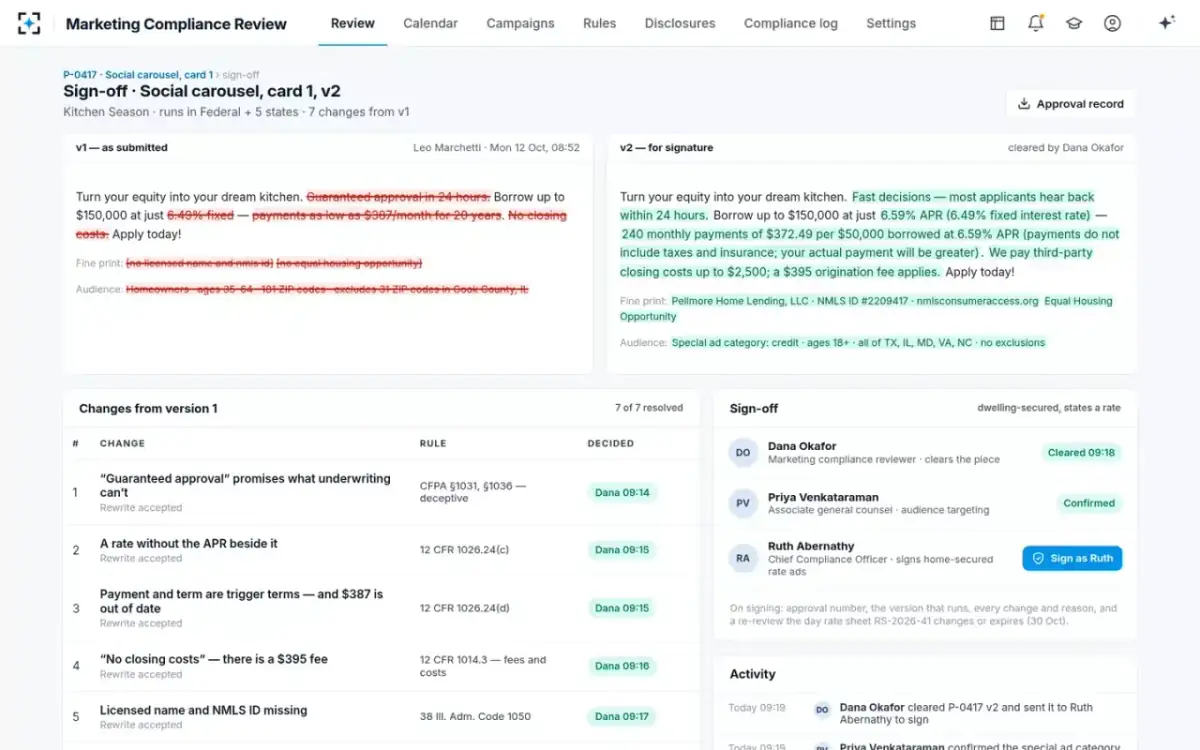
The fictional home equity post reviewed elsewhere in this series came with an ad set: homeowners aged 35 to 64 in 181 ZIP codes, excluding 31 ZIP codes in Cook County, Illinois. The solution's fair lending reviewer compared the excluded ZIP codes with census tract data and found 27 of the 31 were majority-minority. It also flagged the age band, because ECOA lists age as a prohibited basis "provided the applicant has the capacity to contract" (15 U.S.C. 1691(a)).
What the sample ad set left out
31
ZIP codes in Cook County excluded from the audience
27of 31
of them majority-minority, by census tract data
35–64
the age band the ad set targeted
0
exclusions in the audience counsel approved
The reviewer did not fix it. Its written limit is that it "never clears a targeting issue — counsel decides", and the item went to the lender's associate general counsel. She confirmed a new audience: the platform's special ad category for credit, ages 18 and over, all of the five states, no exclusions. Whether an exclusion has a legitimate business reason, whether the age band was chosen for a lawful purpose, and what to do about pieces that already ran are questions with legal consequences. An agent that silently widened the audience would hide the question from the person who must answer it.
The fair lending step in a Marketing Compliance Review run, and where it hands over
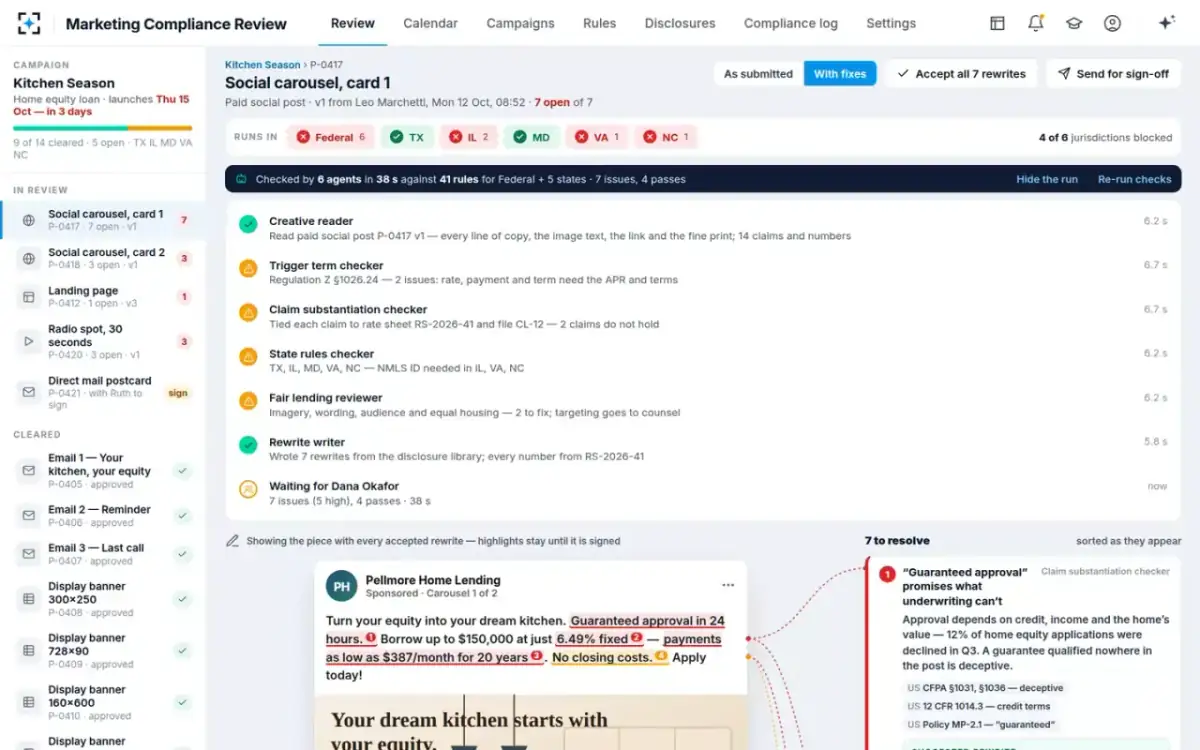
The fair lending step reads the audience settings that the creative reader lists, not just the picture.
The audience, struck and replaced, beside the copy
When is the Equal Housing Lender logo required, and what do audio ads say?
For FDIC-supervised banks and federally insured credit unions, in every ad for a loan to buy, build, improve, repair or maintain a dwelling or secured by one; for nonbank lenders, by policy rather than by a federal ad rule. The equal housing statement is the one fair lending item that is a checkbox. FDIC-supervised banks must "prominently indicate" in ads for dwelling loans that they lend without regard to race, color, religion, national origin, sex, handicap or familial status. The Equal Housing Lender or Equal Housing Opportunity logo with its legend satisfies the rule in print and on screen, and in audio a spoken statement that the bank is an "Equal Housing Lender" or an "Equal Opportunity Lender" (12 CFR 338.3(a)). Federally insured credit unions have a parallel rule (12 CFR 701.31(d)). Nonbank lenders typically carry the logo as policy, as the sample lender does on every home-secured ad.
The audio version is the one that goes missing. In the sample lender's approved wording library, the spoken form sits beside the logo: "Pellmore is an Equal Housing Opportunity lender." A radio spot drafted from a print ad loses the logo and has to gain the sentence.
Fair lending risks must be considered when advertisements are developed, not after they run
The cheapest point to catch a fair lending problem in marketing is before money is spent: at the media plan, the creative brief and the audience build, not at the final approval of a finished ad. By the time an ad reaches review, the stations are booked, the photographs are shot and the audience is saved in the platform, and every change has a cost someone will argue about.
Where each fair lending question is cheapest to answer
| Stage | The question | Evidence to keep |
|---|---|---|
| Media plan | Do the stations, publications and placements reach the whole market area? (M2) | The plan with its market coverage |
| Creative brief | Who will be pictured across the campaign, and in what settings? (M1) | The brief and the image set |
| Audience build | Which ZIP codes, ages and lists are excluded, and why? (M4, M5) | Exclusions laid over census tract data, with the stated reason |
| Piece review | Does any word, image or voice discourage on a prohibited basis? | The reviewed version and the reviewer’s notes |
| After launch | Where did the ads actually deliver, and to whom? | Delivery reports kept with the approval |
The last row is the one most programmes skip. A platform can deliver an ad unevenly even when the audience settings are neutral, and the lender sees that only in its delivery reports. Keeping them with the approval lets a reviewer answer the question an examiner will ask: not what the lender intended, but whom the ad reached.
Images and audiences across a campaign, not one ad at a time
The hardest fair lending question in marketing is cumulative. One ad with one family photo says little; a year of ads that never show a particular group, or never run in a particular part of the market, says a good deal, and M1 and M2 are about exactly that pattern. A review process that clears ads one at a time needs a second view by campaign and by year: which geographies were excluded, which media were bought, whom the images show.
Marketing Compliance Review keeps each approved piece with its states, its audience and its version in one compliance log, so the campaign view is a filter rather than a project. The fair lending rules sit in the same rule library as Regulation Z and the state rules, each with its source and the pieces where it fired, and the maker-checker guide explains why the step that judges these issues is not the step that writes the fixes. For the whole post, issue by issue, see the annotated example; for the solution, the Marketing Compliance Review page.
Questions people ask
Do lenders have to show diverse people in their ads?
No rule cited here requires particular people in an ad. The rules forbid images and words that would discourage applicants on a prohibited basis, and examiners look at patterns across a lender's marketing. A campaign whose images consistently show one group is the pattern M1 describes.
Is excluding ZIP codes from a lending ad always unlawful?
Not always; a lender not licensed in an area cannot lend there. But an exclusion that tracks the minority share of the population is the pattern factor M4 names, and it needs a documented, legitimate reason that someone with legal authority has accepted.
Do fair lending advertising rules apply to car loans and credit cards?
Regulation B's discouragement rule does: it covers any creditor and any credit, so a card or auto ad that discourages applicants on a prohibited basis is within it. The Fair Housing Act and the FDIC and NCUA equal housing rules are narrower, reaching loans tied to a dwelling.
Is targeting an ad by age a fair lending problem?
It can be. ECOA lists age as a prohibited basis "provided the applicant has the capacity to contract", so an age band that keeps credit offers from younger or older adults needs a reason that holds up. The sample review flagged a 35 to 64 band for exactly that, and counsel replaced it with ages 18 and over.
Is the CFPB's 2022 digital marketing rule still in force?
No. The CFPB withdrew its interpretive rule on digital marketers on 12 May 2025, along with dozens of other guidance documents, and said it would not prioritize enforcing withdrawn guidance. Regulation B, ECOA and the Fair Housing Act did not change, and they are what reach the lender's own targeting choices.