UDAAP penalties for advertising are set by the Consumer Financial Protection Act, which bans unfair, deceptive or abusive acts, and they are counted by the day. What is the penalty for deceptive mortgage advertising? Under the Act it can reach $7,217, $36,083 or $1,443,275 for each day a violation continues, depending on whether the violation was ordinary, reckless or knowing, under the 2025 inflation adjustment. In practice the published cases are smaller than those ceilings and still large: the CFPB's 2020 sweep of deceptive VA-loan mailers ended in nine cases and more than $4.4 million in penalties. But the penalty is the last and rarest cost. Long before it, a misleading ad costs money in review rounds, delayed launches, pulled pieces and exam findings, and the cost rises with every step the ad travels before someone catches it. Botminds' Marketing Compliance Review checks every piece against federal and state rules when it is submitted, so the catch happens where it costs a sentence. This guide prices each step.
What regulators found when they read lending ads in bulk
~800
mortgage ads reviewed in one CFPB–FTC sweep, 2012
9cases
from the CFPB’s sweep of VA-loan mailers, ending 2020
$4.4M+
in civil money penalties from that sweep
370days
average Federal Reserve exam with UDAP matters, against 145 for all consumer exams
What are the CFPB civil penalty tiers? UDAAP penalties per day
There are three tiers, each a maximum per day of violation: $7,217 for any violation, $36,083 if reckless and $1,443,275 if knowing, as adjusted in January 2025. The Consumer Financial Protection Act sets the tiers. The first applies to "any violation of a law, rule, or final order"; the second to a person that "recklessly engages in a violation"; the third to one that "knowingly violates" Federal consumer financial law, each "for each day during which such violation… continues" (12 U.S.C. 5565(c)). Adjusted for inflation in January 2025, the maximums are $7,217, $36,083 and $1,443,275 (90 FR, 8 January 2025). We found no later adjustment.
The ceilings are not the likely number. What they show is the shape of the exposure: it grows with every day an ad runs, and it multiplies when the violation is reckless or knowing.
One day at the knowing-violation maximum approaches a whole published case
How is a UDAAP penalty amount decided? Five factors in the statute
The Bureau or the court must weigh five things before fixing an amount: "the size of financial resources and good faith of the person charged", "the gravity of the violation or failure to pay", "the severity of the risks to or losses of the consumer, which may take into account the number of products or services sold or provided", "the history of previous violations", and "such other matters as justice may require" (12 U.S.C. 5565(c)(3)). The Bureau may also "compromise, modify, or remit" a penalty.
The five statutory factors, read for an advertising case
| Factor | What it means for a misleading ad | What the lender can show |
|---|---|---|
| Resources and good faith | Whether the lender tried to get it right | A review process that ran on the piece, with the version, findings and sign-off on file |
| Gravity | How far the ad departed from the truth, and on what term | That the error was a disclosure gap, not an invented rate or a false guarantee |
| Risk to consumers, by volume | How many people saw it and took out loans; the statute names the number sold | Reach, run dates and the loans attributable to the campaign |
| History | Whether this happened before | Earlier findings and what changed after them |
| Justice | Anything else that matters | Prompt correction, refunds, and how quickly the ad came down |
Read that way, the factors reward exactly the evidence a review process produces. A lender that can show the piece was reviewed, by whom, against which rules, and how fast it was corrected once the error surfaced has an answer to the first and last factors. A lender with no record has only its word.
What happened in the CFPB's VA mortgage advertising sweep, and the 2012 ad sweep?
The VA-mailer sweep produced nine enforcement cases and more than $4.4 million in penalties, ending with Low VA Rates in 2020; the 2012 sweep reviewed about 800 ads and led to warning letters and six investigations. Both sweeps were about ads, not about loans that had gone wrong. In 2012 the CFPB and the FTC reviewed "about 800 randomly selected mortgage-related ads across the country", sent warning letters to about a dozen lenders and brokers each, and opened formal investigations of six companies (CFPB, 19 November 2012). The agencies were looking for "misleading claims concerning government affiliation, interest rates, fees, costs, payments associated with the loan, and the amount of cash or credit available", the categories of Regulation N.
The later sweep, prompted by concerns the VA raised about mailers to servicemembers and veterans, ended with Low VA Rates in October 2020: a $1.8 million penalty for ads that stated credit terms "the company was not actually prepared to offer", left out required Regulation Z disclosures, and implied the loans could eliminate debt. The order also "imposes requirements to prevent future violations" (CFPB, 26 October 2020). For a lender, those ongoing requirements can cost more than the penalty, because they change how every future ad is made.
The penalty is counted by the day. The cheapest catch is counted in sentences, before the first day begins.
Beyond the penalty: refunds, disgorgement and limits on the business
The civil money penalty is one of eight kinds of relief the Act allows, and often not the largest. A court or the Bureau may order "rescission or reformation of contracts", "refund of moneys", "restitution", "disgorgement or compensation for unjust enrichment", "payment of damages or other monetary relief", "public notification regarding the violation, including the costs of notification" and "limits on the activities or functions of the person" (12 U.S.C. 5565(a)(2)), with the penalty last on the list.
For an advertising case the measure of harm is the loans the ad brought in. If an ad promised a rate the lender did not give, each borrower who answered it and paid more is a candidate for a refund, and the profit on those loans a candidate for disgorgement. That is why the volume of a campaign, not only its length, belongs in a risk estimate: a misleading mailer to 100,000 homes carries more exposure than the same words on one branch poster.
Does the CFPB still enforce mortgage advertising rules?
It can, and the rules are unchanged, but its docket is much smaller; states, examiners and other agencies carry more of the load. Federal enforcement has thinned since. Between 31 January and 31 December 2025 the CFPB dismissed or withdrew as plaintiff in 19 matters and resolved 7, and said it closed about 40 percent of its pending investigations (CFPB, Enforcement by the numbers). Regulation N, Regulation Z and the CFPA are unchanged, state regulators enforce their own advertising rules, and examiners still cite advertising violations. A thinner federal docket shifts where an ad error is found; it does not stop it being found.
The states can enforce the federal law as well as their own. The Act lets "the attorney general (or the equivalent thereof) of any State" bring a civil action to enforce it, with a narrower path against national banks and federal savings associations, which states may sue only to enforce a Bureau regulation (12 U.S.C. 5552). State licensing regulators add their own rules: Virginia's bans any ad that would "deceptively advertise a mortgage loan" and writes Regulation N and Regulation Z into its own text (10VAC5-160-60), so a state examiner can cite a federal ad breach as a state one.
What does a deceptive ad cost a lender? It depends on who finds it
The cheapest place to find an ad error is the draft; the most expensive is an enforcement action. Between those sit the review round, the pulled campaign and the exam finding, and each multiplies the cost before it, because by then the error has been copied into more pieces and run for more days.
The same error, priced by who finds it
| Found by | When | What it costs |
|---|---|---|
| The writer | While drafting | A sentence. The APR goes beside the rate before anyone else reads it. |
| The reviewer | At submission | A review round. In our estimate of a by-hand review, comments and rounds with marketing take about 14 of the 45 working hours a rate ad spends in review. |
| The lender, after launch | While the ad runs | Pulling and reissuing every piece that carries the error, across every state and channel, and keeping both versions for Regulation N. |
| An examiner | At the next exam | A cited violation, a root cause analysis, and remediation; Federal Reserve exams with UDAP matters averaged 370 days, against 145 for all consumer exams. |
| An enforcement agency | After a sweep, a complaint or an exam | A consent order: a penalty counted by the day, and requirements that change how every future ad is made. |
The examiner row deserves attention because examiners read ads routinely. The CFPB's examination procedures ask whether the institution performs "comprehensive root cause analysis to assess why a particular law violation or error occurred" (CFPB CMR procedures). For advertising, the Federal Reserve's own examiners found that website vendors "unaware of the advertising rules" and "staff turnover" lay behind Regulation Z ad violations (Consumer Compliance Outlook, 2021). A root cause like that is not fixed by correcting one ad; it is fixed by changing how ads are reviewed.
Catching the error at submission with Marketing Compliance Review, and the file that proves it
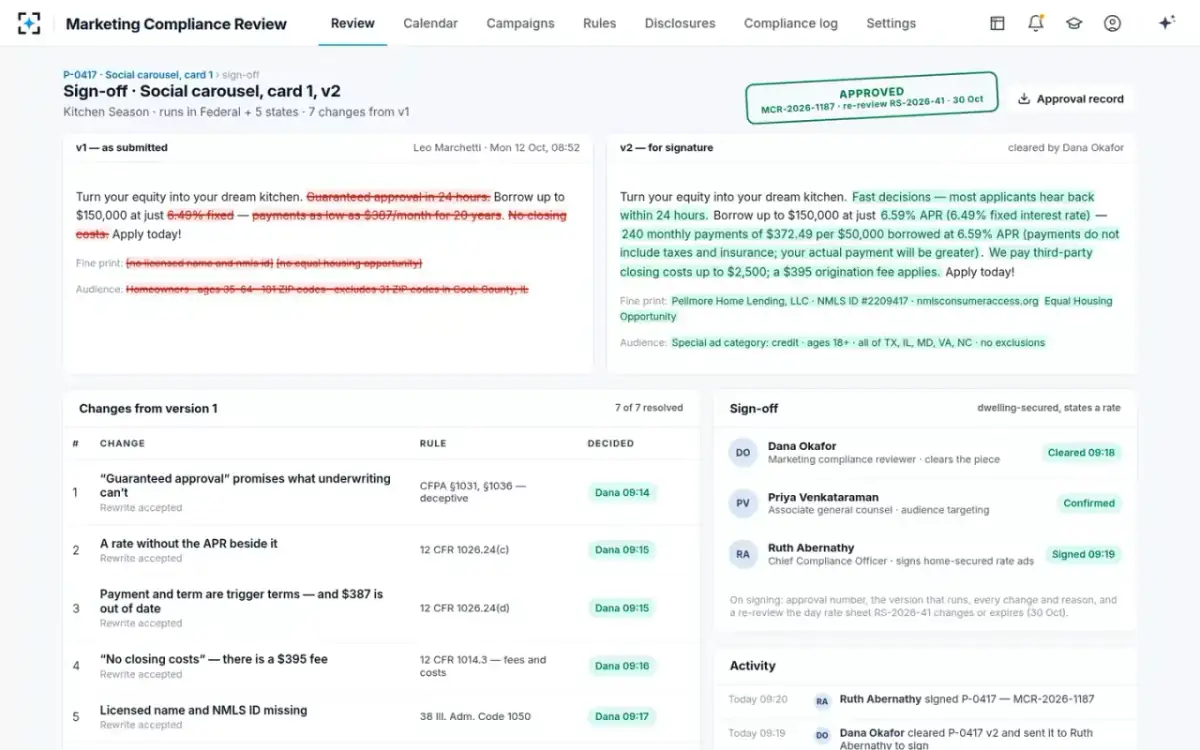
Marketing Compliance Review moves the catch to the second row and makes it cheap there. The checkers read every piece the moment it is submitted, and the rewrite writer drafts the fix from the approved wording library and the live rate sheet, so a review round becomes a reviewer accepting or editing a line. On the fictional sample post used across this series, six agents found seven issues in 38 seconds against 41 rules for Federal and five states, and the piece was signed 27 minutes after it was submitted.
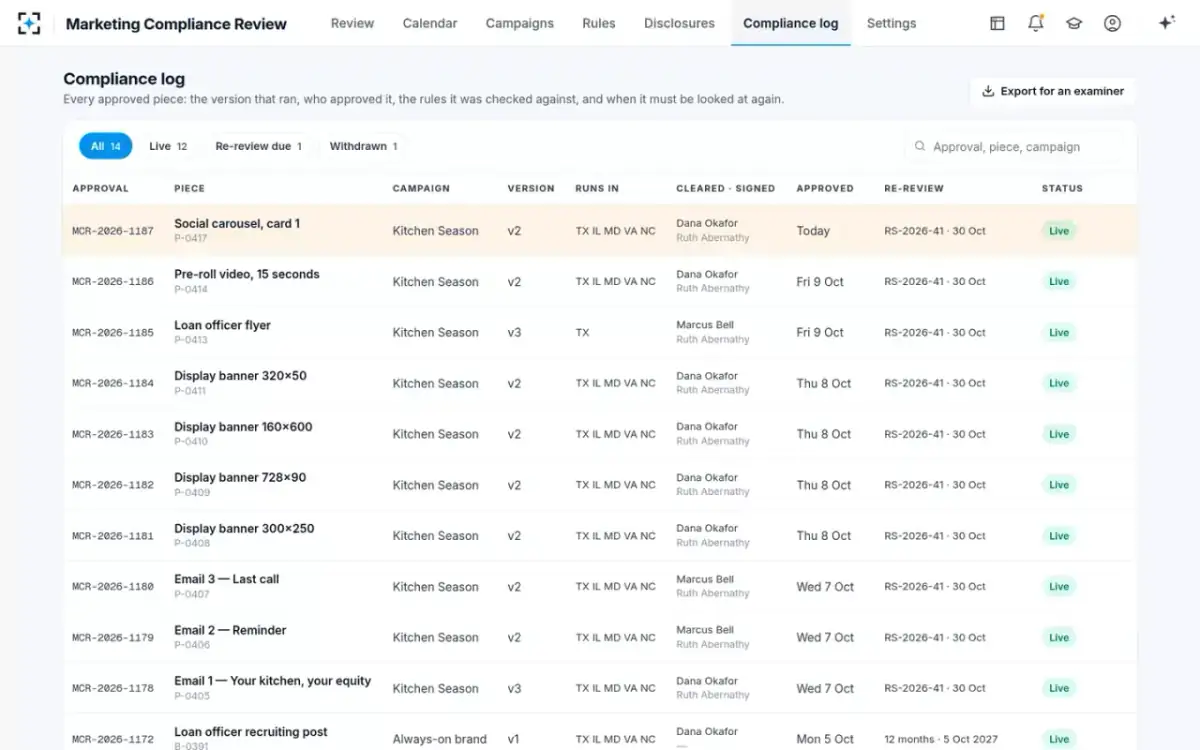
The design target for the whole cycle, from submission to a cleared piece, is 3.4 hours, against our estimate of 5.6 working days by hand. Neither figure is a customer's result; a lender should measure its own. The second saving is harder to see: the compliance log keeps, for every approval, the version that ran, who cleared and signed it, where it ran and when it must be reviewed again, which is the evidence Regulation N requires an advertiser to keep for 24 months (12 CFR 1014.5).
The Marketing Compliance Review log: what an examiner asks for, kept as each piece is approved
Approved: the number, the signature and the day it must be looked at again
A return built on errors avoided, not on hours alone
A business case for marketing compliance review that counts only reviewer hours undervalues it, and one that counts penalties overvalues it. The honest version adds four terms, priced from the lender's own numbers.
The return on catching ad errors at submission
Review time recovered
pieces a year × (hours by hand − hours with agents) × loaded hourly cost
Compliance officers in credit intermediation earned a mean $94,090 in May 2025 (BLS), about $45 an hour before benefits.
Compliance
Launch days recovered
campaigns a year × days of review delay removed × value of a campaign day
The value of a day is marketing’s figure: the pipeline a campaign is planned to produce, divided by its flight.
Marketing
Pulls avoided
errors found after launch a year × cost to pull, reissue and document one
Count last year’s withdrawn and reissued pieces; rate-sheet changes on live ads are a likely cause.
Marketing operations
Cost of the solution
licence + setup + reviewer time on the decisions that remain
Reviewers still accept, edit or dismiss every change; counsel and the CCO still decide and sign.
Finance
The third term is where most lenders lack data, because pulled pieces are rarely counted. The rate-sheet problem is the place to start: the guide to rate sheets and live ads shows one sheet change touching 11 live pieces. The compliance checklist lists the errors behind the published cases, and the approval-process guide covers the launch-day term. The Marketing Compliance Review page shows the review end to end.
Questions people ask
Can a state penalise a misleading mortgage ad separately?
Yes. Texas and Virginia write Regulation N and the Regulation Z advertising rules into their own advertising regulations, alongside their own content requirements, so a state regulator can treat a federal advertising breach as a breach of its rule as well.
Is a misleading ad a violation if no one applied because of it?
Regulation N bans the misrepresentation itself, "expressly or by implication, in any commercial communication", and Regulation Z governs what an ad states. Neither requires that a consumer took out a loan.
Were the daily penalty amounts always this high?
No. The statute set them at $5,000, $25,000 and $1,000,000 a day in 2010, and they are adjusted for inflation by regulation; the January 2025 adjustment gave $7,217, $36,083 and $1,443,275. We found no later adjustment as of October 2026.
Does a penalty count each ad, or each day?
The statute counts "each day during which such violation… continues", so a misleading ad left running accumulates exposure every day it runs. How violations are counted across many ads in one campaign is set case by case, and the Bureau must weigh good faith, gravity, consumer harm and history before fixing an amount.
Do the CFPA penalties apply to banks?
To the largest ones directly: the CFPB enforces against banks with more than $10 billion in assets, while smaller banks answer to their prudential regulator, which uses its own enforcement powers. Regulation N binds only nonbank advertisers; a bank's misleading ad is reached through the ban on deceptive practices and Regulation Z.