Mortgage loan officer social media posts are advertisements whenever they promote a loan, and they carry the same rules as a lender's paid campaign. Does a loan officer need an NMLS number on them? Usually yes, and how depends on the state. A post that promotes mortgage lending is an advertisement, and the state rules that put licensing details into ads apply to it. Texas lets the required names and NMLS IDs sit on the profile page of the social account; Maryland lets a loan officer use the home page within the platform; Illinois, Virginia and North Carolina write their rules for every advertisement, with no such exception. This matters because loan officers publish a lender's most frequent and least reviewed ads. Botminds' Marketing Compliance Review gives their posts the same review as a paid campaign: every claim checked, every state's licensing line written in, and an approval kept with the version that ran. This guide is about that seat, and what it decides.
What a loan officer's profile can carry, and what each post must still say
On the profile page
- Name as it appears in NMLS and the employer's licensed name
- NMLS IDs, the company's and the loan officer's
- Website of the mortgage company, where Texas requires it
- Equal housing statement or logo, where policy calls for it
Satisfies the rule for posts Texas (company and sponsored originator) · Maryland (loan officer)
In each post that promotes a loan
- Every Regulation Z disclosure a rate, payment or term triggers, in the post itself
- No claim the file cannot prove: "guaranteed", "lowest", "no cost"
- The licensing line where the state has no profile exception
- Nothing that discourages applicants on a prohibited basis, in words or images
Profile page is not enough Illinois · Virginia · North Carolina
Is a social media post an advertisement? For a loan officer, almost always
Yes, when it promotes a loan or solicits business. A post is an advertisement when it promotes a loan or solicits business, whoever writes it and whoever pays for it. Texas defines an advertisement as "a commercial message in any medium that promotes, directly or indirectly, a residential mortgage loan transaction", and says the term includes "flyers, business cards, or other handouts, and messages or posts made on a social media site" (7 Tex. Admin. Code §57.203(a)). It applies to the mortgage banker and its sponsored originators alike, and requires both to comply with Regulation N and the Regulation Z advertising rules when they advertise "rates, terms, or conditions".
A loan officer who posts "Rates are at 6.49% this week, DM me" has stated a rate. Under Regulation Z that rate must appear as an APR, and in most states the post also needs the loan officer's NMLS identifier. Neither requirement softens because the account is personal or the post took ten seconds to write.
What does the FFIEC social media guidance require?
It requires no form of words; it expects a risk management program that treats social media as another channel for advertising, applications and complaints, under every consumer law that applies elsewhere. The guidance, which the OCC, Federal Reserve, FDIC, NCUA and CFPB adopted as supervisory guidance in December 2013, notes that institutions use social media for "marketing, providing incentives, facilitating applications for new accounts… or providing loan pricing". When they market products there, they are "expected to take steps to ensure that advertising, account origination, and document retention are performed in compliance with applicable consumer protection and compliance laws" (78 FR 76297).
The program it describes has named parts: a governance structure in which the board or senior management sets how social media serves the institution's goals; policies and procedures for its use and monitoring; a process for managing third parties involved; "an employee training program" covering "official, work-related use of social media"; and oversight, audit and reporting. One phrase in the policies item matters most for loan officers: procedures "should incorporate methodologies to address risks from online postings, edits, replies, and retention".
Replies are where loan officer posts most often turn into unreviewed ads. A follower asks "what's your rate?" under a brand post, and the officer answers with a number in a comment that nobody in compliance will see. A policy that covers posts but not replies covers the planned part of social media and misses the conversational part. The CFPB withdrew several pieces of digital-marketing guidance in May 2025; the FFIEC social media guidance is interagency, has not been withdrawn as far as we could find, and the regulations it points to are unchanged.
Can a loan officer post rates on social media?
Yes, if the post states the rate as an APR, carries the disclosures any trigger demands, quotes a rate the lender is actually offering on the day a follower reads it, and adds whatever each state in the audience requires. That is a lot to fit in a caption, which is why the rate post is the one most worth routing to review.
“Rates are at 6.49% this week, DM me”: what it needs for followers in Texas and Virginia
| Element | Why | Written in |
|---|---|---|
| The rate as an APR, at least as prominent | 12 CFR 1026.24(c); a dwelling-secured ad may show the simple rate only beside the APR | “6.59% APR (6.49% interest rate)” |
| A rate the lender is offering on the days the post is seen | §1026.24(a): only terms that “actually are or will be arranged or offered” | The rate sheet in force, and a date: “rates as of Mon 12 Oct” |
| A statement that the rate may change | Virginia: any ad with a rate must say it “may change or not be available at the time of loan commitment or lock-in” | “Rates may change and may not be available when you lock.” |
| Repayment terms, if a payment or term is added | §1026.24(d); “30-year” alone is a trigger | A representative example per amount borrowed |
| Licensed name and NMLS ID | Virginia: “NMLS ID #” and the Consumer Access address in the ad; Texas: profile page may carry it | “Pellmore Home Lending, LLC · NMLS ID # 2209417 (www.nmlsconsumeraccess.org)” |
The date line is the cheapest protection a rate post can carry. A social post stays visible long after the week it describes, and the Federal Reserve's examiners list rate sheets among the places they "continue to find violations". A post that says when its rate applied, and a review that re-checks live rate posts when the sheet changes, keeps an old number from becoming an advertised term the lender no longer offers.
The seat that publishes most often, and is reviewed least
Loan officers outnumber compliance officers by roughly eleven to one in the industry that employs both. The Bureau of Labor Statistics counts 222,090 loan officers and 19,850 compliance officers in credit intermediation in May 2025, and compliance officers cover every rule, not only advertising. NMLS separately maintained the licenses or registrations of more than 549,294 mortgage loan originators in 2025 (CSBS Annual Report 2025); that figure counts licences and registrations, not jobs, so it is not comparable with the BLS count.
In lending, loan officers outnumber compliance officers eleven to one
The Federal Reserve's examiners describe the pattern behind most advertising findings. They "continue to find violations related to rate sheets, print advertisements, and web pages", and in one case "staff turnover was the root cause of Regulation Z violations" (Consumer Compliance Outlook, 2021). A loan officer who joined last month and posts this week's rate is a turnover risk with a publishing button.
The loan officer is the lender's most prolific advertiser, and the one whose ads the compliance team is least likely to see.
Do loan officers need their NMLS number on social media posts?
In most of the states that regulate it, yes, either in each post or on the profile the post runs from; no federal rule puts an NMLS number into an ad. Regulation Z §1026.36(g) requires the loan originator organization's and the individual's names and NMLSR IDs only on "the credit application", the Loan Estimate and Closing Disclosure, "the note or loan contract" and "the security instrument" (12 CFR 1026.36(g)). The ad requirement comes from the states, and two of them wrote a social media exception.
Maryland's rule addresses the loan officer directly. In any advertisement, a mortgage loan originator must disclose the employer's name and the originator's NMLSR identifier, but one "who utilizes social media for advertising purposes need not disclose" them "in each statement published through a social media platform, provided that such information is disclosed prominently on the mortgage loan originator's home page within that social media platform" (COMAR 09.03.09.09). Texas lets the required content be met "by prominently displaying the required information on the home page, profile page, or similar… so that the viewer can quickly discern the information without reviewing various historical content".
Illinois writes no exception: "any advertisement appearing in Illinois by a licensee regarding residential mortgage loans" must include the NMLS Consumer Access address, and if a loan officer is advertised, the officer's own NMLS identifier in addition to the licensee's (38 Ill. Adm. Code 1050.940). Virginia requires "every advertisement used by, or published on behalf of" a licensed lender or broker to carry its licensed name and "NMLS ID #" in a set format (10VAC5-160-60). A loan officer licensed in Texas and Illinois who posts once to followers in both states has to meet the stricter rule. The state-by-state guide lays the five rules side by side.
Texas and Maryland clear, three states held, on the same post
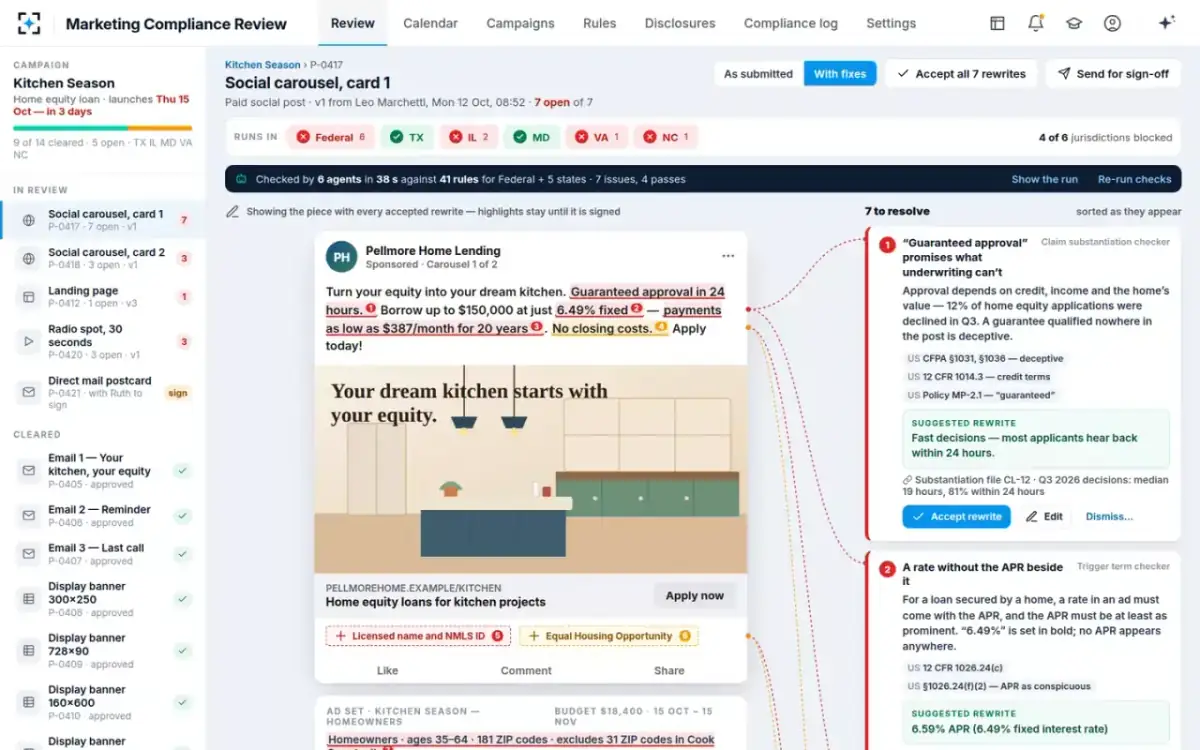
The setting that makes the difference is one switch: whether the social profile carries the NMLS ID.
Who carries a loan officer's post, and what changes for each of them
Four people touch a loan officer's post, though usually only the first one knows it exists. Moving the post into review changes each of their jobs a little, and the loan officer's the most.
Four seats around one loan officer's post, before and after Marketing Compliance Review
Today
Posts this week’s rate from a phone between appointments, with the NMLS number if they remember it and the APR rarely.
With agents
Submits the post, gets it back marked up with the APR, the repayment example and the line each state needs, in their own words.
Still theirs: What to post, when, and to whom: the relationship with their followers.
Today
Learns about a problem post from a complaint or an exam finding.
With agents
Sees which of the branch’s officers post, what was changed, and what is due for review.
Still theirs: Coaching, and deciding who may post about rates at all.
Today
Reviews campaigns; loan officer posts arrive rarely, by screenshot, after they have run.
With agents
Clears posts in the same queue as campaigns, with each claim already checked and each rewrite drafted.
Still theirs: Accepting, editing or dismissing every change, with a reason.
Today
Cannot show an examiner the posts that ran, or who approved them.
With agents
Signs rate posts on home-secured loans like any other ad; every approval sits in one log.
Still theirs: The signature, and the policy that decides which posts need it.
Does a recruiting post count as an advertisement?
Usually not as a mortgage ad, because it promotes a job rather than a loan; it needs a lighter review, not none. Not every loan officer post is a loan ad. A post recruiting loan officers, a team photo or a community event usually states no credit terms, and Texas's definition excludes promotional items that carry only a name and website. Those posts still go out under the lender's name, but they need a brand and fair lending eye, not the trigger terms checklist. A post naming a rate, a payment, a programme or a speed of approval needs the full review.
The sample lender in Marketing Compliance Review runs both kinds. Its always-on brand and recruiting campaign posts weekly and appears on the launch calendar as cleared each Wednesday; one loan officer recruiting post sits in the compliance log with a 12-month re-review date. A loan officer flyer in the same log ran only in Texas, cleared by a reviewer and signed by the Chief Compliance Officer, because it quotes the live rate sheet.
Loan officer pieces in the Marketing Compliance Review log, beside the campaign
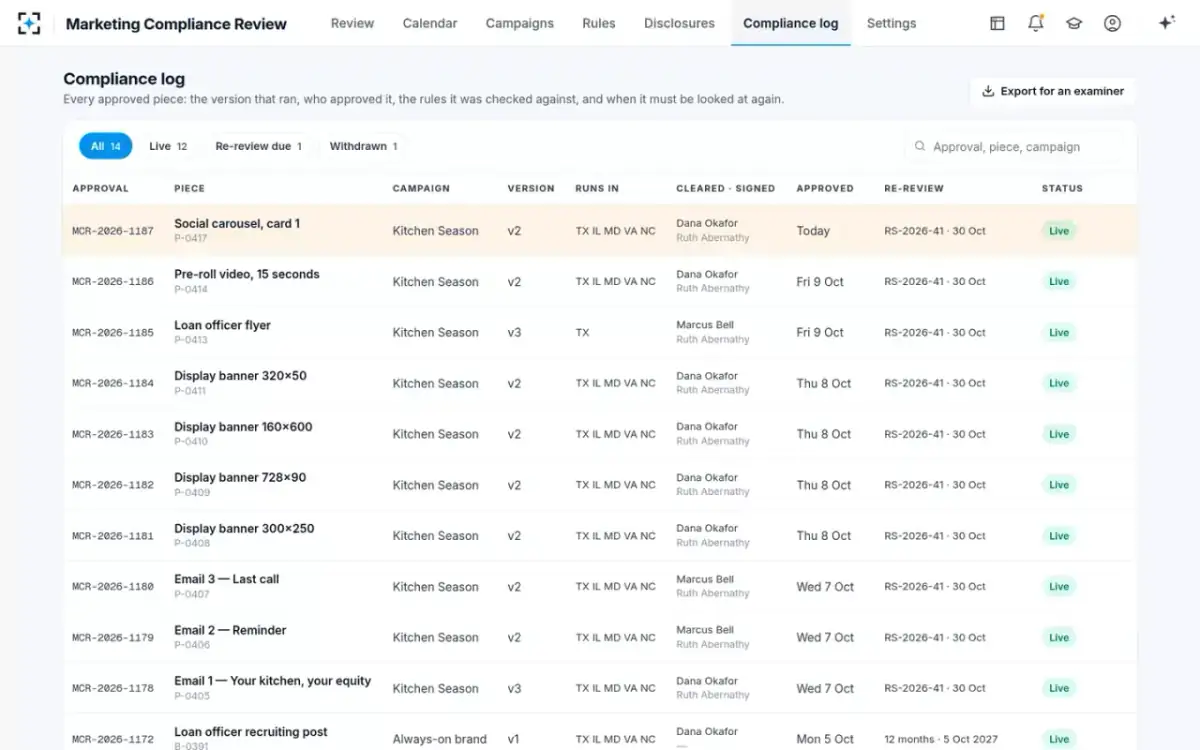
The flyer row runs in one state only, so it carries one state's licensing line.
How long must social media posts be kept?
For mortgage posts, at least 24 months after the last day they ran under federal law, and longer where a state says so. Keeping posts matters as much as clearing them. Regulation N requires copies of "all materially different commercial communications" about mortgage terms for 24 months after last use (12 CFR 1014.5), and Virginia requires a licensed lender to keep "an example of every advertisement" for three years after it is last published, though it excludes copies of web pages. Whether a social post counts as a "web page" under that exclusion the rule does not say, so the cautious course is to keep posts for the longer period. A post deleted from the platform does not delete the obligation.
What is kept matters as much as how long. Regulation N also requires "documents describing or evidencing all mortgage credit products available to consumers" while each ad ran, so a screenshot of the post without the rate sheet it quoted proves half of what an examiner may ask. The sample log keeps both: the version that ran, the sheet it quoted and the dates it was live.
A loan officer social media policy that an examiner can test
- Say which posts need review
Any rate, payment, term, fee, programme, approval speed or claim about cost. Brand and recruiting posts get a lighter check.
- Set up each profile once, per state
Name as in NMLS, employer’s licensed name, both NMLS IDs, and the website where Texas requires it.
- Know where the profile is not enough
Illinois, Virginia and North Carolina rules apply to every advertisement. The strictest state in the audience decides.
- Route rate posts to the same queue as campaigns
Same rate sheet, same disclosures, same approval rules.
- Train on the triggers
The FFIEC asks for training on official social media use; a one-page trigger list prevents most findings.
- Keep what ran
Every materially different post for at least 24 months after last use, longer where a state requires it.
Getting loan officers to submit posts at all is a matter of speed and of the fix they get back. A post returned in an hour with the APR sentence already written is easier to accept than a rejection, and the guide to the approval process looks at what makes people send work in early. For the anatomy of one reviewed post, see the annotated example, and for the whole solution, the Marketing Compliance Review page.
Questions people ask
Does a loan officer need the company's NMLS number too?
Often. Texas requires both the mortgage banker's and the sponsored originator's names and NMLS IDs in ads made through the originator. Illinois requires the licensee's identifier and, where a loan officer is advertised, the officer's as well. Maryland's loan officer rule asks for the employer's name and the originator's own identifier.
Do these state rules apply to loan officers at banks?
The state rules quoted here are written for licensees: Texas for mortgage bankers and their sponsored originators, Illinois for "a licensee", Virginia for licensed lenders and brokers. A bank's loan officers are registered in NMLS rather than state-licensed, so those rules may not reach them, but Regulation Z, Regulation N and the FFIEC guidance do, and many banks put the ID on posts by policy.
Can a loan officer say "pre-approved" in a post?
Only with care. Regulation N bans misrepresenting "whether the consumer has been preapproved or guaranteed" for a product, and Virginia requires any ad stating or implying pre-approval to say "THIS IS NOT A LOAN APPROVAL" in "at least 14-point bold type", with the conditions attached. A general invitation to "get pre-approved" is different from telling a reader they already are.
Is a "like" or a share an advertisement?
The rules cited here turn on whether a message promotes a mortgage transaction, and none of them addresses likes or shares specifically. A share that adds the loan officer's own rate or offer reads as a new message; a policy should say which shares need review rather than leave it to judgement in the moment.
Can a loan officer use a personal account for business posts?
Many do, and the rules follow the content, not the account: Texas counts "messages or posts made on a social media site" that promote a loan, whoever's page they sit on. The FFIEC asks for training on "official, work-related use of social media, and potentially for other uses", which is the hook for a policy that covers personal accounts used for business.