NMLS ID advertising requirements come from state law, not federal law. Regulation Z puts the loan originator's name and NMLS ID on the application, the disclosures, the note and the security instrument, and stops there. Each state that licenses mortgage lenders decides what its ads must carry, and the answers differ in four ways: whose identifier must appear, whether the NMLS Consumer Access address is required, whether a fixed phrase or format is prescribed, and whether a social media profile page can stand in for the line in each post. A lender advertising in five states needs five answers on every piece. Botminds' Marketing Compliance Review keeps those rules as settings, checks every piece against each state it runs in, and writes the exact line each state needs. The table below compares five states' rules as published in October 2026.
What a mortgage ad must carry, in five states
| State and rule | Who must be identified | The line itself | Social media profile page |
|---|---|---|---|
| Texas · 7 TAC §57.203 | The mortgage banker’s name and NMLS ID; its website if it has one; the sponsored originator’s name and NMLS ID when the ad is made through the originator | No fixed wording | Accepted, if prominently displayed so the viewer can quickly discern it |
| Illinois · 38 Ill. Adm. Code 1050.940 | The licensee’s NMLS identifier, and an advertised loan officer’s own identifier as well | The NMLS Consumer Access address; for electronic media, “For licensing information, go to: www.nmlsconsumeraccess.org.” | No exception: “any advertisement appearing in Illinois” |
| Maryland · COMAR 09.03.09.09B | For a loan officer’s ads: the employer’s name or approved trade name, and the loan officer’s NMLSR identifier | No fixed wording | Accepted for loan officers, on their home page within the platform |
| Virginia · 10VAC5-160-60 | The lender or broker, by the name on its licence | “NMLS ID #” followed immediately by the number, with the Consumer Access address; on radio or TV, after the name | No exception: “every advertisement used by, or published on behalf of” a licensee |
| North Carolina · G.S. 53-244.107 | The unique identifier of the loan originator or mortgage business | “Clearly shown”; no fixed wording in the statute | No exception in the statute; it names business cards and websites |
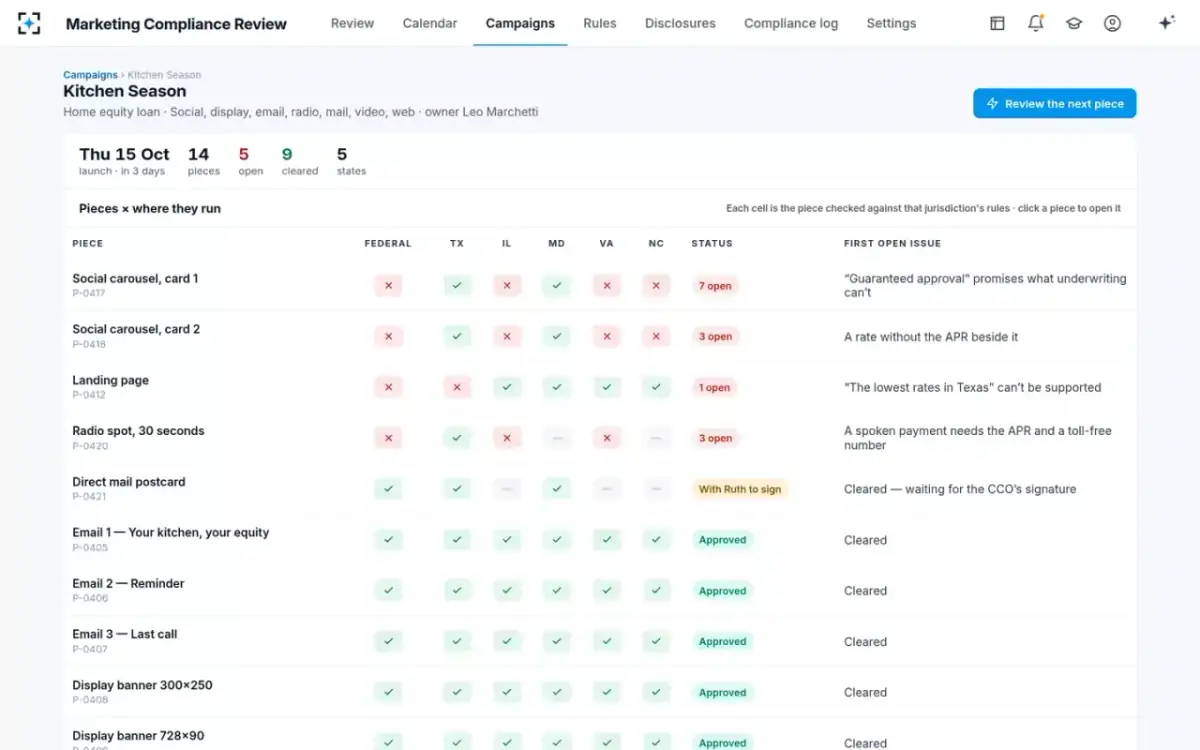
One campaign, every piece against every state it runs in
What law requires the NMLS ID on advertisements? State law, not federal
State licensing law does; the federal rule stops at the loan file. Regulation Z §1026.36(g) requires a loan originator organization to put its name and NMLSR ID, and those of the individual originator, on four documents: "the credit application", the disclosures required by §1026.19(e) and (f), "the note or loan contract" and "the security instrument" (12 CFR 1026.36(g)). Ads are not on the list. The federal advertising rules, Regulation Z §1026.24 and Regulation N, say a great deal about what an ad may claim and must disclose, and nothing about licensing identifiers.
The number exists so a borrower can check a licence. NMLS is the system through which 67 state and territorial regulators license nonbank activities, and it maintained the licences or registrations of more than 549,294 mortgage loan originators in 2025 (CSBS Annual Report 2025). The states that require the identifier in ads also tend to require the Consumer Access address, where that check is made.
Texas and Maryland let a profile page carry the details; Illinois, Virginia and North Carolina do not
The social media question splits the five states into two groups. Texas lets the required content be met "by prominently displaying the required information on the home page, profile page, or similar, on such social media site so that the viewer can quickly discern the information without reviewing various historical content" (7 TAC §57.203(e)). Maryland lets a loan officer who "utilizes social media for advertising purposes" disclose the employer's name and identifier "prominently on the mortgage loan originator's home page within that social media platform" rather than in each statement (COMAR 09.03.09.09B(4)).
Illinois, Virginia and North Carolina have no such text. Illinois's rule reaches "any advertisement appearing in Illinois… whether via electronic or print media, including mailings" (38 Ill. Adm. Code 1050.940). Virginia's reaches "every advertisement used by, or published on behalf of, a licensed mortgage lender or mortgage broker" (10VAC5-160-60). North Carolina's statute requires the unique identifier to be "clearly shown on all residential mortgage loan application forms, solicitations, advertisements, including business cards or Web sites" (G.S. 53-244.107). A post seen in Chicago needs the line in the post.
One home equity post, read in Texas and in Illinois
Texas: The mortgage banker’s name and NMLS ID, and the sponsored originator’s where the ad runs through one.
Illinois: The licensee’s NMLS identifier, and the loan officer’s too if one is advertised.
Texas: The mortgage banker’s website, if it has one.
Illinois: The NMLS Consumer Access homepage.
Texas: Not prescribed.
Illinois: For electronic media: “For licensing information, go to: www.nmlsconsumeraccess.org.”
Texas: The profile page can carry it, if prominent.
Illinois: The post itself must carry it.
Texas: Clear: the lender’s profile carries its NMLS ID.
Illinois: Held: the licensing line is missing.
Format rules: Virginia's "NMLS ID #" and the Illinois electronic phrase
Two of the five states prescribe the words, and a line that satisfies one may not satisfy the other. Virginia wants "the abbreviation "NMLS ID #" followed immediately by the unique identifier assigned by the Registry… along with the address for the NMLS Consumer Access website", and gives the example "NMLS ID # 999999 (www.nmlsconsumeraccess.org)". In a radio or television ad the disclosure comes after the lender's name. Illinois asks electronic media to use "For licensing information, go to: www.nmlsconsumeraccess.org." A single line written for both states has to contain both forms, or the ad needs a version per state.
Virginia's rule carries more than the licensing line. An ad with a rate must state "that the stated rate may change or not be available at the time of loan commitment or lock-in". An ad that says a consumer is "pre-approved" must say "in at least 14-point bold type that "THIS IS NOT A LOAN APPROVAL"" and state the conditions. An ad may not suggest affiliation with a government agency, or look like it comes from the consumer's current lender. Every ad must also comply with Regulation N and the Regulation Z ad rules. Texas has the same federal cross-reference, so a Regulation Z problem in a Texas ad can also be a state-law problem.
How long must mortgage ads be kept? The longest rule decides
At least 24 months from last use under Regulation N, which covers nonbank lenders and brokers, and three years in Virginia. Retention periods differ too, and the longest one governs a multi-state lender. Regulation N requires every advertiser it covers to keep "copies of all materially different commercial communications" about mortgage terms for 24 months from the last date they ran, along with documents showing the products available at the time (12 CFR 1014.5). Virginia requires "an example of every advertisement used" for at least three years after it is last published, "including but not limited to solicitation letters, commercial scripts, and recordings of all radio and television broadcasts, but excluding copies of Internet web pages".
The longest retention rule decides how long every ad is kept
Where does the NMLS number need to be in the ad?
Wherever a reader will notice it without hunting: every one of the five rules sets a visibility standard, and two set a position. Illinois wants the items "in a manner that is clear and conspicuous to the consumer". Virginia defines that phrase as "reasonably understandable, prominently located, and readily noticeable by a potential borrower", and on radio or television puts the identifier "after the name of the mortgage lender or mortgage broker". North Carolina wants it "clearly shown". Texas lets a profile page carry it only if the viewer "can quickly discern the information without reviewing various historical content".
Medium by medium: what the five rules say in their own words
| Medium | What the rules say |
|---|---|
| Social media post | Texas: a post is an ad, but the profile page may carry the line. Maryland: a loan officer’s home page within the platform may. Illinois, Virginia, North Carolina: no exception, so the post carries it. |
| Radio and television | Virginia: the identifier comes “after the name” of the lender or broker. Illinois covers “electronic or print media”; whether a spoken ad must read the electronic phrase word for word, the rule does not say. |
| Business cards | North Carolina names them. Texas counts “business cards, or other handouts” as advertisements. |
| Websites | North Carolina names “Web sites”. Illinois’s fixed phrase applies to electronic media. Virginia’s retention rule excludes copies of web pages, but not its content rule. |
| Mailers | Illinois: “including mailings to individual potential residential mortgage loan customers”. Virginia: a mailing may not look like it comes from a government body. |
In practice the safe default is the footer of every piece, in body type, beside the licensed name, and in the closing line of every spoken ad. A licensing line in grey six-point type under a photograph fails the visibility standard in Virginia and Illinois in the same way a buried APR fails Regulation Z.
An ad seen where the loan officer is not licensed
The identifier is only half the state question; the other half is whether the person advertised may originate loans in that state at all. Under the SAFE Act's Regulation H, an individual engages in the business of a loan originator if they habitually represent to the public, "through advertising or other means of communicating or providing information (including the use of business cards, stationery, brochures, signs, rate lists, or other promotional items)", that they can take applications and negotiate terms (12 CFR 1008.103(b)(2)). States must require a licence for that activity.
For a multi-state lender that turns targeting into a licensing control. A paid post naming one loan officer, shown to all five states, advertises that officer in every state the audience covers. The state matrix a reviewer checks should therefore come from the ad set's geography, and each named officer's licences should be checked against it, not only the company's. A geographic audience wider than the officer's licences is a finding before any wording is read.
Keeping a state ad-rule table current is the hard part
The table at the top of this page will go stale; the method for keeping it right will not. State rules change by rulemaking, statute and agency order, often with little notice outside the state. Texas's current mortgage banker subchapter took effect on 23 November 2024, and Illinois last amended its advertising section in 2019. Each change has to reach two places: the rule set that reviews new pieces, and the live pieces approved under the old rule.
Keeping state ad rules current across a lender's footprint
- One owner per state
Someone who reads that state’s register and regulator notices, and signs off changes to its rule.
- Store the rule’s own words
Quote the provision and its effective date beside each check, so a reviewer can see what is being applied.
- Separate “who”, “what” and “where”
Who must be named, the exact line, and whether a profile page counts. States change one without the others.
- Re-check live pieces when a rule changes
An approval under last year’s wording is not an approval under this year’s.
- Apply the strictest state in the audience
A post seen in five states needs every line, or a version per state.
- Never carry a carve-out across a state line
Texas’s profile-page exception is Texas law. It does not travel to Illinois.
How Marketing Compliance Review applies each state's rule to each piece
The solution's state rules checker applies each target state's ad rules, the licensed name, the NMLS ID and its format, the carve-outs and the state disclaimers, and reports the exact line each state needs. The states a lender advertises in, the licensed name and NMLS ID, and whether a social profile carries the ID are settings. The rule library shows each rule with its source and every piece where it fired this month.
Each state's rule in Marketing Compliance Review, with its source and where it fired
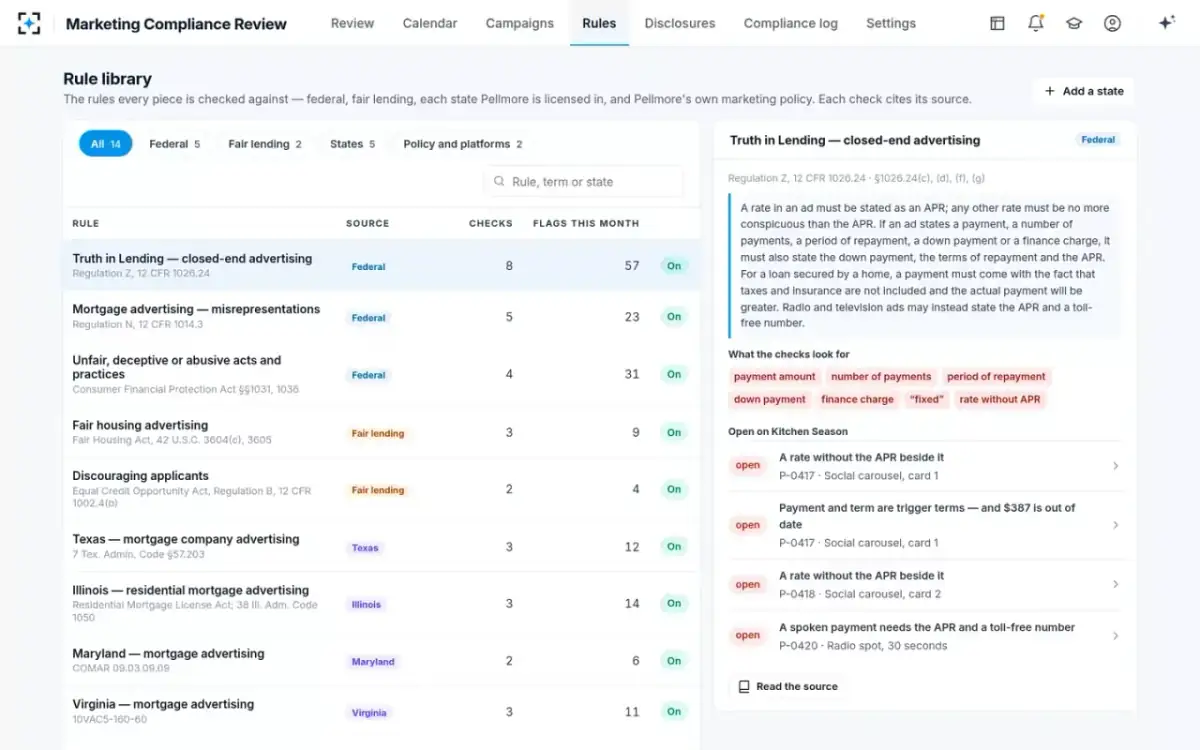
Illinois, which has no profile-page exception, flagged 14 pieces this month; Texas flagged 12.
On the sample campaign, one social post was clear in Texas and Maryland from the start, because the lender's profile carries its NMLS ID, and held in Illinois, Virginia and North Carolina until the licensing line was added to the post. The radio spot in the same campaign was held for Virginia because the identifier has to be read aloud after the lender's name. The loan officer guide covers the people who post most often under these rules, and the annotated post shows the line in place. The Marketing Compliance Review page shows the state grid for a whole campaign.
Questions people ask
Does the NMLS number have to be on a business card?
In North Carolina, yes: the statute names business cards. Texas counts business cards as advertisements, so its content rule applies to them. Elsewhere, check whether the state defines an advertisement broadly enough to include them.
Is the company's NMLS ID enough, or does each loan officer need theirs?
It depends on who is advertised. Illinois and Texas require the loan officer's identifier in addition to the company's when an ad promotes or runs through the loan officer. Maryland's rule for loan officers asks for the officer's own identifier and the employer's name.
What is the NMLS Consumer Access website, and why do ads name it?
It is the public site where a borrower can look up a company's or loan officer's licences by name or NMLS ID. Illinois and Virginia require its address, www.nmlsconsumeraccess.org, in the ad itself, so a reader can check the licence the identifier refers to.
Does a radio ad have to read the NMLS ID aloud?
In Virginia, yes: the disclosure "shall be provided after the name of the mortgage lender or mortgage broker" in radio and television ads. In the sample campaign the radio spot was held for Virginia on exactly that point, alongside a spoken payment that needed its APR.
Does an email signature need the NMLS ID?
When the email promotes a mortgage loan, it is an advertisement in Texas's "any medium" definition and a solicitation under North Carolina's statute, so the identifier belongs in it. Putting it in every loan officer's signature by default settles the question once.