A mortgage marketing compliance checklist has to answer two questions about every ad, and many answer only one. The first is whether the ad says everything the rules require: the APR beside any rate, the repayment terms after any payment or term, the licensing line, the equal housing statement. The second is whether everything the ad says is true: that the rate is one the lender will actually offer, that "no closing costs" means no fees, that "guaranteed" is guaranteed. Regulation Z's trigger rules govern the first; Regulation N, Regulation Z's "actually available terms" rule and the federal ban on deceptive practices govern the second. An ad can pass every disclosure check and still be deceptive. Botminds' Marketing Compliance Review runs the two as separate checks by separate agents, so a complete disclosure never hides a false claim. This guide is the checklist, in both halves.
Two checks on the same ad, and what each one can see
Is everything required there?: Regulation Z §1026.24(c)–(g) and §1026.16; state licensing lines; equal housing rules.
Is everything stated true?: Regulation N §1014.3; Regulation Z §1026.24(a) and (i); the CFPA’s ban on deceptive acts.
Is everything required there?: The ad alone.
Is everything stated true?: The ad plus the rate sheet in force, product terms, fee schedule and the proof behind each claim.
Is everything required there?: “A rate without the APR beside it.”
Is everything stated true?: “The advertised APR is not one the lender offers on the run date.”
Is everything required there?: Add a sentence.
Is everything stated true?: Change the claim, or prove it.
Is everything required there?: Largely yes: the list is short and mechanical.
Is everything stated true?: Only with access to the lender’s own numbers and files.
Why an ad with every disclosure can still be deceptive
Disclosure rules assume the disclosed numbers are real. Regulation Z begins its advertising section with that assumption made explicit: an ad that states specific credit terms "shall state only those terms that actually are or will be arranged or offered by the creditor" (§1026.24(a)). The trigger rules that follow then add the APR, the repayment terms and the rest. A perfect set of disclosures built around a rate the lender will not offer is a perfectly formatted misrepresentation.
Regulation N widens the test to every term and every channel. It is a violation "for any person to make any material misrepresentation, expressly or by implication, in any commercial communication, regarding any term of any mortgage credit product" (12 CFR 1014.3), and the rule lists nineteen categories, from interest and fees to government affiliation and the likelihood of approval. Above both sits the Consumer Financial Protection Act, which makes it unlawful "to engage in any unfair, deceptive, or abusive act or practice" (12 U.S.C. 5536).
Four kinds of mortgage ad, by whether the disclosures are there and whether the claims are true
Claims true
Incomplete, true
“6.49% fixed” — the lender does offer 6.49%, but no APR appears beside it.
Fix: add a sentence
Complete, true
“6.59% APR (6.49% fixed interest rate)”, with the repayment example, from the rate sheet in force.
Clear to sign
Claims false
Incomplete, false
“Guaranteed approval… payments as low as $387/month” — no terms, no guarantee, and last month’s payment.
Fix: rewrite and add
Disclosures missing
Disclosures complete
The bottom-right cell is the dangerous one, because every control that reads only the ad reports it as clean. The sample post on this site landed in the bottom-left, which is easier: the missing APR draws a reviewer's eye to the rate, and the rate turns out to be stale. An ad written by an experienced team can land in the bottom-right instead, because the team knows the trigger rules and does not know this morning's rate sheet.
The case that shows the gap: Low VA Rates, 2020
The CFPB's 2020 action against Low VA Rates found both failures in the same mailers, and the truth failure came first in its list. The Bureau found that the company's ads "misrepresented the credit terms of the advertised mortgage loan by stating credit terms that the company was not actually prepared to offer to consumers, including misrepresenting the annual percentage rate". It also found the ads "failed to properly disclose, when required by Regulation Z, credit terms for the advertised mortgage", used "misleading rhetorical questions" and implied the loans could help consumers eliminate debt (CFPB, 26 October 2020).
"Stating credit terms that the company was not actually prepared to offer to consumers, including misrepresenting the annual percentage rate."
CFPB, Low VA Rates consent order announcement, 2020
The penalty was $1.8 million, and the case was the ninth from a sweep of VA-loan mailers that produced more than $4.4 million in penalties. The guide to what misleading ads cost puts those numbers next to the statutory maximums. The point for a checklist is narrower: the APR in those mailers was disclosed. It was disclosed wrongly.
The truth failure does not need bad intent. The Federal Reserve's examiners describe a bank that advertised a discounted floor rate on a new home equity line that "borrowers did not actually receive", because "account parameters and periodic statements were not set up properly to reflect the advertised rate" (Consumer Compliance Outlook, 2021). The ad matched the product team's intention. It did not match the system that priced the loans.
What is Regulation N in mortgage advertising? The claims it catches that triggers do not
Regulation N is the Mortgage Acts and Practices – Advertising rule, 12 CFR part 1014: it bans material misrepresentations about any term of a consumer mortgage in any commercial communication, and makes advertisers keep the evidence. It covers "persons over which the Federal Trade Commission has jurisdiction", which means nonbank lenders, brokers and others outside the banking agencies' reach; banks answer for the same conduct under the Consumer Financial Protection Act and Regulation Z. Its definition of a commercial communication runs from billboards and "on-hold" scripts to "Web pages" and "the internet", so no channel is outside it.
Most of the truth half of the checklist is a handful of phrases that recur in lending ads, each mapped to a Regulation N category. The categories are broad, so a reviewer's job is to know which evidence answers each one.
Six phrases, the Regulation N category each touches, and the evidence that clears it
| Phrase in the ad | Regulation N, §1014.3 | Evidence that clears it |
|---|---|---|
| “Guaranteed approval”, “pre-approved” | (q) the consumer’s ability or likelihood to obtain credit, including whether “preapproved or guaranteed” | Usually none: rewrite to a claim the lender can prove, such as decision speed |
| “No closing costs”, “no fees” | (c) fees or costs, “including… misrepresentations that no fees are charged” | The fee schedule; state what is paid and what is charged |
| “Fixed” | (g) variability of interest or payments, including misuse of “fixed” | Product terms showing the rate cannot change, or the period it is fixed for |
| A rate, an APR, a payment | (a), (b) interest and rates; Regulation Z §1026.24(a) | The rate sheet in force on every day the ad runs |
| A seal, an eagle, “VA program notice” | (n) association with a government program, including through “formats, symbols, or logos” | Nothing: remove the resemblance |
| “Lowest rates in Texas” | A deceptive-claim risk under the CFPA | A survey of the market the claim names, dated and kept |
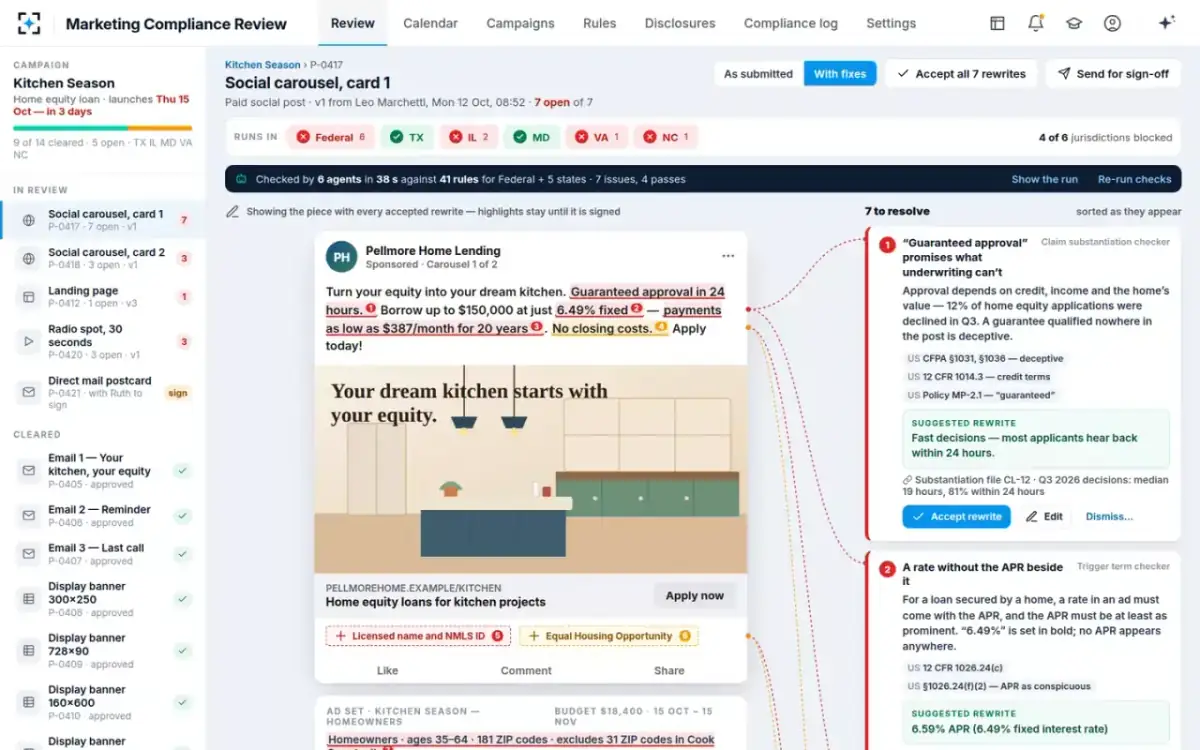
The truth check and the disclosure check, side by side in the margin
What is UDAAP in mortgage advertising?
UDAAP is the Consumer Financial Protection Act's ban on unfair, deceptive or abusive acts or practices, and for advertising the working test is deception: whether the ad, taken as a whole, is likely to mislead a reasonable consumer about something that matters. The Act makes it unlawful for a covered person "to engage in any unfair, deceptive, or abusive act or practice" (12 U.S.C. 5536). It defines unfairness, as conduct causing "substantial injury to consumers which is not reasonably avoidable" (12 U.S.C. 5531(c)), and abusiveness, but not deception.
For deception, regulators use the standard the FTC set out in 1983. "There must be a representation, omission or practice that is likely to mislead the consumer"; the representation must be "material", meaning "likely to affect a consumer's choice of or conduct regarding a product"; and "the entire advertisement, transaction or course of dealing will be considered" (FTC Policy Statement on Deception). Two lines of that statement decide a lot of mortgage ad reviews. The FTC "presumes that express claims are material", so a stated rate or a "guaranteed" never gets the benefit of the doubt. And "written disclosures or fine print may be insufficient to correct a misleading representation", which is why a footnote cannot rescue a headline.
The deception test, applied to three lines from mortgage ads
| Line in the ad | Likely to mislead? | Material? | Cured by fine print? |
|---|---|---|---|
| “Guaranteed approval in 24 hours” | Yes: approval depends on credit, income and the home’s value | Yes: an express claim, presumed material | No: the headline makes the promise |
| “No closing costs*” with “*$395 origination fee applies” below | Yes: the net impression is that nothing is charged | Yes: cost is the point of the claim | Unlikely: the footnote contradicts the headline |
| “Rates as low as 6.59% APR” from the sheet in force | No, if the rate is on offer to borrowers the ad targets | Yes | Not needed, if the terms are disclosed |
Can a mortgage ad say “lowest rate” or “fixed”?
Only if the lender can prove the comparison and the rate really does not change for the period the ad names. "Lowest" is a comparative claim about the whole market, so it needs a dated survey of the market the ad names, and it goes stale as fast as competitors' rate sheets. On the sample lender's landing page, "the lowest rates in Texas" was held because nothing on file could support it.
"Fixed" has its own text in both regulations. Regulation N lists misrepresentations about "the variability of interest, payments, or other terms… including but not limited to misrepresentations using the word 'fixed'". For home-secured ads, Regulation Z goes further: an ad for an adjustable-rate loan may use "fixed" only if "Adjustable-Rate Mortgage", "Variable-Rate Mortgage" or "ARM" appears before the first "fixed" and at least as conspicuously, and each "fixed" carries the period it lasts and the fact that the rate may vary or the payment rise after it (§1026.24(i)(1)). "5-year fixed" on a 30-year ARM is a disclosure problem before it is a truth problem.
How often each half fires on one lender's campaigns
On the sample lender's campaigns this month, the truth rules flag almost as often as the disclosure rule. The rule library counts each rule's flags: Regulation Z's closed-end advertising rule fired 57 times; Regulation N and the UDAAP prohibition fired 54 times between them.
On a sample lender in Marketing Compliance Review, truth rules flag almost as often as the disclosure rule
What does a mortgage marketing compliance checklist include? Two halves
The checklist below keeps the halves apart on purpose. A reviewer who works down a single list tends to stop once the disclosures are in place; one who must sign off each half separately has to open the rate sheet.
Mortgage advertising compliance checklist: first the disclosures, then the truth
- Disclosures · APR beside any rate
Stated as an “annual percentage rate” or “APR”; on a dwelling-secured loan, no other rate more conspicuous.
- Disclosures · repayment terms after any trigger
A payment, term or finance charge (or a down payment, in a credit sale) brings in the down payment, repayment terms and APR, close by and as prominent.
- Disclosures · the medium’s rule
Broadcast alternative for radio and TV; §1026.16 for lines of credit; foreign-language ads disclose in the same language.
- Disclosures · licensing and equal housing lines
Each state’s wording for every state the ad runs in; the equal housing statement in a form fit for the medium.
- Truth · every number against the rate sheet in force
For each day the ad will run, not the day it was written. Note the sheet’s identifier.
- Truth · every absolute against a file
“Guaranteed”, “no fees”, “fixed”, “lowest”, “pre-approved”: proof, or different words.
- Truth · the overall impression
Rhetorical questions, government-looking formats, savings comparisons and debt-elimination promises, read as a consumer would.
- Truth · the audience
Who will see it, who is excluded, and whether counsel has seen any exclusion.
How Marketing Compliance Review keeps the two checks apart
In the solution, the two halves belong to different agents. The trigger term checker answers "is everything required there?". The claim substantiation checker answers "is everything stated true?" by tying every rate, fee, amount and speed claim to the rate sheet in force on the run dates and to the lender's substantiation files, and citing the line that proves or disproves it. Its written limit is that it never treats an unsupported claim as true.
On the sample post, the substantiation checker found two claims that did not hold against rate sheet RS-2026-41 and substantiation file CL-12: the guarantee and the closing costs. Its evidence went into the rewrite. "Guaranteed approval" became "Fast decisions — most applicants hear back within 24 hours", backed by the file's median decision time of 19 hours. Once the reviewer accepted it, the changed line was checked again against every rule for its jurisdictions before anything else moved.
A false claim replaced by a provable one, then checked again
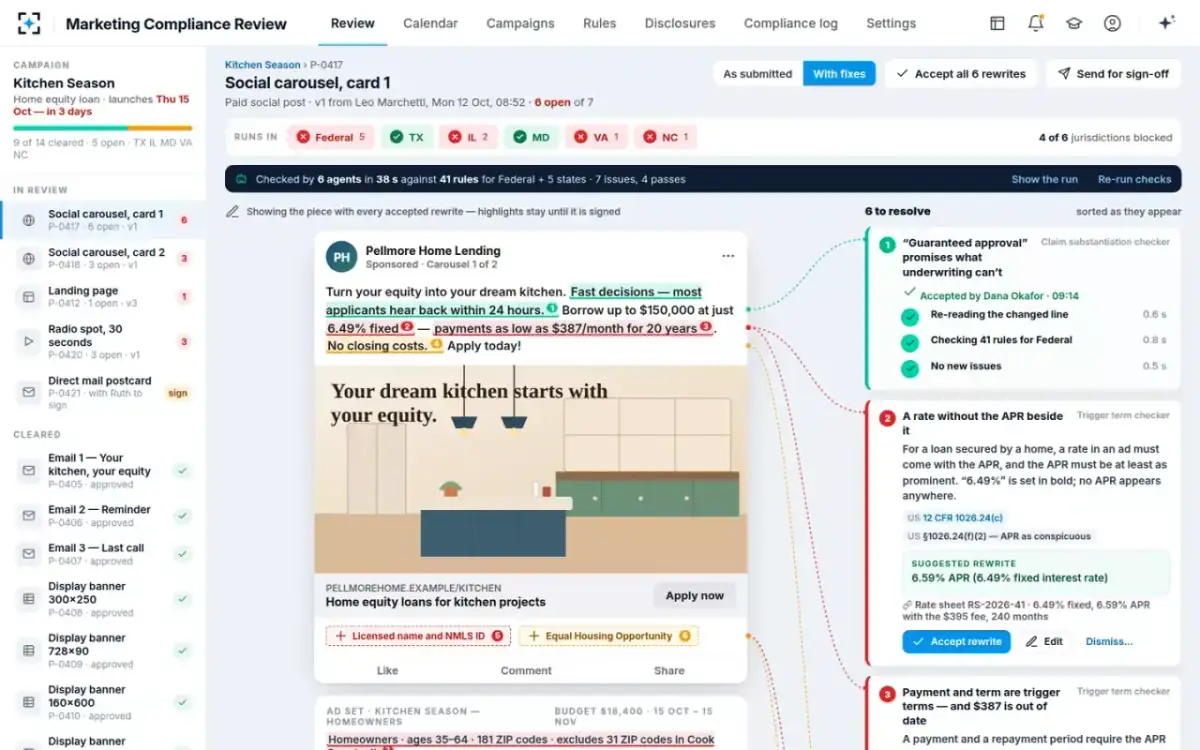
The re-check matters for the same reason the halves are separate. A rewrite that fixes a truth problem can create a disclosure one, if the new wording adds a term, and the reverse. The trigger terms guide covers the first half in depth, and the rate-sheet guide the hardest item in the second. The Marketing Compliance Review page shows both on a whole campaign.
Questions people ask
Can a mortgage ad say "guaranteed approval"?
Only if the lender truly guarantees it, which lenders that underwrite do not. Regulation N names misrepresentations about whether a consumer "has been preapproved or guaranteed", and Virginia adds that an ad saying "pre-approved" must state in 14-point bold type that "THIS IS NOT A LOAN APPROVAL".
Does Regulation N apply to banks?
Not directly. It applies to persons within the FTC's jurisdiction, which excludes banks and federal credit unions, so it binds independent mortgage companies, brokers and other nonbank advertisers. Banks reach the same place through the Consumer Financial Protection Act's ban on deceptive practices and Regulation Z's own "actually available terms" and home-secured ad rules.
How long must mortgage ads be kept?
Under Regulation N, 24 months from the last date the ad ran, together with evidence of the products available while it ran. Some states ask for longer: Virginia requires an example of every ad for three years after it was last published.
Does the same checklist work for home equity lines of credit?
The truth half does; the disclosure half changes. Lines of credit follow §1026.16, where a negative statement such as "no annual fee" triggers disclosures and an introductory rate must carry its period and the rate that follows, beside every mention.
Does the CFPB's withdrawal of guidance in 2025 change this checklist?
No. In May 2025 the CFPB withdrew dozens of guidance documents, including a 2022 interpretive rule on digital marketers, but the statutes and regulations cited here, Regulation Z, Regulation N and 12 U.S.C. 5536, are unchanged.