Marketing compliance review software is worth buying for one reason: it shortens the approval process without loosening it. A marketing compliance approval process has three parts: marketing submits a complete piece, compliance reviews it against federal and state rules within an agreed time, and a named person approves it, with the version that ran kept on file. It fails in a predictable way. Pieces come back with comments rather than corrected wording, go round again, and the review queue becomes the reason campaigns launch late, so marketing learns to submit at the last moment or not at all. Botminds' Marketing Compliance Review changes what comes back: each piece returns marked up, with the rule each claim breaks and the compliant wording already written from the live rate sheet. Software alone does not change the habit, though. This guide covers who approves what, how each seat's work changes, and the stages by which marketers and reviewers come to rely on the drafted rewrites without rubber-stamping them.
Five seats in the approval process, and what changes in each
Today
Learns a piece is wrong, not what to change, and waits through rounds while launch day gets closer.
With agents
Sees each piece against each state, what is holding it, and compliant wording written in the brand’s voice.
Still theirs: The campaign, the message and the call on whether to keep a rate in the ad at all.
Today
Writes the same APR comment by hand on piece after piece, and sends each one back for another round.
With agents
Opens each piece already marked up; accepts, edits or dismisses each rewrite with a reason.
Still theirs: Every decision on every change, and the brand judgement the rule cannot make.
Today
Posts rates on social media outside any review.
With agents
Submits rate posts into the same queue and gets them back fixed.
Still theirs: The relationship with their own followers.
Today
Hears about ZIP code exclusions after the ad set has run.
With agents
Gets targeting, new claims and government-affiliation questions before sign-off.
Still theirs: Every legal judgement; the agents never clear a targeting issue.
Today
Signs rate ads from a PDF of comments she has to reconstruct.
With agents
Sees version 1 and version 2 side by side, every change with its rule and who decided it.
Still theirs: The signature on home-secured ads that state a rate, payment or fee.
Who approves bank and lender advertising: compliance, legal or both?
No federal rule names the approver; the lender's policy does, and the clearest policies split the decision by risk. The FFIEC's social media guidance, which the banking agencies use as supervisory guidance, expects "a governance structure with clear roles and responsibilities" and policies for "the use and monitoring of social media and compliance with all applicable consumer protection laws" (78 FR 76297). The Federal Reserve's examiners recommend that the compliance function review advertising, and note that "strong policies, procedures, and tools are beneficial to address staff turnover" (Consumer Compliance Outlook, 2021).
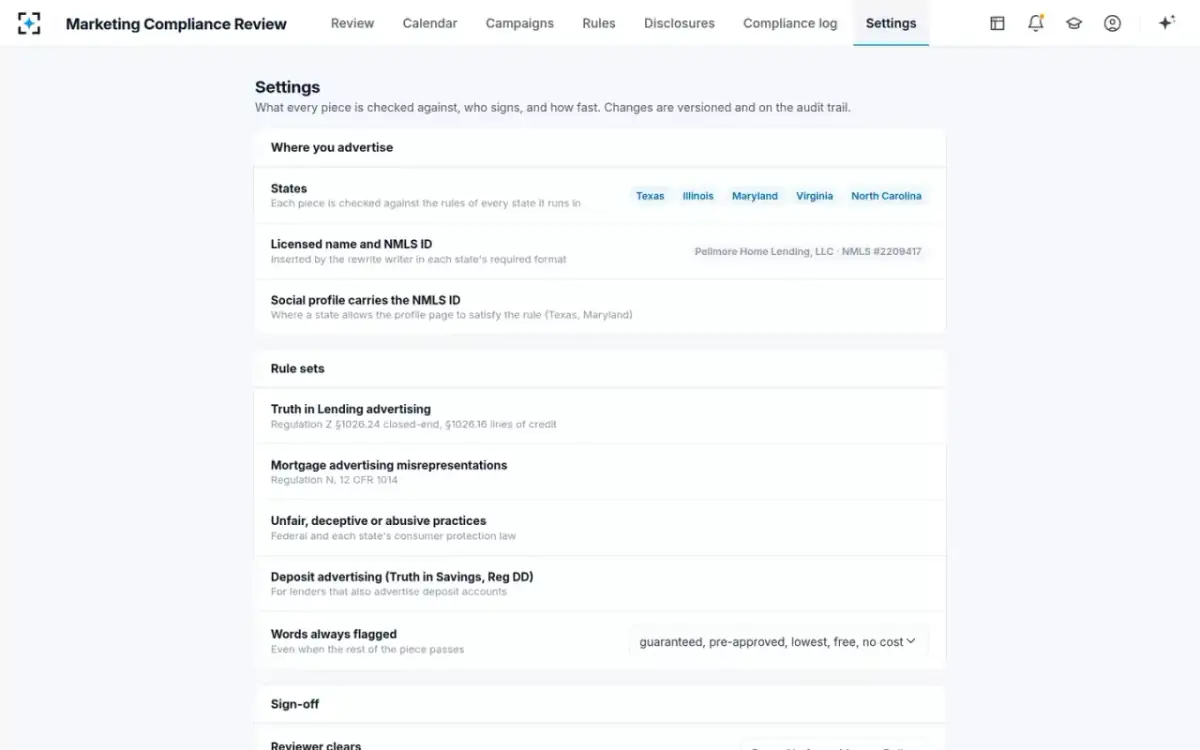
The sample lender in Marketing Compliance Review splits approval three ways, all held as settings. A compliance reviewer clears pieces with no rate. The Chief Compliance Officer, or a delegate, signs home-secured ads that state a rate, payment or fee. Counsel decides audience targeting, new claims and any question of government affiliation, and sees each before sign-off. Each approval expires after 12 months even if nothing changes, and rate pieces come back for review whenever the rate sheet they quote changes.
Who signs, what is always flagged, and how fast, as settings
How long should a marketing compliance review take?
Long enough to read and check, and no longer; in our estimate, most of a by-hand review is waiting. In our estimate for one rate ad reviewed by hand, about 45 working hours pass from submission to a cleared piece, roughly 5.6 business days. Twenty of those hours are the piece sitting in the queue, and fourteen are comments, rewrites and rounds with marketing. Reading, checking the rate sheet and checking each state's rules take eight hours between them.
Most of a by-hand review is waiting and rounds, not reading
- Waiting in the queue20 h
- Reading and checking8 h
- Comments and rounds14 h
- Sign-off3 h
- Queue
- Checks
- Rewrites
- Sign-off
Two levers follow from that split. The queue shrinks when the first read is instant and the reviewer starts from a marked-up piece rather than a blank one; the sample lender sets its review clock at one business day from a complete submission. The rounds shrink when what goes back to marketing is a fix rather than a comment. The second lever is the one that changes behaviour, because it changes what marketing expects to receive.
What makes a submission complete, and why the clock starts there
A complete submission is one a reviewer can clear without asking a question: final words, every version, every place it runs and the evidence behind every claim. The sample lender's review clock, one business day, runs "from a complete submission", and that phrase does more for turnaround than any tool, because most rounds begin with a missing piece of information rather than a broken rule.
What a complete submission carries
- Every word the viewer will see or hear
Copy, text inside images, fine print, link cards, every carousel card, the radio or video script.
- Every version
Each size, channel and language. A Spanish version is a separate ad that must say what the English one says.
- Where and when it runs
States, channels, run dates and the audience settings, so the right state rules and the right rate sheet apply.
- The source of every number
The rate sheet and its identifier; the fee schedule; the product terms.
- The proof behind every claim
Decision times for a speed claim, a dated survey for “lowest”, programme terms for anything named.
- Who owns it
The marketer, the agency or the loan officer who will make the changes and receive the approval.
How to get marketing to submit pieces to compliance early
Send back fixes rather than verdicts, and make the queue visible. Marketing teams submit late when review feels like a verdict they cannot influence. Research on how people adopt imperfect algorithms points to the same remedy for both marketers and reviewers: give them control over the output. In three experiments, participants "were considerably more likely to choose to use an imperfect algorithm when they could modify its forecasts", and the preference held "even when participants were severely restricted in the modifications they could make" (Dietvorst, Simmons and Massey, Management Science, 2018).
"Participants were considerably more likely to choose to use an imperfect algorithm when they could modify its forecasts."
Dietvorst, Simmons and Massey, 2018
In marketing review the modifications are the edit button and the dismissal. A reviewer who can change a drafted rewrite, or dismiss a flag with a reason, uses the drafts; one who can only accept or reject them may retype them. The same holds on the marketing side. A marketer who sees "Fast decisions — most applicants hear back within 24 hours" in place of "Guaranteed approval" can argue with the wording, which is a conversation; "remove guarantee language" is an instruction, which starts a round.
How to roll out marketing compliance review software: four stages of trust
Trust should be earned with numbers the team can see, and it should stop short of letting the drafts approve themselves. Research on automation bias warns that it "cannot be prevented by training or instructions" (Parasuraman and Manzey, 2010), so each stage below keeps a measure that would show reviewers drifting into rubber-stamping.
Four stages of trust, and the measure that moves the team to the next
| Stage | What the reviewer does | Move on when |
|---|---|---|
| 1 · In parallel | Reviews a set of recent pieces by hand, then compares her issues with the agents’ flags. | Every issue she found was flagged, and every extra flag has an explanation she accepts. |
| 2 · Start from the markup | Opens live pieces already marked up and accepts, edits or dismisses each rewrite. | Edits and dismissals settle at a level the team can explain, with reasons that repeat. |
| 3 · Marketing sees fixes | Marketing receives marked-up pieces and proposed wording; rounds become edits. | Rounds per piece and time in the queue fall, and late submissions become rare. |
| 4 · Steady state | Reviewer decides every change; CCO signs rate ads; counsel decides targeting. | Internal audit samples approvals and finds dismissals reasoned and versions complete. |
The measures at each stage come from what the solution already keeps: the issues flagged and accepted, the edits and their reasons, the time each piece spends in the queue, and who decided each change. Stage 1 can use pieces the team has already cleared, which makes it a fair test: the right answer is known. Internal audit's sampling in stage 4 is the check on the checkers, and the compliance log, which exports for an examiner, is what it samples.
Every campaign in Marketing Compliance Review, what is holding it, and the review clock
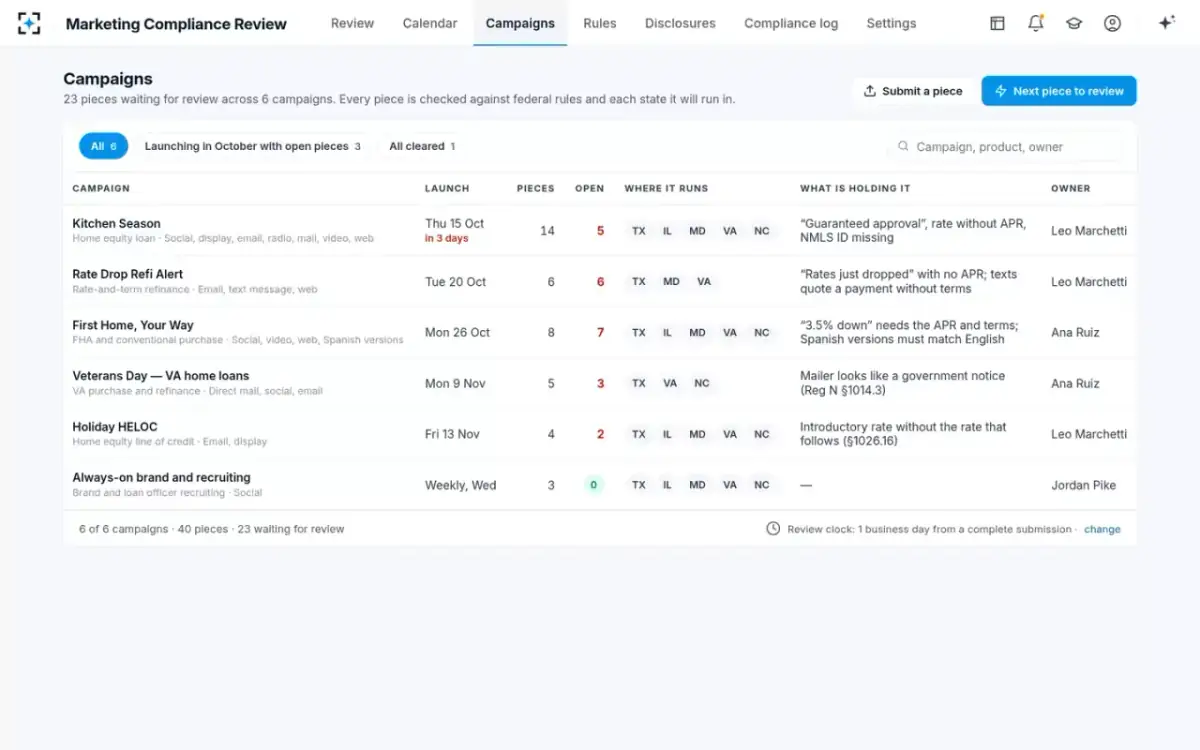
The footer sets the review clock; the calendar marks review work two business days before each launch.
What to look for in marketing compliance review software
Look for the things that remove rounds and the things that keep approvals defensible: a first read on submission, findings per piece per jurisdiction, fixes drafted from approved wording, routing by risk, re-review when a rate or rule changes, and a record an examiner can follow. Teams often start from email and shared PDFs, and the useful comparison is with that, not with another vendor's demonstration.
Email and PDF comments against review software, on the steps that take the time
Email and PDF comments: When a reviewer reaches the piece in the queue.
What to expect from review software: On submission, with every claim and number listed and checked.
Email and PDF comments: Comments: “add APR”, “remove guarantee”.
What to expect from review software: The rule broken and drafted wording, from approved disclosures and the live rate sheet.
Email and PDF comments: One reviewer’s memory of five states’ rules.
What to expect from review software: A grid of every piece against every jurisdiction it runs in.
Email and PDF comments: Whoever replies last.
What to expect from review software: Routing by risk: reviewer, Chief Compliance Officer, counsel, as settings.
Email and PDF comments: Nothing until the next submission.
What to expect from review software: Re-review when the rate sheet changes, a rule changes or the approval expires.
Email and PDF comments: Emails and attachments to reassemble.
What to expect from review software: An exportable log: version that ran, changes, reasons, signatures, dates.
Two questions separate tools that speed approvals from tools that only digitise them. Does the reviewer start from a marked-up piece with drafted fixes, or from a blank one with flags? And does the tool know what is live, so a new rate sheet or a changed state rule brings affected pieces back without anyone searching? The first removes rounds; the second removes the risk that an approval quietly outlives its facts. On the second, the sample lender's log flagged a summer refinance email for re-review because its rate sheet had expired, before anyone had asked.
Six numbers that show whether the approval process is working
Track time in the queue, rounds per piece, edits and dismissals, late submissions, re-reviews, and pieces pulled after launch; together they show whether review is faster, whether it is still careful, and whether marketing has changed its habits. Each is a by-product of the record a good process keeps, so none needs a separate survey.
Measures for a marketing compliance approval process, and which way they should move
| Measure | What it shows | Healthy direction |
|---|---|---|
| Hours in the queue before first review | Whether the clock is met | Down, then flat at the clock |
| Rounds per piece | Whether fixes, not comments, go back | Down towards one |
| Share of drafted rewrites edited or dismissed | Whether reviewers are still reading | Steady and explained; a fall to zero is a warning |
| Pieces submitted inside the review clock before launch | Whether marketing trusts the queue | Down |
| Re-reviews triggered by a rate or rule change | Whether live pieces are being watched | Present whenever sheets change |
| Pieces withdrawn or reissued after launch | Whether errors still escape | Down |
What records should a marketing compliance approval keep?
An approval is only as good as the file behind it. Regulation N requires copies of "all materially different commercial communications" and documents showing the mortgage products available while each ran, for 24 months after last use (12 CFR 1014.5), and some states ask for longer. The sample lender keeps every approval three years after the piece last runs, with every version, change, dismissal reason and signature.
That file is also what lets the team's trust be checked rather than assumed. The maker-checker guide explains why the agent that writes a rewrite never approves it, and the loan officer guide covers the seat that is hardest to bring into the queue. The cost guide prices what a late catch costs. The Marketing Compliance Review page shows a whole campaign moving through review.
Questions people ask
Should compliance review an ad before the creative is final?
Review the claims and numbers as early as they are settled; the trigger terms and the rate-sheet check depend on the words, not the design. A second, quick check on the final creative catches what the layout changed, such as type size and proximity.
How do we go live without slowing a campaign already in review?
Start stage 1 on pieces already cleared, so nothing in flight waits on the comparison. Move live pieces into the new queue at stage 2, one campaign at a time.
Is marketing compliance review software worth it for a small lender?
It depends on volume and spread more than size. A lender with a few pieces a month in one state may do well with a checklist and a reviewer. The case grows with each state, channel and loan officer who posts, and with how often the rate sheet changes under live ads.
Who should own the software, compliance or marketing?
Compliance should own the rules, the approval routing and the settings; marketing should own submissions and campaigns. In the sample setup, settings are versioned and on the audit trail, so a change to who signs or what is always flagged is recorded like any approval.
What is a review clock?
It is the agreed time from a complete submission to a decision, published so marketing can plan launches around it. The sample lender sets one business day and marks review work on the launch calendar two business days before each campaign goes live.