AI marketing compliance software can review a lender's ads, posts and scripts, and the useful question is which part of the review it should own. Can AI review marketing materials for compliance? It can do most of the reading, matching and drafting, and none of the deciding, provided the work is split the way banks have long split payments: one party prepares, another checks, a third approves. In lending advertising that means the agent that writes compliant wording is never the agent that decides whether the wording complies, and a person accepts, edits or dismisses every change. No federal regulator has issued guidance specific to AI in marketing review. What exists says existing law applies and the institution stays responsible for what its tools produce. Botminds' Marketing Compliance Review runs six agents with a written limit on each, and the rewrite writer may not approve anything. This guide explains why that separation matters more for language models than for people.
Who makes, who checks and who decides in Marketing Compliance Review
Agent
Creative readerLists every claim, number and footnote in the piece, with its size and position, and the audience settings.
Never: Guesses at text it cannot read; it flags it.
Agent
Four checkersTrigger terms, claim substantiation, state rules and fair lending, each against its own rules and evidence.
Never: Treats an unsupported claim as true, or carries one state’s carve-out to another.
Agent
Rewrite writerDrafts the shortest compliant wording, from the approved disclosure library and the live rate sheet.
Never: Invents a rate, fee or claim. Never approves.
Agent
Checkers againRe-check each accepted or edited line against every rule for its jurisdictions.
A person decides
Compliance reviewerAccepts, edits or dismisses each rewrite. A dismissal needs a written reason.
A person decides
CounselDecides audience targeting, new claims and any government-affiliation question.
A person decides
Chief Compliance OfficerSigns home-secured ads that state a rate, payment or fee, seeing every change and reason.
Can AI do compliance review of marketing materials? The reading, yes; the deciding, no
AI can do the part of marketing review that is reading and matching: every line of copy, the text inside images, the fine print, the audience settings, each matched to a rule and to the lender's own numbers. That part is large. In the sample run, six agents listed 14 claims and numbers, checked them against 41 rules for federal law and five states, and drafted seven rewrites in 38 seconds. What remains is judgement: whether a rewrite is right for the brand and the evidence, whether an audience exclusion has a lawful reason, whether a piece should run at all.
That division matches what regulators report about their own use of AI. The GAO found agencies using it "to help detect errors or outliers in data submitted by financial institutions", and that they "were not using AI to make decisions autonomously or relying on it as a sole source of input" (GAO-25-107197). A tool that reads everything and decides nothing fits that pattern; one that clears ads on its own does not.
Can AI check its own work? Why the writer should never be the checker
Separation of duties exists because people are poor judges of their own work, and language models turn out to share the weakness. A 2023 study of "intrinsic self-correction", in which a model reviews its own answer with no outside information, found that models "struggle to self-correct their responses without external feedback, and at times, their performance even degrades after self-correction" (Huang et al., 2023). A 2024 study found "self-preference, where an LLM evaluator scores its own outputs higher than others' while human annotators consider them of equal quality", and linked it to the model's ability to recognise its own text (Panickssery, Bowman and Feng, 2024).
For marketing review the consequence is practical. A single model asked to rewrite an ad and then confirm the rewrite complies is grading its own homework, with a measured tendency to like the answer. The remedy the research points to is the one compliance already uses: a check that has different inputs from the work it checks. In ad review those inputs exist. The checker can hold the rule text, the rate sheet and the substantiation file; the writer's job is to produce words.
"LLMs struggle to self-correct their responses without external feedback, and at times, their performance even degrades after self-correction."
Huang et al., Large Language Models Cannot Self-Correct Reasoning Yet, 2023
Self-check and independent check, on the same rewrite
The writer checks its own rewrite: Its own draft and its own reading of the rule.
Separate checkers re-run the rules: The rule text, the live rate sheet, the substantiation file and the state rules, each held by a different checker.
The writer checks its own rewrite: Tends to rate its own output higher than equal-quality alternatives.
Separate checkers re-run the rules: No stake in the draft; it applies the same tests it applied to the original.
The writer checks its own rewrite: Rarely: it believes the rewrite is the fix.
Separate checkers re-run the rules: Yes: a rewrite that adds a payment is a new trigger, and the trigger checker sees it.
The writer checks its own rewrite: A verdict.
Separate checkers re-run the rules: The rewrite, the rule each one satisfies, the evidence, and the re-check result.
Do regulators allow AI for compliance review? What they have said, and what they have not
Regulators have said little about AI in marketing review specifically, and the useful statements are general. The Treasury reported in 2024 that firms use AI for "risk management, regulatory compliance, customer service, and back-office operations", and that use cases should be checked "for compliance with existing laws and regulations before deployment" (U.S. Treasury, 2024). The GAO found that the NCUA, CFTC and Federal Reserve use AI to detect errors in data institutions submit, and "were not using AI to make decisions autonomously or relying on it as a sole source of input" (GAO-25-107197).
The revised interagency model risk guidance of April 2026, which replaced SR 11-7, leaves the question open: "Generative AI and agentic AI models are novel and rapidly evolving. As such, they are not within the scope of this guidance" (SR 26-2). What does not change is accountability. In the words of a Federal Reserve examiner, "the institution remains responsible for ensuring that the output from vendor-provided systems and services meets regulatory requirements" (Consumer Compliance Outlook, 2019). An AI tool that drafts ad copy is such a system, which is a strong reason to design it so that a named person decides each change.
Where each error is caught in the Marketing Compliance Review chain
The chain works because each link catches a different kind of error, and the links cannot vouch for one another. The table follows the seven issues on the sample post through the chain.
Each link, the error it exists to catch, and an example from one post
| Link | Catches | On the sample post |
|---|---|---|
| Creative reader | Claims and audience settings nobody listed | 14 claims and numbers, including the ad set’s excluded ZIP codes |
| Checkers | Breaches of a rule, each against its own evidence | A rate without APR; a payment from the August sheet; a $395 fee behind “no closing costs”; no NMLS line for three states |
| Rewrite writer | Nothing: it drafts | Seven rewrites, every number from rate sheet RS-2026-41 |
| Re-check | Problems the rewrite itself introduced | Each accepted line re-checked against 41 rules; no new issues |
| Reviewer | A rewrite that is compliant but wrong for the brand or the evidence | Each wording change accepted by name, the first at 09:14 |
| Counsel | Questions with legal consequences | The excluded ZIP codes; a new audience confirmed |
| CCO | Anything the earlier links missed or overrode | Signed at 09:19, with every change and its rule on one screen |
Six agents, each step shown, then waiting for a person
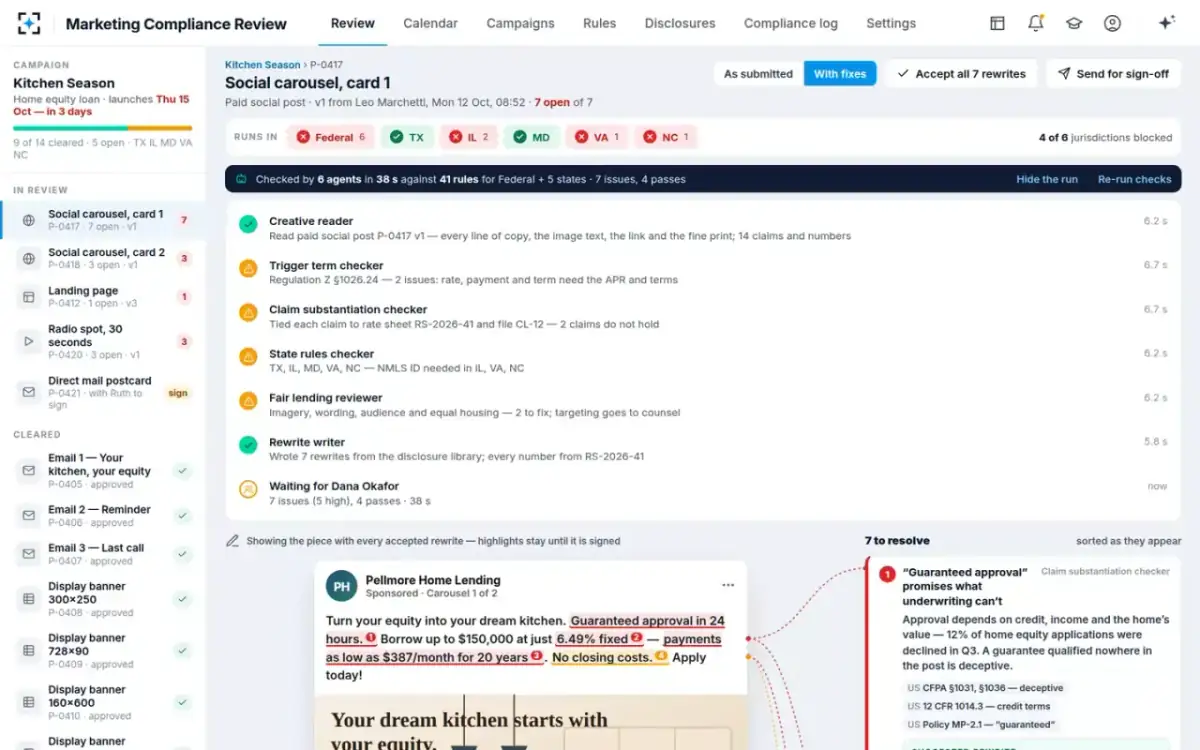
What is automation bias in compliance review, and how do you keep the reviewer awake?
A human approver is only a control if the human actually reviews. Research on automation bias is blunt about the risk: it "occurs in both naive and expert participants, cannot be prevented by training or instructions, and can affect decision making in individuals as well as in teams" (Parasuraman and Manzey, 2010). An "Accept all" button over seven rewrites invites exactly that.
Three features of the solution push against it. Each rewrite shows the rule it satisfies and the evidence behind its numbers, so accepting means reading a citation, not a verdict. A dismissal needs a written reason, which is shown to the Chief Compliance Officer at signature and kept with the approval. And the targeting question cannot be accepted by the reviewer at all; it goes to counsel. Each makes the person's decision visible later, which is what makes it a decision now.
One rewrite accepted by name, then re-checked by the checkers
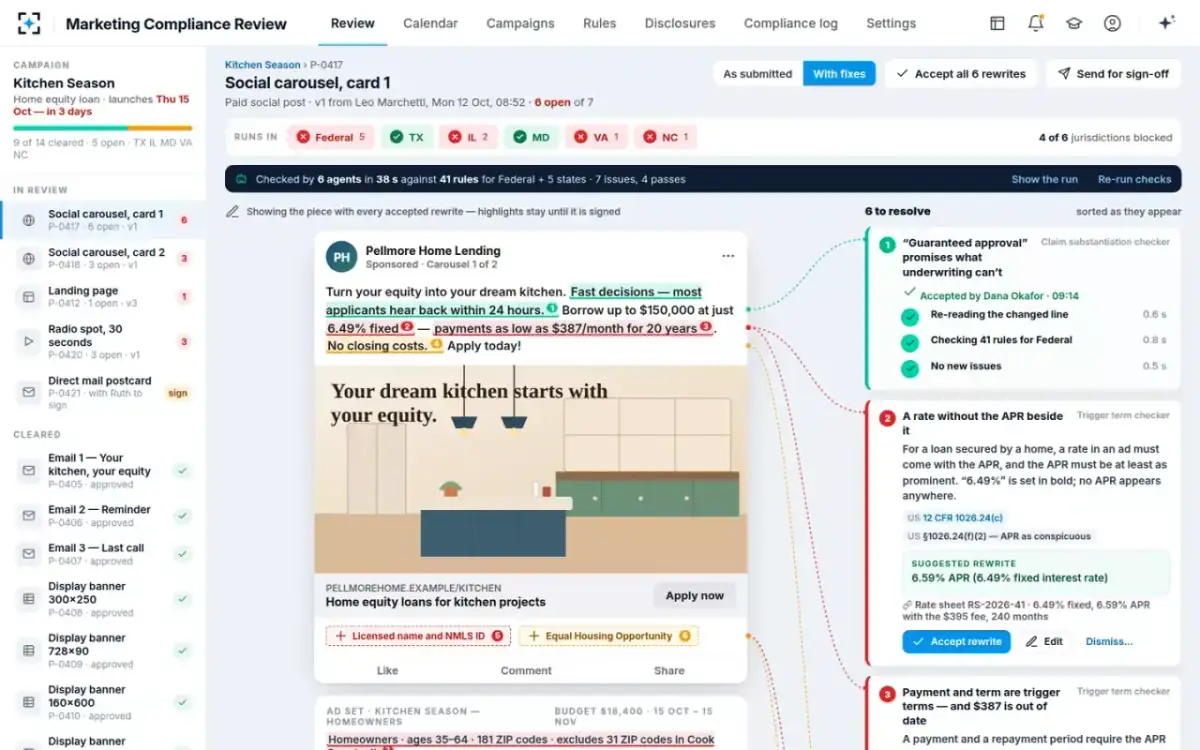
What to look for in AI marketing compliance software
Look for separation, evidence and a record: a writer kept apart from the checkers, every finding tied to a rule and to the lender's own numbers, and a person's name on every decision. The test of all three is whether you could show an examiner, for any ad that ran, every change, its rule, who decided it and the version that ran, for the 24 months Regulation N requires (12 CFR 1014.5). The eight questions below probe each part.
Eight questions for any AI marketing compliance software
- Who writes and who checks?
Separate components with separate inputs, or one model asked twice. Can a reviewer see which raised each finding?
- Where do the numbers come from?
Only the live rate sheet and an approved wording library, or whatever the model produces.
- Is every accepted line re-checked?
A rewrite that adds a payment adds a trigger; the re-check should find it.
- Does it read beyond the copy?
Image text, fine print, link cards, carousel cards and the ad set’s audience.
- Which rules does it hold for your footprint?
Federal rules for your charter type, and each state you advertise in, with sources and dates.
- What can a reviewer not do alone?
Dismiss without a reason, bulk-accept, or clear an audience question that belongs to counsel.
- What does it keep?
For each piece that ran: versions, findings, rules, decisions, signatures, the sheet it quoted, the re-review date.
- What happens when a rule or a rate changes?
Live pieces found and re-checked, or nothing until the next submission.
The charter question is easy to miss. Regulation N binds nonbank advertisers; FDIC-supervised banks carry their own equal housing ad rule (12 CFR 338.3); state rules bind licensees. A tool with a good federal library and no rules for the states you lend in will pass ads that Illinois or Virginia would hold. Botminds' Marketing Compliance Review holds its rules as a library with each rule's source, and the sample lender's configuration covers federal rules and five states. That is the right shape; whether it is the right content for a given lender is a question for the trial.
A tool that answers those well lets reviewers spend their time on the judgements in the lower half of the table. The approval-process guide looks at how a team comes to trust the rewrites, and the annotated post shows the chain on one ad. The Marketing Compliance Review page shows the agents and their limits.
How to test AI marketing compliance software before buying it
Run it on your own past pieces, with the findings your reviewers already made, and add a few tests aimed at the ways language models fail. A general accuracy figure from a vendor's own sample tells you little; the tests below tell you whether the design holds when the model is wrong.
Five tests aimed at how AI review fails, and the result to expect
| Test | How to run it | A pass |
|---|---|---|
| Invention | Submit an ad whose fix needs wording your library does not hold | The tool flags the gap and asks; it does not invent a rate, fee or claim |
| Self-grading | Accept a rewrite that adds a payment amount | The re-check raises the new trigger and its disclosures |
| Consistency | Submit the same ad twice, a day apart | The same findings, the same rules cited |
| Citations | Pick ten findings at random and read the cited rule text | Each rule exists and says what the finding claims |
| Automation bias | Try to accept every rewrite at once, or dismiss without a reason | The interface does not allow it |
For the content half of the trial, a bench of past ads with planted problems, such as a stale rate, a missing state line or a ZIP code exclusion, works for any tool; the worked post lays one out. Treat the trial as a third-party risk review too. Banks still apply the 2023 interagency third-party guidance; in September 2026 the agencies proposed a principles-based replacement that, like all supervisory guidance, "is non-binding" (joint release, 11 September 2026).
Will AI replace compliance officers? What moves to the agents and what stays
It moves the reading and drafting to software and leaves the decisions, the policy and the relationship with marketing with people. The tasks that move are the ones that consume a reviewer's day without using their judgement: reading every line, listing claims, looking up rules, checking numbers against the sheet, writing the standard sentence. The tasks that stay are the ones examiners and boards hold a person accountable for.
The marketing review job, task by task, in the Marketing Compliance Review design
| Task | Who does it | Why |
|---|---|---|
| Read every line, image and setting | Agents | Exhaustive reading is what software is better at than people |
| Match each claim to rules and evidence | Agents | Mechanical, and done the same way every time |
| Draft compliant wording | Agent, from approved wording only | Saves the reviewer the most time; never a control |
| Accept, edit or dismiss each change | Compliance reviewer | The judgement the control exists for, recorded by name |
| Audience and new claims | Counsel | Legal consequences |
| Sign rate ads on home-secured loans | Chief Compliance Officer | Accountability the regulator expects a person to hold |
| Set policy, train marketing, handle exceptions | Compliance team | Outside any single review |
Questions people ask
Can the AI approve an ad on its own?
Not in this design. The agents recommend; the compliance reviewer accepts, edits or dismisses each change, counsel decides targeting and new claims, and the Chief Compliance Officer signs home-secured ads that state a rate, payment or fee.
Is an AI ad review tool a "model" under model risk guidance?
The April 2026 interagency guidance puts generative and agentic AI outside its scope and excludes "deterministic rule-based processes". The agencies said they plan a request for information on AI. Until then, the institution's own third-party and compliance controls carry the weight.
How long does an AI review of one ad take?
The machine part is short: on the sample post, six agents finished in 38 seconds, and the re-check after each accepted rewrite took under two seconds. The whole review, including a reviewer's decisions, counsel's audience call and the signature, took 27 minutes. People set the pace, which is the point.
Does the same software work for banks and nonbank lenders?
The design does; the rule set differs. Regulation N binds nonbank advertisers, banks answer for the same conduct under the Consumer Financial Protection Act, FDIC-supervised banks have their own equal housing ad rule, and state ad rules bind licensees. Software should let the lender's charter and footprint decide which rules apply.
Is it safe to send ads and rate sheets to an AI vendor?
Ads are published material, but drafts, rate sheets and substantiation files are not, so the vendor is a third party handling confidential data. Banks apply third-party risk management to such vendors; the agencies' September 2026 proposal would replace the 2023 guidance, which stays in force until it is final.