A loss mitigation waterfall is an investor's rule for evaluating a delinquent borrower: a ranked list of options, from the least to the most drastic, that the servicer must test in order, offering the first one the borrower qualifies for and treating every option below it as denied. A typical order runs from a repayment plan or forbearance, through a partial claim or payment deferral, to loan modifications with longer terms and deferred principal, and finally to a short sale or deed in lieu of foreclosure. What makes the subject hard is that the waterfall belongs to whoever owns or insures the loan, not to the servicer, so one servicing team may run five or more different orders on the same morning, each with its own payment target, cap and effective date. Botminds' Loss Mitigation Waterfall Decisioning exists for that: agents identify the owner, select the waterfall version in force on the evaluation date and run every step with the arithmetic shown, and a workout underwriter decides.
A waterfall is an evaluation rule. … This means that, if the borrower is offered the option at the "top" of the waterfall, the borrower is denied all other options lower in the waterfall.
CFPB, 2013 RESPA Servicing Rule Assessment Report, 2019
What is a loss mitigation waterfall?
The CFPB's own definition is the plainest. Investors "often require servicers to evaluate borrowers for loss mitigation according to a 'waterfall' of options. A waterfall is an evaluation rule." An owner might list six programs, require them to be "evaluated in order from one through six", and provide that "if a borrower is offered a program evaluated higher in the order, the borrower will be denied for all other programs lower in the order" (CFPB assessment of the 2013 servicing rules, 2019). That is also why the CFPB could find few files in its data where a borrower was offered more than one option: the waterfall makes one offer by design.
The loss mitigation waterfall process therefore has three moves on every file: identify whose waterfall applies, establish the inputs each step reads, and walk down until a step passes. The order encodes the owner's preferences. Cheaper, less permanent tools come first, so a borrower whose hardship has ended is not given a 40-year modification, and a borrower who needs a lower payment is not handed a repayment plan that raises it.
Why the waterfall belongs to the investor, not the servicer
Because Regulation X defines the options a borrower can get as the owner's options. Its commentary says that "the loss mitigation options available to a borrower are those options offered by an owner or assignee of the borrower's mortgage loan", and that options a servicer administers for other owners "are not available to the borrower solely because such options are administered by the servicer" (comment 41(c)(1)-2). A servicer with an excellent proprietary modification cannot offer it to an FHA borrower, and an FHA option cannot be offered on a Fannie Mae loan.
Regulation X then leaves the evaluation itself to the servicer and the owner's rules: the 30-day evaluation duty is met when the servicer "makes a determination regarding the borrower's eligibility", and the rule "does not require that an evaluation meet any standard other than the discretion of the servicer". What it does police is whether the servicer has policies to identify "all loss mitigation options for which borrowers may be eligible pursuant to any requirements established by an owner or assignee" (12 CFR 1024.38(b)(2)). The investor writes the waterfall; the regulator checks that the servicer follows it.
FHA vs VA vs USDA loss mitigation waterfall: the same household, different answers
The government programs share a shape and differ in almost every number. FHA's waterfall is a fixed eight-question table with a payment target; USDA's is a fixed order with an income target; VA's is a sequence the statute requires VA to prescribe, which VA rebuilt in 2026. The matrix below sets them beside the GSEs and the private owners.
Five owners' waterfalls side by side: order, target, cap and income
Order: Repayment plan → forbearance → 24-month check → standalone partial claim → modification (30, then 40 years) → modification with partial claim → Payment Supplement → sale or deed in lieu
Target: 25% off principal and interest; 15% floor on the last modification step
Cap: All partial claims and supplements ≤ 30% of the balance at the first claim’s default, for life
Income: Not required; must not be used to disqualify
Order: Repayment plan, forbearance or payment deferral where the hardship has ended; Flex Modification where it has not
Target: 20% off principal and interest
Cap: Principal forbearance only above 50% mark-to-market LTV; term limits in each GSE’s guide
Income: Set in each GSE’s servicing guide
Order: A mandatory sequence VA must prescribe by statute; the 2024 waterfall was rescinded on 1 May 2025 and a new one introduced with the partial claim in 2026
Target: No statutory payment target
Cap: Partial claim ≤ 25% of the balance (30% for 2020–2025 misses), one per loan
Income: Per VA’s handbook
Order: Repayment agreement → special forbearance → loan modification → mortgage recovery advance with the modification
Target: Total payment as close as possible to 31% of gross monthly income
Cap: Recovery advances ≤ 30% of the balance at initial default; terms to 40 years
Income: Central: the target is an income ratio
Order: Whatever the servicer’s own policy or the trust’s servicing agreement sets
Target: Set by the owner; some still use a net present value test
Cap: Set by the owner
Income: Set by the owner
FHA. Since 1 October 2025 the servicer "must evaluate Borrowers using the Loss Mitigation Option Waterfall", eight questions from a repayment plan to a pre-foreclosure sale (HUD ML 2025-12). Its targets are on principal and interest: 25%, with a 15% floor on the last modification step. It ignores income: the borrower "is not required to provide financial documentation". The FHA waterfall in 2026 traces all eight questions on one loan.
USDA. The Rural Housing Service's rule, effective 11 February 2025, requires lenders to "consider traditional servicing options in the following order": a repayment agreement of three months or less, a special forbearance of up to 12 months of payments, a loan modification, and a mortgage recovery advance; and it says the options "shall be used in the order established in this section to reduce the borrower's mortgage payment to income ratio as close as possible to 31 percent of gross monthly income" (USDA final rule, 2024).
VA. VA rescinded its VA Home Retention Waterfall on 1 May 2025, when it closed VASP, and told servicers to "offer the best loss mitigation option available" with "VA's preferred order of consideration in mind" (VA Circular 26-25-2). The Act of July 2025 then required VA to prescribe "a mandatory sequence" that includes the new partial claim (38 U.S.C. 3732(d)), and VA trained servicers on its new loss mitigation waterfall in June 2026 (VA Home Loans).
What is the Fannie Mae Flex Modification waterfall?
For a GSE loan whose hardship has lasted, Flex Modification is the step that cuts the payment, and it has a small waterfall of its own. FHFA's announcement says the enhanced policy lowers the payment "by incrementally applying the steps below to achieve a 20 percent Principal and Interest (P&I) payment reduction: Reducing the borrower's interest rate (if eligible); Extending the mortgage term; and Forbearing principal for borrowers with mark-to-market loan-to-value ratios greater than 50 percent", effective 1 December 2024 (FHFA, 29 May 2024). Fannie Mae and Freddie Mac apply the same policy; the details sit in each one's servicing guide.
Around Flex Modification sit the GSEs' other tools. FHFA notes servicers "may offer borrowers one of several solutions to resolve a delinquency, including the updated Flex Modification, payment deferral, or a repayment plan depending on borrowers' individual circumstances". The volumes show how the GSE waterfall resolves in practice.
Where the GSE waterfall ended, second quarter of 2026
21,175
permanent loan modifications
15,663
payment deferrals
6,911
forbearance plans
4,163
repayment plans
What is a USDA mortgage recovery advance?
It is money the servicer advances for the borrower "to satisfy the borrower's arrearage and reduce principal", held as "a non-interest-bearing recoverable servicing advance" shown on the borrower's statements, with "no payment arrangement" required (USDA final rule, 2024). Since February 2025 it is part of USDA's regular order: a lender may consider it "if the targeted mortgage payment to income cannot be achieved using a loan modification alone". Borrowers may receive more than one, up to a cumulative 30% of the unpaid balance as of the initial default, and the principal deferred is limited to what brings the total payment to 31% of gross income.
A borrower whose payment is already affordable can use an advance alone to cure the arrears without changing the note. That makes the USDA advance the closest relative of FHA's standalone partial claim, and the rule's 30% cumulative cap the closest relative of FHA's 30% statutory maximum.
Which investor's rules apply to my loan?
The owner or insurer of the loan decides, and the servicer identifies it from the loan's own identifiers. The table shows what a servicer looks for; a borrower can simply ask the servicer who owns or insures the loan.
How a servicer identifies whose waterfall applies
| If the loan has | It is usually | Waterfall to run |
|---|---|---|
| An FHA case number | FHA-insured, often in a Ginnie Mae pool | HUD Handbook 4000.1 as revised by ML 2025-12 |
| A VA loan guaranty number | VA-guaranteed, often in a Ginnie Mae pool | VA’s sequence in its servicer handbook, with the 2026 partial claim |
| A USDA guarantee | USDA Single Family Housing Guaranteed | 7 CFR part 3555 as amended in 2025 |
| A Fannie Mae or Freddie Mac investor code | GSE-owned | The GSE servicing guide, Flex Modification and payment deferral |
| A trust in a securitization | Private-label | The trust’s pooling and servicing agreement |
| None of the above | Held in the servicer’s or lender’s portfolio | The owner’s written loss mitigation policy |
What a waterfall does to the denial notice
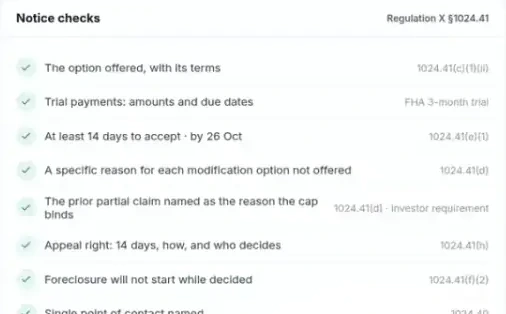
A waterfall offer is also a set of denials, and Regulation X says how to explain them. The commentary treats "a servicer's determination not to offer a borrower a loan modification available to the borrower" as a denial of that option (comment 41(d)-3), and each denial needs a specific reason (12 CFR 1024.41(d)). Where the reason is an investor requirement, the notice "must identify the owner or assignee of the mortgage loan and the requirement that is the basis of the denial"; a bare statement that the denial is "based on an investor requirement" is "insufficient" (comment 41(d)-1).
The same comment gives waterfalls a shortcut. Where an owner "has established an evaluation criteria that sets an order ranking for evaluation of loan modification options (commonly known as a waterfall)", it is enough to tell the borrower, for the options ranked below the one offered, that the investor's requirements use such a ranking and that an offer "necessarily results in a denial for any other loan modification options below the option for which the borrower is eligible". Options above the one offered still need their own reasons.
The enforcement history shows why the comment exists. The CFPB found that Flagstar's policy was to say only "not approved for loss mitigation options by the investor/owner of the loan", even though its systems "contained the true reason for the denial" (CFPB, 2014). The CFPB's 2024 proposal would loosen the waterfall's grip, so that other options "may still remain available ... rather than be automatically denied because of the position of the option in the investor's waterfall" (CFPB, 2024), but it has not been finalized.
Notice lines checked against the rule that requires each one
How Loss Mitigation Waterfall Decisioning picks the waterfall in force
Botminds' Loss Mitigation Waterfall Decisioning treats the choice of waterfall as the first step, not an assumption. The investor rule selector reads the case number, pool, investor code or trust on the loan and picks the rule set version in force on the evaluation date; the decision carries that version so it can be replayed under it later. The sample servicer runs six rule sets: FHA, VA, USDA, GSE-owned loans, its own portfolio policy and private-label trusts by their servicing agreements.
One queue, several owners, each file under its own waterfall
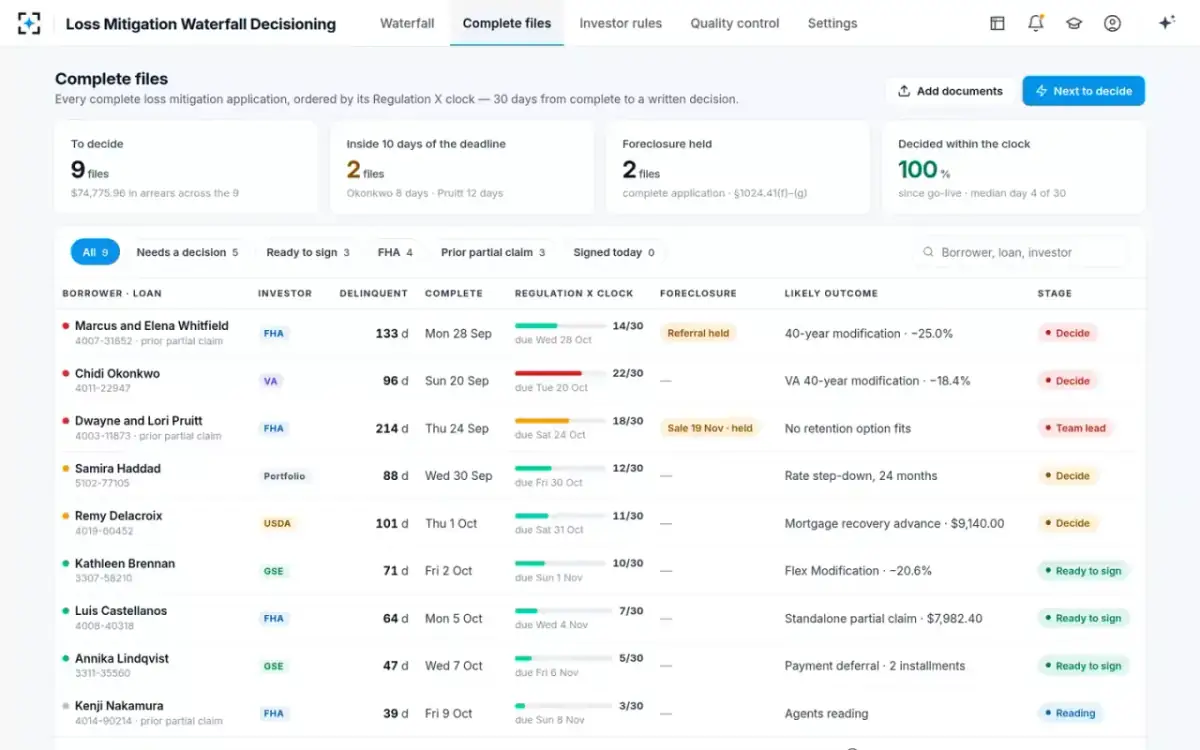
The compliance analyst owns the rule library: each new letter or circular becomes a new dated version, tested against its cases and against past decisions before she approves it. That is how one team can run five owners' waterfalls without anyone holding all five in memory. How the FHA cap works inside its waterfall is in FHA partial claim requirements, and VA's new claim is in the VA partial claim program in 2026. The Loss Mitigation Waterfall Decisioning page shows each agent's role.
Questions people ask
Why is it called a waterfall?
Because the borrower's file falls from one step to the next until a step holds it. The term was common enough by the HAMP era that the CFPB's 2024 proposal cites a legal treatise section titled "The HAMP 'Waterfall'", and Regulation X's commentary uses "commonly known as a waterfall" for an investor's order ranking.
Can a borrower choose an option lower in the waterfall?
Generally not under current rules: an offer higher in the order is treated as a denial of the options below it. The CFPB's 2024 proposal would let borrowers learn of other options and choose one they earlier declined, subject to investor requirements, but it has not been finalized.
Does every investor use a payment reduction target?
No. FHA and the GSEs target a cut to principal and interest (25% and 20%); USDA targets a total payment near 31% of gross income; VA's statute sets no target; some private-label trusts still use a net present value test.
Is the loss mitigation waterfall the same as the foreclosure timeline?
No. The waterfall decides which option a borrower is offered; the foreclosure timeline is governed by Regulation X's 120-day rule and its bars on moving to sale while a complete application is pending, and by state law.
Where is the FHA loss mitigation waterfall published?
In HUD Handbook 4000.1, section III.A.2, as revised by Mortgagee Letter 2025-12, with the calculations in Appendix 4.0. HUD publishes the letter as a PDF.