A mortgage loan modification calculator works out the new monthly payment a delinquent borrower would get by re-amortizing the balance and the arrears at a new rate and term, and, where the investor allows it, by moving part of the debt into a zero-interest partial claim or forborne principal. The answer depends less on the arithmetic than on the payment reduction target, because each loan's owner sets its own: FHA aims for a 25% cut to principal and interest and will accept no less than 15% on its last modification step; Fannie Mae and Freddie Mac aim for 20%; USDA aims for a total payment as close as possible to 31% of gross income. The same household therefore gets three different payments. Botminds' Loss Mitigation Waterfall Decisioning runs the right owner's target on each file, shows the arithmetic, and lets a workout underwriter test what-ifs before deciding. This guide is about what that number is worth.
It is worth a great deal, and the research is clear about which part. Payment relief, not principal reduction on its own, is what changes whether a borrower defaults again.
Why the payment cut is the number to count
10%
redefault rate for loans that exited COVID-19 loss mitigation, as of June 2022
CFPB, 2024
~46%
redefault rate for HAMP modifications as of April 2013
CFPB, citing SIGTARP
$30,100+
average per-borrower benefit of avoiding foreclosure, in 2023 dollars
CFPB estimate, a floor
How much does a loan modification lower the payment? It depends on who owns the loan
By about a fifth to a quarter of principal and interest on a government-insured or GSE loan, when the modification works at all. The target is the owner's, so the first input to any honest calculator is whose loan it is. Run one fictional household through all four: principal and interest of $1,600, escrow of $450, gross income of $5,800 a month.
One household, four owners' targets: the payment each calculator should aim at
Target: 25% off principal and interest; no less than 15% on the last modification step
New P&I: $1,200.00 −25.0%
How: Re-amortize at the survey rate plus 25 or 50 bp; a partial claim of up to 30% of the balance at default fills the gap.
Target: 20% off principal and interest (Flex Modification)
New P&I: $1,280.00 −20.0%
How: Lower the rate if eligible, extend the term, then forbear principal if the mark-to-market LTV is above 50%.
Target: Total payment as close as possible to 31% of gross monthly income
New P&I: $1,348.00 −15.8%
How: 31% × $5,800 = $1,798 total; less $450 escrow leaves $1,348 for principal and interest. A recovery advance may defer principal.
Target: No payment target in the statute; partial claim up to 25% of the balance
New P&I: Depends on the sequence
How: The partial claim cures arrears; payment relief comes from the modification steps in VA’s own sequence.
Notice what the USDA row does. Because its target is a share of income, a household with higher income gets less relief and one with lower income gets more; at $5,000 a month the same rule would aim for $1,100 of principal and interest, a 31% cut. FHA's target ignores income altogether: HUD's rule says the borrower "is not required to provide financial documentation to be evaluated" (ML 2025-12). A calculator that asks for pay stubs on an FHA loan is computing someone else's rule.
What payment reduction does FHA target?
Twenty-five percent of principal and interest, and no less than 15% on the final step. The FHA waterfall tries a 30-year modification, then 40 years, then each again with a partial claim, and the servicer "must offer the 40-year Combination Loan Modification and Partial Claim with the maximum reduction to the P&I portion of the Mortgage Payment that can be achieved up to 25 percent and not less than 15 percent" (ML 2025-12). Below 15%, the file moves to the Payment Supplement, which pays part of the principal for 36 months instead of modifying the loan.
Two inputs dominate an FHA result. The rate is the weekly survey rate rounded to the nearest eighth plus 25 basis points for 30 years or 50 for 40, as of the trial plan offer, and in October 2026 the survey stood between 7.28% and 7.40% (Freddie Mac PMMS, via FRED). And the cap: all partial claims together may not exceed 30% of the balance at default. A loan made in 2021 at 3% cannot be modified downward at those rates; the FHA waterfall traced on one loan shows such a file ending at the Payment Supplement.
What payment reduction does Flex Modification target?
Twenty percent of principal and interest. FHFA's enhanced policy, effective 1 December 2024, lowers a borrower's payment "by incrementally applying the steps below to achieve a 20 percent Principal and Interest (P&I) payment reduction: Reducing the borrower's interest rate (if eligible); Extending the mortgage term; and Forbearing principal for borrowers with mark-to-market loan-to-value ratios greater than 50 percent" (FHFA, 29 May 2024). Forborne principal plays the part that FHA's partial claim plays, without a separate lien. The detailed term limits sit in each GSE's servicing guide.
The GSEs do a lot of them. In the second quarter of 2026 the Enterprises completed 21,175 permanent modifications and 15,663 payment deferrals among 48,439 foreclosure prevention actions (FHFA Foreclosure Prevention and Refinance Report, Q2 2026). A payment deferral does not lower the payment at all: it moves missed payments to the end of the loan for a borrower who can resume, which is why a calculator should report it as zero relief, not as a modification.
The same household's principal and interest under each owner's target
How USDA and VA measure an affordable payment
USDA measures affordability against income. Its 2024 rule, effective 11 February 2025, says traditional servicing options "shall be used in the order established in this section to reduce the borrower's mortgage payment to income ratio as close as possible to 31 percent of gross monthly income", lets terms run to 40 years, and allows mortgage recovery advances up to a cumulative 30% of the balance at the initial default (USDA final rule, 2024). Principal deferred by an advance is limited to the amount that brings the payment to 31%.
VA's statute sets no payment target. It caps the new partial claim at 25% of the balance (30% for borrowers who missed a payment between March 2020 and May 2025), allows one per loan, and requires VA to prescribe "a mandatory sequence" of options (Pub. L. 119-31); the relief a VA borrower gets therefore comes from where the sequence stops. The VA partial claim program in 2026 covers the dates and the cap.
Does principal reduction prevent redefault? What the research says
Principal reduction on its own does little; payment reduction does a lot. The strongest evidence comes from Peter Ganong and Pascal Noel's study of HAMP-era modifications, which separates the two: "principal reductions that increase housing wealth without affecting liquidity have no effect, while maturity extensions that increase only liquidity have large effects", and "liquidity drives borrower default and consumption decisions" (NBER Working Paper 24964, later American Economic Review).
The Philadelphia Fed's study of 2008 to 2011 modifications adds a caution. It found redefault fell most where terms became "increasingly generous", meaning "larger payment reductions", and it also found principal-reduction modifications more effective than other types, because those reductions usually cut the payment too (Calem, Jagtiani and Maingi, Philadelphia Fed WP 18-26). Read together, the lesson for a calculator is to report the monthly payment cut first and treat principal moved to a partial claim or forbearance as the means, not the measure.
What is avoiding foreclosure worth?
At least $30,100 per borrower, by the CFPB's estimate in 2023 dollars, and that is a floor. The estimate rests on a 2010 HUD study of a borrower's average out-of-pocket cost of a completed foreclosure ($10,300 or $14,630 in 2023 dollars) and of the average effect of a foreclosure on neighbouring home values ($14,531, or $20,640 in 2023 dollars), and the CFPB notes it "likely underestimates" the benefit because it leaves out lost equity and other costs (CFPB, 2024).
The servicer's own side of the sum is smaller but real: every month a loan stays delinquent it costs more to service than one that pays. Put the two together and the value of a modification decision has four terms.
What one workout decision is worth, term by term
Payment relief
(current P&I − new P&I) × 12 × years the borrower stays current
In the sample file, $1,795.32 to $1,346.49 is $448.83 a month, $5,385.96 a year.
Workout underwriter
Foreclosure avoided
change in redefault probability × $30,100 or more per borrower
The redefault change is the uncertain input; payment size is what moves it.
Loss mitigation leadership
Servicing cost avoided
months back to performing × (delinquent − performing cost per month)
Use your own cost per loan in each state, from your servicing cost study.
Servicing finance
Cost of a wrong offer
files re-offered × (rework hours + borrower months lost)
An offer over the partial claim cap or on a stale rate must be withdrawn and made again.
QC
Is there still an NPV test for loan modification?
Rarely, and the CFPB has said so. Net present value tests decided many HAMP-era modifications by comparing the investor's expected cash flow from a modification with that from foreclosure. Regulation X still requires a notice that denies a modification "because of a net present value calculation" to include "the inputs used in the net present value calculation" (comment 41(d)-2). But in its 2024 proposal the CFPB proposed removing that comment "because a net present value (NPV) calculation is no longer a frequently used calculation in the loss mitigation review process" (CFPB, 2024). The proposal is not final, so the comment still applies to any servicer whose private-label trusts or portfolio policy use NPV.
Today's government and GSE waterfalls replaced NPV with fixed targets and caps, which is good for calculators: a target can be checked by anyone with the inputs. It also moves the risk. When the decision is arithmetic, the errors are in the inputs (the rate week, the cap base, the arrears) and in which rule set was applied.
What a servicer's loan modification calculator should show
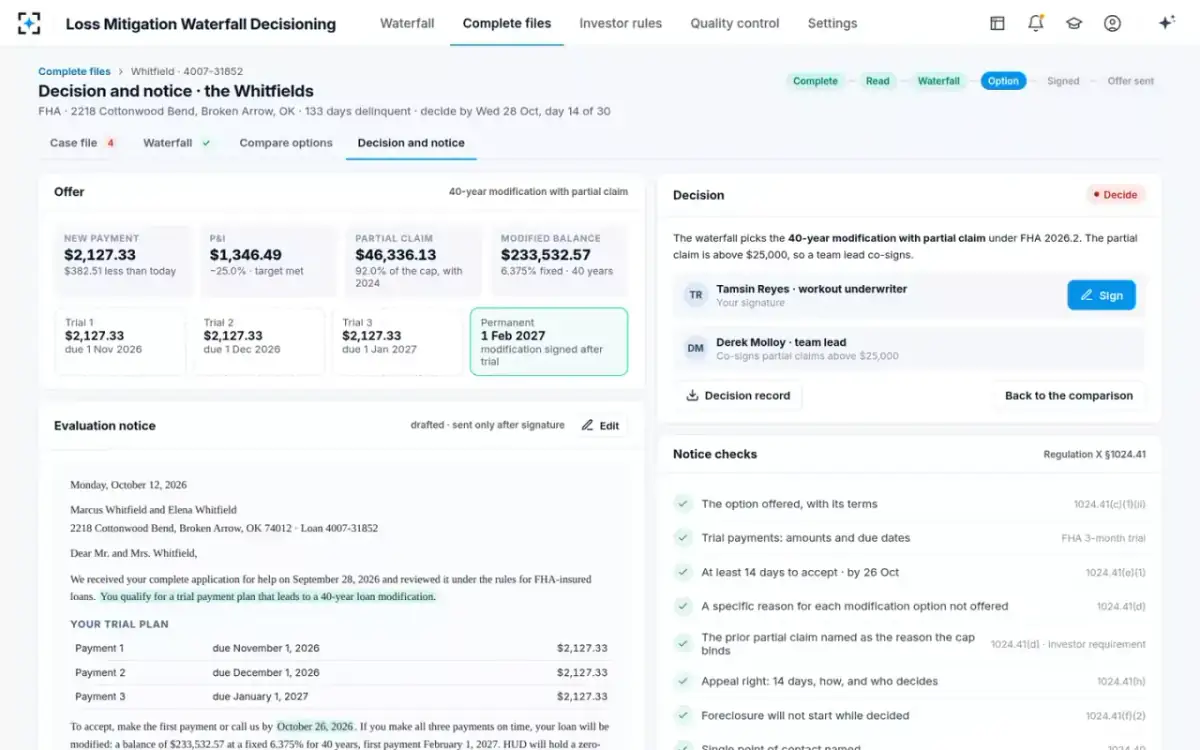
It should show the borrower's payment before and after, the owner's target and whether it was met, and every input with its source. Botminds' Loss Mitigation Waterfall Decisioning shows those options side by side for each file. In its sample file, the Whitfields' FHA loan, the comparison puts today's terms beside the standalone partial claim, the 30-year modification and the 40-year modification, each at the rate and term the rule allows.
Options side by side: rate, term, balance and the change in principal and interest

A spreadsheet can do the arithmetic. Searches for a "loan modification calculator excel" usually end at one function, the payment on a balance at a rate over a term, and that part is easy: $233,532.57 at 6.375% over 480 months is $1,346.49. What spreadsheets get wrong is everything around the function: which week's survey rate, rounded before or after the margin; which balance sets the cap; whether escrow shortages are capitalized or spread; which arrears may be capitalized. Those are rule questions, and they change by investor and by date.
The offer the calculator becomes: payment, trial plan and notice
Whether those numbers survive a quality review is a separate test: replaying decided files shows how often the inputs, not the formula, were wrong. The Loss Mitigation Waterfall Decisioning page shows the full set of agents behind each figure.
Questions people ask
How is a modified mortgage payment calculated?
The balance plus any arrears the owner allows to be capitalized is re-amortized at the new rate over the new term, using the standard payment formula. If that payment is above the owner's target, part of the debt moves into a partial claim or forborne principal until the target is met, within the owner's cap.
Does a loan modification lower the interest rate?
Not always, and in 2026 often not. FHA modifications use a rate tied to the current weekly survey, which in October 2026 was above 7%, so loans made at 3% to 4% would see their rate rise; the payment cut then has to come from a longer term and a partial claim, or from FHA's Payment Supplement.
What is a 40-year loan modification?
A modification that re-amortizes the debt over 480 months to lower the payment. FHA allows it when 30 years cannot reach the 25% target; USDA's rule allows terms up to 40 years "when necessary to demonstrate repayment ability".
Is a payment deferral a loan modification?
No. A payment deferral moves missed payments to a non-interest-bearing balance due at payoff and leaves the monthly payment unchanged. It suits a borrower whose hardship is over; a modification is for a borrower who needs a lower payment.
How much does a partial claim reduce the borrower's payment?
On its own, nothing: a standalone partial claim pays the arrears and leaves the monthly payment where it was. Combined with a modification, it lowers the payment by taking part of the balance out of the amortizing loan, which is how FHA reaches its 25% target when a longer term alone cannot.